Waffle knit is a knitted fabric with a raised grid of small cells, made with tuck or miss stitches, that is warm for its weight and breathable. How it is made, waffle knit vs waffle weave, fibres, dyeing, shrinkage data from our records, weights, sewing and care.
At a glance
Tuckstitch cells
8%cotton shrinkage
Warmand breathable
Thermalbase layers
Waffle knit is a knitted fabric with a raised, three-dimensional grid of small squares or rectangles, like the surface of a waffle. The pattern is created by combining knit and tuck or miss stitches so that some areas sink and others stand up. The pockets trap air, so waffle knit is warm for its weight yet breathable, and its textured surface absorbs water well. It is the classic fabric for thermal underwear, henleys and long-sleeve tops, and it is also used for robes, blankets and towels. Waffle knit is often called thermal knit.
This guide explains how waffle knit is made, waffle knit vs waffle weave, the fibres used, why waffle is warm and breathable, how waffle knit behaves in dyeing, shrinkage and wear, typical weights and uses, how to sew and care for it, and how to choose a good waffle fabric. It is written from the fabric-development and dye-house side, where waffle and thermal knits are a regular development item.
How waffle knit is made
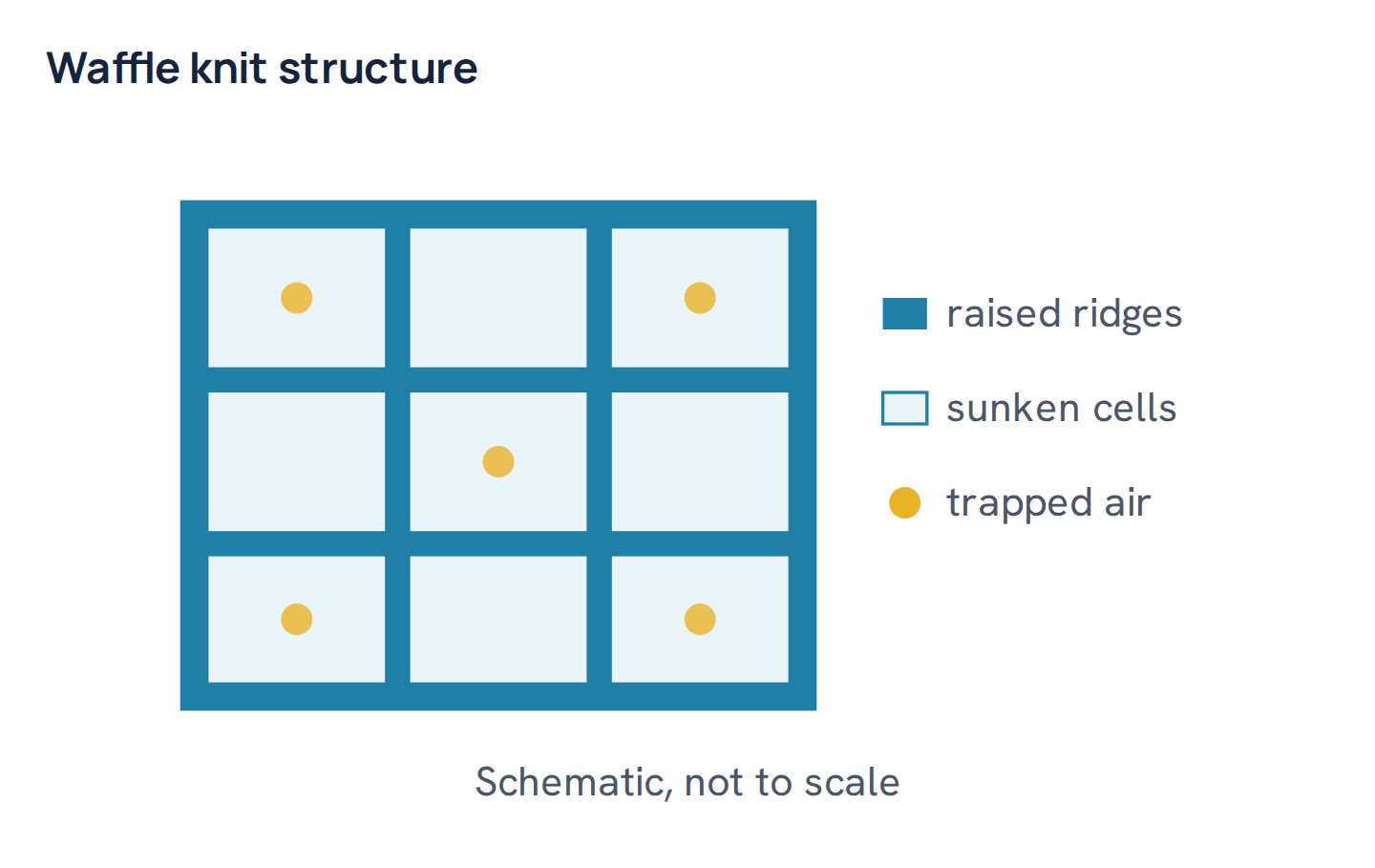
Waffle knit is usually made on a double-knit (rib or interlock) circular machine. On some needles and feeds the yarn is knitted normally; on others it is tucked (the needle takes the yarn but does not knit it off) or missed. Repeating this in a set pattern makes some stitches pull in and others bulge out, building a regular grid of raised ridges and sunken cells. Changing the repeat changes the size of the cells, from small “mini waffle” to large, bold squares.
Waffle knit vs waffle weave
| Point | Waffle knit | Waffle weave |
|---|---|---|
| Construction | Knitted loops (tuck/miss stitches) | Woven, long floats form cells |
| Stretch | Stretchy | Little stretch |
| Typical uses | Thermals, henleys, tops, loungewear | Towels, robes, blankets, kitchen cloths |
| Feel | Soft, flexible | Crisp to soft, more structured |
| Absorbency | Good | Very good, quick drying |
Fibres used in waffle knit
- 100% cotton: soft, breathable, absorbent; the classic thermal.
- Cotton-polyester: less shrinkage, quicker drying, more durable.
- Cotton-modal or viscose blends: softer, drapier waffle for loungewear.
- Polyester or polyester-spandex: technical base layers and sportswear.
- Merino wool: premium thermal base layers.
Why waffle knit is warm and breathable
The sunken cells hold small pockets of still air next to the body, which insulates. At the same time, the open, textured structure lets moisture vapour escape and does not cling flat against the skin, so waffle feels less clammy than a smooth, dense knit of the same weight. That combination is why waffle is used for thermal base layers: warm when still, breathable when moving.
Waffle knit in the dye house
Waffle’s three-dimensional surface and the tuck stitches make it bulkier and more open than plain jersey. In dyeing, the raised and sunken areas must be evenly penetrated, so good circulation and careful loading matter. In finishing, the stenter must not over-stretch the fabric, or the waffle cells flatten and the texture disappears; compacting brings length back under control. See the waffle thermal dyeing and finishing flowchart and the waffle development guide.
Shrinkage: waffle shrinks more than jersey
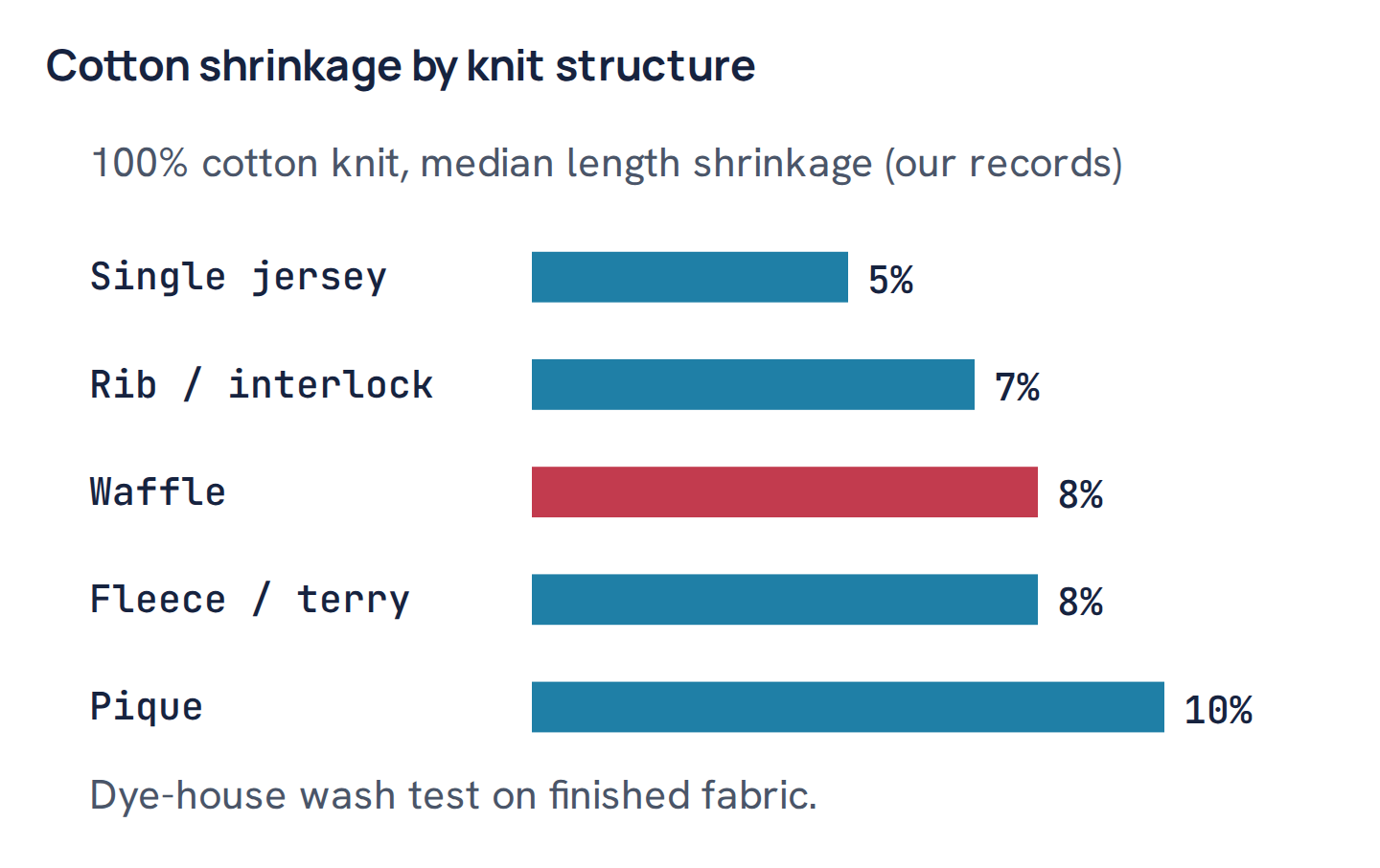
Waffle’s tuck stitches store extra yarn, and the fabric is often stretched during finishing, so it relaxes in washing. In our finishing records, 100% cotton waffle had a median length shrinkage of 8% after the wash test, against 5% for single jersey, 7% for rib and interlock, and 10% for pique. Blending with polyester reduces shrinkage noticeably. Pre-washed or well-compacted waffle garments keep their size best. See does cotton shrink.
Typical weights and uses
| Weight | Feel | Typical uses |
|---|---|---|
| Light (around 160–200 GSM) | Thin, airy, fine texture | Henleys, tees, summer layers |
| Medium (around 200–260 GSM) | Classic thermal | Thermal tops, long johns, loungewear |
| Heavy (260+ GSM) | Thick, plush, bold cells | Robes, blankets, outerwear layers |
Common mistake: stretching waffle fabric hard in width to hit a target width on the stenter. The waffle cells flatten, the fabric looks like plain rib, and it shrinks heavily in the first wash as it springs back. Waffle must be finished with overfeed and little width stretch to keep its texture and stability.
Sewing waffle knit
- Pre-wash cotton waffle to remove shrinkage before cutting.
- Use a ballpoint or stretch needle and a stretch stitch or overlocker.
- Do not stretch the fabric while sewing; let the machine feed it.
- Use a walking foot for heavy waffle.
- Stabilise shoulder seams with tape so they do not grow.
Caring for waffle knit
- Wash at 30–40°C, inside out.
- Avoid high dryer heat to limit shrinkage; tumble low or dry flat.
- Reshape while damp.
- Fold rather than hang heavy waffle to avoid stretching.
- Avoid fabric softener on waffle towels, which reduces absorbency.
How to choose a good waffle fabric
- Look for clear, even cells that spring back when stretched.
- Check the weight for your use: lighter for layering, heavier for warmth.
- Cotton-polyester blends shrink less; 100% cotton is softer and more breathable.
- Look for “pre-shrunk” or “garment washed” on cotton waffle.
Worked example. A brand develops a waffle henley in 100% cotton at 220 GSM. The first sample shrank 9% in length after washing and the waffle looked flat. Finishing with more overfeed, less width stretch and a stronger compacting pass brought shrinkage closer to target and restored the cell texture. Switching to a 60/40 cotton-polyester waffle cut shrinkage further for a budget line.
Waffle knit vs other thermal fabrics
| Fabric | Warmth | Breathability | Feel |
|---|---|---|---|
| Waffle knit | Good | Good | Textured, soft |
| Rib knit | Moderate | Good | Smooth, stretchy |
| Brushed jersey | Good | Moderate | Soft, fuzzy inside |
| Fleece | Very good | Lower | Plush |
| Merino jersey | Very good | Very good | Fine, smooth |
Waffle knit for loungewear and sleepwear
Waffle has become popular for loungewear sets, robes and pyjamas because the texture looks relaxed and feels soft, and the fabric is warm without being heavy. For sleepwear, a lighter cotton or cotton-modal waffle breathes well and keeps warm sleepers comfortable. Heavier waffle robes absorb water after a bath and dry fairly quickly.
Waffle towels and blankets
Waffle towels are usually woven rather than knitted. Their honeycomb cells increase surface area, so they absorb water quickly and dry faster than thick terry towels. They are light, pack small and do not leave much lint, which makes them popular for travel, gyms and kitchens. Waffle blankets, knitted or woven, are good all-season throws: warm enough for cool nights, light enough for summer. See what is terry cloth.
Does waffle knit pill?
Cotton waffle pills little, because cotton pills tend to break off. Polyester and acrylic waffle can pill at rubbing points such as underarms and cuffs. Wash inside out on a gentle cycle to reduce surface wear.
Waffle knit in cotton-polyester
Blending cotton with polyester changes waffle’s behaviour in useful ways. The polyester holds the structure, so the fabric shrinks less and keeps its cell shape after washing; it also dries faster and resists wrinkles. In our records, cotton-polyester knits overall shrank a median 4% in length, against 6% for 100% cotton. The trade-off is a slightly less absorbent, less natural feel. For workwear thermals and budget lines, a 60/40 cotton-polyester waffle is a sensible choice.
Why waffle cells flatten over time
Waffle cells can lose depth with heavy wear, hot washing and high dryer heat, because the tucked loops relax and the fabric is pressed flat. Ironing directly on the face also flattens the texture. To keep the cells crisp, wash cool, tumble low or dry flat, and avoid pressing the fabric. If you must iron, use steam and hold the iron just above the surface.
Summary
- Waffle knit has a raised grid of cells made by tuck or miss stitches.
- It is warm for its weight and breathable, ideal for thermals.
- Waffle knit stretches; waffle weave is woven and used for towels.
- Cotton waffle shrinks more than jersey: a median 8% in our records.
- Finish with overfeed, wash cool and dry low to keep size and texture.
Questions
What is waffle knit?
A knitted fabric with a raised grid of small square cells, made by combining knit and tuck or miss stitches.
Is waffle knit warm?
Yes. The cells trap air for warmth while the open texture stays breathable, which is why it is used for thermals.
What is the difference between waffle knit and waffle weave?
Waffle knit is knitted and stretchy, used for thermals and tops; waffle weave is woven and used for towels and robes.
Does waffle knit shrink?
Cotton waffle can shrink more than jersey; in our records the median was 8% in length after washing.
What is waffle knit made of?
Usually cotton or cotton-polyester, sometimes modal blends, polyester or merino wool.

Textile engineer with 14+ years in dyeing and fabric development. He writes every guide on Dyeing Solution from real production work. Full profile