A step-by-step development guide for cotton, CVC and stretch waffle: cell structure and cam charts, yarn and gauge, singeing, dyeing and finishing that holds the cell, planning for big width relaxation, and testing, built on our real development records.
At a glance
208waffle entries in our register
-8.5%median finished vs required GSM
+19.8%median GSM rise after the wash test
-15%width shrinkage, 26/1 cotton waffle
Waffle, also sold as thermal knit, is the fabric with the small square cells you see on base-layer tops, henleys, long-sleeve tees, lounge pants and winter baby wear. The cells trap air, so it feels warm for its weight. For the development engineer, waffle is demanding. It is knitted on a double-jersey machine with tuck and miss stitches, it comes off the machine bulky and springy, and it shrinks far more in width than jersey, rib or interlock when it relaxes. This guide follows the whole route from yarn to a tested fabric. It is built on our fabric register, which holds 208 waffle entries, and on the 7 waffle test reports that reached our desk. Where our data is thin we say so and give general practice, marked as typical.
New to development? Read the single jersey, rib and interlock guides first. Waffle uses the same double-jersey machine as rib and interlock, and many of its problems are rib problems made larger.
What waffle fabric is
A cellular structure built from tucks and misses
Plain knitted fabrics are made only of knit loops. Waffle adds two other stitches. In a tuck, the needle rises only part of the way, takes the new yarn into its hook but does not cast off the old loop. The needle now holds two loops, and after a second tuck it holds three. In a miss, the needle stays down, takes no yarn, and the yarn passes behind it as a short float. When the needle finally knits again, it pulls a new loop through all the loops it has been holding and casts them off together.
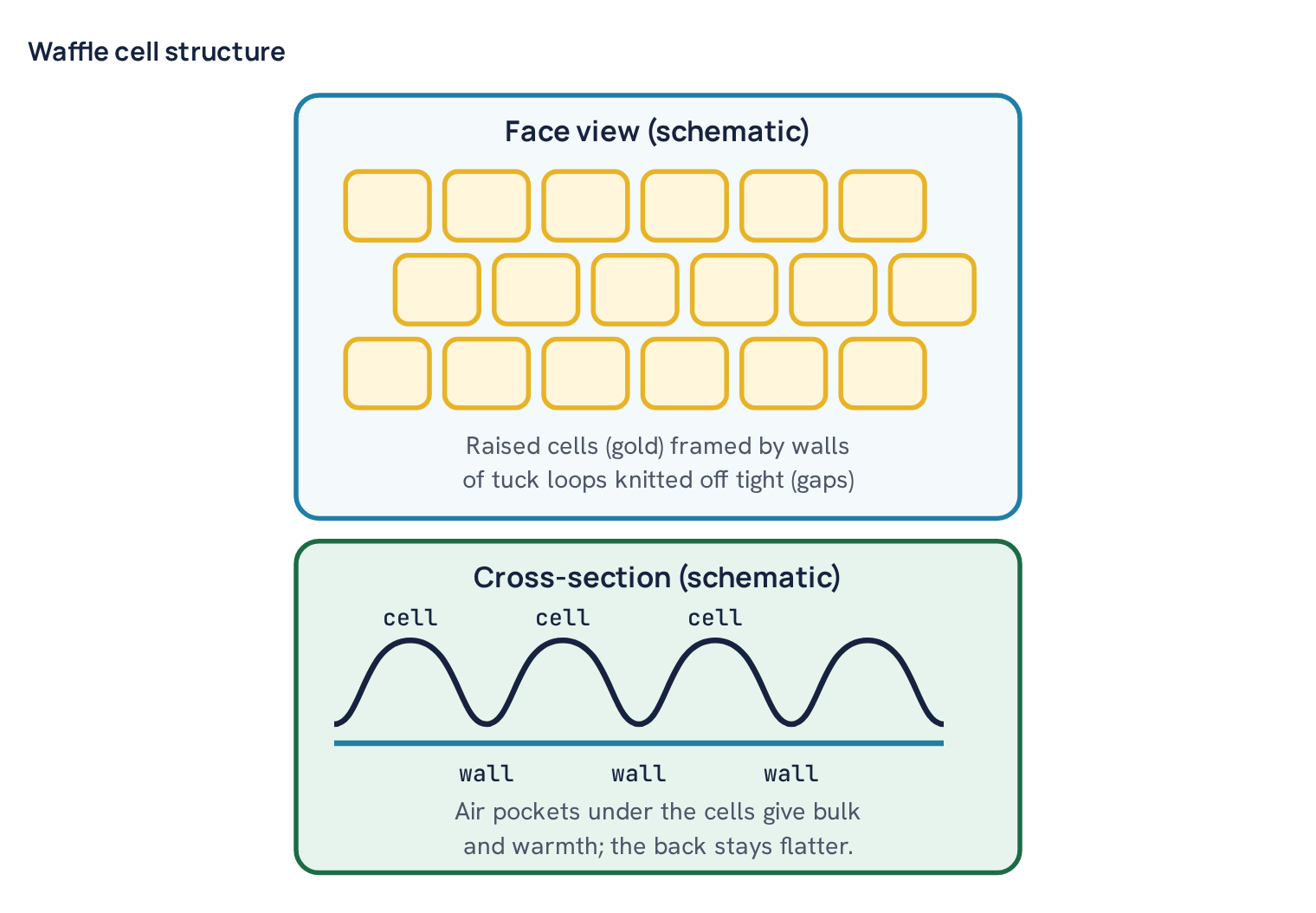
Those held loops are under strain. When they are finally knitted off they are pulled tight and short, and they drag the neighbouring wales and courses towards them. The knit loops around them have nowhere to go but outwards, so they bulge into a raised cell. Repeat this in a regular pattern, with the tuck needles in one block of feeders and different needles tucking in the next block, and the fabric forms a grid of raised cells framed by tight, sunken walls. That grid is the waffle.
Why waffle is bulky, warm and unstable in width
- Bulk and warmth. The cells stand up from the base, so the fabric is much thicker than a flat fabric of the same weight, and the air held in the cells insulates.
- Low width stability. Like rib, waffle is knitted on two needle beds, and its relaxed state is narrow and springy. When the fabric is pulled flat and wide on the stenter, the cells are flattened; when it is washed and relaxes, the cells pucker back up and draw the width in. This is the biggest development issue with waffle.
- Snagging and pilling. The raised surface and any floats catch more easily than a flat face, and protruding fibres on the cell tops show up as fuzz. This is one reason many waffles are singed.
- Low spirality. Double-jersey fabrics are balanced between two beds, so spirality is usually small. Our register gives median spirality of 2% to 3% for the main qualities, and our lab results after washing never went above 0.4%.
Variants in our register
Our register records waffle under three type names, WAFFLE, LY WAFFLE and L/WAFFLE, and this guide treats them all as double-jersey waffle. By fibre the 208 entries split into 92 cotton, 49 CVC or polyester/cotton (PC), 41 CVC or PC with elastane, 25 cotton with elastane, and 1 other. So about a third of our waffle development carries elastane for stretch and recovery. Single-jersey “mock waffle” or honeycomb fabrics, made with tucks on one bed, are flatter and lighter and are developed more like a single jersey.
Development inputs
Read the buyer’s request carefully
Collect every requirement in one place before you choose a yarn. For waffle, ask in particular about:
- Finished GSM, and when it is measured. Waffle can gain a fifth of its weight in the first wash. Ask whether the buyer checks GSM on the fabric as delivered or after a wash, and what the tolerance is.
- Finished width, open or tubular, and whether the buyer will accept the width the fabric naturally relaxes to.
- Cell size and look. Ask for a physical reference; a photograph is not enough.
- Composition, with or without elastane, and any organic or recycled claim.
- Surface finish. Singed or not, one side or both, enzyme or not, brushed or not.
- Wash care and test requirements: dimensional stability (with the wash and dry method), GSM, spirality, bursting strength, pilling, colour fastness, pH and fibre content.
Common mistake: accepting a finished width copied from a rib or interlock order. Waffle relaxes much more in width, so a width that is easy on interlock can be impossible to hold on waffle without stretching the fabric and losing GSM.
Choosing the yarn
Count. Waffle is usually heavier than jersey, so the counts are coarser. The two qualities with enough entries to summarise in our records use 26/1 cotton for a 280 GSM waffle, and a 30/1 polyester/cotton yarn combined with polyester filament and elastane for a 200 GSM stretch waffle. Coarser yarns on 14 gauge make the heavier, chunkier waffles; finer yarns on 24 gauge make small-cell, lighter thermals.
Combed, carded, ring or open-end. Combed ring or compact yarn gives cleaner cells and better pilling, and singes more evenly. Carded yarn is cheaper but hairier, and the hair blurs the cell edges. Open-end yarn suits heavy budget thermals but feels harsher.
Twist. In double jersey, twist matters less for spirality because the two beds balance each other, but it still affects bulk and pilling. A lower-twist yarn makes a fuller cell but pills more easily. Typical cotton knitting twist multipliers are around 3.2 to 3.8 (αe), varying by spinner.
Blends and elastane. Polyester, in the yarn or as a separate filament, reduces shrinkage and helps the fabric hold its shape. Elastane gives stretch and recovery but pulls the fabric in hard when it relaxes, so it must be heat-set.
Knitting
Machine, gauge and diameter
Waffle is knitted on a circular double-jersey machine with a dial and a cylinder, the same machine family used for rib and interlock. In our register 169 of the 208 waffle entries were knitted on 18 gauge, with smaller groups on 14 gauge (25 entries), 24 gauge (5) and 8 gauge (3). Diameters are large: 38 inch is the most used (59 entries), then 34 inch (50), 40 inch (41), 36 inch (34) and 32 inch (8). Waffle loses so much width in relaxation that you must start with many needles to finish wide.
Worked example. A 38 inch, 18 gauge cylinder has 38 × 3.1416 × 18 = about 2,149 needles. If the finished fabric has about 12 cylinder wales per cm, the open width is about 2,149 ÷ 12 = 179 cm, close to the 180 cm finished width of our 26/1 cotton quality. If the fabric then relaxes 15% in width, it reaches about 14 wales per cm and about 153 cm. The needles have not changed; only the wales per cm have. The only way to make the relaxed fabric wider is more needles: a larger diameter or a finer gauge.
Cam notation and needle set-out
A waffle design is written as a cam chart. Each column is a feeder. Each row is a set of needles: the dial, and usually two cylinder groups with butts in different positions, called A and B (or long and short), as on an interlock machine. Each cam is set to knit (K), tuck (T) or miss (M, often drawn as a dash).
The chart below is a simple six-feeder example to show the principle. At feeders 1 and 4, every needle on both beds knits, which makes a rib course that ties the dial and cylinder together. At feeders 2 and 3, the dial misses, cylinder A needles knit and cylinder B needles tuck, so loops pile up on the B needles. At feeder 4 the B needles knit off everything they hold. At feeders 5 and 6 the roles swap, so the next row of cells is offset like brickwork. Real designs use four to twelve or more feeders per repeat, and the tucks, needle groups and dial set-out all change the cell size and depth.
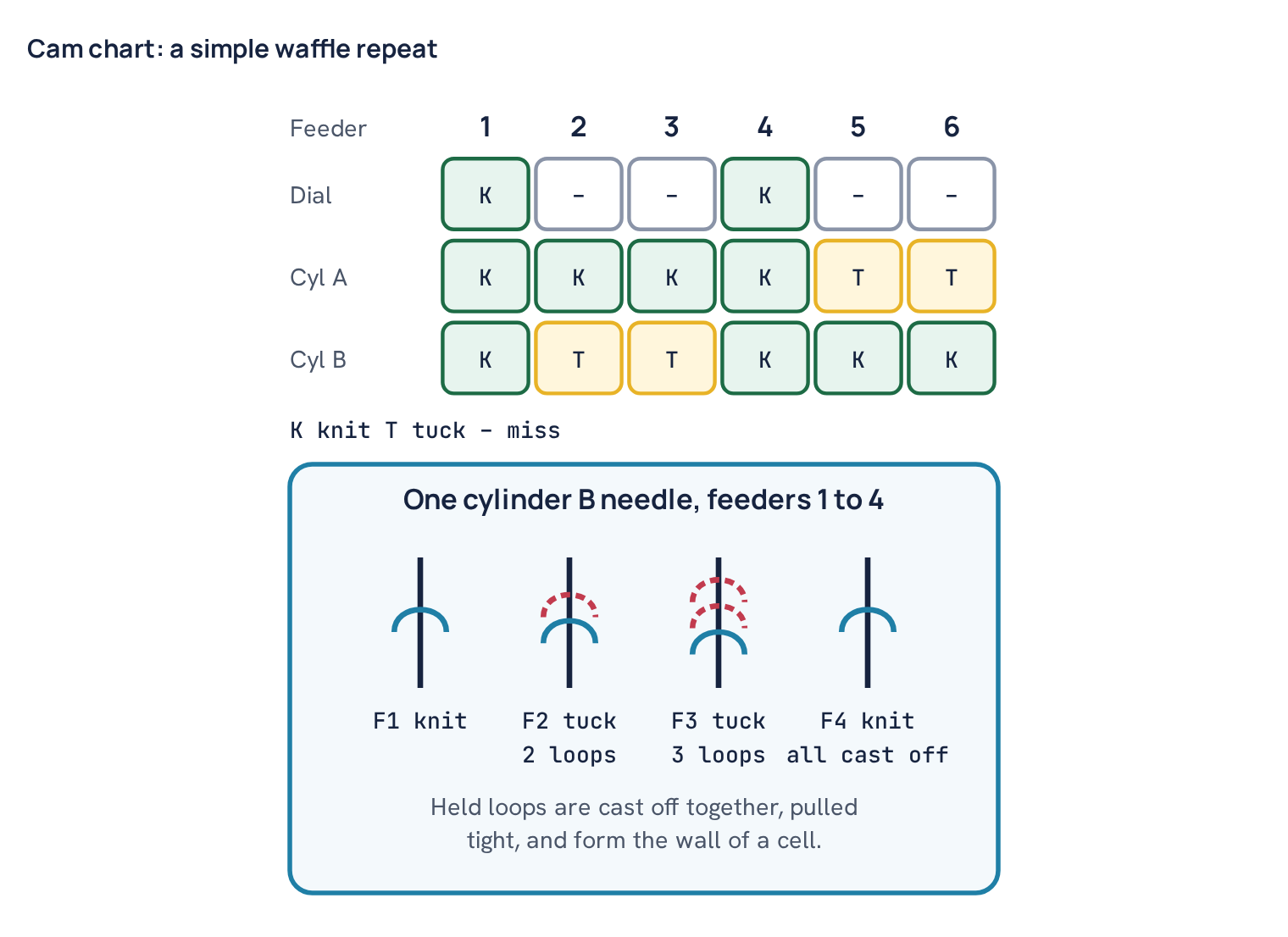
Two practical points follow. Consecutive tucks on one needle are limited: two or three are common, and more strain the yarn and needle and cause holes. And because some feeders knit on only one bed or needle group, feeders consume very different yarn lengths, which is why the register records more than one stitch length for each waffle.
Stitch length, count and GSM
GSM is still the yarn mass in one square metre, but in waffle the yarn per repeat is a sum of different loops, tucks and floats on two beds. The single-jersey formula and the knit GSM from stitch length calculator give only a rough first check; start from a recorded quality, knit a trial and measure, using the GSM calculator on a cut sample. The directions are the same as for other knits: shorter stitch length or coarser count gives a heavier fabric. Waffle adds one lever: more tucks per repeat give deeper cells, a thicker fabric and more width loss in relaxation.
Our recorded waffle qualities
Only two waffle yarns in our register have enough entries to summarise. Stitch length is the stitch length per yarn as recorded, in yarn order. Finished GSM has the interquartile range in brackets; GSM after wash and shrinkage come from the dye-house wash test.
| Yarn | Gauge | Entries | Stitch length per yarn as recorded, mm | Required GSM | Finished GSM | GSM after wash | Finished dia, cm | Shrink L / W, % | Spirality, % |
|---|---|---|---|---|---|---|---|---|---|
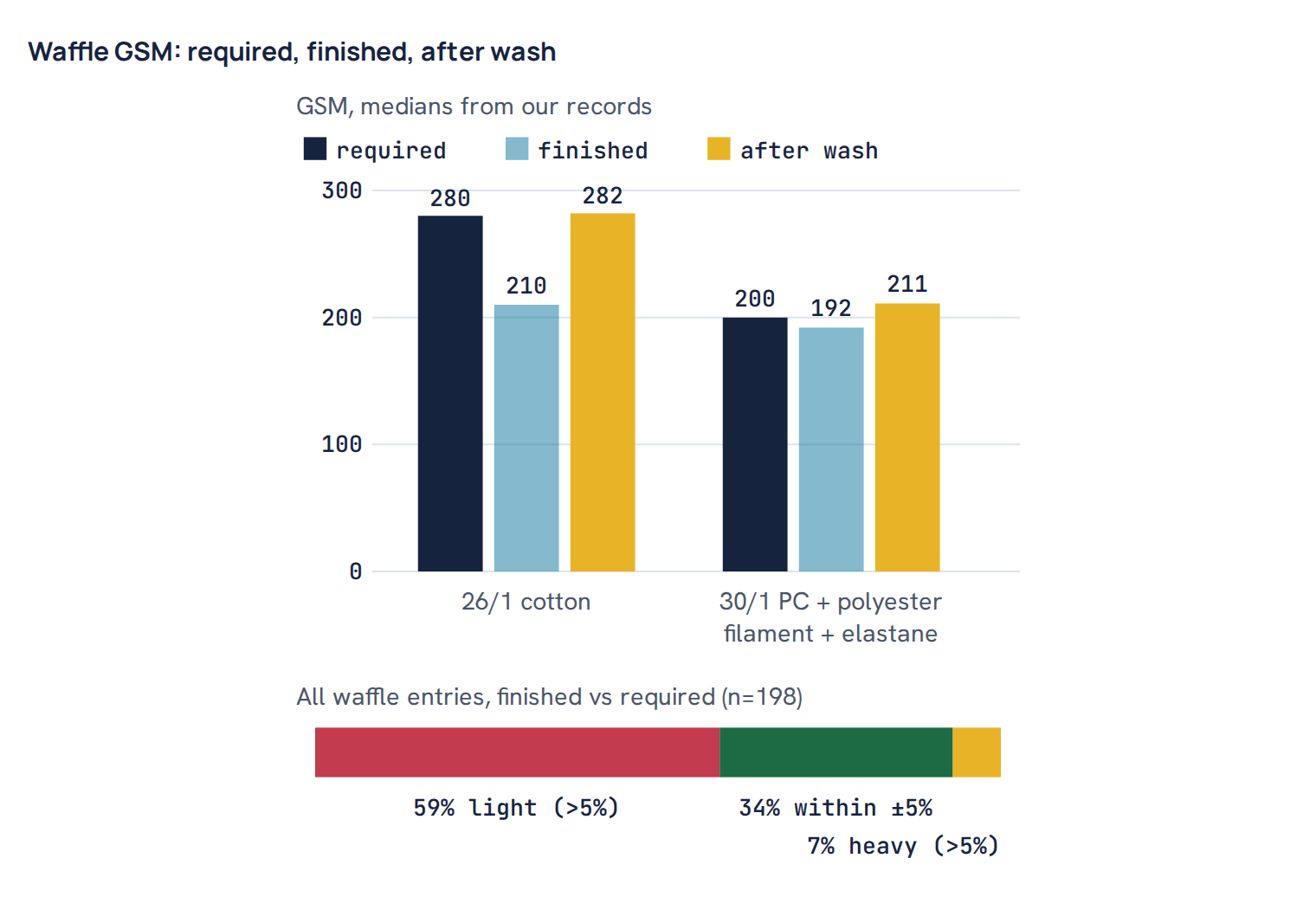
| 26/1 cotton | 18G | 15 | 2.65 + 2.40 | 280 | 210 (210–220) | 282 | 180 | -6 / -15 | 3 |
| 30/1 PC 50/50 + 75 denier/72 filament polyester + 30 denier elastane | 18G | 12 | 1.75 + 2.30 | 200 | 192 (186–200) | 211 | 170 | -3 / -3.5 | 2 |
The two rows tell very different stories. The cotton waffle finishes 25% light: 210 GSM against 280 required. Yet after the dye-house wash it weighs 282 GSM, right on the requirement, and it has shrunk 15% in width. The fabric has enough yarn; it left finishing stretched flat and wide, and pulled back in the wash. The polyester/cotton stretch waffle, with polyester filament and elastane, behaves far better: 192 against 200 GSM, within a ±5% tolerance, with only -3% length and -3.5% width shrinkage. The polyester holds its shape after heat, and heat setting, the usual practice for an elastane quality like this, fixes the width before wet processing.
Elastane and multi-yarn feeding
Elastane is fed from a positive feeder with a controlled draft. Keep the draft equal at every elastane feeder; a tighter or looser feeder shows as a bar and as uneven GSM. Where a filament and a spun yarn are combined, thread each to the feeder and guide shown on the approved cam chart, or the faces can swap. The Lycra single jersey guide covers elastane feeding in more detail.
Machine settings to record
- Machine number, diameter, gauge and number of feeders.
- The full cam chart (dial and cylinder, every track, every feeder) and the needle set-out. A photograph of the cam plates is a useful back-up.
- Yarn count, type, lot and supplier at each feeder; elastane denier and draft.
- Stitch length for each yarn, measured on the greige fabric, in the same yarn order the register uses.
- Yarn input tension, take-down tension, speed, dial height and timing.
- Greige tubular dia, greige GSM and roll weight.
Greige inspection
Let the greige roll rest before measuring, because waffle keeps relaxing for some hours. Inspect for holes at tuck needles, broken needles (a missing cell line along the length), drop stitches, elastane breaks, oil lines and barre, and check the cells are even across the width. Record greige GSM and tubular dia against the finished results.
Dyeing and finishing route
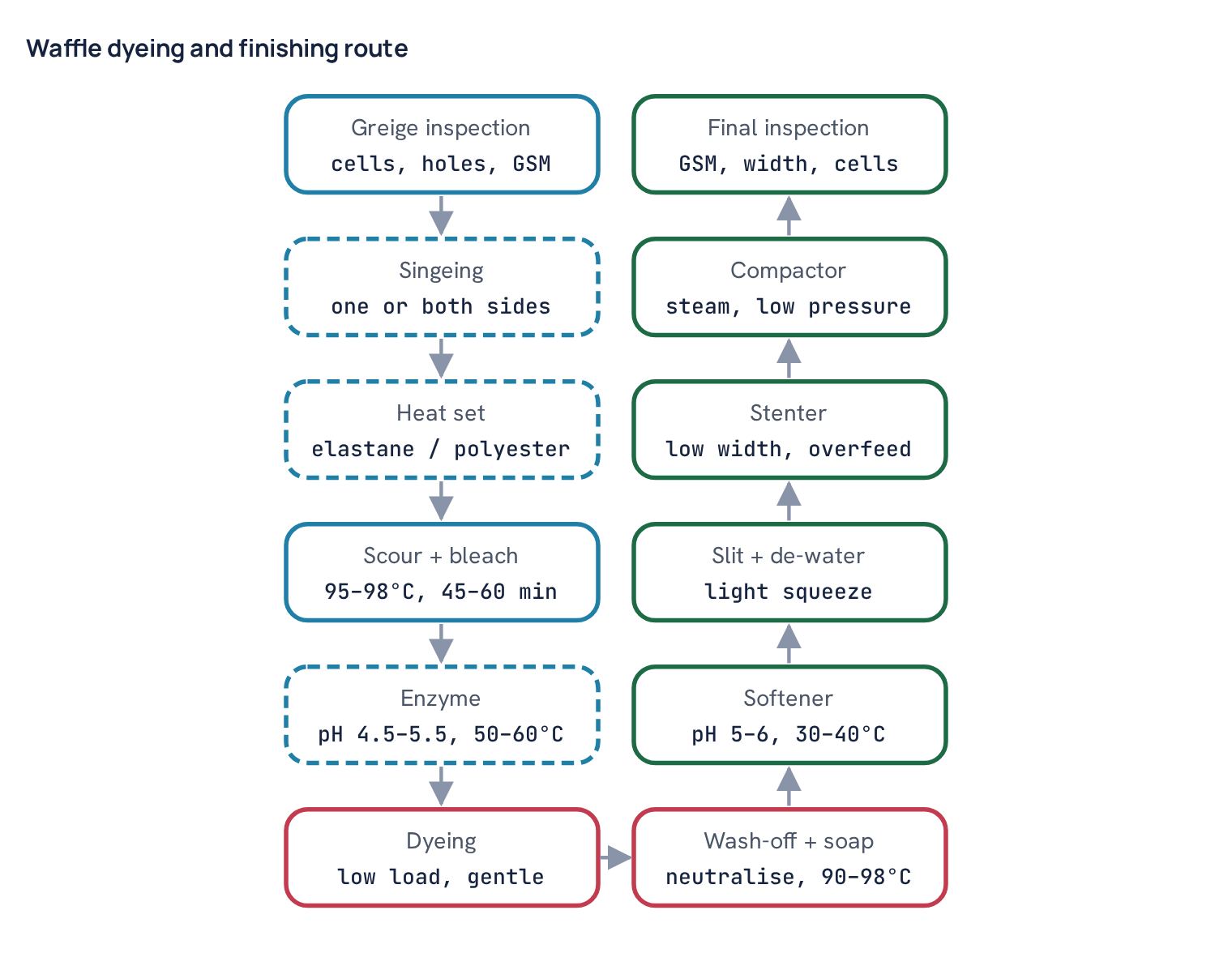
Every one of the 208 waffle entries in our register was finished on the open-width route with stenter and compactor. Along the way, some entries also carry a flag for heat setting or singeing. A shorter overview is in the waffle thermal dyeing and finishing flowchart, and the wet processes are described in 100% cotton knit dyeing process, cotton elastane (Lycra) knit dyeing process and CVC fabric dyeing process.
Singeing
Singeing burns off protruding surface fibres by passing the fabric quickly over a gas flame. On waffle it gives sharper cells, a smoother hand and less fuzzing and pilling. In our register 49 waffle entries carry a singeing flag: 29 written as “sinzing”, 12 as “singeing” (the same process spelled two ways) and 8 as “both side sinzing”, that is, singed on both faces. Both-side singeing suits fabric where both faces show or the pilling requirement is strict.
Typical practice, which varies by machine:
- Singe on greige or after a light pretreatment, before dyeing, so any slight yellowing or uneven burning is covered by the scour, bleach and dyeing.
- Set flame intensity and fabric speed together. Too slow or hot scorches the cell tops; too fast leaves fibre behind. Check a test piece under magnification.
- Keep the fabric flat under light, even tension, and quench sparks straight after the flame to prevent burn holes.
- Take care with polyester and elastane. Polyester fibre ends melt into beads that harshen the hand and can show as dark specks after dyeing, and elastane is heat-sensitive, so many mills avoid singeing elastane qualities.
Enzyme bio-polishing also cleans the surface, more slowly and in the wet process, and softens the hand; some buyers want both.
Heat setting
For waffle with elastane or polyester, heat setting fixes the width and stabilises the structure before wet processing. Typical settings for cotton or polyester/cotton with elastane are about 185 to 195°C for 30 to 60 seconds; check the yarn supplier’s limits. In our register 95 of the 208 waffle entries carry a heat-set flag (some together with singeing), and 66 entries contain elastane. The key choice is the set width: heat-set wide and flat, and you lock in a width the fabric will try to give back. Set it close to the width you want after relaxation.
Pretreatment, dyeing and wash-off
- Scouring and bleaching. Caustic soda, hydrogen peroxide, stabiliser and wetting agent, typically 95 to 98°C for 45 to 60 minutes, then rinse, neutralise and remove leftover peroxide. Thick waffle needs good wetting.
- Enzyme (if required). Acid cellulase at about pH 4.5 to 5.5 and 50 to 60°C, then deactivate. It improves pilling but costs some weight and strength.
- Dyeing. Cotton is dyed with reactive dyes, typically fixed at 60 to 80°C and pH about 10.5 to 11 depending on the dye type; polyester parts need a disperse dyeing step, usually around 120 to 130°C. See how reactive dyes work. Waffle is bulky, so load the machine lighter than for jersey and keep the flow steady. A tight rope crushes the cells and can leave crease marks, and poor circulation gives uneven, patchy dyeing; see also level dyeing and uneven shades.
- Wash-off. Rinse, neutralise and soap near the boil, with enough rinses for a thick fabric that holds liquor.
- Softener. Usually at 30 to 40°C and pH about 5 to 6. A very heavy, smooth softener gives drape that can let the cells lie flat; a moderate dose keeps the texture.
Finishing to hold the cell
Finishing is where waffle is won or lost. The aim is a fabric already close to its relaxed size. Typical practice:
- Light de-watering. Heavy squeeze pressure flattens wet cells.
- Stenter: width low, overfeed high. Set the width close to the relaxed width, not the widest the fabric will go, with generous overfeed. Typical drying temperatures for cotton are 130 to 160°C; stay below the heat-set temperature for elastane qualities.
- Relax before setting. Where a relax or tumble dryer is available, tension-free drying before the final stenter pass lets the cells form.
- Compactor: steam and overfeed, low pressure. High felt or roller pressure crushes the cells; use the least pressure that gives the length stability you need.
- Never correct width by stretching. Every centimetre pulled out on the stenter comes back in the wash and takes GSM with it.
Hitting finished GSM and width
What our records show
Waffle tends to finish light. Across the 198 waffle entries with both values, the median finished GSM is 8.5% below the required GSM. Only 34% of entries finish within ±5% of the requirement; 59% finish more than 5% light and only 7% more than 5% heavy. Then, in the dye-house wash test, the GSM rises by a median of 19.8% (197 entries). That is a much larger rise than in our single jersey and interlock guides.
Relaxation, explained
Every knitted fabric is stretched while it is knitted, dyed and finished, and the distorted loops hold that strain until something lets them move. Textile technologists describe a series of relaxed states:
- Dry relaxed. The fabric is left to rest after knitting. It recovers a little.
- Wet relaxed. Soaked in water, which lubricates the fibres and swells cotton, so the loops move towards a natural shape.
- Fully relaxed. Washed and tumble dried; agitation and heat let the loops reach their lowest-energy shape, as in the buyer’s wash test and the customer’s first wash.
For jersey, the fully relaxed shape is not far from the finished shape. For waffle it is very far. Its natural shape has deep cells and a narrow width, because the tuck loops pull tight and the two beds close up like a rib. On the stenter the cells are pressed out and the width held open. When the fabric is washed and tumbled, the cells pucker back up and the fabric becomes narrower and shorter. The same yarn covers a smaller area, so the GSM rises.
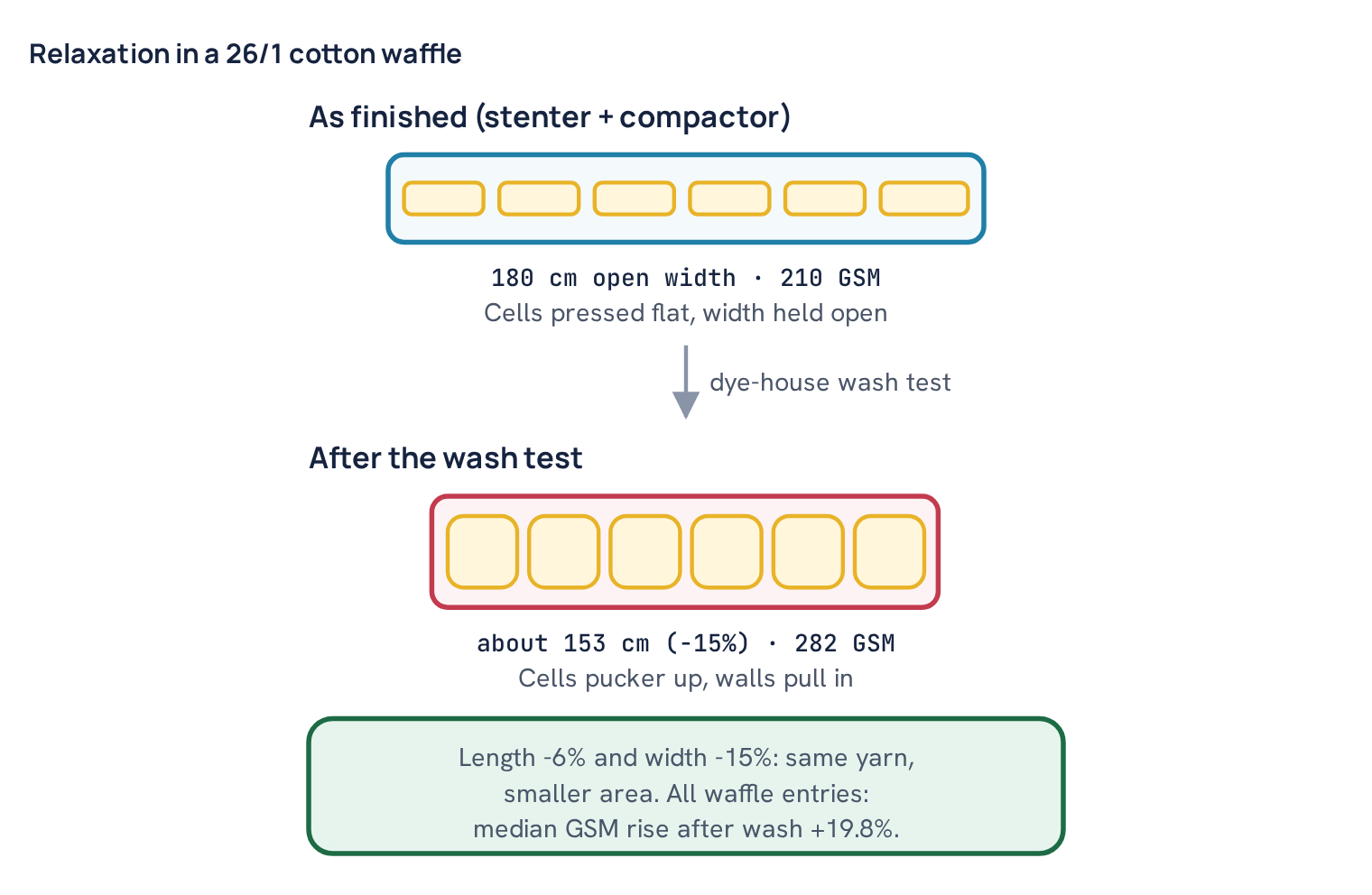
A quick check shows the size of the effect. A fabric that shrinks 6% in length and 15% in width keeps 0.94 × 0.85 = about 80% of its area, so its GSM should rise by about a quarter: 210 GSM would become about 263 GSM. The register median after wash is 282 GSM. The medians come from different spreads of entries, so they do not match exactly, but the point is clear: the cotton waffle loses a fifth of its area, and its GSM climbs to the required figure.
Cotton versus blends and elastane
The 30/1 polyester/cotton stretch waffle shows what a stable construction can do: -3% in length, -3.5% in width, finished GSM 4% light and after-wash GSM 211 against 200 required. Polyester does not swell in water as cotton does and is set by heat, and heat setting holds the width from the start. Plan for large relaxation in cotton waffle and moderate relaxation in blended stretch waffle. A fibre-by-fibre comparison is in our knit GSM and shrinkage by fibre study, and you can test the effect of a planned shrinkage on garment size with the fabric shrinkage calculator.
Planning greige for big relaxation
- Agree what is measured: GSM and width as delivered, after a wash, or both. For cotton waffle the after-wash numbers are the honest ones.
- Design for the relaxed width. Choose the machine diameter and gauge to give enough needles for the width after relaxation.
- Set the finished width close to relaxed. If the relaxed width is about 153 cm, finishing at 180 cm only stores up 15% width shrinkage and a light GSM. Finishing at, say, 160 to 165 cm with more overfeed gives a heavier, more stable fabric. Agree the finished width with the buyer before bulk.
- Check the yarn content with the after-wash GSM. If the after-wash GSM is on target, the construction is right and the problem is finishing. If the after-wash GSM is also low, shorten the stitch lengths slightly, use a coarser count, or add a tuck to the repeat.
- Run the trial through the bulk route, not a lab shortcut, then do the dye-house wash test.
- Record the ratios of greige to finished and finished to after-wash, for GSM and width.
Common mistake: shortening the stitch length to fix a light finished GSM on cotton waffle when the after-wash GSM is already on target. The fabric becomes too heavy after the first wash, and the width shrinkage problem stays exactly where it was.
Testing the developed fabric
Every development must pass the buyer’s tests. Only 7 waffle test reports reached our desk, so treat the figures below as examples, not as a reliable pass rate. Reports that reach our desk fail more often than overall production. The lab shrinkage below is the buyer’s dimensional stability test, separate from the register’s dye-house wash test.
| Test | Typical buyer requirement (varies by buyer) | Our lab reports (waffle, 7 reports) |
|---|---|---|
| Dimensional stability (shrinkage) | Often within ±5% L and W after the stated wash | 2 fails in 12 results; median after one wash L -1.4%, W -1.0% (7 results) |
| GSM | Often ±5% of the required GSM | 3 fails in 7 results; the most failed test |
| Spirality | Often 5% maximum after washing | 0 fails in 12; median 0.0%, max 0.4% |
| Bursting strength | A minimum in kPa set by the buyer | 0 fails in 6; median 257 kPa, range 190–439 kPa |
| Pilling | Often grade 3–4 minimum | 0 fails in 7; all results pilling 4–5, fuzzing 4 |
| Colour fastness to rubbing | Often dry 4, wet 2–3 or 3 | 0 fails in 7; wet grades 4–5 (4 results), 3 (1) and 2–3 (2) |
| Colour fastness to washing | Often 4 change, 3–4 staining | 1 fail in 7 |
| Fastness to perspiration and water | Often 3–4 or better | 0 fails in 6 (perspiration) and 3 (water) |
| Fibre content, pH, light fastness | Within label tolerance; pH often 4.5–7.5; light as specified | 0 fails (7 fibre, 1 pH, 1 light) |
With so few reports, only cautious conclusions are possible. GSM failed in 3 of 7 results, which fits the register finding that waffle tends to finish light. Spirality is not a concern: the maximum after washing was 0.4%. Pilling was 4–5 with fuzzing 4 in every report. Wet rubbing was 2–3 in two results, close to common limits, so give dark shades a thorough wash-off. Buyer-test shrinkage was moderate (median L -1.4%, W -1.0%), but the reports cover a mix of qualities, so do not take this as proof that cotton waffle is stable in width.
The test methods and fixes are covered in these guides:
- How to test shrinkage of knit fabric and shrinkage test fail: causes and remedies
- How to test GSM of knit fabric and GSM test fail: causes and remedies
- How to test spirality of knit fabric
- How to test bursting strength and how to test pilling (box and Martindale)
- Wet rubbing fastness fail: causes and remedies
Worked example. A buyer wants 26/1 cotton waffle at 280 GSM, ±5%. Our register median finishes at 210 GSM and 180 cm, then reaches 282 GSM in the wash test with -15% width shrinkage. The 2.65 + 2.40 mm construction already holds enough yarn. Before touching the knitting, ask the buyer to accept a narrower finished width, then finish the fabric narrower with more overfeed and a relax-dry pass, and re-test. If the agreed width cannot be reached that way, the fix is a larger machine diameter, not a wider stenter.
Development record sheet and troubleshooting
Record sheet template
Use one sheet per trial and keep the request values beside the actual values. For waffle, the cam chart and the after-wash values matter as much as the GSM.
| Stage | Record |
|---|---|
| Request | Buyer, style, required GSM and tolerance, when GSM is measured (delivered or after wash), finished width, composition, cell size reference, surface finish, shade, wash care, test standard |
| Yarn | Count and type of each yarn, spinning method, supplier, lot, filament denier/filaments, elastane denier |
| Knitting | Machine no., diameter, gauge, feeders, full cam chart (dial, cylinder A and B), needle set-out, stitch length per yarn as recorded, yarn input tension, elastane draft, take-down, speed |
| Greige | Greige GSM, tubular dia, roll weight, faults, cell evenness |
| Singeing | Yes/no, one or both sides, flame setting, speed, quench |
| Heat set | Temperature, time or speed, set width, overfeed |
| Wet process | Machine, load, pretreatment recipe, enzyme yes/no, dye recipe, fixation temperature and pH, wash-off, softener and dose |
| Stenter | Temperature, speed, set width, overfeed; relax dry yes/no |
| Compactor | Overfeed, steam, pressure, exit width |
| Finished | Finished GSM and width, GSM and width after wash test, shrinkage L/W, spirality, cell look, shade |
| Lab tests | Each result against requirement, pass/fail |
| Decision | Approved / adjust; the one thing that will change next, and why |
Troubleshooting
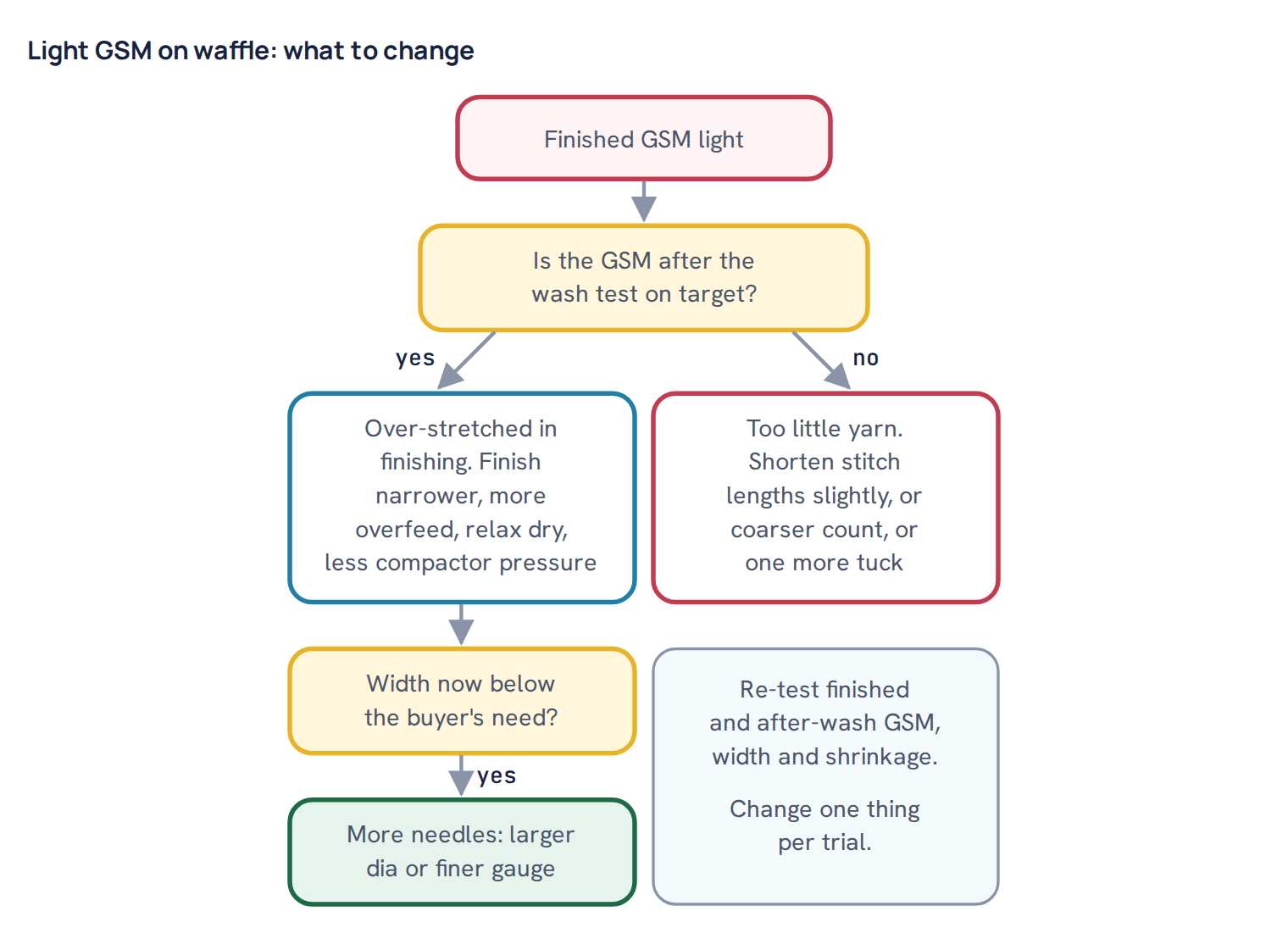
The most common waffle problem is a light finished GSM. The diagram below shows the first decision; the table that follows covers the other common faults.
| Problem | Likely cause | What to change |
|---|---|---|
| Finished GSM low, after-wash GSM on target | Fabric stretched wide and long in finishing; not relaxed | Lower stenter width, more overfeed, relax dry, gentle compaction |
| Finished and after-wash GSM both low | Too little yarn: stitch lengths too long or count too fine | Shorten stitch lengths slightly, coarser count, or deeper tuck repeat |
| High width shrinkage | Finished far wider than the relaxed width; cotton without heat-set support | Finish near relaxed width; more needles for width; consider a blend or heat-set quality |
| Width too narrow after relaxation | Too few needles for the target | Larger machine diameter or finer gauge; agree a realistic width |
| Flat, poorly defined cells | Heavy squeeze, high compactor pressure, over-wide stenter, heavy softener | Light de-watering, low pressure, narrower setting, moderate softener |
| Holes at tuck positions | Too many consecutive tucks, high yarn tension, weak or dry yarn | Fewer tucks per needle, lower input tension, check yarn and needles |
| Missing cell line along the length | Broken or bent needle, wrong butt in the set-out | Replace needle; check set-out against the cam chart |
| Barre or bars across the width | Mixed yarn lots; uneven elastane draft or yarn tension | One yarn lot; equalise feeder and elastane tension; see barre causes and remedies |
| Fuzzy face, low pilling grade | Hairy yarn; no singeing or enzyme | Combed or compact yarn; singeing (one or both sides) or enzyme |
| Specks or harsh hand after singeing | Polyester fibre ends melted into beads; flame too strong | Gentler flame or faster speed; singe before dyeing; avoid on elastane |
| Crease marks or patchy shade | Machine overloaded with bulky fabric; poor circulation | Lighter load, steady flow; see the crease and uneven dyeing guides |
| Low wet rubbing | Poor wash-off in thick fabric; deep shade | More rinses and soaping; review recipe depth and softener |
Waffle development comes down to respecting relaxation. Plan width with needles, not stenter stretch, finish gently so the cells survive, and judge every trial by its after-wash GSM and width. For rarer problems, see the bursting strength and spirality fail guides.
Questions
How is waffle (thermal) fabric knitted?
On a double-jersey machine with a dial and cylinder, mostly 18 gauge in our register. Some needles tuck or miss for a few feeders and then knit off all their held loops at once; those tight loops form the walls, and the knit loops between them bulge into cells.
Why does waffle shrink so much in width?
Its relaxed shape has deep cells and a narrow width. Finishing pulls it flat and wide, and washing lets the cells pucker back. Our 26/1 cotton waffle shows -15% width shrinkage in the dye-house wash test.
Why does cotton waffle finish below the required GSM?
Mostly because it leaves the stenter and compactor stretched. Our 26/1 cotton waffle finishes at 210 GSM against 280 required, but reaches 282 GSM after the wash test, so the yarn content is right and the fix is in finishing and width planning.
Should waffle fabric be singed?
Singeing gives sharper cells and less fuzzing and pilling, and 49 waffle entries in our register carry a singeing flag, 8 of them singed on both sides. Take care with polyester and elastane qualities, which can bead or be damaged by heat.
How do I keep the cells from flattening in finishing?
Use light de-watering, set the stenter close to the relaxed width with generous overfeed, relax-dry if possible, keep compactor pressure low and avoid a heavy softener.

Textile engineer with 14+ years in dyeing and fabric development. He writes every guide on Dyeing Solution from real production work. Full profile