Fabric grain is the direction of the yarns in a woven fabric: lengthwise along the warp, crosswise along the weft, and bias at 45 degrees. Why grain matters, how to find it, off-grain fabric, skew and spirality, grain in knits, bias cutting and how to straighten fabric.
At a glance
Straightmost stable
Biasmost stretch
Skewand spirality
Walesgrain in knits
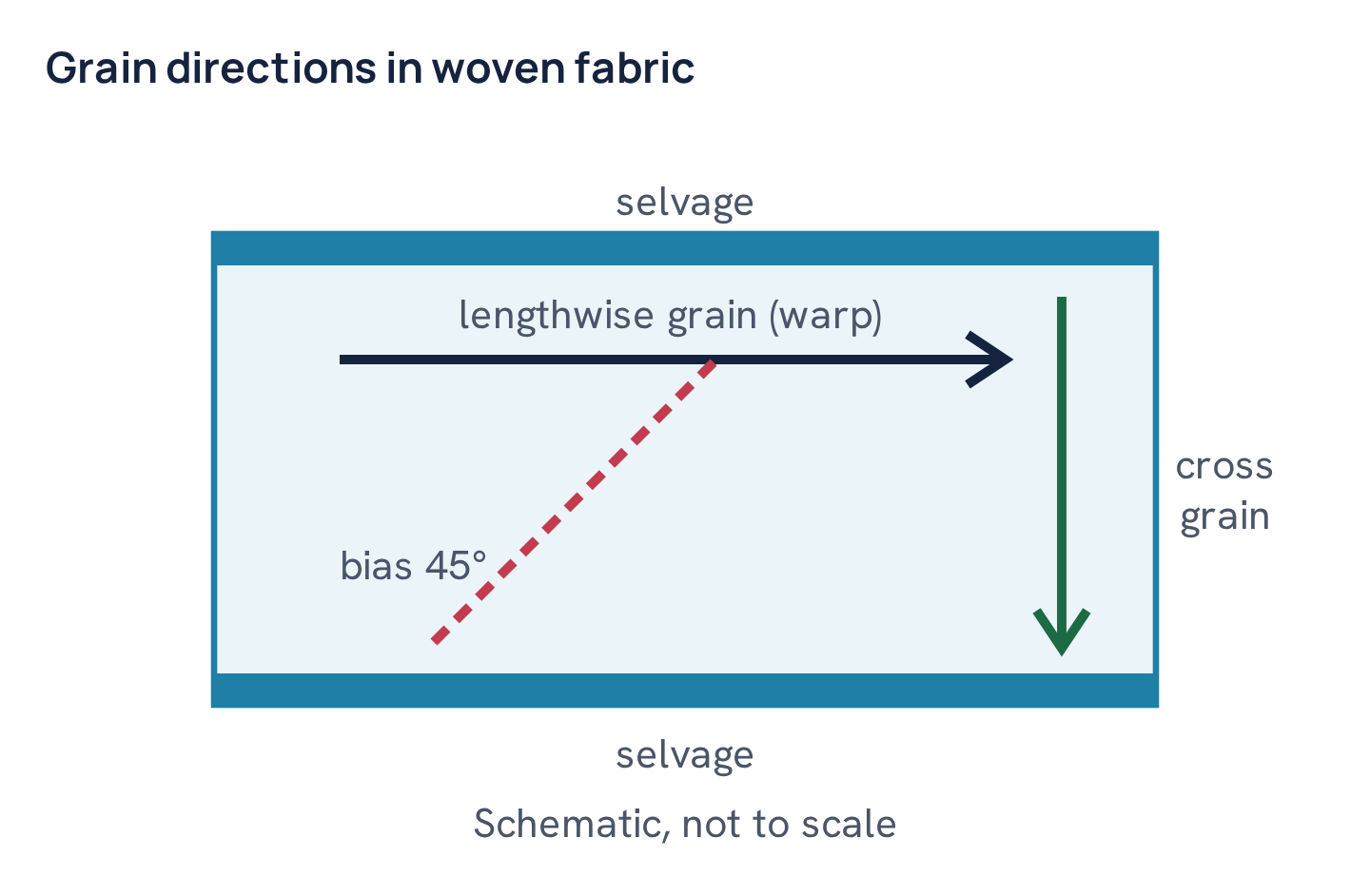
Fabric grain is the direction of the yarns in a woven fabric. The lengthwise grain (straight grain) runs along the warp yarns, parallel to the selvage; the crosswise grain (cross grain) runs along the weft yarns, at right angles to the selvage; and the bias runs diagonally at 45 degrees. Each direction behaves differently: the straight grain is the most stable, the cross grain gives slightly, and the bias stretches and drapes the most. Cutting pattern pieces “on grain” is what makes garments hang straight, keeps seams from twisting and controls how fabric drapes.
This guide explains the three grain directions, why grain matters in sewing and garment making, how to find the grain, what “off-grain” fabric is and how to straighten it, grain in knit fabrics, bias cutting, and how grain problems relate to skew and spirality faults in factory testing. It is written from the textile-processing side, where we test skew and spirality on finished fabric and see how grain distortion shows up in garments.
The three grain directions
| Direction | Runs along | Behaviour | Common uses |
|---|---|---|---|
| Lengthwise (straight) grain | Warp, parallel to selvage | Strongest, least stretch | Most pattern pieces; grainline arrows |
| Crosswise (cross) grain | Weft, selvage to selvage | Slight give | Some yokes, borders, directional prints |
| Bias (true bias at 45°) | Diagonal | Most stretch and drape | Bias-cut dresses, binding, piping, collars |
Why grain matters
- Hang: garments cut on the straight grain hang vertically; off-grain pieces drift sideways.
- Seam twist: trouser legs and skirt seams twist if pieces are cut off grain.
- Stretch and drape: bias-cut pieces cling and flow; straight-grain pieces hold shape.
- Stability: waistbands, plackets and straps cut on the straight grain do not stretch out.
- Pattern matching: stripes and checks only line up if the fabric is on grain.
How to find the grain
- Use the selvage: the straight grain runs parallel to it.
- Pull a thread: on loosely woven fabric, pull a cross thread and cut along the gap it leaves to find the true cross grain.
- Tear: some crisp cottons tear straight along the grain.
- Stretch test: the straight grain barely stretches, the cross grain gives a little, the bias stretches most.
- Follow a stripe or check: woven stripes follow the grain.
What is off-grain fabric?
Fabric is off grain when the warp and weft are no longer at right angles. This happens when fabric is pulled unevenly during finishing, wound onto the roll under tension, or printed off-square. Two common forms are bow (the weft curves across the width) and skew (the weft runs at a slant across the width). Off-grain fabric looks fine on the bolt, but garments cut from it twist or hang crooked after washing as the fabric relaxes back to its natural shape.
Skew and spirality in knits and wovens
In factories, grain distortion is measured as skew (or bow) for wovens and as spirality for knits. Spirality is the twisting of the wales in single jersey caused by yarn twist and finishing, and it makes T-shirt side seams twist round the body after washing. Both are tested by marking the fabric, washing it and measuring the angle or displacement. See skew test causes and remedies and how spirality is tested.
Grain in knit fabrics
Knits do not have warp and weft, but they have a similar idea. The lengthwise direction follows the wales (vertical columns of loops) and the crosswise direction follows the courses (horizontal rows). Most knits stretch more across the courses. Pattern pieces for knits are placed with the grainline parallel to the wales. Because circular knits come off the machine as a tube, the wales can spiral, which is why knit “grain” is checked by following a single wale rather than the folded edge. See what is cotton jersey.
How to straighten off-grain fabric
- Pre-wash the fabric if it will be washed in use; washing often lets it relax back onto grain.
- Fold it lengthwise with selvages together; if the cut ends do not match or the fold ripples, it is off grain.
- Pull gently along the short bias direction to bring the grain square.
- Press with steam while holding it square.
- Note: printed fabric may be printed off grain; in that case, follow the grain, not the print, for garments that must hang straight.
Fabrics with permanent finishes or heat-set synthetics may not straighten; they are best cut following the true grain and accepting that prints may be slightly off.
Common mistake: laying pattern pieces against the folded edge of a knit tube, assuming the fold is on grain. If the knit has spirality, the fold is not straight along a wale, and the garment twists after washing. Re-fold the fabric along a single wale before cutting.
Bias cutting
Cutting on the bias gives woven fabric stretch and a fluid, body-skimming drape, which is why bias-cut slip dresses, cowl necks and skirts move so beautifully. Bias strips are used for binding curved edges and making piping because they bend smoothly. Bias pieces can stretch and grow during sewing and hanging, so they are often hung for a day before hemming.
Grain and print placement
Directional prints, stripes and checks are usually aligned with the straight grain. If a print is not square to the grain, a garment can either hang straight with a crooked print, or show a straight print but hang crooked. Good fabric is printed on grain; buyers often check print skew as part of fabric inspection.
Worked example. A batch of cotton trousers twists towards the front after the first wash. Checking the fabric shows 4% skew: the weft runs at a slant across the width. The fabric was distorted in finishing. Cutting the next batch with grainlines aligned to the true warp direction, and asking the mill to correct the skew on the stenter, fixes the problem.
Grain in pattern instructions
Patterns mark grain with a long double-headed arrow called the grainline. To place a piece on grain, measure from each end of the arrow to the selvage; both distances must be equal. “Place on fold” markings mean the piece is cut on a fold that runs along the straight grain. Some pattern pieces, such as bias-cut skirts or binding strips, show the grainline at 45 degrees. Always follow the grainline rather than the outline of the piece.
Grain and fabric shrinkage
Woven fabric usually shrinks more along the warp than across the weft, because warp yarns are held under more tension in weaving and finishing and relax in washing. That is one reason garments can get shorter more than narrower. Knits often shrink more in length too, as the loops relax. Pre-washing before cutting removes much of this and helps the fabric settle onto grain. See does fabric shrink after washing.
Grain and stripes or checks
Woven stripes and checks are made by the yarns themselves, so they always follow the grain. Printed stripes and checks may not. When matching plaids across seams, cut single layers and align the woven pattern; for printed plaids, decide whether to follow the print or the grain, usually the grain for trousers and the print for shirts and skirts where visual alignment matters more.
Testing grain in finished garments
To check a finished garment, look at a side seam or centre front: it should hang vertically when worn. On a trouser leg, the crease should run straight down the front. If a seam spirals or a hem dips on one side after washing, the fabric was off grain or the piece was cut off grain.
Small grain errors add up: even a few degrees off can make a long skirt or trouser leg twist noticeably.
Summary
- Grain is the direction of the yarns: lengthwise, crosswise and bias.
- The straight grain runs parallel to the selvage and is the most stable.
- Cutting on grain keeps garments hanging straight and seams untwisted.
- Off-grain fabric shows up as skew, bow or knit spirality.
- Bias cutting adds stretch and drape.
Questions
What is fabric grain?
The direction of the yarns in a fabric: lengthwise along the warp, crosswise along the weft, and bias diagonally at 45 degrees.
What is the straight grain?
The lengthwise grain, running along the warp yarns parallel to the selvage. It is the most stable direction.
What is off-grain fabric?
Fabric in which the warp and weft are no longer at right angles, causing garments to twist or hang crooked.
What is bias cut?
Cutting fabric at 45 degrees to the grain, which gives woven fabric stretch and a fluid drape.
Does knit fabric have a grain?
Yes. The lengthwise grain follows the wales, the vertical columns of loops.

Textile engineer with 14+ years in dyeing and fabric development. He writes every guide on Dyeing Solution from real production work. Full profile