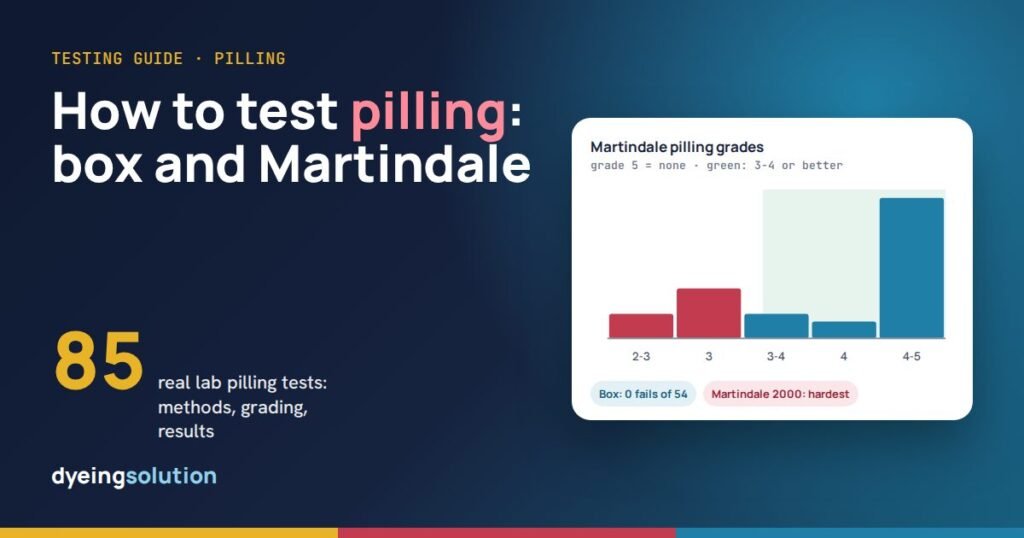
How the lab tests pilling with the pilling box (ISO 12945-1) and the Martindale (ISO 12945-2), step by step, how the grading works, and what 85 real lab tests showed.
About this guide. The method below is written from the public ISO and AATCC standards in plain words. The data comes from our own lab reports on 95 new knit developments, each tested by an accredited lab to the buyer’s standard, so you can see what real results look like.
At a glance
85Pilling tests in our data
89%Passed
10,800Pilling box revolutions
3-4Usual minimum
What the test measures
Pills are small balls of tangled fibre that form on the fabric face when it is rubbed in wear. They make a garment look old long before it wears out, so buyers test for them on every new fabric. The lab rubs the fabric in a controlled way and then compares it with photographic standards.
Two methods
| Pilling box (ISO 12945-1) | Martindale (ISO 12945-2) | |
|---|---|---|
| How it rubs | Specimens on rubber tubes tumble against a cork lining | Specimen is rubbed against the same fabric in a figure-of-eight path |
| Typical run | 10,800 revolutions (3 hours at 60 rpm) in our reports | Assessed at stages, up to 2000 cycles in our reports |
| Specimens | Four squares, sewn into tubes | Round specimens, under a set load |
| Tests in our data | 54 | 31 |
Equipment
- A pilling box tester with cork-lined boxes and polyurethane tubes, or a Martindale tester with pilling holders and loads.
- A template and cutter for the specimens, and tape or a sewing machine to make the tubes.
- A viewing cabinet with light from the side (oblique), and the photographic pilling standards for knit fabric.
How the pilling box test is done, step by step
- Condition the fabric in the standard atmosphere.
- Cut four specimens, 125 × 125 mm; two with the face out along the length, two across.
- Sew each into a tube with the face outside, push it onto a polyurethane tube and tape the ends so they cannot fray.
- Tumble the tubes in the box for the set number of revolutions.
- Remove and assess each specimen in the viewing cabinet, comparing it with the standards.
How the Martindale test is done
Round specimens are fixed face down in holders and rubbed against a piece of the same fabric under a set load, along a figure-of-eight path, so the fibres are rubbed in every direction. The tester stops at set stages (for example 125, 500, 1000 and 2000 cycles), and the specimen is assessed at each stage. Some buyers use a lighter load for knits; 155 g appears in some of our reports.
Grading the result
Pilling is graded from 5 (no pilling) to 1 (very severe pilling), in half grades, against photographs of knit fabric. Fuzzing, raised fibre that has not yet rolled into pills, is often graded beside it. The lowest grade is reported.
What real results look like
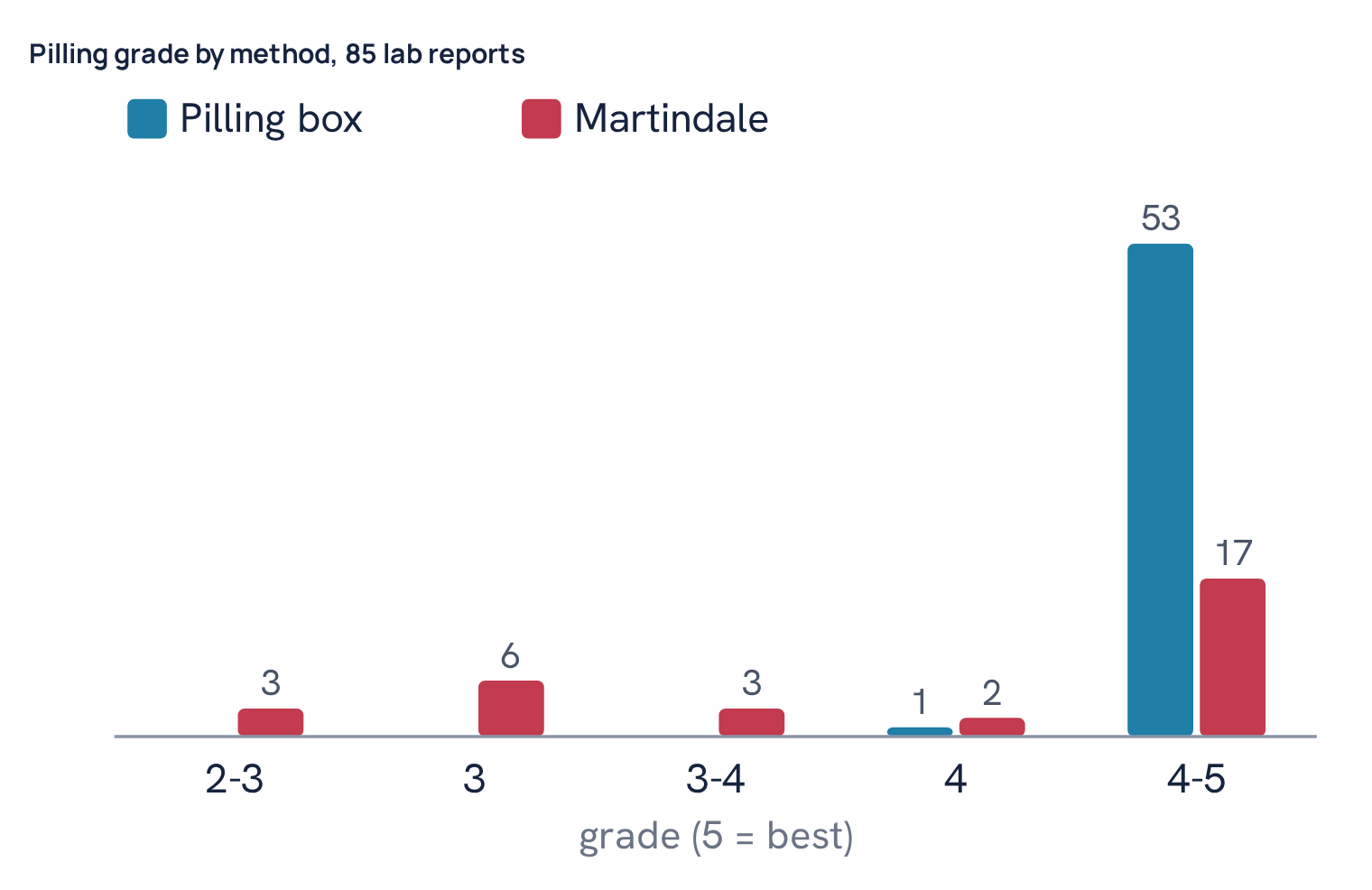
76 of 85 batches passed. None of the pilling-box tests failed; every fail was a fleece or terry on the Martindale at 2000 cycles. The method and the number of cycles change the result more than anything else, so check them with the buyer before a development is sampled.
| Fabric group | Tested | Passed |
|---|---|---|
| Single jersey | 14 | 14 (100%) |
| Rib | 21 | 21 (100%) |
| Interlock | 10 | 10 (100%) |
| Terry | 11 | 8 (72%) |
| Waffle | 10 | 10 (100%) |
| Fleece | 17 | 11 (64%) |
| Pique and lacoste | 2 | 2 (100%) |
Common mistakes that change the result
- Assessing under flat light: pills only show clearly with light from the side.
- Specimens not taped at the ends, so they fray in the box and look worse.
- Testing fabric with a softener still fresh on the surface, which can change the result after washing.
- Using the wrong load or cycle count for the buyer’s method.
If a batch fails, see why fleece and terry fail the pilling test.
From the floor
- Pilling starts in spinning: short fibre leaves more fibre ends coming out of the yarn, and they pill. Long fibre gives less pilling.
- A tightly knitted fabric pills less than a loose one, and an unstable loop pills badly.
- In dyeing, a proper enzyme treatment or singeing makes the face smooth. Without it, the face stays hairy and pilling is poor.
Questions
What is the difference between the pilling box and Martindale tests?
The pilling box tumbles specimens on tubes in a cork-lined box; the Martindale rubs a specimen against the same fabric in a figure-of-eight path. In our data the Martindale at 2000 cycles was the harder test.
What pilling grade is acceptable?
Most buyers ask for 3-4; some ask for 4.
How long is the pilling box test?
In our reports, 10,800 revolutions, which is 3 hours at 60 revolutions a minute.

Textile engineer with 14+ years in dyeing and fabric development. He writes every guide on Dyeing Solution from real production work. Full profile