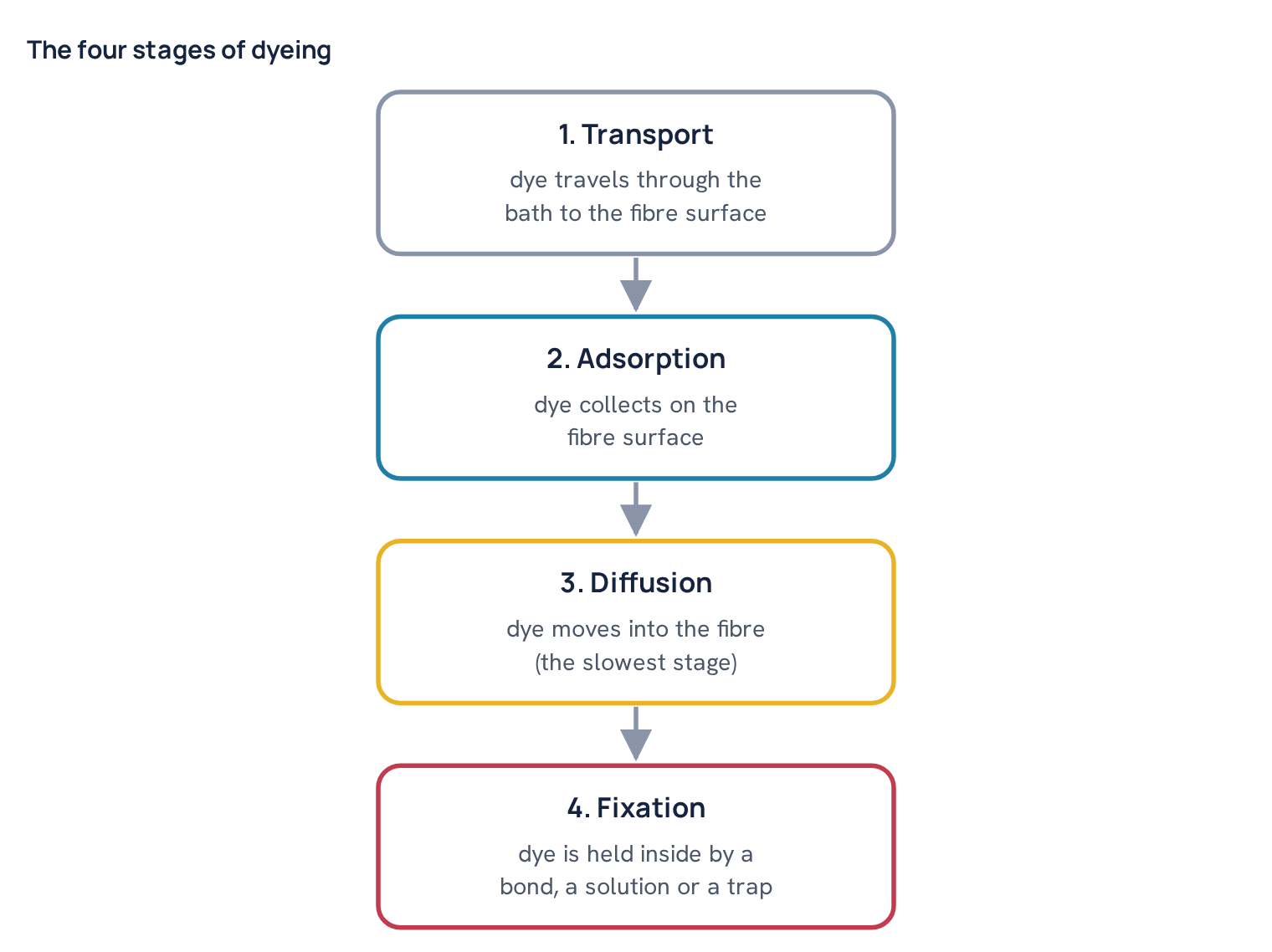
Every dyeing is the same four-stage journey from the dyebath into the fibre. Here is the theory behind each stage, how dye is held, and how it explains a real dyeing curve on the floor.
At a glance
4 stagesTransport, adsorption, diffusion, fixation
5 waysA dye is held in a fibre
SlowestDiffusion sets most of the dyeing time
E% ≠ F%The gap must be washed off
Every dyeing, whatever the fibre and whatever the dye, is the same journey: a dye molecule starts in the water and ends up locked inside the fibre. The journey has four stages: transport, adsorption, diffusion and fixation. Once you understand them, almost every setting on a dyeing curve makes sense: why we heat slowly through certain temperatures, why salt and alkali go in portions, why the pH is set before the dye, why liquor flow matters, and why the wash-off after dyeing is not optional. This article is the theory behind all the practical process pages on this site. It is written so a beginner can follow it, but it stays true to the chemistry an engineer needs.
Dye or pigment: what are we putting into the bath?
A dye is a coloured substance that can be dissolved or finely dispersed in water and that has a natural attraction to a fibre. It goes inside the fibre and becomes part of it. A pigment is a coloured particle that does not dissolve and has no attraction to any fibre. It cannot go inside, so it has to be glued to the surface with a binder, as in pigment printing or pigment dyeing. That is why a pigment-coloured fabric often feels a little stiffer and loses colour by rubbing, while a well-dyed fabric keeps its handle.
A dye molecule has three working parts:
- Chromophore. The part that gives colour. It is a chain of alternating single and double bonds (a conjugated system) that absorbs part of visible light. We see the light that is not absorbed. Azo groups (–N=N–) and anthraquinone rings are the most common chromophores in textile dyes.
- Auxochromes. Groups such as –OH and –NH2 that shift the colour and make it stronger. Older textbooks also credit them with helping the dye attach to the fibre.
- Solubilising and binding groups. Sulphonate groups (–SO3Na) make most water-soluble dyes dissolve and give them a negative charge in water. Reactive dyes also carry a reactive group that can form a bond with the fibre. Disperse dyes have almost no solubilising groups, which is exactly why they prefer the water-hating polyester to the water.
The attraction between a dye and a fibre is called affinity or substantivity. In practice the two words are used loosely for the same idea: how strongly the dye prefers to sit on the fibre rather than stay in the bath. A high-substantivity dye leaves the bath quickly; a low-substantivity dye needs help from salt, pH or temperature. For which class suits which fibre, see dye classes: which dye for which fibre.
The dyebath is a system, not a bucket
It is easy to think of dyeing as “dye plus fabric plus heat”. In reality five things work together, and a change in any one of them changes the result:
- Fibre. Its chemistry decides which dye can be held and how. Its structure (how open or compact the polymer is, how much it swells) decides how fast dye can get in. Pre-treatment matters too: a badly scoured or unevenly bleached fabric will not take dye evenly however good the recipe is.
- Water. The carrier for everything. Hardness, iron and pH of the incoming water all affect dye solubility and shade.
- Dye. Its size, charge, solubility and affinity set how fast it strikes and how easily it levels.
- Auxiliaries. Salt, alkali, acid, buffers, levelling agents, dispersing agents and sequestering agents. Each one controls a stage of the journey.
- Machine. It moves liquor through the fabric and fabric through the liquor, controls the heating and cooling rate, and sets the liquor ratio.
Keep this picture in mind. When a shade goes wrong, the cause is usually one of these five, and the stage where it went wrong tells you which one to look at.
The four stages in depth
1. Transport: getting dye to the fibre
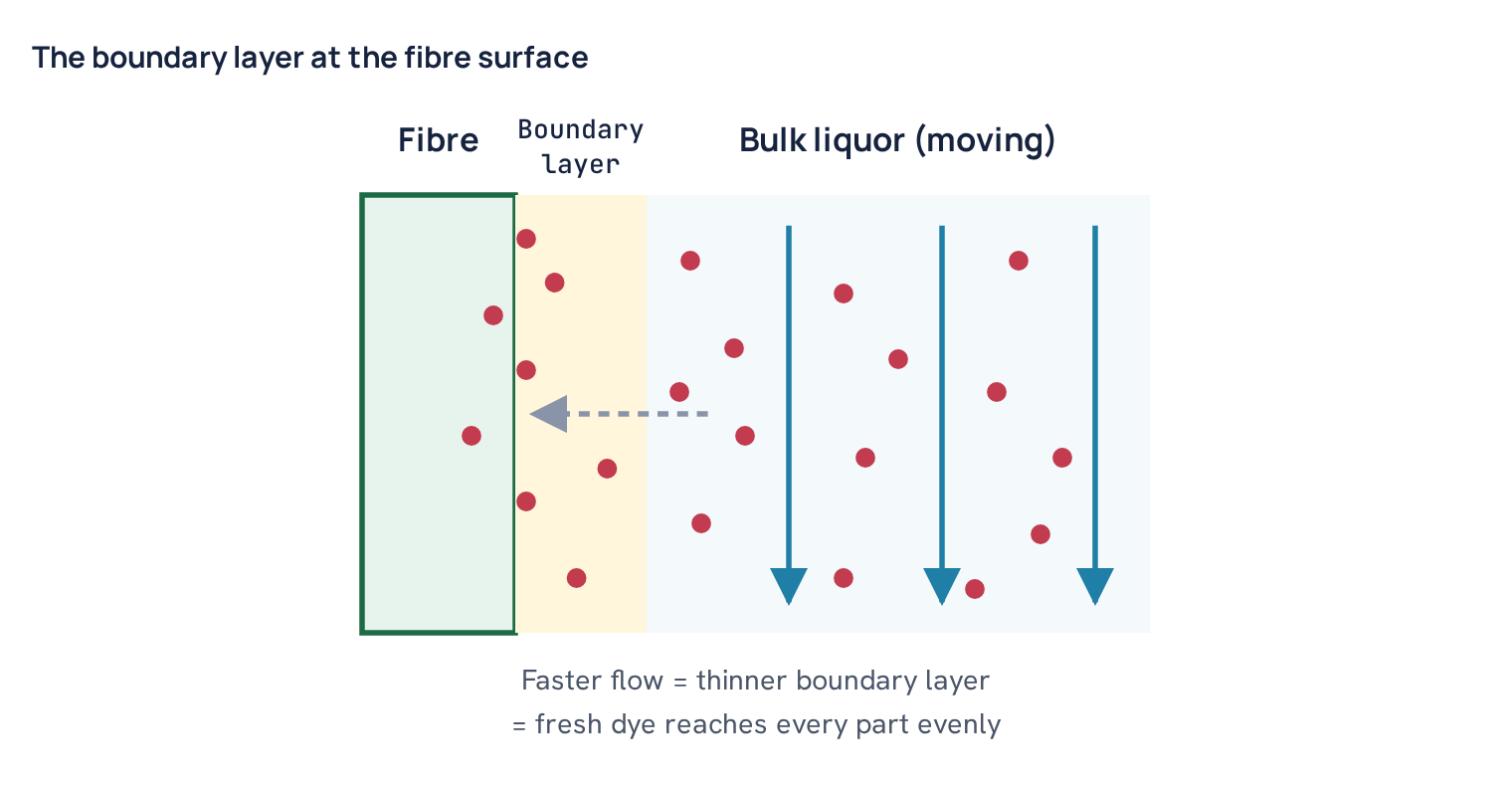
The dye is dissolved (or, for disperse dye, dispersed as very fine particles) in the bath. Moving liquor carries it to the fabric. In a jet or overflow machine, the pump pushes liquor through the nozzle and the fabric rope moves round, so fresh liquor keeps meeting every part of the surface.
Right at the fibre surface, though, the water hardly moves. There is a thin, almost still film called the boundary layer (or diffusion boundary layer). Dye cannot be carried across it by flow; it has to diffuse across it by itself. The faster and more turbulent the liquor flow, the thinner this layer and the quicker dye reaches the surface. A slow pump, a tightly packed rope, an overloaded chamber or a fabric that balloons and tangles all let the boundary layer thicken in some places. Those places get less dye in the critical early minutes, and the result is unevenness, streaks or a patchy shade.
2. Adsorption: dye collects on the surface
Once dye reaches the surface, it is attracted to it and collects there. This is adsorption. How fast and how much depends on affinity and on the electric charge of the fibre surface.
Most surfaces in water carry a small charge, measured as the zeta potential. Two examples show why it matters:
- Cellulose (cotton, viscose, modal). In water, cotton carries a negative surface charge. Reactive and direct dyes are also negative because of their sulphonate groups. Like charges repel, so the dye is pushed away from the fibre. Adding salt (sodium chloride or sodium sulphate) puts a crowd of positive sodium ions around the fibre. They screen the negative charge, the repulsion drops, and the dye can approach and adsorb. This is why reactive and direct dyeing need salt, and why deep shades need more of it.
- Nylon (and wool). Nylon has amino end groups (–NH2). In an acid bath they pick up a hydrogen ion and become positive (–NH3+). Acid dyes are negative, so they are pulled straight onto these sites. The lower the pH, the more positive sites and the faster the dye goes on. Here salt works the other way: sulphate ions compete with the dye for the positive sites, so salt acts as a retarder, not a booster.
Adsorption can be very fast. If it is too fast, the dye rushes onto the first surfaces it meets, the outside of the rope and the areas with the best flow, and the shade comes out uneven before diffusion has even started. Controlling adsorption is the first job of a dyeing curve.
3. Diffusion: dye moves into the fibre
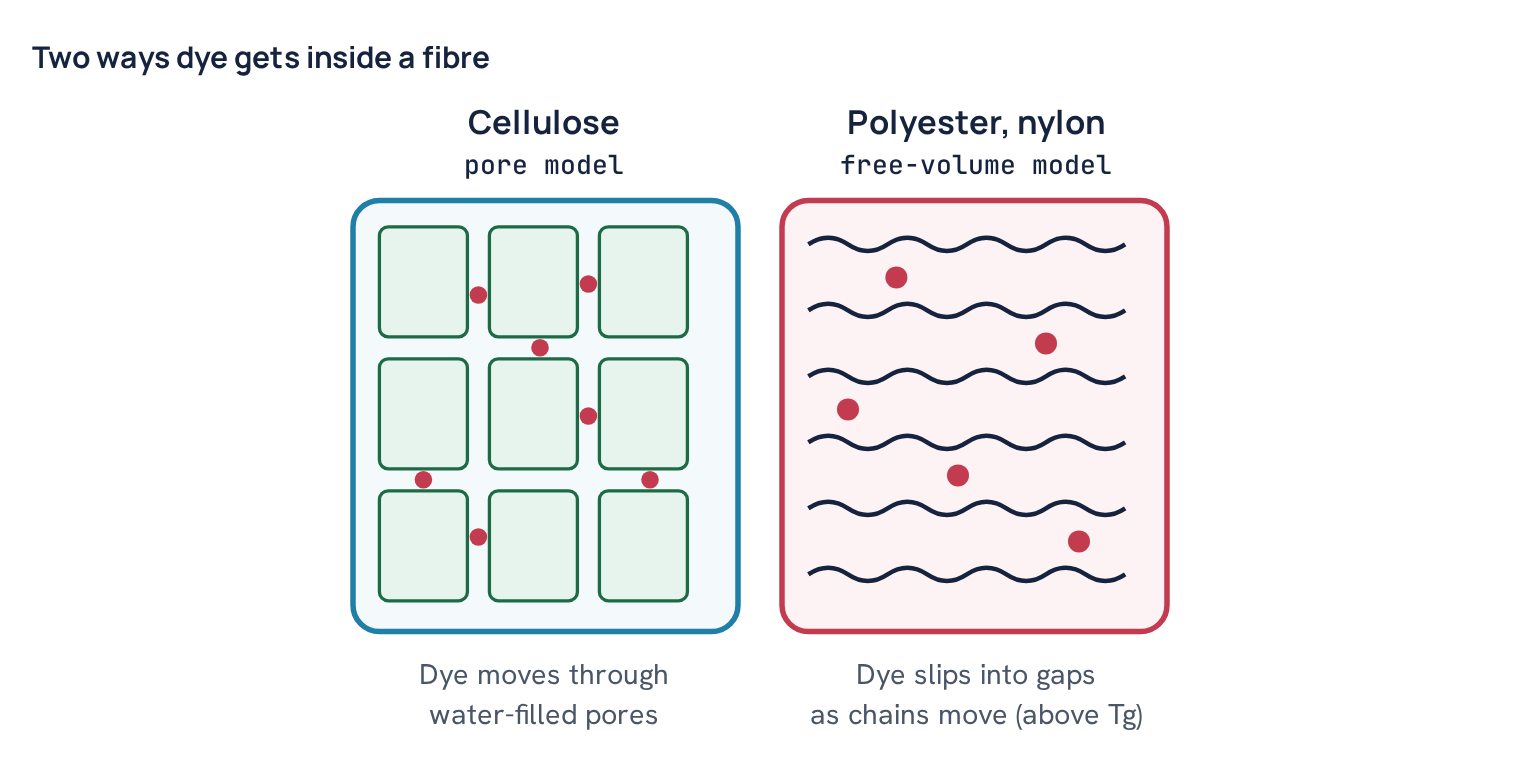
From the surface, the dye has to work its way inside. Diffusion is driven by the difference in concentration: lots of dye at the surface, little in the core. It is the slowest of the four stages, so it usually controls the total dyeing time. How dye gets in depends on the fibre, and two models describe it.
Pore model (cellulose). Cotton and viscose swell in water. Between the crystalline fibrils open a network of tiny water-filled channels, and the dye diffuses along these channels. As it travels, it keeps sticking to and leaving the channel walls, which slows it down. Heat speeds this up by giving the molecules more energy and by loosening the dye’s hold on the walls. Viscose swells more than cotton and has more accessible regions, so it generally takes dye faster and deeper.
Free-volume model (polyester, nylon, other synthetics). Synthetic fibres do not swell much and have no water pores. Dye can only move into the small gaps that open and close as the polymer chains wriggle. Below the glass transition temperature (Tg) the chains are almost frozen and diffusion is extremely slow. Above Tg, segments of the chains start to move, short-lived gaps (free volume) appear, and the dye slips from gap to gap. For polyester, Tg is roughly 70–80°C when dry and somewhat lower in hot water; even so, useful dyeing speed needs much higher temperatures, which is why polyester is dyed under pressure at about 130°C. Nylon has a lower Tg, especially when wet, so it already takes dye quickly well below the boil, and that is why nylon can strike so fast in the middle of the heating.
In both models, temperature is the strongest lever. A small rise in temperature can make diffusion much faster, which is good for penetration and levelness at the top temperature, but dangerous during heating if the dye goes on faster than it can spread out.
4. Fixation: dye is held inside
Last, the dye must be held so it does not come out again in washing, rubbing or sweat. There are five ways a dye is held in a fibre:
| How the dye is held | Dye class | Fibre |
|---|---|---|
| Covalent bond (strongest) | Reactive | Cotton, viscose, modal, lyocell, linen |
| Ionic bond (salt link) | Acid; cationic (basic) | Nylon, wool, silk; acrylic, cationic-dyeable polyester |
| Solid solution in the fibre | Disperse | Polyester, acetate, nylon (light shades) |
| Hydrogen bonds and van der Waals forces | Direct | Cotton and other cellulose |
| Trapped as an insoluble pigment inside | Vat, sulphur | Cotton and other cellulose |
A covalent bond is a true chemical bond between the reactive group and the cellulose, formed in alkali; see how reactive dyes work. An ionic bond is the attraction between the negative dye and the positive amino site; see how acid dyes work on nylon. A solid solution means the disperse dye is literally dissolved in the polymer, the way sugar dissolves in water, and stays when the fibre cools and the chains freeze again; see how disperse dyes work on polyester. Hydrogen bonds and van der Waals forces are many weak attractions along a long, flat direct-dye molecule. Mechanical entrapment happens when a soluble form of vat or sulphur dye goes in, then is oxidised back to an insoluble form too big to come out.
Equilibrium and dyeing isotherms in simple words
If you leave a dyeing long enough at constant conditions, the dye stops moving overall. Dye still goes in and comes out, but at the same rate. This is equilibrium. At equilibrium the dye is split between fibre and bath in a fixed way. A graph of “dye in fibre” against “dye left in bath” at equilibrium, at one temperature, is called an isotherm. Its shape tells you how the dye is held.
- Nernst (disperse on polyester). A straight line. The dye simply shares itself between bath and fibre in a fixed ratio, like a solute between two solvents. The line stops when the fibre is saturated, that is, when it cannot dissolve any more of that dye at that temperature.
- Langmuir (acid on nylon). Rises quickly and then levels off. The fibre has a limited number of positive sites; once they are full, extra dye in the bath does not add more. This is why nylon has a ceiling on how deep it can be dyed with acid dyes, and why dyes that compete for the same sites must be chosen with care in combination shades.
- Freundlich (direct and reactive on cellulose, before fixation). Rises and keeps rising more slowly, with no sharp limit. Cellulose offers a huge, mixed surface inside its pores rather than a fixed number of sites.
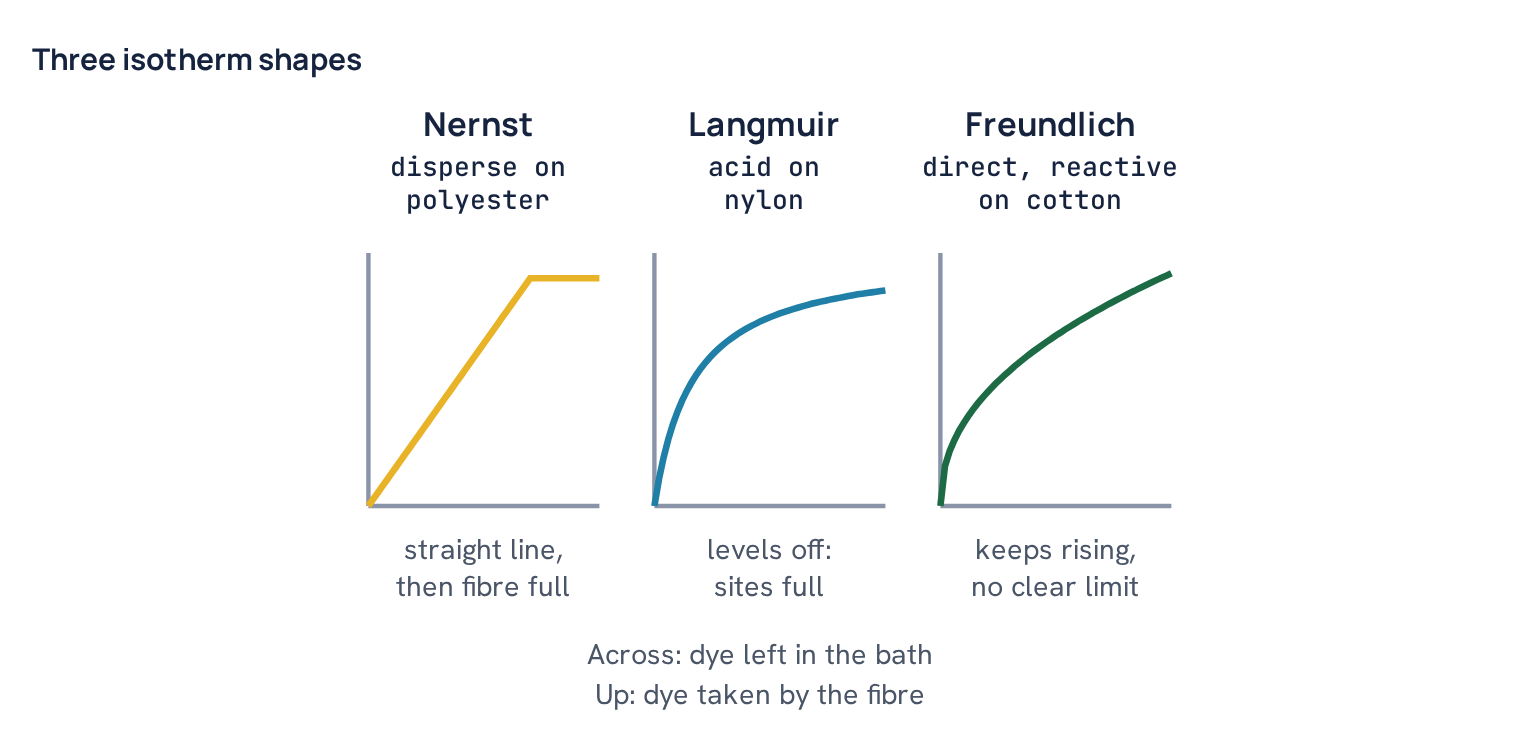
You do not need the equations on the floor. The useful lesson is this: equilibrium decides how much dye can end up on the fibre, and the rate of dyeing decides how evenly it gets there. Good practice works on both.
The dyeing rate curve: strike, half-dyeing time and levelness
If you measure the dye on the fibre every few minutes and plot it against time, you get a rate curve. It rises quickly at first and then flattens out towards equilibrium.
- Strike is the early, rapid uptake. A high-strike dye goes on hard in the first minutes.
- Half-dyeing time (t½) is the time to reach half of the equilibrium uptake. A short t½ means a fast dye; a long t½ means a slow dye. It is a handy way to compare dyes and to see whether dyes in a combination will travel together. If the three dyes in a recipe have very different t½, the shade changes as the dyeing goes on and becomes hard to repeat.
- Levelness is how evenly the dye is spread across the fabric and between the fibres. It comes from two things: controlling the strike so the dye goes on evenly, and migration, the ability of dye already on the fibre to come off and move to lighter areas.
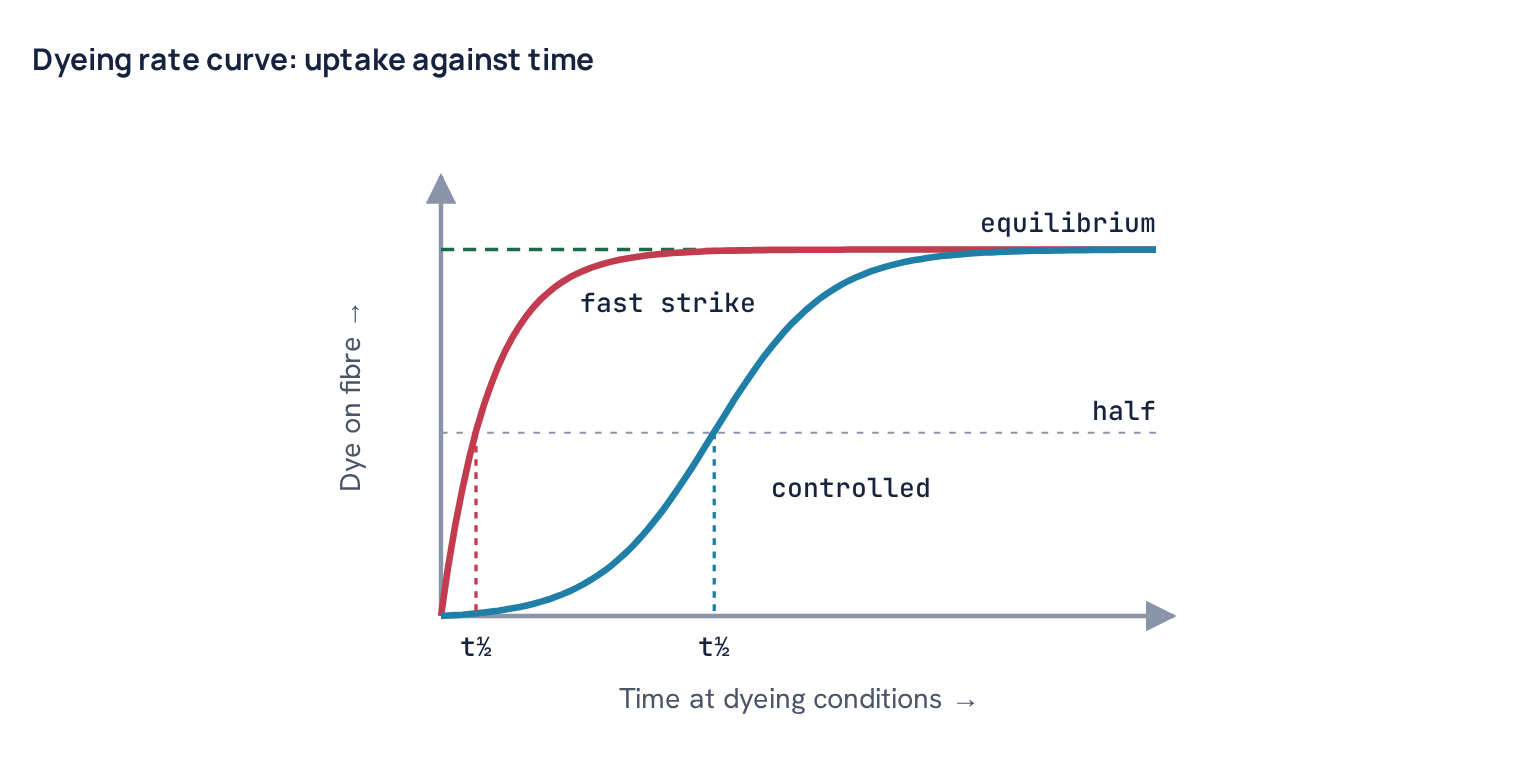
Migration is strongest before fixation. Acid dyes migrate at the boil if pH and levelling agent allow it; disperse dyes migrate at 130°C; reactive dyes can migrate after salt but before alkali. Once a reactive dye has bonded, it cannot migrate at all. That is why reactive dyeing gives you one chance to level the shade: in the salt stage.
Common mistake: treating a fast-strike shade like any other. If the shade goes on too quickly, slow the dosing and the heating. Once the dye is fixed, an uneven shade can only be stripped and redyed, and that costs time, water, chemicals and fabric quality.
The factors that control dyeing, and why
- Temperature. Raises the energy of the dye molecules and opens the fibre structure, so adsorption and diffusion speed up. It also changes equilibrium: for many dyes, the final uptake falls a little at higher temperature even though the rate rises. A fast temperature rise through the critical range is the most common cause of unlevel dyeing.
- Electrolyte (salt). On cellulose it screens the negative charge so anionic dyes can adsorb, raising exhaustion. Added all at once, it can cause a rush strike. On nylon with acid dyes it does the opposite and slows the dye.
- pH. Decides how many sites nylon offers (lower pH, more sites), whether a reactive dye can fix (alkali turns cellulose –OH into the reactive cellulosate form), and whether a disperse dye stays stable (usually mild acid, around pH 4.5–5.5; many disperse dyes break down in alkali at high temperature).
- Liquor ratio. The weight of water to the weight of fabric, for example 1:8. A lower ratio means a more concentrated bath, higher exhaustion and less water, salt and energy, but it also means faster strike and greater need for good circulation.
- Time. Enough time at temperature for diffusion and migration. Cutting the hold time may leave dye in the outer layer only (ring dyeing) and give poor fastness and shade changes in finishing.
- Liquor flow and agitation. Keeps the boundary layer thin and supplies fresh dye evenly. Pump speed, nozzle setting, rope length and fabric cycle time all belong here.
- Auxiliaries. Levelling agents either hold the dye in the bath for a while (bath-affine type) or attach to the fibre and compete with the dye (fibre-affine type). Dispersing agents keep disperse dyes as fine particles. Sequestering agents tie up calcium, magnesium and iron so they do not dull the shade or precipitate the dye.
Exhaustion and fixation
Two numbers describe how well a dyeing used its dye.
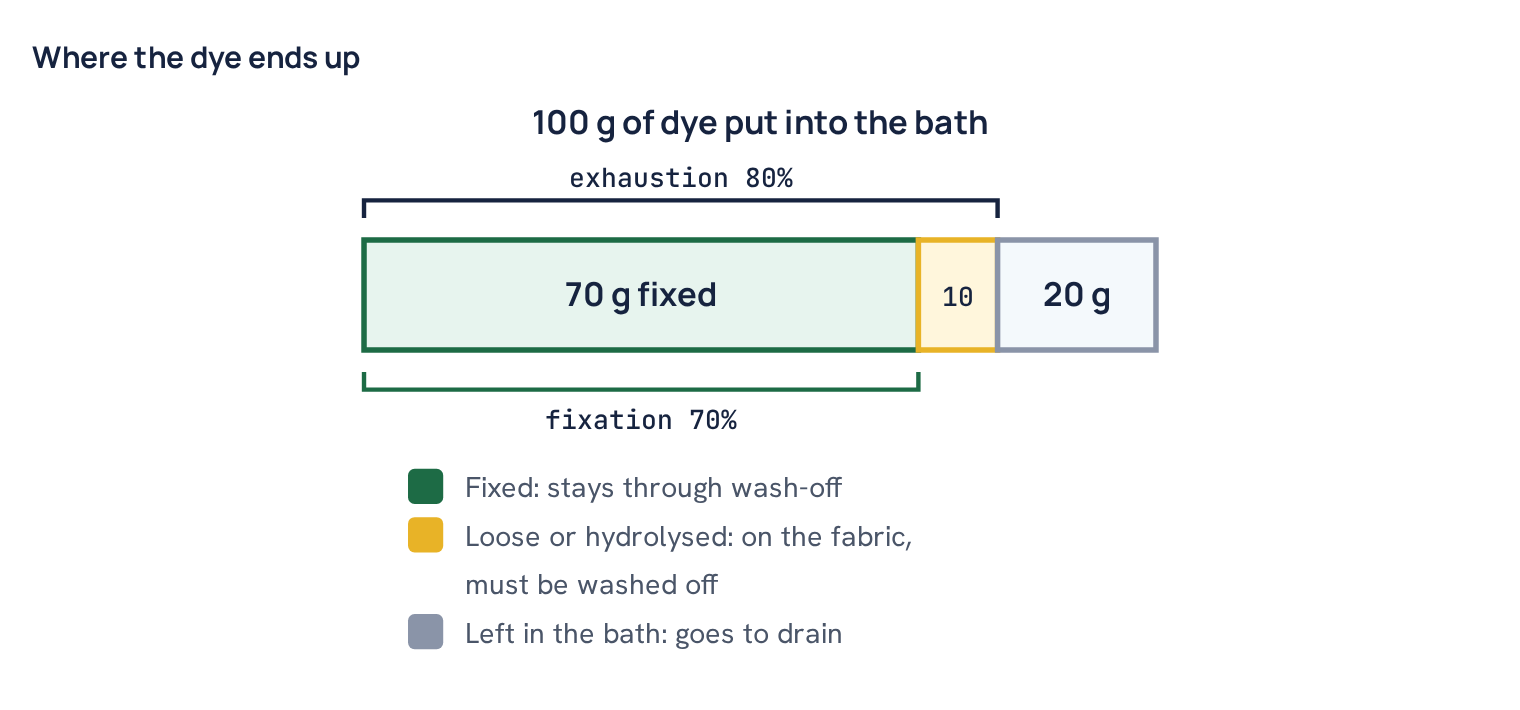
- Exhaustion (E%) is the share of dye that left the bath and went onto the fibre: E% = (dye at the start − dye left in the bath) ÷ dye at the start × 100.
- Fixation (F%) is the share of the dye applied that is still held after full wash-off: F% = dye fixed on the fibre ÷ dye at the start × 100.
- Fixation efficiency is the share of the exhausted dye that actually fixed: F% ÷ E% × 100.
For reactive dye, fixation is always lower than exhaustion, because part of the dye reacts with water (hydrolysis) instead of the fibre. That hydrolysed dye sits on the fabric with no bond and must be washed away. For acid and disperse dyes the gap is mostly loosely held surface dye.
Worked example. A bath starts with 100 g of dye. At the end, 20 g is left in the bath, so exhaustion is (100 − 20) ÷ 100 × 100 = 80%. After wash-off, 70 g is still on the fabric, so fixation is 70%. Fixation efficiency is 70 ÷ 80 × 100 = 87.5%. The 10 g difference was loose or hydrolysed dye. If it is not washed off, it is what fails rubbing and staining tests.
Shade depth is written as % on weight of fabric (% owf): grams of dye per 100 g of dry fabric. A 2% owf shade on a 500 kg batch needs 10 kg of dye. Pale shades may be well under 0.5% owf, and deep blacks and navies can need several percent or more; the exact amount varies by dye strength and fibre. Deep shades also need more salt or acid, longer holds and a harder wash-off, because more dye is chasing the same fibre.
From theory to the dyeing curve on the floor
Every step on a practical dyeing curve is one of the stages above being controlled:
- Run the fabric blank first with auxiliaries, so the fabric is wet, the liquor is circulating and the pH is set before any dye arrives. Transport is ready before adsorption begins.
- Dose dye over several minutes, not all at once, so the first metres of the rope do not grab more than the rest.
- Add salt and alkali in portions. Each portion raises substantivity or starts fixation a little at a time, so adsorption stays even.
- Heat slowly through the critical range, the band where the dye strikes fastest, then hold at the top temperature for diffusion and migration.
- Wash off thoroughly to remove loose and hydrolysed dye, so wash, rubbing and staining fastness match the shade.
- On reactive dyeing, the salt goes in three portions at 80°C and the soda in steps at 60°C, so the dye goes on slowly and evenly.
- On polyester we heat at 1°C per minute to 130°C; on nylon we slow down to 0.5°C per minute between 50°C and 98°C. That is where the shade is made level.
- After dyeing, the loose dye must be washed off. If it stays, wet rubbing and staining fail.
Read those three lines against the theory. Portion dosing controls adsorption on cotton. The slow ramp on nylon sits right where its low glass transition and positive sites make acid dye strike hardest. The steady ramp to 130°C on polyester gives diffusion time to work evenly as free volume opens. And the wash-off removes the gap between exhaustion and fixation. When deep shades fail wet rubbing, that gap is usually the first place to look; see knit fabric wet rubbing fastness fail: causes and remedies.
For full step-by-step processes built on this theory, see the 100% cotton knit dyeing process, the 100% polyester knit dyeing process and the 100% nylon knit dyeing process.
Questions
What are the stages of dyeing?
Transport of dye through the bath to the fibre, adsorption on the fibre surface, diffusion into the fibre, and fixation inside it.
What is the difference between a dye and a pigment?
A dye dissolves or disperses in water, has affinity for the fibre and goes inside it. A pigment is insoluble, has no affinity and must be held on the surface with a binder.
Why does salt help reactive and direct dyeing?
Cotton and these dyes are both negatively charged in water, so they repel. Salt screens the charge so the dye can adsorb and exhaust onto the fibre.
Why is polyester dyed at 130°C?
Disperse dye can only diffuse into polyester when its polymer chains move freely, well above the glass transition. At about 130°C under pressure, diffusion is fast enough for full, level dyeing.
What is the difference between exhaustion and fixation?
Exhaustion is the dye that left the bath for the fibre; fixation is the dye still held after wash-off. The difference is loose or hydrolysed dye that must be washed off.

Textile engineer with 14+ years in dyeing and fabric development. He writes every guide on Dyeing Solution from real production work. Full profile