Direct dyes colour cotton from a simple salt bath, held only by physical forces. Here is why their shape gives affinity, how salt and temperature control uptake, and how fixing agents improve wet fastness.
At a glance
1884Congo Red, the first direct dye
H-bonds + Van der WaalsNo covalent bond
~5–20 g/LTypical salt, varies by dye
Cationic fixerMost common after-treatment
Direct dyes are the simplest way to colour cotton. You dissolve the dye in water, add salt, heat the bath, and the cotton takes up the colour on its own. There is no mordant, no alkali fixation step and no chemical reaction with the fibre. That simplicity made direct dyes the main cotton dyes for decades, and it still makes them the cheapest choice for many products today.
The same simplicity is also their weakness. Because the dye is held only by physical forces, some of it can come out again in washing. This article explains why a direct dye sticks to cotton at all, what salt and temperature do in the bath, how the dyes are grouped for practical control, and how after-treatments improve wet fastness. Once you see the mechanism, it also becomes clear why reactive dyes took over most cotton knit dyeing.
What direct dyes are
A direct dye is an anionic (negatively charged), water-soluble dye that has natural attraction to cellulose fibres. Dyers call this attraction substantivity, and the older name for the class is “substantive dyes” for exactly that reason. The dye goes from the water onto cotton, viscose, linen or paper directly, without any other chemical to hold it there. That is where the name comes from.
Before direct dyes, most cotton colours needed a mordant: a metal salt or tannin applied to the fibre first, so that the dye had something to attach to. Mordant dyeing was slow, needed several baths and gave results that were hard to repeat.
A short history
The first direct dye was Congo Red, made by Paul Böttiger in 1884. It was a red azo dye that dyed cotton from a simple salt bath, with no mordant. For cotton dyers this was a big step. Within a few years chemists had built a large family of similar dyes covering almost every hue.
Many of those early dyes, Congo Red included, were made from benzidine and related aromatic amines. Benzidine was later shown to cause bladder cancer, and dyes that can break down to release it or to other listed amines are now banned or restricted for textiles in many markets. Modern direct dyes are built on safer intermediates. If you buy direct dyes today, the supplier should be able to confirm that they do not release restricted amines.
From the 1950s, reactive dyes offered much better wash fastness on cotton, and direct dyes slowly lost ground in quality apparel. They never disappeared, because they remain cheap, easy to apply and good enough for many end uses.
Why the shape of the molecule matters
Most direct dyes are azo dyes, which means their colour comes from one or more azo groups (–N=N–) linking aromatic rings. Many contain two, three or even four azo groups in a row. A smaller number are built on other structures, such as stilbene, thiazole or phthalocyanine. Whatever the chromophore, good direct dyes share four features:
- Long. The molecule is stretched out, often 2 to 3 nanometres from end to end, much longer than a typical acid dye.
- Flat (coplanar). The rings lie in one plane. There are no bulky side groups that twist the molecule out of shape.
- Linear. The rings are joined end to end in a fairly straight line rather than in a branched or bent shape.
- Sulphonated. Sulphonate groups (–SO₃⁻), usually two to four, make the dye soluble and give it a negative charge in water. Many also carry amino (–NH₂), hydroxyl (–OH) or amide groups that can form hydrogen bonds.
Now look at the fibre. Cellulose is a long, straight chain of glucose units, and each unit carries hydroxyl groups. In the less ordered (amorphous) regions of the fibre, water opens up spaces between these chains. A long, flat dye molecule can slide into such a space and lie along the length of a cellulose chain, like a ruler laid on a plank.
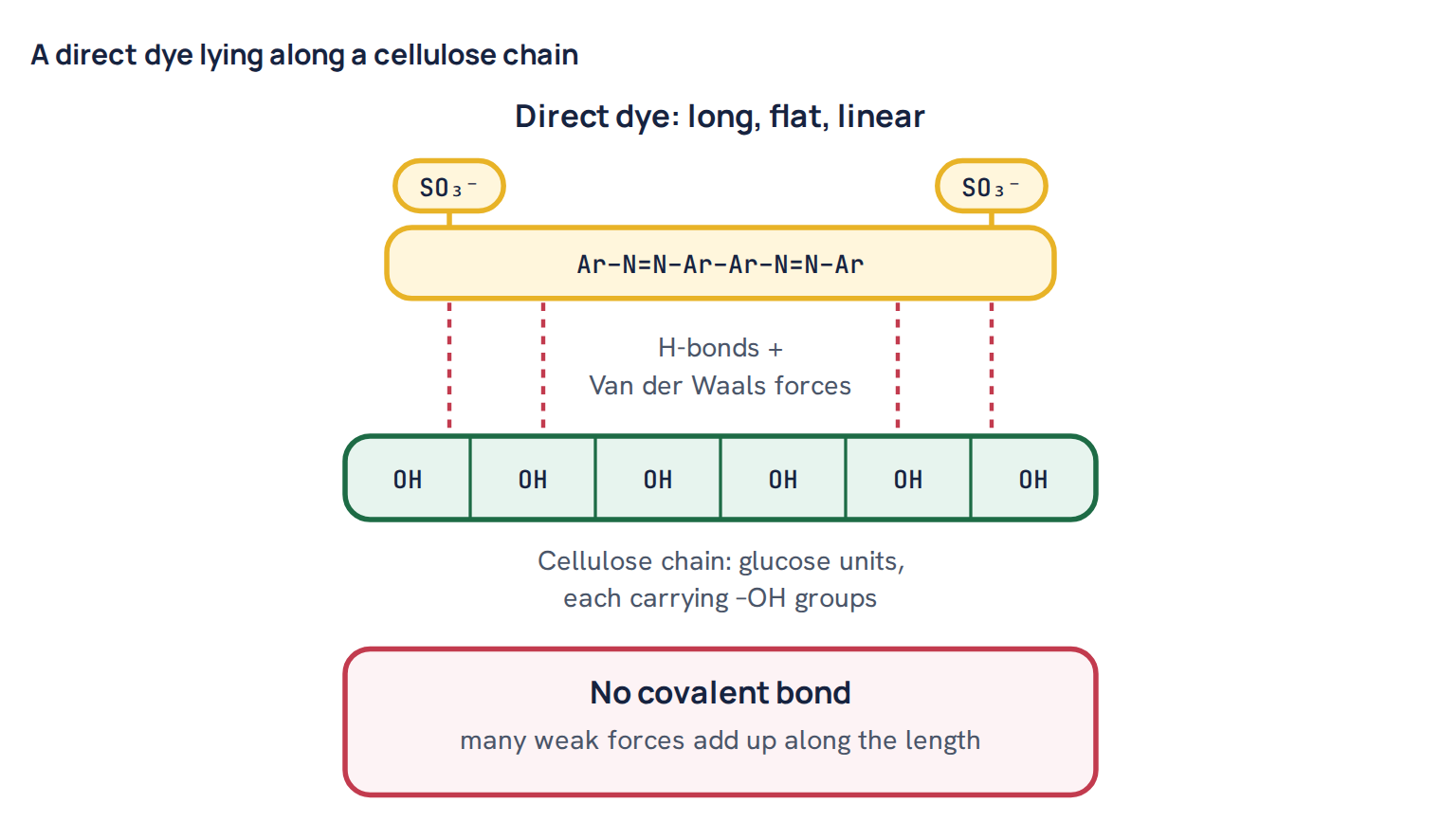
Once it lies flat against the chain, the dye is held by many weak forces at once. Hydrogen bonds form between the dye’s amino, hydroxyl and azo nitrogens and the hydroxyl groups of the cellulose. Van der Waals forces, the weak attraction between any two molecules that are very close together, act all along the contact area. One such bond is weak. But because the molecule is long and flat, dozens of contact points add up, and the total attraction is strong enough to pull the dye out of the water and hold it in the fibre.
This explains why shape is everything. A bent or bulky molecule cannot lie close to the chain, so it makes fewer contacts and has low substantivity. A short molecule has too few contact points. A long, flat, straight molecule fits the cellulose chain well, and it is often said that the spacing of its bonding groups roughly matches the repeat spacing along the chain.
No covalent bond is formed. The dye can still move in and out of the fibre, slowly, at any time it is wet and warm. That single fact controls everything about direct dye fastness, as we will see below.
Aggregation: dye molecules stack in the bath
The same flat shape that attracts the dye to cellulose also makes dye molecules attracted to each other. In solution, direct dyes stack face to face into groups called aggregates. A dye that is mostly single molecules at the boil may be largely aggregated at room temperature.
Aggregation increases with:
- higher dye concentration, so deep shades and strong stock solutions are more affected;
- lower temperature, because heat breaks the stacks apart;
- more salt, because salt reduces the charge repulsion between dye molecules as well as between dye and fibre;
- hard water, because calcium and magnesium ions can link dye anions together and even precipitate them.
Aggregation matters because only single molecules, or very small groups, can diffuse into the narrow spaces inside the fibre. Large aggregates stay on the surface or in the water. In mild form they slow down dyeing; in severe form they deposit on the fabric as dark specks. This is why direct dyes are dissolved in hot, soft water, why salt is not dumped into a cold bath, and why some dyers add a little soda ash to the bath to keep the dye fully dissolved and to soften the water.
The role of salt
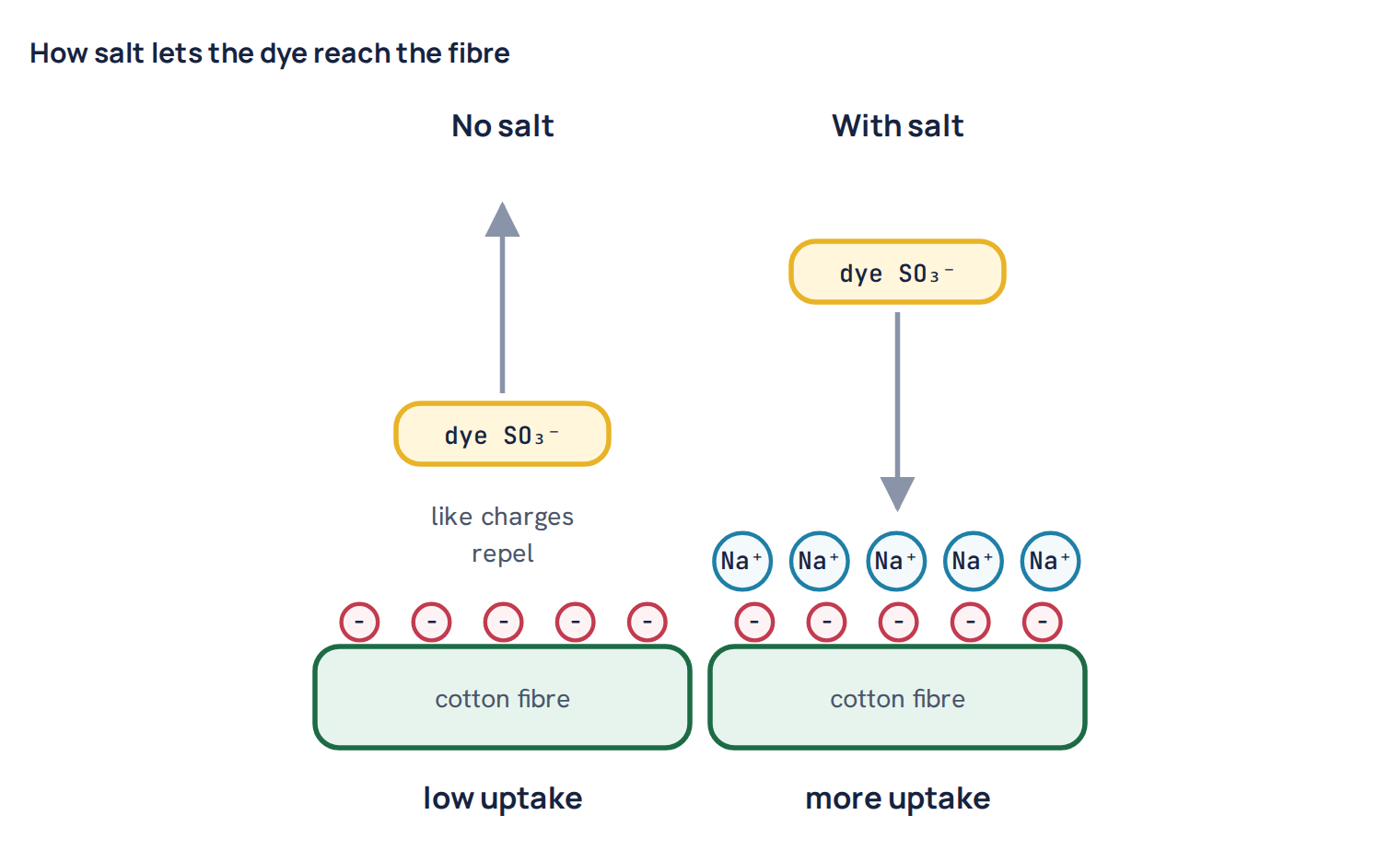
The dye anion carries a negative charge from its sulphonate groups. Cotton in water also carries a small negative surface charge. Like charges repel, so without help the dye is pushed away from the fibre surface before the hydrogen bonds and Van der Waals forces can act. This is the same problem reactive dyes face, and it has the same answer: salt.
Common salt (sodium chloride) or Glauber’s salt (sodium sulphate) dissolves into sodium ions and chloride or sulphate ions. The positive sodium ions gather around the negative fibre surface and shield its charge. The repulsion falls, the dye can come close, and the short-range forces take over. More salt means more shielding and more dye on the fibre at equilibrium, which is called higher exhaustion.
There is one important difference from reactive dyeing. Direct dyes are much more substantive, so they need much less salt. Typical additions are in the region of 5–20 g/L, with the low end for pale shades and the high end for deep ones, but the right amount varies a lot from dye to dye. Some direct dyes exhaust well with almost no salt; others need generous amounts. Always start from the dye maker’s guidance.
Because direct dyes respond so strongly to salt, salt is also a control tool. Add it all at once and the dye rushes onto the outside of the fabric and the first surfaces it meets, giving unlevel dyeing. Add it in portions and the dye goes on gradually and evenly.
Worked example. A dyer runs 200 kg of viscose fabric at a liquor ratio of 1:10, so the bath holds 2,000 litres. The recipe calls for 15 g/L of salt. Total salt: 2,000 × 15 g = 30 kg. Split into three portions, that is 10 kg each, added perhaps 10–15 minutes apart once the bath is hot. If the same fabric were run at 1:6 (1,200 litres), the salt would fall to 18 kg for the same concentration, and the shorter liquor would also leave less dye in the water at the end.
The role of temperature
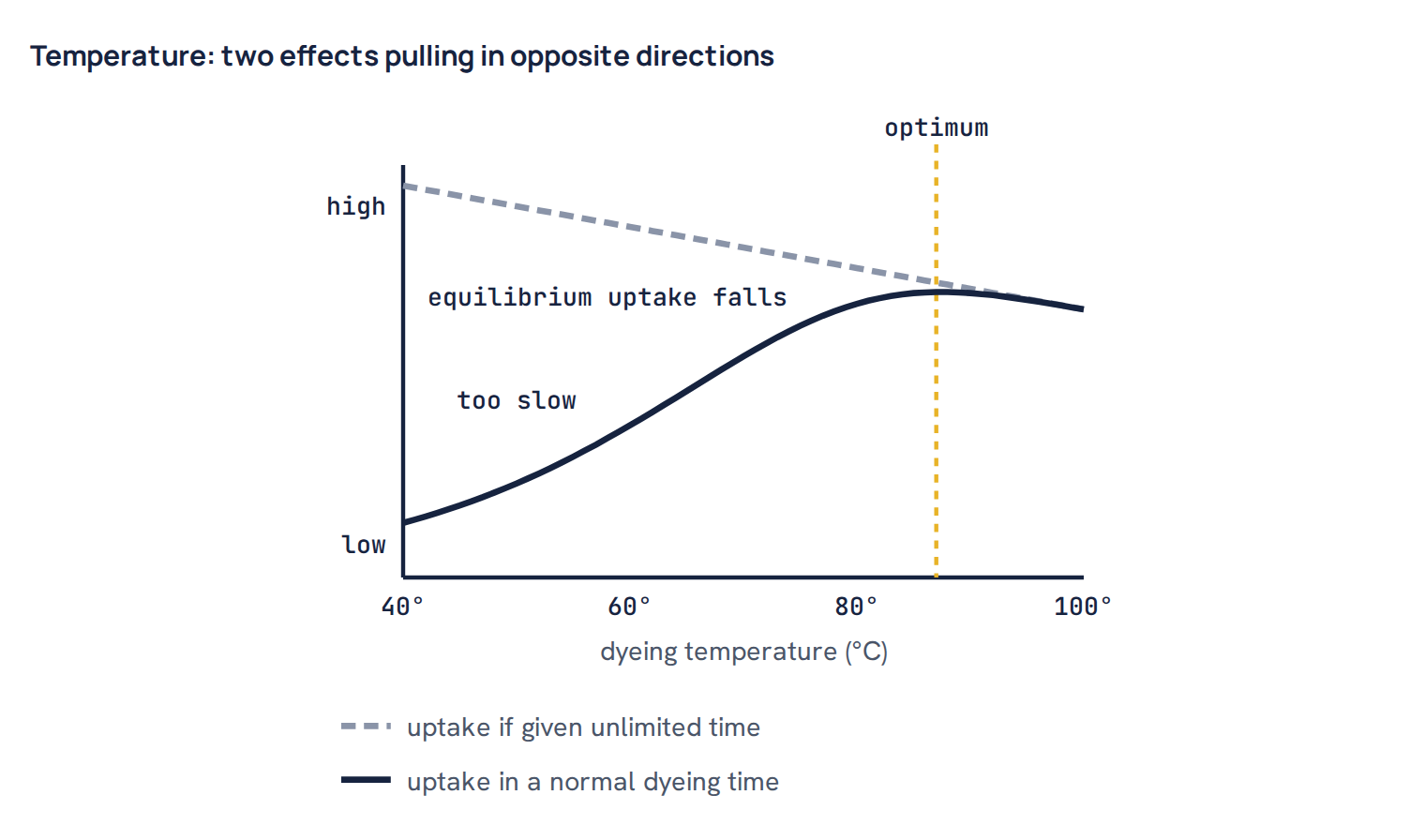
Temperature does two opposite things in direct dyeing, and the art is to balance them.
First, temperature lowers the equilibrium uptake. Adsorbing onto the fibre releases a little heat, so by the basic rules of equilibrium, a hotter bath favours the dye staying in solution. If you could wait forever, a bath at 40°C would leave more dye on the fibre than a bath at the boil.
Second, temperature speeds up diffusion. Direct dyes are large molecules and they move into cotton slowly. Heat swells the fibre, breaks up aggregates and makes each molecule move faster. At 40°C a direct dye may take many hours to come close to equilibrium; near the boil it gets much closer in an hour or so. Heat also helps the dye migrate, that is, leave heavily dyed areas and move to lighter ones, which improves levelness.
A real dyeing has a fixed time, perhaps 45–90 minutes at top temperature. Within that time, a low temperature gives little uptake because the dye cannot get in quickly enough. A very high temperature lets it in quickly, but the equilibrium itself is lower. Somewhere in between is the temperature that gives the most dye on the fibre in practical time. For many direct dyes this optimum lies roughly between 80°C and the boil, though some dyes give their best yield lower, around 60–80°C.
There is a neat practical trick that follows from this. Dye near the boil to get the dye into the fibre and level, then let the bath cool slowly before draining. As the temperature falls, the equilibrium shifts back in favour of the fibre, and more dye leaves the water. The dye already inside the fibre is close to the cellulose chains, so it settles quickly. Cooling in the bath can noticeably improve the final exhaustion and reduce the colour going to drain.
Class A, B and C: grouping by how the dye behaves
Direct dyes differ widely. Some level easily; some rush onto the fibre and stay where they land. The Society of Dyers and Colourists (SDC) proposed a practical grouping based on how the dyes respond to salt and temperature. It is still the most useful way to choose direct dyes for a combination shade and to set the process.
- Class A: self-levelling. These dyes migrate well. Even if they go on unevenly at first, they move from heavy to light areas during the hold, and the shade evens out. They may need a fair amount of salt to exhaust, but they forgive mistakes in salt addition.
- Class B: salt-controllable. These dyes level poorly once on the fibre, but their exhaustion responds steadily to salt. Level dyeing comes from adding the salt gradually, in portions, so the dye goes on at a controlled rate.
- Class C: temperature-controllable. These dyes also level poorly and are highly sensitive to salt; they exhaust strongly even with very little. Salt alone cannot control them, so the dyer controls the rate by starting cooler and raising the temperature slowly. Salt, if used, goes in late, once most of the dye is already on the fibre.
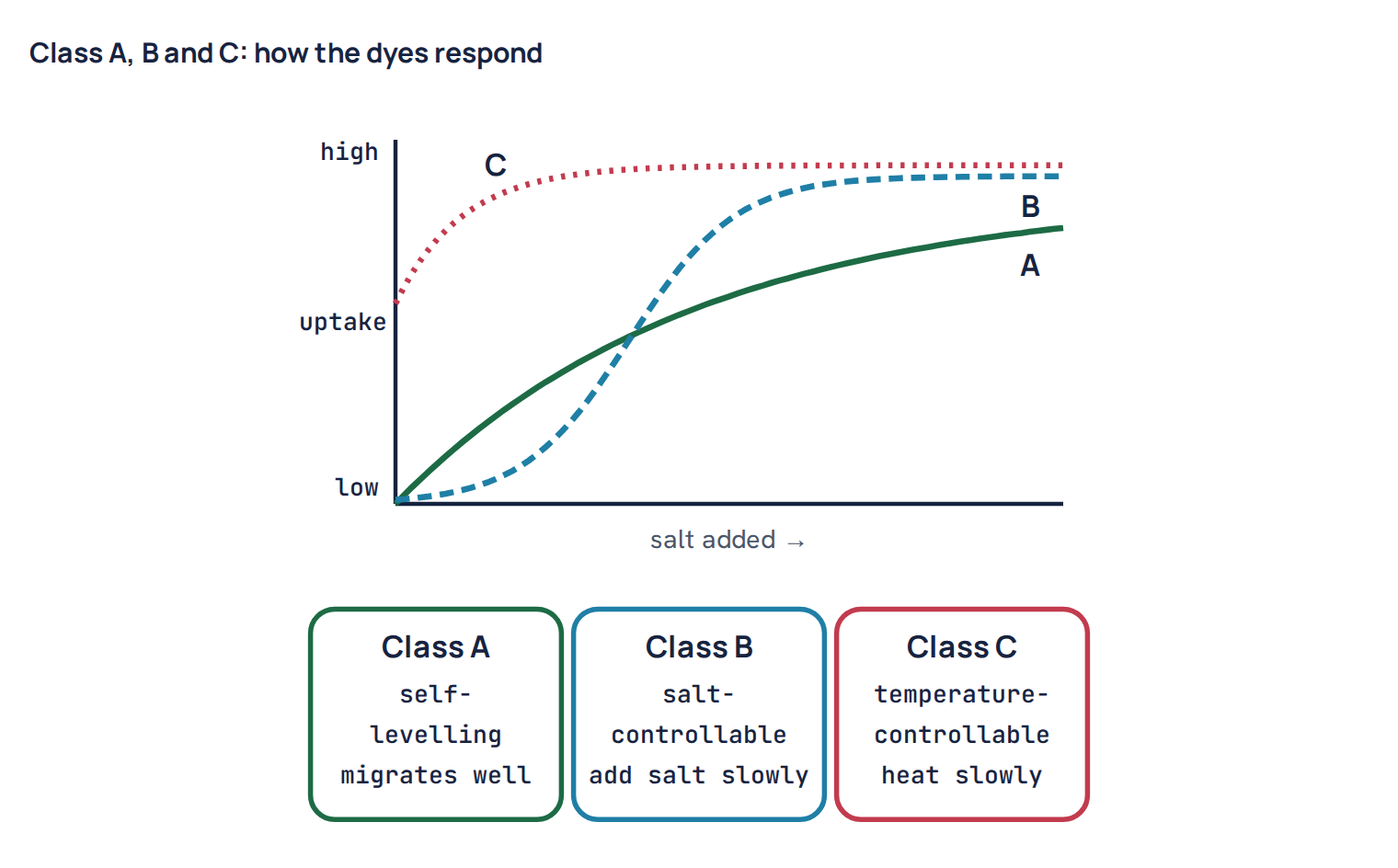
In a combination shade, the dyes should belong to the same class or at least behave similarly. If you mix a Class A dye with a Class C dye, one component goes on early and the other late, so the shade shifts during dyeing and can vary between batches or from the outside to the inside of a package. Good dye ranges show the class for each dye on the data sheet.
A typical direct dyeing procedure
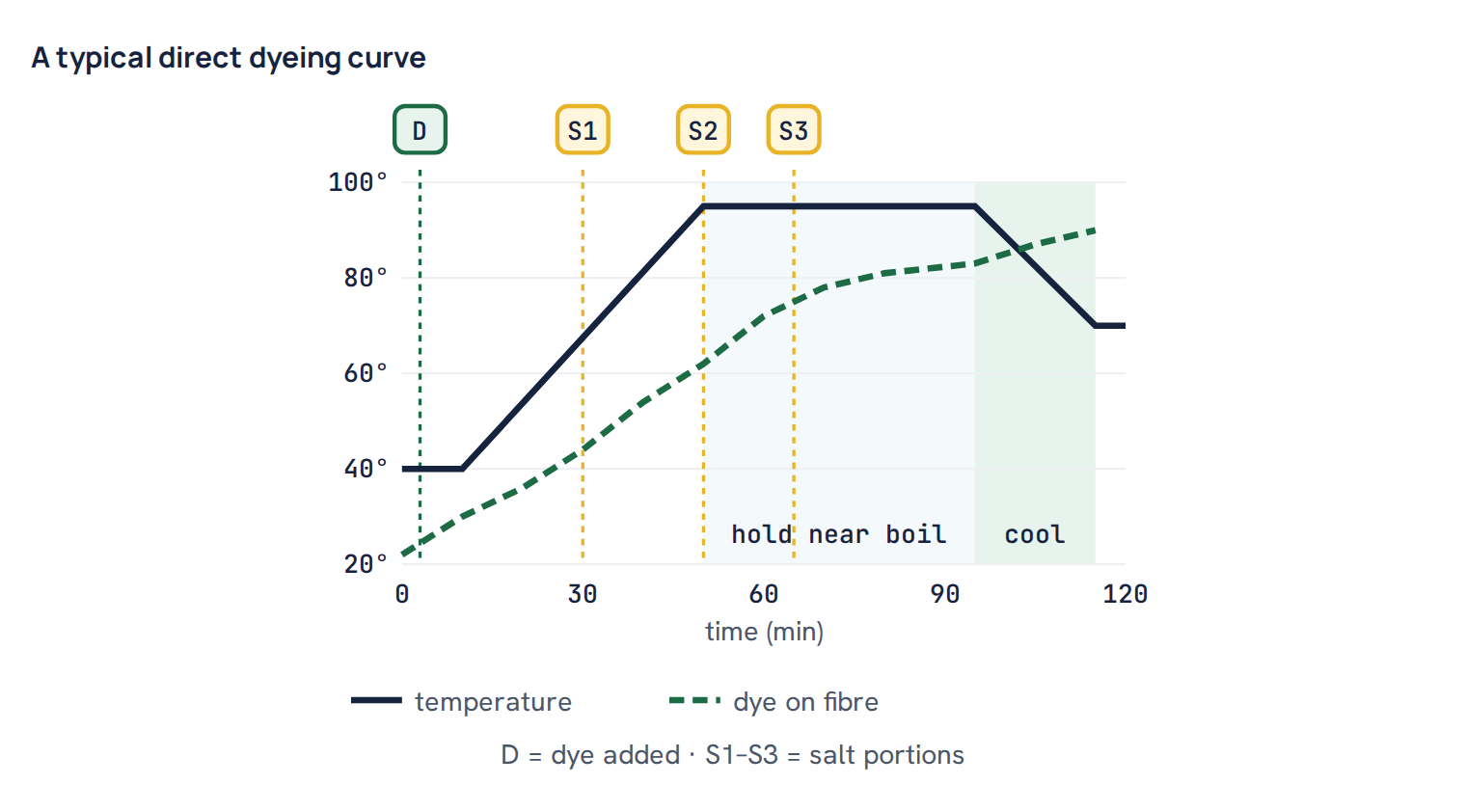
The details depend on the dye class, the fibre and the machine, but a common exhaust procedure for cotton or viscose looks like this:
- Prepare the fabric. It must be evenly scoured and absorbent, the same as for any cotton dyeing. Bleaching is needed only for bright or pale shades.
- Set the bath warm. Fill with soft water at about 40°C. Add a wetting agent and, if needed, a sequestering agent and a little soda ash.
- Add the dye. Dissolve the dye in hot water, strain it, and add it to the bath. Run for about 10 minutes so it spreads evenly.
- Raise the temperature. Heat slowly, often 1–2°C per minute, towards 90–95°C or the boil. Class C dyes need the slowest rise.
- Add salt in portions. Add the salt in two or three portions, during the rise or at top temperature, a few minutes apart. Each portion pushes more dye onto the fibre in a controlled step.
- Hold. Run 30–60 minutes near the boil so the dye diffuses into the fibre and levels.
- Cool in the bath. Let the bath cool to about 60–70°C before draining, to improve exhaustion.
- Rinse and after-treat. Give a cold rinse, then apply a fixing agent if wet fastness is needed.
The liquor ratio has a strong effect. Since some dye always stays in the water at equilibrium, a long liquor ratio (more water per kilogram of fabric) leaves more dye behind. Direct dyes usually exhaust less completely than modern reactive dyes, often leaving a clearly coloured bath, so a short liquor ratio makes a big difference to both shade depth and effluent colour. When a recipe is moved from a long-liquor machine to a short-liquor one, the shade usually comes out deeper and the recipe must be corrected.
Unlike reactive dyeing, there is no long soaping wash-off. Direct dyes cannot be soaped hard at the boil after dyeing, because that would strip them. A simple rinse removes salt and loose dye, and then the after-treatment follows.
Fastness properties
Wash fastness is the weak point. Because the dye is held only by physical forces, a warm wash lets some of it diffuse back out of the fibre. Untreated direct dyeings typically have only moderate wash fastness, often around grade 2–3 for change and staining in a 40–60°C test, with large differences between dyes and depths. Deep shades bleed most because there is more dye to lose. Wet rubbing fastness is often limited for the same reason.
Light fastness varies widely. Some direct dyes fade quickly in sunlight; others, especially certain metal-complex types, have very good light fastness and are chosen for curtains and upholstery. The data sheet is the only reliable guide.
Fastness to perspiration and water is usually in the same moderate range as wash fastness. Fastness to dry cleaning is generally good, because the solvents used do not dissolve water-soluble dyes.
After-treatments that improve wet fastness
The aim of every after-treatment is the same: make the dye molecule effectively larger or less soluble once it is inside the fibre, so that it cannot diffuse out again in washing.
Cationic dye-fixing agents
This is by far the most common method today. A cationic fixing agent is a positively charged compound, often a quaternary ammonium compound or a cationic polymer such as a polyamine. It is applied from a fresh bath, usually warm and slightly acidic, after rinsing.
The positive fixer is attracted to the negative sulphonate groups of the dye and forms a salt-like complex with them. The complex is much larger and much less soluble than the dye alone. It is trapped in the fibre and washes out far less easily. A good fixing treatment typically improves wash and water fastness by around one grade, though the gain depends on the dye and the agent.
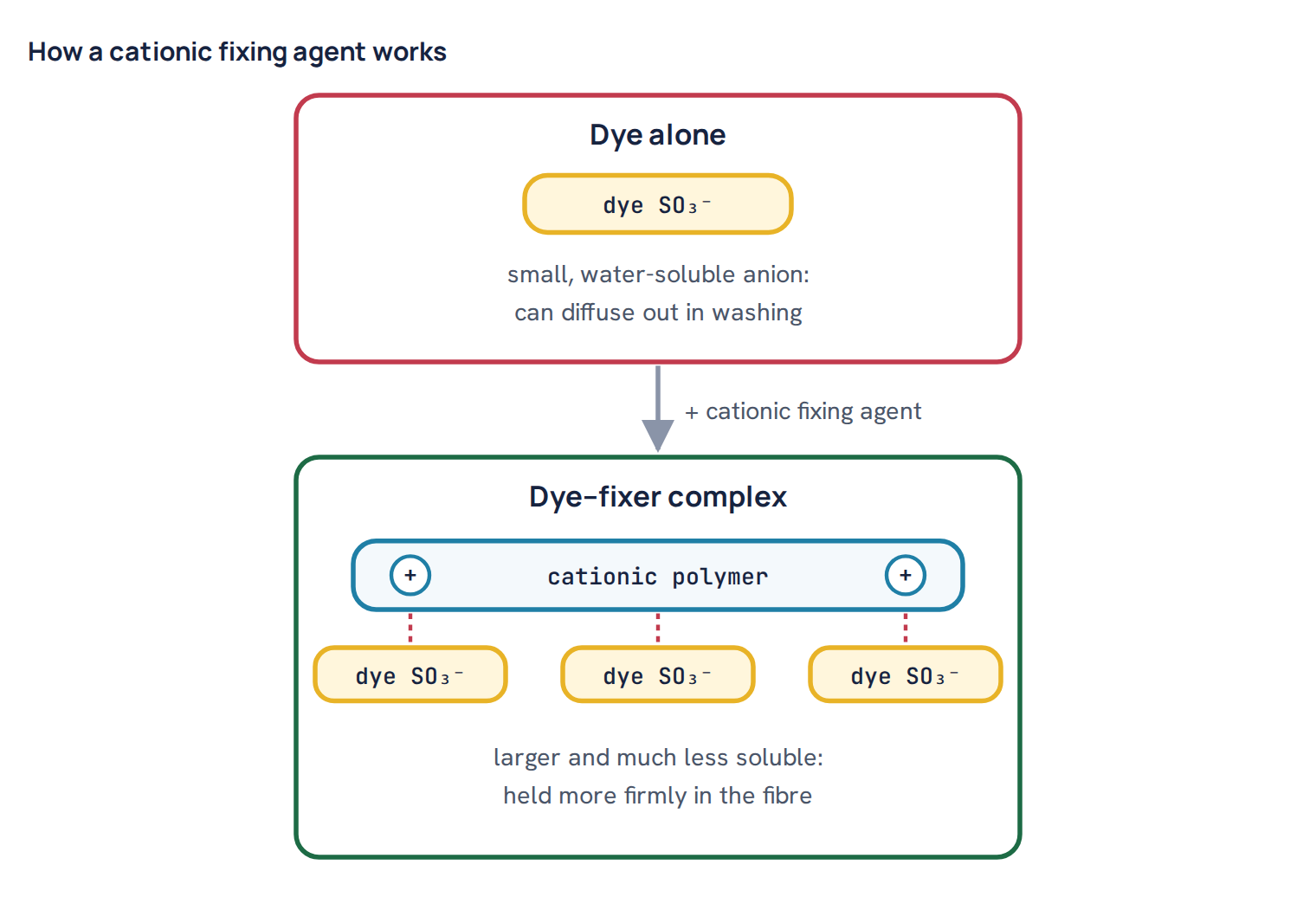
Fixing agents have side effects. They can change the shade, often making it slightly duller or shifting the hue, so the shade must be approved after fixing, not before. Some reduce light fastness. The bond is ionic, not covalent, so repeated washing with strong anionic detergents can slowly weaken the effect. And the fixer must be applied evenly to clean fabric, or it can cause patchiness.
Copper salts and formaldehyde-based fixers
Older methods used copper salts, typically copper sulphate, with dyes designed to form a metal complex on the fibre. The copper treatment improves light fastness and some wet fastness, but it dulls the shade and puts copper, a heavy metal, into the effluent and the product. It is rarely used today.
Formaldehyde treatment, and fixing agents based on formaldehyde condensates, also improved wash fastness. Formaldehyde is a recognised health hazard, and many buyers set strict limits for free formaldehyde in textiles, so these methods have largely been replaced by formaldehyde-free cationic fixers.
Diazotisation and development
Some direct dyes carry a free amino group. After dyeing, the fabric is treated in a cold bath of sodium nitrite and acid, which converts the amino group into a reactive diazonium group. The fabric is then passed into a bath of a developer, a coupling compound that reacts with the diazonium group to build a larger azo dye inside the fibre. The new molecule is bigger, less soluble and usually deeper in shade, so wash fastness improves. The process is long, sensitive to temperature and needs careful handling of chemicals, so it is now rarely used in commercial dyeing.
Where direct dyes are used today
Direct dyes are no longer the first choice for quality cotton apparel, but they remain important wherever low cost and simple processing matter more than top wash fastness:
- Paper. By volume, paper and board are one of the largest uses of direct dyes, because pulp is cellulose and is not washed in use.
- Cheap cotton and viscose fabrics, especially where the product will not be washed often or hot.
- Linings and interlinings, where colour is needed but heavy washing is not expected.
- Viscose. Viscose takes up direct dyes readily, often dyeing deeper than cotton with the same recipe.
- Garment dyeing, where the simple one-bath process and easy shade correction are an advantage.
- Blends. Some direct dyes are used for the cellulose part of blends, sometimes in one bath with dyes for the other fibre.
- Shading. A small amount of direct dye is sometimes used as a shading component, though mixing classes needs care with fastness.
In knit dyeing for export apparel, reactive dyes replaced direct dyes for a clear reason. Buyers test washing at 40–60°C, colour staining on multifibre and wet rubbing, and untreated direct dyes often fail these tests in medium and deep shades. Reactive dyes, once properly washed off, are held by a covalent bond and pass far more easily. Reactive dyes also give brighter shades. The price is a longer process with more salt, alkali and wash water, which is why the choice depends on the end use.
Direct and reactive dyes compared
| Property | Direct dyes | Reactive dyes |
|---|---|---|
| Held by | Hydrogen bonds and Van der Waals forces | Covalent bond with cellulose |
| Substantivity | High | Low to moderate |
| Salt needed | Low (often about 5–20 g/L) | High (often 30–100 g/L) |
| Alkali | None, or a little soda ash | Needed for fixation |
| Typical temperature | Near the boil | 30–80°C, depending on type |
| Wash-off | Simple rinse | Long, with hot soaping |
| Wash fastness | Moderate; improved by fixer | Good to very good |
| Brightness | Usually duller | Bright shades possible |
| Cost and process | Low cost, short process | Higher cost, longer process |
| Main uses today | Paper, cheap fabrics, linings, viscose | Most cotton knits and wovens |
For a wider view of where both classes fit among all dye types, see dye classes: which dye for which fibre. For the full reactive process, see how reactive dyes work.
Common faults and their causes
Most direct dyeing faults come back to the two weak points of the class: the dye is held only physically, and it aggregates easily.
Common mistake: skipping the fixing agent, or rinsing too little before it. The fabric passes shade but bleeds in the first wash and stains white parts of the garment. Rinse out salt and loose dye first, then apply the fixer to clean fabric.
Common mistake: approving the shade before fixing. The cationic fixer can dull or shift the shade, so a lot that matched in the dyeing machine can be off-shade after the after-treatment. Lab dips should be fixed in the same way as production before they are judged.
Common mistake: adding dye or salt to a cold bath, or using hard water. The dye aggregates, and dark specks or spots appear on the fabric. Dissolve the dye in hot soft water, strain it, and add salt only once the bath is warm.
Common mistake: adding all the salt at once with Class B or C dyes. The dye strikes rapidly onto the first surfaces it meets and cannot migrate afterwards, so the result is unlevel or streaky. Add salt in portions, and raise the temperature slowly for temperature-sensitive dyes.
Other causes of trouble include poor pretreatment, which leaves the fabric unevenly absorbent, mixing dyes from different classes in one shade, and draining the bath hot when cooling would have given a fuller and more repeatable shade.
Further reading
To understand dye uptake in general terms, read how dyeing works: transport, adsorption, diffusion and fixation. The direct dye story is a clear example of adsorption and diffusion without a fixation reaction. For the complete sequence used for most cotton knits today, see the 100% cotton knit dyeing process.
Questions
Why do direct dyes have affinity for cotton?
Their molecules are long, flat and linear, so they can lie close along cellulose chains. Many hydrogen bonds and Van der Waals forces add up along the length and hold the dye, without any covalent bond.
Why is salt used in direct dyeing?
Cotton and the dye are both negatively charged in water, so they repel. Salt shields the fibre’s charge so the dye can approach; more salt gives more exhaustion, so salt is added in portions to keep dyeing level.
Why are direct dyes dyed near the boil if heat lowers uptake?
Heat lowers the equilibrium uptake but greatly speeds diffusion and levelling. In a practical dyeing time the best uptake is usually reached between about 80°C and the boil, and cooling in the bath before draining adds more.
What is the difference between Class A, B and C direct dyes?
Class A dyes are self-levelling, Class B dyes are controlled by gradual salt addition, and Class C dyes are very salt-sensitive and are controlled by a slow temperature rise.
How can the wash fastness of direct dyes be improved?
The usual method is a cationic dye-fixing agent, which forms a larger, less soluble complex with the dye. Copper, formaldehyde-based and diazotisation methods also exist but are now rarely used.

Textile engineer with 14+ years in dyeing and fabric development. He writes every guide on Dyeing Solution from real production work. Full profile