From wetting agents to softeners, every auxiliary in a knit dyeing recipe has one job. Here is what each chemical class does, stage by stage, how charges decide compatibility, and how to dose and test them.
At a glance
3 stagesPretreatment, dyeing, after-treatment
+ meets −Cationic and anionic products clash
g/L vs % owfLiquor-based vs fabric-based dosing
Jar testCheck any new combination first
A dye recipe card for a cotton knit rarely lists just dye, salt and soda. It also lists a wetting agent, a sequestering agent, an anti-crease agent, a levelling agent, a soaping agent, perhaps a fixer and almost always a softener. These are the dyeing auxiliaries. They carry no colour of their own, but they decide whether the colour goes on evenly, whether the fabric runs without marks, whether the shade washes fast, and how the fabric feels in the hand.
This article goes through the bath stage by stage and explains what each chemical class does and why it is there. Brand names are left out on purpose. Every supplier sells its own version of each product, but the chemistry behind them is the same, and once you know the class you can judge any product on the shelf.
What an auxiliary is, and what it is not
An auxiliary is any chemical added to a process to help the dye, the fibre or the machine do its job. Some, like salt and soda ash, are simple inorganic chemicals that take a direct part in the dyeing reaction. Others are speciality products: blends of surfactants, polymers or enzymes, sold as a liquid with a recommended dose.
A useful way to think of them is by the problem they solve. Water brings hardness and metal ions, so we add a sequestering agent. Fabric traps air and resists wetting, so we add a wetting agent. Dye can rush onto the fibre too fast, so we add a levelling agent. Loose dye remains after dyeing, so we add a soaping agent. Each auxiliary should answer a real problem in your process. If you cannot say which problem a product solves, it probably does not belong in the recipe.
Surfactant basics: the molecule behind most auxiliaries
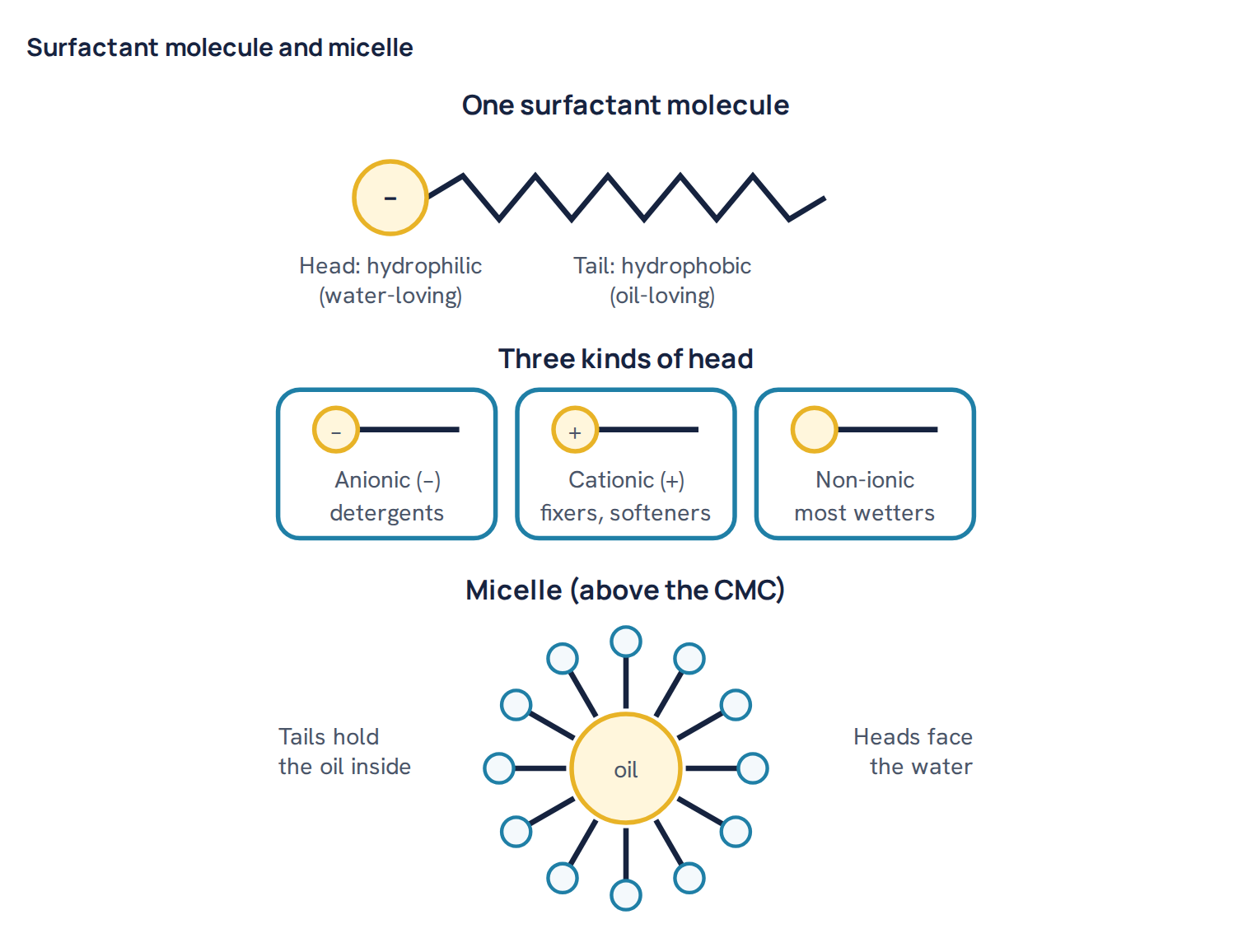
Most speciality auxiliaries are built on surfactants (surface-active agents). A surfactant molecule has two ends that behave in opposite ways. The head is hydrophilic: it likes water and dissolves in it. The tail is hydrophobic: a long hydrocarbon chain that avoids water and prefers oil, grease, wax and air. Because the molecule is split like this, it gathers at any boundary between water and something else, such as the surface of a fibre, a droplet of oil or an air bubble. There it lowers the surface tension, which is why water with a little surfactant wets fabric much faster than plain water.
Anionic, cationic and non-ionic
Surfactants are grouped by the electric charge on the head once they are dissolved.
- Anionic surfactants have a negative head, for example sulphate, sulphonate or carboxylate groups. They are strong detergents and dispersants, and they are used in scouring agents, soaping agents and many dispersing agents.
- Cationic surfactants and polymers have a positive head, usually a quaternary ammonium or amine group. They are attracted to negatively charged surfaces, which is why they are used as softeners and as fixing agents for anionic dyes.
- Non-ionic surfactants carry no charge. Most are ethoxylates: a hydrophobic chain joined to a chain of ethylene oxide units, which makes the water-loving part. They are good wetting agents and emulsifiers and are used in many levelling agents.
- Amphoteric surfactants carry both charges, and their overall charge depends on pH. Some levelling agents for acid dyes work this way.
Micelles and the CMC
At very low concentration, surfactant molecules sit at the surfaces. As you add more, the surfaces fill up, and above a certain level, called the critical micelle concentration (CMC), the molecules start to cluster into small balls called micelles. In a micelle the tails point inwards and the heads face the water. The oily core can hold dirt, oil, wax or even dye molecules. This is how a detergent lifts oil off cotton, and it is also how some levelling agents hold dye back for a while before releasing it to the fibre.
HLB in simple terms
HLB stands for hydrophilic–lipophilic balance. It is a number, roughly from 0 to 20, that says how strongly a non-ionic surfactant prefers water over oil. A low HLB (around 3–6) means the oil-loving part dominates; such products are used as water-in-oil emulsifiers and in some defoamers. Middle values (around 7–9) suit wetting agents. Higher values (around 8–18) make oil-in-water emulsifiers, and detergents usually sit around 13–15. You do not need to calculate HLB on the floor, but it explains why two non-ionic products that look the same in the drum can behave very differently: one wets fast, another emulsifies oil, another just foams.
One more property of non-ionic surfactants matters in dyeing: the cloud point. When a non-ionic solution is heated, it turns cloudy at a certain temperature because the product becomes less soluble. Salt lowers the cloud point. Above it, the surfactant can separate and deposit on the fabric, so a non-ionic product chosen for a 60 °C reactive bath may not be right in a 130 °C polyester bath.
Ionic compatibility: why charges decide what can share a bath
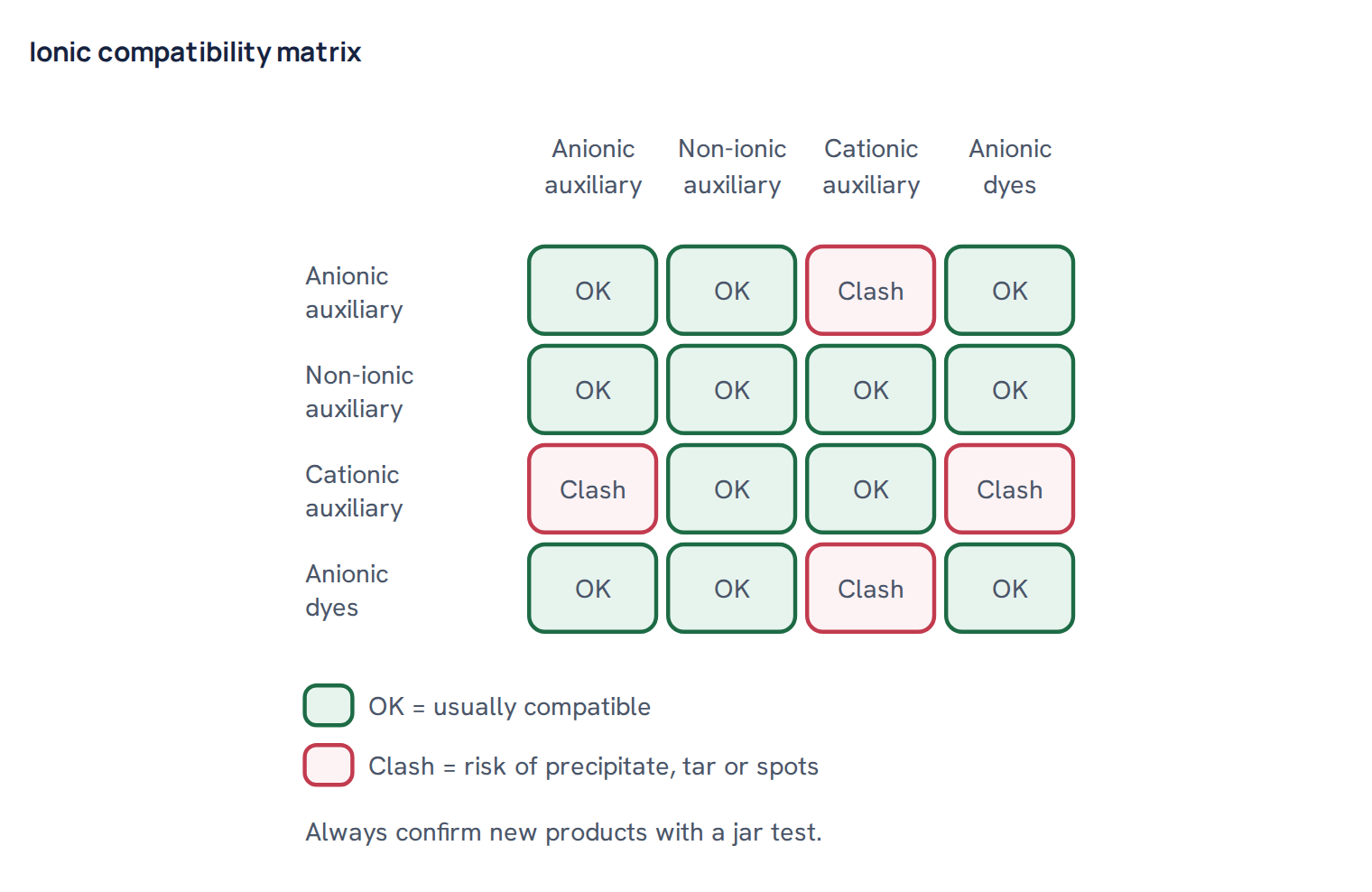
Reactive, direct and acid dyes are all anionic: their sulphonate groups carry a negative charge in water. Many detergents, dispersants and levelling agents are anionic as well. Cationic fixing agents and cationic softeners carry a positive charge. When a positive and a negative species of reasonable size meet in the same liquor, they attract each other and form a neutral complex that is much less soluble than either part. The result is a fine precipitate, a sticky tar on the machine walls, or coloured spots on the fabric.
This is the single most important rule for combining auxiliaries: do not put cationic products in the same bath as anionic dyes or anionic auxiliaries. That is why a cationic fixer always goes into a fresh bath after the soaping and rinsing are complete, and why a cationic softener must not meet residual anionic soaping agent. Non-ionic products are usually compatible with both sides, which is why they are often used as the bridge, but “usually” is not “always”. Some non-ionic products form complexes with dye, and that is exactly how certain levelling agents work.
Where each auxiliary enters the process
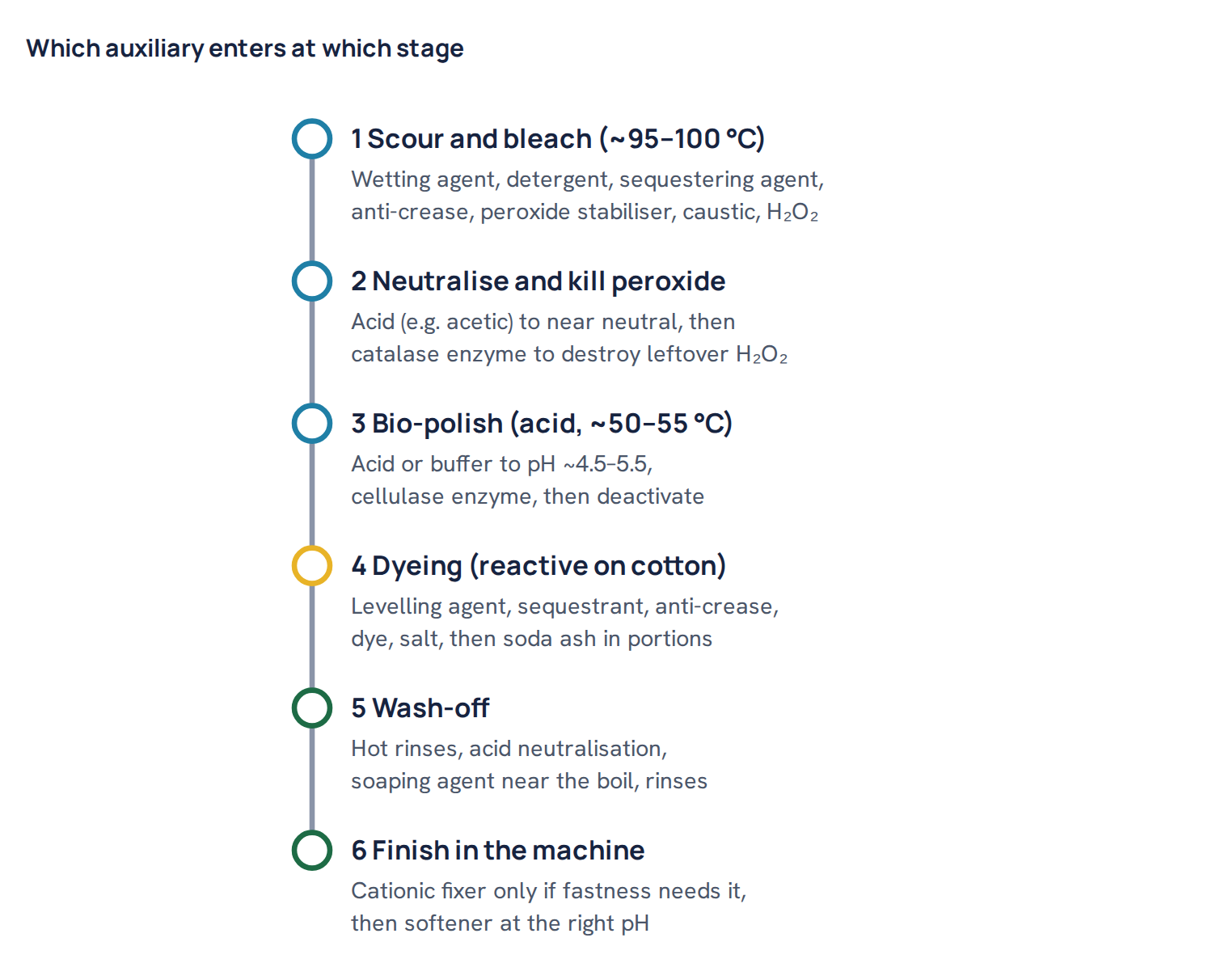
Before looking at each chemical in detail, it helps to see the whole sequence. The example below is a typical cotton knit route with reactive dyes. Polyester, nylon and blends follow the same logic with different chemicals at each step.
Pretreatment auxiliaries
Grey knit fabric carries natural wax and pectin, knitting oil, dirt and the natural cream colour of cotton. Pretreatment removes these so the dye sees a clean, absorbent, uniform fibre. Most dyeing faults that look like dye problems actually start here.
Wetting agents
Wetting agents lower the surface tension of water so it can push the air out of the yarn and wet the fabric quickly and evenly. They are usually non-ionic or anionic surfactants with low foam. Without good wetting, the chemicals in the bath reach some areas later than others, which leads to patchy scouring and later to patchy dyeing.
Detergents and scouring agents
Detergents remove oil, wax and dirt by emulsifying them into micelles and keeping them suspended so they do not settle back on the fabric. In a combined scour-bleach, they work with caustic soda, which saponifies natural fats and breaks down other impurities. Many products sold for pretreatment combine wetting and detergent action in one liquid.
Sequestering agents
Hard water contains calcium and magnesium, and many water supplies also carry iron and copper. A sequestering agent binds these metal ions into stable, soluble complexes so they cannot react with anything else. Common classes are aminocarboxylates, phosphonates, polyacrylates and gluconates. In pretreatment they stop calcium soaps from depositing and stop iron from catalysing peroxide. In dyeing they stop hardness from precipitating dye or dulling certain shades, especially metal-sensitive turquoise and some bright blues.
Peroxide stabilisers
Hydrogen peroxide bleaches best in hot alkali, but in those conditions it also decomposes. If it breaks down too fast, it is wasted. If metal ions catalyse the breakdown at one spot, the local attack can damage the cellulose and produce weak spots or pinholes. A stabiliser, traditionally sodium silicate and today often an organic stabiliser based on phosphonates or polymers, slows and controls the decomposition so bleaching is steady and safe. Organic stabilisers are popular because silicate can leave hard deposits on the fabric and machine.
Anti-crease agents and lubricants
In jet and overflow machines the fabric runs in rope form, and when it is hot and wet it creases easily. Anti-crease agents, usually polymers or lubricating esters, reduce friction between fabric layers and between fabric and machine, so creases do not set. They are used in pretreatment and again in dyeing. Our article on crease marks in knit dyeing explains why this matters so much.
Acid for neutralising
After a strong alkaline scour, the fabric holds caustic soda. Acid, commonly acetic acid or a neutralising blend of organic acids, brings the pH back towards neutral before the next step. This protects the enzymes that follow and stops leftover alkali from upsetting the pH of the dye bath.
Enzymes: peroxide killer and bio-polishing
Catalase is an enzyme that breaks hydrogen peroxide into water and oxygen. It is used after bleaching because even a small amount of leftover peroxide can oxidise some reactive dyes and give a weak or off shade. Catalase works fast at moderate temperature and near neutral pH, and it leaves nothing harmful behind.
Cellulase is used for bio-polishing. It removes the fine protruding fibres from the surface of cotton, giving a cleaner surface, better pilling resistance and a brighter look. Acid cellulases typically work at about pH 4.5–5.5 and around 50–55 °C, but each product has its own range. After treatment the enzyme must be deactivated, usually by raising temperature or pH, otherwise it keeps working and the fabric loses strength.
Dyeing auxiliaries
In the dye bath, auxiliaries control three things: how the dye moves onto the fibre, how it fixes, and how the bath behaves physically. The background to all three is covered in how reactive dyes work and how disperse dyes work on polyester.
Levelling agents
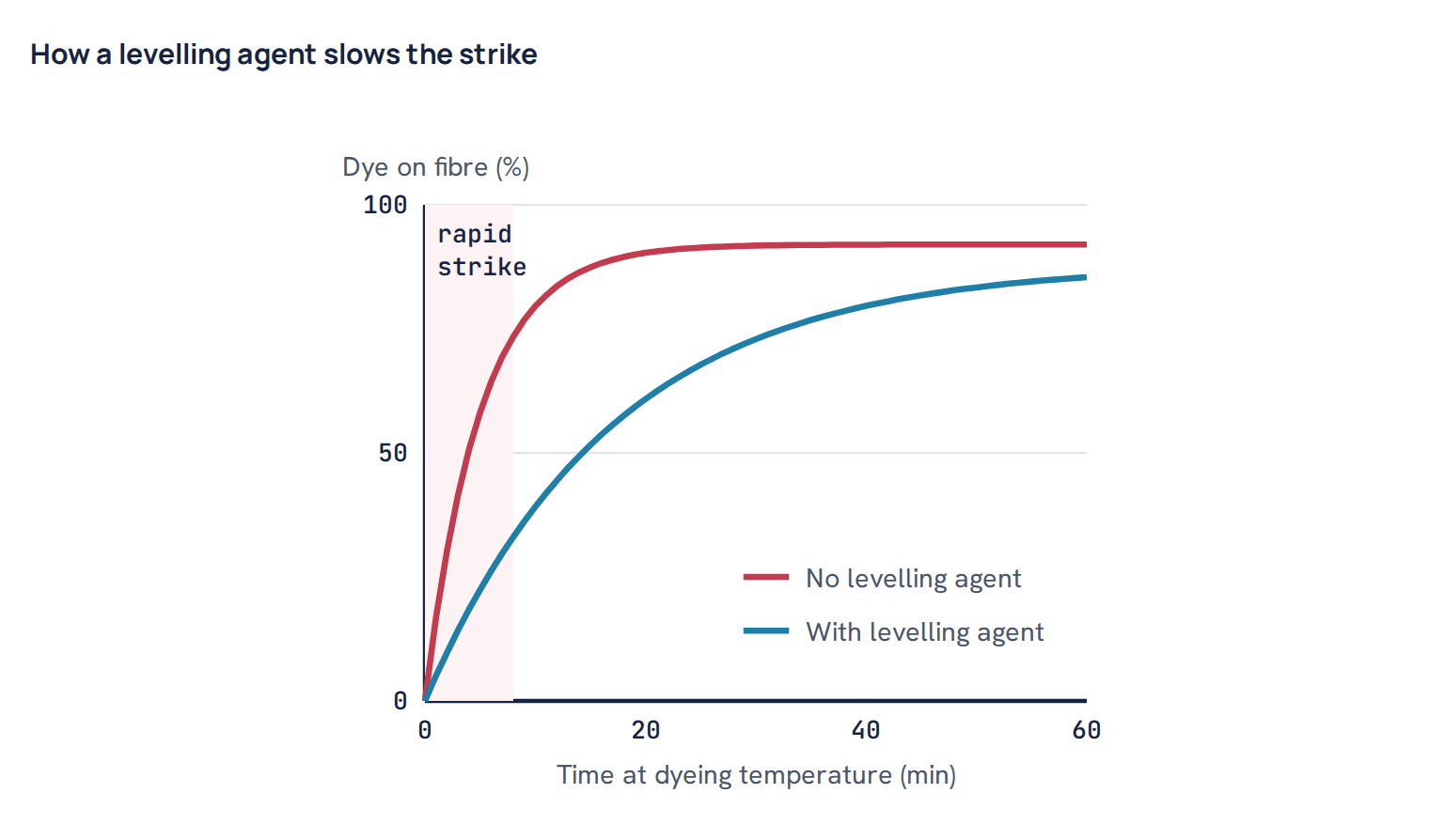
A levelling agent helps the dye spread evenly over all the fabric. It does this in two main ways. A retarding leveller slows the first uptake, so the dye has time to circulate before it settles. A migrating leveller helps dye that has already gone on move from heavy areas to light areas. Different dye classes need different products.
- Reactive dyes on cotton. Levelness is controlled mainly by salt and alkali dosing and the temperature profile. Levelling agents here are usually mild anionic or non-ionic products that keep the dye well dissolved and reduce the risk of aggregation at high salt.
- Disperse dyes on polyester. The levelling agent is usually an anionic and non-ionic blend that helps dye migrate at 125–135 °C and keeps the dispersion stable. Too much of it can hold dye in the bath and lower the yield.
- Acid dyes on nylon. Two types are used. Anionic levellers have affinity for the fibre: they occupy the amino sites and compete with the dye. Weakly cationic or amphoteric levellers have affinity for the dye: they form a loose complex in the bath and release the dye gradually as temperature rises.
Dispersing agents
Disperse dyes are almost insoluble in water. They are supplied as very fine particles with dispersing agents already in them, often anionic condensates such as lignosulphonates or naphthalene sulphonate condensates. Extra dispersing agent is added to the bath to keep the particles separate during heating, when the dispersion is most likely to break down. If it does, particles clump and produce dark specks, filtration on the package or rings on the fabric.
Electrolytes: salt and Glauber’s salt
Cotton takes on a negative surface charge in water, and so do reactive and direct dyes, so the dye is pushed away from the fibre. Common salt (sodium chloride) or Glauber’s salt (sodium sulphate) shields that charge and drives the dye onto the fibre. Darker shades need more electrolyte; typical values for reactive dyes range from around 20 g/L for pale shades to 80 g/L or more for deep shades, depending on the dye and liquor ratio. Glauber’s salt is often preferred for its purity and lower corrosion. Note that it is sold both anhydrous and as the decahydrate crystal; 1 kg of the anhydrous form equals about 2.27 kg of the crystal.
Alkali: soda ash and caustic soda
Alkali starts the fixation of reactive dyes. It turns some of the hydroxyl groups of cellulose into cellulosate ions that attack the reactive group of the dye. Soda ash gives a pH of about 10.5–11, which suits most processes. Caustic soda is much stronger and is sometimes added in small amounts with soda ash for deep shades or less reactive dyes. Alkali is usually dosed in portions or progressively, because a sudden pH jump makes the dye fix where it lands and can cause unlevelness.
Buffers and acid donors
Disperse dyeing runs best at a controlled pH of about 4.5–5.5, so a buffer such as acetic acid with sodium acetate holds the pH steady during heating. For acid dyes on nylon, an acid donor is useful: an ester or salt that slowly releases acid as temperature rises. The pH drifts down gradually instead of starting low, so the dye strikes slowly and evenly. Ammonium sulphate works in a similar way, releasing acid as ammonia is lost on heating.
Carriers, and why they are avoided
Carriers are aromatic organic compounds that swell polyester so disperse dyes can enter below 100 °C. They were essential before high-temperature machines became normal. Today they are avoided wherever possible: many are toxic or have a strong smell, they pollute the effluent, they are hard to remove from fabric, they can lower light fastness and they can leave spots. They now survive mainly in a few special cases, such as some wool and polyester blends that cannot be dyed at 130 °C.
Anti-foam agents
Foam traps air, makes the fabric float and stops the liquor flowing properly through the rope. Anti-foam agents, either silicone emulsions or silicone-free products based on oils or fatty alcohols, break the foam. Use the minimum. Too much silicone anti-foam, or a product that splits in hot or salty liquor, can leave greasy silicone spots that are very hard to remove.
Reducing and oxidising agents for vat and sulphur dyes
Vat and sulphur dyes are insoluble pigments. To dye with them, they are first reduced to a soluble form: sodium hydrosulphite with caustic soda for vat dyes, and sodium sulphide or glucose-based reducing agents for sulphur dyes. After the soluble form has gone into the fibre, an oxidising agent, typically hydrogen peroxide under controlled conditions, turns it back into the insoluble pigment inside the fibre. The details are in how vat and sulphur dyes work.
After-treatment auxiliaries
After dyeing, the fabric carries loose dye, salt, alkali and leftover auxiliaries. After-treatment removes them and then gives the fabric its final fastness and handle.
Soaping and wash-off agents
Some reactive dye always reacts with water instead of the fibre. This hydrolysed dye is still coloured but cannot bond, and if it stays it bleeds in washing and stains other fabric. Soaping near the boil, often around 90–98 °C, removes it. A soaping agent, usually an anionic or polymer-based product with dispersing and anti-redeposition action, keeps the loose dye in solution so it does not settle back. Rinses before soaping should first remove salt and alkali, because high salt makes the loose dye cling to the fibre.
Reduction clearing for polyester
On polyester, disperse dye particles stay on the fibre surface after dyeing, especially in medium and dark shades. Reduction clearing destroys them with sodium hydrosulphite and caustic soda at about 70–80 °C, followed by rinsing and neutralising. Acid reduction clearing agents, usually sulphinic acid derivatives, can do the same job at acid pH, sometimes in the same bath after draining down. Skipping or shortening this step is a common reason for poor wash and rubbing fastness on polyester and its blends.
Cationic fixing agents
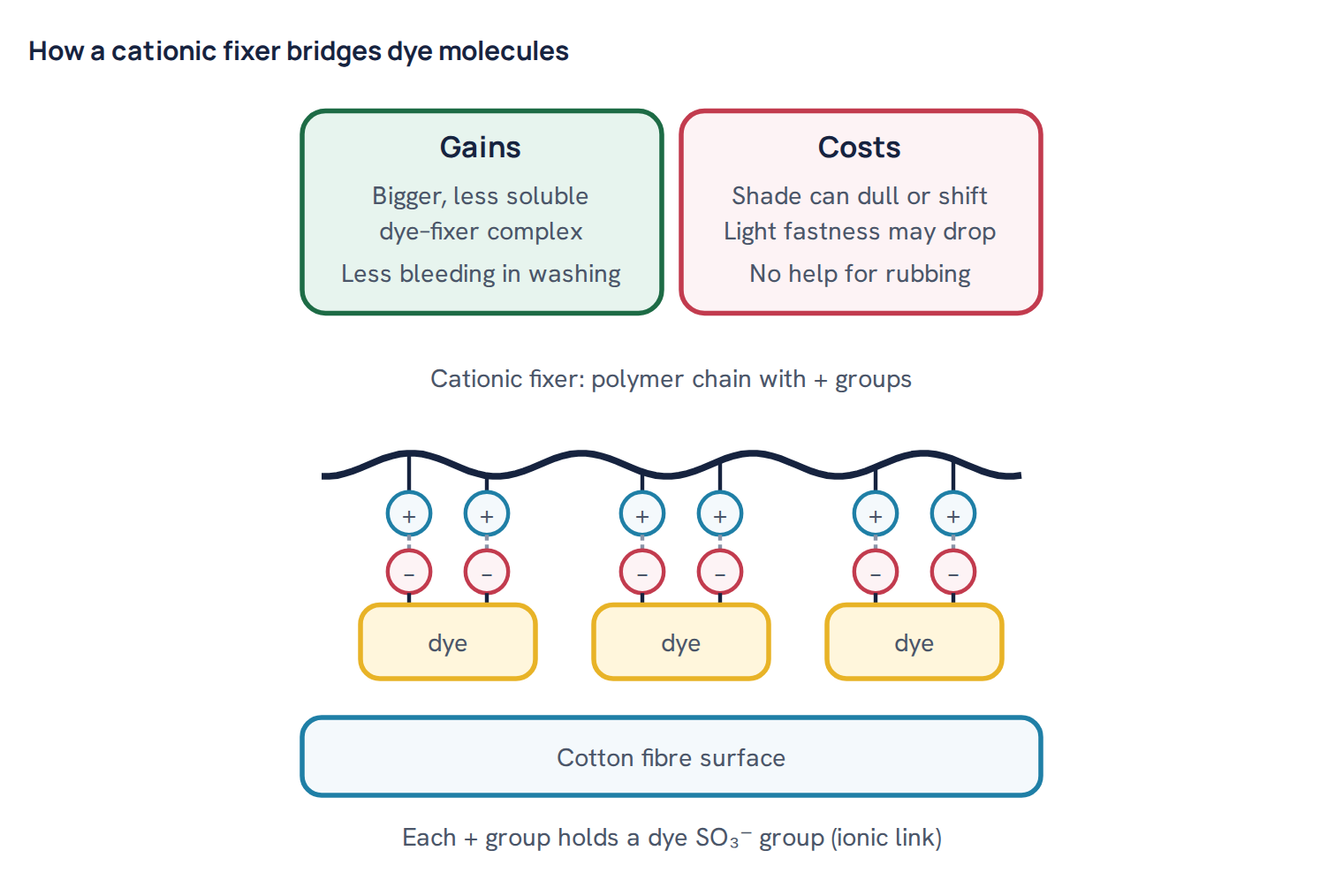
A cationic fixing agent is a polymer with many positive groups along its chain. It attaches to the negative sulphonate groups of anionic dyes and links several dye molecules into one large, less soluble complex. That complex washes out less easily, so wet fastness and staining improve, especially for direct dyes and for deep reactive shades.
The cost is real. A fixer can shift or dull the shade, especially bright and turquoise shades, and it can lower light fastness, often by about half to one grade depending on the dye and product. It does nothing for rubbing fastness, because rubbing removes surface dye particles rather than dissolved dye. Always check the shade and the light fastness after fixing, and never use a fixer as a shortcut for poor soaping. It hides the loose dye for a while; it does not remove it.
Acid fixer and syntan for nylon
Acid dyes on nylon can bleed in washing, especially in deep shades. A syntan (synthetic tanning agent), usually an anionic sulphonated condensation product, is applied in an acidic bath after dyeing. It forms a barrier at the fibre surface that slows the dye coming back out. It improves wet fastness, but it can slightly change the shade, may stiffen the handle and can cause light yellowing in some cases, so it is tested on pale and white areas too.
Softeners
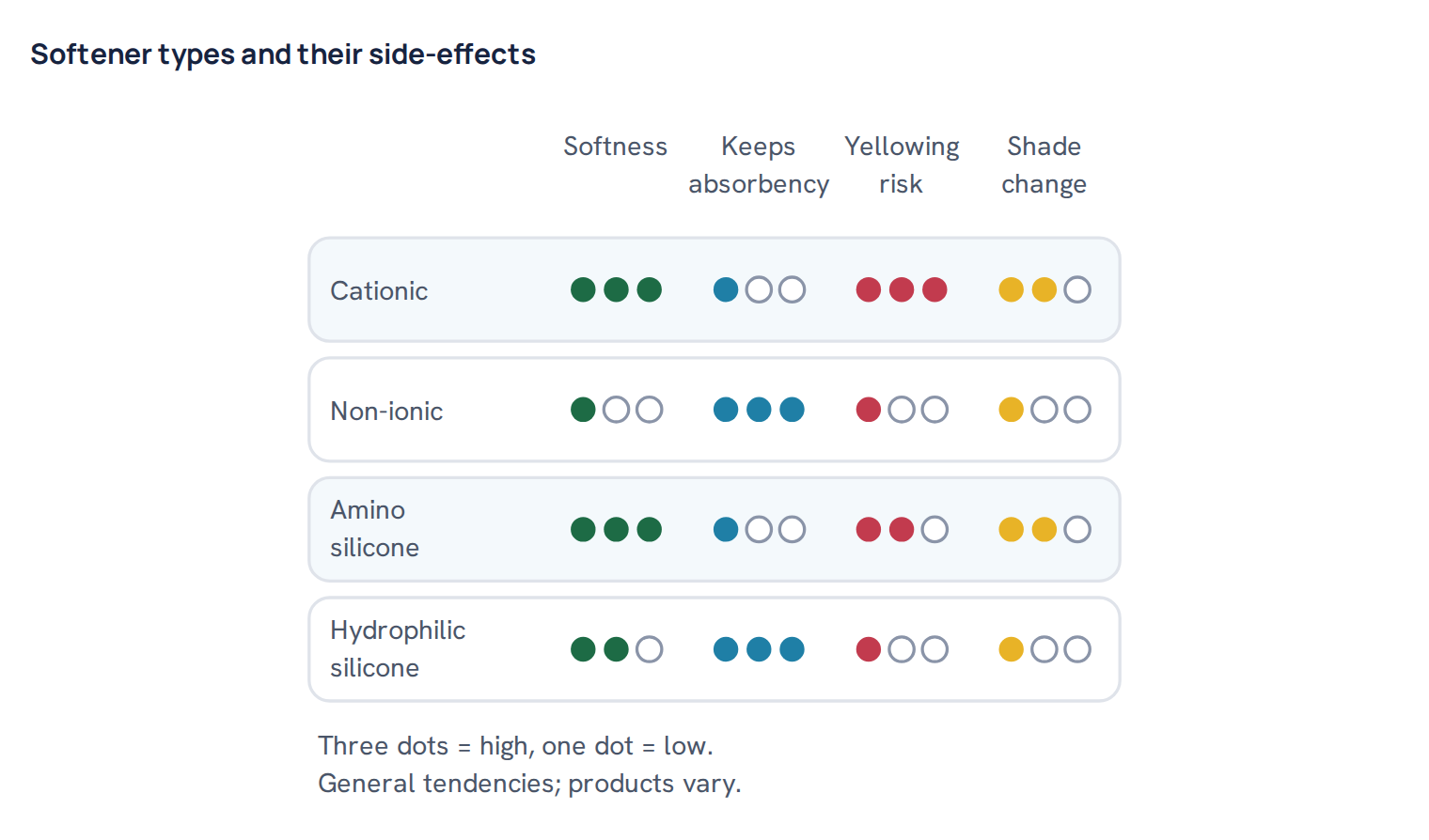
Softeners give the final handle and are usually applied in the last bath. They differ a lot in their side-effects.
- Cationic softeners, usually fatty quaternary compounds, are attracted to the negative fibre and give a full, soft handle on cotton at low cost. They reduce absorbency, can yellow on heat, can lower light fastness of some dyes and clash with anionic residues.
- Non-ionic softeners give a milder softness but keep absorbency and are compatible with most other products. They are a common choice for towels and sportswear where water absorbency matters.
- Silicone softeners, especially amino-functional silicones, give a very smooth, slippery, silky handle. They can make fabric water-repellent, can deepen or shift the shade, may yellow on heat because of the amino groups, and are hard to strip if the fabric needs re-dyeing. A badly stable emulsion can also break and leave silicone spots.
- Hydrophilic silicones are modified with water-loving groups so they keep much more absorbency while still giving a soft, smooth handle. They are a common choice for knitwear today, though their softness is usually a little less than conventional amino silicone.
Dosage: g/L versus % owf
Auxiliaries are dosed in two ways, and mixing them up is a classic error.
- g/L (grams per litre) is based on the volume of liquor. It is used for chemicals whose job depends on their concentration in the water: wetting agents, sequestering agents, anti-crease agents, salt, alkali, buffers and soaping agents. If the liquor ratio changes, the amount changes.
- % owf (on weight of fabric) is based on the dry weight of fabric. It is used for products that must end up on or in the fibre: dyes, fixing agents and softeners. If the liquor ratio changes, the amount stays the same.
For full calculation methods, see dyeing recipe calculation.
Worked example. A batch of 400 kg cotton single jersey is dyed at a liquor ratio of 1:8, so the bath is 3,200 L. The recipe asks for a wetting agent at 1 g/L, a sequestering agent at 1 g/L, an anti-crease agent at 1.5 g/L, Glauber’s salt (anhydrous) at 60 g/L, soda ash at 15 g/L and a hydrophilic silicone softener at 2% owf. The g/L items scale with the liquor: wetting agent 3.2 kg, sequestering agent 3.2 kg, anti-crease agent 4.8 kg, Glauber’s salt 192 kg (or about 436 kg if only the decahydrate crystal is in stock), and soda ash 48 kg. The softener scales with the fabric: 2% of 400 kg is 8 kg. If the same batch were run at 1:6 (2,400 L), every g/L item would drop by a quarter, but the softener would stay at 8 kg.
Order of addition
The order in which products go into the machine matters almost as much as the dose. A sensible general order for a reactive cotton bath is:
- Fill with water at the start temperature and run the fabric so it is fully wet.
- Add the wetting agent, sequestering agent, anti-crease agent and levelling agent, and run a few minutes so they spread.
- Check the pH, then add the pre-dissolved and filtered dye solution slowly.
- Add salt in portions over several minutes.
- Add alkali last, in portions or by progressive dosing.
Each concentrated product should be diluted in water in the side tank before it goes in. Never pour two concentrated products into the side tank together, and rinse the tank between additions, especially before and after anything cationic. Undiluted alkali or a concentrated chemical dropped onto the fabric creates local spots that no levelling agent can fix later.
The jar test: checking compatibility before bulk
Whenever you change a supplier, add a new product or combine products for the first time, do a simple jar test. Prepare the actual liquor in a glass beaker at the real concentrations and in the real order, using the mill’s own water. Include dye if the product will meet dye in bulk. Heat it to process temperature, add salt or alkali if the process uses them, then let it stand and look for haze, flocks, oily drops on the surface or a tarry film on the glass. A second useful check is to pass the liquor through a filter paper: a clean product leaves no coloured or sticky residue. Ten minutes of testing can save a full batch.
Storage and shelf life
Auxiliaries are not stable forever. Typical shelf life is from about six months to two years, depending on the product, so always read the supplier’s data sheet. Some practical rules:
- Keep containers closed, labelled and out of direct sun and frost. Many emulsions, especially silicone softeners, split if they freeze or overheat.
- Use first in, first out. Mark the date the drum was opened.
- Stir or roll emulsions before use if the data sheet asks for it; separated layers give wrong doses.
- Store enzymes cool and use them within their stated life, as they slowly lose activity.
- Keep cationic and anionic products clearly separated, and never reuse a drum or dosing jug for a different product without washing it.
Common mistakes
Common mistake: Adding a cationic fixer or cationic softener while anionic soaping agent or loose dye is still in the fabric. The two react, and you get spots, a dull shade or a sticky deposit. Rinse well and confirm the bath is clear before any cationic product.
Common mistake: Dosing g/L products as % owf, or the other way round. On a long liquor ratio this can double or halve the real amount without anyone noticing.
Common mistake: Leaving residual peroxide before reactive dyeing. The shade comes out weak or off-tone and the cause is blamed on the dye. Use catalase and test for peroxide before adding dye.
Common mistake: Using a fixer to pass a wash fastness test instead of improving the soaping. The test may pass, but light fastness and shade suffer, and the problem returns after a few washes.
Common mistake: Choosing a softener only by hand feel. A very soft amino silicone on a towel or sportswear can ruin absorbency, and a cationic softener on a white or pale shade can yellow during heat-setting or drying.
Auxiliaries are the quiet half of every recipe. Learn the class, the charge and the job of each one, keep the doses and order consistent, test anything new in a jar first, and most of the faults that look mysterious on the floor stop happening.
Questions
What is a dyeing auxiliary?
It is any chemical added to the bath to help the dye, fibre or machine do its job, such as wetting, sequestering, levelling, soaping or softening. Auxiliaries add no colour of their own.
Why can’t a cationic fixer or softener go into the same bath as reactive dye?
Reactive dyes and many auxiliaries are anionic. Positive and negative species attract and form insoluble complexes, which show up as precipitate, tar or spots, so cationic products go into a fresh bath after thorough rinsing.
What is the difference between g/L and % owf?
g/L is based on liquor volume and is used for chemicals that work by concentration, such as salt, alkali and wetting agents. % owf is based on fabric weight and is used for products that must end up on the fibre, such as dyes, fixers and softeners.
Does a cationic fixing agent reduce light fastness?
It can. Depending on the dye and product, light fastness may drop by about half to one grade and the shade can dull or shift, so always check after fixing.
Which softener keeps towels absorbent?
Non-ionic and hydrophilic silicone softeners keep absorbency much better than cationic or conventional amino silicone softeners. Always test absorbency on your own fabric before bulk.

Textile engineer with 14+ years in dyeing and fabric development. He writes every guide on Dyeing Solution from real production work. Full profile