Water is more than 95% of every dye bath. Here is what to test, typical targets, how hardness, metals, chlorine and bicarbonate spoil shades, and how a dye house softens, sequesters and checks its water every day.
At a glance
95%+Share of the dye bath that is water
< 50 ppmTypical hardness limit as CaCO₃, varies by mill
< 0.1 ppmTypical iron limit, often lower
DailyHardness, iron, chlorine, pH and TDS checks
Water is the biggest raw material in any dye house. In a typical knit dyeing bath, water makes up well over 95% of everything in the machine. Dyes, salt, alkali, acid and auxiliaries are only a few grams per litre, dissolved in hundreds or thousands of litres of water. So whatever is already in that water takes part in the dyeing, whether you planned it or not.
Hard water, a trace of iron, a little chlorine or too much bicarbonate can dull a shade, shift a hue, leave spots, make the handle harsh, or even burn small holes in cotton during bleaching. Many “dye problems” that are blamed on a dye lot or a machine are really water problems. This article explains what to test, what the usual targets are, how each impurity damages the result, and how a dye house keeps its water under control every day.
Why water quality matters so much
Think about the numbers. A 600 kg cotton batch at a liquor ratio of 1:8 uses about 4,800 litres of water just for the dyeing step. The full process, with scouring, bleaching, dyeing, rinsing, soaping and finishing baths, can use that volume many times over. If that water carries 150 ppm of hardness, every single bath brings in hundreds of grams of calcium and magnesium salts. These ions do not leave politely. They react with dyes, soaps, alkali and silicates, and part of what they form ends up on the fabric and inside the machine.
Water also has to behave the same way every day. A recipe that was approved in the lab only works in bulk if the water in bulk is close to the water used in the lab. When water quality drifts with the season, the borehole level or the softener cycle, shade reproducibility drifts with it. That is why water is part of process control, not just utilities.
Typical process-water targets
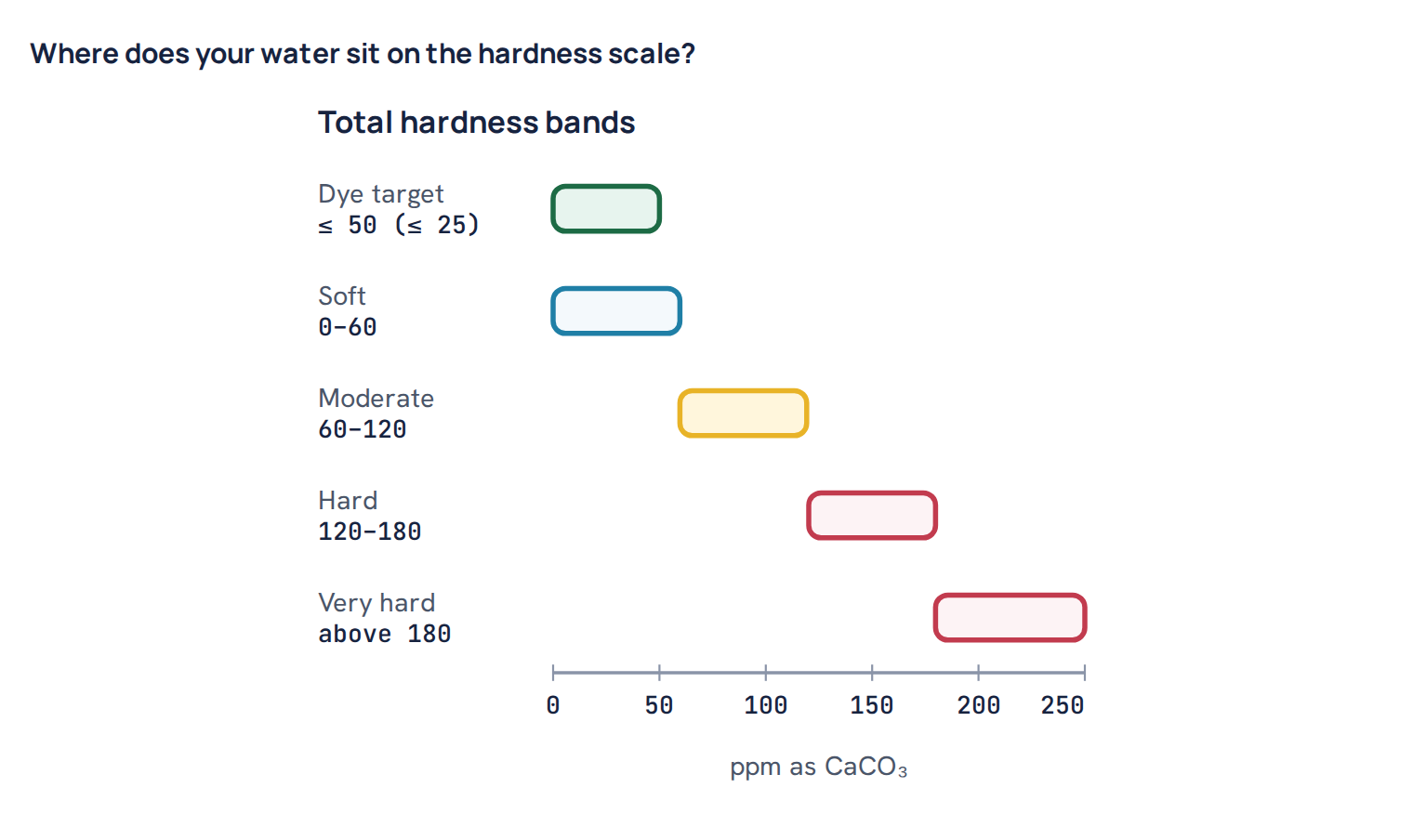
There is no single world standard for dyeing water. Each mill sets its own limits based on its fibres, its shades, its water source and its treatment plant. Dye and chemical suppliers also publish their own recommendations. The table below shows values that are commonly used as targets for knit dyeing. Treat them as a starting point, not as law. Pale shades, bright turquoise and green shades, and peroxide bleaching usually need the tighter end of each range.
| Parameter | Typical target (varies by mill and source) | Main risk if too high |
|---|---|---|
| pH | 6.5–7.5 (some mills accept 6–8) | Wrong start pH, drift in acid and disperse dyeing |
| Total hardness | Below 50 ppm as CaCO₃; many mills aim below 25, close to 0 for pale reactive shades | Dye precipitation, dull shades, spots, scale |
| Iron (Fe) | Below 0.1 ppm; often below 0.05 ppm | Dull or yellowish shades, pinholes in bleaching |
| Manganese (Mn) | Below 0.05 ppm; often below 0.02 ppm | Brownish stains, peroxide breakdown |
| Copper (Cu) | Below 0.05 ppm; often below 0.01 ppm | Shade change, catalytic fibre damage |
| Total dissolved solids (TDS) | Below 500 ppm; lower is better | Uncontrolled extra electrolyte, levelness problems |
| Total alkalinity | Below 100 ppm as CaCO₃; often below 50 | pH drift, extra acid demand |
| Free chlorine | Nil, or below 0.1 ppm | Reactive dye oxidation, shade loss |
| Turbidity | Below 1–5 NTU | Deposits, specks, filter blockage |
| Colour | Colourless (below about 5–10 Hazen) | Tint on whites and pale shades |
Units: ppm as CaCO₃, °dH and friends
Hardness is caused mainly by dissolved calcium (Ca²⁺) and magnesium (Mg²⁺) ions. Because there are two different ions with different weights, hardness is usually reported as if all of it were calcium carbonate. That is what “ppm as CaCO₃” means. One ppm in water is the same as one milligram per litre (mg/L).
You will also meet older or regional units on test kits and machine manuals:
- German degree (°dH): 1 °dH = 10 mg/L of CaO, which equals about 17.8 mg/L (ppm) as CaCO₃.
- French degree (°fH or °f): 1 °fH = 10 mg/L as CaCO₃.
- English or Clark degree (°e): 1 °e = about 14.3 mg/L as CaCO₃.
- mmol/L: 1 mmol/L of Ca²⁺ plus Mg²⁺ = about 100 mg/L as CaCO₃.
Alkalinity is also reported “as CaCO₃”, so hardness and alkalinity can be compared on the same scale. Iron, manganese and copper are reported simply as mg/L of the metal.
Worked example. A lab technician titrates a 50 mL water sample with 0.01 M EDTA and uses 2.4 mL to reach the end point. Moles of EDTA used = 2.4 mL × 0.01 mmol/mL = 0.024 mmol. EDTA binds hardness ions one to one, so the 50 mL sample held 0.024 mmol of Ca²⁺ plus Mg²⁺. Per litre that is 0.024 × (1000 ÷ 50) = 0.48 mmol/L. Multiply by 100 (the molar mass of CaCO₃ in g/mol) to get about 48 ppm as CaCO₃. In German degrees that is 48 ÷ 17.8 ≈ 2.7 °dH, and in French degrees 4.8 °fH. This water just passes a 50 ppm limit but would be too hard for a pale reactive shade at a mill that works to 25 ppm.
Calcium and magnesium: how hardness spoils shades
Most dyes used on knits carry a negative charge in water. Reactive and direct dyes for cotton and acid dyes for nylon all have sulphonate (–SO₃⁻) groups that make them soluble. Calcium and magnesium are positive ions with a charge of two. One Ca²⁺ ion can pair with sulphonate groups on two dye molecules at once, linking them together. These calcium–dye pairs are far less soluble than the sodium form of the dye, so they start to clump into aggregates.
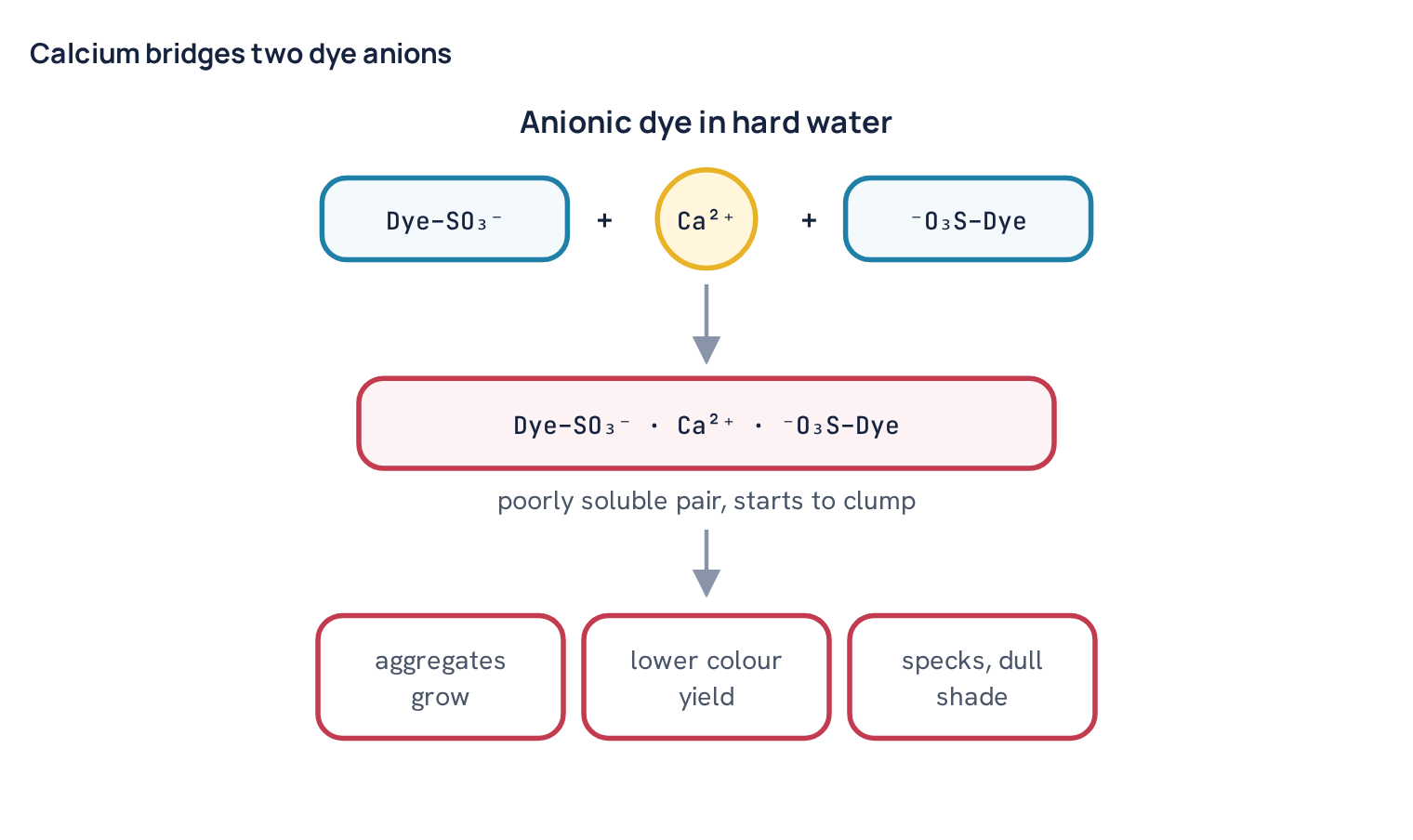
On the fabric this shows up in several ways:
- Lower colour yield. Dye locked in aggregates cannot diffuse into the fibre, so the shade comes out lighter than the recipe intends.
- Dull or shifted hue. Aggregated dye and metal–dye complexes often look duller. Some dyes are more sensitive than others, so in a three-dye mix the balance changes and the hue shifts, not only the depth.
- Spots and specks. Large aggregates settle on the fabric surface as darker dots, especially in dark shades with high dye concentration.
- Poor rubbing fastness. Surface deposits of dye are loosely held and rub off.
Hardness also causes trouble outside the dyeing step. In scouring and soaping, calcium reacts with fatty soaps to form insoluble lime soap, the same scum that forms a ring in a bathtub. It sticks to fabric and machine walls and is hard to rinse out. With soda ash and caustic, calcium and magnesium form carbonate and hydroxide deposits. These leave a harsh handle, reduce absorbency, and build scale on heat exchangers, which slows heating and cooling. Magnesium combined with silicate stabiliser in peroxide bleaching can leave silicate deposits that feel rough and are very hard to remove.
Disperse dyeing of polyester is less directly affected, because disperse dyes carry no charge. But the dispersing agents that keep disperse dye particles apart are usually anionic. Hardness weakens them, the dispersion breaks down at high temperature, and the result is dye spots and tar-like deposits. For more detail on why dispersion stability matters, see how disperse dyes work on polyester.
Iron, manganese and copper: small amounts, big damage
Heavy metals are present in water at much lower levels than hardness, but they do more damage per milligram. Iron comes from the source water, from corroded pipes and tanks, from rusty steam lines, and sometimes from chemicals such as low-grade salt or caustic.
In dyeing, iron and copper can form complexes with some dyes and dull the shade or turn it slightly brown or yellowish. Whites and pale shades suffer most, because there is little dye to hide the tint. Manganese tends to give brownish stains, often after the fabric has been in contact with alkali.
The worst damage happens in hydrogen peroxide bleaching of cotton. Under normal alkaline conditions peroxide forms the perhydroxyl ion, which bleaches slowly and evenly. Iron and copper act as catalysts. They split peroxide very fast into hydroxyl radicals, which are much stronger and attack cellulose itself. If a rust particle or a metal fragment is sitting on the fabric, all of this happens in one tiny spot. The cellulose there is oxidised and broken down, and the result is a pinhole or a weak, tendered patch that may only open up later in washing or sewing.
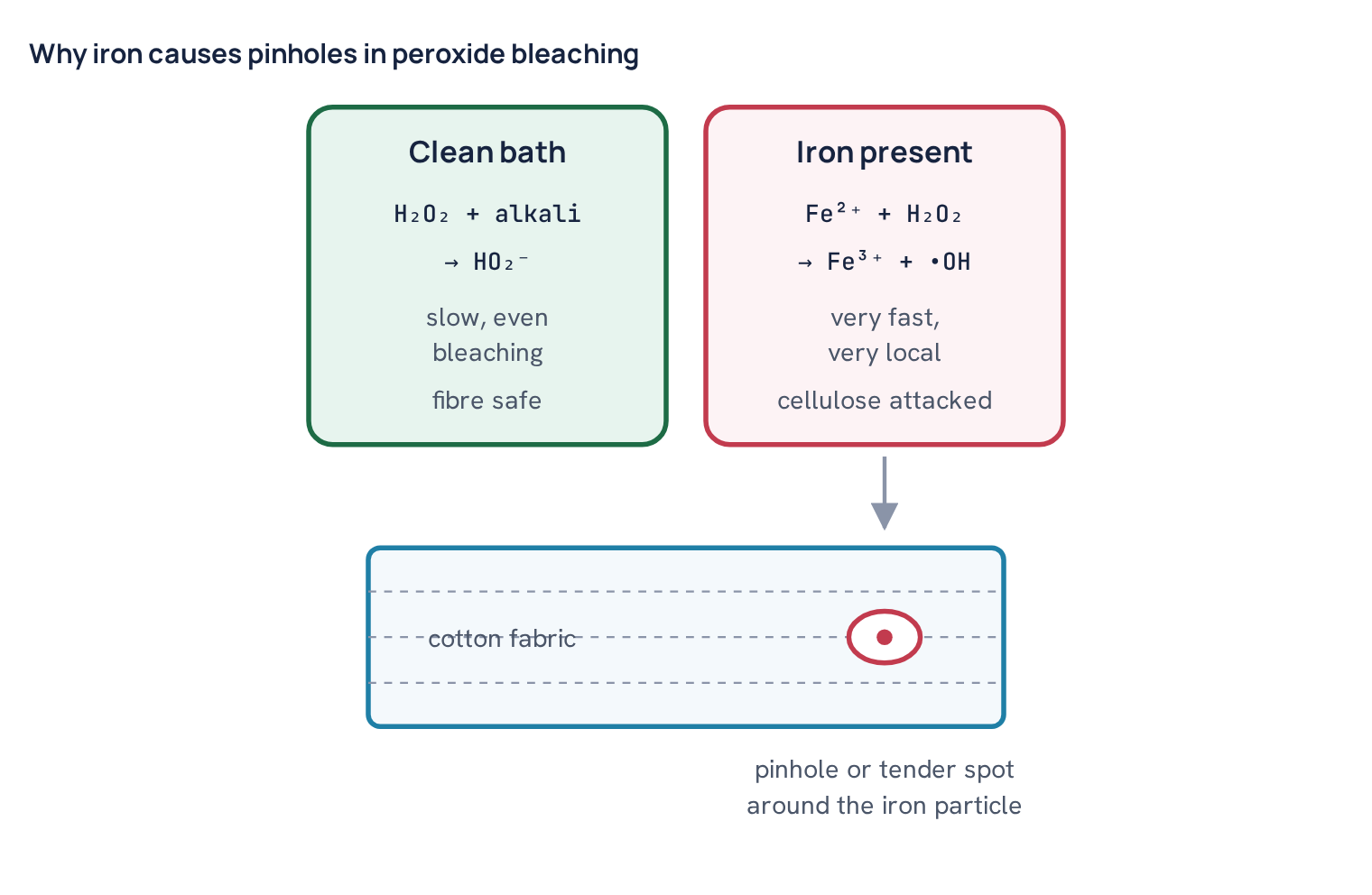
Iron and copper also raise peroxide consumption across the whole bath, so whiteness drops and absorbency can be uneven. This is why bleaching baths contain a peroxide stabiliser and why many mills keep iron in process water below 0.1 ppm, and often lower. Machines, pipes and trolleys that touch wet fabric should be stainless steel or coated. Rust flakes from old pipework are a common, easily missed source of pinholes.
Chlorine: the reactive dye killer
Municipal water and some treated well water contain chlorine, added as a disinfectant. Even small amounts of free chlorine, around 0.1 ppm or more, can harm reactive dyes. Active chlorine is an oxidising agent. It attacks the chromophore, the coloured part of the dye, and can lighten or shift the shade. Some reactive dyes, such as certain blues and turquoises, are known to be more sensitive than others. Chlorine can also damage dye that is already fixed, which is why chlorinated tap water fastness is a separate test.
The fix is to remove chlorine before the water reaches the dyeing machine. Activated carbon filters do this well. For small or temporary needs, a reducing agent such as sodium thiosulphate or sodium bisulphite can be added to neutralise free chlorine. Test the water after treatment, because carbon filters become exhausted. For a full picture of reactive dye chemistry, read how reactive dyes work.
Alkalinity, bicarbonate and pH drift
pH and alkalinity are not the same thing. pH tells you how acidic or alkaline the water is at this moment. Alkalinity tells you how much acid the water can absorb before its pH falls. In most natural water, alkalinity comes mainly from bicarbonate (HCO₃⁻). Water can have a neutral-looking pH of 7.5 and still carry a lot of bicarbonate.
Bicarbonate causes three practical problems:
- It buffers against acid. In acid dyeing of nylon and disperse dyeing of polyester, the bath is set to a specific pH, often around 4.5–5.5 for polyester and a range that depends on the dye and depth for nylon. High-alkalinity water uses up acid, so the same acid dose gives a higher pH than expected. On nylon this can slow exhaustion and change the build-up of the shade. See how acid dyes work on nylon.
- It changes when heated. On heating, bicarbonate loses carbon dioxide and turns into carbonate. The pH of the bath rises during the temperature ramp, even though nobody added anything. In an acid or disperse bath that has weak buffering, this drift can be large enough to matter.
- It feeds scale. Carbonate formed from bicarbonate combines with calcium to form calcium carbonate scale on heaters and fabric. This is “temporary hardness”, the part that drops out on boiling.
In reactive dyeing, extra alkalinity in the water adds to the alkali you dose. Small amounts may not matter, but variable alkalinity makes the start of fixation less predictable. A buffer system in acid and disperse baths, rather than acid alone, makes the process far less sensitive to the water. Always check the pH of the actual bath, not just the water, at the stage that matters.
Salt quality is water quality too
Reactive dyeing of cotton can use 30–80 g/L of salt or more in dark shades, which is a large amount of material going into the bath. Industrial grade sodium chloride may contain calcium, magnesium, iron and insoluble grit. When you add 60 g/L of a salt that carries even a small fraction of calcium, you can bring in more hardness than the water itself. Glauber’s salt (sodium sulphate) is usually cleaner but costs more.
A simple check is to dissolve salt at the working concentration in deionised water and test the hardness and iron of that solution. Also look for insoluble residue after the salt dissolves. If a batch of salt fails, it is cheaper to reject it than to fight dull shades and specks for a month. The same logic applies to soda ash and caustic: buy grades with a known, low iron content.
Water softening: ion exchange and reverse osmosis
Most dye houses treat raw water before use. The usual steps are filtration to remove suspended solids, iron removal where needed, and then softening.
Ion exchange softeners are the most common. They contain a resin made of small beads that carry fixed negative groups, loaded with sodium ions. As hard water flows through, the resin prefers to hold calcium and magnesium, so it swaps them for sodium. The water that comes out has almost no hardness, but its total dissolved solids stay about the same, because each calcium ion is replaced by two sodium ions. When the resin is full of calcium and magnesium, the softener is regenerated with strong brine. The high sodium concentration pushes the hardness back off the resin and out to drain.
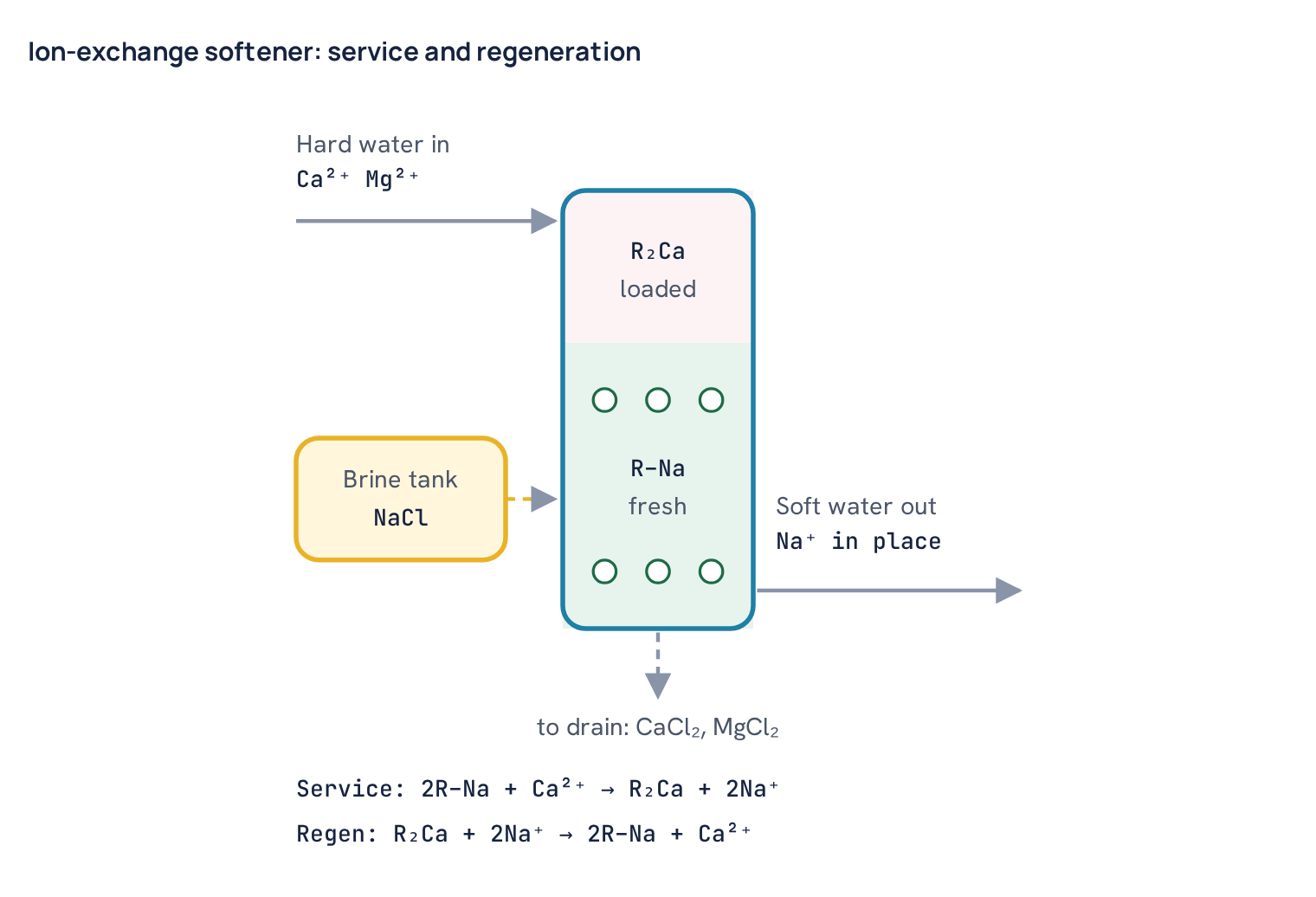
Softeners fail in predictable ways. If regeneration is late, hardness “leaks” through, often in the last part of the cycle. If the brine is weak or the contact time is short, the resin is only partly regenerated. Iron in the feed water fouls the resin and reduces its capacity, which is why iron removal usually comes first. A softener that worked well for years can slowly lose capacity without anyone noticing, unless the outlet is tested daily.
Reverse osmosis (RO) pushes water through a very fine membrane under pressure. It removes most dissolved salts, hardness, metals and colour, so it lowers TDS as well as hardness. RO gives the cleanest water but costs more to run, needs good pre-treatment to protect the membranes, and produces a concentrated reject stream that has to be handled. Many mills use RO water for pale shades, whites and sample dyeing, and softened water for general use.
Other steps you may see include aeration and filtration to remove iron and manganese, sand or multimedia filters for turbidity, and activated carbon for chlorine and organic colour.
Sequestering agents: chemical insurance
Even with a softener, some hardness and metal reaches the machine. It comes from leakage, from salt and chemicals, and from the fabric itself, because cotton naturally contains calcium, magnesium and some iron. A sequestering agent, also called a chelating agent, binds these metal ions into a stable, soluble complex. The metal is still in the water, but it is no longer free to react with dye, soap or peroxide.
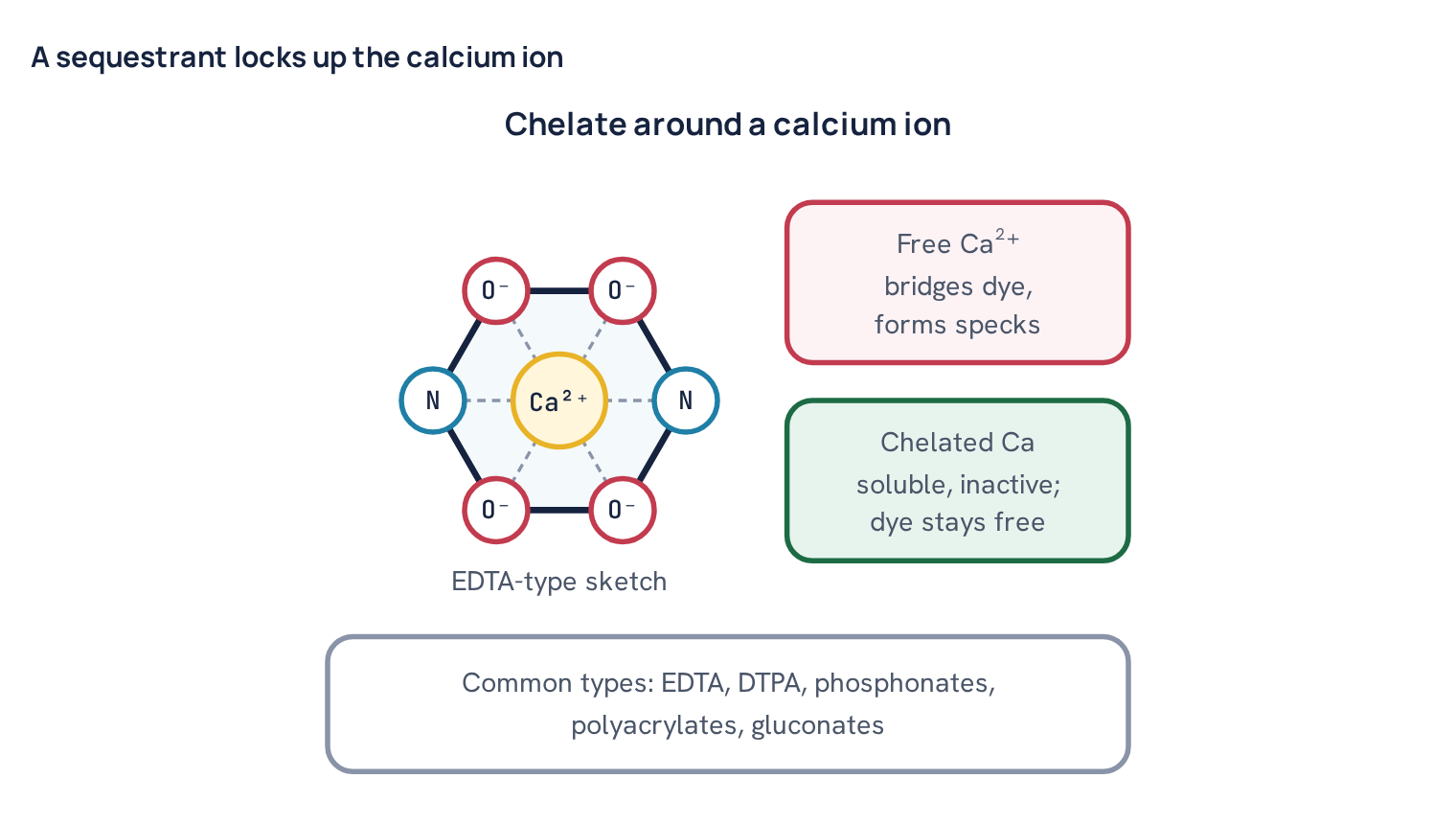
Sequestrants are not all the same, so choose by job:
- Aminocarboxylates (EDTA, DTPA type). Strong binders for calcium, magnesium and heavy metals over a wide pH range. They are poorly biodegradable, and many buyers and environmental standards now restrict their use.
- Phosphonates. Good for iron and for stabilising peroxide, and work well at high temperature and high pH. Often used in scouring and bleaching.
- Polyacrylates and similar polymers. Act as dispersants as well as sequestrants. They keep small particles of scale and lime soap from depositing, even when they do not bind every ion.
- Gluconates and hydroxy acids. Bind iron and calcium strongly in high alkali, which suits caustic-heavy baths.
Strong chelating agents have a downside. Some dyes contain a metal as part of their structure, for example copper in many turquoise and some blue reactive dyes. An aggressive chelator, used in excess at high temperature, can pull some of that metal out of the dye and change the shade. Too much sequestrant can also interfere with peroxide stabilisation that depends on a little magnesium. The rule is to dose based on the actual hardness and metal load, not “a bit extra to be safe”.
Worked example. A 600 kg batch is dyed at 1:8, so the bath holds 4,800 L. The softener leaks and the water tests at 40 ppm as CaCO₃. Hardness entering with the water = 4,800 L × 40 mg/L = 192,000 mg, or about 192 g as CaCO₃. Suppose the supplier’s data sheet says the sequestrant binds 200 mg CaCO₃ per gram of product at the bath pH (this number is only for the example; use your own supplier’s figure). The minimum dose is 192 ÷ 0.2 = 960 g, or about 0.2 g/L. Now add a margin for hardness from the salt and the fabric, then confirm in the lab with the real water and salt. If the water had been 5 ppm instead of 40, the same bath would need only about 120 g. This is why daily testing saves money as well as shades.
Daily water testing in the dye house
Water quality changes. Softeners exhaust, filters clog, and well water changes with the season. A short daily routine catches most problems before they reach fabric. It does not need an expensive laboratory.
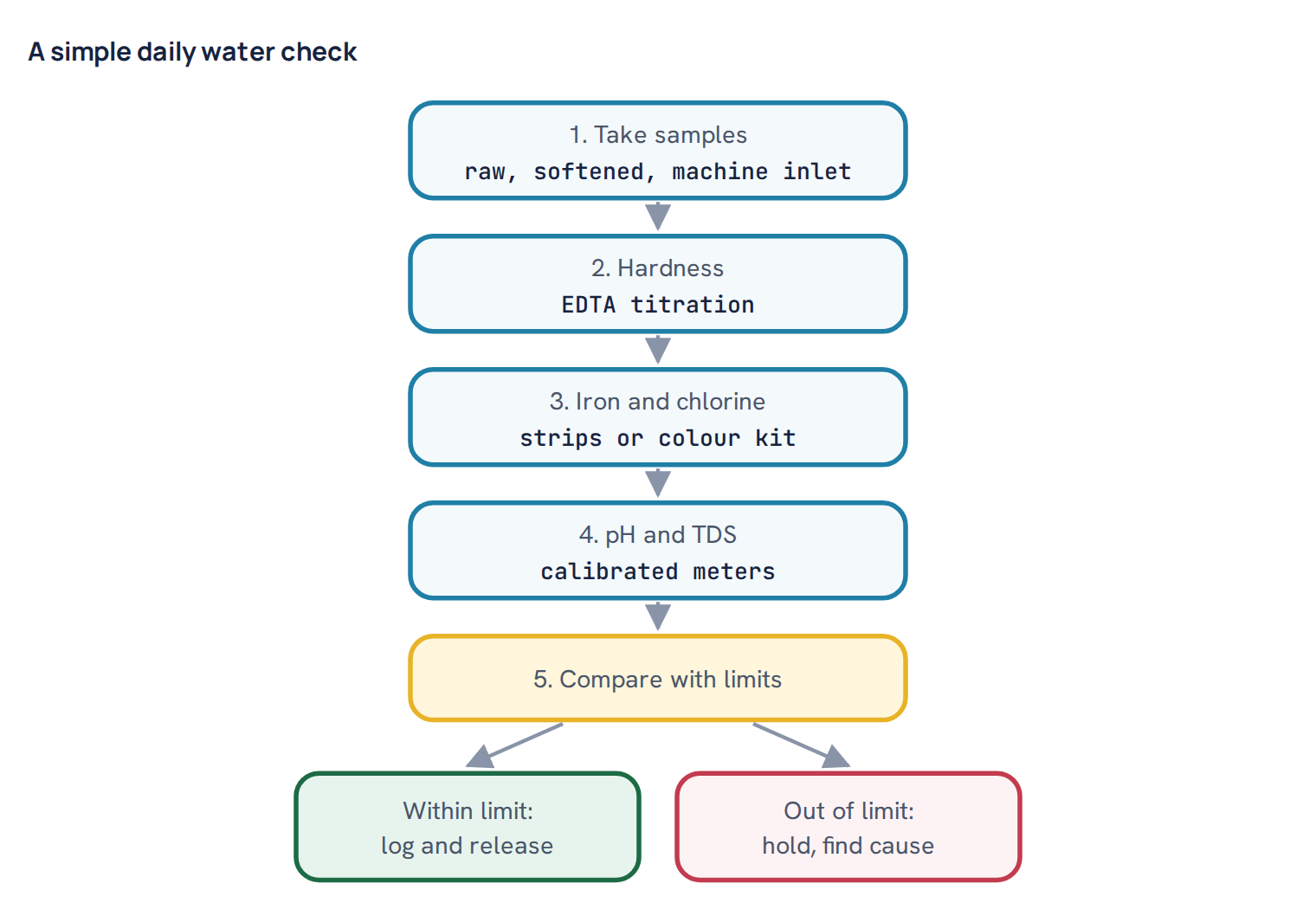
A practical routine looks like this:
- Sample at fixed points. Raw water, softener outlet, and at least one machine inlet. Testing only at the softener misses problems from pipes and storage tanks.
- Hardness by EDTA titration. Buffer the sample to about pH 10, add a few drops of an indicator such as Eriochrome Black T, and titrate with standard EDTA until the colour changes from wine red to blue. Calculate as in the worked example above. It is cheap, fast and accurate enough for daily control.
- Iron and chlorine. Test strips or simple colour comparison kits are fine for screening. If a strip shows any iron above your limit, confirm with a better method before taking action.
- pH and TDS. Use a pH meter calibrated each day with at least two buffer solutions, and a conductivity or TDS meter. Rinse probes and store them correctly. A drifting pH meter gives confident wrong numbers. The same care applies when you test the pH of fabric.
- Record and react. Keep a log sheet with date, time, point, result and the person’s name. Agree in advance what happens when a value is out of limit: regenerate the softener, hold pale shades, increase sequestrant, or switch to RO water.
A trend on the log sheet is often more useful than a single value. If softener outlet hardness creeps up from 2 ppm to 15 ppm over a week, you know it is time to regenerate or service it before it fails completely.
Lab water versus bulk water
Many shade problems between lab and bulk come from water. Laboratories often use distilled or deionised water for recipe development, because it is easy and gives clean results. Bulk dyeing uses softened process water, which may have some residual hardness, higher TDS, some alkalinity and traces of iron. The same recipe can then dye slightly lighter, duller or a different hue in bulk.
The simple rule is that lab dyeing should use water that matches bulk. Either bring process water to the lab in clean containers each day, or treat both lab and bulk with the same system. When you develop a recipe for a new shade, especially pale shades and sensitive turquoises and greens, record which water was used. If you need a refresher on how recipe amounts are set, see dyeing recipe calculation: liquor ratio and shade percent.
Condensate and recycled water
Steam condensate is very soft and hot, so it looks like ideal process water, and returning it saves energy. But condensate can pick up iron from corroded steam and return lines, and sometimes traces of oil or boiler treatment chemicals. Test it for iron and pH before using it for dyeing, and avoid using it for whites and pale shades unless it is consistently clean.
Recycled water from rinse baths or an effluent recovery plant can carry residual dye, surfactants, salt and high TDS. It can be useful for the first rinses after dark shades or for washing machines, but it is risky for pale shades and bleaching. If a mill reuses water, it should test it like any other source and set clear rules about which processes can use it.
Common mistakes
Common mistake: Testing the softener outlet once a week. Softeners can exhaust in a single shift if the raw water hardness rises. Test at least daily, and at the machine inlet, not only at the plant.
Common mistake: Adding more sequestrant “to be safe”. Excess chelator wastes money, adds to effluent load and can pull copper out of metal-containing dyes, which changes turquoise and some blue shades.
Common mistake: Blaming the dye lot for dull shades without checking water and salt. A batch of poor-grade salt can bring in more hardness and iron than the water, and it will affect every reactive shade until it is used up.
Common mistake: Setting acid dyeing pH by acid amount alone. Water alkalinity changes, so the same acid dose gives a different pH. Measure the bath pH and use a buffer.
Common mistake: Ignoring rust in pipes, tanks and trolleys. A single rust flake on wet cotton during peroxide bleaching is enough to make a pinhole.
A worked troubleshooting example
A dye house finds that a mid-depth navy on cotton jersey is coming out duller and slightly redder than standard, with a few dark specks. The lab dyeing was fine. The dye lots are the same as last month. Here is a logical way to check water first.
- Test the machine inlet water. Hardness is 45 ppm as CaCO₃, while the log shows that it was usually 5–10 ppm. The softener outlet also reads high, so the problem is the softener, not the pipes.
- Check the softener. The regeneration timer was set by volume, but the raw water hardness has increased with the dry season. The resin is exhausting before the next regeneration.
- Test the salt solution at working strength. It reads low hardness, so the salt is not the cause.
- Explain the fault. Calcium bridged some of the anionic dye, reducing colour yield and forming specks. The dyes in the mix did not all react the same way, so the hue shifted as well as the depth.
- Correct it. Regenerate the softener and shorten the cycle. Re-test the outlet. For the batch already dyed, judge whether a correction add or a strip-and-redye is needed. Update the daily log sheet limits so the same rise triggers action earlier.
The fix took one titration and a look at the softener. Without testing, the same batch could have been topped up three times with extra dye, never reaching the standard.
Good water does not make a dyer great, but bad water will beat even a very good dyer. Know your targets, test every day, keep lab and bulk on the same water, and remove hardness, iron and chlorine before they reach the machine. For how water control fits into the full cotton process, see the 100% cotton knit dyeing process.
Questions
What water hardness is acceptable for textile dyeing?
Many mills work to below 50 ppm as CaCO₃, and aim below 25 ppm or close to zero for pale reactive shades. The exact limit varies by mill, fibre and shade.
How do I convert °dH to ppm as CaCO₃?
Multiply by about 17.8. For example, 3 °dH is about 53 ppm as CaCO₃. One French degree equals 10 ppm as CaCO₃.
Why does iron in water cause holes in cotton?
Iron catalyses the breakdown of hydrogen peroxide into aggressive hydroxyl radicals. Where a rust particle sits on the fabric during bleaching, the cellulose is oxidised locally and a pinhole or weak spot forms.
Does chlorine in water affect reactive dyes?
Yes. Free chlorine is an oxidiser that can attack the dye chromophore and lighten or shift the shade, and some blues and turquoises are especially sensitive. Remove it with activated carbon or a reducing agent such as sodium thiosulphate.
Why does my lab shade not match bulk?
One common reason is that the lab uses distilled or deionised water while bulk uses process water with some hardness, alkalinity and metals. Use water in the lab that matches bulk water quality.

Textile engineer with 14+ years in dyeing and fabric development. He writes every guide on Dyeing Solution from real production work. Full profile