How the lab tests bursting strength of knit fabric (ISO 13938-2), step by step, with the formula, a worked example, why the test area matters, and what 81 real lab tests showed.
About this guide. The method below is written from the public ISO and AATCC standards in plain words. The data comes from our own lab reports on 95 new knit developments, each tested by an accredited lab to the buyer’s standard, so you can see what real results look like.
At a glance
81Bursting tests in our data
92%Passed
179%Median result vs minimum
kPaCompare at the same area
What the test measures
Knit fabric is not tested for tensile strength the way woven fabric is, because it stretches too much in one direction. Instead it is burst: pushed from below in every direction at once, the way a knee or an elbow pushes a garment. The result is the pressure at which it bursts.
Equipment
- A bursting tester with a rubber diaphragm, a clamping ring and a pressure gauge: pneumatic (air) for ISO 13938-2, hydraulic for ISO 13938-1 and ASTM D3786.
- Clamping rings for the test area: 50 cm² or 7.3 cm² in our reports.
- A conditioning room at 20 ± 2°C and 65 ± 4% RH.
How the test is done, step by step (ISO 13938-2)
- Condition the fabric for at least 24 hours.
- Clamp the specimen flat over the diaphragm, without tension, with the face up, so it cannot slip.
- Raise the pressure at a steady rate so the fabric bursts in about 20 seconds.
- Record the pressure at bursting, and the bursting distension (how high the fabric domed) if the buyer asks for it.
- Measure the diaphragm pressure: run the test again with no fabric, to the same distension, and subtract it.
- Repeat on at least five specimens and average.
Calculating the result
Bursting strength = mean bursting pressure − diaphragm pressure, in kilopascals (kPa).
Worked example. Five specimens burst at a mean of 158 kPa; the diaphragm alone needs 12 kPa to reach the same height. Bursting strength = 158 − 12 = 146 kPa. Against a minimum of 140 kPa on a 50 cm² area, it passes.
The test area changes the number
| Test setting | Reports | Usual minimum |
|---|---|---|
| 50 cm² area | 50 | 125 to 140 kPa |
| 7.3 cm² area | 22 | 200 to 350 kPa |
| ASTM D3786 (hydraulic) | 9 | 35 psi (about 240 kPa) |
A small test area gives a much higher kPa on the same fabric. Always compare a result with the minimum for the same area.
What real results look like
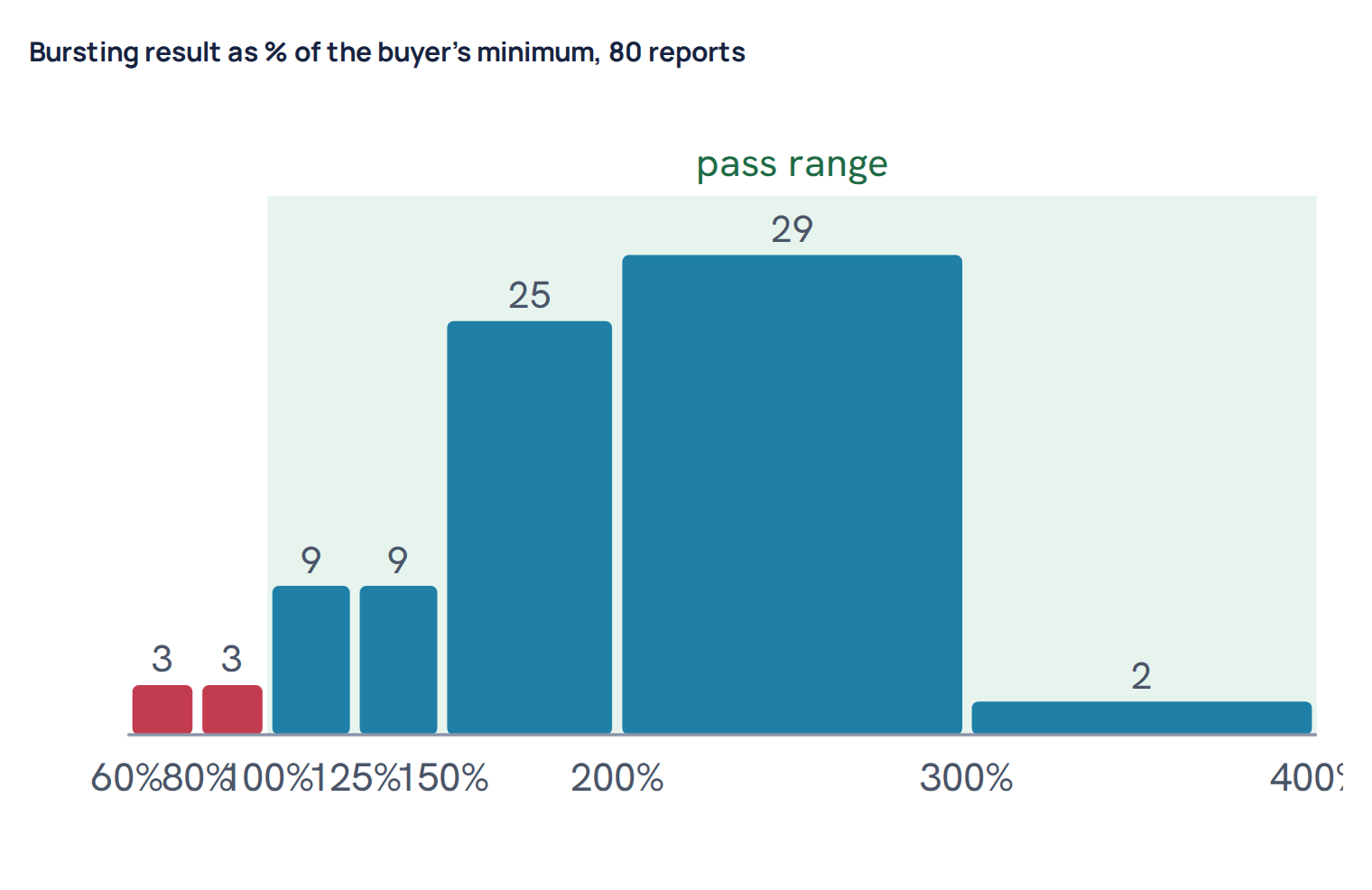
75 of 81 batches passed, most of them with a wide margin: the median result was 179% of the minimum. The fails were all stretch rib or light single jersey finished under their required GSM.
| Fabric group | Tested | Passed |
|---|---|---|
| Single jersey | 16 | 13 (81%) |
| Rib | 20 | 17 (85%) |
| Interlock | 8 | 8 (100%) |
| Terry | 11 | 11 (100%) |
| Waffle | 10 | 10 (100%) |
| Fleece | 13 | 13 (100%) |
| Pique and lacoste | 3 | 3 (100%) |
Common mistakes that change the result
- Clamping the fabric stretched, or loose enough to slip.
- Forgetting to subtract the diaphragm pressure.
- Comparing a 7.3 cm² result with a 50 cm² minimum.
- Raising the pressure too fast, which gives a higher reading.
If a batch fails, see why knit fabric fails bursting strength: 6 real cases.
From the floor
- Bursting mostly comes down to a loose knit and the enzyme treatment.
- It fails when the yarn strength is poor, when the fabric is under its GSM or knitted loose, or when the process takes strength away: excess enzyme, singeing that scorches the fabric, or a dyeing cycle much longer than normal.
Questions
Why is bursting strength used for knits instead of tensile strength?
Knit fabric stretches too much in one direction for a tensile test to mean much; bursting loads it in every direction at once, like a knee or elbow.
What is a good bursting strength for knit fabric?
On a 50 cm² area most buyers ask for 125 to 140 kPa; on 7.3 cm² the minimum is usually 200 to 350 kPa.
Why subtract the diaphragm pressure?
Part of the pressure only stretches the rubber diaphragm; subtracting it leaves the pressure the fabric itself resisted.

Textile engineer with 14+ years in dyeing and fabric development. He writes every guide on Dyeing Solution from real production work. Full profile