Vat and sulphur dyes start as insoluble solids. They are reduced to a soluble form, absorbed by cotton, then oxidised back inside the fibre. Here is the chemistry, indigo and denim, vat fastness, sulphur black tendering and a comparison with reactive dyes.
At a glance
Reduce → oxidiseInsoluble dye made soluble, then locked inside
Hydros + NaOHReducing system for vat dyes
Sodium sulphideClassic reducing agent for sulphur dyes
Soap at the boilDevelops true shade and fastness
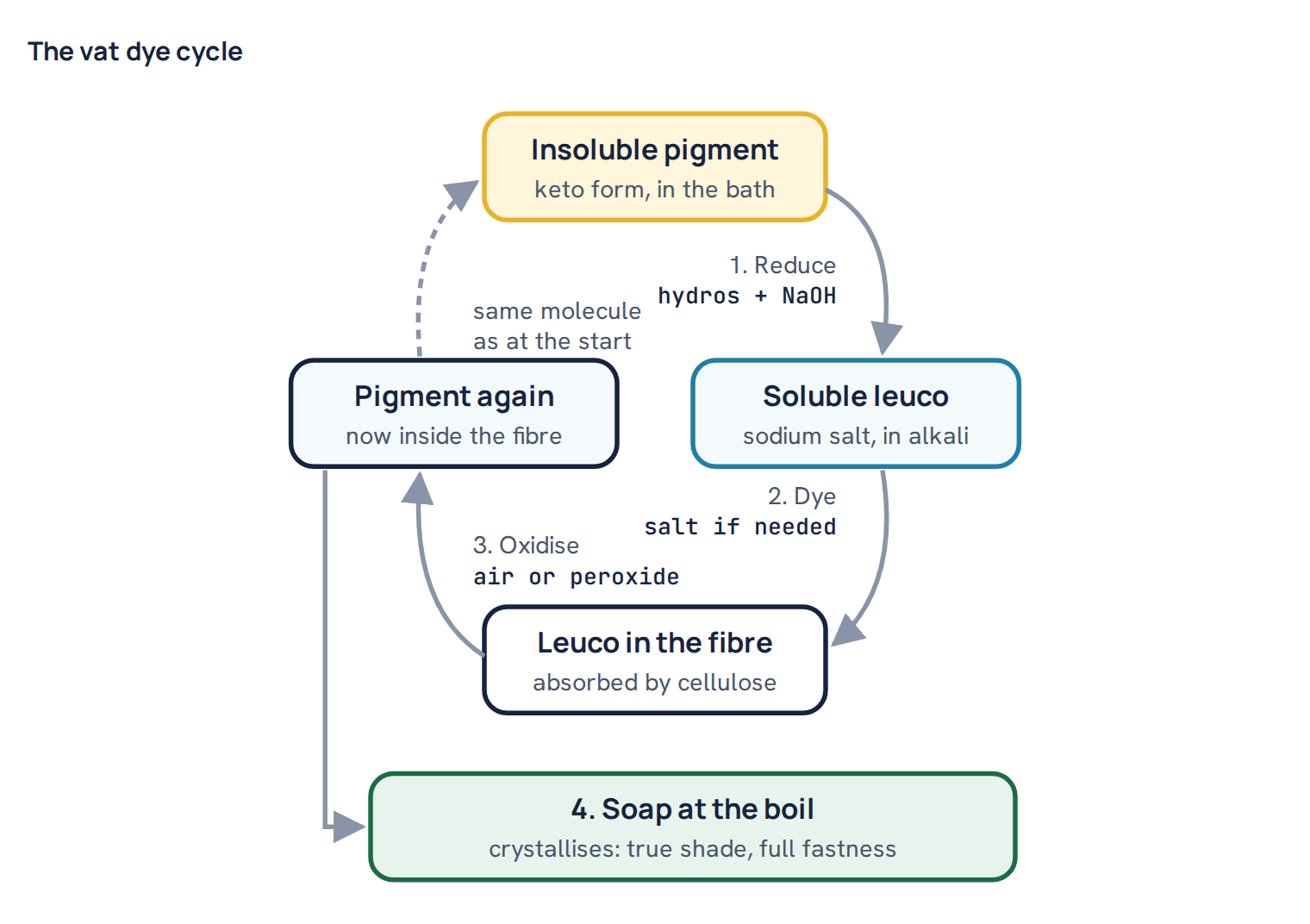
Most cotton dyes go into the fibre already dissolved and stay dissolved. Vat and sulphur dyes work the other way round. In the drum they are insoluble coloured solids, closer to a pigment than to a dye. They cannot dye cotton in that form. So the dyer first changes them chemically into a soluble form, lets the cotton absorb that form, and then changes them back into the insoluble solid inside the fibre. The dye is now locked in, not by a chemical bond but because it is too big and too insoluble to get out.
That cycle, reduce, dye, oxidise, then soap, is the whole idea behind both classes. Vat dyes use it to give some of the best wash and light fastness available on cotton. Sulphur dyes use it to give cheap, deep blacks, navies and browns. This article explains the chemistry in simple words, then the practical side of each class: indigo and denim, anthraquinone vat dyes, vatting methods, oxidation and soaping, and for sulphur dyes, tendering, bronziness and effluent. A comparison with reactive dyes is at the end.
The shared principle: reduce, dye, oxidise, soap
Cellulose fibres such as cotton, viscose and linen swell in water and have open, water-filled pores. A dye can only travel into those pores if it is dissolved as single molecules. A pigment particle is far too big. The general steps of any dyeing (getting dye to the fibre, adsorbing it on the surface, diffusing it inside and fixing it) are covered in how dyeing works: transport, adsorption, diffusion and fixation. Vat and sulphur dyes follow those same steps, but with a chemical switch at each end.
- Reduce. A reducing agent in alkali adds electrons to the dye. The insoluble dye becomes a negatively charged sodium salt, called the leuco form, which dissolves in water.
- Dye. The leuco form has affinity (substantivity) for cellulose, a little like a direct dye. It is adsorbed and diffuses into the swollen fibre. Salt is added for dyes with low affinity.
- Oxidise. Air or a chemical oxidant takes the electrons back. The leuco form turns back into the original insoluble dye, now inside the fibre.
- Soap. A hot wash, usually close to the boil, removes loose dye from the surface and lets the dye molecules inside group together into small crystals. Only after this step does the fabric show its true shade and full fastness.
The difference between the two classes is mostly in the reducing agent and in the structure of the dye. Vat dyes are reduced with sodium hydrosulphite (sodium dithionite, often just called “hydros”) and caustic soda. Sulphur dyes are traditionally reduced with sodium sulphide.
Vat dyes: what they are
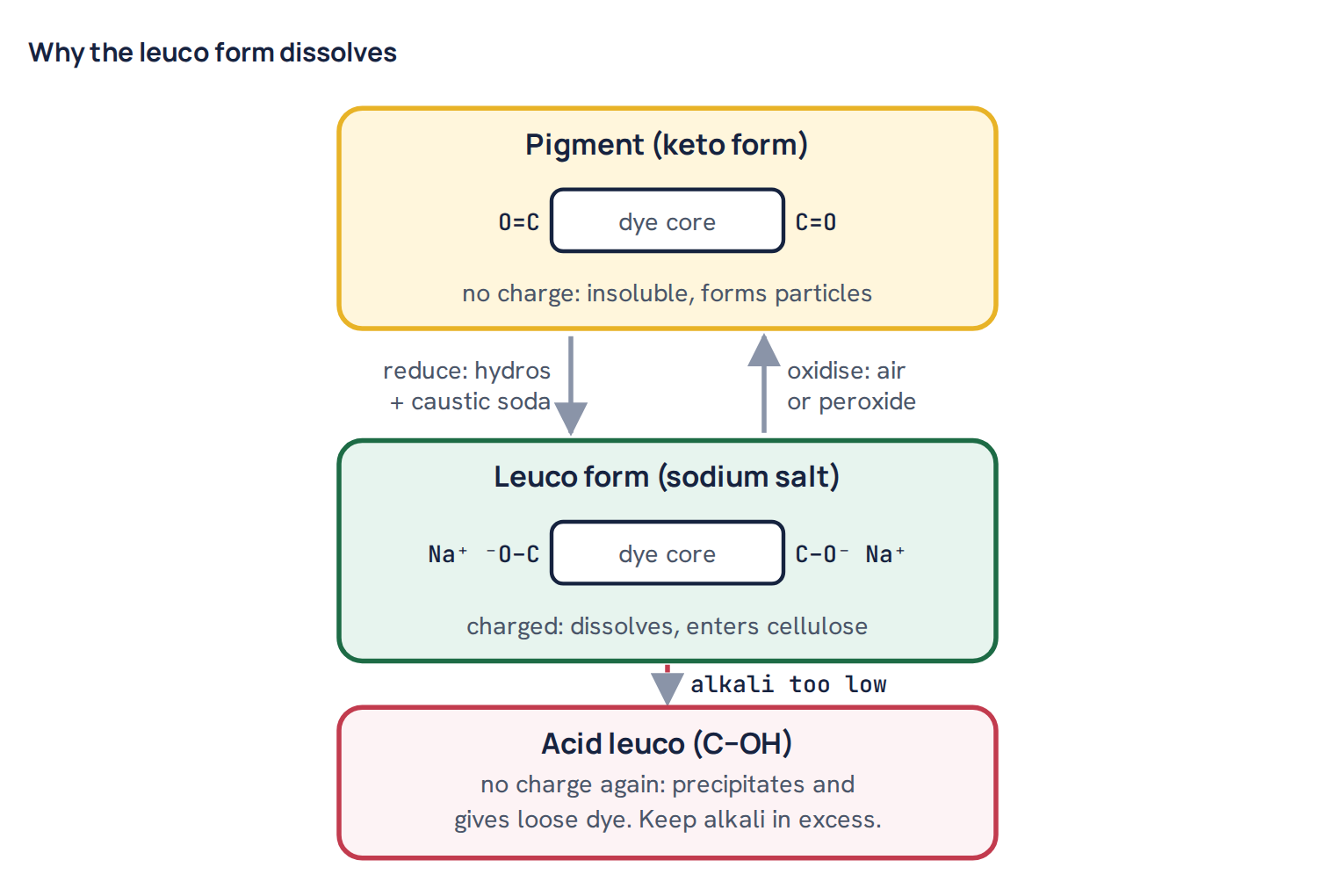
The name comes from the old wooden vats in which indigo was fermented and reduced. Chemically, vat dyes are large, flat, water-insoluble molecules that contain two or more carbonyl groups (C=O) in a ring system. These carbonyl groups are the “switch”. Reduction turns each C=O into C–O⁻, a negatively charged group that pairs with a sodium ion. Oxidation turns it back.
There are two main families:
- Indigoid dyes, of which indigo is by far the most important. Indigo is used in huge amounts for denim.
- Anthraquinone vat dyes, a large family of bigger molecules built on anthraquinone and related ring systems. They give blues, greens, olives, browns, greys, violets, yellows and oranges, and they have very high fastness.
The two families behave quite differently in the dye house, so they are treated separately below. For where vat dyes sit among all the dye classes, see dye classes: which dye for which fibre.
The leuco form in simple words
“Leuco” means white, because the reduced form of many vat dyes is pale or a different colour from the final dye. Leuco indigo, for example, is a yellowish-green solution, and yarn coming out of an indigo bath is green-yellow before it turns blue in the air. Anthraquinone leuco forms are often strongly coloured, but in a different hue from the final shade, which is one reason shade judging during the dyeing is difficult.
The leuco form only stays dissolved while the bath is alkaline enough. Its charged C–O⁻ groups need sodium hydroxide around them. If the alkali drops, the groups pick up a hydrogen and become C–OH. This “acid leuco” form, sometimes called the vat acid, has no charge and is insoluble again. It precipitates in the bath or on the fabric surface, where it oxidises later as loose, badly fixed dye. That is why vat dyeing always runs with an excess of both caustic soda and hydros.
Indigo: the classic vat dye
Indigo is the dye of denim. It is almost always applied to cotton warp yarn, not to fabric, and the way it is applied creates the look that denim is known for.
Low affinity, many dips
Leuco indigo has low affinity for cotton. One immersion puts only a light layer of dye on the yarn, and long immersion does not help much, because the leuco dye does not exhaust strongly. So indigo is built up in many short steps. The yarn runs through a dye box for a short time, comes out, and travels through the air for longer, so that the leuco dye oxidises to blue (this air passage is often called skying). Then it enters the next box. A typical range has several boxes, often somewhere between four and eight or more depending on the depth and the plant. Each dip adds another layer of blue.
Two machine types dominate. In rope dyeing, hundreds of warp ends are gathered into a loose rope, and many ropes run side by side through the dye boxes. The ropes are later opened out and beamed for sizing. In sheet or slasher dyeing, the warp runs as a flat sheet straight from the beams through the dye boxes and into the sizing machine. Rope dyeing is generally regarded as giving more even dyeing across the warp, while sheet dyeing is shorter and simpler. Both work on the same principle of short dips and air oxidation.
Ring dyeing
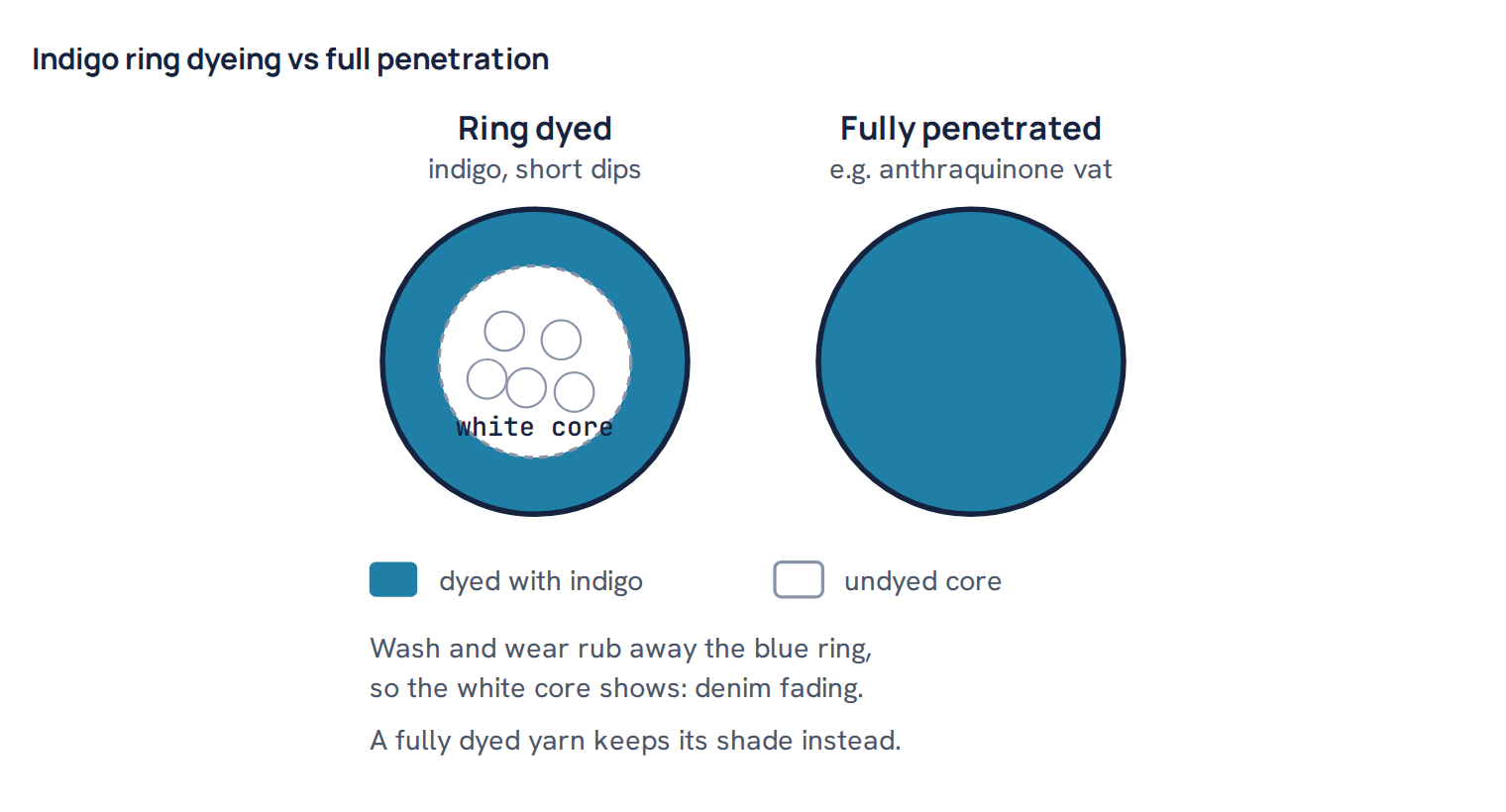
Because the dips are short and the leuco indigo is taken up quickly at the surface, the dye stays mainly in the outer layer of the yarn. The core remains white or pale. This is ring dyeing, and it is a feature, not a fault. When the denim garment is washed, stone washed or worn, the dyed outer fibres are abraded and the white core shows through. That is the fading that denim buyers pay for.
The degree of ring dyeing is controlled mainly by the dyebath pH and the immersion time. In general, a pH roughly in the 10.5–11.5 region favours strong ring dyeing and good colour yield, while a higher pH gives more penetration into the yarn but a lighter, duller result for the same dye. The exact working range depends on the plant, the reducing system and the look required, so treat these figures as a guide only.
Indigo fastness
Indigo’s fastness is moderate, not excellent. Rubbing fastness, especially wet rubbing on dark denim, is often the weak point, because a lot of dye sits at the surface. Wash fastness is also only moderate, which is why denim fades and why indigo garments can stain other items in the first washes. For denim this is accepted and even wanted. It is a big difference from the anthraquinone vat dyes.
Anthraquinone vat dyes: the high-fastness group
Anthraquinone vat dyes are larger molecules, and their leuco forms have much higher affinity for cellulose than leuco indigo. They are normally dyed in one bath, exhaust well, and penetrate the fibre fully. After oxidation and soaping they give some of the best all-round fastness of any dye class on cotton: very good wash fastness, often very high light fastness, and good resistance to many bleaching agents.
This makes them the choice when a fabric must survive hard use and harsh laundering:
- Workwear and uniforms, such as hospital, industrial and military clothing that goes through repeated industrial washing, sometimes with bleach.
- Towels and terry products, which are washed hot and often.
- Yarn-dyed shirting, stripes and checks, where any bleeding between colours would spoil the pattern.
- Outdoor and furnishing fabrics, such as curtains and awnings, that need high light fastness.
- Sewing thread, which must not bleed onto the garment.
They are also widely used for the cotton part of polyester-cotton workwear in continuous pad-steam ranges. On cotton knits for fashion, reactive dyes are far more common, because they are easier, brighter and cheaper. Vat dyes on knits are mostly found where a buyer asks for very high fastness, for example to chlorine or peroxide bleach.
Vatting methods: getting the dye into the leuco form
“Vatting” simply means reducing the dye to its leuco form. Two broad approaches are used:
- Stock vat (pre-vatting). The dye is reduced in a small, concentrated tank with caustic soda and hydros at a set temperature, then added to the main bath. This gives quick, complete reduction and is common for dyes that reduce slowly.
- Dyebath vatting. The dye is added to the main bath, and the caustic soda and hydros are added there. It is simpler, but the reduction conditions are less concentrated, so the dye maker’s guidance on temperature and time must be followed.
Hydros is not stable. It is used up by oxygen from the air, by heat and by time, and a bath that runs out of it starts to oxidise the leuco dye too early. Dyers check that the bath is still reduced with a reduction test paper or a redox potential reading, and add more hydros if needed. Some dyes, particularly certain blues, can also be over-reduced at high temperature with too much reducing agent, which gives a duller shade that does not fully recover. The dye maker’s data sheet says which dyes are sensitive.
IK, IW and IN dyeing types
Anthraquinone vat dyes differ a lot in their affinity and in how much alkali they need. For this reason they have long been sorted into three application groups. The letters come from an old German classification: K for cold, W for warm and N for normal. The general pattern is:
- IK (cold). Low-affinity dyes. Dyed at a low temperature, around room temperature to about 30°C, with relatively little caustic soda, and salt is needed to push the dye onto the fibre.
- IW (warm). Medium-affinity dyes. Dyed at around 40–50°C, with a moderate amount of caustic soda and some salt.
- IN (normal). High-affinity dyes. Dyed at around 60°C, with the most caustic soda, and usually no salt.
These ranges are a general guide. Exact temperatures and chemical amounts vary between dye makers and depend on depth and liquor ratio, so always work from the supplier’s recommendations. When combining dyes in one recipe, choose dyes from the same group where possible, so that they need the same conditions.
Leuco method vs pre-pigmentation
Leuco forms of anthraquinone vat dyes have high affinity and strike fast. If the leuco dye is added to the bath with the fabric already running, much of it goes onto the first fibres it meets, and the result can be unlevel. Two ways of applying the dye manage this.
In the leuco method, the dye is vatted first and the leuco solution is added to the bath, often at a low temperature and with a levelling agent that holds part of the leuco dye in solution for a while. It is quick and straightforward, and it works well when the dye and machine level well.
In the pre-pigmentation method, the unreduced dye, finely dispersed, is added first. As a pigment it has no affinity, so it circulates and spreads evenly through the fabric or yarn package. Only then are the caustic soda and hydros added, and the dye is reduced on and around the fibre, where it is absorbed evenly. This is preferred for packages, beams and other material where even distribution is hard. The same idea is used in continuous dyeing: the fabric is padded with the pigment dispersion and dried, then padded with caustic soda and hydros and steamed, so that reduction and dyeing happen in the steamer in about a minute or less, depending on the range.
A typical exhaust cycle
For an IN-type dye on cotton, the sequence usually looks like this: set the bath with caustic soda and hydros, add the dye (pre-vatted or as pigment), heat to the dyeing temperature, add salt if the dye type needs it, hold to exhaust, drain, rinse to remove excess alkali and hydros, oxidise, then soap at or near the boil and rinse.
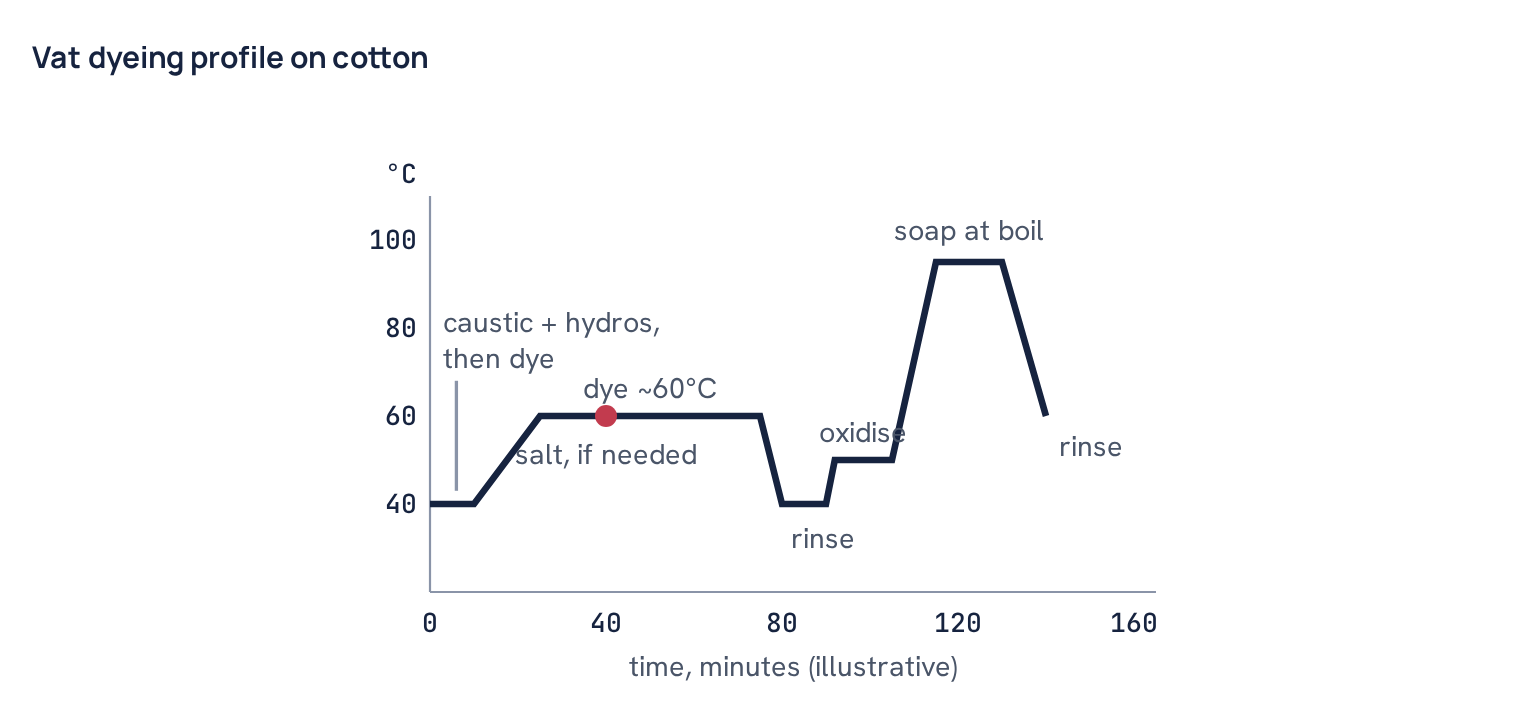
Worked example. A recipe calls for 6 g/L caustic soda and 5 g/L hydros at a liquor ratio of 1:8, and the batch is 500 kg of cotton. The bath volume is 500 × 8 = 4,000 litres. Caustic soda: 6 × 4,000 = 24,000 g, or 24 kg. Hydros: 5 × 4,000 = 20,000 g, or 20 kg. These figures are only for the arithmetic; the real amounts come from the dye maker’s tables for the dye, depth and dyeing type.
Oxidation
After dyeing, the fabric is rinsed to remove most of the free hydros and caustic soda. If too much hydros remains, the oxidant is wasted fighting it, and oxidation is slow and uneven. Then the leuco dye is converted back to the pigment.
- Air oxidation. Enough for indigo in continuous ranges, where the yarn travels through the air between dips. In exhaust machines it is too slow and uneven for most anthraquinone dyes.
- Hydrogen peroxide. The most common oxidant in exhaust dyeing, usually used warm, often in the range of about 40–60°C, for a short time. A little acetic acid or a buffer may be used to bring the pH down from the strongly alkaline dyeing conditions. Typical amounts vary with depth and practice.
- Other oxidants, such as sodium perborate or sodium meta-nitrobenzene sulphonate, are used in some processes. Over-oxidation with strong oxidants can dull certain shades, so conditions should follow the dye maker’s advice.
You can see oxidation happen: the leuco colour on the fabric changes to the expected hue within minutes. But the shade is still not final.
Soaping at the boil
Soaping is not just a wash. Straight after oxidation, the dye inside the fibre is present as scattered, poorly organised molecules. Treating the fabric at or near the boil with a detergent, often with a little soda ash, lets these molecules move slightly and pack together into small, ordered aggregates or crystals. This changes the shade, often noticeably, and in many cases makes it brighter and truer. It also improves light and wash fastness, and it removes loose pigment from the surface that would otherwise rub off. A common soaping is about 10–20 minutes at 90–98°C, though practice varies.
The shade must always be judged after soaping, never before. A lab dip or a sample cut from the machine before soaping can give a very wrong reading.
Common mistake: letting the hydros run out during dyeing. The bath starts to oxidise, leuco dye turns to acid leuco or pigment on the surface instead of inside the fibre, and the result is unlevel dyeing with poor rubbing fastness that soaping cannot repair.
Fastness of vat dyes
For anthraquinone vat dyes, fastness is their reason to exist. Wash fastness is excellent, because the large pigment molecules are trapped inside the fibre and cannot dissolve out. Light fastness is very good to outstanding for many dyes. Fastness to chlorine and peroxide bleaching is good for many dyes, which is why they are chosen for towels and workwear. The exact grades vary from dye to dye, so check the data sheet for the property you need.
There are some weak points:
- Rubbing on deep shades. In dark shades, some pigment may be left at or near the surface, especially if rinsing and soaping were short. Dry rubbing is usually acceptable, but wet rubbing on deep shades can be a problem, as it is with indigo.
- Phototendering. Some vat dyes, mainly certain yellows and oranges, can speed up the breakdown of cellulose in sunlight. The dye stays bright, but the fabric weakens. This matters for curtains, awnings and other items exposed to strong light. Dye makers mark these dyes, and they are avoided for such end uses.
Disadvantages of vat dyes
- Cost. The dyes themselves are expensive, and the process uses large amounts of caustic soda and hydros.
- Process complexity. The bath must stay reduced and alkaline through the whole dyeing, temperatures must match the dye type, and there are extra steps for rinsing, oxidation and soaping. Mistakes are hard to correct.
- Shade matching. The colour during dyeing is the leuco colour, and the final shade appears only after oxidation and soaping. Additions to correct the shade therefore need a full sample cycle each time, which slows matching.
- Limited brightness in some areas. Some very bright shades that reactive dyes give easily are hard or impossible with vat dyes.
- Effluent. Hydros breaks down into sulphite and sulphate salts. The waste water is strongly alkaline, has a high oxygen demand and a high salt load, and needs proper treatment.
Sulphur dyes: what they are
Sulphur dyes are made by heating aromatic compounds, such as certain amines and phenols, with sulphur or sodium polysulphide. The result is not a single, neat molecule but a mixture of large, complex structures containing many sulphur links: single sulphur bridges (–S–), disulphide links (–S–S–), polysulphide chains and sulphur-containing rings. Their exact structures are often not fully known.
Like vat dyes, they are insoluble in water. Their shade range is narrow and mostly dull: black, navy, brown, olive, khaki, dark green and some blues. Bright reds and bright colours generally are not available. Sulphur black is by far the most important, and it is one of the cheapest ways to dye cotton deep black.
Some dyes sit between the two classes. These sulphurised vat dyes are made in a similar way to sulphur dyes but can be applied by either the vat or the sulphur method, giving better fastness than ordinary sulphur dyes.
How sulphur dyeing works
Reduction
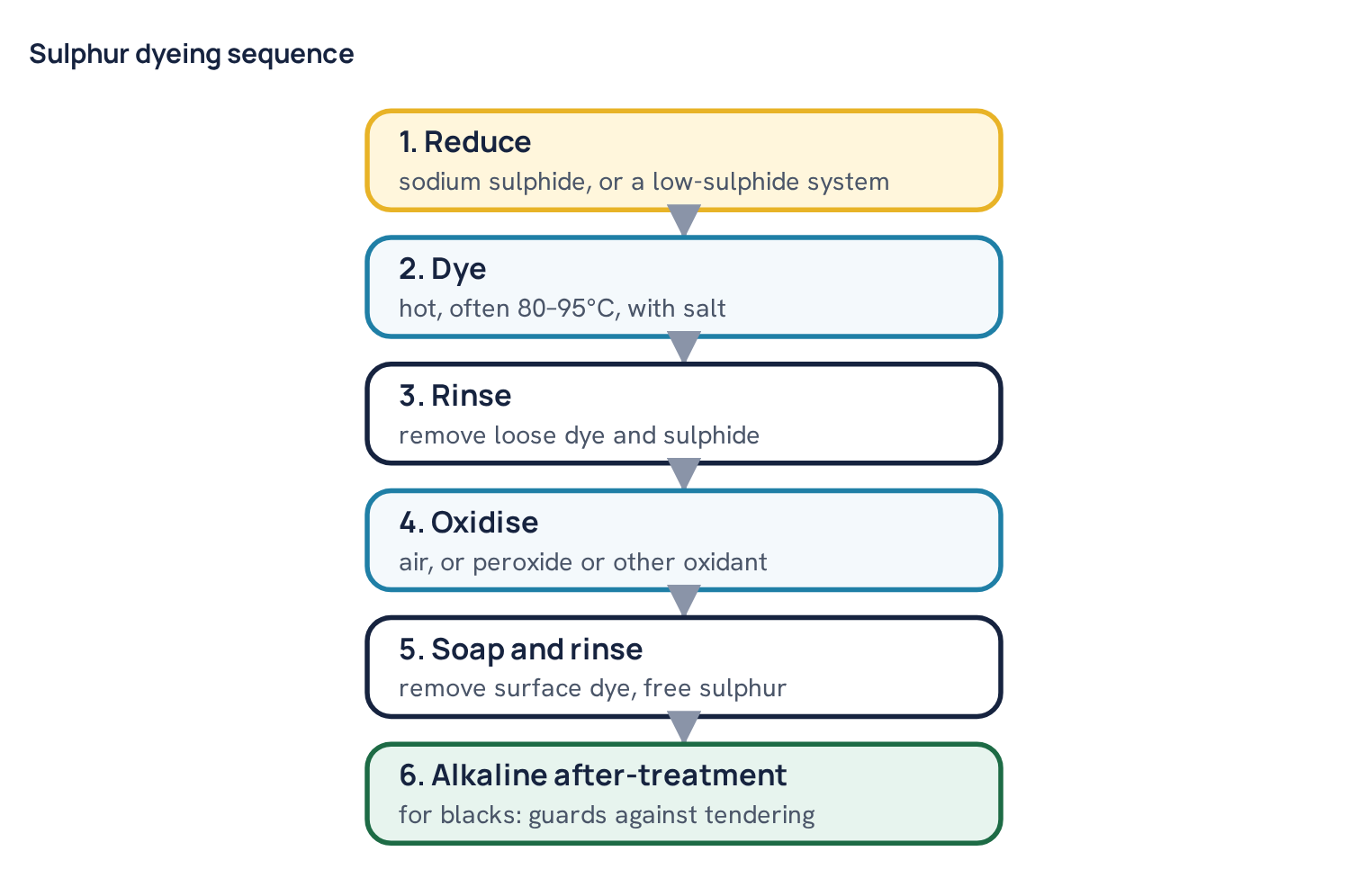
The classic reducing agent is sodium sulphide. In the alkaline bath, it breaks the disulphide links in the dye into thiolate groups (–S⁻), which carry a negative charge. The dye becomes soluble and gains affinity for cellulose, much like a leuco vat dye. Sodium sulphide itself is strongly alkaline, and soda ash is often added as well.
Today many sulphur dyes are supplied as liquid, pre-reduced products that already contain reducing agent, so the dye house adds less, or no, sodium sulphide. Because sulphide is a serious effluent problem, lower-sulphide and sulphide-free reducing systems are also used, for example combinations based on glucose or other reducing sugars with alkali. How well these work depends on the dye, the temperature and the process, so they need to be checked for each case.
Dyeing
The reduced dye has only moderate affinity, so salt is added to drive exhaustion, often in substantial amounts for deep shades. Dyeing is usually done hot, often in the region of 80–95°C, though some processes run cooler. Sulphur dyes exhaust and penetrate well and give good coverage at low cost. They are applied in jigger, winch, package and continuous ranges, and in denim ranges for warp yarn.
Rinsing, oxidation and soaping
After dyeing, the material is rinsed to remove the loose dye and sulphide. Then it is oxidised. Air oxidation works for some dyes, but chemical oxidants give more control: hydrogen peroxide is widely used, and some processes use other oxidants such as sodium bromate under mildly acidic conditions. Dichromate was once common but is no longer acceptable, because of chromium in the waste water. Oxidation re-forms the sulphur links and traps the insoluble dye inside the fibre. A soaping and good rinsing follow, and for sulphur black an alkaline after-treatment is added to protect the cotton during storage, as explained below.
Fastness of sulphur dyes
- Wash fastness is generally good, and good enough for most workwear and denim, though deep shades fade gradually with repeated home washing.
- Light fastness is moderate overall. Blacks and some navies are reasonably good; browns, olives and lighter shades tend to be lower.
- Chlorine fastness is poor. The sulphur groups are attacked by hypochlorite, so the colour fades or changes. Sulphur-dyed goods should not be bleached with chlorine, and buyers who test for chlorine fastness need another dye class.
- Rubbing fastness is fair, and often weaker on very deep shades, especially when the goods are not well rinsed and soaped.
Sulphur black tendering
Tendering means loss of fabric strength. Sulphur black has a known risk: a fabric that tests fine after dyeing can become weak weeks or months later in storage.
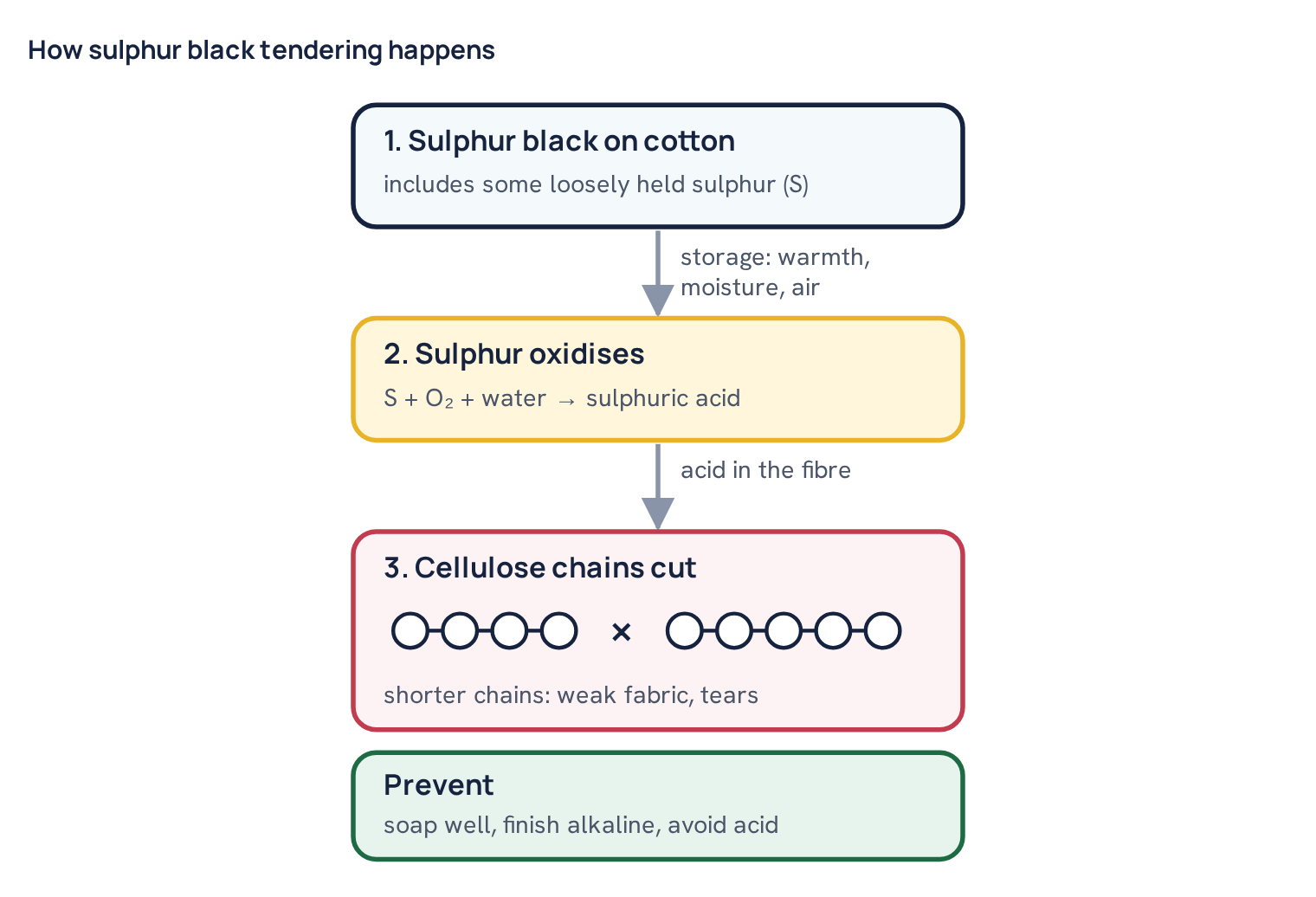
The reason is the extra sulphur in the dye. Sulphur black contains some loosely bound sulphur that is not firmly part of the dye structure. During storage, especially in warm and humid conditions, this sulphur is slowly oxidised by air, and the end product is sulphuric acid. Acid attacks cellulose by hydrolysis: it cuts the long cellulose chains into shorter ones. Shorter chains mean a weaker fibre. In bad cases the fabric tears easily by hand.
The usual prevention steps are simple:
- Rinse and soap thoroughly after oxidation, to remove free sulphur and loose dye.
- Leave the fabric slightly alkaline. A final treatment with a mild alkali, such as soda ash, or with a buffering salt such as sodium acetate, neutralises any acid that forms later.
- Avoid acid. Do not finish sulphur black goods with acid-side softeners or resin finishes that leave the fabric acidic, and do not leave them in acid conditions after processing.
- Check with a storage test. An accelerated ageing test (warm, humid storage, then a strength test) is commonly used to confirm the treatment works.
Bronziness
Bronziness is a reddish or coppery, metallic sheen on deep sulphur shades, most often on blacks and navies. It means too much dye has built up at the fibre surface instead of inside it. Common causes are dyeing heavier than the fibre can really take, too little reducing agent so that some dye is not fully reduced, early oxidation in the machine when the material is exposed to air during dyeing, and poor rinsing and soaping. It is prevented by using the right amount of dye and reducing agent for the depth, keeping the material under the liquor during dyeing, and rinsing and soaping well. A bronzy surface also tends to have poor rubbing fastness. Indigo can show a similar bronze effect when very heavy shades are built with too many dips.
Environmental concerns with sulphur dyes
Sodium sulphide is the main problem. Sulphide in waste water is toxic to aquatic life, has a high oxygen demand, and corrodes pipes and concrete. If sulphide-containing water meets acid, it releases hydrogen sulphide gas, which smells of rotten eggs and is dangerous to breathe at higher concentrations. This is a real safety hazard in drains and effluent pits, not only an environmental issue. Add the high salt load and alkaline pH, and sulphur dyeing effluent needs careful treatment.
This is why the industry has moved toward pre-reduced liquid dyes with low sulphide content, glucose-based and other sulphide-free reducing systems, and peroxide oxidation instead of dichromate. These changes reduce the problem but do not remove the need for good effluent treatment.
Common mistake: treating sulphur black like any other black and giving it an acid final rinse or an acid softener. The fabric passes inspection, then loses strength in the warehouse as the residual sulphur turns to acid.
Where sulphur dyes are used
- Cheap blacks and navies on cotton yarn and fabric, where cost matters more than brightness or chlorine fastness.
- Denim. Sulphur black is used to dye black denim, and also in combination with indigo. In a sulphur bottom, the yarn is dyed with sulphur first and then with indigo over it. In a sulphur top, indigo goes on first and sulphur over it. Both change the cast of the blue and the way it fades.
- Workwear, canvas and corduroy in dark, practical shades such as navy, olive, khaki and brown.
- Linings and pocketing, where a cheap dark shade with fair fastness is enough.
Vat vs sulphur vs reactive
Reactive dyes are the main dye class for cotton knits, and they work in a completely different way: they are soluble from the start and form a covalent bond with the fibre. See how reactive dyes work and the full knit process in 100% cotton knit dyeing process. The table compares the three classes in general terms; individual dyes vary.
| Property | Vat (anthraquinone) | Sulphur | Reactive |
|---|---|---|---|
| Form in the drum | Insoluble pigment | Insoluble (or pre-reduced liquid) | Soluble |
| Reducing agent | Hydros + caustic soda | Sodium sulphide or low-sulphide system | None |
| How held in fibre | Insoluble pigment trapped inside | Insoluble dye trapped inside | Covalent bond to cellulose |
| Shade range | Wide, many deep and dull shades; some brights | Narrow: black, navy, brown, olive | Full range, very bright |
| Wash fastness | Excellent | Good | Very good |
| Light fastness | Very good to excellent | Moderate | Moderate to good, varies |
| Chlorine fastness | Good for many dyes | Poor | Varies, often moderate |
| Rubbing, deep shades | Can be weak wet | Fair, can be weak | Can be weak wet |
| Cost | High | Low | Medium |
| Main effluent issue | Sulphite/sulphate, high pH | Sulphide, H₂S risk, salt | Salt, colour, hydrolysed dye |
| Typical use | Workwear, uniforms, towels, yarn-dyed shirting | Cheap blacks, denim, workwear | Cotton knits, fashion, most cotton |
A simple way to choose: if the buyer needs top wash, light and bleach fastness and will pay for it, use vat dyes. If the shade is black, navy or brown, cost is tight and chlorine fastness is not required, sulphur dyes are hard to beat. For bright shades, short cycles and everyday knit fashion, reactive dyes remain the standard. Indigo stays in its own world: chosen not for fastness but for the way it fades.
Questions
What is the leuco form of a vat dye?
It is the reduced, water-soluble sodium salt of the dye, made with sodium hydrosulphite and caustic soda. It has affinity for cotton, and after it enters the fibre it is oxidised back to the insoluble dye.
Why are vat dyed fabrics soaped at the boil?
Soaping lets the dye molecules inside the fibre group into small crystals and removes loose surface dye. This develops the true shade and improves fastness, so the shade must be judged only after soaping.
Why is indigo ring dyed?
Leuco indigo has low affinity and is applied in short dips with air oxidation between them, so the dye stays mainly in the outer layer of the yarn. Wear and washing remove that layer and expose the white core, which gives denim its fading.
What causes sulphur black tendering?
Loosely held sulphur in the dye slowly oxidises to sulphuric acid during storage, and the acid breaks cellulose chains. Thorough soaping and a slightly alkaline final treatment prevent it.
Are sulphur dyes fast to chlorine?
No. Chlorine bleach attacks the sulphur groups and fades or changes the shade. Where chlorine fastness is required, vat dyes or selected reactive dyes are used instead.

Textile engineer with 14+ years in dyeing and fabric development. He writes every guide on Dyeing Solution from real production work. Full profile