
Most hoodies are fleece or French terry, knitted in cotton, polyester or a cotton-polyester blend. Fleece vs terry, cotton vs polyester vs blends, hoodie GSM, why hoodies pill and shrink, printing, and how to choose, from our fleece development and finishing records.
At a glance
Fleeceor French terry
260–350typical GSM
8% / 4%cotton vs blend shrink
Terrypills least
Most hoodies are made from fleece or French terry, knitted from cotton, polyester or a cotton-polyester blend. Fleece has a brushed, fluffy inside for warmth; French terry has small loops on the inside and feels lighter and cooler. The fibre mix decides the rest: 100% cotton feels natural and breathes best, cotton-polyester blends (such as 80/20 or 60/40) shrink less and keep their shape, and 100% polyester fleece is light, warm and quick drying. Weight, measured in GSM, decides how heavy and warm the hoodie feels.
This guide explains hoodie fabrics from the knitting and dyeing side: fleece vs French terry, cotton vs polyester vs blends, hoodie weights, how each material behaves in the wash, why some hoodies pill and shrink, and how to choose the best hoodie material for your use. It draws on our fabric development register, which holds more than 1,600 fleece entries, and on our finishing and lab records.
The two main hoodie fabrics: fleece and French terry
Nearly all hoodies are made from a knitted fabric with a smooth face and a different back. The two families are:
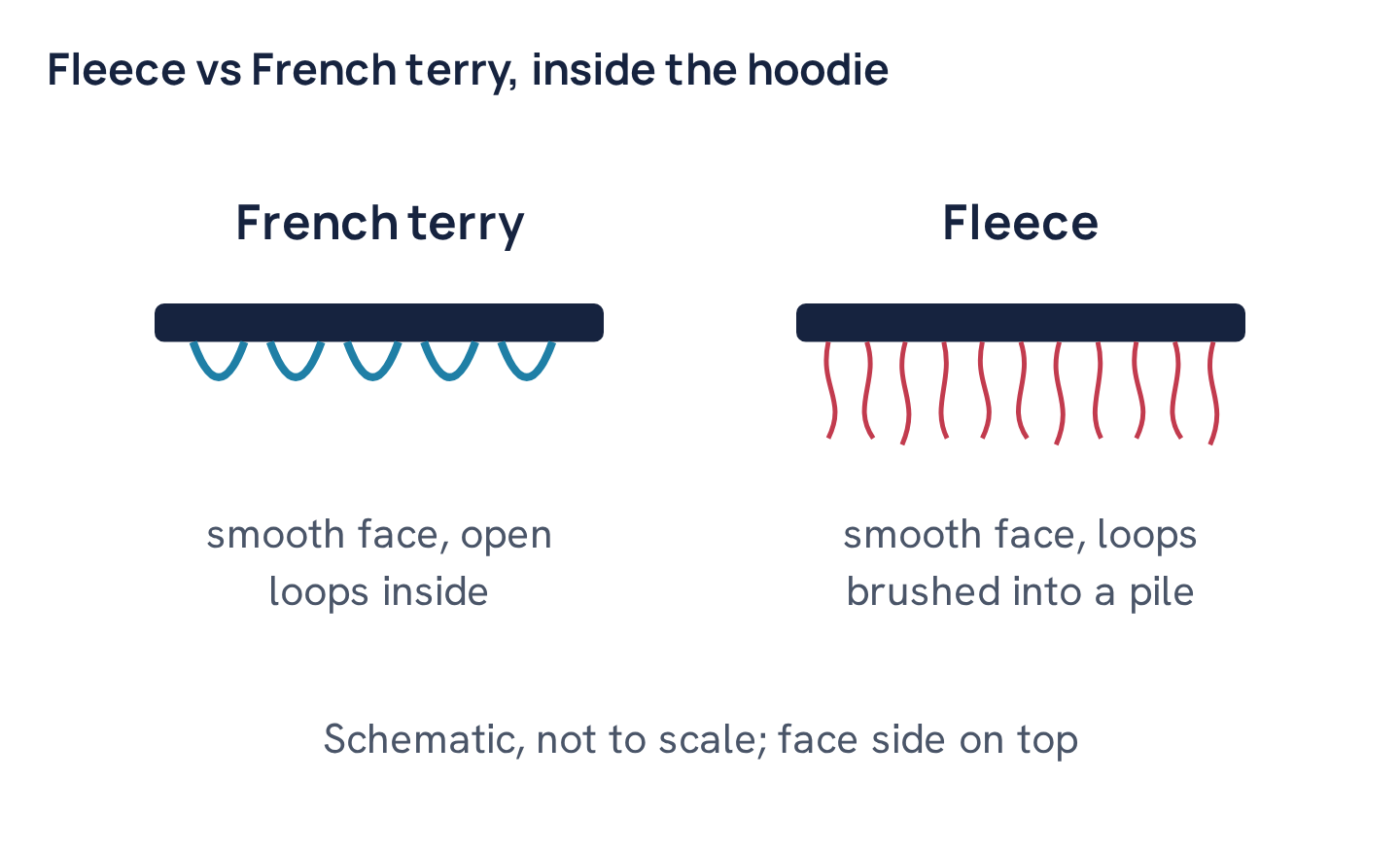
- Fleece (brushed back): knitted with extra loop yarns on the back, which are then brushed with wire rollers to raise a soft, fluffy pile. The pile traps air, so fleece is warm. Sometimes called sweatshirt fleece or brushed fleece.
- French terry (loop back): knitted the same way, but the back loops are left unbrushed. It is lighter, cooler, absorbs well and pills less. Often called loopback.
The same base fabric becomes fleece or terry depending on whether it is brushed. See what is French terry fabric and the fleece fabric development guide.
Cotton, polyester or a blend?
| Hoodie material | Feel and comfort | Shrinkage | Pilling | Best for |
|---|---|---|---|---|
| 100% cotton fleece or terry | Natural, breathable, soft | Highest; fleece and terry median 8% in our cotton records | Pills wear off | Everyday comfort, sensitive skin |
| Cotton-polyester (CVC) e.g. 80/20, 60/40 | Soft, slightly smoother | Lower; blends median 4% | Pills stay on more | Printed hoodies, all-round use |
| Polyester-rich (PC) e.g. 50/50, 65/35 | Smooth, light | Low | Pills stay on | Budget, team and promo wear |
| 100% polyester fleece | Light, warm, less breathable | Very low; polyester median 3% | Can pill unless anti-pill | Outdoors, sport, quick drying |
| Tri-blend (polyester, cotton, rayon) | Very soft, drapey, heathered | Low to medium | Moderate | Fashion hoodies |
Shrinkage figures are median length shrinkage of knit fabric after the dye-house wash test in our finishing records. Blends shrink less because polyester does not shrink and holds the cotton in place; see what is CVC fabric and what is poly cotton.
Hoodie weight: what GSM to look for
Fabric weight is given in grams per square metre (GSM) or ounces per square yard. As a general guide for hoodie fabric:
- Lightweight, about 200–260 GSM: French terry or thin fleece for spring, layering and warm climates.
- Midweight, about 280–330 GSM: the most common hoodie weight; warm enough for most of the year.
- Heavyweight, about 350 GSM and above: thick, structured streetwear and winter hoodies.
Heavier is not always better: a dense 330 GSM fleece in good yarn can wear better than a loose 400 GSM one. See what is GSM in fabric.
Why hoodies pill
Hoodie fabrics are made to be soft, and softness means loose fibre on the surface, especially on brushed fleece. Rubbing at the cuffs, sides and under bag straps rolls that fibre into pills. With polyester in the blend, the pills stay attached instead of breaking off. In our 316 outside lab reports on knit developments, pilling failures were concentrated in heavy fleece and terry around 330 GSM tested at 2,000 Martindale rubs, where 9 of 16 such fabrics failed. Factories reduce this with better loop yarn, singeing, tighter knitting and moderate brushing. See why fleece and sweatpants pill.
Why hoodies shrink
Cotton hoodies shrink mainly because the knit loops, stretched during processing, relax when washed and tumbled, and because cotton swells in water. In our records of 100% cotton knits, fleece and terry shrank a median 8% in length, more than single jersey at 5%. Cotton-polyester fleece shrinks much less. A good factory dries the fabric without stretching it and compacts it; a “pre-shrunk” label means this has been done, though some shrinkage still remains. See what does pre-shrunk mean.
Printing on hoodies
The material also decides how a hoodie can be printed. Screen printing works on cotton and blends. Direct-to-garment printing works best on high-cotton fabrics. Sublimation works only on light polyester, because the dye bonds only to polyester; on a cotton hoodie it washes out. Heat-transfer and DTF prints work on most blends, but polyester fleece needs lower press temperatures to avoid shine and dye migration from dyed polyester. See heat presses for sublimation.
Common mistake: choosing a very soft, heavily brushed CVC fleece hoodie for a gym bag. The deep pile feels great in the shop, but rubbing against the bag and straps makes it pill fast, and the polyester keeps the pills on. For heavy daily use a French terry or a less brushed, tighter fleece holds up better.
Other hoodie materials
- Waffle and thermal knits: textured knits with small pockets that trap air; light but warm, used for lounge hoodies. See the waffle fabric development guide.
- Sherpa or teddy-lined: a polyester pile lining inside a cotton or blend shell for extra warmth.
- Interlock and scuba: smooth, double-faced knits for structured, sporty hoodies; see what is scuba fabric.
- Polyester-spandex tech knits: stretchy, quick-drying hoodies for running and the gym.
- Melange or heather fleece: fleece knitted from yarn that mixes dyed and undyed fibres, giving the classic grey marl look; see what is heather fabric.
How to judge hoodie quality in the shop
- Check the inside: fleece should be evenly brushed without bald patches; French terry loops should be even and tight.
- Feel the weight and density: a dense fabric that springs back when squeezed wears better than a loose, heavy one.
- Look at the ribbing: cuffs and hem should recover quickly when stretched; slack ribbing will sag.
- Check the seams: flat, even seams and reinforced hood and pocket corners show good make.
- Read the label: fibre content, weight if given, and whether it is pre-shrunk.
- Rub the face: heavy fuzzing after a few rubs with your thumb is an early sign of pilling.
How hoodie fabric is dyed and finished
A cotton or CVC fleece is knitted as a tube, dyed in a jet or winch machine, then slit, dried, brushed or left as terry, and compacted. Cotton parts are dyed with reactive dyes; polyester parts need disperse dyes at high temperature, so a CVC fleece is dyed in two stages. Fabric with polyester must be finished at lower stenter temperatures, about 100–110°C, to avoid dye bleeding. See the fleece dyeing and finishing flowchart.
Worked example. You want one hoodie for everyday wear, printed with a logo, that keeps its size. A midweight 300 GSM CVC fleece (about 60/40 cotton-polyester) shrinks less than 100% cotton, takes a screen print well, and is warm. If you want maximum comfort and breathability and do not mind a little shrinkage, choose 100% cotton French terry and wash it cool.
Which hoodie material for which use?
- Lounging at home: 100% cotton or tri-blend French terry for softness and breathability.
- Cold weather: heavyweight cotton or CVC fleece, 330 GSM or more, or a sherpa-lined hoodie.
- Gym and running: polyester or polyester-spandex tech fleece that dries quickly.
- Printed merchandise: CVC fleece, which holds its size and takes most print methods.
- Sensitive skin: cotton, with a soft brushed or loop back and no heavy finish.
How to care for a hoodie
- Wash inside out at 30°C with similar colours.
- Close the zip and empty pockets.
- Do not wash with jeans, towels or rough items that rub the surface.
- Line dry, or tumble on low; hot drying shrinks cotton and flattens fleece.
- Do not iron prints directly.
Summary
- Hoodies are usually fleece (brushed back) or French terry (loop back).
- Cotton breathes best but shrinks most; blends shrink less; polyester is light and quick drying.
- Most hoodies weigh about 260–350 GSM; heavier is warmer but not always better.
- Brushed fleece with polyester pills most; terry pills least.
- Wash cool, inside out, and dry low to keep size and surface.
Questions
What material are hoodies made of?
Usually fleece or French terry knitted from cotton, polyester or a cotton-polyester blend such as 80/20 or 60/40.
What is the best hoodie material?
For comfort and breathability, cotton; for size stability and printing, a cotton-polyester blend; for light warmth and quick drying, polyester fleece.
Is fleece or French terry better for a hoodie?
Fleece is warmer and softer inside; French terry is lighter, cooler, more absorbent and pills less.
What GSM is a good hoodie?
Lightweight hoodies are about 200 to 260 GSM, midweight about 280 to 330 and heavyweight 350 and above.
Why does my hoodie pill?
Brushed fleece has loose fibres on the surface that rub into pills, and polyester in the blend keeps the pills attached.

Textile engineer with 14+ years in dyeing and fabric development. He writes every guide on Dyeing Solution from real production work. Full profile