
Cashmere pills because its fibres are very fine and often short, and its yarns are soft and loosely knitted. Why it happens, whether pilling means poor quality, how to judge cashmere, how to remove pills and how to wash and store cashmere to keep pilling down.
At a glance
14–19 µmfibre fineness
Normalat first
Combdo not pull
Two-plypills less
Cashmere pills because its fibres are extremely fine, soft and fairly short, and they are spun and knitted loosely to make the garment feel light and warm. Rubbing pulls loose fibre ends out of the yarn and rolls them into small balls. Almost every cashmere sweater pills to some degree, especially in the first weeks and wherever it rubs: under the arms, at the sides, on the cuffs and under bag straps. Pilling is not proof of a bad sweater, but heavy, never-ending pilling usually points to short fibres or a loosely made yarn.
This guide explains why cashmere pills, what affects how much it pills, how to tell better cashmere from cheaper cashmere, how to remove pills safely, how to wash and store cashmere to keep pilling down, and how cashmere compares with merino, lambswool and acrylic. It is written from the textile-testing side, where pilling is a standard test on knitwear and knit fabrics.
Why does cashmere pill?
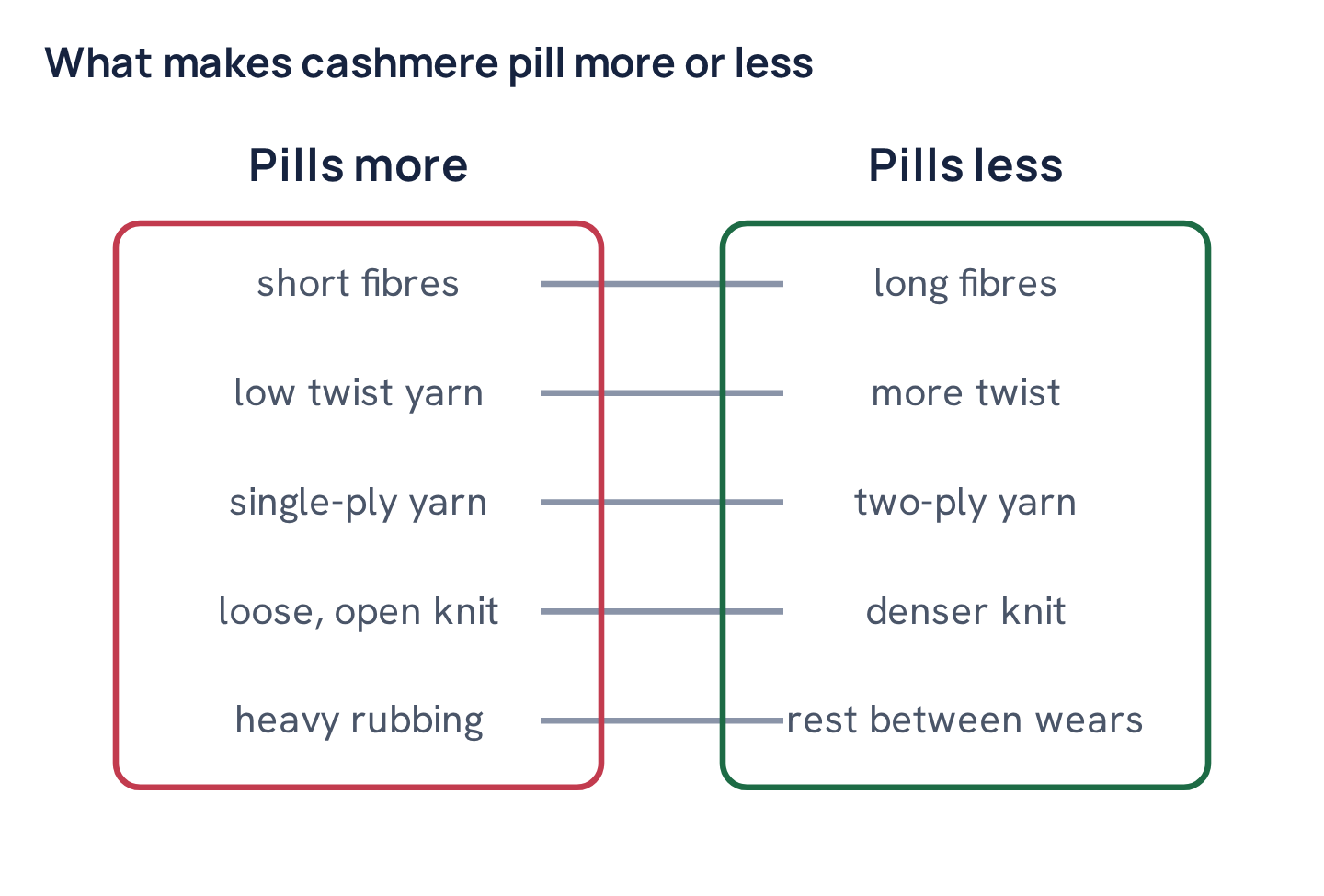
Cashmere comes from the soft undercoat of cashmere goats. Its fibres are very fine, roughly 14–19 microns across, which is finer than most wool, and many of them are relatively short. Several things combine:
- Fine fibres: they bend and tangle easily, so loose ends roll into pills quickly.
- Short fibres: short fibres have less length held inside the yarn, so they slip out more easily.
- Low twist: cashmere yarns are often lightly twisted for softness and loft, which holds the fibres less firmly.
- Loose knitting: many cashmere sweaters are knitted at a fine gauge but with a soft, open structure.
- Friction: arms rubbing the body, bags, seat belts and desks pull fibres out.
The general pilling process is the same for all knitwear: fuzz forms, the fuzz tangles into pills, and the pills either break off or stay. See why fleece and sweatpants pill for how the same process works on other fabrics.
Does pilling mean cheap cashmere?
Not by itself. Good cashmere also pills a little at first, because there are always some short, loose fibres near the surface. Once those have worked out and been removed, pilling slows down. Signs of lower-quality cashmere are:
- Pilling that keeps returning heavily after many de-pillings.
- A very fluffy, hairy surface when new, often from heavy brushing to make short fibres feel soft.
- A thin, light sweater at a very low price; fine, long cashmere is expensive.
- Single-ply yarn knitted loosely, which feels soft in the shop but wears quickly.
- A blend label hiding a large share of wool, nylon or other fibres.
Where cashmere pills first, and why
Pills appear in a predictable pattern, and it tells you that friction, not washing, is the main cause:
- Under the arms and at the sides: your arms rub the body with every step.
- Cuffs and forearms: they rub on desks, keyboards and table edges.
- Shoulders and back: bag straps and backpacks.
- Front at waist height: seat belts and kitchen counters.
- Inside of the collar: hair and coat collars.
If your sweater pills mainly in one of these places, changing what rubs there, such as moving a cross-body bag or wearing a smoother coat, reduces pilling more than any washing method.
Cashmere blends
Many sweaters mix cashmere with other fibres to cut cost or change the handle. A cashmere-wool blend is warm and sturdier, with pills that often fall away. Cashmere-silk is lighter and smoother and tends to pill less. Cashmere-cotton is cooler and pills less, but it feels less lofty. Cashmere-nylon and cashmere-polyester blends are cheaper and stronger, but the synthetic fibre anchors pills so they stay on, just as with acrylic. Read the percentages: a “cashmere blend” can contain as little as a few percent cashmere.
Is expensive cashmere worth it for pilling?
Price buys longer fibre, better spinning and denser knitting, and those are exactly the things that reduce pilling. A well-made two-ply sweater from longer fibre will usually pill less, recover its shape better and look good for many seasons, while a very cheap one may look tired within weeks. The difference is not the label or the brand name, but the fibre length, yarn and knit, which is why feel, weight and density are better guides than price alone.
How to judge cashmere before buying
- Feel the surface: it should be soft but not excessively fuzzy. Very long “hair” on the surface often means brushing to hide short fibre.
- Stretch gently: a well-knitted sweater springs back; a loose one stays stretched.
- Hold it to the light: a dense knit lets little light through; a thin, open knit pills sooner.
- Check the ply: two-ply yarn is generally more durable than single-ply.
- Read the label: “100% cashmere” or a stated blend. Fibre content is checked in labs by microscopy; see how fibre content is tested.
How pilling is tested
Knitwear and knit fabrics are tested for pilling by rubbing samples in a controlled way, for example on a Martindale tester or in a tumbling pilling box, and then grading them against photographs from 5 (no pilling) to 1 (very severe pilling). Many buyers ask for grade 3 or better. In our 316 outside lab reports on knit developments, 266 included a pilling result and only 19 failed, but the fails were concentrated in soft, fuzzy, loosely constructed fabrics tested hard. Soft, lofty knitwear such as cashmere tends to grade lower than firm cotton knits for the same reason. See how pilling tests work.
How to remove pills from cashmere
- Cashmere comb: a fine-toothed comb made for knitwear; lay the sweater flat and comb lightly in one direction.
- Sweater stone: a pumice-like block that lifts pills; use very light strokes.
- Small scissors: snip larger pills individually without pulling.
- Fabric shaver: possible on a low setting with a guard, but use with great care on fine cashmere, as it can cut the yarn.
Always work on a flat, firm surface, hold the fabric smooth, and stop as soon as the surface looks clean. Never pull pills off with your fingers; that drags more fibre out and starts the next pill.
Common mistake: de-pilling a new cashmere sweater every day. Over-combing thins the fabric and keeps pulling fresh fibres to the surface. De-pill when pills are visible, a few times in the first weeks, then only as needed.
How to wash cashmere to reduce pilling
- Hand wash in cool water with a wool or cashmere detergent, or use a wool cycle with a low spin.
- Turn the sweater inside out.
- Squeeze gently; never rub, scrub or wring.
- Roll in a towel to remove water.
- Dry flat, reshaping it, away from heat and sun.
- Never tumble dry: heat and tumbling also felt and shrink cashmere, as with wool; see shrinkage by fibre.
How to wear and store cashmere
- Rotate sweaters; let each rest a day or two between wears so the fibres recover.
- Avoid cross-body bags, rough jackets and seat belts rubbing the same spot.
- Fold cashmere; hanging stretches the shoulders.
- Store clean, in breathable bags, with moth protection.
- Wear a smooth layer under a cashmere sweater rather than a rough one.
Cashmere vs merino, lambswool and acrylic
| Fibre | Softness | Pilling | Notes |
|---|---|---|---|
| Cashmere | Very high | Medium to high at first | Pilling slows after loose fibres are removed |
| Fine merino | High | Low to medium | Longer fibres stay anchored better |
| Lambswool | Medium to high | Medium | Pills often fall away |
| Acrylic | Medium | High | Strong fibre holds pills on |
| Cashmere-silk or cashmere-cotton | High | Lower than pure cashmere | Smoother companion fibre reduces pilling |
Worked example. A new two-ply cashmere sweater shows small pills under the arms after the first two weeks. Combed off gently on a flat surface, they return more slowly the next month and are minor by winter’s end. A cheap, fluffy single-ply sweater, by contrast, pills heavily all over within days and keeps doing so; its fibres are short and loosely held, and no amount of care will fully change that.
Summary
- Cashmere pills because its fibres are very fine and often short, and its yarns are soft and lightly twisted.
- Some pilling at first is normal; persistent heavy pilling suggests short fibre or loose yarn.
- Remove pills with a comb, stone or scissors, never by pulling.
- Hand wash cool, dry flat, rotate sweaters and avoid friction.
- Two-ply, denser knits in longer fibres pill less.
Questions
Why does cashmere pill?
Its fibres are very fine and often short, and cashmere yarn is lightly twisted and loosely knitted for softness, so rubbing easily pulls fibres out into pills.
Does pilling mean cheap cashmere?
Not on its own. Good cashmere pills a little at first. Heavy pilling that never stops suggests short fibres, loose single-ply yarn or heavy brushing.
How do I remove pills from cashmere?
Use a cashmere comb, sweater stone or small scissors on a flat surface with light pressure. Do not pull pills off by hand.
Will cashmere stop pilling?
Usually it slows down a lot once the loose surface fibres have been removed in the first weeks of wear.
How should I wash cashmere?
Hand wash cool with a wool detergent, squeeze gently, roll in a towel, and dry flat. Never tumble dry.

Textile engineer with 14+ years in dyeing and fabric development. He writes every guide on Dyeing Solution from real production work. Full profile