Why two lots dyed to the same approved shade, or a body and its rib, come out different: how to confirm it, the causes from yarn to finishing, prevention, topping, stripping and shade sorting.
At a glance
~4 in 10Orders with a body plus matching rib or collar
~18 kgMedian batch size in our records
ΔE CMCAgreed tolerance against the standard
2 triesCommon limit before rejecting a lot
Lot-to-lot shade variation is when two batches dyed to the same approved shade do not match each other. Each lot may look fine on its own. The problem shows when lots meet: on the cutting table, in a carton, or in one garment where the body comes from one lot and the collar from another. It is one of the most common reasons for shade complaints in knit dyeing. It is also one of the hardest to prevent, because almost every step from yarn to finishing can move the shade a little, and small moves add up. This article explains how to confirm the fault, how to tell it apart from look-alikes, where it comes from, how to prevent it, and how to correct or sort a lot that has already gone off.
What lot-to-lot shade variation looks like
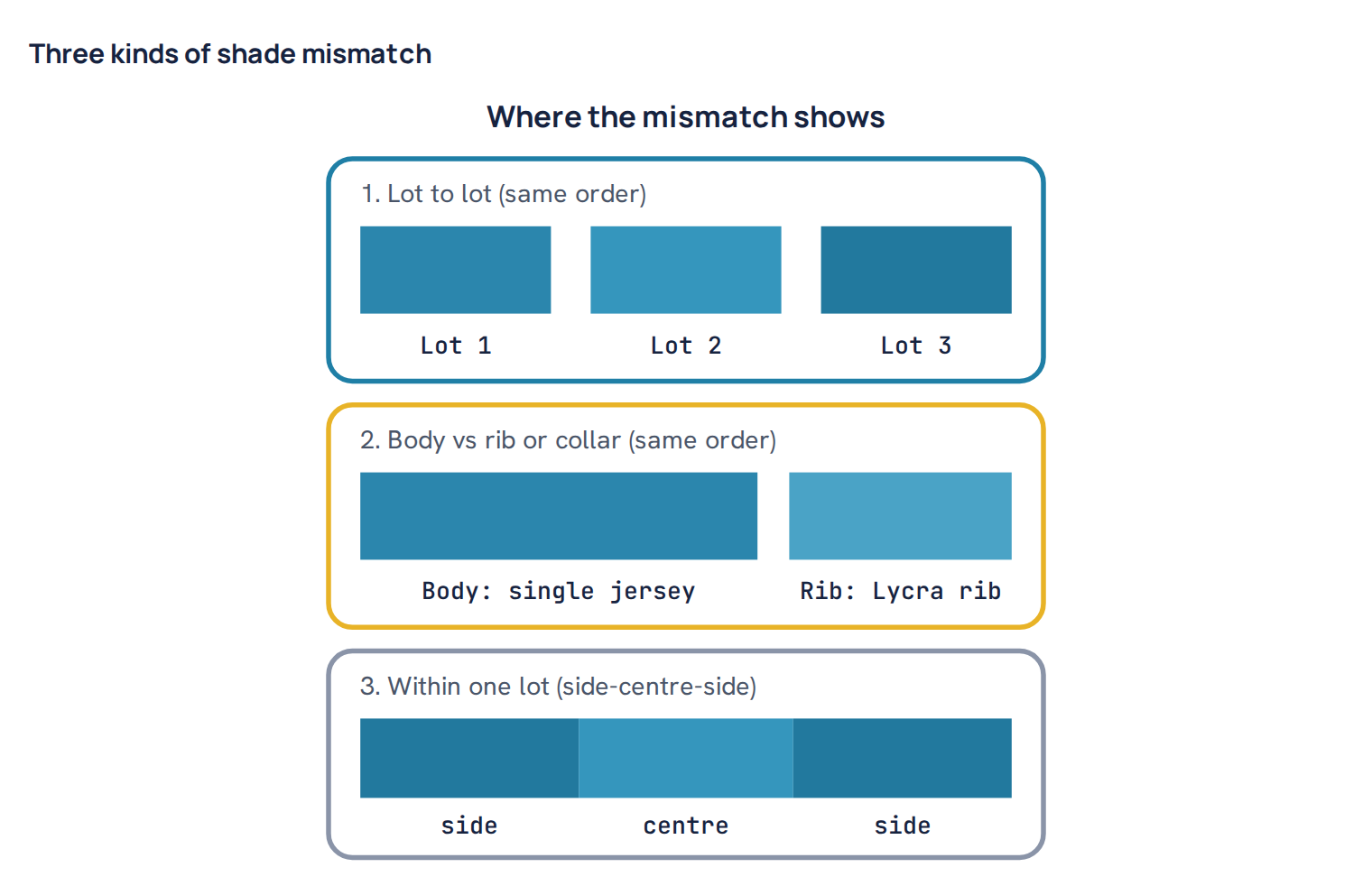
The fault comes in two main forms. The first is batch-to-batch variation: lot 1, lot 2 and lot 3 of the same order are each level, but one is a little lighter, redder or duller than the others. The second is component mismatch: the body fabric and its matching rib, collar or cuff fabric are dyed to the same shade but do not match when sewn together. This second form is very common in knit orders. In our dye house records, about 4 in 10 orders are a body fabric plus a matching rib or collar fabric, such as single jersey with 1×1 rib or with Lycra (elastane) rib. These two fabrics are often knitted from different yarns, yet the buyer sees them side by side on the neck of every garment.
A third form, a shade difference from one edge of the same lot to the centre, is a different fault with different causes. It is covered in the article on listing and side-centre-side shade variation.
How to confirm the fault
Many shade complaints turn out to be a viewing problem, not a dyeing problem. Before you blame the dyeing, confirm the difference under controlled conditions.
- Condition the samples first. Wet or warm fabric looks deeper than dry fabric, and fabric straight off the stenter can read differently from fabric that has rested. Let samples cool and take back normal moisture before judging. For instrument readings, many labs condition in a standard atmosphere of about 20 °C and 65% relative humidity.
- Cut and compare side by side. Cut a piece from each lot and lay them edge to edge, same direction of knit, same face up. Fold each sample to enough layers that the background does not show through. Do not compare a single layer of one lot with a folded piece of the other.
- Use a light box with more than one light. Check under daylight (D65) first, then under the buyer’s store light (often a fluorescent such as TL84) and incandescent (A). If the lots match in one light and not in another, you have metamerism between lots, which points to a recipe difference rather than a simple depth difference.
- Check face and back. For plated fabrics such as Lycra single jersey or fleece, face and back show different fibres. A lot can match on the face and miss on the back, or the reverse.
- Measure. Read both lots against the approved standard on the spectrophotometer, with the same instrument settings, the same number of folds and the same aperture. Look at the parts of the difference, not only the total: is it lightness (ΔL), chroma (ΔC) or hue (ΔH)? The breakdown tells you where to look. The background is in the article on colour measurement, CIELAB and Delta E.
Telling it apart from look-alike faults
Several faults can make two pieces of the same order look different. The fix depends on which one you have, so name the fault before you act.
| Fault | How it looks | Key test |
|---|---|---|
| Lot-to-lot shade variation | Each lot level, but lots differ from each other | Two lots side by side, each uniform inside |
| Barré | Repeating horizontal stripes inside one piece | Stripes follow knitting courses and feeders |
| Listing (side-centre-side) | Edges differ from centre within one lot | Compare edge and centre of the same roll |
| Uneven or patchy dyeing | Blotches, cloudy areas, streaks | Variation is random inside one piece |
| Crease marks | Lines or branches, often darker or lighter | Marks follow fold lines from the machine |
| Metamerism between lots | Lots match in one light, differ in another | Light box with two or three sources |
The important point is uniformity inside each piece. If each lot is level and the difference only appears between lots, you are dealing with shade variation. If stripes repeat across the width, read the article on barré in knit fabric. If the colour wanders inside one piece, see uneven and patchy dyeing.
Causes, from most common to least
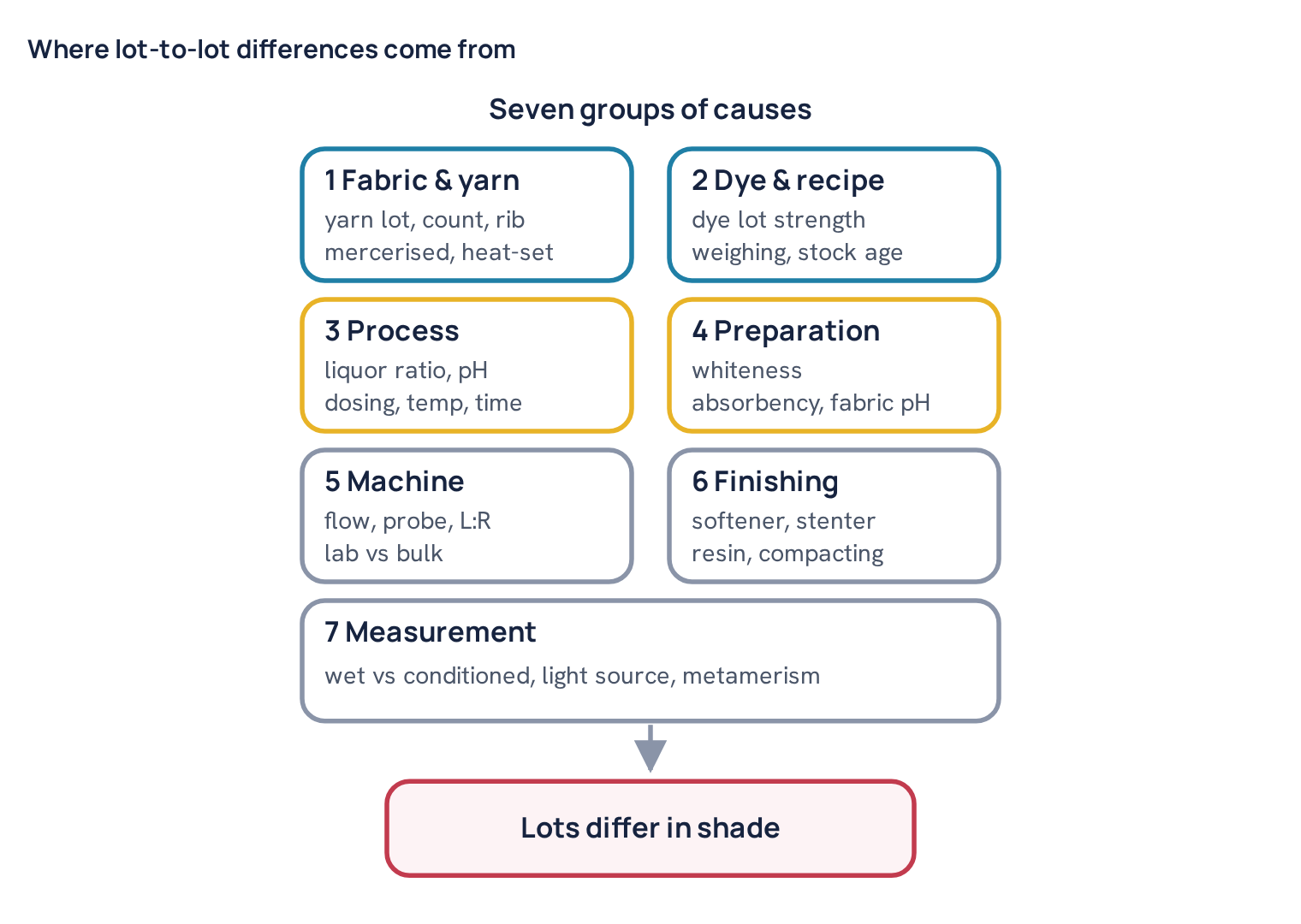
A shade is the result of how much dye goes into the fibre, which dyes go in, and how the finished surface reflects light. Anything that changes one of these from lot to lot changes the shade. The order below is a rough guide from knit dye houses. The real order in your plant depends on your fabric mix, machines and discipline, so use your own records to rank them.
1. Fabric and yarn
The fibre decides how much dye it can take, and cotton is a natural fibre that varies. Two yarn lots from the same count and the same spinner can still dye differently, because the cotton mix, fibre maturity and spinning conditions change. Yarn from a different spinner can differ even more. Immature cotton has thin cell walls; it takes less dye and looks lighter, and it shows as white specks in dark shades.
Other fabric causes are just as real:
- Mixed yarn lots. On our fabric register, about 1 in 5 entries lists more than one yarn lot for the same batch. Inside one piece that gives barré. Across lots it gives lot-to-lot drift, because lot A may be knitted mostly from one yarn lot and lot B from another.
- Mercerised against non-mercerised yarn. Mercerised cotton takes noticeably more dye and looks deeper and brighter. If the body is mercerised and the rib is not, they will never match on the same recipe.
- Count and construction. A finer count, a tighter loop or a different structure changes how light scatters from the surface. The same dye content can look a shade apart.
- Elastane content and heat-setting. Elastane takes little or no reactive dye, and in polyester-elastane blends the heat history of the polyester changes disperse dye uptake. Rolls heat-set at different temperatures or speeds can dye differently.
- Blend ratio. In CVC and other blends, a small change in the cotton-polyester ratio changes the balance between the two dye classes.
2. Dye and recipe
Commercial dyes are standardised by the maker, but each new dye lot can still differ a little in strength and sometimes in hue. A few percent strength change in one component of a three-dye recipe is enough to move the hue. Then there is weighing. Small batches make this worse, because the dye weights become tiny. In our dye house records, the median batch is about 18 kg, and about 6 in 10 batches are 20 kg or less. In a light shade, that means some dyes are weighed in single grams.
Worked example. An 18 kg batch of a pale shade needs 0.08% yellow, 0.02% red and 0.015% blue on the weight of fabric. That is 14.4 g yellow, 3.6 g red and 2.7 g blue. A weighing error of 0.3 g on the blue is about 11% of that dye, which is enough to move the hue visibly. If the blue is instead taken from a fresh 5 g/L stock solution, 2.7 g is 540 mL. A 5 mL error on 540 mL is under 1%. This is why small batches in pale shades should be dispensed from stock solutions or by an automatic dispenser, not weighed as powder.
Stock solutions also have a life. Reactive dyes slowly react with water (hydrolyse) in solution, faster when the solution is warm or alkaline. Hydrolysed dye still colours the bath but no longer fixes, so an old stock gives a weaker, often off-hue result. Make reactive stocks fresh and use them the same shift. For the basic arithmetic, see dyeing recipe calculation.
Common mistake: Opening a new dye lot halfway through an order without checking it. Lots 1 to 4 match, lot 5 is redder, and nobody links it to the new drum. Check every new dye lot against the retained standard with a lab dyeing before it goes to bulk.
3. Process: liquor ratio, dosing, pH, temperature and time
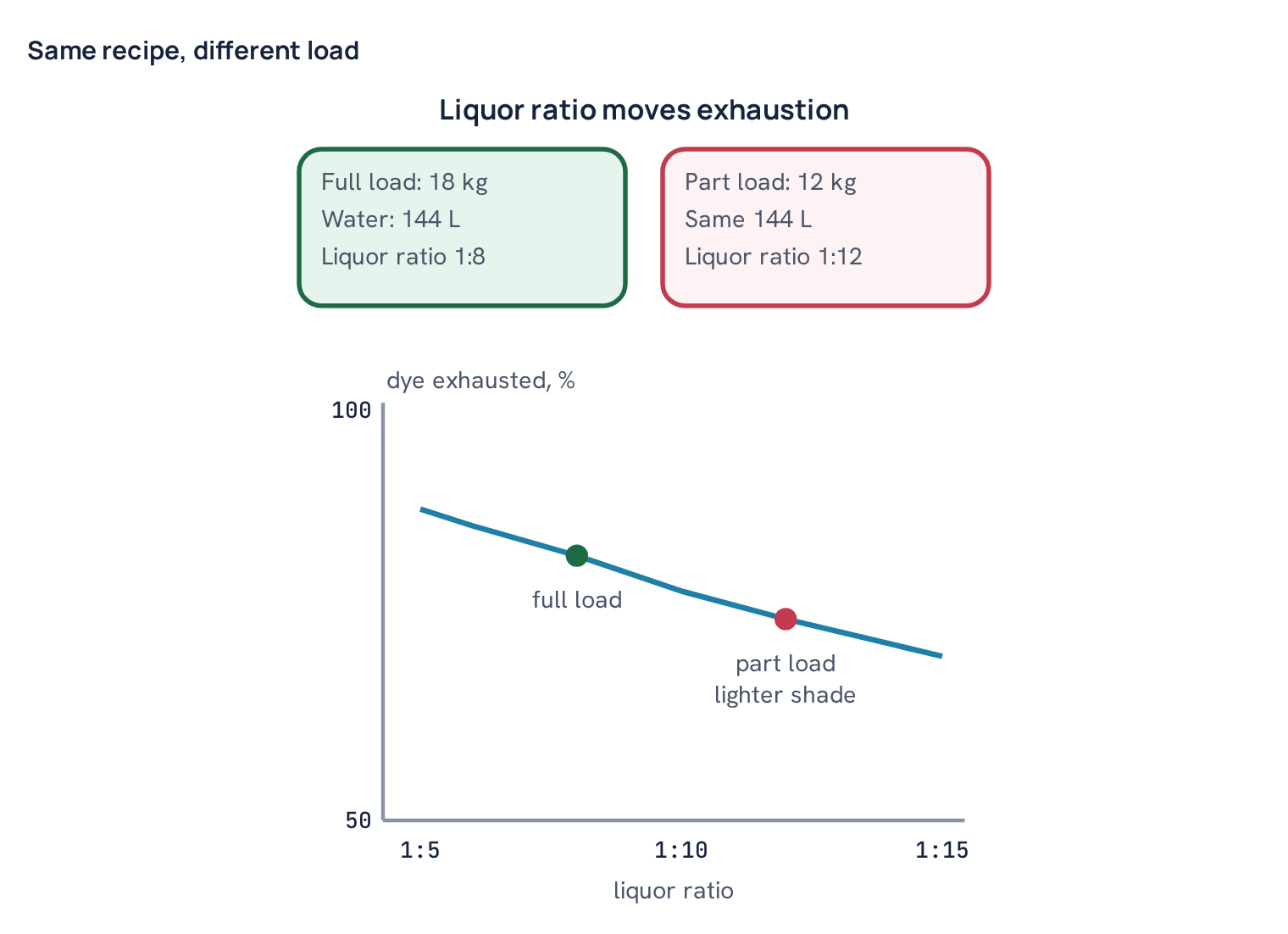
The dyeing process controls how much of the dye in the bath ends up fixed in the fibre. Every lot must see the same conditions. The most common slip is the liquor ratio. Dye is weighed on the weight of fabric, but salt and alkali are usually dosed in grams per litre, and exhaustion depends on how much water there is. If a machine is filled to a fixed level regardless of the load, a part load runs at a longer liquor ratio. More of the dye stays in the water, and the lot comes out lighter.
Other process causes include:
- Heating and dosing profile. A faster heating rate or a quicker alkali dose changes how the dye is taken up. Change the profile and you change the result, even with the same recipe.
- pH. Reactive dye fixation depends on the alkalinity of the bath; disperse dyes on polyester are normally run in a weakly acidic bath. A bath that drifts from its usual pH from lot to lot gives a different fixation, and some dyes are more sensitive than others.
- Water hardness. Calcium and magnesium can combine with some dyes and auxiliaries and dull the shade. If the water quality changes from day to day, shades follow, so check hardness at the machine, not only at the treatment plant.
- Temperature and time. A temperature probe that reads 2 °C high, or a holding time cut short to save a cycle, changes fixation and the final hue, especially in blends where two dye classes each have their own best temperature.
- Washing-off. More or less soaping changes how much unfixed dye stays on the surface, which affects both depth and brightness.
Common mistake: Filling the machine to a fixed level for every batch, then dyeing a 12 kg lot in a machine set up for 18 kg. Water should be calculated from the actual fabric weight on the scale, not from the planned weight or the machine’s nominal capacity.
4. Preparation
The dyer never dyes raw fibre; he dyes whatever the preparation gives him. If one lot is fully bleached and another only scoured, or one lot is more absorbent than another, they will dye differently. In pale and bright shades, the whiteness of the base shows through, so a creamier base gives a duller, yellower result. Residual peroxide left after bleaching can damage some reactive dyes in the bath. Residual alkali or acid left in the fabric shifts the start pH of the dyebath. Every lot of an order should get the same preparation recipe, the same peroxide killing or neutralisation, and a check on fabric pH before dyeing.
5. Machine
Two machines that look the same can still dye differently. They may differ in real liquor ratio at a given load, in nozzle pressure and fabric speed, in heating power, and in how accurate the temperature probe is. A lab beaker machine differs from all of them. So a recipe that is right on one machine can be slightly off on the next. Where possible, run all lots of one order on the same machine, or on machines that you have checked against each other. Calibrate temperature probes and flow meters on a fixed schedule.
6. Finishing
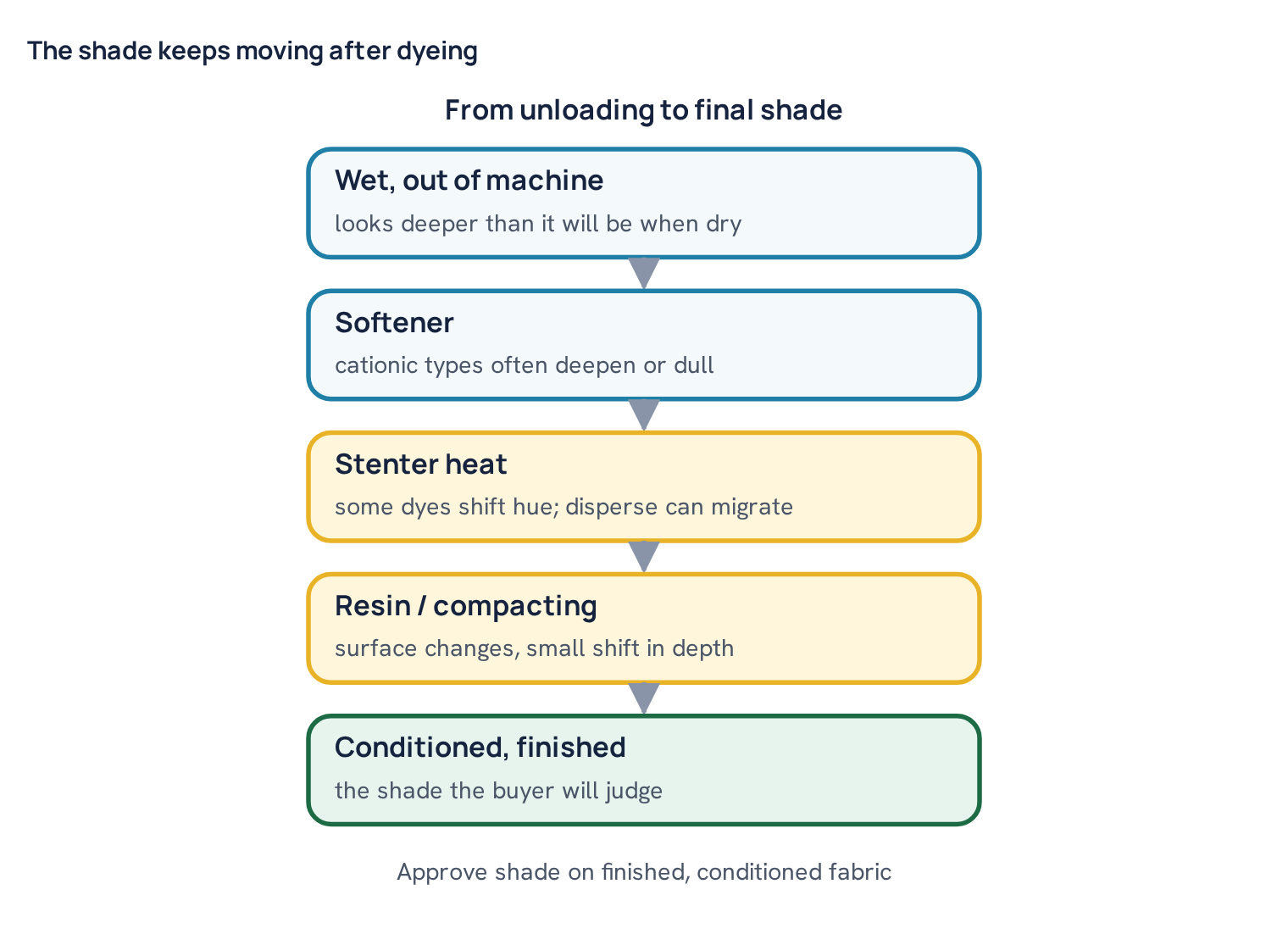
The shade at unloading is not the final shade. Softeners, especially cationic ones, can deepen or dull the colour. Silicone softeners can change how the surface reflects light. Stenter heat can shift the hue of some dyes, and on polyester it can move disperse dye to the surface. Resin finishes and compacting change the surface too. If one lot is finished at 150 °C and the next at 170 °C, or with a different softener dose, they can drift apart after both matched at the dye machine.
7. Measurement and viewing
Sometimes the lots are close and the measurement is the problem. A lot measured warm from the dryer, or a sample read with fewer folds, gives a different number. If one lot was judged under daylight and the next under shop fluorescent, the two decisions are not comparable. Metamerism adds another trap: if lot 3 was corrected with a different dye than lots 1 and 2, it may match them in daylight and miss under store lighting. Keeping the same recipe across lots is the best defence against this.
Body and rib: the special case
Body and rib mismatch deserves its own section because it is so common and so visible. The rib is often knitted from a different count, sometimes combed when the body is carded or the reverse, and often with elastane to give the collar stretch and recovery. Its structure is denser, so it reflects light differently. Elastane takes little reactive dye, so in a Lycra rib a part of the surface stays lighter, and the rib can look paler or slightly off-hue next to a 100% cotton body even when the cotton in both took the same dye. With so many body-and-rib orders, this is a daily problem, not a rare one.
Practical rules that help:
- Dye body and rib for the same garments in the same machine and the same batch when the load allows. Same bath, same history.
- When they must be dyed separately, make a lab dip on the actual rib fabric too. Do not assume the body recipe will fit the rib.
- Judge the match the way the buyer will see it: rib laid against the body, face up, in the buyer’s light.
- For elastane ribs, keep heat-setting and dyeing temperatures within the limits for the elastane, and keep them the same for every lot.
Quick diagnostic checklist
When two lots do not match, work through these questions in order. Most cases are solved before the end of the list.
- Were both samples conditioned, folded the same way and read with the same instrument settings and light?
- Is the difference mainly lightness, chroma or hue? A pure depth difference points to dye amount, liquor ratio or fabric uptake. A hue difference points to one dye component, pH or a dye lot.
- Do the lots match in one light and miss in another? Then the recipes are not the same.
- Were the yarn lots, spinner, count and mercerisation the same? Was the greige from the same knitting lot?
- Was the preparation the same, and was the fabric pH and whiteness the same before dyeing?
- Were the dye lots the same? Were stock solutions fresh?
- Was the water calculated from the actual fabric weight? Was the machine the same?
- Were the heating rate, dosing curve, pH, temperature and holding time the same as in the operating sheet?
- Were softener type and dose, stenter temperature and speed, and compacting the same?
Prevention: control every lot the same way
Prevention is about removing differences between lots. The goal is that the only thing that changes from lot to lot is the lot number. The settings below are typical; the right values depend on the dye class, machine and buyer, so take them as starting points.
| Control point | Typical practice |
|---|---|
| Yarn and greige | One yarn lot per order where possible; no mixed lots in one batch; record lot on every roll |
| Dye lots | Reserve the same dye lots for the whole order; lab-check each new lot against standard |
| Dispensing | Stock solutions or automatic dispensing for small weights; fresh reactive stock each shift |
| Liquor ratio | Water from actual fabric weight; fixed ratio per machine (often about 1:6 to 1:10 for jets; varies) |
| Water | Soft water; many dye houses aim below about 50 ppm hardness as CaCO₃ (varies) |
| Temperature | Probes calibrated; same heating rate and holding time every lot |
| pH and dosing | Check bath pH before and after alkali or acid; same dosing curve every lot |
| Finishing | Same softener, dose, stenter temperature and speed for the whole order |
| Tolerance | Agreed ΔE CMC limit with the buyer; often around 1.0 against standard (varies by buyer) |
Four habits make the biggest difference:
- Standard operating sheets. Every shade gets a written programme: recipe, liquor ratio, heating and dosing curve, pH targets, times, washing-off and finishing settings. The operator follows the sheet; changes are made only by the shift engineer and written down.
- A lab-to-bulk factor. Bulk machines rarely give the same depth as the lab. Many dye houses keep a factor for each machine type and dye class, built from their own history, and adjust the lab recipe by it before the first bulk lot. The method is explained in shade matching from lab dip to bulk.
- Right first time. Every addition or correction adds a difference between that lot and the others. A dye house that hits shade first time on most lots gets better lot-to-lot consistency almost automatically.
- Continuity cards. Keep a card for each order with a cutting from every lot, mounted next to the approved standard. Each new lot is compared with the standard and with the earlier lots, not only with the standard.
Common mistake: Checking each lot only against the standard. Lot 1 can sit at the light edge of tolerance and lot 2 at the dark edge. Both pass, yet they do not match each other. Compare new lots against earlier lots too, and sort them into shade bands.
Correction once a lot is off
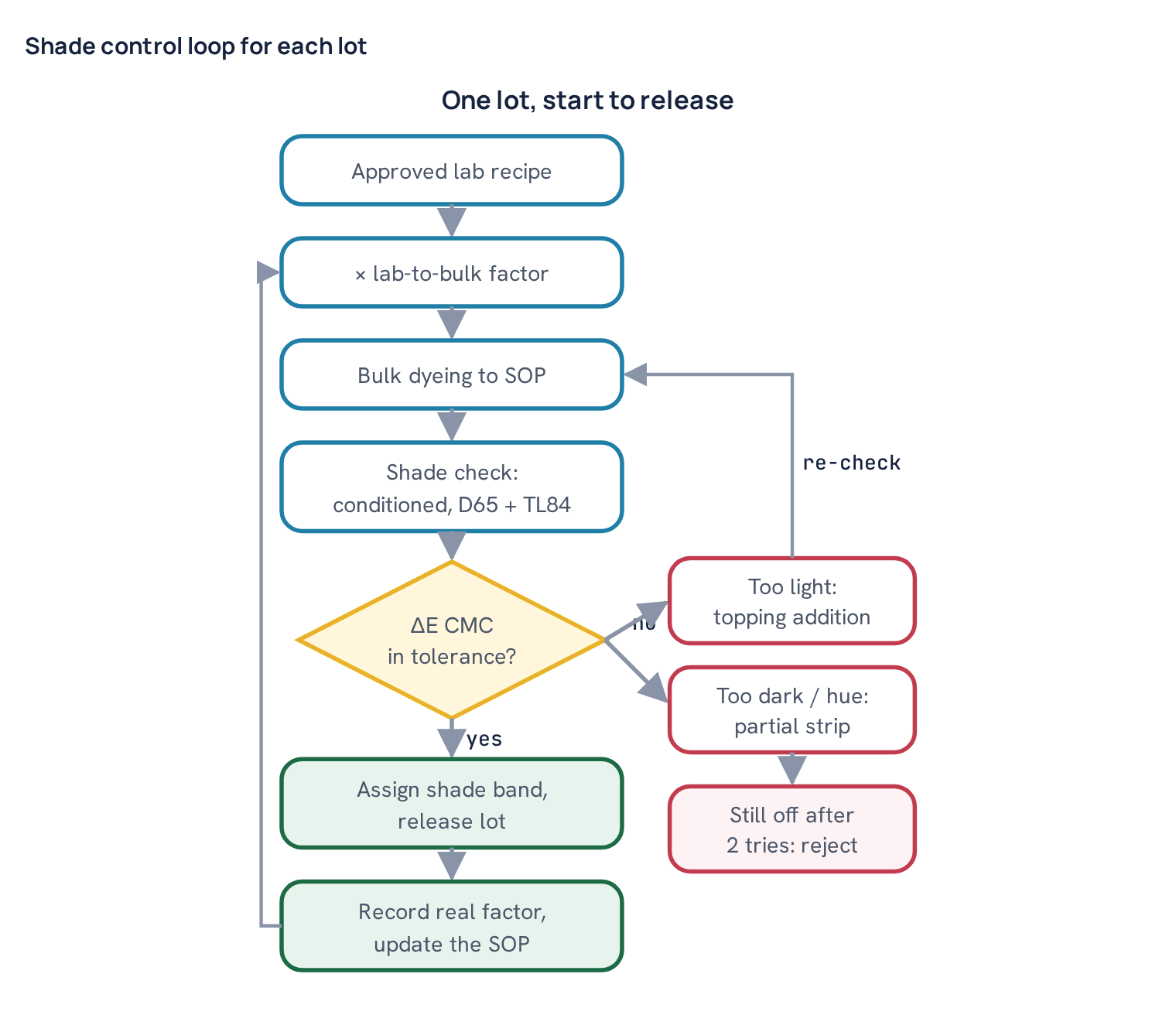
When a lot is outside tolerance, first decide what kind of difference it is, then pick the gentlest fix that will work. Every correction costs time, energy and fibre quality, and every one makes the lot a little more different in history from the others.
Too light: topping
A light lot is the easiest to fix. Calculate a small addition from the measured difference, usually only the dyes needed to correct the depth or the hue, at a fraction of the original recipe. Add it at the right point in the cycle: for reactive dyes, with enough salt and alkali in the bath so the addition fixes, then wash off as normal. Make additions in small steps. Overshooting turns a light lot into a dark one, which is much harder to fix.
Too dark or wrong hue: partial strip
A dark lot needs some dye removed. For reactive-dyed cotton, a partial strip, often a reducing or oxidising treatment under controlled conditions, takes some colour out, after which the lot is re-shaded. Stripping is never perfectly even and it attacks some dyes more than others, so the hue after stripping may differ from what you expect. It also costs strength, handle and, for elastane fabrics, stretch. The details are in stripping reactive-dyed cotton knit.
Within tolerance but different: shade sorting
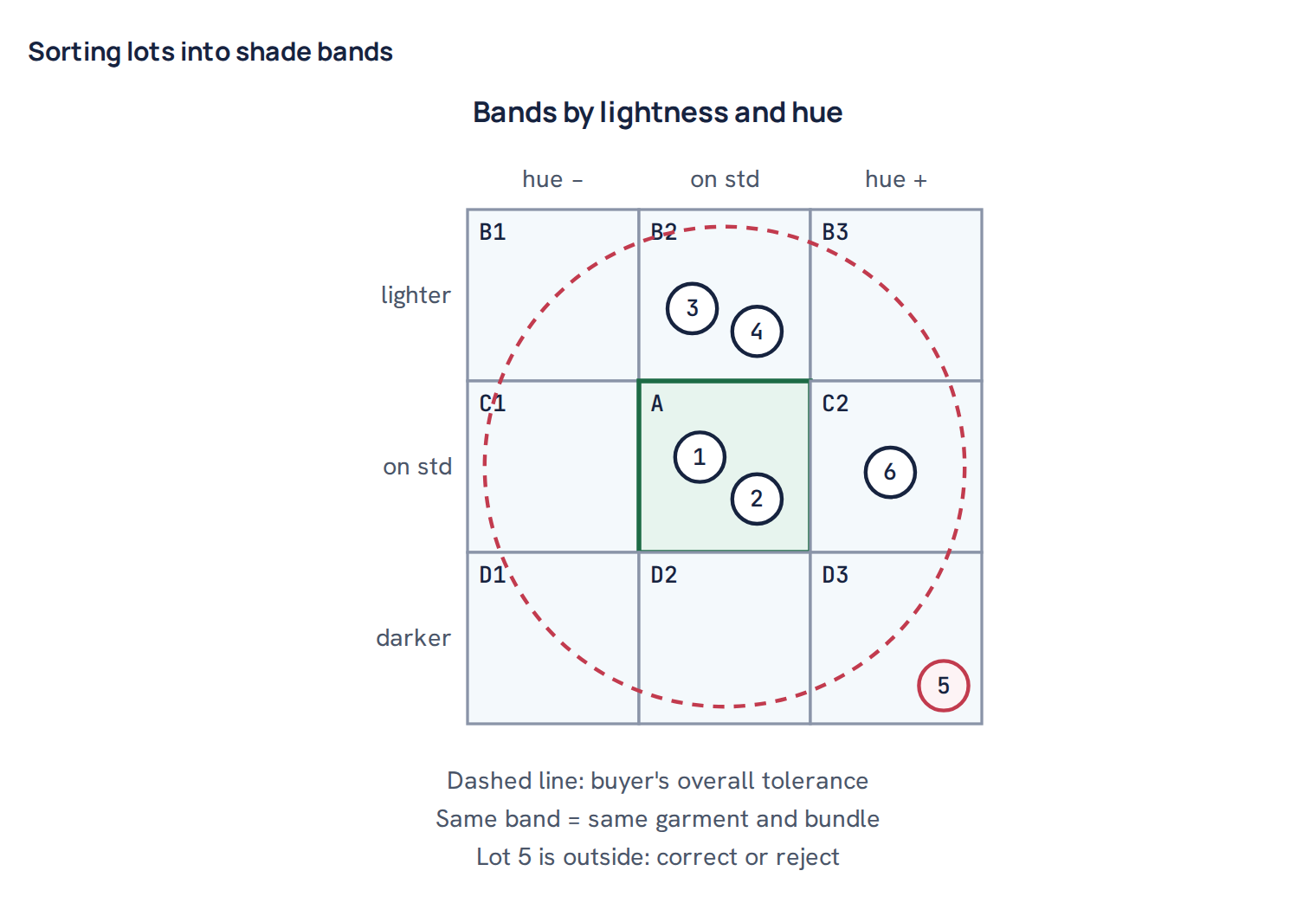
Often every lot is inside the buyer’s tolerance, but the lots are not identical to each other. The answer is shade sorting into bands. Each lot is measured against the standard and given a band code by its lightness and hue difference. The cutting room then cuts each garment, and each bundle, from a single band. A garment made from one band will not show a mismatch, even if the bands differ slightly from each other.
When to stop and reject
Know when to stop. A practical limit in many dye houses is two correction attempts. If a lot is still outside tolerance after that, more work usually makes it worse. Reject or re-dye to a darker shade for another order when:
- the lot is metameric against the others and cannot be fixed without changing the recipe;
- a strip has visibly harmed strength, handle, surface or elastane recovery;
- the correction would leave the lot level in colour but out of the order’s shade bands, so it cannot be cut with the other lots;
- the cost of further processing is higher than the value of the fabric.
What to record so it does not repeat
Shade variation repeats when nobody can see what was different about the bad lot. Good records turn a mystery into a quick comparison. For every lot, record:
- yarn lots, spinner, count and greige knitting lot for body and rib;
- preparation recipe, fabric pH and a whiteness or absorbency check;
- actual fabric weight on the scale, water volume and the real liquor ratio;
- machine number, programme, heating rate, dosing curve, pH readings, temperatures and times;
- dye and chemical lot numbers, and the age of each stock solution;
- every addition or strip, with amounts and the reason;
- finishing settings: softener and dose, stenter temperature and speed, compacting;
- measured ΔL, ΔC, ΔH and ΔE CMC against the standard, the light sources used, and the shade band assigned.
Keep the continuity card for each order with a cutting from every lot. When a complaint comes, you can lay the card out in five minutes and see which lot drifted and in which direction. Over months, the same records show which machines, yarn sources and shade families give the most trouble. That tells you where to spend effort first, and it lets you set a realistic lab-to-bulk factor for each machine instead of guessing.
Questions
What is lot-to-lot shade variation?
It is when separate batches dyed to the same approved shade do not match each other, even though each batch is level on its own. It shows when lots meet in cutting or in one garment.
Why does the rib or collar not match the body fabric?
The rib is often knitted from a different count or yarn type and often contains elastane, which takes little reactive dye. Its denser structure also reflects light differently, so the same recipe rarely gives an exact match without a separate lab dip.
How do small batches affect shade consistency?
Small batches mean very small dye weights in pale shades, so a fraction of a gram changes the recipe by several percent. Dispensing from fresh stock solutions or an automatic dispenser greatly reduces this error.
What is shade banding or shade sorting?
Each lot is measured against the standard and given a band code by its lightness and hue difference. The cutting room cuts each garment and bundle from a single band, so lots that differ slightly never meet in one garment.
Can a lot that is too dark be corrected?
Yes, by a controlled partial strip followed by re-shading, but stripping can be uneven and can reduce strength, handle and elastane stretch. If the lot is still off after about two correction attempts, it is usually better to reject it.

Textile engineer with 14+ years in dyeing and fabric development. He writes every guide on Dyeing Solution from real production work. Full profile