Why horizontal stripes repeat down circular knit fabric, how to trace them to a yarn lot or feeder, which dyes reveal or hide them, and the honest limits of correction after dyeing.
At a glance
1 feederone odd yarn package gives one odd course per machine revolution
1 in 5fabric register entries in our records listing more than one yarn lot
~37%of our batches contain elastane, where draft differences can cause barré
Greigethe cheapest stage to catch barré, before any dyeing
Barré is one of the most frustrating faults in knit dyeing. The fabric comes out of the machine with the right shade, but when you hold it up to the light you see thin lines or wider bands running across the width, repeating down the length like a faint ladder. The buyer calls it a dyeing fault. The dye house usually knows it is not. In most cases the stripes were already built into the greige fabric by the yarn or the knitting machine, and the dyeing only made them visible. This article explains why barré forms, how to prove where it comes from, which dyes and processes reveal it or hide it, and what the dye house can realistically fix once a lot is already faulty.
What barré looks like
Barré (also written barre or barriness) is a repeating, horizontal stripe in knit fabric. On circular knit fabric it runs course-wise, which means across the width of the fabric, parallel to the rows of loops. Each stripe may be one course wide, giving a fine line, or many courses wide, giving a broad band. The key feature is that it repeats. When you measure from one stripe to the next, the distance is the same, or follows a clear pattern, all along the roll.
Barré shows in several ways:
- Shade difference. Some courses are slightly darker or lighter than the rest. This is the classic form and is usually caused by yarn that takes up dye differently.
- Lustre difference. Some courses look shinier or duller. The colour may be the same, but light reflects differently, often because the loop size or yarn surface is different.
- Texture difference. Some courses look tighter or more open. You can sometimes feel it with a fingertip, especially on fine single jersey.
Barré is usually most visible in solid medium and dark shades on plain constructions such as single jersey and interlock. It is least visible in black, in mélange or heather yarns, in prints and in heavily textured fabrics such as fleece back or piqué, because the surface is already broken up. Light pastels can hide a small uptake difference but still show a lustre or texture difference.
The physics: why one feeder makes a repeating stripe
A circular knitting machine has a large cylinder of needles and many yarn feeders around it. Each feeder supplies one yarn, and each yarn knits one course. As the cylinder turns once, every feeder knits its own course in turn, so one revolution produces as many courses as there are feeders. A single jersey machine commonly has about three feeders per inch of diameter, so a 30-inch machine has roughly 90 to 120 feeders. The exact number varies by machine and construction.
Now imagine that one of those feeders is running a yarn package that is slightly different from all the others. It may come from another lot, another spinner, or simply a package with a different twist. That feeder knits its course once in every revolution. So the odd course appears once every N courses, where N is the number of feeders. The result is a fine line that repeats down the fabric with a perfectly regular spacing. If a group of neighbouring feeders all carry the odd yarn, the line becomes a band.
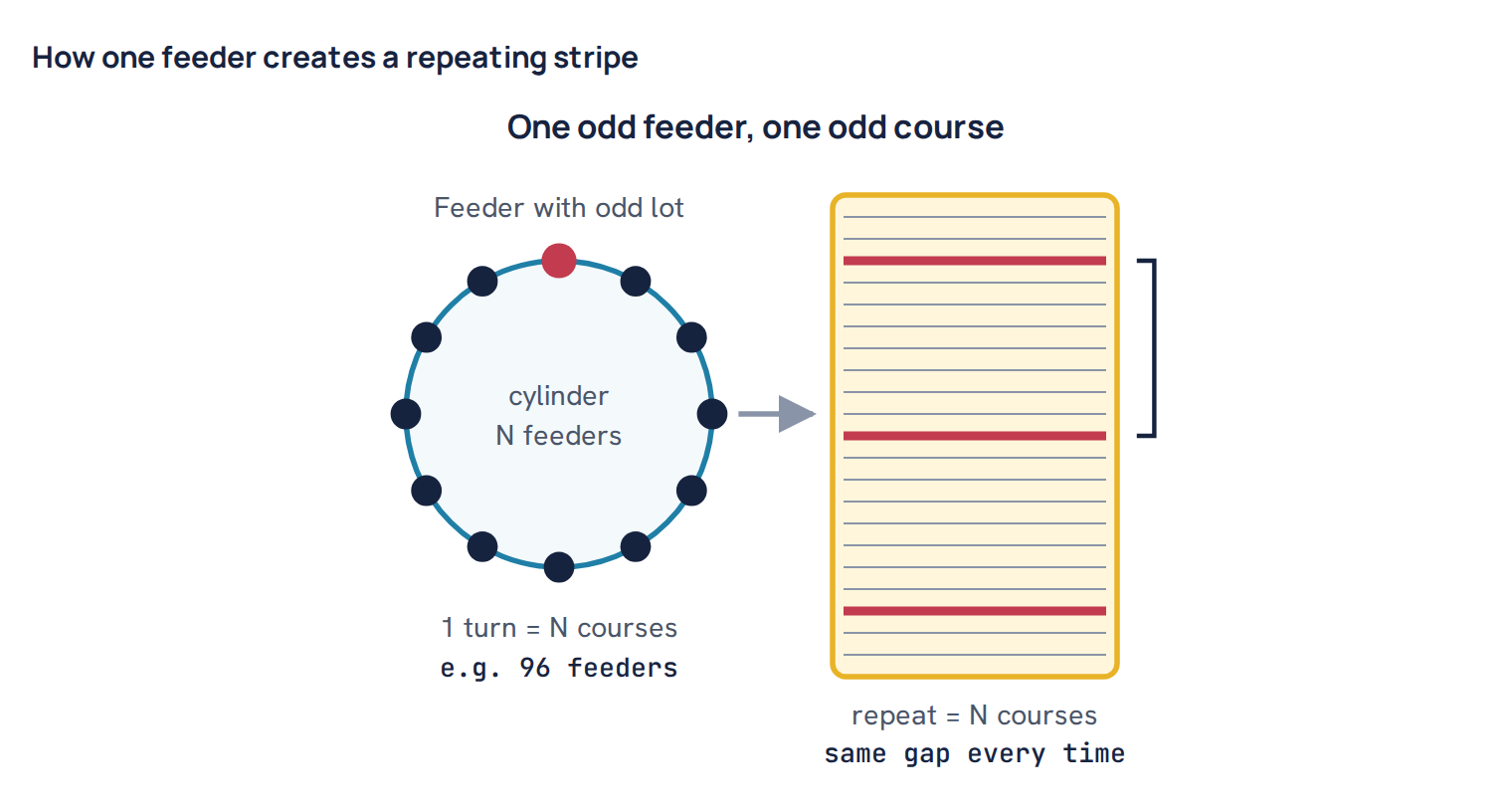
This is why barré is a knitting-and-yarn fault at heart. The dye bath treats every course the same way. It cannot produce a pattern that repeats exactly every 96 courses. When you see that kind of regularity, the cause was in the greige fabric before it ever reached the dye house. Dyeing simply turns a small physical or chemical difference into a visible colour difference.
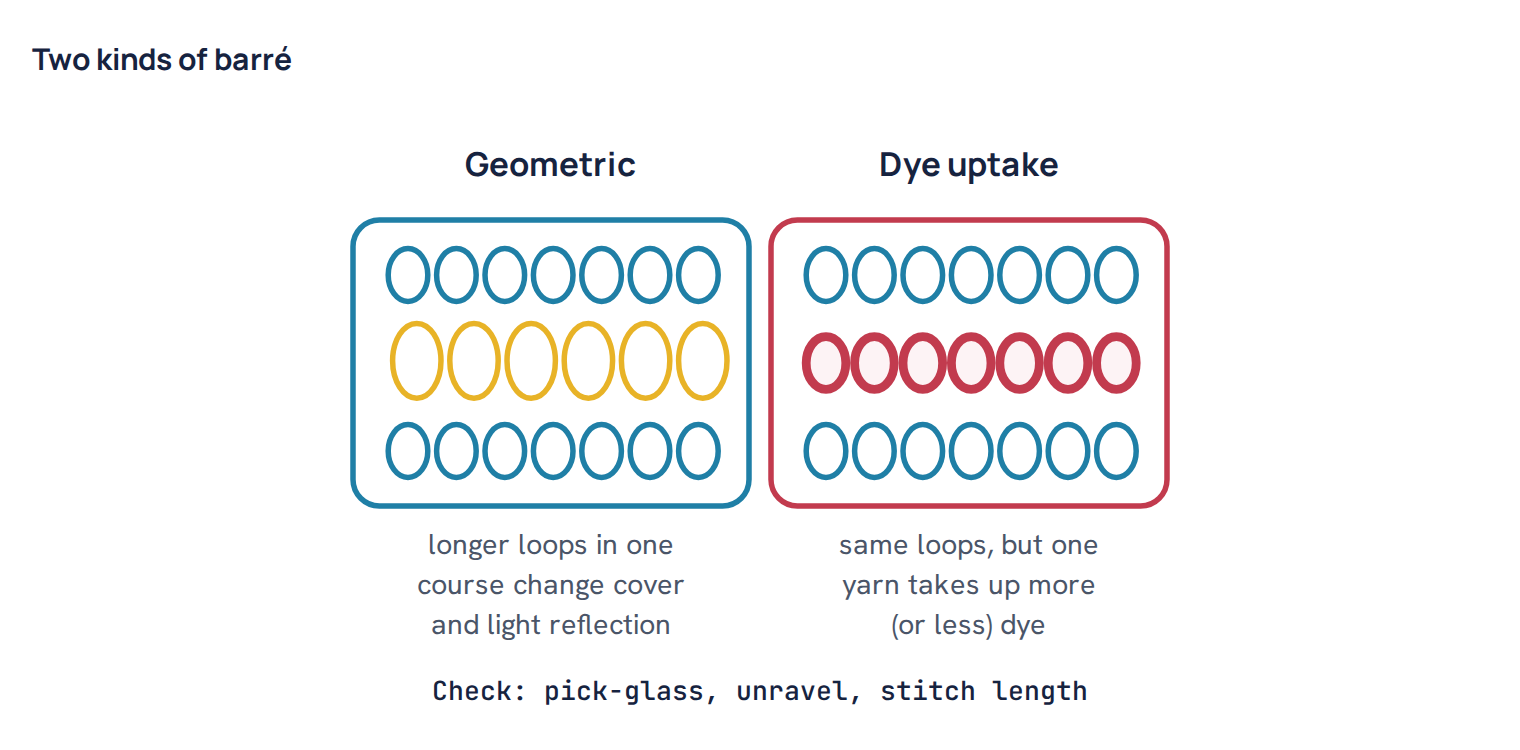
Two kinds of difference can do this. The first is a dye-uptake difference: the odd yarn absorbs more or less dye, so its course is darker or lighter. The second is a geometric difference: the odd course has longer or shorter loops, so it covers the surface differently and reflects light differently, even if the yarn holds the same amount of dye. Many real cases are a mix of both.
How to confirm barré
Before blaming anyone, confirm that the fault really is barré and find out which kind. The checks below move from quick visual tests to lab work.
Look at it properly
- Light box and daylight. Lay the fabric flat under the inspection light, then hold it up against a window so light passes through it. Transmitted light shows loop-size differences very clearly, because longer loops let more light through.
- Change the viewing angle. Tilt the fabric. A lustre-type barré changes strongly with angle; a dye-uptake barré stays similar.
- Face and back. Check both sides. A stitch-length difference usually shows on both. A surface difference such as yarn hairiness may show mostly on one side.
- Different light sources. Look under daylight, store light and incandescent light in a viewing cabinet. If the stripe changes in hue, not just depth, the odd yarn may be dyeing to a slightly different hue, which often happens in blends where one component takes a different share of the dye.
- Cut and compare. Cut a piece across the stripe and lay a piece from a “good” area beside it. This makes small differences easier to judge and gives a sample to keep.
Count the repeat
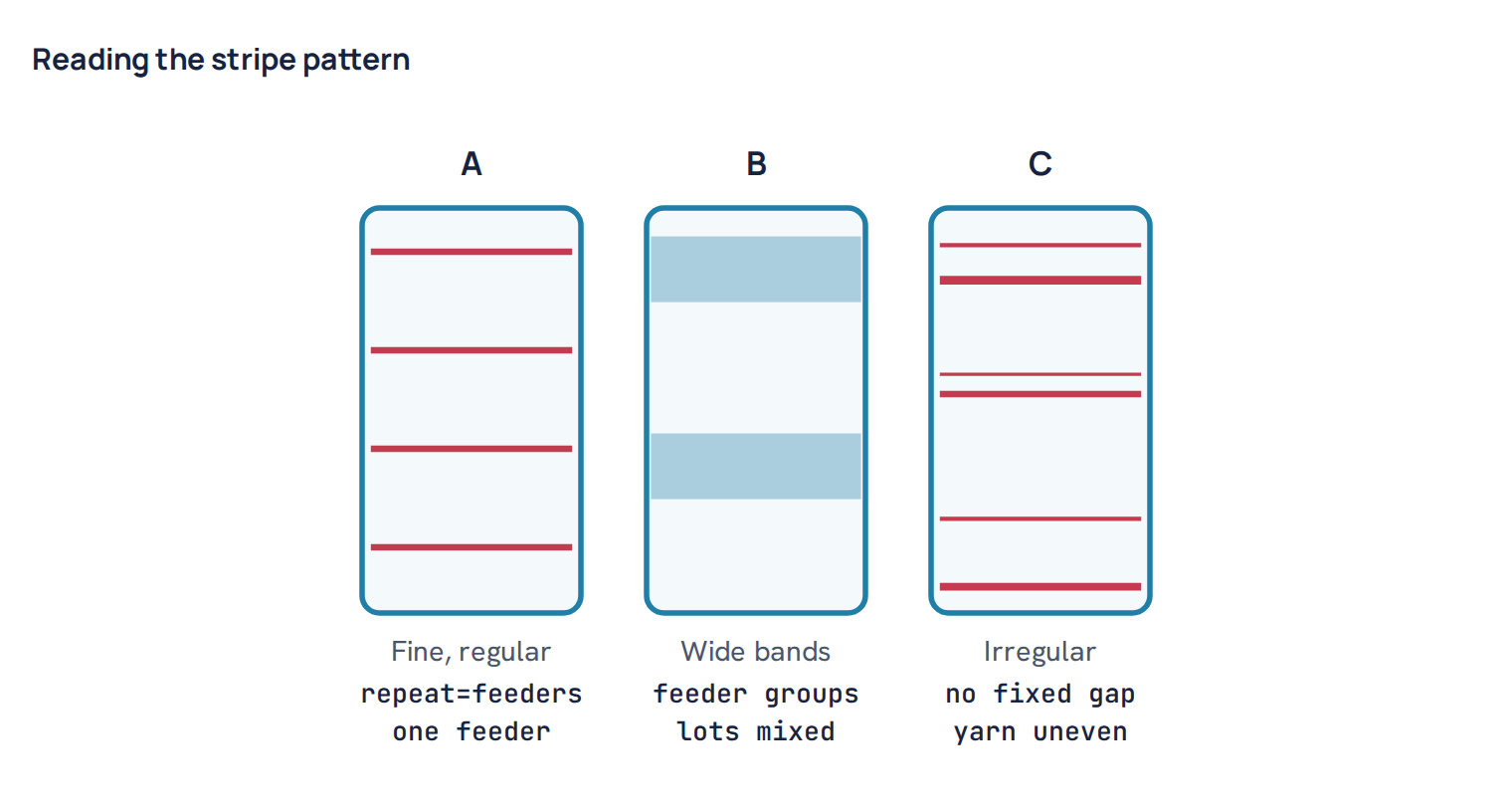
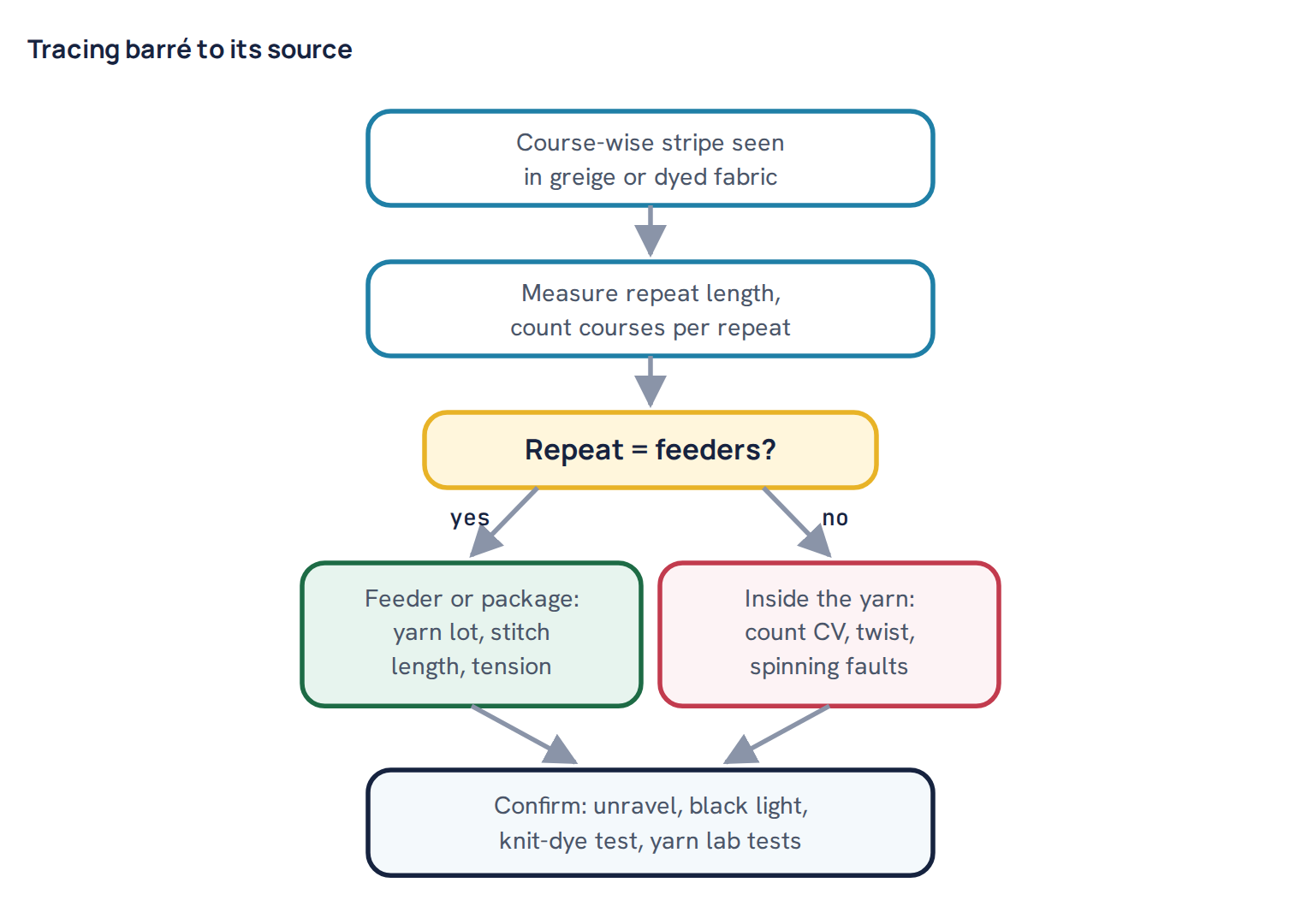
Measure the distance from one stripe to the same stripe further down, over several repeats, and take an average. Then count the courses per centimetre with a pick-glass and multiply. If the number of courses in one repeat equals the number of feeders on the knitting machine, or a simple fraction of it, the cause is tied to the feeders: a package, a yarn lot or a feeder setting.
Worked example. A navy single jersey shows fine lines about 4.6 cm apart. With a pick-glass you count 21 courses per centimetre. 4.6 × 21 is about 97 courses. The knitting record shows a 96-feeder machine. The repeat matches one revolution, so one feeder (or one package) is different. If you had counted about 48 courses, two opposite feeders could be involved; if the spacing were irregular, you would look at yarn evenness instead.
Unravel and measure
Unravel the faulty course and a normal course from the greige fabric (or a retained greige sample) and compare them. Measure the yarn length taken by a fixed number of loops, for example 100 stitches. This gives the stitch length. If the faulty course uses noticeably more or less yarn, the knitting setting on that feeder is different. If the stitch lengths match, keep the two yarn pieces and send them for testing.
Black light and dye tests
Under ultraviolet (black) light, different yarn lots can glow differently because of optical brightener traces, spinning lubricants or different polymer additives. A greige roll that shows the stripe under UV light before dyeing gives early warning. A knit-dye test is the strongest proof: knit a short tube using yarn from each suspect package or lot on known feeders, dye it in a dark, sensitive shade, and see which feeders stand out. Many mills use this test routinely when a new yarn lot arrives.
Lab analysis of the yarn
For cotton, the lab checks count, count variation, twist, hairiness and, where mill data is available, fibre micronaire and maturity. For polyester and nylon filament, it checks denier, tenacity and elongation, crimp or texturing level, boiling-water shrinkage and a dye-uptake test against a reference. For elastane, it checks count and confirms the draft setting on the knitting machine. The goal is to find the one property that differs between the odd yarn and the normal yarn.
Barré and its look-alikes
Several faults can be confused with barré. Getting the name right matters, because each one points to a different department.
- Crease and rope marks. These are lines from folds in the fabric rope during dyeing. They run at random angles, are often lengthwise, and do not repeat at a fixed spacing. See crease marks in knit dyeing.
- Listing and side-centre-side variation. These run along the length, not across it.
- Patchy or uneven dyeing. Clouds and patches with no geometric pattern, usually from the dye process or preparation. See uneven and patchy dyeing.
- Stop marks or start-up marks. A single horizontal line where the knitting machine stopped and restarted. It does not repeat.
- Needle lines. Vertical lines along one wale, caused by a bent or worn needle or sinker. They run lengthwise.
- Elastane misses. A course where the elastane broke or did not feed. It looks like a slack, more open stripe and may be single or repeating.
- Lot-to-lot shade variation. Whole rolls or batches differ in shade, which is a different problem from stripes inside one roll.
Causes, from most common to least
1. Yarn: the usual root cause
Mixed yarn lots. This is the single most common cause. Two lots of the same count from the same spinner can still differ in fibre mix, twist or finish. When packages from both lots end up on the same knitting machine, the courses from each lot dye differently. In our dye house records, about 1 in 5 fabric register entries lists more than one yarn lot for the same batch. Each of those entries is a barré risk unless the lots were kept on separate machines and the rolls were kept apart.
Different spinners. Yarns from two spinners almost always differ in cotton source, blend and spinning settings. Mixing them on one machine is even riskier than mixing lots from the same spinner.
Count variation. A slightly coarser yarn makes a heavier, more covered course; a finer yarn makes a thinner, more open one. Both can look darker or lighter after dyeing.
Twist differences. Higher twist packs fibres more tightly, so dye penetrates less easily and the yarn may look lighter. It also changes lustre and loop shape.
Cotton micronaire and maturity. Immature cotton fibres have thin walls and take up less dye. A lot with a different share of immature fibre dyes lighter overall. Reactive dyes often show this difference clearly.
Polyester filament merge and texturing. Filament producers give each production run with uniform properties a merge number. Yarns of different merges can differ in molecular orientation and crystallinity, and so in how fast disperse dye diffuses into them. Texturing adds another variable: the heater temperature, tension and draw ratio during texturing change the heat history of the yarn. Even a small difference in texturing conditions between positions on a texturing machine can give packages that dye differently. Mixing merges, or mixing packages from different texturing positions, is a classic cause of barré on polyester knits.
Nylon. Nylon is very sensitive. Besides physical differences like polyester, nylon can have chemical differences in the number of amine end groups, which are the sites that hold acid dyes. A small change in end-group content between lots gives a clear stripe with acid dyes.
Elastane tension and draft. In plaited elastane fabrics, the elastane is fed under a set draft (stretch) at each feeder. If one feeder runs a different draft or tension, or a package from a different elastane lot, that course contracts differently after relaxation and heat-setting. The loop shape changes and a stripe appears. About 37% of our batches contain elastane, so this is a daily concern, not a rare one. See the cotton-elastane knit dyeing process for how heat-setting fixes this geometry in place.
2. Knitting machine
Stitch length differences per feeder. Each feeder has its own stitch cam setting. If one is set differently, its course uses more or less yarn per loop. A longer stitch gives a more open course that looks lighter in transmitted light and different in reflected light.
Yarn tension. Uneven input tension, caused by a sticking tensioner, a dirty yarn path or a package unwinding badly, changes the amount of yarn each loop takes, even when the cam is set correctly.
Feeder setting and positive feed. On machines with positive feed, every feeder should be driven at the same speed through the feed tape. A slipping tape or a feeder not engaged on the tape gives a different yarn input on that position.
Needles and sinkers. Worn or damaged needles and sinkers usually cause vertical lines rather than barré, but a worn cam or a damaged sinker ring section can affect loop formation in a repeating way.
3. Pretreatment
Different yarn lots can carry different amounts of spinning oil, wax or knitting oil. If scouring is weak, the courses with more residue wet out and take up dye more slowly. A thorough, even scour and good absorbency before dyeing reduce this effect, though they cannot remove differences in the fibre itself. For cotton, uneven bleaching of a lot with different natural colour can also leave a slight course-wise difference in light shades.
4. Dyeing recipe and process: revealing or hiding barré
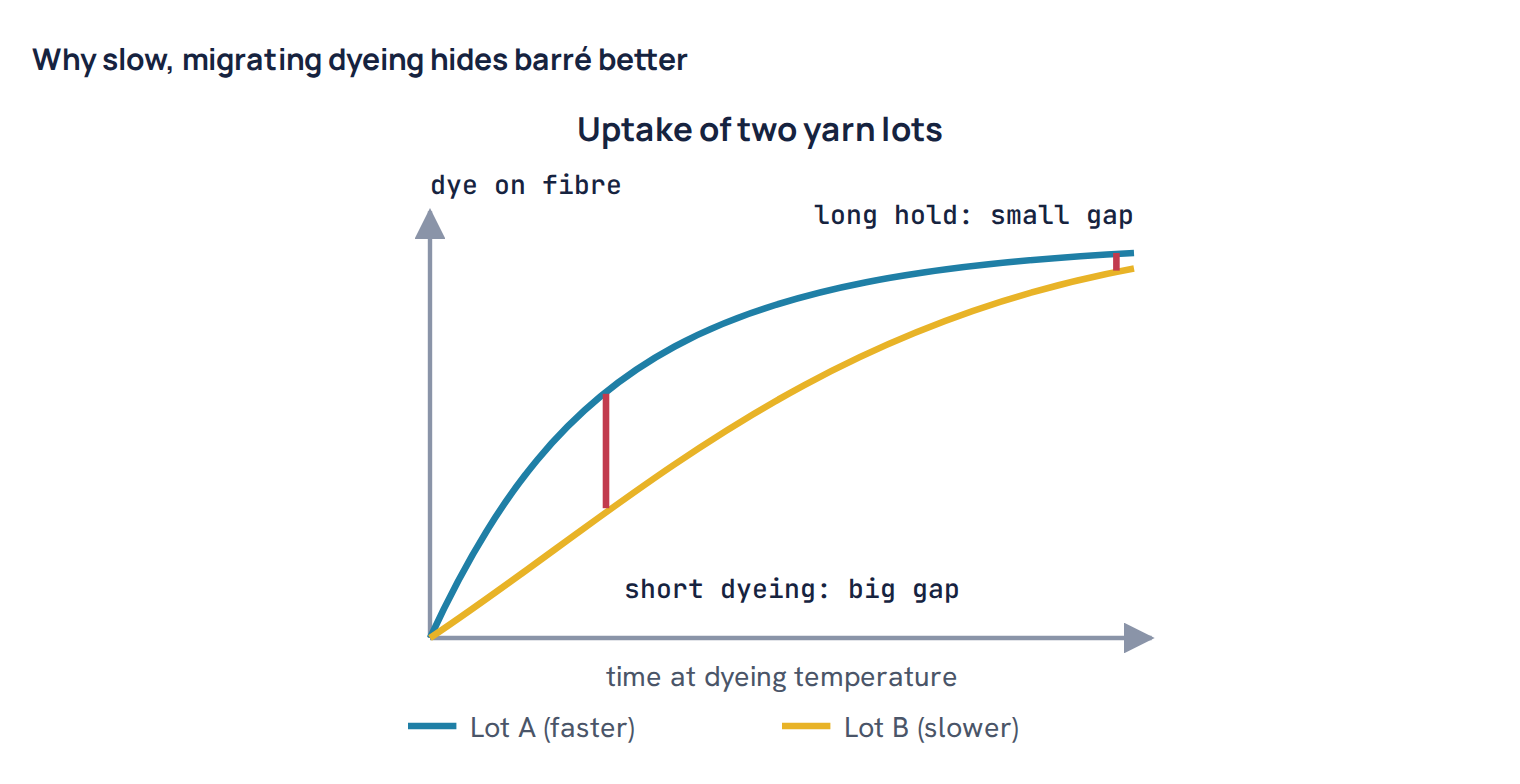
The dye bath does not create barré, but it decides how strongly it shows. Two yarns that differ in dye affinity or diffusion rate will show a large difference if the dyeing stops while the fast yarn is ahead, and a smaller difference if the dye is given time and the ability to move until both yarns are near equilibrium.
Cotton and viscose. Reactive dyes fix quickly once alkali is added, and fixed dye cannot migrate. So whatever difference exists between yarns at the moment of fixation is locked in. Reactive dyes also vary among themselves in how well they cover maturity and yarn differences, and suppliers’ coverage ratings or your own knit-dye tests are the best guide. Direct dyes generally migrate more at high temperature and can cover some yarn differences better, but their wet fastness is lower, so they suit only some end uses. Slower salt and alkali dosing and a well-chosen levelling agent help reactive dyes go on more evenly. See level dyeing: strike and migration.
Polyester. Disperse dyes differ a lot in barré coverage. In general, dyes with smaller molecules and good migration (often low- to medium-energy types) cover physical differences in polyester better than large, slow-diffusing high-energy dyes, which tend to highlight differences in orientation and crystallinity. Fastness requirements limit how far you can go, because better migrating dyes usually have lower sublimation fastness. A slow heating rate through the critical zone (often around 80–130°C, depending on dye and fibre) and an adequate hold at 130°C help the dye approach equilibrium. See how disperse dyes work on polyester.
Nylon. Acid dyes on nylon are very sensitive to barré, because they bind to amine end groups and any lot difference in end-group content shows directly. Levelling acid dyes, which migrate well, cover physical barré better than milling or high-fastness acid dyes. An anionic levelling or blocking agent can reduce the difference. For pale shades, disperse dyes cover nylon barré very well, at the cost of wash fastness. See how acid dyes work on nylon.
Blends. In cotton-polyester and elastane blends, a stripe can come from either fibre. Dyeing the polyester and cotton parts in separate stages lets you find which component shows the stripe.
5. Finishing
Finishing rarely creates true barré, but it can make it worse or better. Heat-setting fixes the loop geometry of polyester and elastane fabrics, so a stitch-length difference becomes permanent. Compacting and calendering can change lustre and make a lustre-type barré more obvious. Raising, brushing or peaching break up the surface and can reduce visibility. Softeners do not change it.
Quick diagnostic checklist
- Is the stripe across the width and repeating down the length? If not, it is probably another fault.
- Measure the repeat and count courses. Does it match the feeder count, or a simple fraction of it?
- Check the greige records: how many yarn lots, spinners or merges went into this fabric? Were lots mixed on one machine?
- Look at retained greige under transmitted light and black light. Is the stripe already there?
- Unravel faulty and normal courses. Compare stitch length and yarn appearance.
- Send both yarns for count, twist and uptake testing, or run a knit-dye test.
- Only then review the dye recipe: did dye choice, heating rate or dosing make the stripe more visible?
Prevention: stopping barré before it reaches the dye house
Yarn lot control
- Run one yarn lot per knitting machine. Never put packages from two lots, two spinners or two merges on the same creel.
- Finish one lot on a machine before starting the next. If a lot change is unavoidable mid-order, change the whole creel at once, not package by package.
- Label every greige roll with yarn lot, spinner and machine. Keep rolls from different lots in separate dye batches, and dye them separately if the shade is critical.
- For polyester filament, order and store by merge number, and ask the supplier not to mix merges or texturing positions in one delivery where possible.
- For elastane, keep one elastane lot per machine, just as with the main yarn.
Knitting control
- Check stitch length on every feeder when a machine is set up and at regular intervals, using a yarn-length counter or by unravelling a known number of loops.
- Check input tension on each feeder with a tension meter, and clean the yarn path, tensioners and feeders.
- For positive feed, confirm every feeder is on the tape and the tape is not slipping.
- For elastane, set the same draft on every elastane feeder and check it after any package change or breakdown.
Knit trials and greige inspection
When a new yarn lot arrives, knit a short trial tube with the new lot on some feeders and the current lot on others, then dye it in a dark, sensitive shade. If the boundary shows, do not mix those lots. Inspect greige rolls under transmitted light before dyeing. Catching barré at the greige stage costs very little; catching it after dyeing and finishing costs the whole batch.
Dye selection and process
- For fabric with known lot risk, choose dyes with good barré coverage. Use lab trials on the actual greige, not just on a standard substrate.
- Use slower heating through the critical temperature zone and an adequate hold at top temperature for disperse and acid dyes. Exact rates vary by dye and machine.
- Dose salt and alkali gradually for reactive dyes, so fixation starts evenly.
- Use a suitable levelling agent for the fibre and dye class.
- Where the buyer allows, place fabric with mixed lots into darker or heather shades, where barré is less visible.
Common mistake: Changing the dye recipe again and again to “cure” a barré that is in the yarn. If the stripe is there in the greige under transmitted light, no recipe change will remove it. Fix the creel first.
Common mistake: Topping up a creel with a few packages from a new lot to finish an order. This is exactly how one odd feeder appears, and it gives the regular fine-line barré that is hardest to hide.
Correction: what the dye house can and cannot fix
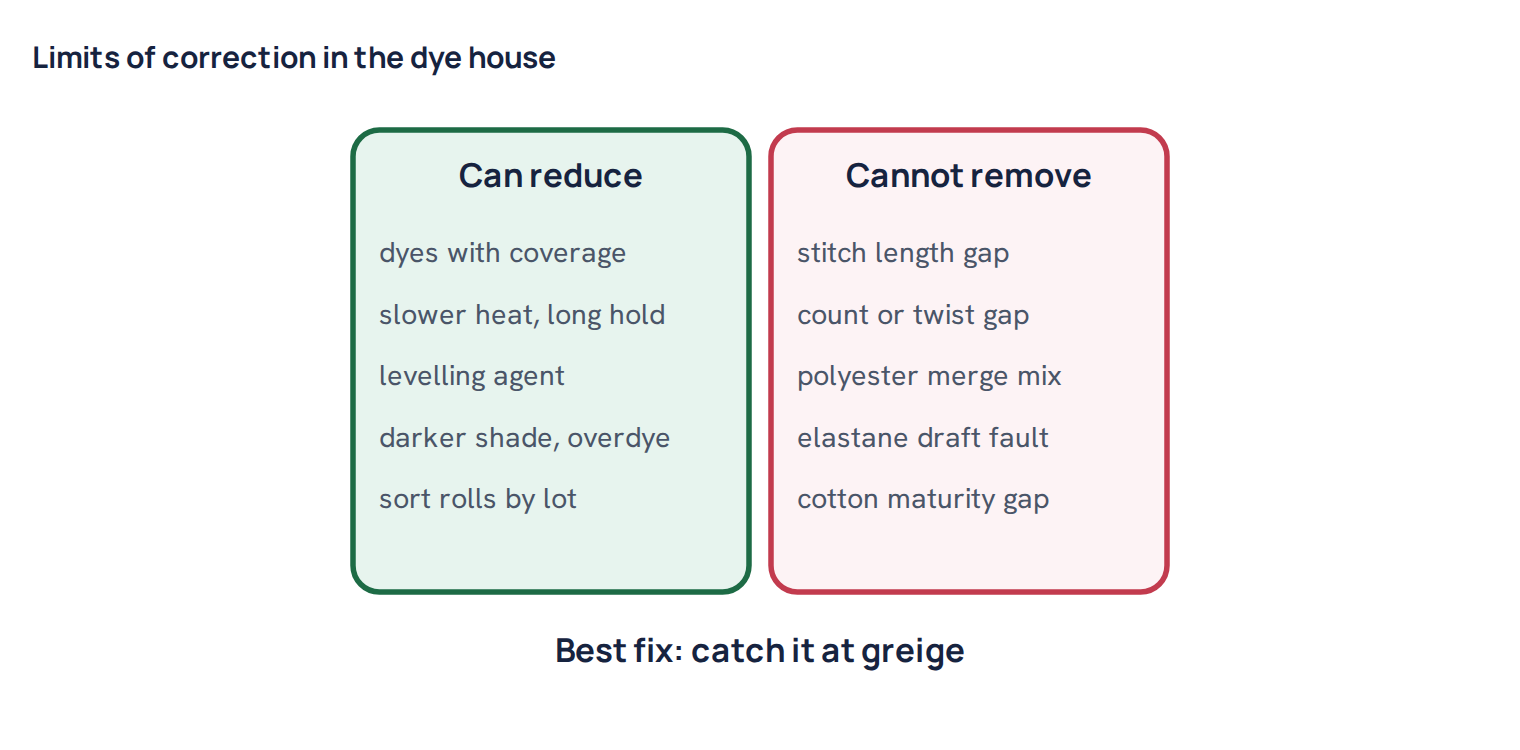
Barré is usually a yarn or knitting fault. Dyeing can reduce it, but it can rarely remove it completely. Be honest with the merchandiser and buyer about this early, because the realistic options often involve a different shade, a lower grade, or a return to knitting.
Options by fibre
- Reactive-dyed cotton. Fixed reactive dye is bonded to the fibre and will not migrate, so a levelling treatment does little. The usual options are to top the shade to a darker or duller version (if the buyer accepts), to overdye into navy or black, or to strip and redye with dyes chosen for better coverage. Stripping costs strength and handle and rarely removes the stripe fully. See stripping reactive-dyed cotton knit.
- Disperse-dyed polyester. An extra hold at 130°C with a levelling agent can move migrating disperse dyes and soften the stripe. A partial reductive strip and redye with dyes of better barré coverage is the next step. Results depend strongly on which dyes were used the first time.
- Acid-dyed nylon. A treatment with a levelling agent near the boil can help levelling acid dyes migrate. Redyeing with levelling acid dyes, or with disperse dyes for pale shades, often covers better than the original recipe.
- Blends. Find which component carries the stripe and treat only that component, so you do not disturb the other.
Sorting and when to stop
If the barré is confined to some rolls, sort them out and use them for darker colours, smaller garment parts, or lower-grade orders. The garment factory can sometimes cut around mild barré if the repeat is wide. Stop and reject the lot, or return it to the knitting unit, when the stripe is clearly visible in the greige under transmitted light, when it is a stitch-length or elastane-draft fault, or when one correction attempt has not brought it within the buyer’s tolerance. Repeated stripping and redyeing usually damage the fabric more than they help.
Common mistake: Sending a barré lot back for a second and third redye in the same light shade. Each cycle weakens the fabric and increases cost, while the physical stripe stays. Decide after the first attempt whether to change shade, sort or reject.
What to record so it does not repeat
Barré comes back when the link between yarn, machine and fabric is lost. Good records keep that link.
- Yarn lot, spinner and, for filament, merge number for every greige roll.
- Knitting machine number, feeder count, stitch length and elastane draft.
- Whether more than one lot was used, and on which machine and feeders.
- Greige inspection result, including transmitted-light and black-light checks.
- Dye recipe, dye selection, heating rate, hold time and levelling agent used.
- Measured repeat length, courses per repeat and the confirmed cause.
- Correction tried and the final result, so the next engineer knows what worked.
Over time, these records show which spinners, lots and machines cause trouble, and which dyes cover barré well on your own fabrics. That knowledge is worth more than any single correction recipe.
Questions
What is barré in knit fabric?
Barré is a horizontal, course-wise stripe that repeats down the length of knit fabric. It shows as lines or bands of different shade, lustre or texture, usually caused by the yarn or knitting rather than the dye bath.
How can I tell if barré comes from the yarn or the dyeing?
Measure the stripe repeat and count the courses in it. If the count matches the number of feeders on the knitting machine, the cause is a yarn package, yarn lot or feeder setting, not the dyeing.
Can barré be removed by redyeing?
Rarely. Redyeing with better-migrating dyes, a levelling treatment, a darker shade or an overdye can reduce how visible it is, but a physical difference in the yarn or loop size stays in the fabric.
Which dyes hide barré best?
Dyes that migrate well and are given enough time to approach equilibrium usually cover barré better. On polyester these are often low- to medium-energy disperse dyes; on nylon, levelling acid dyes or disperse dyes for pale shades. Coverage varies by dye, so test on the actual greige.
How do I prevent barré?
Run one yarn lot, spinner or merge per knitting machine, keep lots separate through dyeing, check stitch length and tension on every feeder, knit-dye test new lots, and inspect greige under transmitted light before dyeing.

Textile engineer with 14+ years in dyeing and fabric development. He writes every guide on Dyeing Solution from real production work. Full profile