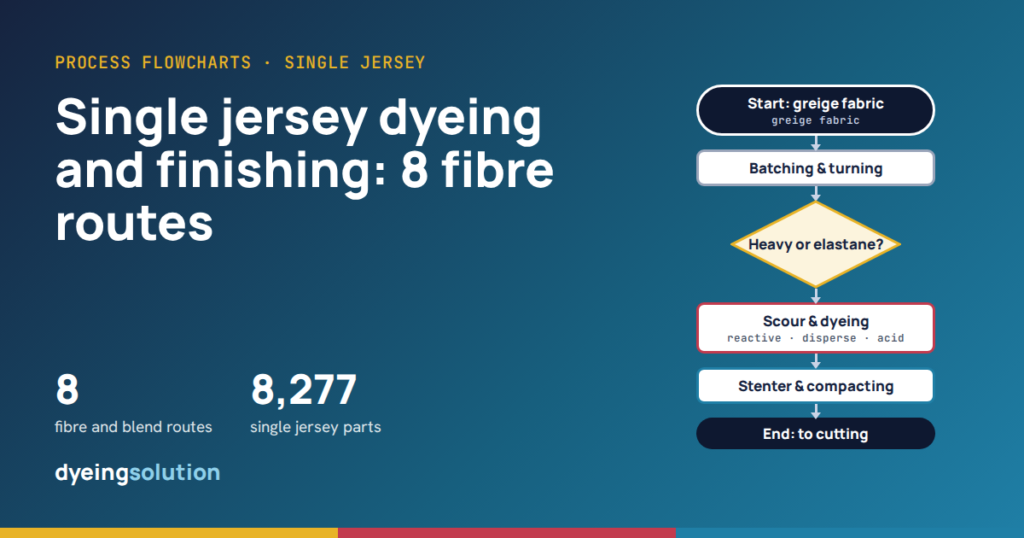
Single jersey is the most common knit we dye, and it is made in more fibres than any other fabric. Here is the dyeing and finishing route for each one, from greige fabric to the cutting table, with what our records show about GSM, shrinkage and spirality.
At a glance
8,277Single jersey parts in our records
8Fibre and blend routes
41%Within GSM tolerance
180 GSMHeat set from here
Single jersey is the plainest weft knit: one set of needles, one face of plain loops and one face of half-loops. It is light, it stretches more across than along, and it has two habits that shape everything in dyeing and finishing: it twists (spirality) and its edges curl. In our finishing records it is half of all fabric, 8,277 of 16,329 parts, made in 100% cotton, cotton-elastane, CVC, viscose, modal, lyocell, polyester and their blends.
- Single jersey and interlock run almost the same process.
- Rib is different: it is usually finished in tube form, through the tubular route. When rib is open, it goes slitting, stenter and compacting like single jersey.
Single jersey by fibre: what our records show
| Fibre or blend | Parts | With elastane | Within ±5% GSM | More than 5% light | Median length shrinkage | Median spirality | Heat set |
|---|---|---|---|---|---|---|---|
| 100% cotton | 5,703 | 0% | 47% | 51% | 5% | 2.0% | 47% |
| Cotton-elastane | 1,347 | 100% | 18% | 80% | 7% | 2.0% | 98% |
| CVC / PC | 555 | 21% | 60% | 32% | 4% | 2.0% | 54% |
| Viscose / modal / lyocell | 266 | 95% | 17% | 80% | 9% | 3.0% | 94% |
| Cotton + modal / viscose / lyocell | 86 | 55% | 24% | 71% | 6% | 2.5% | 57% |
| Polyester-viscose | 48 | 40% | 21% | 60% | 4% | 2.0% | 71% |
| Polyester | 30 | 50% | 33% | 47% | 4% | 2.0% | 80% |
| Cotton-linen | 41 | 10% | 29% | 63% | 8% | 3.0% | 24% |
Light GSM is the main problem on single jersey: 56% of all parts finish more than 5% under the required weight. It is worst on cotton-elastane and on viscose, modal and lyocell with elastane, where about four parts in five finish light. CVC holds GSM best. 100% cotton shrinks a median 5% in length, viscose-type blends 9%.
When single jersey is heat set
Elastane single jersey is always heat set before dyeing. On 100% cotton it depends on the weight: below 160 GSM it is almost never heat set, and from about 160–180 GSM most parts are, because heavy single jersey creases in the rope if it is not.
| 100% cotton single jersey, required GSM | Heat set |
|---|---|
| Up to 160 GSM | 1% |
| 160–180 GSM | 60% |
| 180–200 GSM | 78% |
| 200–250 GSM | 73% |
| Above 250 GSM | 62% |
See crease marks in knit dyeing for the heavy-fabric rules: heat set from 180 GSM, load straight at 80% capacity at most, and keep scouring, dyeing and soaping at 80°C or below.
The sequence before the dyeing machine
Every chart below follows the same sequence before dyeing. Steps a fabric does not need simply drop out; they are drawn dashed.
- Greige inspection, then batching. A fabric that stays a tube is turned inside out here.
- If it needs heat setting, singeing or mercerising: slitting first. None of these is ever done on a tube.
- If it needs heat setting: heat setting in open width.
- If it needs singeing: singeing in open width, after checking the flame cannot damage the fabric.
- If it is mercerised: mercerising, then drying.
- If the fabric was opened: back sewing, to make it a tube again with the face side inside (the loop side, for terry).
- Loading into the dyeing machine, then scouring, bleaching and dyeing, single part or double part as the fibre needs.
Flowcharts by fibre and blend
- 100% cotton single jersey
- Cotton-elastane (Lycra) single jersey
- CVC and PC single jersey
- Viscose, modal and lyocell single jersey
- Cotton-modal, cotton-viscose and cotton-lyocell single jersey
- Polyester-viscose single jersey
- Polyester and polyester-elastane single jersey
- Cotton-linen single jersey
100% cotton single jersey
Light single jersey goes straight to batching. From 180 GSM it is heat set first and kept at 80°C or below to prevent crease marks. In our records: 5,703 parts, 47% within GSM tolerance, median length shrinkage 5%. Full process: 100% cotton dyeing process.
Dyeing and finishing: 100% cotton single jersey
Cotton-elastane (Lycra) single jersey
Always heat set before dyeing to fix the stretch, with a cooler 80°C scour to protect the elastane. In our records: 1,347 parts, 18% within GSM tolerance, median length shrinkage 7%. Full process: cotton-elastane dyeing process.
Dyeing and finishing: Cotton-elastane (Lycra) single jersey
CVC and PC single jersey
Two baths: the polyester part first at 130°C, then the cotton part at 60°C. When the polyester part is dyed, PC is always heat set, because polyester dyeing makes the fabric balloon and crease. CVC is heat set only when it is heavy or carries elastane. In our records: 555 parts, 60% within GSM tolerance, median length shrinkage 4%. Full process: CVC / PC dyeing process.
Dyeing and finishing: CVC and PC single jersey
Viscose, modal and lyocell single jersey
Heat set only when it carries elastane or is heavy, and in practice almost all of it carries elastane. A mild scour and nothing above 80°C in wash-off. The enzyme depends on the fibre. In our records: 266 parts, 17% within GSM tolerance, median length shrinkage 9%. Full process: viscose / modal / lyocell dyeing process.
Dyeing and finishing: Viscose, modal and lyocell single jersey
Cotton-modal, cotton-viscose and cotton-lyocell single jersey
One reactive bath dyes both fibres. Scoured like cotton, washed off like modal. Heat set only when it carries elastane or is heavy. In our records: 86 parts, 24% within GSM tolerance, median length shrinkage 6%. Full process: cotton + modal / viscose / lyocell dyeing process.
Dyeing and finishing: Cotton-modal, cotton-viscose and cotton-lyocell single jersey
Polyester-viscose single jersey
The same two-bath route as CVC, with a viscose-type scour: disperse for the polyester, reactive for the viscose. Heat set when it carries elastane or is heavy. In our records: 48 parts, 21% within GSM tolerance, median length shrinkage 4%. Full process: polyester + viscose / modal / lyocell dyeing process.
Dyeing and finishing: Polyester-viscose single jersey
Polyester and polyester-elastane single jersey
Heat set, disperse dyeing at 130°C, reduction clearing on every shade, and a cool stenter to protect fastness. In our records: 30 parts, 33% within GSM tolerance, median length shrinkage 4%. Full process: polyester dyeing process.
Dyeing and finishing: Polyester and polyester-elastane single jersey
Cotton-linen single jersey
Scoured like cotton but with soda ash instead of caustic, at a temperature set by the shade, and no enzyme, because the enzyme can destroy linen. Heavy fabric is sometimes heat set first. In our records: 41 parts, 29% within GSM tolerance, median length shrinkage 8%. Full process: cotton-linen dyeing process.
Dyeing and finishing: Cotton-linen single jersey
- When the polyester part is dyed, PC is always heat set, whatever the GSM, because polyester dyeing makes the fabric balloon and that brings crease marks.
- CVC is heat set only when the GSM is high. Light CVC does not need it.
- Viscose, modal and lyocell single jersey is not always heat set: only when it has elastane or the GSM is heavy. The same rule applies to cotton-modal, cotton-viscose and cotton-lyocell, and to polyester-viscose.
- Lycra fabric is always heat set.
- Polyester-viscose follows the CVC process, but with a viscose-type scour.
- Cotton-linen gets no enzyme. It is scoured like cotton, only with soda instead of caustic, and the temperature depends on the shade.
Finishing single jersey: spirality, width and GSM
Every fabric is turned inside out at batching and dyed with its back side outside. The face of a garment is the top side of the fabric, so it is kept inside: the back takes the friction of the nozzle and the reel, and if a colour, softener or chemical spot lands on the fabric, it lands on the back. Today all our single jersey is finished in open width: after dyeing it is slit open, set on the stenter to width and GSM, and compacted for shrinkage. The stenter runs at about 150°C for cotton, and at 100–110°C whenever the polyester part has been dyed, to protect fastness.
Open width or tubular finishing
| Open-width route | Tubular route |
|---|---|
| Dyeing (fabric inside out) | Dyeing (fabric inside out) |
| Slitting | Dewatering on a squeezer |
| Stenter | Relax dryer |
| Compacting | Turning machine, back to face side |
| Final inspection | Tube compacting |
A tube keeps whatever dust gets inside it, because there is no way out. If it goes into the tube compactor like that, the dust lumps are pressed into the fabric and leave a white mark like a friction mark. The dust can be removed later, but the pressed mark stays. That is why tube fabric is turned on the turning machine to let the dust out before it is compacted.
Spirality in our records has a median of 2% and rarely goes above 3%; only loose-knitted single jersey tends to twist badly. Stretching the fabric on the stenter to gain width spreads its weight and makes it light, which is why light GSM is the most common single jersey problem.
- Spirality is normally good on single jersey. It is not an issue for us.
- Only loose-knitted single jersey can have bad spirality. Then we work to the wash GSM: we dry it on the relax dryer to standard, then check it after washing.
- The spirality limit is whatever the buyer requires.
- Standard stenter temperature for cotton single jersey is about 150°C. When the polyester part is dyed, in CVC solid looks or PC, we finish at the polyester temperature: 100–110°C.
- All single jersey is now finished in open width. Tube fabric goes squeezer, dryer, turning, then tube compacting.
Common faults and buyer complaints
Single jersey has no fault of its own. What varies is the fibre. 100% cotton single jersey shrinks and twists a little more than CVC and PC, and viscose-type single jersey more again, which matches our records: median length shrinkage of 5% for cotton, 4% for CVC and 9% for viscose, modal and lyocell.
- Light GSM, above all on elastane and viscose-type single jersey.
- Shrinkage, highest on viscose, modal and lyocell.
- Spirality on loose-knitted single jersey.
- Crease marks on heavy single jersey that was not heat set.
- Single jersey has no special fault as such.
- 100% cotton single jersey has a bit worse shrinkage and spirality than CVC and PC. Viscose is worse again.
- Spirality depends on how loose the fabric is: a loose fabric has more capacity to shrink. A tight knit has less of the problem, and polyester fabrics less again.
- 100% cotton costs more, and it is less durable. CVC and PC are cheaper and last longer, so polyester is often added for that, and to reduce shrinkage and spread problems.

Textile engineer with 14+ years in dyeing and fabric development. He writes every guide on Dyeing Solution from real production work. Full profile