Reactive dye bonds inside the fibre; pigment is glued on the surface with a binder. How each is applied, how they perform in fastness tests, how to tell them apart and which to choose.
At a glance
Insidereactive: bonded in fibre
Surfacepigment: binder film
Rubbingpigment’s weak point
Any fibrepigment works on blends
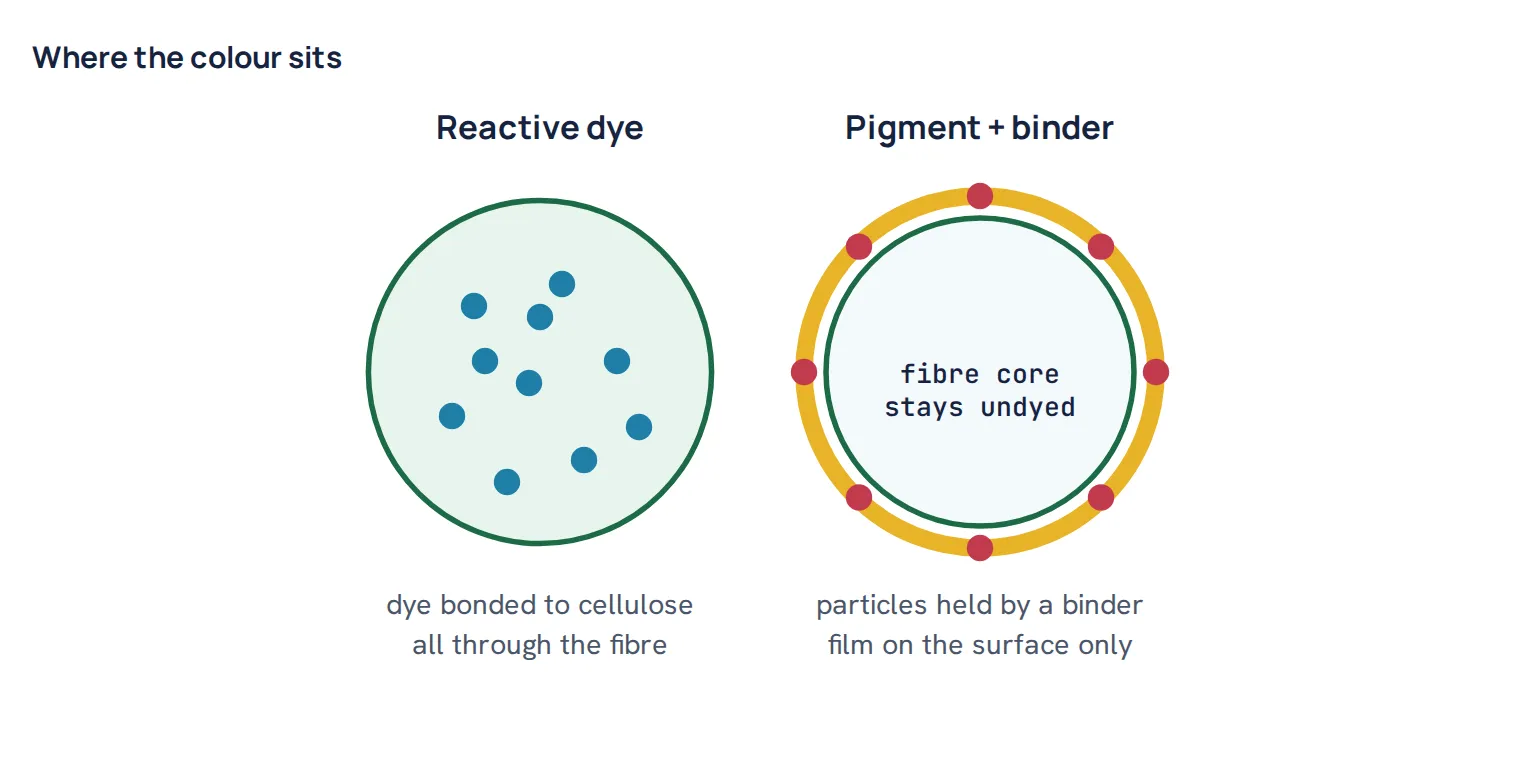
Reactive dye and pigment both put colour on cotton, but they work in completely different ways. A reactive dye goes inside the fibre and forms a chemical bond with it. A pigment never enters the fibre at all: it is a coloured powder glued onto the surface with a binder. That one difference explains almost everything you see in the finished garment: the handle, the way the colour fades, how it behaves in a rubbing test and why “pigment dyed” T-shirts look washed-out on purpose.
This guide compares the two side by side from a knit dye-house point of view: what each one is, how each is applied, how they perform in the tests buyers ask for, how to tell them apart on a finished garment, and which one to choose for which product.
What is a reactive dye?
A reactive dye is a water-soluble coloured molecule with a reactive group attached. In the dye bath it is attracted to cellulose fibres such as cotton, viscose, modal, lyocell and linen. When the bath is made alkaline, the reactive group forms a covalent bond with the hydroxyl groups of the cellulose. Once that bond forms, the colour is part of the fibre and cannot simply wash out.
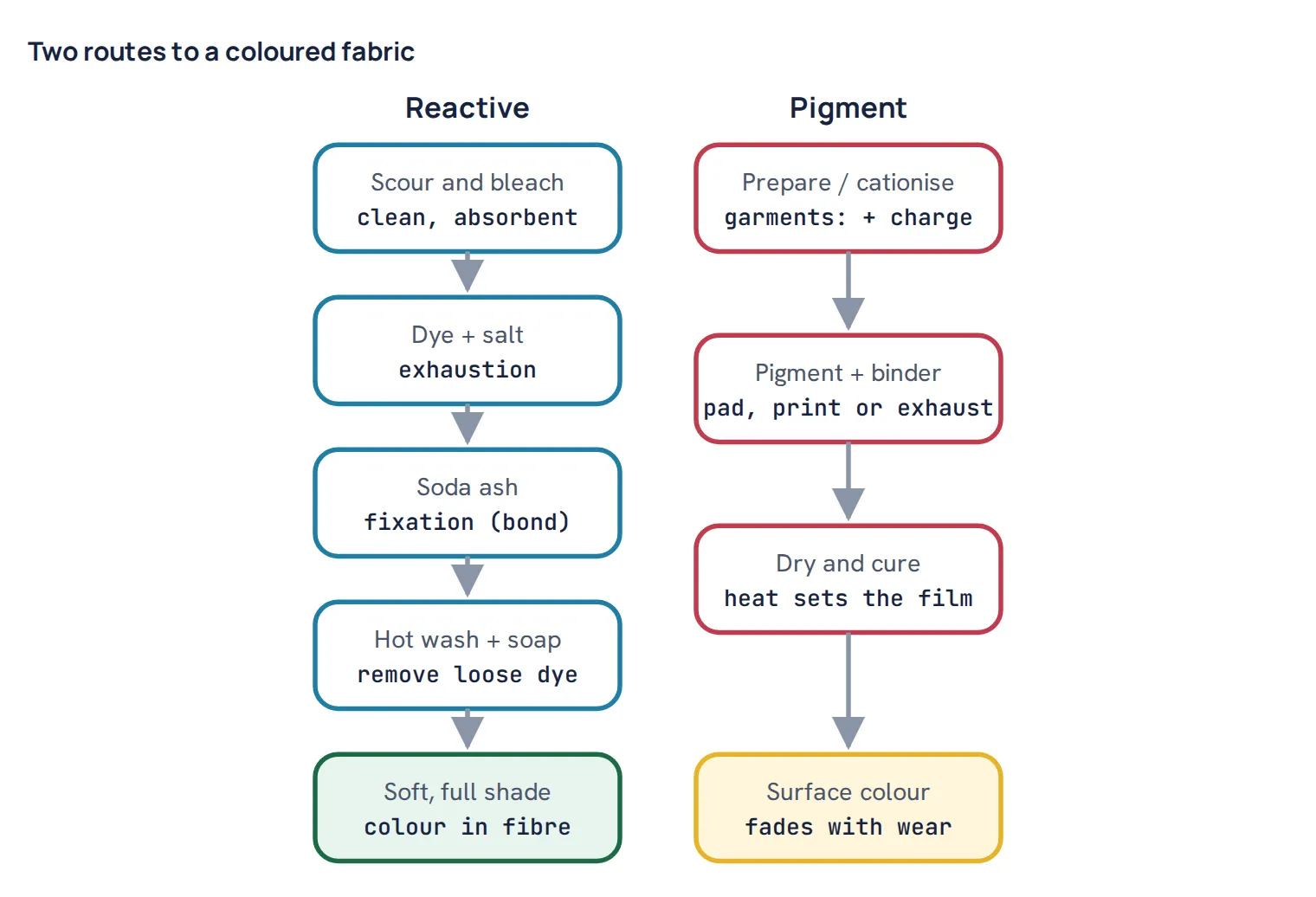
In a knit dye house the process runs in three stages. Salt is added to push the dye from the water onto the fibre. Then soda ash raises the pH so that the dye reacts with the fibre (this is called fixation). Finally the fabric is washed hot and soaped to remove the dye that reacted with water instead of the fibre. That last step, the wash-off, is what gives reactive shades their good wash and rubbing fastness. The full mechanism is in how reactive dyes work.
Reactive dyes give the full colour range, from bright turquoise and fluorescent-looking pinks to deep navy and black, and the fabric keeps its natural soft handle because nothing is coated on the surface.
What is a pigment dye?
A pigment is a finely ground coloured particle that does not dissolve in water and has no attraction for any fibre. On its own it would rinse straight off. To make it stay, it is mixed with a binder, usually an acrylic or similar polymer, and the binder is cured with heat. The binder forms a thin film that traps the pigment particles on the fibre surface.
Strictly speaking, pigment colouring is not dyeing at all, because no colour enters the fibre. The trade still calls it “pigment dyeing”, especially for garments. There are two common routes:
- Pad or print and cure. Fabric is padded or printed with pigment, binder and a few auxiliaries, dried, then cured at a high temperature (typically around 150–170°C for a few minutes, depending on the binder) so the film cross-links.
- Garment pigment dyeing. Finished garments are first treated with a cationic agent so the negatively charged pigment dispersion is attracted to them, then pigment and binder are exhausted in a washing machine and the garments are tumble dried or cured.
Because the colour sits on the outside, a pigment shade wears and fades with every wash and every rub. Fashion brands use this deliberately to get a soft, vintage, sun-faded look.
How the two processes compare
On the dye-house floor the two routes look very different. A reactive shade on cotton knit is an exhaust process in a jet or soft-flow machine: pretreatment, dyeing with salt and alkali, then several hot rinses and a soaping. Depending on depth, the dyeing and wash-off take several hours and a lot of water and steam. Pigment colouring needs no salt, no alkali fixation and almost no wash-off, because nothing loose is left once the binder has cured. That makes it quicker, cheaper in water and energy, and the same recipe works on cotton, polyester and blends.
Reactive dye vs pigment dye at a glance
| Point | Reactive dye | Pigment dye |
|---|---|---|
| How it holds | Covalent bond with cellulose | Binder film on the surface |
| Where the colour is | Through the fibre | On the outside only |
| Fibres | Cotton, viscose, modal, lyocell, linen | Any fibre, including polyester and blends |
| Handle | Natural, soft | Can be stiffer, especially in deep shades |
| Wash fastness | Good to very good after proper wash-off | Shade washes down over time |
| Rubbing fastness | Dry good; wet lower in deep shades | Usually the weak point, dry and wet |
| Light fastness | Moderate to good, varies by dye | Often very good |
| Water and energy | High (salt, long wash-off) | Low |
| Typical look | Clean, even, full shade | Soft, faded, vintage |
Fastness: what the tests usually show
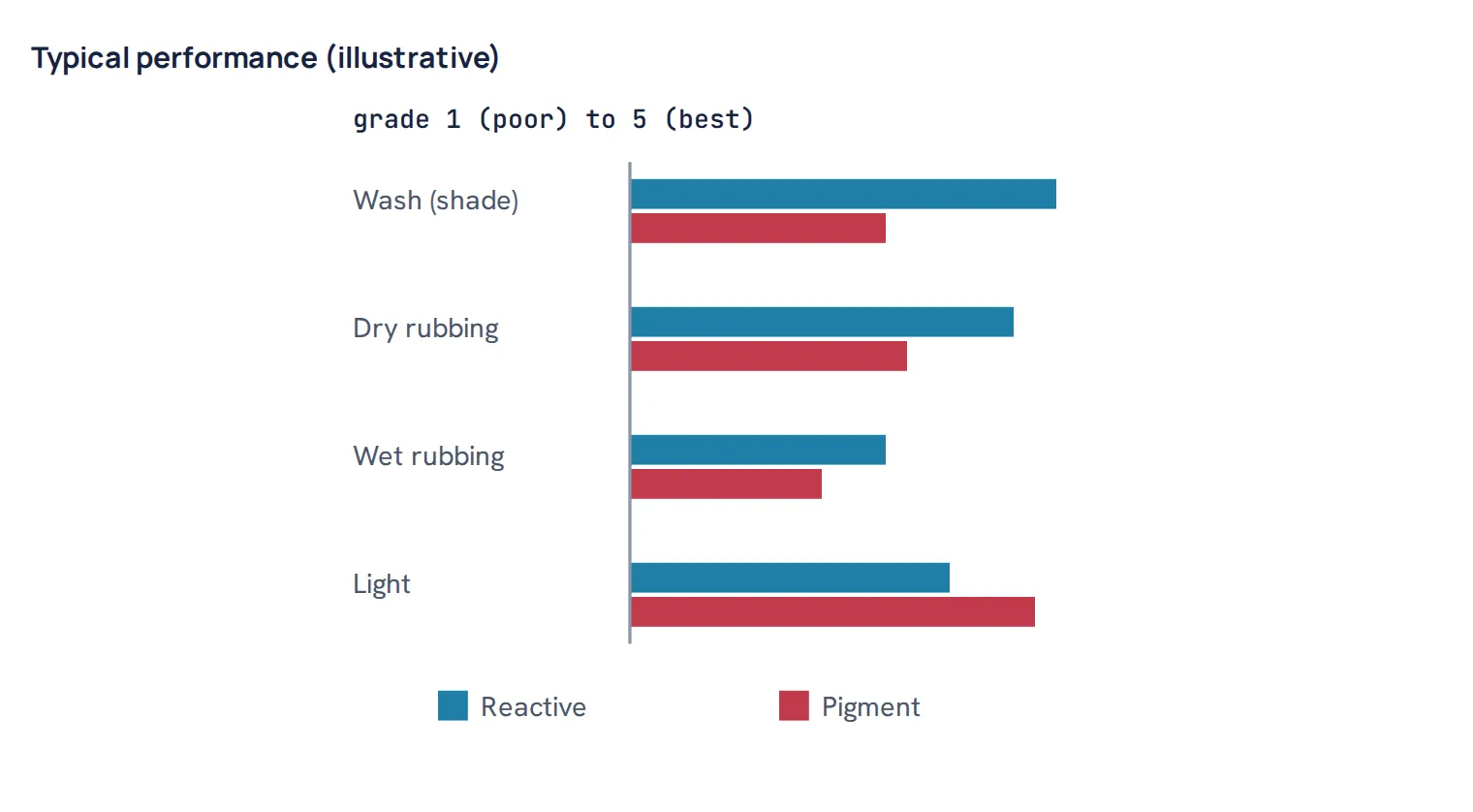
Buyers judge colour by fastness tests, and here the two behave very differently. With reactive dyes the risk is unfixed, hydrolysed dye left in the fabric. If the wash-off is good, wash fastness and staining are good and dry rubbing is good. Wet rubbing is the hardest grade to reach in deep shades. In our own lab reports on knit developments, deep reactive shades often reached only grade 2–3 on wet rubbing, and getting to grade 3 depended on the wash-off, not on adding more dye (see why knit fabric fails wet rubbing).
With pigments the weak point is the surface itself. Every rub takes a little binder and pigment away, so dry and wet rubbing are both limited, and they get worse as the shade gets deeper and the binder film thicker. Wash fastness is usually acceptable as “no staining” but the shade itself lightens wash by wash, which is exactly what a vintage garment wants and exactly what a uniform does not. Light fastness is often a strength of pigments, because pigment particles are larger and more stable than dissolved dye molecules.
Common mistake: treating “garment dyed” and “pigment dyed” as the same thing. Garments can be dyed with reactive dyes too, giving a solid, fast colour. Pigment dyeing is one specific route that gives a surface colour designed to fade.
How to tell them apart on a finished garment
You do not need a lab to make a good first guess. Try these checks on a hidden area such as the inside of a hem:
- Look at the folds and seams. Pigment colour wears first on edges, seam allowances and creases, showing a lighter, almost white line. Reactive colour wears much more evenly.
- Look inside the yarn. Pull a yarn out and untwist it, or cut the fabric and look at the cut end with a magnifier. A pigment shade often shows paler fibres inside the yarn; a reactive shade is the same colour all the way through.
- Rub with a damp white cloth. Both can mark the cloth in deep shades, but pigment usually leaves more colour, and it comes off as fine particles rather than a stain.
- Feel the handle. A deep pigment shade can feel slightly firm or “coated” compared with the same shade in reactive dye.
- Check the label and the look. Words like “pigment dyed”, “washed” or “vintage wash”, together with uneven, faded colour, point strongly to pigment.
A lab can confirm it: a cross-section under a microscope shows the colour as a ring on the outside for pigment and spread through the fibre for reactive.
Which should you choose?
Neither is “better”. They answer different briefs. Choose by what the garment has to do and how it should look after a year of washing.
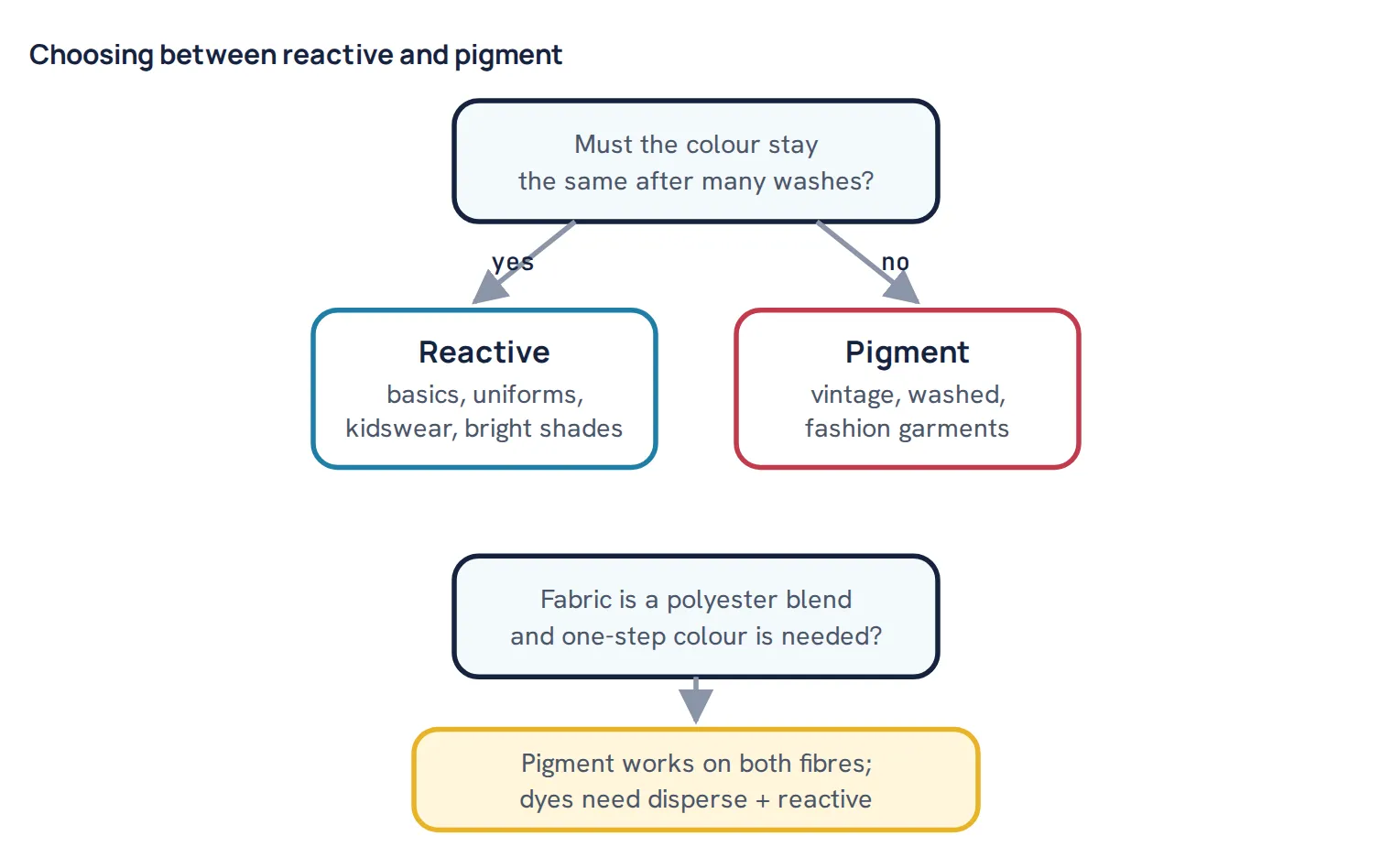
Choose reactive dye when the garment must keep its shade through home laundering, when you need bright or very deep colours, when the buyer has strict wash and rubbing requirements, or when handle matters, such as baby wear and fine single jersey. Most knit basics are reactive dyed for this reason.
Choose pigment when the design brief is a soft, washed or vintage look, when small garment lots need fast colour changes, or when a blend has to be coloured in one step. Expect lower rubbing grades and agree the test limits with the buyer before production. On a cotton-polyester blend, a true dye route needs two dye classes, disperse for the polyester and reactive for the cotton, which is covered in the CVC dyeing process.
Worked example. A buyer sends a faded charcoal sweatshirt and asks for “the same colour” with wash fastness grade 4 and wet rubbing grade 3. The look is pigment, but the test limits fit reactive better. The safe answer is to dye reactive and get the faded look from a washing or enzyme finish, or to agree pigment with relaxed rubbing limits. Matching the look and missing the test is still a rejection.
Environmental side
Reactive dyeing uses salt, alkali and a long wash-off, so it needs more water, steam and effluent treatment, and some unfixed dye always goes to drain. Pigment colouring uses far less water and almost no salt, but the binder is a synthetic polymer that stays on the garment, and curing needs heat. Low-salt reactive dyes and better wash-off control reduce the reactive load; formaldehyde-free binders reduce the main concern with pigments. Both can meet restricted substance lists when the chemicals are chosen correctly.
Summary
- Reactive dye bonds chemically inside cellulose fibres; pigment is glued to the surface with a binder.
- Reactive gives full, fast, soft shades on cotton and other cellulosics; pigment gives a faded, vintage look and works on any fibre.
- Rubbing is the usual weak point of pigment; wet rubbing in deep shades is the hardest test for reactive.
- Choose by end use and by the buyer’s test limits, not by the swatch alone.
For the other dye classes and which fibre takes which, see dye classes explained.
Questions
What is the main difference between reactive dye and pigment dye?
Reactive dye forms a chemical bond inside cellulose fibres such as cotton. Pigment has no attraction to any fibre and is held on the surface by a binder film that is cured with heat.
Which is more colourfast, reactive or pigment?
Reactive dye is usually better for wash and rubbing fastness after a proper wash-off. Pigment often has better light fastness but fades with washing and rubbing, which is why it is used for vintage looks.
Why do pigment dyed shirts fade?
The colour sits only on the surface in a binder film, so each wash and rub removes a little of it. The fading is usually intended as part of the washed or vintage look.
Can pigment dye be used on polyester?
Yes. Because the binder holds the pigment, it works on polyester, cotton and their blends in one step. Dyes would need disperse dye for polyester and reactive dye for cotton.
How can I tell if a T-shirt is pigment dyed?
Look for lighter wear lines at seams and folds, paler fibres inside the yarn and a slightly firm handle in deep shades. A microscope cross-section confirms it: pigment sits as a ring on the outside of the fibre.

Textile engineer with 14+ years in dyeing and fabric development. He writes every guide on Dyeing Solution from real production work. Full profile