Pima and Egyptian cotton are both premium long-staple cottons, usually the same species; the main difference is where they are grown. What Egyptian cotton is, Pima vs Egyptian vs regular cotton, why labels are often wrong, and what really makes a premium cotton feel premium.
At a glance
35+ mmextra-long staple
Samespecies, usually
Originnot a grade
6%cotton shrinkage
Pima and Egyptian cotton are both premium long-staple cottons; the main difference is where they are grown. Both usually come from the same cotton species, Gossypium barbadense, which produces longer, finer and stronger fibres than ordinary upland cotton. Pima is grown mainly in the south-western United States, and also in Peru and Australia. Egyptian cotton is grown in the Nile delta and valley in Egypt. At equal quality you would struggle to tell them apart; what matters far more is the actual staple length, the yarn and the honesty of the label.
This guide explains what Egyptian cotton is, what Pima cotton is, how they compare on softness, strength, pilling and price, why so much “Egyptian cotton” on the market is not what it claims, and how fibre quality shows up in a finished T-shirt or sheet. It is written from the fabric-processing side, where we see how fibre and yarn quality carry through to the finished fabric.
What is Egyptian cotton?
Egyptian cotton is cotton grown in Egypt. The country’s climate and the long, warm growing season of the Nile valley suit Gossypium barbadense, and Egypt developed a range of named varieties, many of them extra-long staple (ELS), meaning fibres of around 35 mm or more. Hand picking, used widely in Egypt, also helps keep fibres unbroken. These long fibres spin into fine, smooth, strong yarns, which is why “Egyptian cotton” became a byword for luxury sheets and shirts.
An important detail: “Egyptian cotton” is a statement of origin, not of quality. Egypt also grows long-staple rather than extra-long-staple varieties, and the label alone does not tell you which you are buying.
What is Pima cotton?
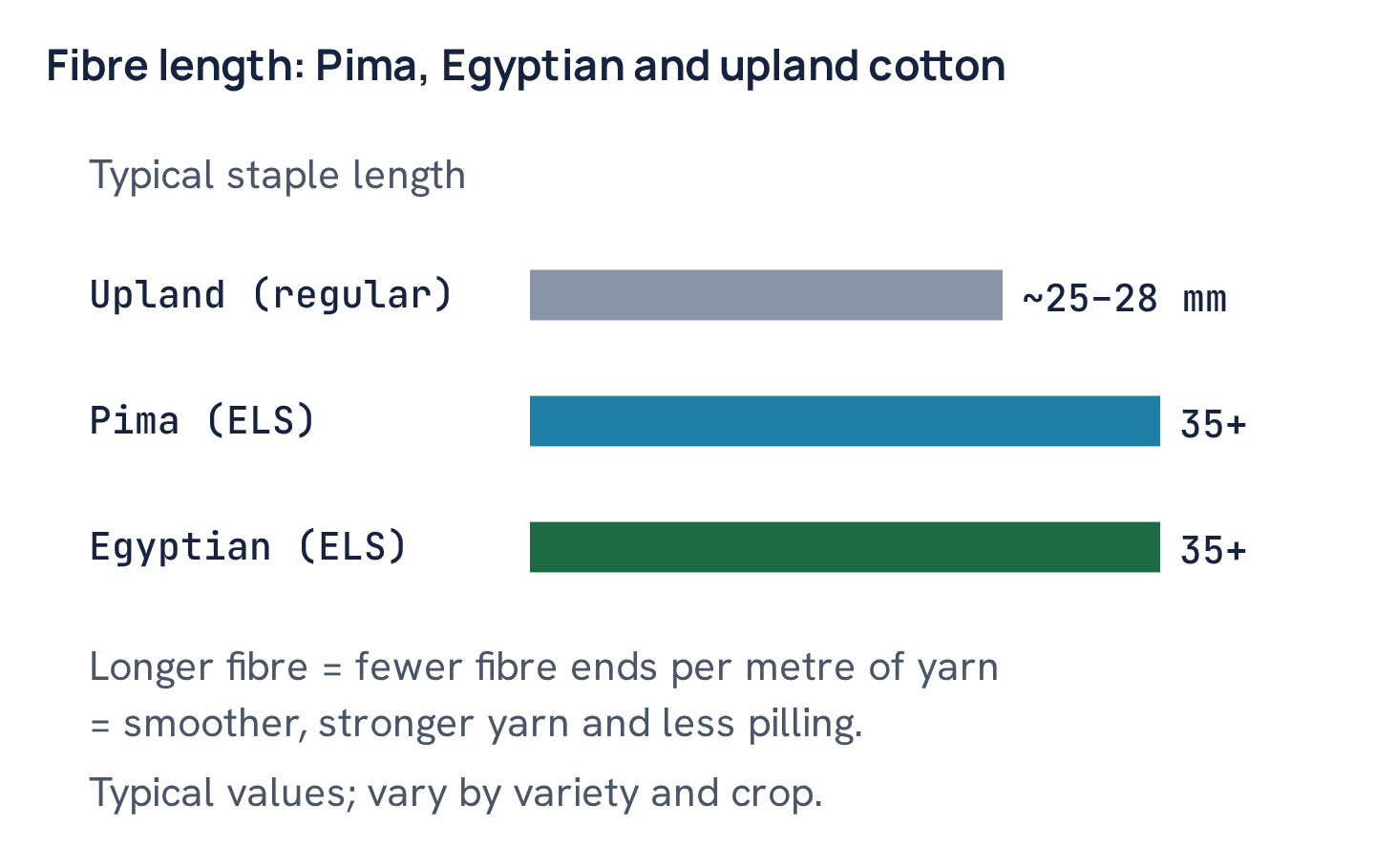
Pima cotton is also Gossypium barbadense, bred and grown mainly in the south-western United States, and also grown in Peru and Australia. Its fibres are typically 35 mm or longer, against roughly 25–28 mm for ordinary upland cotton. Pima yarn is smoother and stronger and produces fabric that is softer, more lustrous and less prone to pilling. See what is Pima cotton for more detail on the fibre.
Pima vs Egyptian cotton compared
| Point | Pima | Egyptian (ELS) | Upland (regular) |
|---|---|---|---|
| Species | G. barbadense | G. barbadense | G. hirsutum |
| Main growing areas | USA, Peru, Australia | Egypt | Worldwide |
| Staple length | Extra-long | Extra-long (best varieties) | Short to medium |
| Softness and lustre | Very high | Very high | Good |
| Strength | High | High | Moderate |
| Pilling | Low | Low | More |
| Typical uses | Premium T-shirts, polos, shirts | Luxury sheets, shirts, towels | Everyday clothing and home textiles |
| Price | High | High | Lowest |
Side by side, good Pima and good Egyptian ELS cotton are very close. Many textile people would say that a specific variety and a specific spinning mill matter more than the country.
Is Egyptian cotton better than Pima?
Neither is automatically better. At the top end, the best Egyptian varieties are among the longest, finest cottons in the world, and some luxury bedding is made from them. At the same time, a large share of products sold as “Egyptian cotton” have been found to contain little or none of it, or to use shorter Egyptian varieties. Pima, especially when traceable to a known source, is often the more dependable choice for clothing. For sheets, a verified Egyptian ELS yarn and a verified Pima yarn will feel very similar.
Why the label is the biggest risk
Because “Egyptian cotton” and “Pima” sell at a premium, both are tempting to mislabel. Investigations in the bedding trade have found products labelled Egyptian cotton that tested as ordinary cotton. Fibre testing can check whether a yarn is long-staple barbadense cotton, and DNA and isotope methods can help trace origin, but shoppers cannot do this at home. What you can do:
- Prefer products that name the supply chain or carry a recognised origin or licensing mark.
- Be wary of very low prices for “100% Egyptian cotton” sheets.
- Look for “extra-long staple” or a named variety, not just the country.
- Judge by feel and weight, not by thread count alone.
Fibre identity and blend percentages are checked in the lab by standard fibre tests; see how fibre content is tested.
Pima vs Egyptian cotton for T-shirts and sheets
The two cottons tend to appear in different products, which shapes how people compare them:
- T-shirts, polos and knit tops: Pima is the more common premium choice. Its long fibres spin into fine, strong knitting yarn that gives a smooth, slightly lustrous jersey that pills less and keeps its colour well.
- Bed sheets and pillowcases: Egyptian cotton is the traditional luxury name. Long-staple yarn woven as percale feels cool and crisp; as sateen it feels smooth and slightly lustrous.
- Dress shirts: both are used for fine poplins and twills; the yarn count and weave matter more than the origin.
- Towels: long-staple cotton makes towels that shed less lint and feel softer; absorbency depends mostly on the loop construction and finishing.
How to feel the difference in the shop
You cannot test fibre length by touch, but you can feel the results of good fibre and yarn:
- Smoothness: rub the fabric between finger and thumb. Long-staple cotton feels smooth and slightly cool, with little surface fuzz.
- Lustre: under light, premium cotton has a soft sheen rather than a flat, dull look.
- Surface hairiness: hold the fabric against the light and look along the edge. Fewer loose fibres sticking up usually means better yarn and less pilling later.
- Weight and density: a fabric that feels substantial for its thinness usually has fine, well-spun yarn packed closely.
- Recovery: crumple a corner briefly. Good cotton creases, but the creases are softer and fall out more easily on a well-finished fabric.
Thread count, yarn and finish matter more than you think
For sheets, thread count is often treated as the measure of quality, but a high count made with thin, multi-ply, short-staple yarn can feel worse than a moderate count in good long-staple single yarn. For T-shirts, the yarn quality shows in a different way: a combed, ring-spun or compact yarn from long-staple cotton gives a cleaner, smoother surface and pills less. See what is ring spun cotton.
Finishing matters too. Mercerising adds lustre and colour depth; enzyme washing removes surface fuzz; compacting controls shrinkage. A premium fibre that is badly finished will not feel premium. See what is mercerized cotton and enzyme washed.
Do Pima and Egyptian cotton shrink?
Yes, like all cotton. Long staple does not stop shrinkage; it comes from the knit or weave relaxing and the cotton fibre swelling in water. In our finishing records, 100% cotton knit shrank a median 6% in length after the wash test, and premium cotton knits behave the same way. What controls it is how well the fabric was relaxed and compacted at the mill, and whether you wash it hot. See does cotton shrink.
Common mistake: paying for “Egyptian cotton” sheets with a very high thread count at a bargain price. That combination usually means short-staple or mixed cotton in thin, multi-ply yarn. A moderate thread count in verified long-staple single yarn feels better and lasts longer.
How they dye
Pima and Egyptian cotton are both cotton, so they are dyed exactly like any other cotton, with reactive dyes. Their smooth, long fibres often give a slightly cleaner, brighter shade, especially after mercerising, because there are fewer loose fibre ends scattering light. The process is the same as in the 100% cotton knit dyeing process.
Worked example. You are choosing between a Pima T-shirt and an “Egyptian cotton” T-shirt at a similar price. If both brands are reputable and name their sources, choose by fit, weight and feel; the fibres will be very similar. If one is much cheaper and gives no detail beyond the country name, the more transparent product is the safer buy.
Caring for premium cotton
- Wash at 30–40°C with similar colours; whites can go hotter if the label allows.
- Use a mild detergent and avoid heavy bleach, which weakens fibres.
- Line dry or tumble on low to limit shrinkage and keep the surface smooth.
- Iron while slightly damp for crisp shirts and sheets.
Summary
- Pima and Egyptian cotton are both usually G. barbadense, a long-staple species.
- Pima is grown mainly in the USA, Peru and Australia; Egyptian cotton in Egypt.
- Good Pima and good Egyptian ELS cotton are very similar in softness and strength.
- “Egyptian cotton” is an origin claim and is often mislabelled; look for traceability.
- Yarn, finishing and care matter as much as the fibre; both still shrink like cotton.
Questions
What is Egyptian cotton?
Cotton grown in Egypt, mostly of the long-staple species Gossypium barbadense. The best varieties are extra-long staple, which spins into fine, smooth, strong yarn.
Is Pima cotton the same as Egyptian cotton?
They are usually the same species and very similar in quality. Pima is grown mainly in the USA, Peru and Australia; Egyptian cotton is grown in Egypt.
Is Egyptian cotton better than Pima?
Not automatically. The best Egyptian varieties are excellent, but many products labelled Egyptian cotton are mislabelled. Traceable Pima is often the more dependable choice.
Does Egyptian cotton shrink?
Yes, like all cotton. Shrinkage depends on how the fabric was finished and how it is washed, not on the staple length.
Is thread count the best sign of quality?
No. Yarn quality and staple length matter more. A moderate thread count in good long-staple yarn feels better than a very high count in thin, short-staple yarn.

Textile engineer with 14+ years in dyeing and fabric development. He writes every guide on Dyeing Solution from real production work. Full profile