
Yes, polyester pills, and its strong fibres keep the pills attached, so worn polyester fleece and blends look bobbly. Which polyester fabrics pill easily, polyester vs cotton, what our lab reports show, how mills reduce pilling, and how to remove and prevent pills.
At a glance
Strongfibre holds pills
Spunpills most
9 of 16fleece Martindale fails
Shaverremoves them
Yes, polyester pills, and its pills are the hard-to-get-rid-of kind. Pilling happens on almost every fabric when rubbing pulls loose fibre ends into small balls. Polyester is not more likely to fuzz than cotton, but its fibres are much stronger, so the pills cannot break off. They stay anchored to the fabric and collect more fibre, which is why a worn polyester fleece, sweater or pair of leggings can look covered in bobbles while a cotton one just looks a little worn. Spun polyester and polyester blends pill most; smooth filament polyester pills least.
This guide explains why polyester pills, which polyester fabrics pill easily and which do not, polyester vs cotton and blends, what our lab reports show, how mills reduce pilling with anti-pill fibres and finishing, how to remove polyester pills, and how to wash polyester to keep it smooth. It is written from the dyeing and testing side, where pilling is checked on every knit development.
Why polyester pills
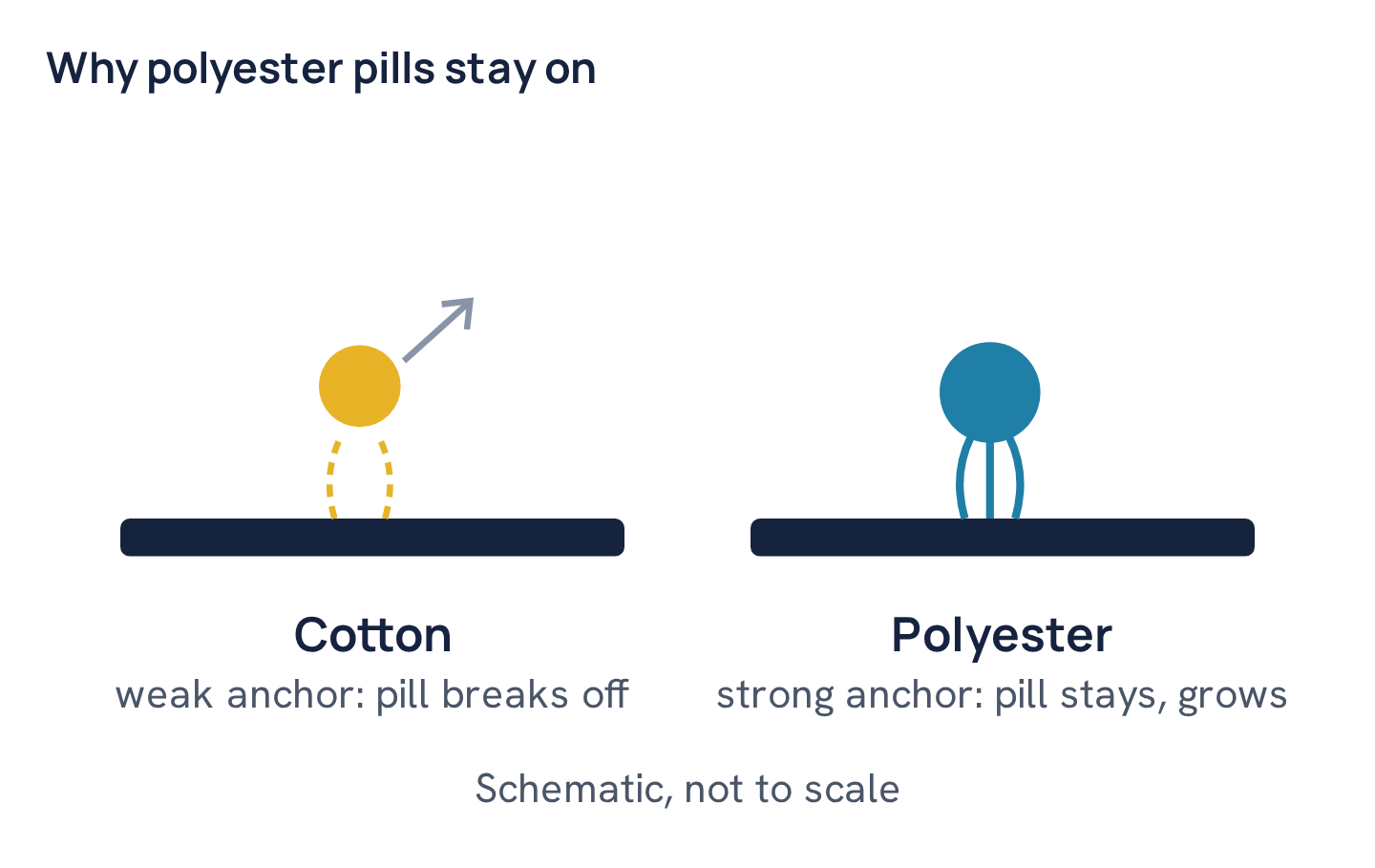
Pills form in three steps: rubbing pulls fibre ends to the surface (fuzz), the fuzz tangles into small balls (pills), and the pills either break away or stay. What decides the last step is fibre strength. Cotton fibres are relatively weak, so most cotton pills snap off during wear and washing. Polyester fibres are several times stronger, so the anchoring fibres hold, the pill stays put and grows. That is the core reason polyester pilling is so visible.
Polyester’s smoothness adds to this: smooth fibres slip out of the yarn more easily than rough, twisted cotton fibres, especially in loosely spun yarns.
Which polyester fabrics pill most?
| Fabric | Pilling | Why |
|---|---|---|
| Brushed fleece (polyester or CVC) | High | Raised pile is loose fibre ready to tangle |
| Spun polyester and poly-cotton jersey | Medium to high | Staple fibre ends on the yarn surface |
| Polyester-acrylic knitwear | High | Loose, bulky yarns with strong fibres |
| Brushed or peached microfiber | Medium | Sanded surface has fibre ends |
| Filament polyester knit (sportswear) | Low | Continuous filaments have few ends; may snag instead |
| Woven filament polyester (satin, linings) | Very low | Smooth, tight, continuous filaments |
The key difference is staple vs filament: spun polyester is made from short cut fibres, each with two ends that can work loose, while filament polyester is continuous. See what is CVC fabric for the most common spun blend.
Does polyester pill more than cotton?
Polyester and cotton fabrics of the same construction fuzz about as easily, but polyester shows pills for much longer because they do not break off. A cotton T-shirt and a polyester-cotton T-shirt may both look slightly fuzzy after a few months; the blend will show distinct bobbles, especially at the sides and underarms. Cotton has its own wear problem: it thins and fades faster. So polyester looks worse sooner in one way, and cotton wears out sooner in another.
What our lab reports show
Pilling is graded from 5 (no pilling) to 1 (very severe) after a controlled rubbing test, and most buyers require grade 3 to 4. In our 316 outside lab reports on knit developments, 266 included a pilling result and only 19 failed, about 7%. The fails were concentrated in heavy brushed and loop-back fabrics, mostly CVC fleece and terry around 330 GSM, tested on the Martindale method at 2,000 rubs. None of 54 fabrics tested in the pilling box failed, while 9 of 16 fleece and terry fabrics failed at 2,000 Martindale rubs. In our early reports, none of the failing fabrics had been singed or heat set. See why fleece and terry fail the pilling test.
How mills reduce polyester pilling
- Low-pill polyester fibre: fibres made with lower strength so pills break off, like cotton’s.
- Filament instead of staple where the design allows.
- Better spinning: compact or more twisted yarns hold fibres in.
- Tighter knitting and less aggressive brushing on fleece.
- Singeing: burning off protruding fibres; possible on CVC only when the face is cotton, because the flame hardens polyester.
- Heat setting: helps lock polyester fibres in place.
- Anti-pill finishes: resins that bind fibre ends on the surface.
Enzyme treatment, which removes loose cotton fibres, does nothing for polyester fuzz, which is why polyester-rich fabrics depend more on yarn choice and heat setting. See heat setting of polyester fabric.
Common mistake: brushing a CVC fleece harder to make the sample feel softer. The deeper pile looks great in the showroom, then fails the Martindale test at 2,000 rubs and pills quickly in the customer’s hands.
How to remove pills from polyester
- Electric fabric shaver: the most effective tool for polyester and blends; lay the garment flat and move gently in small circles.
- Disposable razor: used lightly on a flat, stretched surface.
- Fabric comb or pumice-type stone: works on fleece and knitwear.
- Lint roller: lifts loose fuzz after shaving.
Never pull pills off by hand: it drags more fibre out and starts new pills. Avoid over-shaving, which thins the fabric.
How to stop polyester pilling
- Wash inside out to protect the face.
- Use a gentle cycle and a full but not packed load.
- Wash with similar soft garments, not with jeans, towels or items with zips and Velcro.
- Use liquid detergent rather than gritty powder.
- Air dry or tumble on low; tumbling is a major source of rubbing.
- Avoid friction points: rough bag straps, seat belts and rough furniture.
- Remove pills early before they collect more fibre.
Does polyester pill easily?
That depends on the fabric more than the fibre. Smooth filament sportswear and woven polyester rarely pill. Brushed fleece, spun polyester jersey, cheap polyester-acrylic knitwear and leggings rubbed at the inner thighs pill easily. When buying, feel the surface: a smooth, tight, slightly crisp polyester will pill less than a soft, fuzzy, loosely knitted one. Labels mentioning anti-pill or low-pill fleece are worth looking for.
Polyester bedding and upholstery
Polyester microfiber sheets, fleece blankets and polyester sofa fabrics pill too, usually where they rub most: the foot end of sheets, the middle of a blanket, sofa cushion fronts and armrests. Brushed microfiber sheets pill more than smooth, tightly woven polyester-cotton percale. For upholstery, tightly woven, filament polyester fabrics resist pilling far better than soft, fuzzy, spun-yarn fabrics. A fabric shaver removes pills from sheets and sofas the same way as from clothes.
Is pilling a sign of poor quality?
Often, but not always. Heavy, early pilling usually points to short, loosely spun staple fibre, a loose knit or heavy brushing, all ways of making a fabric feel soft and look bulky cheaply. But even good polyester fleece pills somewhat where it is rubbed hard. What separates quality is how quickly pilling starts, how dense the pills get, and whether the fabric uses low-pill fibre, tighter construction and proper finishing.
Polyester leggings and pilling
Leggings often pill between the thighs, where the fabric rubs on itself with every step. Polyester-spandex and nylon-spandex leggings made from fine filament yarns in a dense knit pill least; brushed, soft-touch leggings pill more. Washing leggings inside out, cool, without fabric softener and drying them flat reduces pilling and protects the spandex.
Worked example. Two fleece jackets: one standard polyester fleece, one labelled anti-pill. After a winter of wearing a backpack, the standard fleece has a band of pills across the shoulders and back that needs shaving; the anti-pill fleece shows light fuzz but few bobbles. Same fibre, different fibre treatment and finishing.
Washing mistakes that speed up pilling
Overloading the machine, long heavy-duty cycles, washing fleece with towels or denim, using powder detergent with abrasive particles, and tumble drying on high all add friction. So does washing a garment face-out next to zips, hooks and Velcro. Most of these are easy to avoid, and avoiding them does more for polyester garments than any pilling remover.
Summary
- Polyester pills, and its strong fibres keep the pills attached.
- Spun polyester, blends and brushed fleece pill most; filament polyester pills least.
- In our lab reports, pilling fails were mainly heavy CVC fleece and terry at 2,000 Martindale rubs.
- Low-pill fibre, tight construction, singeing (cotton face) and heat setting reduce pilling.
- Remove pills with a shaver; wash inside out, gently, and dry low.
Questions
Does polyester pill?
Yes. Polyester fuzzes like other fibres, and its strong fibres hold the pills on so they build up instead of breaking off.
Does polyester pill more than cotton?
It shows pills longer. Cotton pills tend to break away, while polyester pills stay anchored and grow.
Which polyester fabrics pill the least?
Smooth filament polyester, such as sportswear knits and woven linings, and fabrics made from low-pill polyester fibre.
How do you stop polyester from pilling?
Wash inside out on a gentle cycle with soft items only, use liquid detergent, air dry or tumble low, and remove pills early.
How do you remove pills from polyester?
Use an electric fabric shaver or a light razor on a flat surface. Do not pull pills off by hand.

Textile engineer with 14+ years in dyeing and fabric development. He writes every guide on Dyeing Solution from real production work. Full profile