Fabric content is the list of fibres in a fabric and the percentage of each by weight, as shown on the care label. What it tells you, how to read it, labelling tolerances, how labs test it, and why 18% of the fibre content tests in our lab reports failed.
At a glance
By weightlargest first
±3%usual blend allowance
18%of our tests failed
57%CVC + elastane fails
Fabric content is the list of fibres a fabric is made from and the percentage of each, by weight. It is what you see on a care label as “100% cotton”, “60% cotton, 40% polyester” or “95% viscose, 5% elastane”. Fabric content is also called fibre content or fibre composition. It tells you how a fabric will feel, breathe, stretch, shrink and need to be washed, and in most countries it is a legal requirement on clothing and textiles. Labs check it with standard fibre analysis tests, and declared blends usually have a small tolerance.
This guide explains what fabric content means, how to read it on a label, the common fibres and what each tells you, labelling rules and tolerances, how fabric content is tested, why it sometimes fails, and how to use it when buying and caring for clothes. It draws on our lab reports, which include 188 fibre content results on knit developments.
What fabric content tells you
The fibres in a fabric decide most of its everyday behaviour:
- Comfort: cellulose fibres (cotton, linen, viscose, modal, lyocell) absorb moisture and feel cool; synthetics (polyester, nylon, acrylic) absorb little and can feel warm.
- Stretch: elastane (spandex) adds stretch and recovery, even at 2–8%.
- Shrinkage: cotton and especially viscose shrink more; polyester barely shrinks.
- Durability and pilling: polyester and nylon are strong but hold pills; cotton pills wear off.
- Care: heat-sensitive fibres need cooler washing and ironing.
- Dyeing: each fibre needs its own dye class, so blends are dyed differently.
How to read fabric content on a label
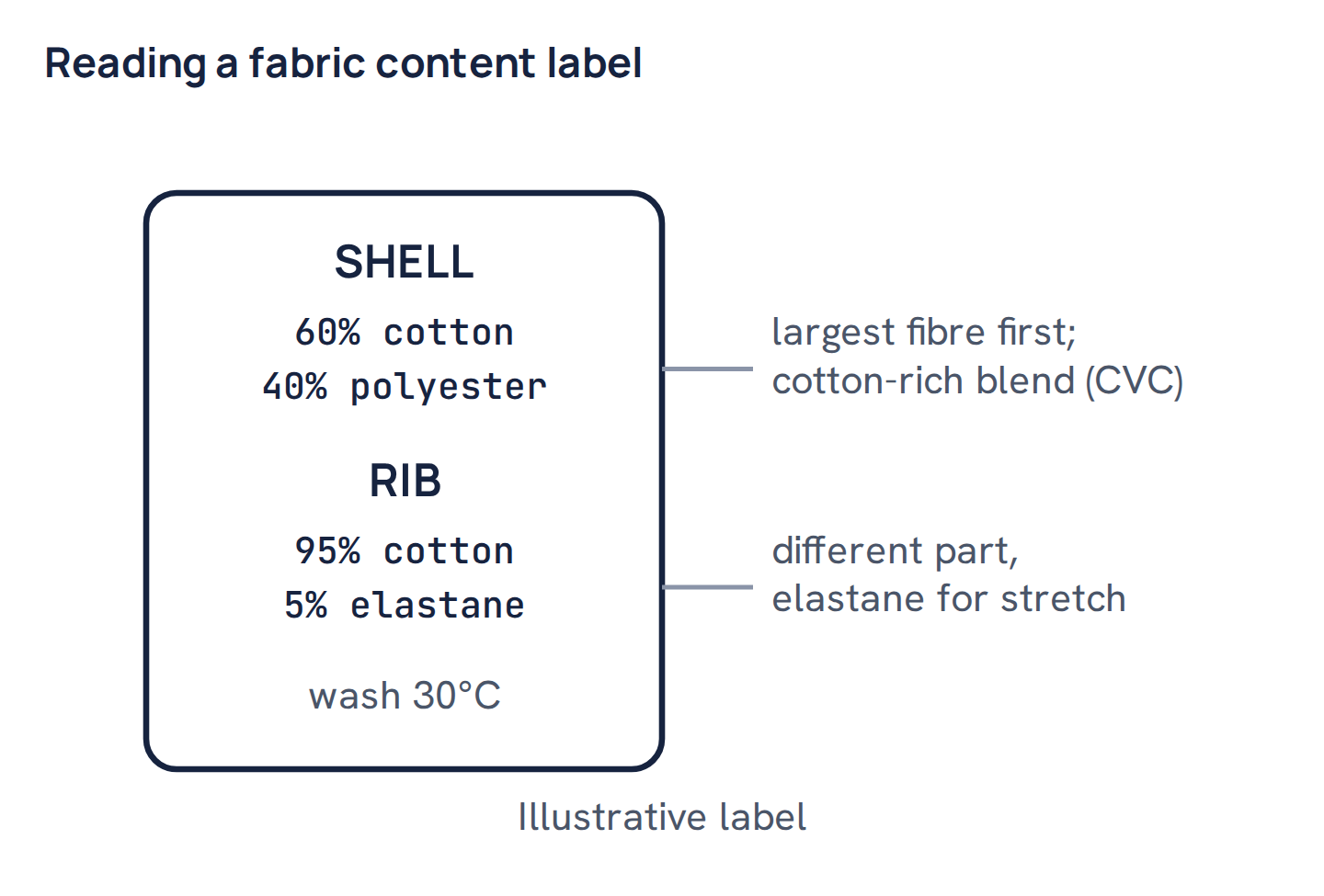
- Fibres are listed in order of weight, largest first.
- Percentages add up to 100%.
- Generic fibre names are used: polyester, nylon or polyamide, elastane or spandex, viscose or rayon, acrylic.
- Different parts can be listed separately: “Body: 100% cotton; Rib: 95% cotton, 5% elastane; Lining: 100% polyester”.
- Small amounts of decorative fibre may be grouped or excluded, depending on local rules.
Common fibres you will see
| Fibre | Type | What it tells you |
|---|---|---|
| Cotton | Natural cellulose | Breathable, absorbent, shrinks some |
| Linen | Natural bast fibre | Cool, crisp, wrinkles easily |
| Viscose / rayon | Regenerated cellulose | Soft, drapey, shrinks most |
| Modal, lyocell | Regenerated cellulose | Soft, smooth, more stable than viscose |
| Polyester | Synthetic | Strong, quick drying, barely shrinks, can pill |
| Nylon / polyamide | Synthetic | Very strong, stretchy, abrasion resistant |
| Elastane / spandex | Synthetic | Stretch and recovery; heat sensitive |
| Acrylic | Synthetic | Warm, wool-like, pills easily |
| Wool | Natural protein | Warm, can felt and shrink |
Labelling rules and tolerances
Most countries require fibre content on clothing and home textiles. Typical rules include using recognised generic fibre names, stating percentages by weight, and listing fibres in order. Many rules allow a small manufacturing tolerance on blends, commonly around ±3 percentage points per fibre, while a single-fibre claim such as “100% cotton” usually allows nothing else except permitted minor decorative or functional exceptions defined in the rules. Buyers often apply the same ±3% allowance in their lab tests. Details differ between countries, so brands follow the rules of each market they sell in.
How fabric content is tested
Labs first identify each fibre, using microscopy, burning behaviour and solubility, then measure how much of each is present. For blends, a chemical reagent dissolves one fibre and leaves the other: for cotton with polyester, 75% sulphuric acid dissolves the cotton and leaves the polyester, which is dried and weighed; elastane is removed with a solvent that leaves cotton and polyester. Results are corrected for moisture and compared with the declaration. See how fibre content is tested.
Why fabric content sometimes fails
In our 316 outside lab reports on knit developments, 188 included a fibre content result and 33 failed, about 18%. The fail rate depended heavily on the fabric:
| Declared fibre | Tested | Failed | Fail rate |
|---|---|---|---|
| 100% cotton | 95 | 5 | 5% |
| CVC / PC | 45 | 14 | 31% |
| Cotton + elastane | 18 | 0 | 0% |
| Other blends | 16 | 6 | 38% |
| CVC / PC + elastane | 14 | 8 | 57% |
Most fails were small shifts in blend ratio, for example a declared 60/40 cotton-polyester coming out near 54/46, because cotton loses weight in scouring and bleaching while polyester does not. Others were undeclared fibres, such as the elastane core of a covered yarn or polyester in a blended yarn left off the declaration. See why knit fabric fails fibre content.
Common mistake: declaring a CVC fabric by the yarn ratio bought from the spinner. Scouring and bleaching remove some cotton weight, so the finished fabric often tests with less cotton than the yarn did. Test a finished swatch before fixing the label.
Fabric content vs fabric type
Fabric content is not the same as fabric type. Content says what fibres are used; type says how they are made into fabric. “100% cotton” can be jersey, pique, fleece, poplin, denim or canvas, which feel and behave very differently. “Jersey” can be cotton, polyester, viscose or a blend. To understand a fabric, you need both: for example, “100% cotton single jersey, 160 GSM” or “95% viscose, 5% elastane rib”. See what is cotton jersey and what is GSM.
Recycled and certified fibres on labels
Labels increasingly mention recycled or organic fibres, such as “recycled polyester” or “organic cotton”. These describe the source of the fibre, not a different fibre type: recycled polyester behaves like new polyester, and organic cotton like conventional cotton of the same quality. Claims like these are usually backed by certification schemes that track the material through the supply chain. If a label makes such a claim, a certification mark or code usually accompanies it.
Using fabric content when buying
- For heat and comfort: look for cotton, linen, viscose, modal or lyocell first in the list.
- For easy care: polyester or a cotton-polyester blend.
- For stretch: a few percent elastane; more for leggings and swimwear.
- For sport: polyester or nylon-based technical fabrics.
- For low shrinkage: polyester-rich blends rather than 100% viscose or cotton.
- For sensitive skin: cotton, modal or lyocell next to the skin.
Using fabric content to wash correctly
The care label is based on the fabric content and the garment’s construction. As a rule, wash for the most delicate fibre in the blend: a cotton-elastane garment should be washed cooler than plain cotton to protect the elastane; a polyester-viscose dress should be washed gently because of the viscose. In our finishing records, median length shrinkage after the wash test was 3% for polyester, 4% for cotton-polyester blends, 6% for cotton and 9% for viscose, which shows why the fibre list matters; see shrinkage by fibre.
Worked example. Two T-shirts look alike. One label says “100% cotton”, the other “50% polyester, 25% cotton, 25% rayon”. The first will breathe best and shrink a little more; the second is a tri-blend that feels softer and drapier, shrinks less and shows a heathered look. The fabric content alone tells you most of what to expect.
What if a garment has no fabric content label?
Labels sometimes get cut off or fade. Clues can help: feel, drape, how the fabric reacts to a water drop, how it creases when crushed and how it stretches. Synthetic fabrics tend to spring back, resist water and build static; cellulose fabrics absorb water quickly and crease. For an accurate answer, a textile lab can run a fibre analysis. When washing an unlabelled garment, assume the most delicate case: cool water, gentle cycle and line drying.
Fabric content on online listings
When buying online, the fibre content should appear in the product details, often under a heading such as material or composition. If it only lists a marketing name, look for the percentages before buying, or ask the seller. The content tells you more about comfort, shrinkage and care than the product name or the photo does.
Summary
- Fabric content is the list of fibres and their percentages by weight.
- It predicts comfort, stretch, shrinkage, pilling, dyeing and care.
- Labels list fibres largest first; blends usually allow about ±3% per fibre.
- In our lab reports, 18% of fibre content tests failed, mostly on CVC and blends with elastane.
- Read the content when buying, and wash for the most delicate fibre.
Questions
What is fabric content?
The fibres a fabric is made from and the percentage of each by weight, such as 60% cotton, 40% polyester.
How do you read fabric content on a label?
Fibres are listed in order of weight, largest first, using generic names. Different parts of a garment can be listed separately.
Is fabric content the same as fibre content?
Yes. Fabric content, fibre content and fibre composition all mean the list of fibres and their percentages.
How accurate is fabric content on labels?
Blends are usually allowed about ±3% per fibre. In our lab reports 18% of fibre content tests failed, mostly on cotton-polyester blends.
How is fabric content tested?
Labs identify the fibres, then dissolve one fibre with a chemical reagent and weigh what remains to calculate the percentages.

Textile engineer with 14+ years in dyeing and fabric development. He writes every guide on Dyeing Solution from real production work. Full profile