Polyester fibre absorbs almost no moisture, so dense polyester can feel hot, but open and technical polyester fabrics can be very breathable. What breathability means, which polyester fabrics breathe best, how wicking works, polyester vs cotton, and how to choose.
At a glance
0.4%moisture regain
Structuredecides
Wickingfor sport
Nofabric softener
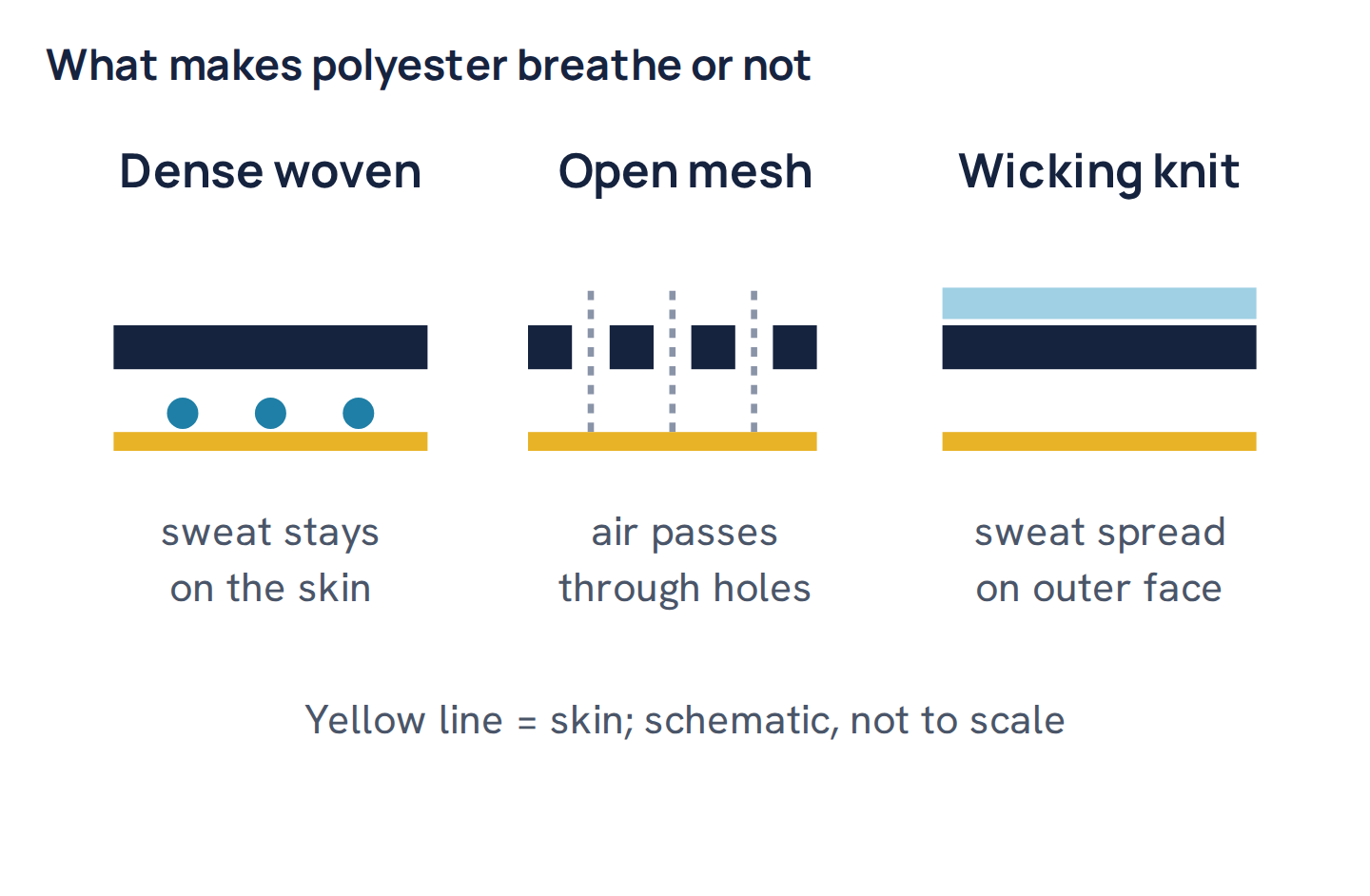
Polyester is less breathable than cotton or linen in the sense that the fibre absorbs almost no moisture, but whether a polyester fabric feels breathable depends far more on how it is made than on the fibre. A tightly woven polyester blouse can feel sticky and trap heat. An open, lightweight polyester mesh or a technical knit designed to wick sweat can be among the most breathable fabrics you can wear. So “is polyester breathable?” has two answers: the fibre is not absorbent, but the fabric can be very breathable if its structure lets air and water vapour pass.
This guide explains what breathability really means, why polyester fibre behaves differently from cotton, which polyester fabrics breathe well and which do not, how wicking works, how breathability is measured, and how to choose polyester that will not make you feel clammy. It is written from the dye-house side, where we dye and finish polyester knits, including wicking finishes, every day.
What breathability actually means
“Breathable” usually mixes up three different things:
- Air permeability: how easily air passes through the fabric. This depends mostly on how open the structure is.
- Water vapour transmission: how easily sweat vapour escapes from the skin through the fabric.
- Moisture handling: what happens to liquid sweat: whether the fibre absorbs it, spreads it or leaves it on the skin.
Polyester scores poorly on absorbing moisture but can score very well on air permeability and on moving liquid sweat away, if the fabric is designed for it.
Why polyester fibre does not absorb sweat
Polyester is hydrophobic. At standard conditions it holds only around 0.4% moisture, compared with about 8% for cotton and 13% for viscose. Sweat cannot soak into the fibre, so in a dense polyester fabric it stays on the skin or sits between the fibres. That is why a cheap, tightly woven polyester top can feel hot and clammy. See is polyester good for hot weather.
Polyester fabrics from least to most breathable
| Fabric | Breathability | Why |
|---|---|---|
| Coated or laminated polyester | Very low | Coating blocks air and vapour |
| Dense polyester satin, taffeta | Low | Tight, smooth weave, no absorption |
| Polyester fleece | Low to medium | Warm pile traps air for insulation |
| Polyester chiffon, georgette | Medium to high | Very light, sheer, open weave |
| Polyester jersey (plain) | Medium | Knit is open, but no wicking finish |
| Technical wicking polyester knit | High | Designed yarns or finish move sweat |
| Polyester mesh, birdseye, eyelet knits | Very high | Open holes let air flow freely |
How wicking polyester works
Sportswear polyester often feels more comfortable than cotton during exercise because it is designed to wick. Moisture-wicking polyester uses fine or shaped fibres (with channels along their length), knit structures with different inner and outer faces, and hydrophilic finishes that let water spread along the fibre surface. Sweat is pulled from the skin into the fabric and spread over a large area on the outside, where it evaporates quickly. Because polyester does not absorb the water, the fabric stays light and dries fast. Cotton, by contrast, soaks up sweat and holds it, becoming heavy and cold.
Polyester vs cotton for breathability
| Situation | Better choice | Why |
|---|---|---|
| Office, relaxed summer day | Cotton or linen | Absorbs light sweat, feels natural |
| Running, gym, sport | Wicking polyester | Moves sweat and dries fast |
| Hot, humid, low activity | Linen or light cotton | Feels cooler at rest |
| Hiking, layering | Wicking polyester base layer | Stays dry, less chill when you stop |
| Sleepwear | Cotton or modal | Soft, absorbent, comfortable at rest |
How breathability is measured
Laboratories measure air permeability by blowing air through a fabric under a set pressure and recording the flow. Water vapour transmission is measured by how much water vapour passes through a fabric sample in a set time. Wicking is tested by how quickly water rises up a strip of fabric or how fast a drop spreads and dries. These tests show clearly that structure dominates: a polyester mesh can be far more air-permeable than a heavy cotton twill.
Polyester blends and breathability
- Cotton-polyester (CVC, 60/40, 50/50): cotton adds absorbency; polyester adds quick drying and durability. A good everyday compromise. See what is CVC fabric.
- Polyester-spandex: fitted activewear; breathability depends on knit weight and openness.
- Tri-blends: polyester, cotton and rayon for a soft, light, airy tee. See what is tri-blend.
Common mistake: using fabric softener on polyester sportswear. Softener coats the fibres and blocks the wicking finish, so the fabric stops spreading sweat and starts to feel clammy and smelly. Wash technical polyester without softener.
Signs a polyester garment will breathe well
- Light weight and visible open structure (mesh panels, eyelets, fine knit).
- Labels such as “moisture wicking”, “quick dry” or “breathable mesh”.
- Thin, soft hand rather than a crisp, plasticky feel.
- Hold it to light: you can see light through an open structure.
- Breathe through it: if air passes easily, the fabric is air-permeable.
Worked example. A runner compares two black polyester T-shirts. One is a heavy, tight jersey from a fashion line; the other is a light birdseye mesh with a wicking finish. After a 5 km run the fashion tee is wet and sticky against the back; the mesh tee feels damp only briefly and dries within minutes after the run. Same fibre, very different breathability.
Odour and polyester
Polyester can hold body odour more than cotton because oily sweat compounds cling to the hydrophobic fibre surface and bacteria grow there. Antimicrobial finishes reduce this, and regular washing at 30–40°C with a good detergent helps. See antimicrobial finish.
Polyester in hot, humid climates
In humid heat, sweat evaporates slowly whatever you wear, so the fabric’s job is mainly to avoid trapping heat and to let air move. Loose cuts matter as much as fibre: a loose polyester mesh shirt can feel cooler than a tight cotton tee. For everyday wear in humid places, light cotton, linen or a cotton-polyester blend is usually the most comfortable at rest, while technical polyester is better for activity. Avoid dense, shiny polyester fabrics such as satin and taffeta in the heat; they trap warm air and feel sticky.
Polyester bedding and sleepwear
Polyester microfiber sheets feel smooth and soft, resist wrinkles and are inexpensive, but many people find them warm because the dense, fine fabric does not absorb night sweat. Cotton percale, linen or modal-blend sheets usually sleep cooler. Polyester fleece blankets are warm because their pile traps still air, which is exactly the opposite of breathable. If you sleep hot, choose natural or cellulose fibres for anything touching the skin at night. See is polyester a microfiber.
Recycled polyester and breathability
Recycled polyester, made from used bottles or textile waste, is chemically the same as virgin polyester. It breathes, wicks and dries in the same way when it is made into the same fabric structure. Any difference in comfort comes from the yarn and fabric design, not from whether the polyester is recycled.
Does a polyester-cotton blend breathe better?
Yes, usually. Adding cotton gives the fabric some ability to absorb sweat, while the polyester helps it dry faster and keep its shape. In our finishing records, cotton-polyester knits also shrank less than 100% cotton, with a median 4% length shrinkage against 6% for cotton. For a T-shirt worn all day in mixed conditions, a cotton-rich blend is often the most comfortable compromise between breathability, drying speed and easy care. For pure sport, a fully technical polyester knit still dries fastest.
Breathability and dark colours
Colour does not change how much air passes through a fabric, but dark fabrics absorb more sunlight and get warmer outdoors. A black polyester sports top in direct sun will feel hotter than a white one of the same fabric. For outdoor sport in strong sun, lighter colours help, as does a fabric with a UV-protective finish.
Summary
- Polyester fibre absorbs almost no moisture, so dense polyester fabrics can feel hot.
- Open and technical polyester fabrics can be very breathable.
- Wicking polyester moves sweat away and dries fast, which suits sport.
- Cotton and linen feel cooler at rest; polyester wins during exercise.
- Avoid fabric softener on technical polyester to keep it breathable.
Questions
Is polyester breathable?
Polyester fibre is not absorbent, but polyester fabric can be very breathable if it is open, light or designed to wick sweat.
Is polyester more breathable than cotton?
At rest, cotton usually feels more breathable. During exercise, a wicking polyester knit often feels drier and more comfortable.
Why does polyester make me sweat?
Dense polyester fabrics do not absorb sweat, so it stays on the skin. Choose light, open or wicking polyester instead.
What is the most breathable polyester fabric?
Open mesh, birdseye and eyelet knits and lightweight technical wicking knits.
Does fabric softener affect polyester breathability?
Yes. Softener coats the fibres and blocks wicking, making technical polyester feel clammy.

Textile engineer with 14+ years in dyeing and fabric development. He writes every guide on Dyeing Solution from real production work. Full profile