For sublimation on 100% polyester, a typical starting point is about 195 to 205°C for 45 to 60 seconds at medium pressure. How sublimation works on polyester, settings by item, why 100% polyester works best, blends, common problems, polyester-spandex, and washing.
At a glance
195–205°Ctypical range
45–60 spress time
100%polyester best
Whitefabric only
For sublimation on 100% polyester fabric, a typical starting point is about 195–205°C (385–400°F) for 45–60 seconds at medium pressure. Thin, light polyester tees often need the shorter end of that range; thicker items such as polyester fleece, sweatshirts and heavier sportswear may need the longer end. Always follow your paper and ink supplier’s settings and test first, because presses vary and the real platen temperature is often different from the dial. Sublimation works best on white or light, high-polyester fabric: the more polyester, the brighter and more washfast the print.
This guide explains how sublimation works on polyester, typical time, temperature and pressure for different polyester items, why 100% polyester gives the best result, polyester blends, common problems such as ghosting, scorching and box marks, how to protect the fabric and press, and how to wash sublimated polyester. It is written from the dye-house side, where we dye polyester with the same disperse dye family that sublimation ink is made from.
How sublimation works on polyester
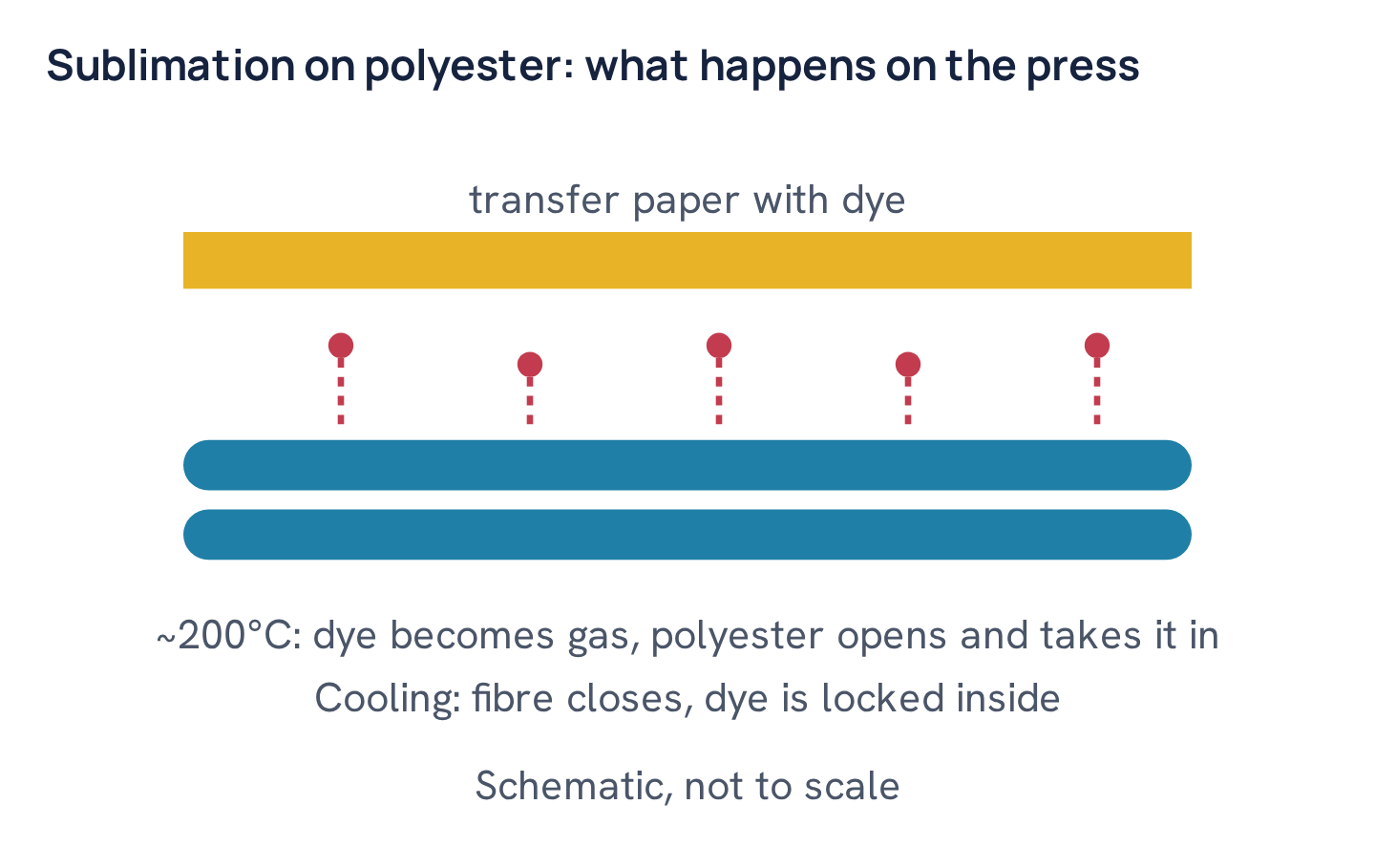
Sublimation ink is a disperse dye printed onto special transfer paper. On the heat press, the dye turns from solid to gas and the polyester fibres soften and open up at around 200°C. The gaseous dye diffuses into the fibre, and when the fabric cools, the fibre closes and traps the dye inside. Because the colour is inside the fibre rather than on top, the print has no feel and is very washfast. In the dye house, polyester is dyed with disperse dyes in water at about 130°C under pressure, by the same principle: heat opens the fibre so the dye can enter. See how disperse dyes work on polyester.
Typical sublimation settings for polyester
| Item | Temperature | Time | Pressure |
|---|---|---|---|
| Light polyester T-shirt | About 195–200°C (385–392°F) | About 45–55 s | Medium |
| Polyester sportswear / jersey | About 195–205°C | About 50–60 s | Medium |
| Polyester fleece or sweatshirt | About 195–200°C | About 55–60 s | Medium to light (avoid crushing pile) |
| Polyester-spandex (leggings, swim) | About 190–200°C | About 40–50 s | Light to medium |
| Polyester bags, cushions, flags | About 195–205°C | About 45–60 s | Medium |
These are starting points only. Paper, ink, press and fabric all change the ideal settings. Check your supplier’s guide and do a test press. An infrared thermometer or heat strips help confirm the real platen temperature. See choosing a heat press and choosing a sublimation printer.
Why 100% polyester works best
Sublimation dye only bonds to polyester (and some polyester-coated surfaces). On a 100% polyester fabric, every fibre takes dye, giving bright, solid, washfast colour. On blends, only the polyester part takes the dye; the cotton or rayon part stays white or fades in washing. That gives a lighter, heathered or vintage look. As a rule of thumb, 65% or more polyester gives acceptable results, and 100% gives the best. See can you sublimate on cotton.
Colour and white fabric
Sublimation dye is transparent, and there is no white ink, so the fabric colour shows through. Prints are brightest on white polyester. Light colours work, but they tint the print. Dark polyester garments cannot show sublimation colours; use DTF or another method for dark polyester. See DTF on polyester.
Common sublimation problems on polyester
| Problem | Likely cause | Fix |
|---|---|---|
| Faded, dull print | Too low temperature or time; low-polyester blend | Increase settings slightly; use 100% polyester |
| Ghosting (double image) | Paper shifted as the press opened | Use heat-resistant tape or tacky paper; lift press smoothly |
| Box marks / press lines | Platen edge pressed into fabric | Use a pressing pillow or foam; lower pressure |
| Scorching or yellowing | Too hot or too long | Lower temperature or time; check real platen temp |
| Blurry edges | Too much pressure, moisture, or too long | Pre-press to remove moisture; reduce time |
| Shiny patches | Polyester glazed by heat and pressure | Use a cover sheet; reduce pressure |
| Colour blowout on the back | Dye passes through thin fabric | Put protective paper inside the garment |
Common mistake: pressing a polyester shirt straight from the bag without a pre-press. Moisture in the fabric turns to steam, blurs the image and can cause uneven colour. Pre-press the garment for 5–10 seconds to remove moisture and wrinkles, then let it cool slightly before pressing the transfer.
Step-by-step sublimation on polyester
- Print the design mirrored on sublimation paper with sublimation ink.
- Pre-press the garment for 5–10 seconds.
- Insert protective paper inside the garment to stop dye passing to the back.
- Place the transfer face down and secure it with heat-resistant tape.
- Cover with a protective sheet (parchment or butcher paper).
- Press at your tested settings, around 195–205°C for 45–60 seconds.
- Open the press smoothly and remove the paper carefully while hot.
- Let the garment cool flat.
Polyester-spandex and sublimation
Polyester-spandex leggings, swimwear and sports tops sublimate beautifully, but spandex is sensitive to heat. Use the lower end of the temperature range and shorter times, and avoid over-pressing, which can weaken the spandex and make the fabric shiny. Stretch the fabric slightly flat before pressing so the print does not crack or show white lines when stretched later. See the polyester-elastane dyeing process.
Dye migration and colour fastness
Because sublimation is disperse dye, it can migrate if the fabric is later exposed to high heat, for example a very hot iron or another heat transfer pressed on top. That is the same reason polyester fabric must be finished at controlled temperatures in the factory. See colour fastness to hot pressing.
Fabric with polyester must be finished at 100–110°C, not at the 140–150°C used for cotton. Hotter than that and the dye bleeds and the fastness fails.
How to wash sublimated polyester
- Wait 24 hours before the first wash.
- Wash inside out at 30–40°C with similar colours.
- Use mild detergent; avoid bleach.
- Line dry or tumble on low.
- Do not iron directly on the print; iron inside out on low if needed.
Worked example. A print shop presses white 100% polyester sports shirts at 200°C for 55 seconds with medium pressure and gets bright, sharp prints. On a 50/50 cotton-polyester shirt at the same settings, the print looks faded and heathered, and loses more colour after washing. Switching the blend order to 100% polyester solves the complaints.
Sublimation on polyester fleece and sweatshirts
Polyester fleece and sweatshirts sublimate well, but the raised pile can crush under pressure, leaving a flattened area in the shape of the platen. Use medium to light pressure, a foam pad or pillow inside the garment, and the time needed for the thicker fabric. Brushing the pile lightly after pressing can lift it. Very high-pile fleece gives a slightly softer, less sharp image than smooth polyester.
Sublimation vs DTF on polyester
Sublimation dyes the fibre itself, so there is no feel, the fabric stays breathable and the print cannot crack or peel. It only works on white or light, high-polyester fabric. DTF sits on top of the fabric, works on any colour and on blends, but adds a thin layer and is pressed at lower temperatures to avoid dye migration from dyed polyester. For white sportswear, sublimation is ideal; for dark polyester, DTF is the practical choice.
All-over prints
All-over sublimation prints on finished garments can show white creases where folds and seams blocked the transfer. That is why all-over sportswear is usually sublimated on fabric panels before cutting and sewing. For garments, smooth the fabric carefully, open out side seams where possible, and accept that seams and collars may show small white areas.
Choosing sublimation blanks
Look for blanks labelled “sublimation-ready” or “100% polyester”, in white or very light colours, with a smooth, tightly knitted surface. Fine polyester with a cotton-like feel gives a more comfortable tee while still taking sublimation well.
Storing sublimation transfers
Printed transfers absorb moisture from the air, which can blur prints. Store them flat in a dry place, and press within a few days, or dry them briefly on the press before use.
Summary
- Typical sublimation settings on polyester: about 195–205°C for 45–60 seconds, medium pressure.
- 100% white polyester gives the brightest, most washfast prints.
- Blends give lighter, vintage prints; dark polyester cannot be sublimated.
- Pre-press, tape the paper and use protective sheets to avoid common faults.
- Use lower heat on polyester-spandex and wash prints cool.
Questions
What temperature for sublimation on polyester?
Typically about 195 to 205°C (385 to 400°F) for 45 to 60 seconds at medium pressure. Follow your supplier and test first.
How long do you press sublimation on polyester?
Usually 45 to 60 seconds; thin fabric needs less, thicker fleece needs more.
Can you sublimate on 100% polyester?
Yes, 100% polyester gives the brightest and most washfast sublimation prints.
Why is my sublimation print faded?
Usually too low temperature or time, a low-polyester blend, or moisture in the fabric.
Can you sublimate on dark polyester?
No. Sublimation dye is transparent and there is no white ink, so it only shows on white or light fabric.

Textile engineer with 14+ years in dyeing and fabric development. He writes every guide on Dyeing Solution from real production work. Full profile