Yes: a tumble dryer shrinks most clothes more than air drying, most of all cotton. In 744 knit fabric lab reports, 50% of tumble-dried shrinkage tests failed against 37% of line-dried ones. Why it happens, how much each fibre shrinks, and how to dry clothes without shrinking them.
At a glance
50%tumble-dry fails
37%line-dry fails
3.7%median after 1 tumble
Low heattake out damp
Yes. A tumble dryer shrinks most clothes more than air drying does, and the effect is biggest on cotton. In our collection of 744 knit fabric lab reports, half of the shrinkage tests that were tumble dried failed, against 37% of the tests that were line dried. Tumble-dried cotton shrank a median 4.6% in length after one wash, against 2.3% when it was line dried. Heat, moisture and tumbling together let the yarns and loops pull in further than water alone does.
Air drying does not stop shrinkage completely, though. Part of the shrinkage happens as soon as the fabric gets wet, whatever you do next. This guide explains what actually shrinks clothes, what our lab data shows for each fibre, why the dryer makes it worse, and how to dry clothes without shrinking them.
Why clothes shrink in the first place
Most new clothes are slightly stretched when they leave the factory. Yarn is spun and knitted under tension, and the fabric is pulled to width and length on the finishing machines. That stretch is held in place while the fabric is dry. When it gets wet, the fibres swell and the yarns and loops are free to relax back toward a shorter, wider and more compact shape. This is called relaxation shrinkage, and it is the main reason cotton T-shirts get shorter after the first washes.
Two more effects add to it:
- Consolidation: tumbling and agitation keep packing the loops closer together, wash after wash. This is why knits often keep shrinking a little over the first five washes.
- Fibre-specific shrinkage: wool felts when it is warm, wet and rubbed; viscose swells strongly and is weak when wet; synthetics such as polyester, nylon and acrylic soften with heat and can shrink or distort if they get hot enough.
Washing starts the shrinkage. The drying method then decides how far it goes.
Does the dryer shrink clothes? What our lab reports show
Our dataset is 744 lab test reports on new knit fabrics and garments, tested to buyers’ requirements before bulk production. In 658 of them the report says how the shrinkage samples were dried: 158 were tumble dried and 500 were line dried. Here is how often each group failed the shrinkage requirement.
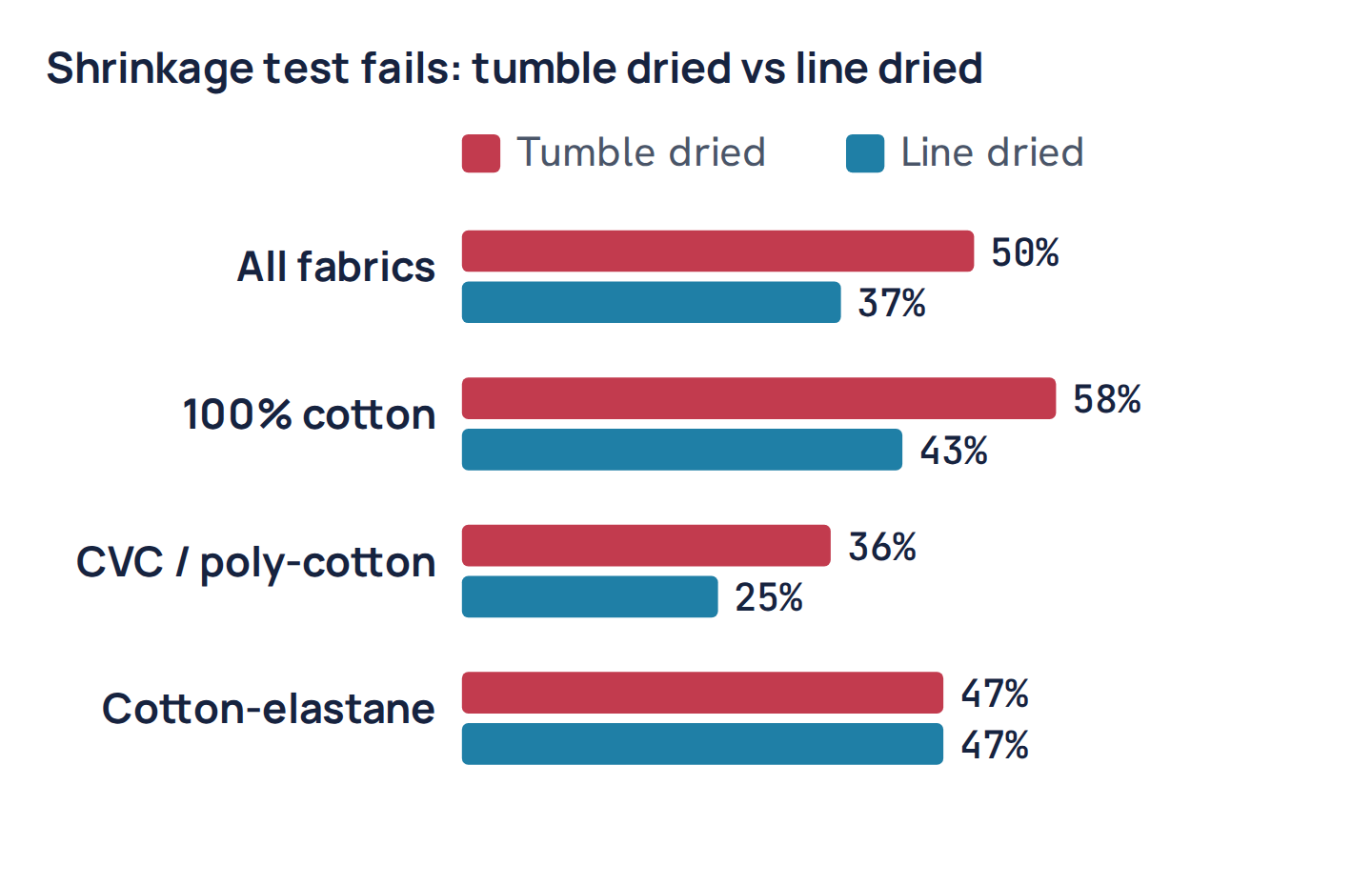
Tumble-dried tests failed more often for every main fibre group except cotton-elastane, where both groups failed at the same high rate. Cotton showed the clearest gap: 58% of tumble-dried cotton tests failed against 43% of line-dried ones. Cotton-polyester (CVC) blends were more stable overall but showed the same pattern. Only 8 viscose-blend reports were tumble dried, too few to judge, although 6 of those 8 failed.
The measured shrinkage tells the same story:
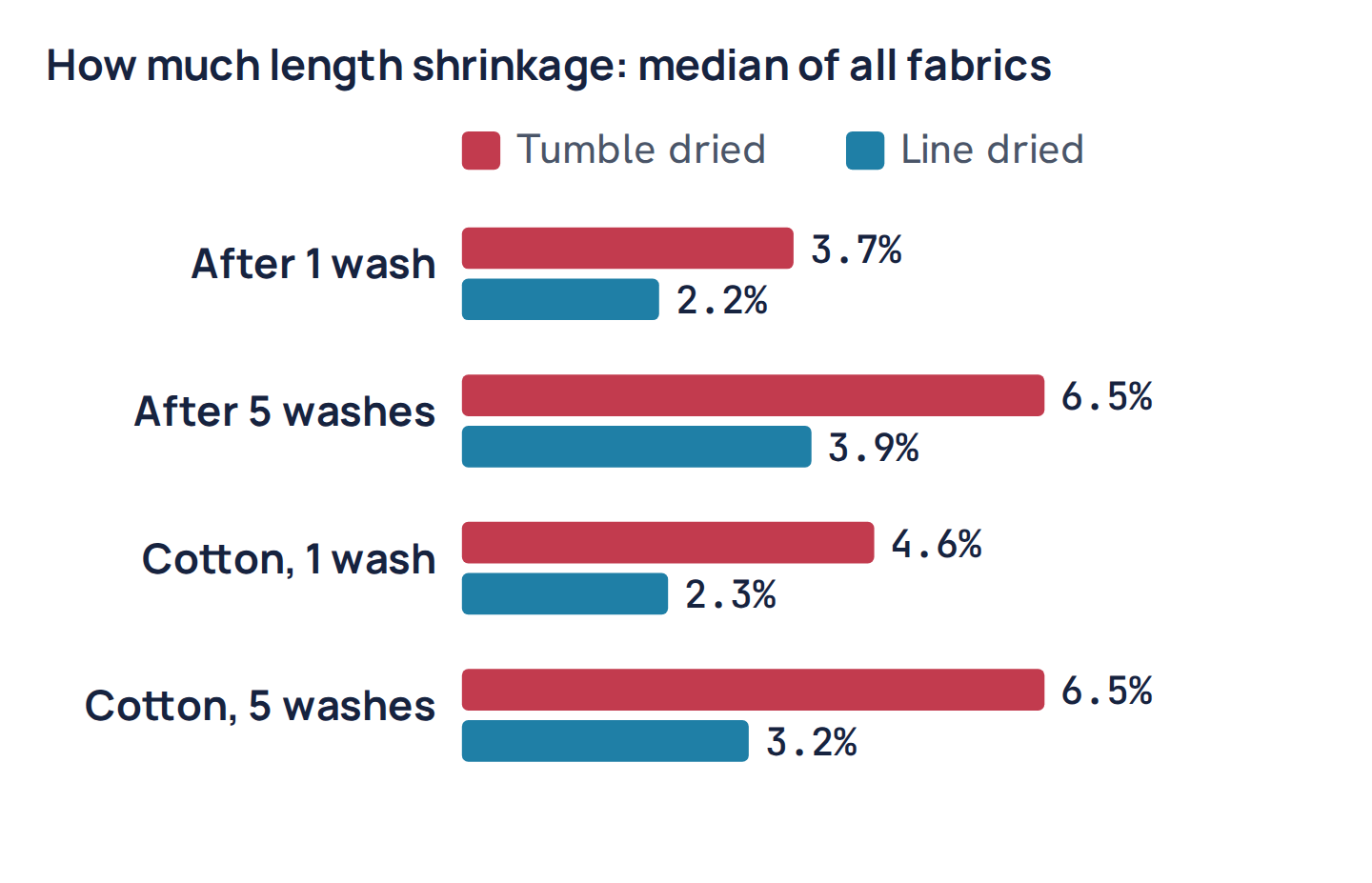
After one wash, the median tumble-dried fabric had shrunk 3.7% in length, against 2.2% for line-dried fabric. After five washes the gap widened to 6.5% against 3.9%. For a 70 cm T-shirt body, the five-wash difference is roughly 2 cm of length.
Read the data fairly. The tumble-dried and line-dried reports are not the same fabrics, and buyers set different limits for different garments. So treat this as a strong pattern from real tests, not a controlled experiment. The direction is consistent with what every dye house sees: heat and tumbling push shrinkage further.
Why the dryer shrinks clothes more
A tumble dryer combines the three things that let fabric relax and compact: moisture, heat and movement.
- Moisture: while the fabric is still damp, the fibres are swollen and the yarns can move. The dryer keeps them moving during exactly that stage.
- Heat: warm, damp cotton relaxes faster and further. For synthetics, high heat softens the fibre itself.
- Tumbling: the garment falls and folds again and again with no tension on it, so the loops are free to draw in. A line-dried shirt, by contrast, hangs under its own weight, which holds some of the length.
The last part of the cycle matters most. Over-drying, where clothes keep tumbling hot after they are already dry, adds shrinkage and harshness without any benefit.
Does air drying shrink clothes?
A little, yes. In our reports, line-dried fabric still shrank a median 2.2% in length after one wash, because relaxation shrinkage starts as soon as the fabric is wetted. What air drying avoids is the extra shrinkage from heat and tumbling.
The way you air dry also matters for knits:
- Line drying a heavy wet knit, such as a sweatshirt, can pull it longer and narrower while it dries.
- Flat drying on a towel or rack keeps knitwear closest to its original shape. It is the safest option for sweaters, wool and viscose.
- Hanging on a hanger suits woven shirts and dresses; smooth them by hand first.
How much each fibre shrinks
Fibre content matters more than anything else. Our 2026 factory finishing records, covering about 17,500 finished knit batches, give these median length shrinkages after the standard wash test:
| Fibre | Median length shrinkage | Dryer risk |
|---|---|---|
| Polyester | 3% | Low; avoid high heat |
| Cotton-polyester (CVC, PC) | 4% | Low to medium |
| 100% cotton | 6% | High |
| Cotton-elastane | 6% | High; heat also weakens the elastane |
| Viscose, modal or lyocell blends | 6% | High |
| Viscose, modal or lyocell with elastane | 8% | Very high |
A small group of 28 batches of 100% viscose, modal or lyocell showed a median of 12%, but the sample is too small to rely on. For more on each fibre, see does cotton shrink, does rayon shrink, does polyester shrink, does wool shrink and the full fibre-by-fibre data in fabric shrinkage by fibre.
Which dryer setting shrinks clothes least?
| Setting | Shrinkage risk | Use it for |
|---|---|---|
| High heat | Highest | Towels and sturdy cotton you have already pre-shrunk |
| Medium or permanent press | Medium | Poly-cotton, CVC, synthetics |
| Low or delicate | Lower | Cotton T-shirts, stretch fabrics, activewear |
| Air or no heat | Lowest in a dryer | Refreshing, softening, delicate knits |
| Line or flat drying | Lowest overall | Wool, viscose, knitwear, anything that must not shrink |
Common mistake: drying a new cotton T-shirt on high heat “to get the shrinkage over with”. It does get the shrinkage over with, but the shirt comes out shorter than if it had been dried low, and it keeps shrinking a little in later washes anyway.
How to dry clothes without shrinking them
- Read the care label. It reflects how the garment was tested. “Tumble dry low” or a dryer symbol with one dot means low heat only; a crossed-out dryer means do not tumble dry.
- Wash cool. A 30°C or cold wash starts less shrinkage than a hot one, so there is less for the dryer to finish.
- Use low heat and take clothes out while slightly damp. Most shrinkage happens near the end of the cycle. Finish drying flat or on a hanger.
- Do not over-dry. Use a sensor-dry or shorter cycle instead of a long timed one.
- Shake out and reshape. Straighten seams and gently pull the garment back to shape while it is still damp.
- Dry knitwear flat. Sweaters, wool and viscose keep their size best on a flat rack.
- Separate heavy and light items. Light T-shirts over-dry while towels are still damp.
- Buy with shrinkage in mind. Choose blends with polyester for easy care, and look for pre-shrunk cotton.
What factories do to reduce dryer shrinkage
Shrinkage is controlled long before a garment reaches the shop. In knit finishing, fabric is compacted to push the loops closer together before cutting, so less relaxation is left for the customer’s wash. Fabrics with polyester, nylon or elastane are heat set to fix their dimensions; whether heat setting is needed depends on the fibre content, the elastane, the GSM, how tight the construction is and the buyer’s width and stability requirement. Then samples are washed and dried in the lab, tumble or line as the buyer requires, and measured before bulk production goes ahead.
When a fabric fails, the usual remedies are more compaction, a different finishing width, heat setting or a change in knitting. See how shrinkage is tested and why knit fabric fails the shrinkage test. You can estimate the finished size with the fabric shrinkage calculator.
Can you unshrink clothes that shrank in the dryer?
Sometimes, partly. Cotton and cotton-blend knits can often be eased back by soaking in lukewarm water with a little hair conditioner, then gently stretching the garment back to size and drying it flat. This works because the loops can move again when wet. It does not work on felted wool, and it cannot reverse heat damage to synthetics or elastane. Prevention is far easier than repair.
Summary
- The dryer shrinks clothes more than air drying: in our lab reports, 50% of tumble-dried shrinkage tests failed, against 37% of line-dried ones.
- Tumble-dried fabric shrank a median 3.7% in length after one wash and 6.5% after five, against 2.2% and 3.9% when line dried.
- Cotton, cotton-elastane and viscose shrink most; polyester and CVC blends shrink least.
- Air drying still shrinks clothes slightly, because wetting alone lets the fabric relax.
- To avoid shrinkage: wash cool, dry low, take clothes out damp, and dry knitwear flat.
Questions
Does the dryer shrink clothes?
Yes, usually more than air drying. In our lab reports, half of tumble-dried shrinkage tests failed, against 37% of line-dried ones. Heat, moisture and tumbling together let the fabric relax and compact further.
Does air drying shrink clothes?
Slightly. Fabric starts to relax as soon as it is wet, so line-dried knits in our reports still shrank a median 2.2% in length after one wash. Air drying avoids the extra shrinkage from heat and tumbling.
Which dryer setting does not shrink clothes?
No heat or low heat shrinks least. Take clothes out while slightly damp and finish drying flat or on a hanger; avoid long, hot cycles.
Do clothes shrink every time you dry them?
Most shrinkage happens in the first few washes and dries. Knits can keep shrinking a little up to about five washes, more if they are tumble dried hot each time.
Which fabrics shrink most in the dryer?
Cotton, cotton-elastane, viscose (rayon) and wool. Polyester and polyester-cotton blends are the most stable, but high heat can still damage synthetics and elastane.

Textile engineer with 14+ years in dyeing and fabric development. He writes every guide on Dyeing Solution from real production work. Full profile