Acid dyes hold to nylon, wool and silk mainly by an ionic bond with the fibre’s amine groups. Here is the mechanism, why nylon saturates and shows barré, and how pH, heating rate and after-treatment give a level, fast shade.
At a glance
IonicMain bond with nylon
pH 7 → 4Sliding pH from acid donor
60–90°CCritical range, heat slowly
SyntanFixes dark shades
Nylon, wool and silk are dyed with acid dyes. The main bond is ionic: positive sites on the fibre attract negative dye molecules. On nylon the number of those sites is small, and they can be switched on fast or slowly by the pH of the bath. That one fact explains most of what happens in a nylon dyeing: why deep shades saturate, why some dye combinations fight each other, why we start near neutral and slide the pH down, and why barré stripes appear when the dye goes on too fast. This article explains the mechanism step by step, then turns it into practical control of pH, temperature and auxiliaries.
What nylon looks like to a dye
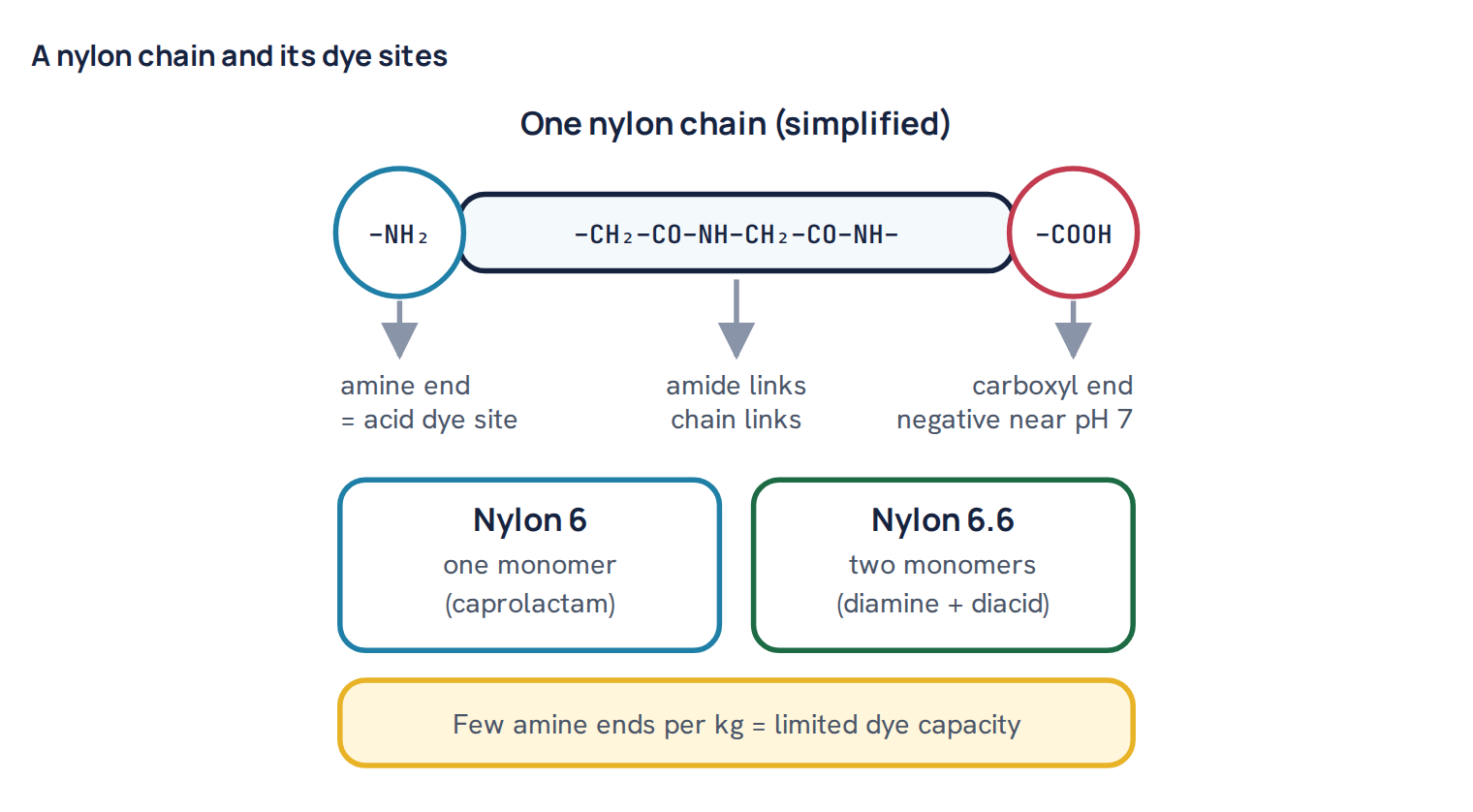
Nylon is a polyamide. Its long chains are built from short carbon segments joined by amide links (–CO–NH–). The amide links make the chains strong and let them hold tightly to each other through hydrogen bonds. For dyeing, though, the important parts are the two ends of each chain.
- Amine end group (–NH₂). At one end of the chain. In an acid bath it picks up a hydrogen ion and becomes positive. This is the main dye site for acid dyes.
- Carboxyl end group (–COOH). At the other end. It is acidic, and near neutral pH it can carry a negative charge, which pushes anionic dye away.
There are two common types of nylon in knitting. Nylon 6 is made from one starting material (caprolactam), so its repeating unit has the amide link pointing the same way all along the chain. Nylon 6.6 is made from two starting materials (a diamine and a diacid with six carbons each). Both have the same kind of amide links and end groups. In general, nylon 6 has a slightly more open structure and a lower melting point, and many dyers find it takes dye a little faster and at slightly lower temperatures than nylon 6.6. The exact behaviour depends on the yarn producer, the draw ratio and the heat history of the yarn, so do not treat this as a fixed rule.
Amine end groups set the limit
Each chain has only one amine end, and the chains are long, so a kilogram of nylon carries only a small number of amine end groups. Values quoted for regular nylon are usually a few tens of millimoles per kilogram, and they vary by producer. Each sulphonate group on a dye needs one positive site. When all the sites are used, the fibre is saturated and extra dye stays in the bath, or sits loosely on the surface and washes off later.
Yarn producers make use of this. Deep-dye nylon has more amine end groups and can build darker, fuller shades. Normal types sit in the middle. Some special yarns have very few amine ends and dye light, which is used for cross-dye and two-tone effects. If a fabric is knitted from two yarn lots with different amine end group content, the two will not dye the same, however good the dyeing is. This is the chemical side of barré, which comes later.
Wool and silk, briefly
Wool and silk are protein fibres. Their chains carry many side groups, not just end groups, including basic amino groups and acidic carboxyl groups. Both fibres are therefore amphoteric: they can carry positive or negative charge, depending on pH. In acid they become positive and attract acid dyes, in the same way as nylon. The big difference is quantity. Wool has many times more basic groups than nylon, so it has a much higher capacity for acid dye and saturation is rarely a problem. Silk sits between nylon and wool. Wool is usually dyed at lower pH than nylon with levelling dyes, and both protein fibres need gentler handling because hot, strongly acid or alkaline baths damage them. The rest of this article focuses on nylon, which is what most knit dye houses deal with.
The mechanism: how acid dye holds on
Acid dyes are anionic. They are coloured molecules with one or more sulphonate groups (–SO₃⁻), usually supplied as sodium salts that dissolve in water. They are called acid dyes because they are applied from an acid bath, not because the dye itself is strongly acidic. If you need a refresher on the general steps of dye moving from bath to fibre, see how dyeing works: transport, adsorption, diffusion, fixation.
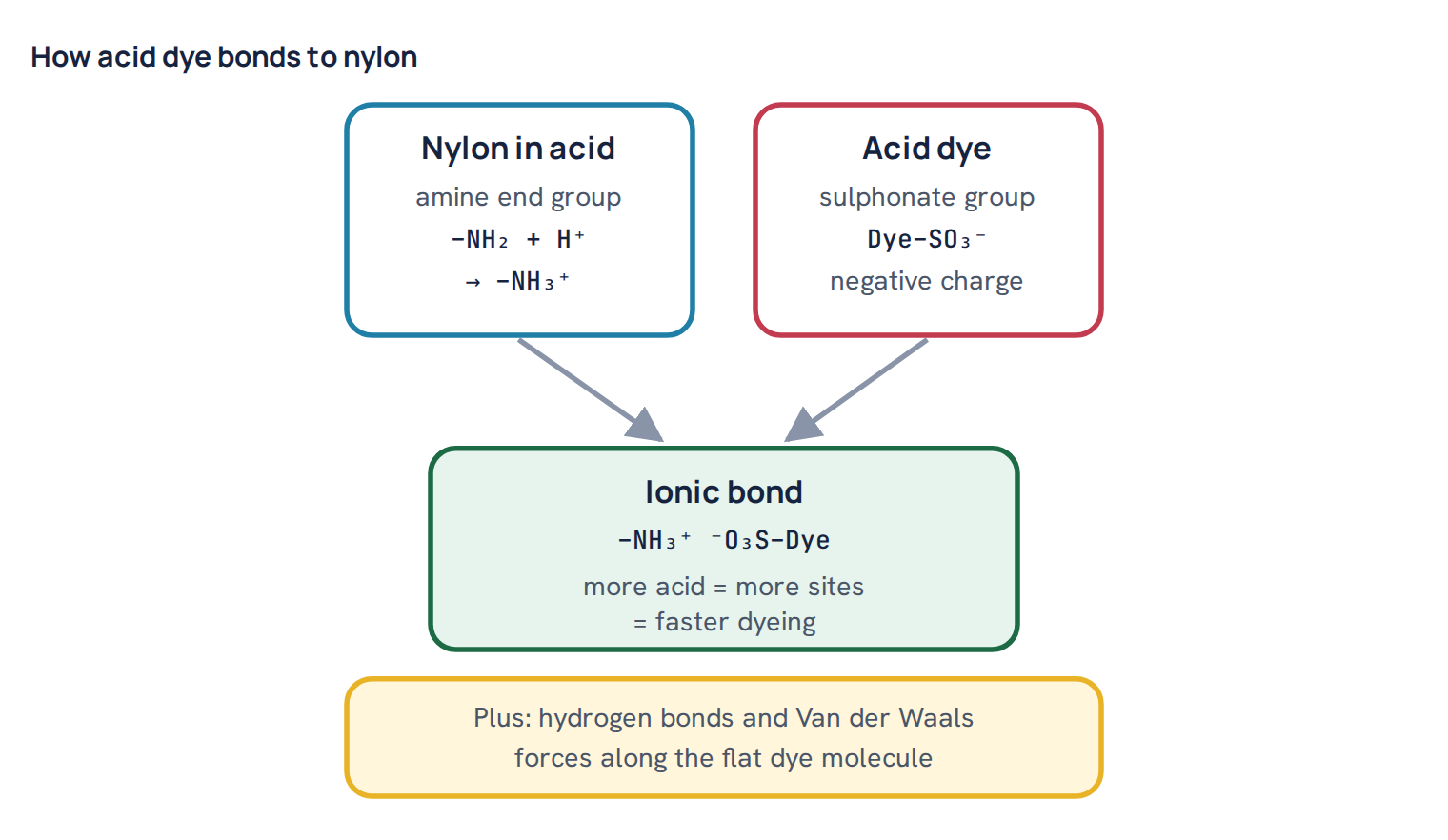
The process runs in four simple steps:
- Protonation. Acid in the bath gives hydrogen ions. Each amine end group takes one and becomes –NH₃⁺. The lower the pH, the more amine ends are switched on.
- Attraction. The negative dye ions are drawn to the positive fibre surface. At the same time, the carboxyl ends lose their negative charge as the pH falls, so the surface pushes dye away less.
- Diffusion. Heat opens the nylon structure. Dye moves from the surface into the fibre and finds positive sites inside.
- Fixation. The dye sulphonate group pairs with an –NH₃⁺ site. This salt link is the ionic bond.
The ionic bond is not the whole story. Acid dye molecules are fairly flat and often long. Along their length they also form hydrogen bonds with the amide links of the nylon, and Van der Waals forces act between the dye and the polymer chains. These extra forces are what give an acid dye its affinity beyond the simple charge match. They explain why larger dyes with fewer sulphonate groups hold more tightly, and why some acid dyes still go onto nylon near neutral pH, when few amine sites are switched on. They also explain why, at very low pH, nylon can take up more dye than its amine end groups should allow. In strong acid the amide links themselves start to take on charge and attract dye. This is called overdyeing. It gives poor fastness and is normally avoided in practice.
Saturation and competition between dyes
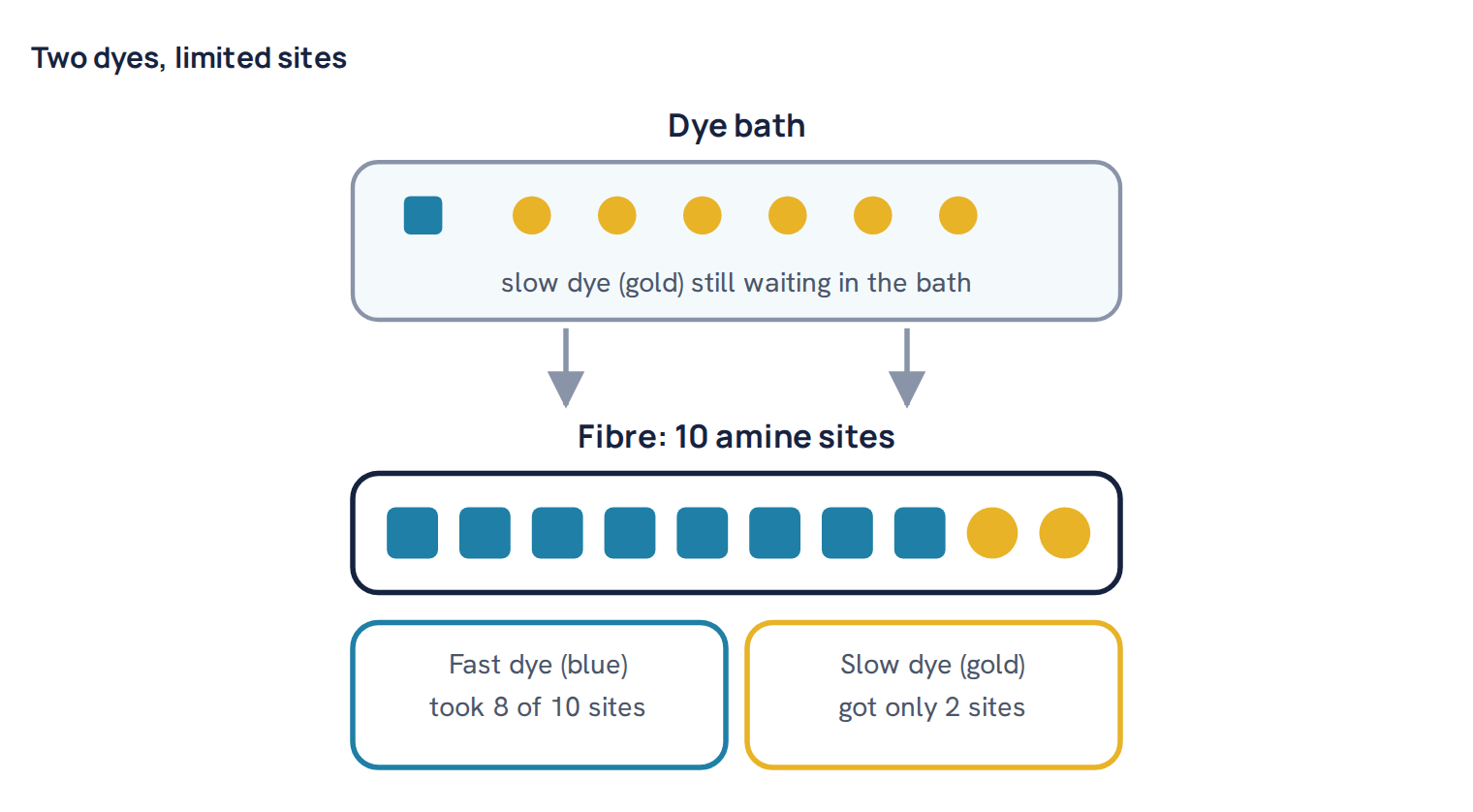
Because the number of sites is limited, dyes in a combination share the same seats. Think of it as a room with a fixed number of chairs. Every sulphonate group needs a chair.
- A fast dye fills the chairs first. If one dye has a higher affinity or a faster rate, it takes sites early in the cycle. A slower dye arrives later and finds fewer free sites.
- A dye can block another. In deep shades, the fast dye may take so many sites that the slower one is partly left in the bath. The shade drifts toward the fast dye, and small changes in time or pH change the result.
- Dyes with more sulphonate groups use more sites. A di-sulphonated dye uses two sites per molecule, so it reaches the saturation limit sooner than a mono-sulphonated dye at the same depth.
The practical answer is to build recipes from compatible dyes: dyes of the same type with similar rates of uptake, so they go on together and keep the same ratio from start to finish. Dye makers group their acid dyes into recommended trichromatic sets for this reason. Mixing a fast levelling dye with a slow metal-complex dye in a deep shade is asking for shade variation between batches. For a wider view of how dye classes are matched to fibres, see dye classes: which dye for which fibre.
Types of acid dye
Acid dyes are a broad family. Dyers group them by how they behave in the bath, which mainly follows their molecular size and the number of sulphonate groups. As a rule, the bigger and more firmly held the dye, the better its wet fastness and the worse its levelling.
- Levelling (equalising) acid dyes. Small molecules with low affinity. They migrate well, so they move from heavy to light areas during the boil and cover yarn differences. Wet fastness is only moderate, so they suit light and pale shades.
- Milling and half-milling dyes. Larger molecules with higher affinity, applied at a less acid pH. Levelling is moderate, migration is limited, and wet fastness is good. Half-milling dyes sit between levelling and full milling types.
- 1:1 metal-complex dyes. One metal atom (usually chromium) bound to one dye molecule. They need a strongly acid bath and are mainly used on wool, rarely on nylon.
- 1:2 metal-complex dyes. One metal atom holding two dye molecules. These are large, firmly held dyes with very good wet and light fastness, widely used for medium and dark shades on nylon. Their levelling is poor, so they show yarn variations clearly.
| Type | Typical pH on nylon | Levelling | Wet fastness |
|---|---|---|---|
| Levelling (equalising) | about 3–5 | Very good | Moderate |
| Half-milling | about 4–6 | Good to moderate | Good |
| Milling | about 5–7 | Moderate to poor | Very good |
| 1:1 metal-complex | about 2–3 (mainly wool) | Good | Good |
| 1:2 metal-complex | about 5–7 | Poor | Very good |
These pH ranges are typical and vary between dye ranges and dye makers. Always check the supplier’s data for the exact range you use.
pH control: switching the sites on slowly
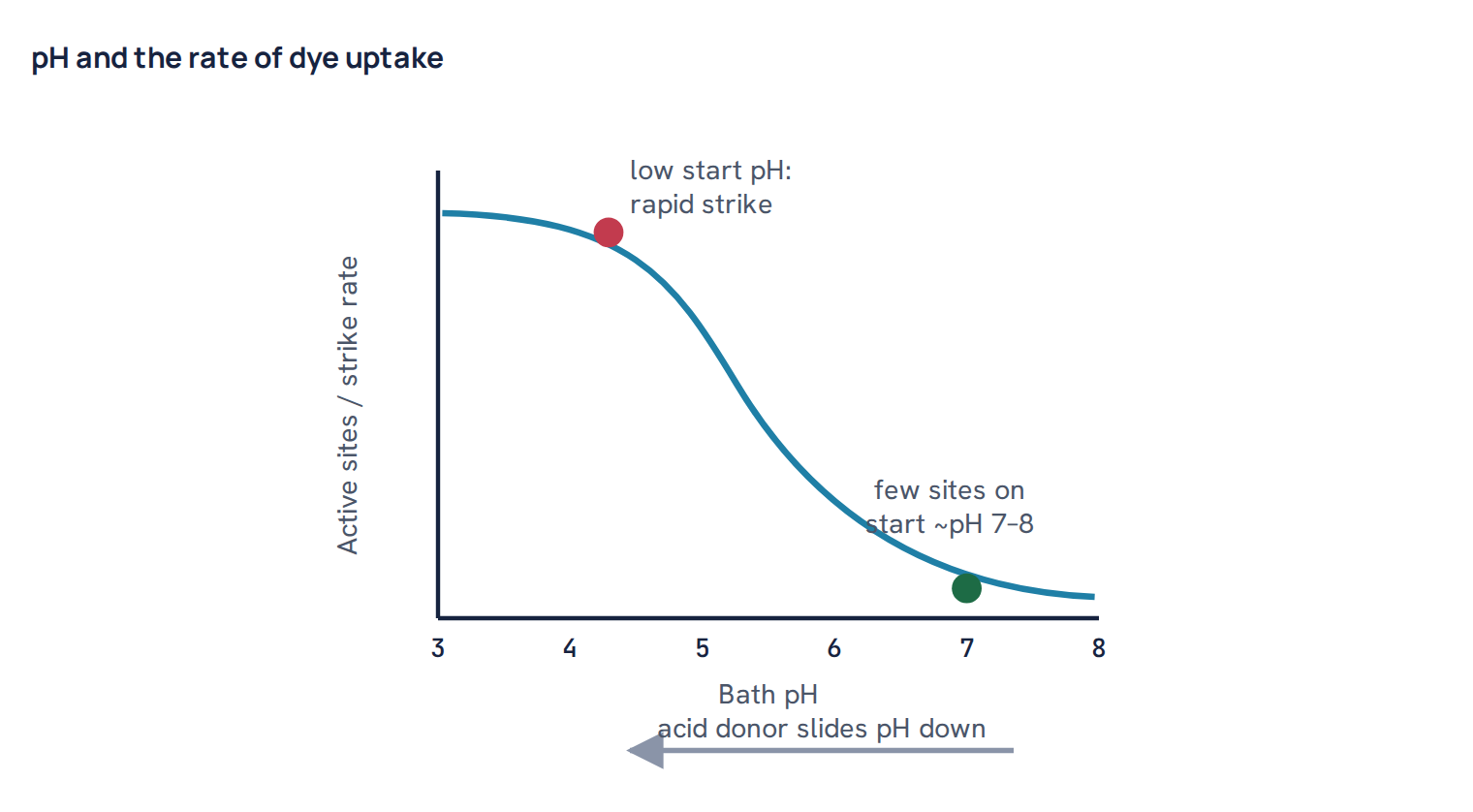
Since pH decides how many amine sites are switched on, pH is the main brake and accelerator in a nylon dyeing. If the bath starts at a low pH, nearly all sites are positive from the first minute. As soon as the temperature rises, the dye rushes onto the outside of the fibre and onto whatever part of the fabric it meets first. This is called a rapid strike. Acid dyes on nylon, especially the larger types, migrate poorly once they are fixed, so an uneven strike is very hard to correct later.
Acid donors: a sliding pH
An acid donor is a chemical that is nearly neutral when cold and releases acid gradually as the bath heats. Common types are esters or salts that hydrolyse with temperature. The bath starts at a pH where few sites are active, and the pH slides down during the heating, so sites are switched on at about the same rate as the dye can spread evenly. By the end of the cycle the pH is low enough for good exhaustion. A deeper shade needs more dye sites in use, so it gets a higher dose of acid donor and ends at a lower pH. A light shade needs only a small push.
Buffers: a fixed pH
The other approach is a buffer, such as an acetic acid and sodium acetate mix, or ammonium salts. A buffer holds the pH steady at one value for the whole cycle. It is simple and repeatable, and it protects the bath against alkali carried in with the fabric. Its weakness is that the pH is the same at the start, when you want slow dyeing, and at the end, when you want full exhaustion. In practice, many dye houses use a buffer for levelling dyes and light shades, and an acid donor for milling and metal-complex dyes, where a controlled strike matters most. Whatever system you use, check the pH of the water and the fabric before dyeing. Residual alkali from scouring will shift the start pH.
Temperature and the rate of dyeing
Below about 40–50°C, wet nylon is fairly closed and the dye takes up slowly. As the temperature rises, the polymer chains move more freely, the structure opens and dye diffuses in fast. For most acid dyes on nylon, most of the uptake happens in a band of roughly 60–90°C. The exact band depends on the dye, the pH and the yarn, so treat it as a guide. This is the critical range. A fast heating rate through it gives the same result as a low start pH: a rapid, uneven strike.
So the heating rate is slowed through the critical range, often to around 0.5–1°C per minute, and sometimes a short hold is added in the middle to let the dye even out. After that, the bath is held near the boil. That final hold has two jobs. It lets dye diffuse deep into the fibre for good fastness, and it gives some migration time so the dye can move from heavy to light areas.
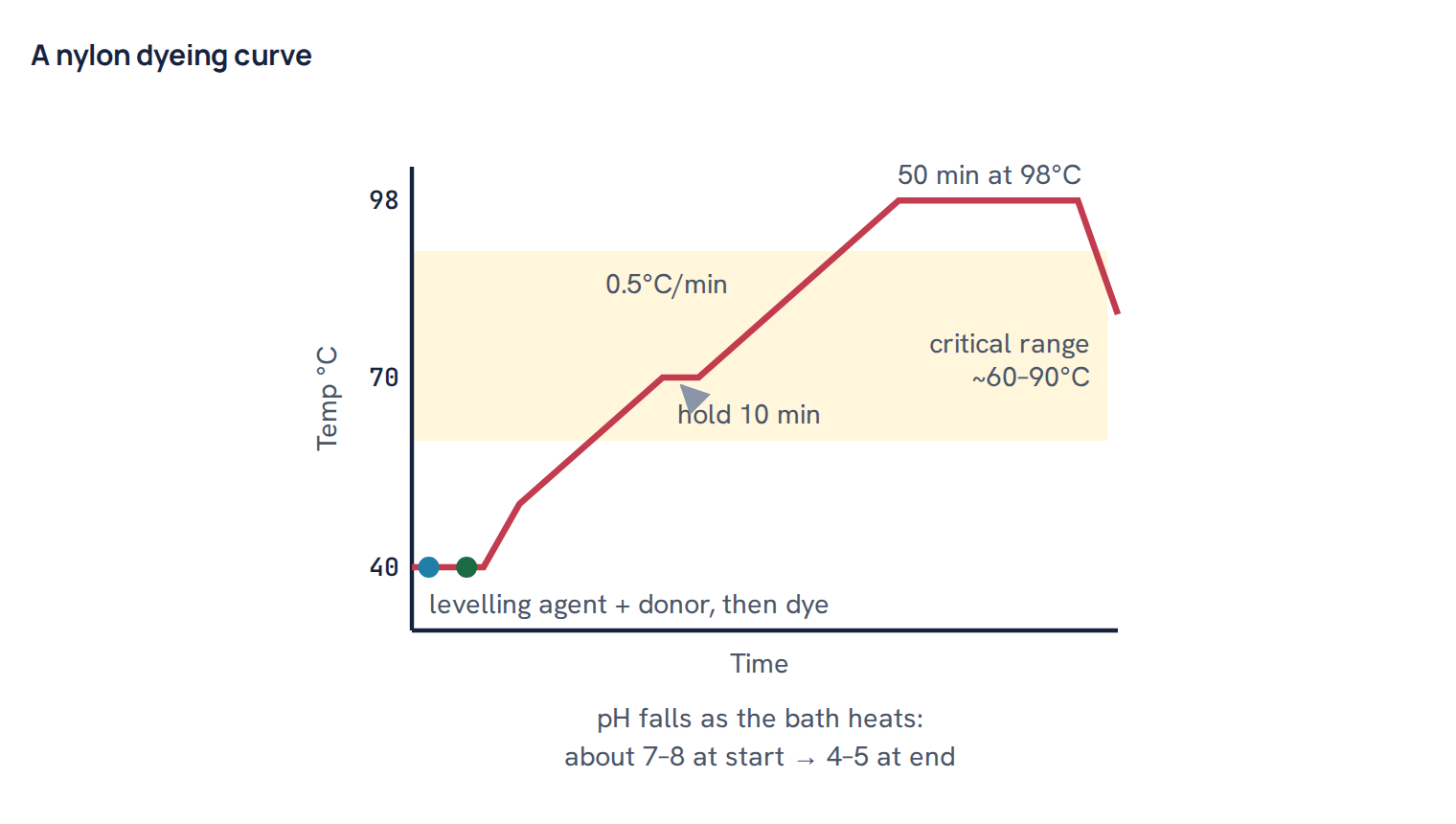
- On nylon we start at 40°C, dose the levelling agent and acid donor, then the colour.
- We heat at 0.5°C per minute from 50°C to 98°C, with a 10 minute hold at 70°C, and run 50 minutes at 98°C.
- Acid donor by shade: light 0.25 g/L (pH 8.0 to 5.0), medium 0.5 g/L (pH 7.5 to 4.5), deep 1.0 g/L (pH 7.0 to 4.1).
- Every addition is mixed in the side tank with water at 90°C for 15 minutes, so it goes in fully dissolved.
- Medium and dark shades get a fixing agent at pH 5–5.5 after soaping; light shades do not need it.
| Shade | Acid donor | pH start → end |
|---|---|---|
| Light | 0.25 g/L | 8.0 → 5.0 |
| Medium | 0.5 g/L | 7.5 → 4.5 |
| Deep | 1.0 g/L | 7.0 → 4.1 |
Notice the pattern in the table. Deeper shades start a little lower and end clearly lower. More dye needs more active sites, so the bath is driven further down the pH scale to exhaust it. A light shade has plenty of free sites, so it only needs a gentle slide.
Worked example. A medium navy on 100% nylon single jersey at a liquor ratio of 1:8 with 600 L of liquor needs 0.5 g/L of acid donor, which is 300 g. If the same machine runs a pale grey, the dose drops to 0.25 g/L, or 150 g, and the end pH is higher because the light shade does not need as many sites switched on.
Barré: stripes from the yarn
Barré is a pattern of horizontal stripes across knitted fabric (or warp-wise bands in woven fabric) where some courses dye darker or lighter than others. In nylon it is one of the most common complaints, and acid dyes show it more clearly than most dye classes. The cause is in the yarn, but the dyeing decides how visible it becomes.
- Physical variation. Differences in draw ratio, texturing, crimp, tension, or heat history change how open the fibre is. A more open yarn takes dye faster. This mainly changes the rate of dyeing.
- Chemical variation. Differences in amine end group content between yarn lots or bobbins change the number of sites. This changes how much dye the yarn can hold at equilibrium.
Physical barré can often be covered. Given a slow strike and enough time near the boil, a levelling dye moves from the faster yarn to the slower one and the stripes fade. Chemical barré is much harder. Even at equilibrium, the yarn with more amine ends holds more dye, and dyes with high affinity make the difference sharper. That is why light, critical shades on suspect yarn are best done with levelling or half-milling dyes, while metal-complex dyes on such yarn are a risk.
To reduce barré:
- Choose dyes with good migration and coverage for barré-prone yarns.
- Start near neutral with an acid donor and heat slowly through the critical range.
- Use a suitable levelling agent.
- Keep yarn lots separate in knitting, and report suspect lots back to the yarn supplier.
Levelling agents: anionic and cationic-active
Levelling agents for acid dyes on nylon work in two broad ways.
Anionic levelling agents are small negative molecules with affinity for nylon. They go on fast and take some of the positive sites first, so the dye has to compete with them. As the temperature rises the dye, with its higher affinity, gradually displaces the agent. The effect is a slower, more even strike. Because they use up sites, a high dose can lower the final depth in deep shades. They are often called blocking agents and are also useful for reducing chemical barré.
Cationic-active levelling agents (weakly cationic or amphoteric types) work in the bath rather than on the fibre. They form a loose complex with the anionic dye, which slows the dye down. As the temperature rises, the complex breaks up and releases the dye bit by bit. Many of these agents also help migration at the boil.
Many commercial products combine both actions. The dose depends on the dye type, the shade depth and the barré risk, so follow the supplier’s guidance and confirm it in the lab. Too much levelling agent gives a weak or off-tone shade, and too little gives a rapid strike.
After-treatment for wet fastness
On medium and dark shades, acid dyes on nylon can bleed in washing, especially in hot or alkaline washes and in perspiration tests. The ionic bond is reversible: when the pH goes up, the amine sites lose their charge and the dye can come out. Before any after-treatment, the fabric is rinsed or soaped to remove loose dye from the surface.
A syntan (synthetic tanning agent) is used to lock the dye in. Syntans are large, anionic condensation products, often based on sulphonated aromatic compounds. Applied in an acid bath, they sit mainly at the outer layer of the fibre and form a barrier that makes it harder for the dye to diffuse back out. They also block remaining amine sites near the surface, which reduces staining of other fibres in wash tests.
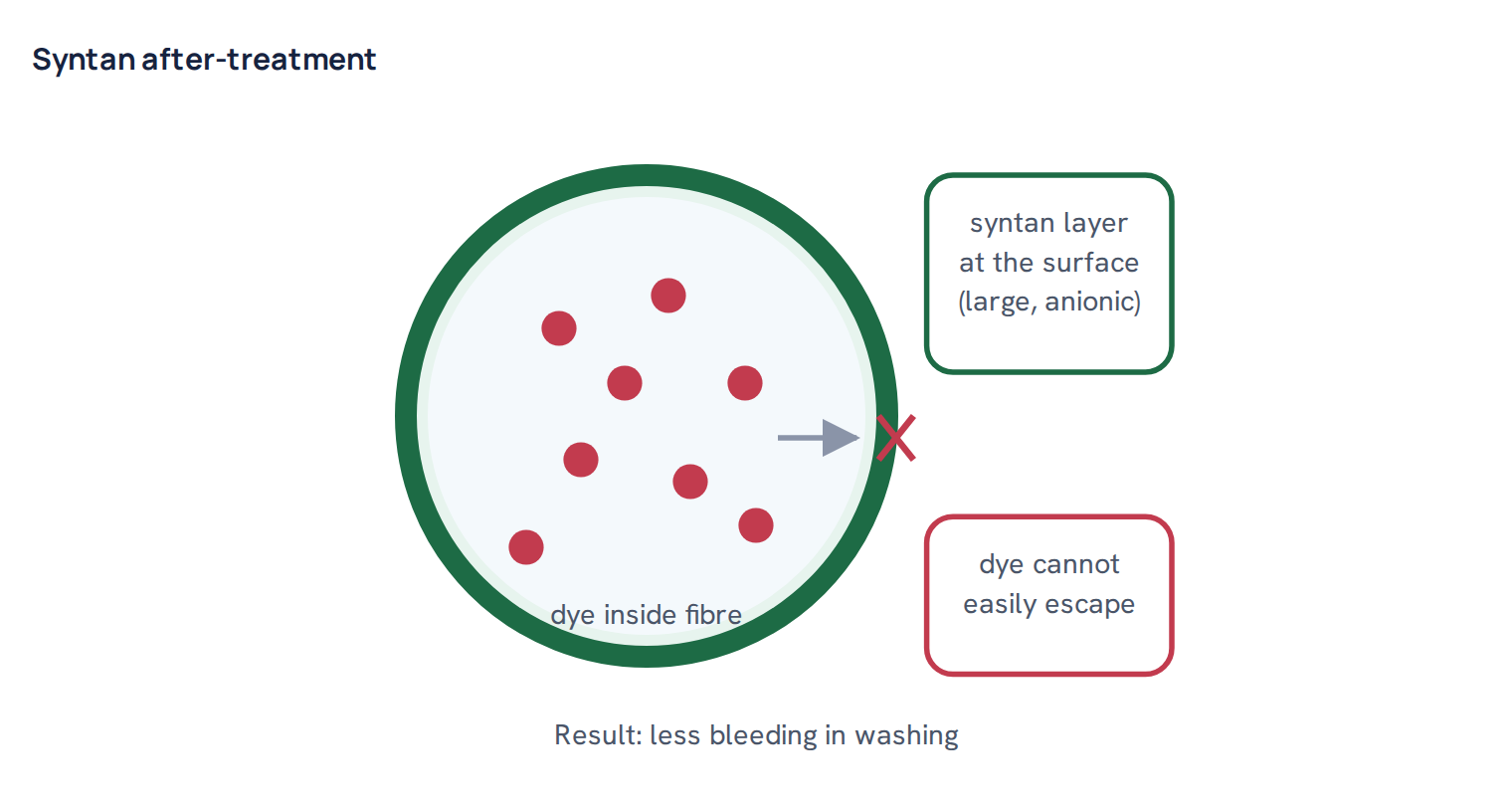
Light shades usually pass wet fastness without this step, and skipping it saves cost and avoids any small shade change. Syntans can slightly change the shade or handle and, depending on the product, may affect light fastness a little, so the fixed shade should be checked against the standard.
Before syntans, the traditional method was the full backtan: a treatment with tannic acid followed by a metal salt (an antimony compound) that formed an insoluble layer on the fibre. It gave very good fastness but dulled shades, stiffened the handle and used a toxic heavy metal. Today it is rarely used, and syntans have replaced it in almost all dye houses.
Notes on nylon-elastane
Most nylon knits for swimwear, lingerie and sportswear contain elastane, often sold as Lycra (elastane). A few points matter for acid dyeing:
- Elastane can stain. Elastane has some sites that take acid dye, but fewer and with weaker hold. It usually dyes lighter than the nylon, and the dye on it has poorer wet fastness. In dark shades this can cause “grin-through” when the fabric is stretched, and bleeding in washing.
- Heat set first. The fabric is normally heat set before dyeing to fix its width and stability and to prevent creases and curling edges in the machine. Heat setting also changes how nylon takes dye, so it must be even across the fabric. Uneven heat setting shows up as shade variation.
- Be gentle with temperature and time. Elastane loses elasticity with excessive heat, long boiling and strong chemicals. Keep the cycle as short as the shade allows.
For full process routes, see the 100% nylon knit dyeing process, the nylon-elastane knit dyeing process and, for blends, the polyester-nylon knit dyeing process.
Common faults and their causes
- Uneven or streaky dyeing. Usually a rapid strike: start pH too low, heating too fast through the critical range, too little levelling agent, or poor liquor flow. Uneven heat setting and fabric creases also show as streaks.
- Shade change between batches. Variation in start or end pH, different yarn lots, incompatible dyes competing for sites, changes in liquor ratio, or alkali left in the fabric from scouring.
- Spots and specks. Undissolved dye or auxiliary particles that settle on the fabric. Dissolve every addition fully and add it slowly.
- Poor wet fastness on dark shades. Dye above the saturation limit sitting on the surface, poor soaping, no after-treatment, or overdyeing at too low pH.
- Barré. Yarn differences made visible by the wrong dye choice or a fast strike.
Common mistake: starting the bath at a low pH. All the sites are switched on at once, the dye rushes onto the fibre and the shade comes out uneven, and it cannot be levelled afterwards.
When a nylon dyeing goes wrong, start with three questions. What was the pH at the start and at the end? How fast did the bath heat through 60–90°C? Are the dyes in the recipe compatible? Those three answers explain most problems with acid dyes on nylon.
Questions
How do acid dyes bond to nylon?
In an acid bath, nylon’s amine end groups pick up a hydrogen ion and become positive. They attract the negative sulphonate groups of the dye and form an ionic bond, helped by hydrogen bonds and Van der Waals forces.
Why does nylon saturate in deep shades?
Each nylon chain has only one amine end group, so the fibre has a limited number of dye sites. Once they are filled, extra dye stays in the bath or sits loosely on the surface.
Why is nylon dyed with a sliding pH?
Starting near neutral and releasing acid slowly with an acid donor switches the dye sites on gradually, so the dye goes on evenly instead of striking all at once.
What causes barré in nylon?
Barré comes from physical differences in the yarn, such as draw ratio or heat history, and chemical differences in amine end group content. A slow strike and well-migrating dyes reduce it, but chemical barré is hard to cover.
Why are dark nylon shades after-treated with a syntan?
The ionic bond can reverse in hot or alkaline washing. A syntan forms a barrier at the fibre surface that keeps the dye in and improves wet fastness.

Textile engineer with 14+ years in dyeing and fabric development. He writes every guide on Dyeing Solution from real production work. Full profile