How exhaust machines, pad-dry-fix ranges and cold pad-batch put dye on fabric, how to pick a method, and what dyeing at the fibre, yarn, fabric or garment stage means for quality and cost.
At a glance
2 familiesExhaust (long bath) and pad (squeeze and fix)
3 waysFabric moves, liquor moves, or both
12–24 hTypical cold pad-batch fixing time at room temperature
4 stagesFibre, yarn, fabric or garment dyeing
Two dye houses can use exactly the same dye and the same recipe and still get different results, because they put the dye on the fabric in different ways. The method decides how the dye meets the fibre, how long it has to get inside, how much water and energy the job uses, and which faults you are likely to see. This article explains the main dyeing methods: exhaust (batch) dyeing, continuous dyeing and semi-continuous dyeing such as cold pad-batch. It also covers the other big choice, the stage at which the colour goes in: fibre, yarn, fabric or garment. By the end you should be able to look at a fabric and an order size and say which route makes sense, and why.
Two big families: exhaust and pad
Every dyeing method belongs to one of two families. The difference is how the dye gets from the liquid onto the fabric.
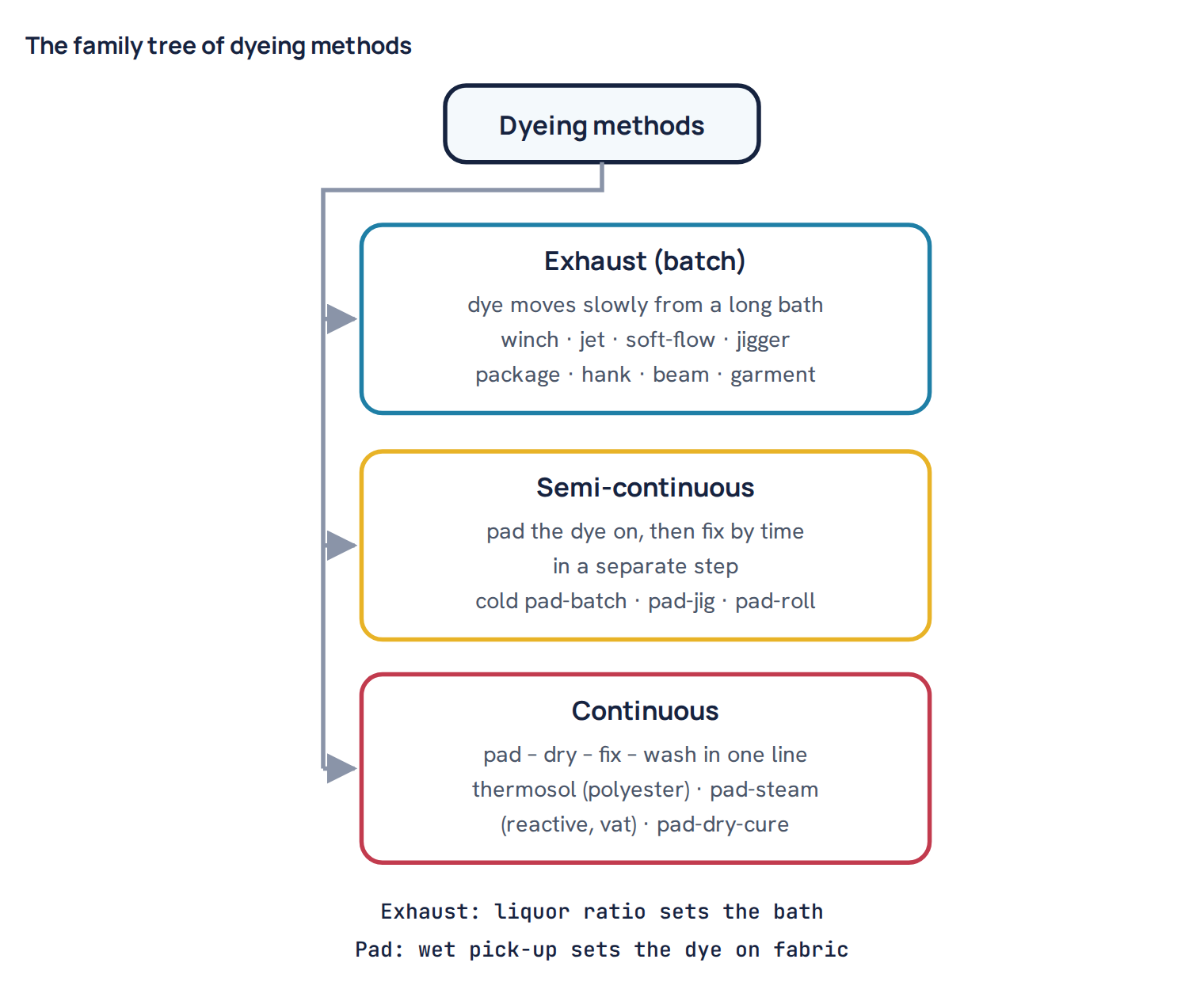
- Exhaust dyeing (batch dyeing). The fabric, yarn or fibre sits in a large volume of dye liquor for a long time, often one to several hours. The dye slowly leaves the water and goes onto the fibre because it has affinity for it. Salt, pH and temperature are used to push it across. The bath “exhausts”: at the end, most of the dye has moved from the water into the material. The amount of water is set by the liquor ratio, the weight of material to the volume of liquor, written as 1:8, 1:10 and so on.
- Pad application. The fabric runs in open width through a small trough of concentrated dye liquor and then between two heavy squeeze rollers. The rollers press out the excess and leave a fixed amount of liquor in the fabric. The dye is now on the fabric but not yet fixed. It is fixed afterwards by heat, steam or simply time. Here the dye does not need high affinity; in fact low affinity is better, so that the trough does not get stripped of dye. The amount of dye applied is set by the wet pick-up and the concentration of the pad liquor, not by exhaustion.
Pad application is used in two ways. If padding, drying, fixing and washing all happen in one connected line, the method is continuous. If the fabric is padded and then left (batched) to fix before it is washed in a separate step, the method is semi-continuous. The theory of how the dye actually gets inside the fibre is the same in all of them; see how dyeing works: transport, adsorption, diffusion and fixation.
Exhaust dyeing machines: what moves?
An exhaust machine has one job: keep fresh liquor meeting every part of the material, evenly, for the whole cycle. There are only three ways to do that. You can move the material through a still bath, move the liquor through still material, or move both. This is the simplest way to understand the machines. The liquor ratios below are typical ranges; they vary with machine design, fabric weight and load, so treat them as a guide.
The material moves: winch (beck) and jigger
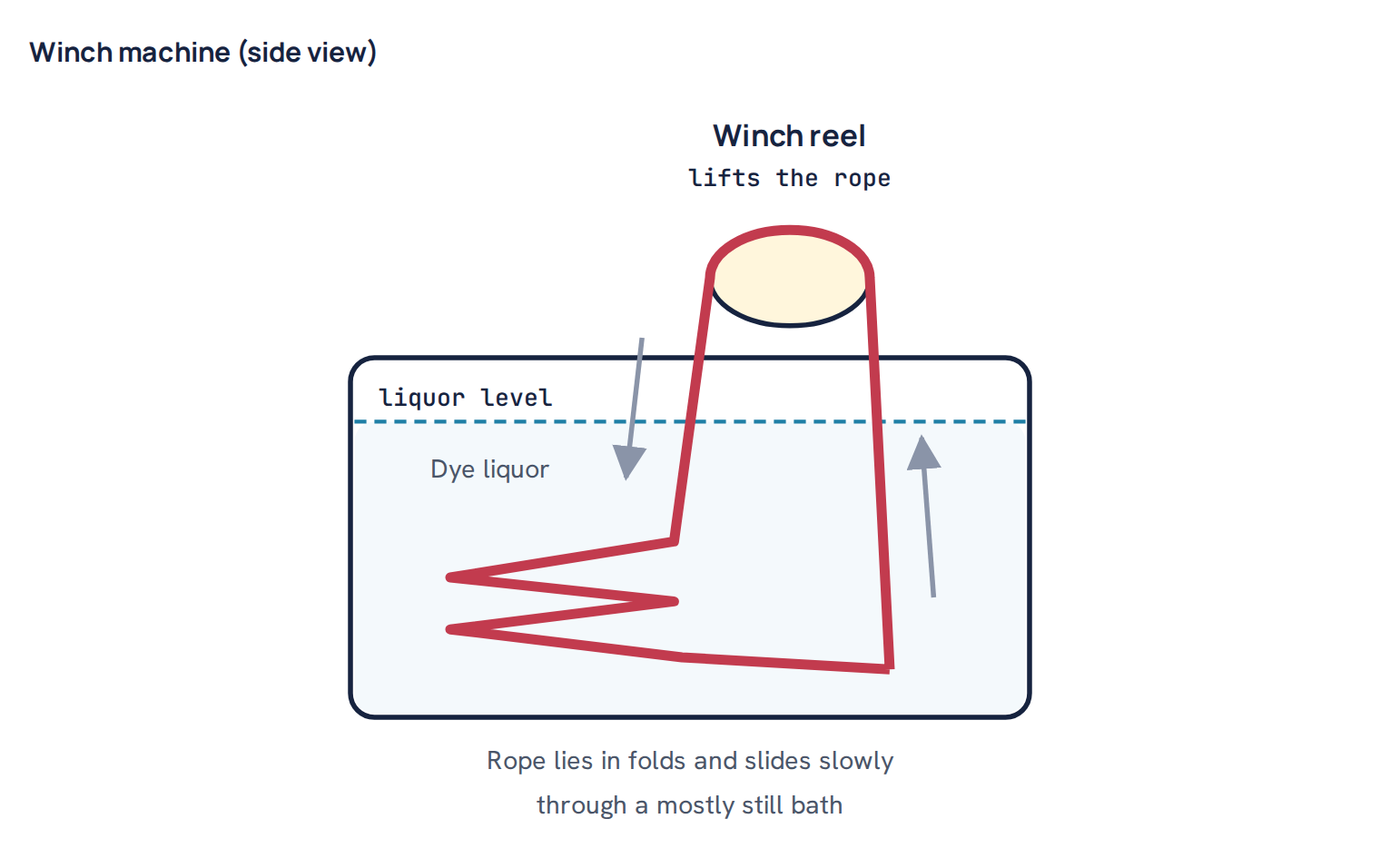
The winch, also called a beck, is the oldest rope-dyeing machine and still a workhorse for knits. The fabric is sewn into an endless loop (a rope). A slowly turning reel above the bath lifts the rope out of the liquor and drops it back into the rear of the tank. It then lies in loose folds and slides slowly forward along the bottom until the reel picks it up again. The liquor itself moves very little; in modern winches a pump and heat exchanger circulate it, but the main exchange still comes from the fabric moving.
Because the rope is under very little tension, the winch is gentle on knits and on bulky, open fabrics. The handle comes out soft and full. The downsides are a fairly long liquor ratio (older open winches often 1:15–1:30, modern closed ones nearer 1:8–1:15), more water, steam and chemicals per kilo, and slow dye exchange, so fast-striking dyes can go on unevenly. Most winches are atmospheric: they cannot go above about 98°C.
The jigger is the open-width cousin for wovens. The fabric is wound from one roller to another through a small trough of liquor, then wound back, end to end, many times. The liquor ratio is short, often around 1:2 to 1:5. It suits wovens that must not be creased, small to medium lots and vat, sulphur, direct and reactive dyes. It is not suitable for knits, because the winding tension would stretch and distort them. Its classic faults are shade differences between the ends and the middle of the batch (ending) and between selvedge and centre (listing), usually caused by uneven tension, temperature or dosing.
The liquor moves: package, hank, beam and stock
Here the material is held still and the pump forces liquor through it, usually reversing the flow direction (inside-to-out, then outside-to-in) at set intervals.
- Package dyeing. Yarn is wound onto perforated tubes or springs at a controlled, soft density. The packages are stacked on hollow perforated spindles in a closed vessel, and the liquor is pumped through them. Liquor ratios are commonly around 1:6 to 1:12. It is the main method for yarn dyeing of cotton, polyester, nylon and blends, and most package machines are high-temperature. The key to a good result is even winding density: a hard spot or a soft channel changes the flow and the shade.
- Hank dyeing. Yarn in loose skeins (hanks) hangs on rods, and the liquor flows through. The yarn is not compressed, so bulky and delicate yarns (high-bulk acrylic, wool for knitting, some fancy yarns) keep their loft. The liquor ratio is longer and labour is higher.
- Beam dyeing. Woven or warp-knitted fabric is wound in open width onto a large perforated beam, and liquor is pumped through the layers. The fabric does not move at all, so there is no abrasion, creasing or stretching. It suits lightweight, tightly built synthetics and microfibre wovens, warp knits and fabrics that crease easily. Liquor ratios are often around 1:6 to 1:12. The fabric must be permeable and evenly wound; a fabric that is too dense lets liquor channel round it.
- Stock (loose fibre) dyeing. Loose fibre is packed into a perforated carrier and liquor is pumped through. This is covered under dyeing stages below.
Both move: jet, soft-flow and overflow
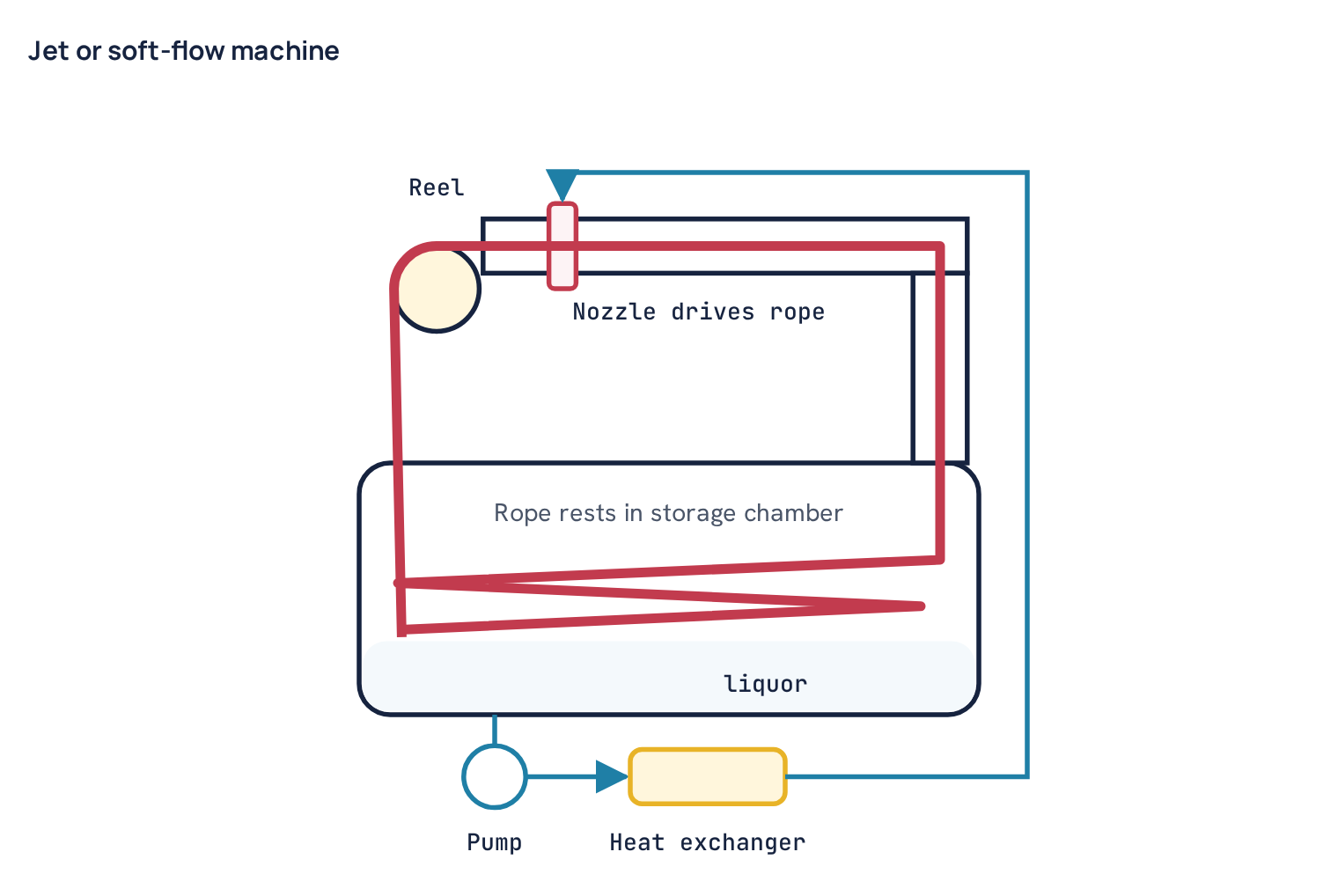
In a jet machine, both the fabric and the liquor move fast. The fabric rope passes through a nozzle (a venturi) where a strong stream of liquor from the main pump hits it. That stream drives the rope forward and at the same time forces liquor into it. The rope then falls into a storage chamber, slides round, is lifted by a reel and goes through the nozzle again. Because the liquor exchange happens at the nozzle every few minutes, the dyeing can be level at a much shorter liquor ratio than a winch, often around 1:5 to 1:10. Most jets are high-temperature machines, rated to about 135–140°C, so they can dye polyester and its blends.
Soft-flow and overflow machines are gentler versions of the same idea. The reel does more of the lifting, and the liquor flows over or around the rope at lower pressure, so the fabric is not hit as hard. This reduces surface damage, pilling and stretching on delicate knits, elastane blends and fine viscose. Liquor ratios are often around 1:4 to 1:8. A further type, the air-jet (airflow) machine, uses a blower to carry the rope with air and only a little liquor, reaching very low ratios of roughly 1:2 to 1:4; it saves water and energy but costs more to buy and run carefully.
Atmospheric or high-temperature?
Exhaust machines are also split by the temperature they can reach. Atmospheric machines (open winches, jiggers, hank and paddle machines, many garment machines) work at up to about 98°C. That is enough for cotton and viscose with reactive, direct, vat and sulphur dyes, for nylon and wool with acid dyes and for acrylic with cationic dyes. High-temperature (HT) machines are sealed pressure vessels that can go to about 130–140°C. Polyester needs this, because disperse dye only diffuses fast enough into polyester well above its glass transition temperature; see how disperse dyes work on polyester. HT machines cost more, need pressure safety systems and must be cooled before they are opened, but they can also run any atmospheric recipe, so a dye house that handles polyester or blends will have mostly HT jets, package and beam machines.
Continuous dyeing: pad, dry, fix, wash
A continuous range is a long line that takes undyed woven fabric in at one end and delivers dyed, washed fabric at the other, at speeds that are often in the tens of metres per minute. The fabric is always in open width. The basic steps are:
- Pad. The fabric runs through the pad liquor and the squeeze rollers, taking up a measured amount of dye.
- Dry. It is usually pre-dried gently with infrared heaters, then dried on hot-air chambers or drying cylinders. Pre-drying without contact stops the dye migrating towards the hot, drying surface.
- Fix. The dye is fixed by the method that suits its class.
- Wash. A series of wash boxes rinses, neutralises, soaps and rinses again to remove unfixed dye and chemicals.
The fixing step changes with the dye:
- Thermosol for polyester. Disperse dye is padded and dried, then the fabric passes through a hot-air chamber at roughly 190–220°C for about one to two minutes (conditions vary with the dye and fabric). At this temperature the disperse dye sublimes and diffuses into the polyester. On polyester–cotton, the polyester part is thermosoled first and the cotton part is then dyed in a second pass, often with reactive or vat dye.
- Pad-steam for reactive and vat dyes. In a typical pad-dry-pad-steam process, the dye is padded and dried, then the fabric is padded again through a chemical liquor (alkali and salt for reactive; caustic soda and sodium hydrosulphite for vat) and passes straight into a steamer with saturated steam at about 100–102°C for a minute or two. Vat dyes are then oxidised and soaped. Reactive dyes can also be fixed by dry heat (pad-dry-thermofix) with alkali and urea in the pad liquor.
- Pad-dry-cure for pigments. Pigment with a binder is padded, dried and cured with heat. It is not true dyeing, because the colour sits on the surface.
The reason continuous dyeing exists is economics. Setting up a range, filling the trough, running the start-up length until the shade is stable and cleaning everything down afterwards takes a fixed amount of time, fabric and chemicals. Over 50,000 metres of the same shade that cost is tiny per metre, and the line produces very high output with low water and energy per kilo. Over 1,000 metres it is not worth it. That is why continuous dyeing is used for long runs of one shade: workwear, uniforms, shirting, bottom-weight cotton and polyester–cotton. The reproducibility within a long run is excellent, but every change of shade needs a stop or a careful change-over, and a mistake affects a lot of fabric very quickly.
Pad mangle basics: wet pick-up and pad liquor
The pad mangle is the heart of both continuous and semi-continuous dyeing, so it is worth understanding properly. The fabric runs down into a small trough, round an immersion roller, and up between two squeeze rollers pressed together under controlled pressure. The line where they meet is the nip.
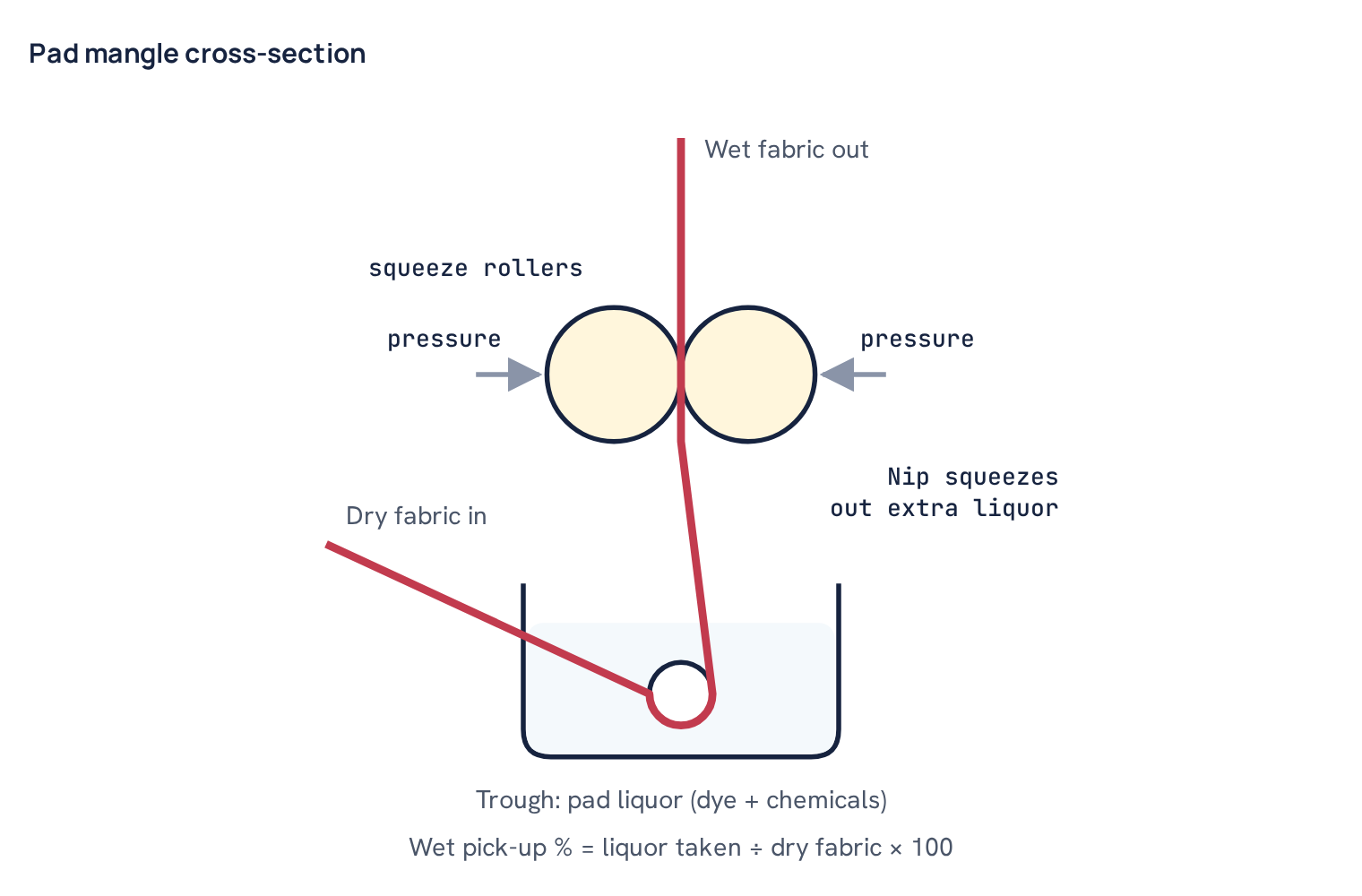
Wet pick-up (sometimes called expression) is the weight of liquor left in the fabric as a percentage of the dry fabric weight. If 100 kg of fabric leaves the nip weighing 170 kg, the wet pick-up is 70%. For cotton wovens it is commonly in the range of about 60–80%, and for synthetics lower, since they hold less water. It depends on nip pressure, roller hardness, fabric construction, how absorbent the fabric is after preparation and running speed.
The dye on the fabric is set by two numbers together: the wet pick-up and the concentration of dye in the pad liquor (in grams per litre). Change either one and the shade changes. That is why a pad recipe is written in g/L, not as a percentage on the weight of fabric as in exhaust dyeing.
Worked example. You need 2% dye on the weight of fabric, and the mangle gives 70% wet pick-up. One kilogram of fabric needs 20 g of dye and picks up 0.7 L of liquor. So the pad liquor must hold 20 ÷ 0.7 = about 28.6 g/L of dye. If the pick-up drifts up to 75% with the same liquor, the fabric now carries 0.75 × 28.6 = 21.4 g per kg, about 7% stronger. A few points of pick-up are a visible shade change.
Two classic pad faults come straight from this picture:
- Tailing (ending). The shade drifts from the start of the run to the end. The usual cause is affinity: if the dye has substantivity for the fibre, the fabric takes dye out of the trough faster than its share of liquor, so the trough gets weaker and the fabric gets lighter, until a balance is reached. Small trough volumes, fast liquor turnover, dyes chosen for low substantivity, a slightly weaker start-up liquor and keeping the trough temperature steady all help. Changing pick-up or liquor temperature during the run also causes ending.
- Listing. The shade differs from one selvedge to the other, or between the selvedges and the centre. It usually comes from uneven nip pressure across the width (roller bending under load, worn or uneven roller covers), uneven drying, or fabric that was prepared unevenly across its width. Dye migration during drying can make the edges, which dry first, darker.
Semi-continuous dyeing: cold pad-batch and pad-jig
Semi-continuous methods use a pad mangle to apply the dye, but give the fixing step its own time, away from the line. The best known is cold pad-batch (CPB) for reactive dyes on cotton and viscose.
In cold pad-batch, the dye solution and the alkali are kept in separate tanks and mixed by metering pumps just before they reach the small pad trough, because once they meet, the reactive dye starts to hydrolyse (react with water). The fabric is padded, wound tightly onto a batching roller, wrapped in plastic film so the edges do not dry out or pick up carbon dioxide from the air, and kept rotating slowly at room temperature. During this time, typically 12–24 hours depending on the dye and the alkali system, the dye diffuses into the swollen cotton and reacts with it. The roll is then taken to an open-width washer, or sometimes a jigger, for rinsing, hot soaping and final rinses. The chemistry of the reaction is explained in how reactive dyes work.
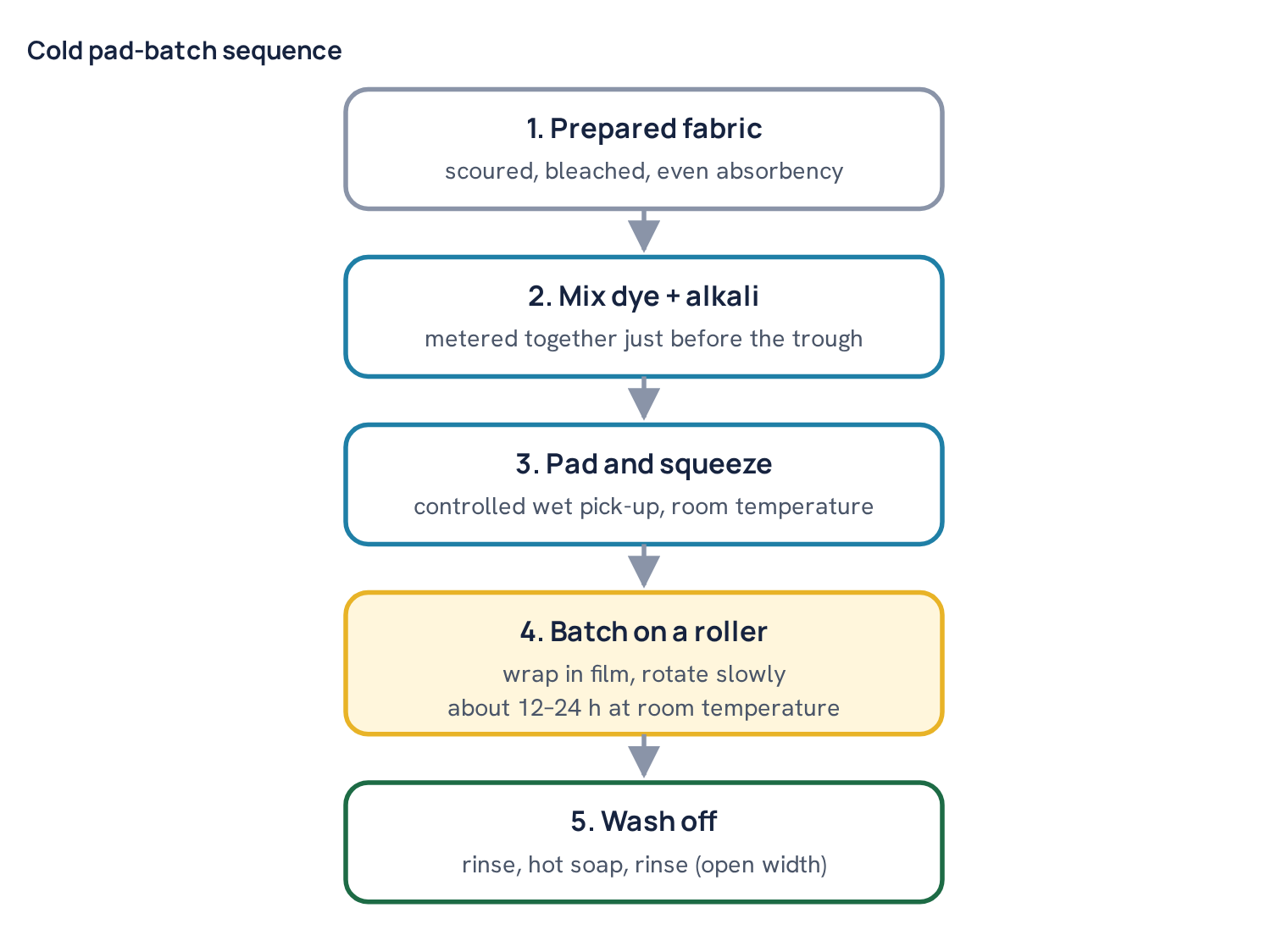
The advantages are large. There is no salt, very little heating, short liquor in the trough, low water use and good penetration and levelness, because the dye has hours to diffuse before it is fixed. The equipment is simple compared with a full continuous range. It suits medium to long runs of one shade on woven cotton and viscose, and it can also be used on knit fabric in open or tubular form with suitable padders. The limits are that the process is sensitive to room temperature (a cold night slows fixation), the mixed liquor has a short life, the roll must keep turning so liquor does not drain to the bottom, and exposed edges can come out lighter if the film wrap is poor.
Pad-jig is a simpler semi-continuous route. The dye is padded onto the fabric, which is then run on a jigger through the alkali or fixing chemicals, so fixation happens on the jigger. Pad-roll is similar to cold pad-batch, but the padded roll is held warm in a heated chamber to shorten the fixing time.
Dyeing at each stage: fibre, yarn, fabric or garment
The second big decision is when the colour goes in. The general rule is simple. The earlier you dye, the better the colour is distributed and the more pattern effects you can make, but the earlier you commit to a colour and the more stock you risk. The later you dye, the more flexible you are, but the harder it is to get even colour in a complex product.
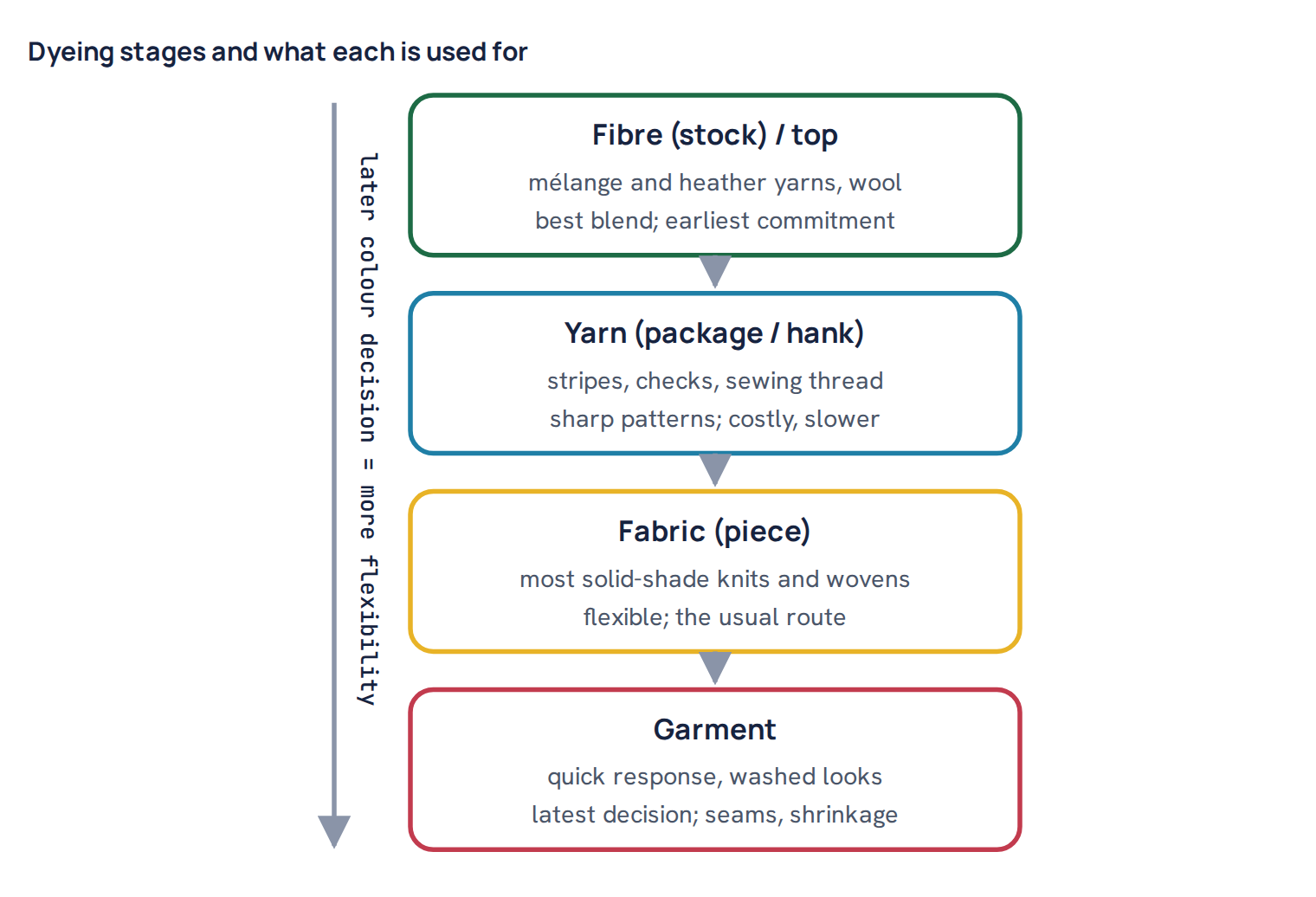
- Fibre (stock) dyeing. Loose fibre is dyed in a liquor-moves machine before spinning. Because the dyed fibre is then blended and carded, small differences between batches are averaged out, so levelness is excellent. This is how mélange and heather effects are made: dyed fibre is blended with undyed or differently dyed fibre and spun into one yarn, giving a soft, speckled colour. Grey mélange jersey is the everyday example. The trade-offs are that colour is fixed very early, waste from spinning is coloured waste, and harsh dyeing can affect how the fibre spins.
- Top dyeing. Mainly for wool. The combed sliver (top) is wound into balls and dyed on perforated carriers before worsted spinning. It gives very even colour and allows fine colour blends in suiting.
- Yarn dyeing. Done on packages or hanks, as described above. It is needed whenever the pattern is built from coloured yarns: yarn-dyed stripes in knits, checks and plaids in shirting, coloured sewing thread and many sweater yarns. Denim warp is also yarn-dyed, on special continuous rope or sheet ranges. The costs are longer lead time, more handling, and the risk of shade variation from package to package or from the inner to the outer layers of one package.
- Fabric (piece) dyeing. The fabric is knitted or woven from undyed yarn and dyed afterwards, in rope or in open width. This is the most common route for solid shades, because the grey fabric can be held in stock and dyed to order. The choice of machine depends on the fabric, as the next section explains.
- Garment dyeing. The garment is sewn from undyed (prepared-for-dye) fabric and then dyed, usually in rotary drum or paddle machines. Brands use it to decide colours very late and to get washed, vintage or soft looks. The difficulties are real: the fabric must be pre-shrunk or the garment allowed for shrinkage, sewing thread must take the same dye (or be chosen to contrast on purpose), seams, pockets and collars can dye lighter or darker than the body, and trims such as zips and labels must survive the dyebath.
Knit or woven: why knits go in rope form
A woven fabric is stable. Its yarns cross at right angles, so it can take tension in open width without much distortion. That is why wovens run on jiggers, beams, pad mangles and continuous ranges. A knit is made of loops. Pull it and the loops change shape: it gets longer and narrower, and it may not recover properly. Run a single jersey through a tensioned open-width line and the width, GSM and spirality all go out of control.
So most knit fabric is dyed in tubular rope form, in machines where the fabric moves with low tension and relaxes in the bath: winches, jets, soft-flow and overflow machines. The rope form also lets the fabric shrink and settle during dyeing, which helps dimensional stability later. Wet processing of knits is therefore normally a batch process from preparation to dyeing and wash-off, followed by de-watering and open-width finishing. For the full step-by-step route, see the 100% cotton knit dyeing process.
- Our floor dyes knit fabric on winch machines and finishes on the stenter and compactor.
- The route for a knit is batching, scouring and bleaching, enzyme, dyeing, soaping, softening, then slitting, stenter and compacting.
- Fabric that is not heat set is turned inside out at batching before dyeing; heat-set fabric is slit, heat set and back sewn into a tube with the face side inside.
Turning the fabric so the face is inside, as described in the box, protects the face from rubbing against the machine and against itself during the long rope cycle. Elastane knits are heat set first so the fabric is dimensionally stable and less likely to crease in the rope. There are exceptions on both sides: some knits, especially warp knits, are dyed in open width on beam machines or by cold pad-batch, and many lightweight synthetic wovens are dyed in jets.
How to choose a method
No method is best for everything. In practice the choice comes from five questions:
- What is the fabric? Knit or woven, fibre type, weight and how easily it creases or distorts. Knits point to rope machines; crease-sensitive wovens point to jigger or beam; polyester and its blends need high temperature.
- How big is the lot? Small lots of a few hundred kilos suit exhaust machines of the right size. Tens of thousands of metres of one shade suit continuous or cold pad-batch.
- How many shades, how often? A dye house with many small colour orders needs many batch machines of different sizes. A plant with a few large standard shades can run continuously.
- What quality is needed? Handle, surface appearance, levelness, penetration and fastness. A soft, bulky handle favours rope dyeing; a flat, crease-free surface favours open width.
- What does it cost? Water, steam, power, chemicals, labour, machine time and the cost of reprocessing. Short liquor ratios cut water and energy, but only if the machine still dyes level.
The dye class also matters. Which dye suits which fibre is covered in dye classes: which dye for which fibre; the method must suit the dye too, for example high-affinity dyes for exhaust, low-affinity dyes for padding.
Comparison of dyeing methods
| Method | Material form | Typical liquor ratio (varies) | Best for | Main limits |
|---|---|---|---|---|
| Winch (beck) | Fabric rope | 1:8 – 1:30 | Knits, bulky fabrics, soft handle | High water and energy; mostly atmospheric |
| Jet | Fabric rope | 1:5 – 1:10 | Knits, polyester and blends, wide shade range | Rope and crease marks, surface abrasion |
| Soft-flow / overflow | Fabric rope | 1:4 – 1:8 | Delicate knits, elastane blends, viscose | Higher machine cost; load limits |
| Jigger | Open-width woven | 1:2 – 1:5 | Crease-sensitive wovens, small lots | Ending and listing; not for knits |
| Beam | Open-width on beam | 1:6 – 1:12 | Light synthetics, warp knits | Moiré, needs permeable fabric |
| Package | Yarn on tubes | 1:6 – 1:12 | Yarn-dyed stripes and checks | Inner–outer variation, winding critical |
| Continuous (pad–dry–fix) | Open-width woven | Pad trough, no long bath | Long runs of one shade | High set-up cost; tailing, listing |
| Cold pad-batch | Open-width (or tubular) | Pad trough, no long bath | Reactive on cotton, medium–long runs | Temperature sensitive; batching time |
| Garment | Sewn garments | Often 1:10 – 1:40 | Late colour decision, washed looks | Seams, shrinkage, trims |
Common faults by method
Each method has its own typical faults, and knowing them helps you look in the right place.
- Crease marks and rope marks (jet, winch, soft-flow). Lines or streaks along the length where the rope stayed folded in the same place while hot, or was cooled too fast. Overloading, too slow a rope cycle, wrong nozzle setting, shock cooling and unstable fabric all contribute. See crease marks in knit dyeing.
- Abrasion, pilling and tangling (jet). Too much nozzle pressure or too fast a speed rubs the surface, raises fibres and can tangle the rope. Lighter, gentler settings or a soft-flow machine help.
- Unevenness and patchiness (winch). The slow exchange lets fast-striking dyes rush onto the fabric. Controlled dosing of dye and chemicals and slower heating help.
- Ending and listing (jigger and continuous). Shade change from end to end or across the width, from tension, temperature, nip pressure or trough concentration changes. Tailing in padding is the same idea along the length.
- Migration (continuous). Dye moves towards the faster-drying surface or edges before it is fixed, giving face–back or edge differences. Gentle infrared pre-drying and a migration inhibitor reduce it.
- Moiré (beam). A watery, wavy pattern on the fabric. It comes from uneven pressure and flow between tightly wound layers, especially on fine, smooth synthetics. Correct winding tension and the right flow rate help.
- Inner–outer variation (package). The inside and outside layers of a package come out different in shade, usually because of uneven winding density, wrong flow direction timing or too high a flow that channels through soft spots.
- Edge and bottom problems (cold pad-batch). Lighter edges where the roll dried out or the alkali was neutralised by air, and heavier bottoms where liquor drained because the roll did not rotate.
Common mistake: Treating a method-related fault as a recipe problem. Adding levelling agent will not cure a crease mark from an overloaded jet, a listing from a worn pad roller or an inner–outer shade from a badly wound package. Check the machine, the loading and the material form before changing the chemistry.
Once you know which family a method belongs to and what moves in it, most of its strengths and faults follow logically. Exhaust machines trade water and time for flexibility; pad methods trade set-up cost for speed and economy on long runs; and the stage at which colour goes in decides how much design freedom and how much stock risk you carry.
Questions
What is the difference between exhaust and continuous dyeing?
In exhaust dyeing the material sits in a long dye bath and the dye slowly moves onto it. In continuous dyeing open-width fabric is padded with concentrated liquor, then dried, fixed and washed in one line.
What is cold pad-batch dyeing?
Cotton or viscose is padded with reactive dye and alkali mixed just before the trough, wound on a roller, wrapped and rotated at room temperature for about 12–24 hours, then washed off.
What is wet pick-up?
The weight of liquor the fabric carries after the squeeze rollers, as a percentage of its dry weight. Together with the pad liquor concentration it sets how much dye goes on.
Why are knit fabrics dyed in rope form?
Knits are made of loops that stretch and distort under tension, so they are dyed as a relaxed tubular rope in winch, jet or soft-flow machines rather than on tensioned open-width lines.
What is the difference between yarn-dyed and piece-dyed fabric?
Yarn-dyed fabric is made from yarn coloured before knitting or weaving, which allows stripes and checks. Piece-dyed fabric is made from undyed yarn and dyed afterwards, usually in a solid shade.

Textile engineer with 14+ years in dyeing and fabric development. He writes every guide on Dyeing Solution from real production work. Full profile