Linen can shrink, mostly in its first hot wash and dryer and mainly in length. How much unwashed and pre-washed linen shrinks, whether it shrinks every wash or more than cotton, and how to wash it safely.
At a glance
First washmost shrinkage
Lengthshrinks more than width
1–2%pre-washed linen
Line drybest care
Yes, linen can shrink, mostly in its first hot wash and in a hot dryer. Linen is made from flax, a cellulose fibre like cotton, so it swells in water and relaxes when it is washed and tumbled. Linen that has not been pre-washed typically shrinks a few percent, more in length than in width. Pre-washed or “stonewashed” linen has already done most of its shrinking and changes very little. Washing cool and line drying keep shrinkage small.
This guide explains why linen shrinks, how much, whether it shrinks in the dryer, in cold or hot water and every time you wash it, whether it shrinks more than cotton, and how to wash it safely.
Why linen shrinks
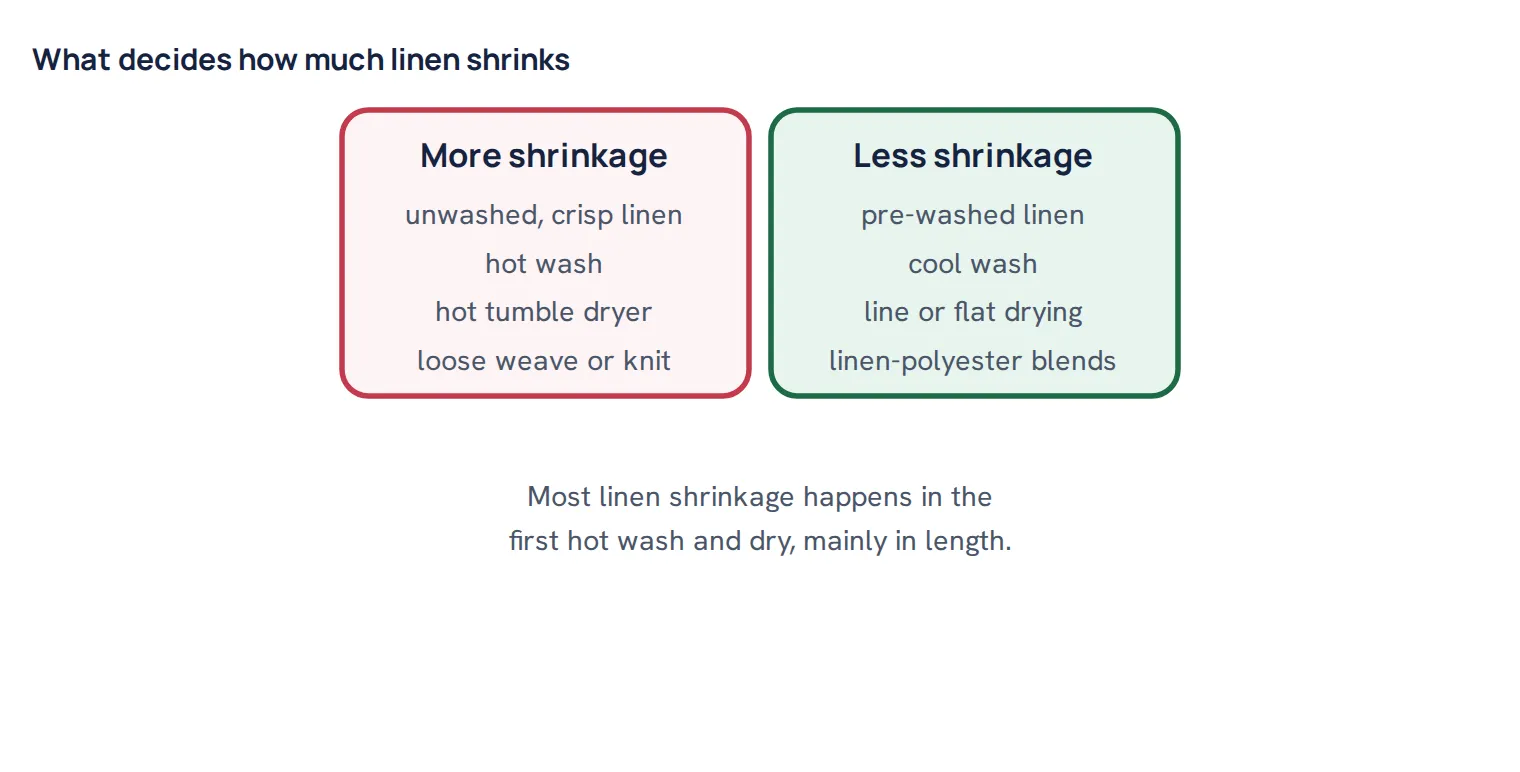
Linen yarn is held under tension when it is spun and woven or knitted. Like cotton, the fibres also absorb water and swell. When linen is washed, especially in hot water, and then tumbled, the yarns relax and draw together, so the fabric gets shorter. Linen fibres are stiffer and more crystalline than cotton, which makes linen resist stretching back once it has shrunk.
How a linen garment was finished makes a big difference. Linen that was washed, tumbled or “stonewashed” before cutting has already relaxed; crisp, unwashed linen fabric has not.
How much does linen shrink?
Unwashed linen fabric commonly shrinks a few percent in its first wash, often quoted at up to about 4–5%, and more if it is washed hot and tumble dried. Pre-washed linen garments usually shrink only 1–2% more. Shrinkage is usually greater in length than in width, because the length direction carries more tension in manufacture.
Our own records point the same way for knitted linen blends: cotton-linen knit fabrics showed higher length shrinkage than 100% cotton, which itself shrank a median 6% in length in our records, and three out of four cotton-linen parts finished more than 5% below the required weight, a sign that the fabric still had relaxing to do. Our linen data is a small set, so treat it as a direction rather than a firm figure. See the linen knit dyeing process.
| Linen type | Typical first-wash shrinkage | Notes |
|---|---|---|
| Unwashed, crisp linen fabric | A few percent, up to about 4–5% | Pre-wash before sewing |
| Pre-washed / stonewashed garment | About 1–2% | Already relaxed |
| Linen-cotton blend | Similar to or above cotton | Both fibres shrink |
| Linen-polyester blend | Lower | Polyester does not shrink |
These are typical ranges, not guarantees; the label and the way the fabric was finished matter most.
Does linen shrink in the dryer?
Yes. The heat and tumbling of a dryer relax linen further and can also make it stiff and very wrinkled. Drying on low heat and removing it while still damp, or line drying, keeps shrinkage and creasing down. Linen dries quickly in the air, so the dryer is rarely needed.
Does linen shrink in cold water? In hot water?
Cold water causes the least shrinkage; linen can still relax slightly. Hot water causes more, which is why many people deliberately wash new linen hot once before sewing or wearing it, to get the shrinkage over with.
Does linen shrink every time you wash it?
No. Most shrinkage happens in the first one or two washes. After that, linen is stable if you keep washing it at the same temperature. Washing hotter or using a hotter dryer than before can shrink it a little more.
Does linen shrink more than cotton?
They are similar in principle, because both are cellulose. Unwashed linen fabric can shrink more than pre-shrunk cotton; pre-washed linen often shrinks less than a cotton T-shirt that was not well compacted. In our knit records, cotton-linen blends shrank more in length than 100% cotton.
Does linen shrink in length or width?
Mainly in length. The length direction of a fabric is pulled hardest in weaving, knitting and finishing, so it has the most to relax. Trousers and long dresses therefore show linen shrinkage most.
Common mistake: hemming new linen trousers to length before washing them. After the first hot wash and dry they can lose a couple of centimetres. Wash first, then hem.
How to wash linen without shrinking it
- Wash at 30–40°C on a gentle cycle.
- Use a mild detergent; avoid chlorine bleach on coloured linen.
- Line dry or dry flat, or tumble on low and remove while damp.
- Iron while slightly damp to smooth it and ease it back to shape.
Worked example. A pair of unwashed linen trousers has a 100 cm inside leg plus hem. A first hot wash and tumble dry that shrinks it 4% in length takes off 4 cm; a pre-washed pair might lose only 1–2 cm. Washing the fabric before cutting, or buying pre-washed linen, avoids the surprise.
Summary
- Linen can shrink, mostly in the first hot wash and dryer, and mainly in length.
- Unwashed linen often shrinks a few percent; pre-washed linen only 1–2%.
- Cool washing and line drying keep shrinkage small.
- It does not keep shrinking every wash at the same temperature.
For other fibres, see fabric shrinkage by fibre, and for colouring linen see can you dye linen.
Questions
Does linen shrink?
Yes. Unwashed linen commonly shrinks a few percent in its first wash, more in a hot wash and dryer. Pre-washed linen shrinks only 1–2% more.
Does linen shrink in the dryer?
Yes. Heat and tumbling relax linen further and add creases. Dry on low and remove while damp, or line dry.
Does linen shrink every time you wash it?
No. Most shrinkage happens in the first one or two washes; after that it is stable at the same temperature.
Does linen shrink more than cotton?
Unwashed linen can shrink more than pre-shrunk cotton; pre-washed linen often shrinks less. In our knit records cotton-linen blends shrank more in length than 100% cotton.
Does linen shrink in length or width?
Mainly in length, because the length direction carries the most tension during manufacture.

Textile engineer with 14+ years in dyeing and fabric development. He writes every guide on Dyeing Solution from real production work. Full profile