Double knit fabric is knitted on two sets of needles at once, making a thick, stable fabric with two interlocked layers that lies flat and looks similar on both sides. How it is made, double knit vs single jersey, interlock, ponte, scuba and other types, dyeing, shrinkage, sewing and care.
At a glance
Twoneedle sets
Flatno edge curl
Ponteinterlock, scuba
7%cotton rib/interlock
Double knit fabric is a knit made on two sets of needles at once, producing a thick, stable fabric with two closely joined layers that looks the same, or nearly the same, on both sides. It is heavier, firmer and more stable than single jersey, does not curl at the edges, and holds its shape well, which makes it popular for structured dresses, skirts, trousers, jackets, sportswear and babywear. Interlock, ponte (ponte di Roma), scuba and many jacquard knits are all types of double knit.
This guide explains how double knit is made, how it differs from single jersey, the main types of double knit and what each is used for, the fibres used, how double knits behave in dyeing, shrinkage and wear, how to sew and care for them, and how to choose the right double knit for a project. It is written from the fabric-development and dye-house side, where double knits are a large share of what we develop and finish.
How double knit is made
Most knit fabric comes from circular knitting machines. A single jersey machine has one set of needles, in the cylinder, so it makes a single layer of loops with a clear face (V shapes) and back (bumps). A double knit machine has two sets of needles: one in the cylinder and one in the dial above it. Both sets knit at the same time, and their loops interlock, so the fabric is effectively two layers joined together. Depending on how the needles are arranged and which ones knit on each feed, the machine produces rib, interlock, ponte, jacquard or other double structures.
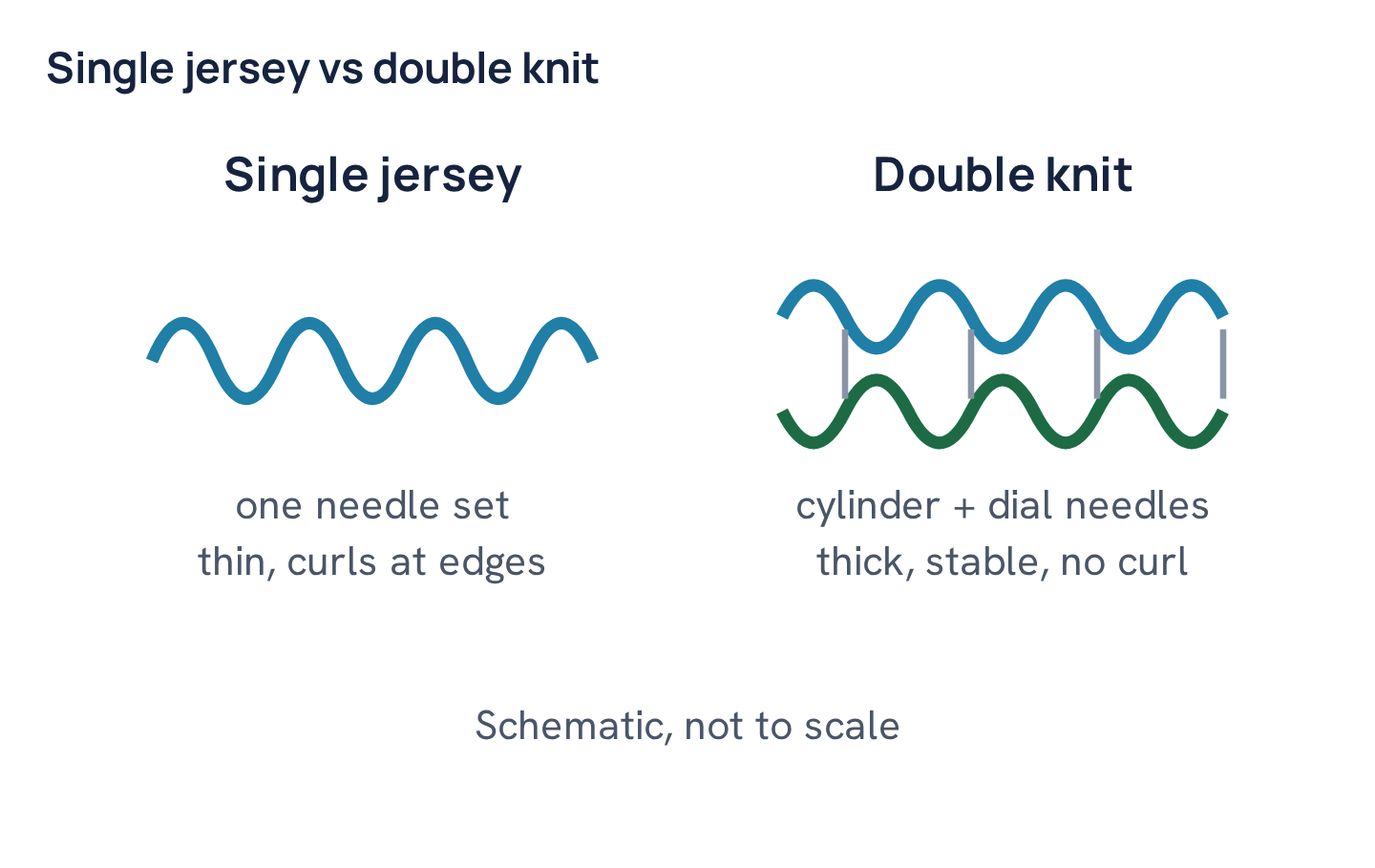
Double knit vs single jersey
| Point | Single jersey | Double knit |
|---|---|---|
| Layers | One | Two, interlocked |
| Weight | Light to medium (about 120–240 GSM) | Medium to heavy |
| Face and back | Different | Similar on both sides |
| Edge curling | Curls | Lies flat |
| Stretch | Good width stretch | Less, more stable |
| Laddering | Can ladder from a cut | Resists laddering |
| Uses | T-shirts, tops | Dresses, trousers, jackets, polos, babywear |
See what is cotton jersey for single jersey.
Types of double knit fabric
| Type | What it is | Typical uses |
|---|---|---|
| Rib | Alternating face and back wales, very stretchy across the width | Cuffs, collars, fitted tops |
| Interlock | Two 1×1 ribs interlocked; smooth both sides | T-shirts, babywear, polos, sportswear |
| Ponte (ponte di Roma) | Firm double knit with a subtle horizontal line, often with spandex | Trousers, skirts, dresses, jackets |
| Scuba | Smooth, thick polyester-spandex double knit | Structured dresses, skirts, sportswear |
| Jacquard double knit | Patterns knitted in with selected needles | Fashion tops, sweaters, dresses |
| Ottoman | Raised horizontal ribs | Dresses, tops, outerwear |
| Bonded double face | Two different faces, sometimes in two colours | Reversible garments |
See what is interlock fabric, ponte development guide and what is scuba fabric.
Fibres used in double knits
- Cotton: soft, breathable interlocks and ribs for babywear, T-shirts and polos.
- Polyester and polyester-spandex: stable, crease-resistant ponte and scuba for dresses and sportswear.
- Viscose-nylon-spandex: the classic ponte blend, with drape and recovery.
- Cotton-polyester (CVC): durable, easy-care interlocks for uniforms.
- Wool and acrylic: sweater double knits and jacquards.
Double knit in the dye house
Double knits are thicker and denser than single jersey, so dye and chemicals take longer to penetrate evenly through both layers. Dense double knits need good liquor circulation, careful rope loading in the machine and enough time at temperature. Crease marks are a risk with heavy, stiff double knits, because they can be folded in the machine. In finishing, double knits are heat set (for synthetic and spandex blends) and compacted to control width, weight and shrinkage. See the interlock dyeing and finishing flowchart and crease marks in knit dyeing.
Shrinkage and stability
Double knits are more stable than single jersey because the two layers hold each other. Cotton interlock still shrinks if washed hot; in our records, 100% cotton rib and interlock had a median length shrinkage of 7% after the wash test, against 5% for single jersey, because their extra stretch relaxes more in washing. Polyester and polyester-spandex double knits, once heat set, shrink very little. See does fabric shrink after washing.
Common mistake: treating a ponte like a woven and sewing it with a straight stitch and no allowance for stretch. The seams can pop when the garment is pulled on. Use a stretch or narrow zigzag stitch, a ballpoint or stretch needle, and let the fabric feed without pulling.
Sewing double knit fabric
- Use a ballpoint or stretch needle.
- Choose a stretch stitch, narrow zigzag or overlocker.
- Use a walking foot for thick double knits.
- Edges do not curl or fray much, so hems can be simple.
- Pre-wash cotton double knits to remove shrinkage first.
Caring for double knit garments
- Wash at 30–40°C, inside out.
- Dry flat or tumble low; high heat can shrink cotton and weaken spandex.
- Fold rather than hang heavy double knits to prevent stretching.
- Iron on the reverse at a setting suited to the fibre.
Worked example. A designer wants a fitted skirt that holds its shape without lining. Single jersey would cling and show every line. A viscose-nylon-spandex ponte gives a smooth, firm, opaque fabric that skims the body and recovers after sitting. A cotton interlock would be softer but less structured. Ponte is the right double knit for the job.
Is double knit warm?
Double knits are warmer than single jersey of the same fibre because they are thicker and trap more air between the layers. Cotton interlock is a good all-season fabric for babywear; polyester ponte and scuba are fairly warm and less breathable, suiting cooler weather and air-conditioned offices.
Double knit vs woven fabrics
Designers often use double knits where they would once have used a woven, because a firm double knit such as ponte gives a tailored look with comfort stretch. Compared with a woven gabardine or twill, ponte moves with the body, rarely needs lining, resists creasing and is easier to fit because the stretch forgives small differences in size. The trade-off is that very sharp tailoring, crisp pleats and pressed creases hold better in wovens. For work trousers, pencil skirts and unstructured blazers, double knit is a comfortable alternative; for formal suits, wovens still dominate.
How to identify double knit fabric
- Look at both sides: if they look alike or nearly alike, it is probably a double knit.
- Pull a cut edge: single jersey curls; double knit stays flat.
- Stretch it: double knit stretches but feels firm and springs back.
- Try to unravel a cut edge: single jersey ladders easily; interlock does not.
- Feel the weight: double knits feel thicker and heavier for the same fibre.
Common quality problems in double knits
The faults we see most on double knits in production are uneven width across the roll, crease marks from dyeing heavy fabric in rope form, and weight that comes out higher or lower than required after compacting. Spirality, a twisting of the wales that makes side seams twist after washing, is much less of a problem in double knits than in single jersey because the two layers balance each other. Pilling can still occur on spun polyester and acrylic double knits, especially on the inside where the fabric rubs. Buyers usually test double knits for GSM, shrinkage, pilling and colour fastness before bulk approval. See how GSM is tested and how spirality is tested.
Double knit for babywear
Cotton interlock is the classic baby fabric. It is soft on both sides, so there is no rough back against delicate skin, it does not curl or ladder, and it holds its shape after many washes. Because it is thicker than single jersey, it is also a little warmer. For babywear, look for fine-gauge, combed cotton interlock that has been well compacted, so shrinkage is controlled.
Summary
- Double knit is knitted on two needle sets, making a thick, stable two-layer fabric.
- It lies flat, resists laddering and looks similar on both sides.
- Interlock, rib, ponte, scuba, jacquard and ottoman are double knits.
- It needs careful penetration in dyeing and controlled finishing.
- Sew with stretch stitches and a ballpoint needle; wash cool.
Questions
What is double knit fabric?
A knit made on two sets of needles at once, giving a thick, stable fabric with two interlocked layers.
What is the difference between double knit and jersey?
Jersey is a single layer that curls at the edges; double knit has two layers, is thicker, more stable and lies flat.
Is ponte a double knit?
Yes. Ponte di Roma is a firm double knit, often made with viscose, nylon and spandex or polyester and spandex.
Is interlock a double knit?
Yes. Interlock is two 1×1 rib structures interlocked, smooth on both sides.
Does double knit fabric stretch?
Yes, but less than single jersey or rib. Spandex blends such as ponte and scuba stretch and recover well.

Textile engineer with 14+ years in dyeing and fabric development. He writes every guide on Dyeing Solution from real production work. Full profile