What is really inside a packet of home dye, why it comes with a fixative, how natural dyes and food colours hold on fibre, and which one suits cotton, wool, silk, nylon or polyester.
At a glance
3 familiesReady-made, natural, food colour
CottonBest with direct or cold reactive dye
Wool, silkTake natural dyes and food colours
PolyesterNeeds disperse dye, not these three
Quick answer. Most packet dyes sold for home use are ready-made synthetic dyes. They are usually direct dyes for cotton, or “all-purpose” blends of direct and acid dyes that colour several fibres at once. Natural dyes come from plants and insects and need a mordant, a metal salt or tannin that helps the colour hold. Food colours only work reasonably on wool, silk and nylon, in an acid, hot bath. None of these three choices dyes polyester properly.
This guide explains what each type of home dye really is, why it behaves the way it does, and which fabric it suits. It is written from the dye-house side. The chemistry that decides a result in a 2,000-litre machine is the same chemistry that decides it in a kitchen bucket. New to the topic? Start with our home dyeing hub.
How clothes get dyed at home
In industry, finished garments are dyed in the washing department, in rotating machines that control temperature, time and liquor ratio. At home, the “machine” is a bucket, a sink or a large pot. The tools are simple, but the steps follow the same logic. The dye must dissolve in water. It must move from the water onto the fibre. Then something must hold it there when the garment is washed later.
Each dye family solves that last problem differently, and that difference explains most home dyeing surprises.
- Garments are dyed in two ways: in industry, garment dyeing is done in the washing department; at home, people dye in a bucket.
- At home people usually use ready-made colours bought from the market or online, for example direct dyes, which colour the garment directly. A fixative is sold with them, and you fix the colour with it afterwards.
- Natural dyes are the most popular choice today, because people worry that some synthetic dyes are harmful to skin. People also use food colours or ready-made colours bought online.
- The home process: take a bucket and water, dissolve the dye, put the garment in, add the fixative. Sometimes heat is needed and sometimes not; it depends on the dye. Then wash lightly (do not over-wash) and dip it again in fixative solution.
Ready-made home dyes: what is actually in the packet
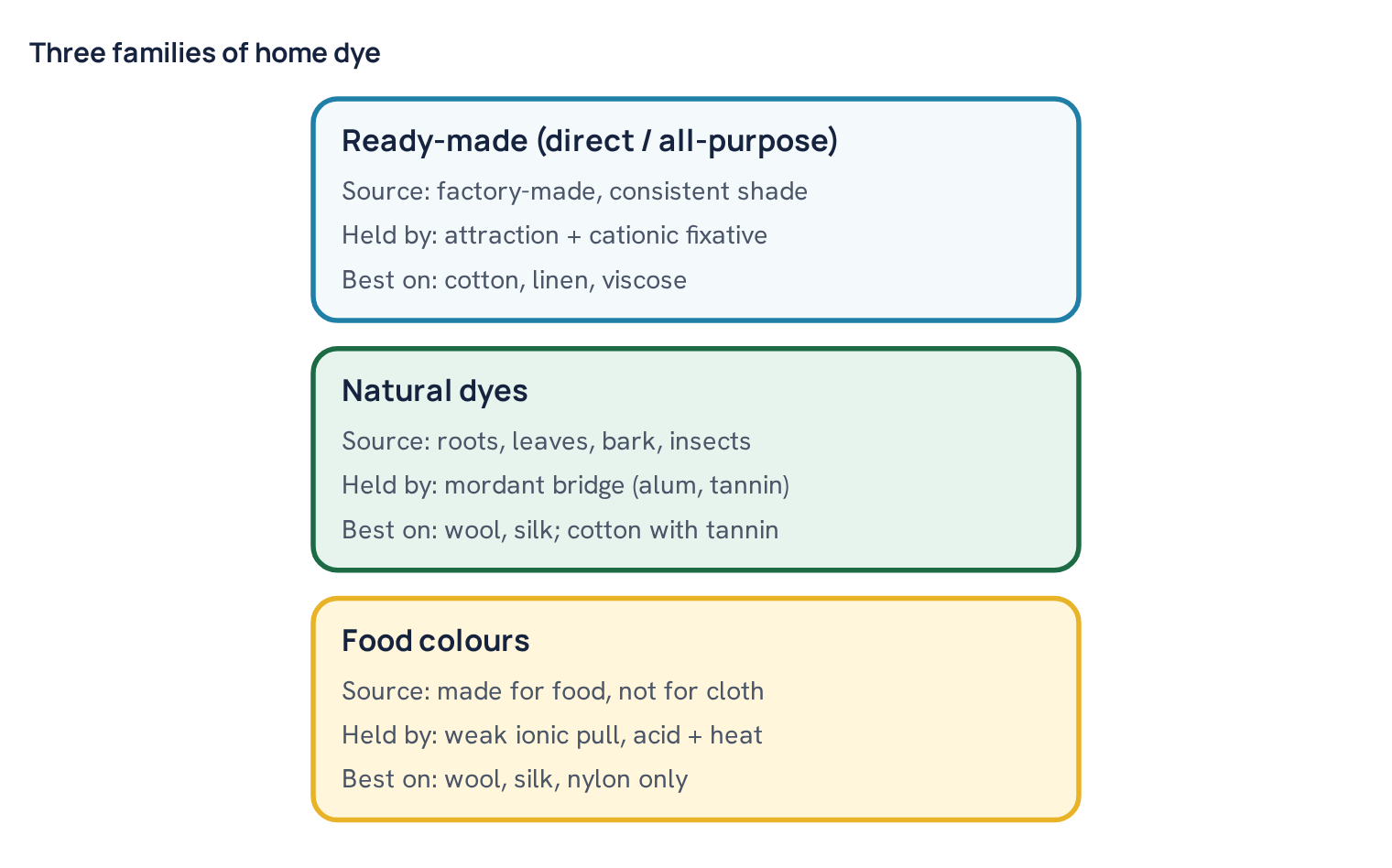
The small sachets and bottles sold in shops and online rarely name their dye class. From the way they behave, though, most fall into a few groups.
Direct dyes
Direct dyes are named for what they do: they colour cellulose fibres such as cotton, linen and viscose “directly”, without a mordant. Their molecules are long, flat and carry negative charges from sulphonate groups, so they dissolve well in water. A long, flat molecule can lie close along a straight cellulose chain. There it is held by hydrogen bonds and van der Waals forces, the same weak attractions that make two sheets of wet glass stick together.
Salt is often part of the recipe. Cotton in water carries a slight negative surface charge, which pushes the negative dye away. Salt cancels that effect and lets more dye move onto the fibre. Heat helps the dye travel deep into the fibre and spread evenly. Our article on how direct dyes work on cotton goes into the mechanism in more detail.
The weakness of a direct dye is that nothing chemically locks it in place. The same attractions that pull it onto the fibre in a hot bath can let it go again in a hot wash. That is the reason a fixative comes in the packet.
All-purpose (mixed) dyes
Many packets say they dye “cotton, wool, silk, nylon and blends”. These are usually blends of two dye classes in one powder. A direct dye takes care of the cellulose fibres. An acid dye takes care of the protein fibres (wool, silk) and nylon. Each fibre takes up the part of the mix that suits it, and the other part mostly stays in the water or rinses out.
This is convenient, but it has a cost. You pay for dye that never reaches your fibre, so the shade is often lighter than the packet photo. On a blend, the two fibres can come out in slightly different tones. And the wash fastness is limited by the weaker of the two classes on that fibre.
Hot-water and cold-water types
Packets also divide into hot-water and cold-water dyes, and this tells you a lot about the chemistry.
- Hot-water dyes are usually direct dyes or direct and acid blends. They need hot or near-boiling water because heat swells the fibre and helps the dye move in. They are often used in a pot on the stove or in a washing machine on a hot cycle.
- Cold-water dyes for cotton are usually fibre-reactive dyes of a type that reacts at low temperature. Reactive dyes form a true chemical bond with the cellulose once alkali is added. In these kits the extra sachet is often soda ash (sodium carbonate), the alkali that starts the reaction. It may be labelled “fixer”, but it works differently from the cationic fixative sold with direct dyes.
Common mistake: treating every “fixer” sachet as the same product. With a direct dye, the fixative is a cationic after-treatment used after dyeing. With a cold reactive dye, the “fixer” is usually an alkali that has to be in the bath during dyeing. Use each one at the stage its own instructions give.
Why a fixative comes with direct dyes
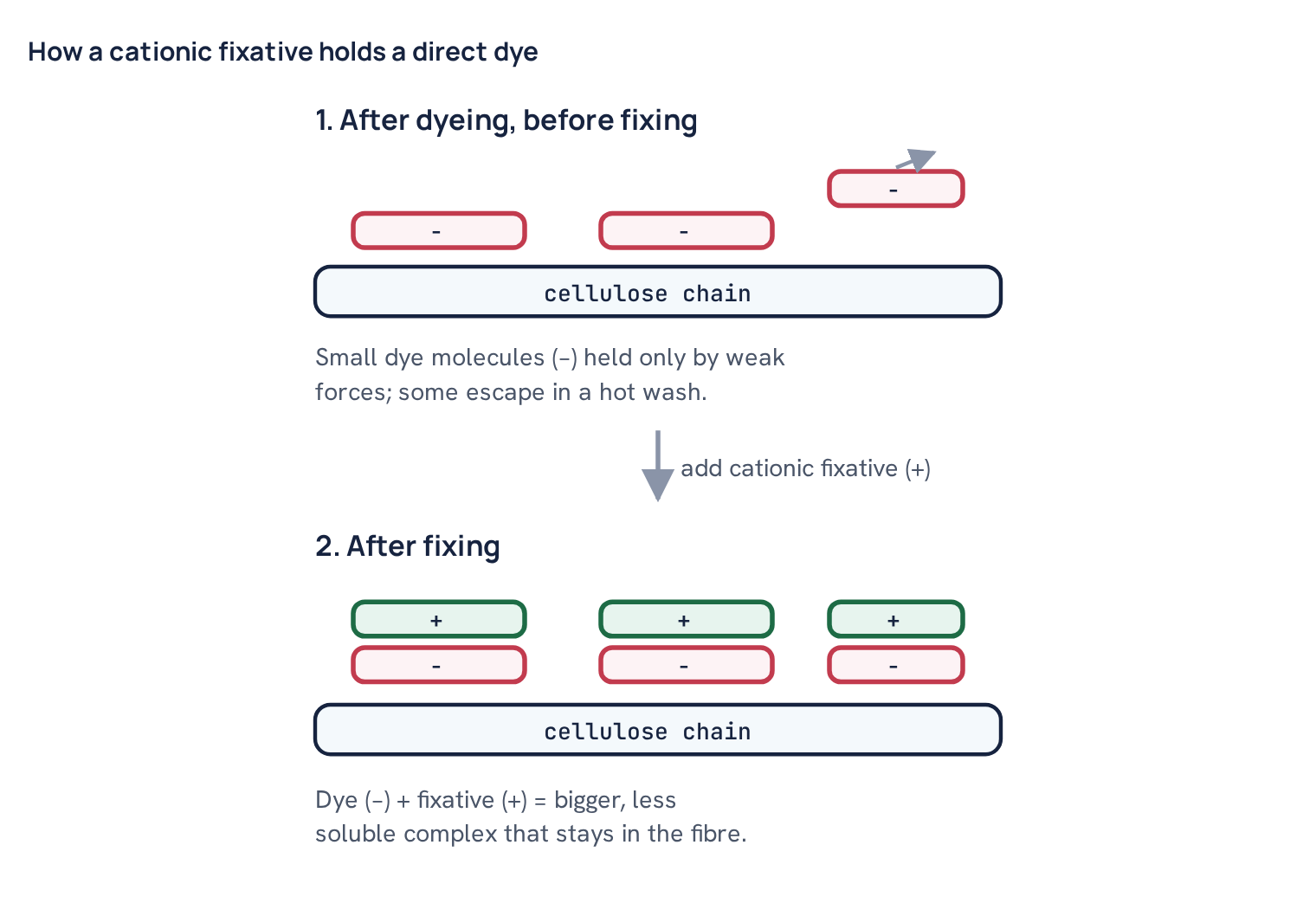
A direct dye molecule carries negative charges (it is anionic). The fixative sold with it is a cationic dye-fixing agent: a molecule with positive charges. When the dyed garment goes into the fixative solution, the positive fixative meets the negative dye inside and on the fibre. The two join into a larger complex.
That complex is much bigger and much less soluble in water than the dye molecule alone. A big, poorly soluble complex cannot easily diffuse back out of the fibre in a wash. The result is better wash fastness and water fastness, with less colour bleeding onto other clothes. Our full guide to what a dye fixative is and how it works covers the different fixative types.
Fixatives have trade-offs. They can slightly dull or shift the shade, and some lower light fastness, so a fixed colour may fade a little faster in strong sun. They also mainly reduce bleeding. They do not stop the dye rubbing off a very dark, overloaded garment if loose dye was never rinsed away first.
This explains the order of the home steps. You dye, then rinse gently to remove dye that is only sitting loosely on the surface. Do not over-wash at this stage, or you strip dye the fixative could still have held. Then you treat the garment in the fixative solution so it can lock in the dye that remains.
Worked example. A navy cotton T-shirt dyed with a direct dye bleeds heavily in its first wash and stains a white shirt. The likely causes are too little rinsing before fixing, a skipped or rushed fixative step, or more dye than the fabric could take up. A navy that has been fixed properly still loses a little colour at first, but much less, and the bleeding drops off quickly with later washes.
Natural dyes: plants, insects and mordants
Natural dyes are popular again, mainly because people want to avoid synthetic chemicals on their skin. They come from many sources. Roots give reds (madder). Leaves give yellows (weld, and many common garden plants) and blues (indigo-bearing plants). Bark, nut husks and onion skins give browns and golds. Insects give crimson and pink, such as cochineal and lac. Tannin-rich materials like oak galls and pomegranate rind give beiges and greys, and they are also used as a pre-treatment.
Why a mordant is needed
Most natural dyes have little natural attraction to the fibre on their own. A mordant solves this. The word comes from the Latin for “to bite”. A mordant is usually a metal salt, most commonly alum (potassium aluminium sulphate). The metal ion attaches to the fibre and also forms a complex with the dye molecule. In effect it works as a bridge, with the fibre on one side and the dye on the other.
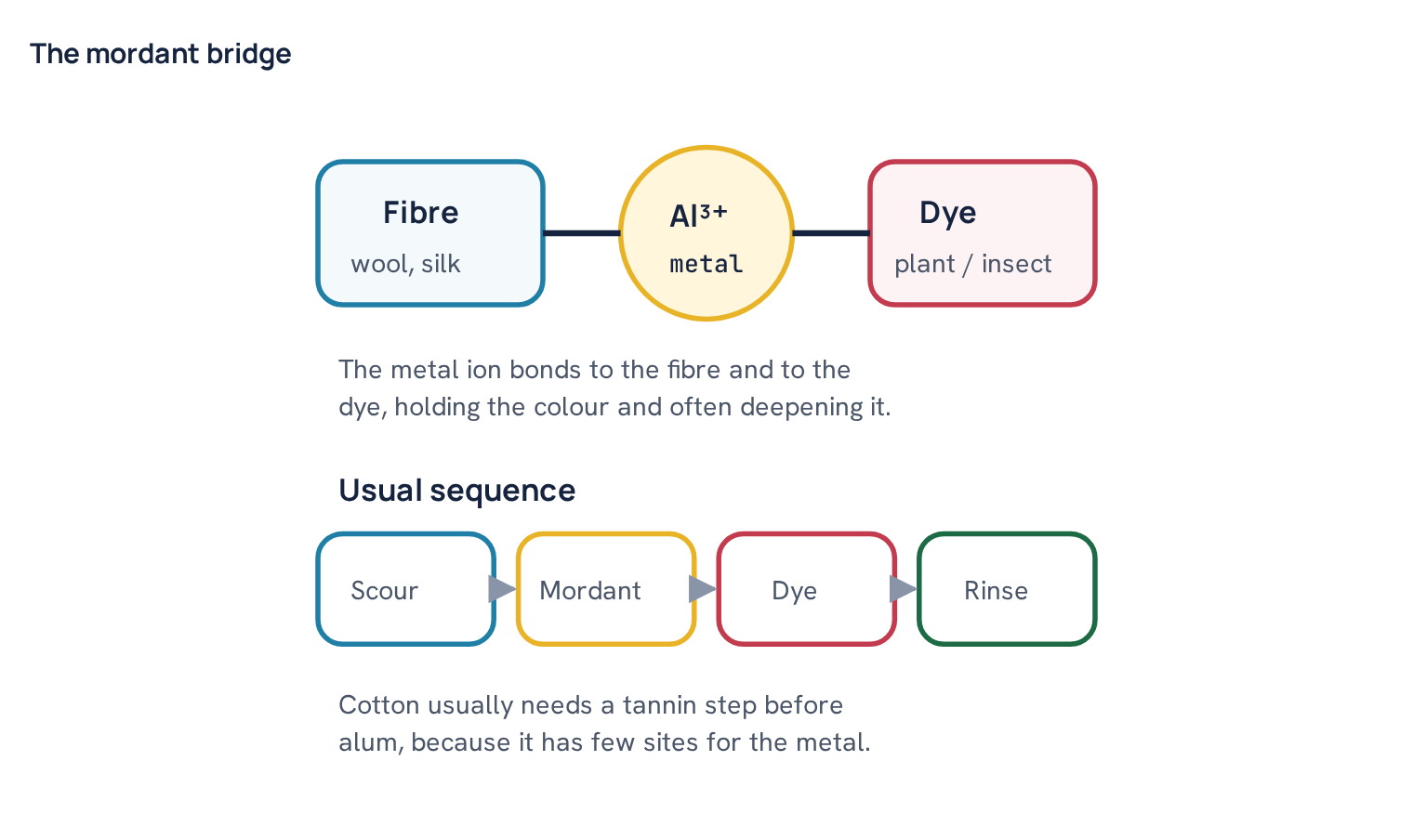
Protein fibres (wool and silk) have many chemical groups that can hold a metal ion, so they mordant easily. Cotton and linen have far fewer of these groups. Dyers usually treat them first with a tannin and then with alum, so there are more places for the metal and dye to attach. That extra step is one reason natural dyeing on cotton feels harder than on wool.
Not every natural dye needs a mordant. Indigo is a vat dye: it is made soluble in a reducing bath, enters the fibre, and turns insoluble and blue again in air. Tannin-rich dyes can also hold reasonably on their own. For the full picture, read natural dyes and mordants basics.
What to expect from natural dyes
- Softer shades. Natural dyes usually give muted, earthy tones. Very bright, clean colours are hard to reach.
- Variation batch to batch. The dye content of a plant depends on species, season, soil and storage. Two dye baths made from “the same” onion skins can give different results.
- Mordant changes the colour. The same dye can give a clear yellow with alum and an olive or grey with iron. Iron “saddens” (darkens and dulls) a shade.
- Variable fastness. Madder and indigo can be quite fast. Turmeric, beetroot and many berries fade quickly in light and washing. “Natural” says nothing about durability on its own.
Common mistake: assuming “natural” means “harmless”. Alum is the mildest common mordant, but copper and chrome mordants are hazardous and are best avoided at home. Some plant materials can also irritate skin. Use separate pots that never go back to the kitchen, and wear gloves.
Food colours: what they can and cannot do
Many synthetic food colours are chemically close to acid dyes. They are water-soluble and carry negative (anionic) groups. That is why they can colour wool, silk and nylon, the same fibres acid dyes are used on in industry.
The mechanism needs two things: acid and heat. Protein fibres and nylon contain amino groups. In an acidic bath, for example with vinegar or citric acid, those groups pick up a hydrogen ion and become positively charged. The negative food colour is then attracted to these positive sites and held by an ionic bond. Heat swells the fibre and speeds up the process.
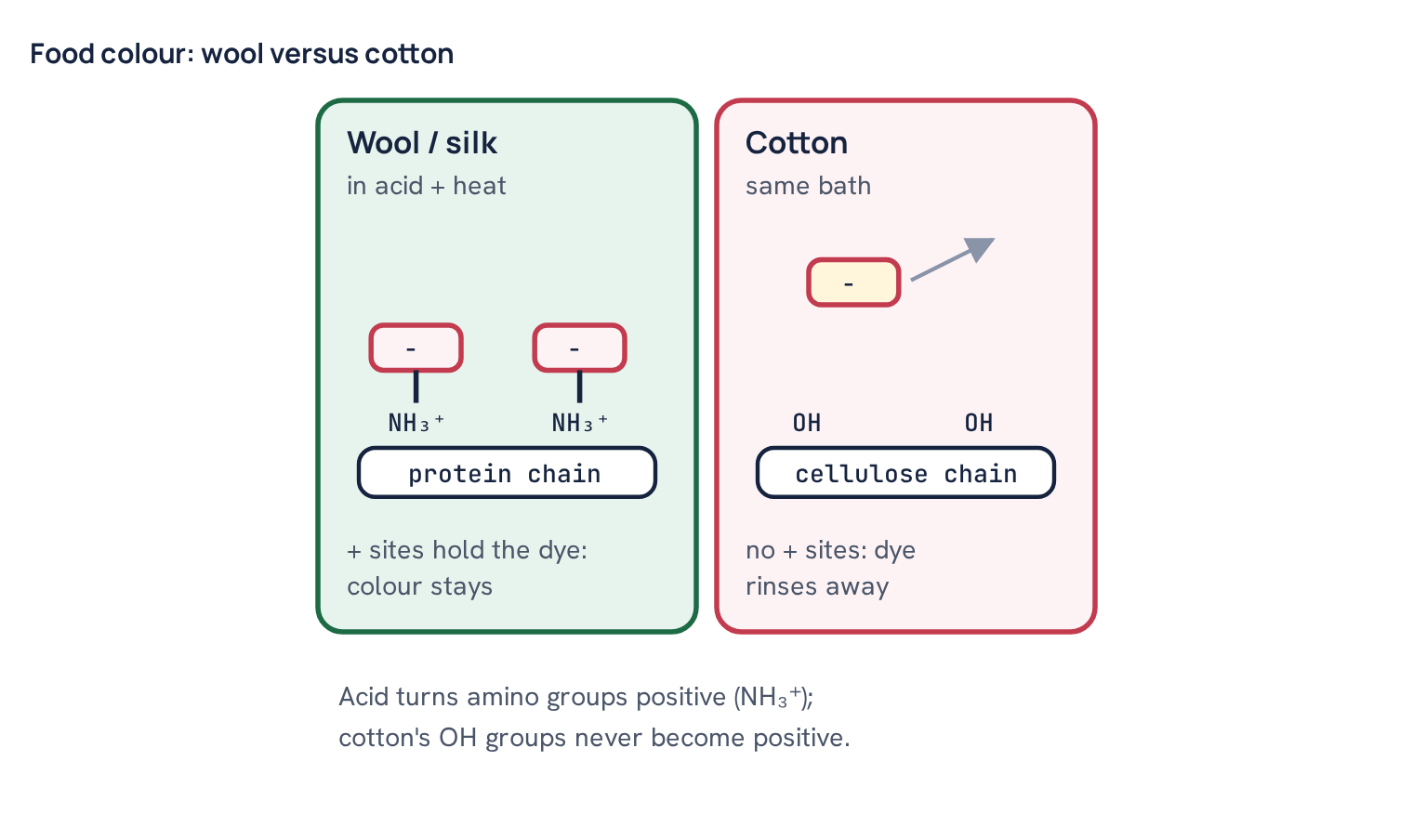
Cotton is the problem. Cellulose has hydroxyl (OH) groups, but these do not become positive in vinegar. There is nothing for the negative food colour to grip, so a food-coloured cotton T-shirt looks tinted while wet and loses most of its colour in the first few washes.
Even on wool, food colours are not textile dyes. They were chosen to be safe to eat and look bright in food, not to resist detergent, sweat or sunlight. Expect fair results at best: often acceptable for craft yarn, felt or a costume piece, but weak for a garment that goes through the washing machine every week. Natural food colourings such as turmeric and beetroot are weaker still and fade fast in light.
Which dye works on which fabric
The table below gives a general guide. The fibre content on the care label matters more than what the fabric looks or feels like. For the industrial version of this question, see our guide to dye classes and which dye suits which fibre.
| Fibre | Hot-water direct / all-purpose | Cold-water (reactive type) | Natural dye + mordant | Food colour (acid + heat) |
|---|---|---|---|---|
| Cotton, linen | Good | Very good | Fair (needs tannin + alum) | Poor, washes out |
| Viscose, modal | Good (handle gently when wet) | Good | Fair | Poor |
| Wool | Good with all-purpose (acid part) | Limited, not the usual choice | Very good | Fair; avoid felting |
| Silk | Good with all-purpose | Possible, varies by kit | Very good | Fair |
| Nylon | Good with all-purpose | Poor | Light shades only | Fair |
| Polyester | Poor, stays pale | Poor | Poor | Poor |
| Acrylic | Poor to light tint | Poor | Poor | Poor |
| Polyester-cotton | Paler, heathered look | Paler, heathered look | Very pale | Poor |
| Cotton with Lycra (elastane) | Cotton dyes; elastane stays light | Cotton dyes; avoid high heat | Fair on cotton part | Poor |
Polyester is the fibre that most often disappoints home dyers. It needs disperse dyes, which work at high temperature in industry (around 130 °C under pressure) or with special carriers. A kitchen bucket cannot give those conditions, and the general dyes above do not suit the fibre. Specialist synthetic-fibre home dyes do exist. Even with them, expect lighter shades than on cotton. Sewing thread is often polyester too, so a dyed cotton garment can end up with pale stitching.
What fastness to expect
“Fastness” means how well the colour resists washing, light, rubbing and sweat. In the lab it is rated on grey scales after standard tests. The chart below is not test data. It is an illustrative comparison of what home dyers can broadly expect from each option when it is used correctly.
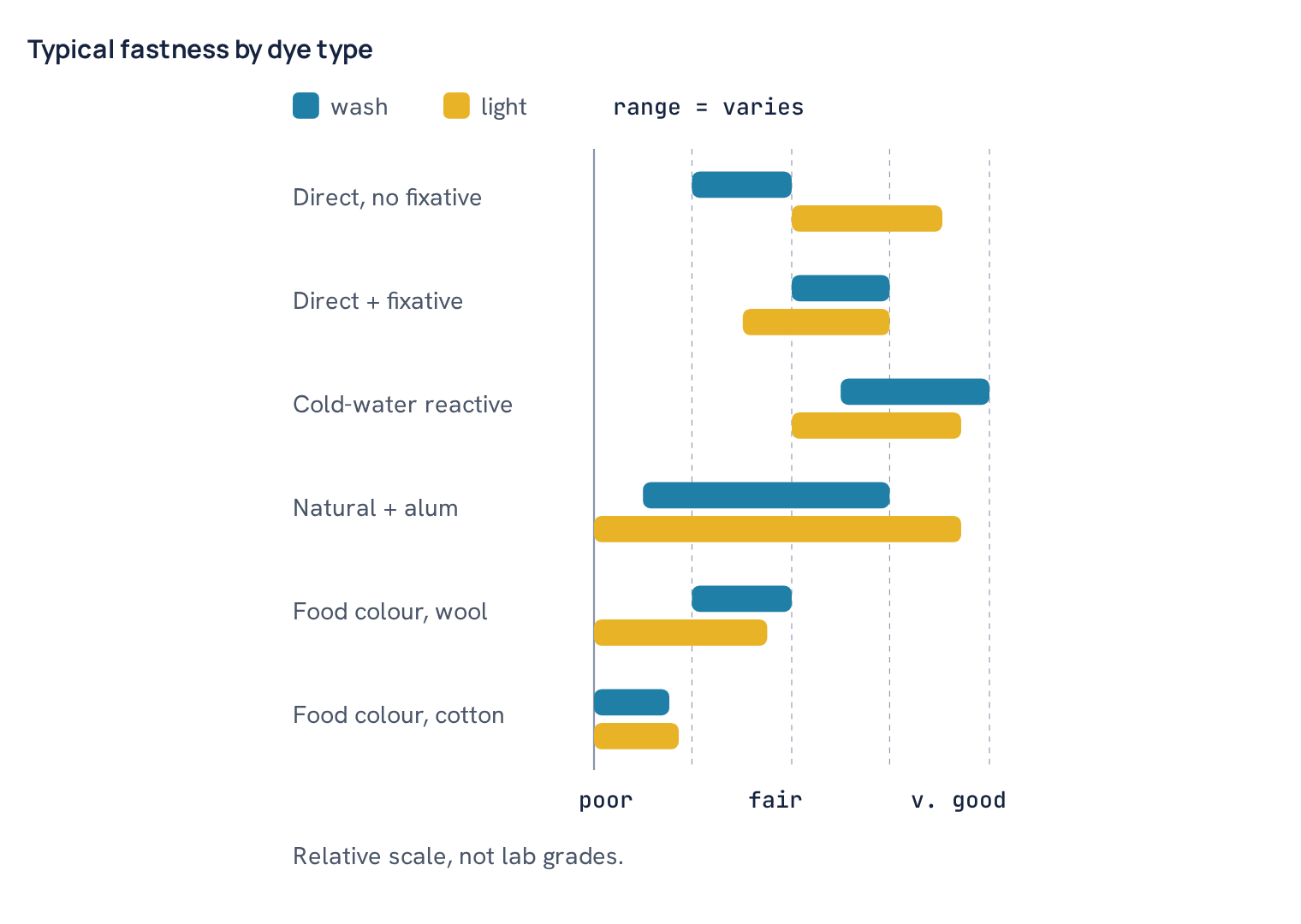
Cold-water reactive dye on cotton gives the best wash fastness, because of its chemical bond. Fixing clearly lifts a direct dye. Natural dyes have the widest range, depending on plant and mordant. Food colours sit at the bottom.
Dark shades also bleed more than pale ones, whatever the dye. Wash any newly dyed garment on its own or with dark colours for the first few washes. If you want to check a result properly, our guide on how to test colour fastness to washing explains a simple method.
How to read a home dye packet
Packet wording varies, but the useful information is usually there if you know where to look.
- Fibre list. This is the most important line. If your fabric is not listed, assume it will not dye well. “Not suitable for polyester, acrylic or fabrics with special finishes” is common and should be taken seriously.
- Hot or cold. This hints at the dye class. Hot usually means direct or a direct and acid blend. Cold usually means a reactive type for cotton.
- Weight of fabric per pack. The weight is for dry fabric. Using one pack for a heavier load gives a paler shade, because the dye is spread over more fibre.
- Extra sachets. Check what each one is for: salt (helps uptake), soda ash or “fixer” (starts a reactive dye), or a cationic fixative (an after-treatment for direct dyes). The instructions will say when each one goes in.
- Shade on the box. The photo shows the colour on white cotton. Your result depends on the starting colour (dye is transparent, so blue over yellow gives green) and on the fibre mix.
- Safety information. Look for advice on avoiding breathing in powder, wearing gloves and keeping dye equipment away from food. These apply to all three dye families.
- Aftercare. Most packets suggest washing separately at first and may recommend a lower wash temperature. That advice reflects the fastness the dye can actually deliver.
Worked example. A packet says “for cotton, linen, viscose; hot water; not for wool or polyester; includes fixative”. From this you can read that it is almost certainly a direct dye with a cationic fixative. It will suit a cotton shirt, not a wool jumper, and it will leave polyester stitching pale.
A note on safety: synthetic, natural and food
Concern about skin safety is the main reason people choose natural dyes, so it is worth being accurate here. Most synthetic textile dyes are azo dyes, and most azo dyes are used safely. A small group of azo dyes can break down into certain aromatic amines that are restricted. Regulations such as the EU REACH restrictions, along with brand restricted-substance lists, control these. Compliant synthetic dyes from reputable suppliers do not use the restricted ones.
The worry is not “synthetic versus natural”. It is whether a product is compliant and used correctly. Natural dyeing has its own hazards, especially some mordants and some plant materials. Food colours are safe to eat in permitted amounts, but that is not the same thing as being a good, fast textile dye. Our article are fabric dyes safe? Azo dyes explained covers this in detail.
Whatever you choose, the basics are the same. Avoid breathing in dye powder. Wear gloves. Keep dyeing buckets and pots separate from cooking equipment. Rinse finished garments well before wearing, so no loose dye or chemical sits against the skin.
Choosing the right home dye
Start from the fibre, not the colour. For cotton, linen or viscose, a direct dye with its fixative is the simple option. A cold-water reactive kit is the more durable one. For wool and silk, an all-purpose dye, a natural dye with alum, or food colour for a small craft project will all work, in roughly that order of wash fastness. For polyester, none of these three families will work well, and a specialist synthetic-fibre dye is the only realistic home route.
Then decide what matters most. For bright, repeatable colour, use a ready-made dye. For soft, individual shades, use natural dyes and accept that every batch will differ. For a quick, low-cost experiment on wool, food colour and vinegar are fine, but don’t expect a long-lasting garment.
Questions
What kind of dye is in most home dye packets?
Usually a direct dye for cotton, or an all-purpose blend of direct and acid dyes for several fibres. Cold-water kits for cotton are usually fibre-reactive dyes activated by an alkali such as soda ash.
Why does my dye come with a fixative?
Direct dyes are held only by weak forces and can bleed in washing. The cationic fixative joins with the anionic dye to form a larger, less soluble complex, which improves wash and water fastness, though it can slightly dull the shade.
Can I dye cotton with food colouring?
Not well. Food colours behave like weak acid dyes and need the positive sites that wool, silk and nylon develop in an acid bath. Cotton has no such sites, so most of the colour washes out within a few washes.
Do natural dyes need a mordant?
Most do. A mordant such as alum links the fibre and the dye molecule. Indigo is an exception, and tannin-rich dyes can hold reasonably without one. Cotton usually needs a tannin step before alum.
Are natural dyes safer than synthetic dyes?
Not automatically. Only a small group of azo dyes that can release restricted aromatic amines is a concern, and compliant synthetic dyes are widely used safely. Some mordants and plant materials used in natural dyeing also need care.

Textile engineer with 14+ years in dyeing and fabric development. He writes every guide on Dyeing Solution from real production work. Full profile