Most azo dyes are safe once a garment is properly dyed and washed. Here is why a small group is banned, what the bigger everyday concerns are, and how to dye and wear dyed clothes safely at home.
At a glance
-N=N-The azo group behind most synthetic dyes
About 22Amines listed under the EU REACH rule
~30 mg/kgApproximate EU limit per listed amine
Wash firstSimplest step to cut skin contact
Quick answer: Most fabric dyes sold and used today are safe on skin once the garment is properly dyed and washed. The worry about “azo dyes” is about one small group: azo dyes that can break down into certain restricted aromatic amines. Those are banned in many markets and tested for by brands. The vast majority of azo dyes are not in that group. A few other things deserve more of your attention than the word “azo”, and natural dyes are not automatically safer.
Search “are azo dyes safe” or “are fabric dyes toxic” and you will find two kinds of answer: every synthetic dye is poison, or there is nothing to worry about. Neither is right. This article explains what an azo dye is, why part of the family is restricted, the other real concerns, how industry controls them, and what you can do at home.
What is an azo dye?
An azo dye is any dye whose colour comes from the azo group: two nitrogen atoms joined by a double bond, written -N=N-. On each side of this bridge sits an aromatic ring, usually a benzene or naphthalene ring carrying other groups. The double-bonded nitrogens and the rings together form a long chain of shared electrons. That chain absorbs part of visible light, and the light that is left over is the colour you see.
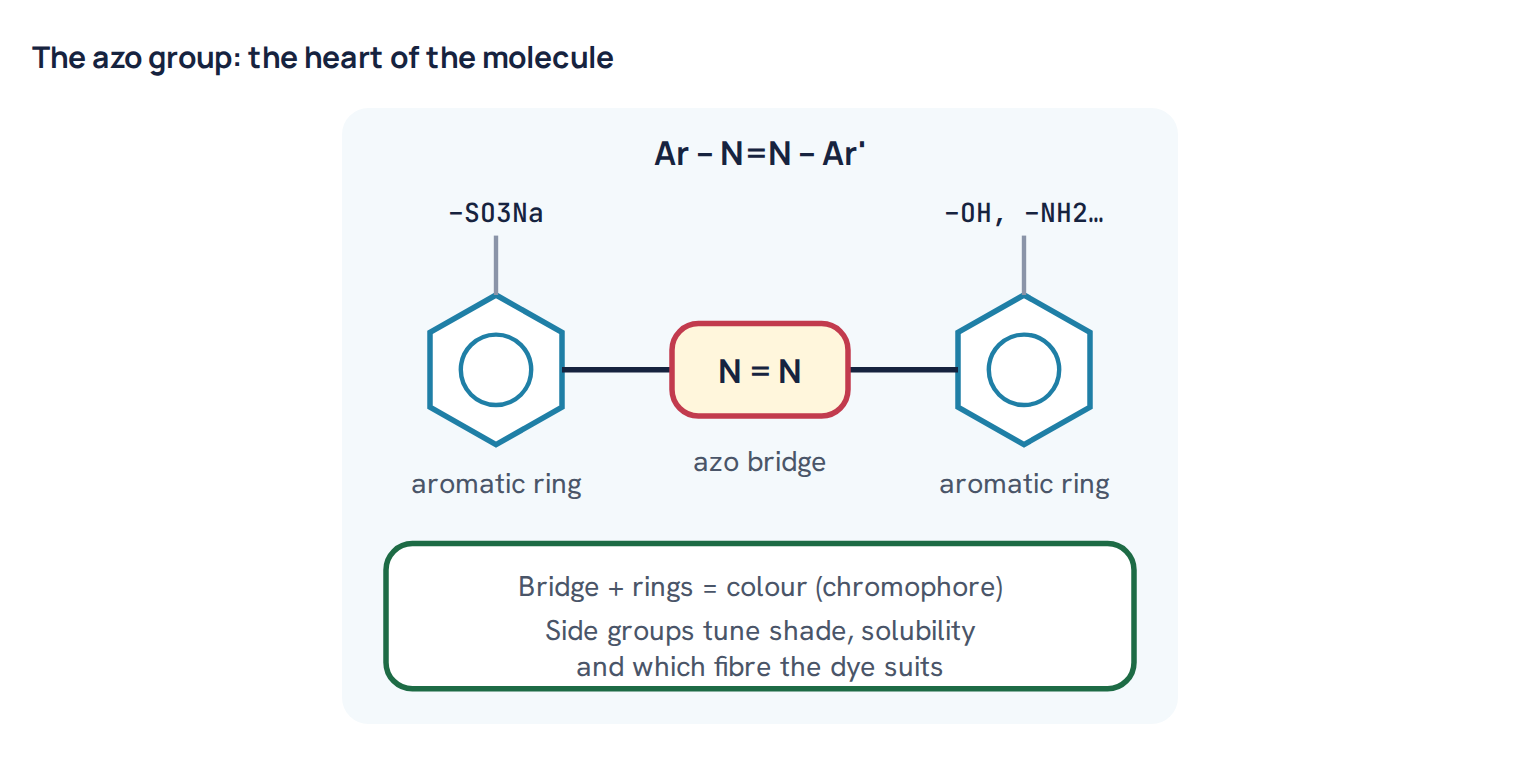
Azo dyes are the largest family of synthetic dyes. Most sources put them at well over half of all commercial dyes, though the exact share varies by source. They are cheap to make, cover almost the whole colour range, and chemists can easily change the side groups to suit different fibres.
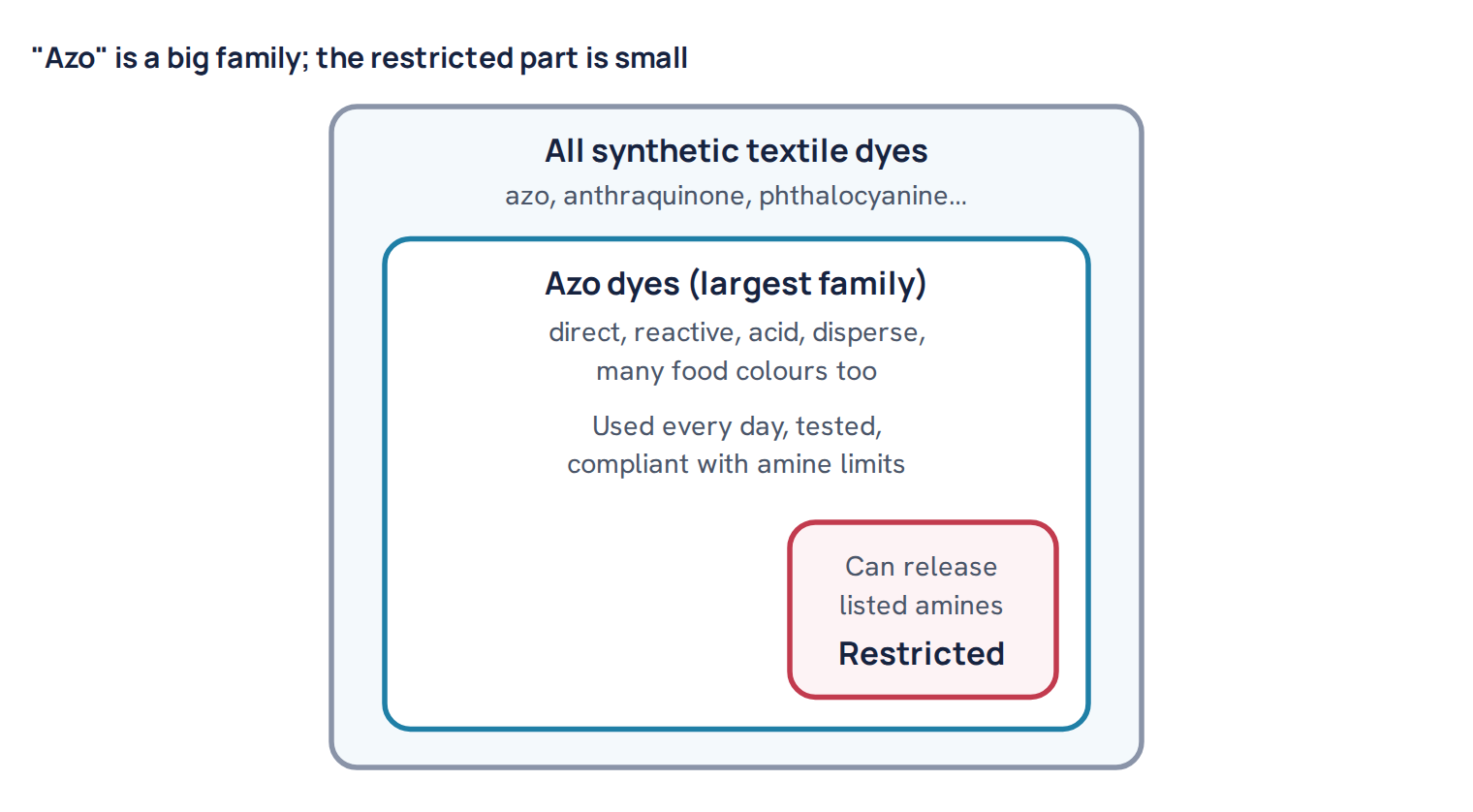
That last point matters. “Azo” describes a chemical structure, not a dye class. Many direct dyes for cotton are azo dyes. So are most reactive dyes, many acid dyes for wool and nylon, and many disperse dyes for polyester. Even many synthetic food colours are azo compounds. So when someone says “azo dyes are toxic”, they are talking about a group that includes thousands of very different molecules. You cannot judge them all by one bond. If you want the bigger picture of which dye classes go with which fibres, see dye classes: which dye for which fibre.
Why some azo dyes are restricted
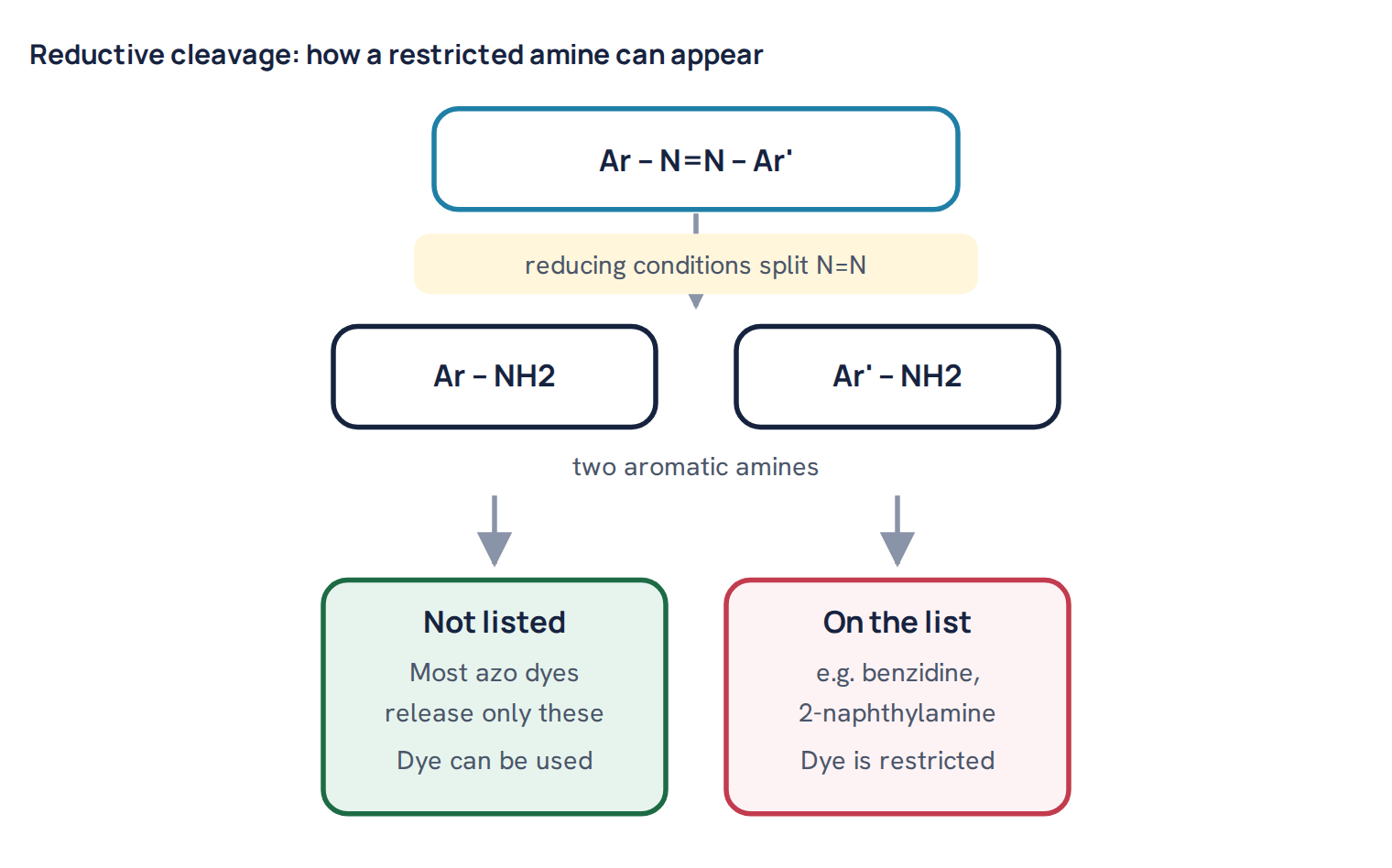
The concern is not the azo dye molecule sitting on the fibre. It is what some of these molecules can turn into. Under reducing conditions the -N=N- bond can split. Reducing conditions means chemical environments that add electrons or hydrogen. In the body, certain bacteria on the skin and in the gut, and enzymes in the liver, can do this. When the azo bond splits, each half of the molecule becomes an aromatic amine: a ring carrying an -NH2 group.
Most of the amines released this way are not a known problem. But a short list of specific aromatic amines are known or suspected to cause cancer. Benzidine is the best-known example; others on the list include 4-aminobiphenyl, 2-naphthylamine and o-toluidine. If an azo dye was built from one of these amines, splitting it can release that amine again. Those dyes are the ones that are restricted.
What the EU rule says (in short)
The best-known rule is in the European Union’s REACH regulation, Annex XVII. In plain terms, it restricts azo dyes in textile and leather articles that may come into direct and prolonged contact with the skin or mouth, if the dye can release any of about 22 listed aromatic amines above about 30 mg/kg (30 parts per million) in the finished article or its dyed parts. Clothing, bedding, towels, wigs and similar items fall under it. Products that break the limit cannot be sold in the EU. A separate entry restricts one specific blue azo colourant.
Many other countries have similar rules, and many brands apply the same list, sometimes with a few extra amines, worldwide. Rules change over time, limits are reviewed, and lists differ slightly between regions and buyers. If you are selling dyed goods, check the current regulation for your market rather than relying on any article, including this one.
Testing follows a standard method. The lab extracts or treats the fabric with a reducing agent (sodium dithionite, the same chemical dyers call sodium hydrosulphite) to deliberately break any azo bonds. It then measures the released amines by chromatography.
The vast majority of azo dyes are not in this group
This is the point most scary articles miss. Dyes that release listed amines were withdrawn from mainstream production in Europe, Japan and many other places years ago, and reputable dye makers do not offer them for textiles. The azo dyes in a normal dye house today are built from other amines that are not on the list. They are widely used, tested, and meet the restriction.
So where do restricted amines still turn up? Mainly in goods from poorly controlled supply chains: cheap dyes of unknown origin, small units that buy colour by the kilo without documents, or old stock. That is why brands test rather than trust. For a home dyer buying sealed dye from a known supplier, the risk from banned amines is low, but buying from a seller who can tell you the dye class and give a safety data sheet is still wise.
Common mistake: Reading “azo-free” on a label as “safe” and anything else as “toxic”. A garment can be azo-free and still carry allergenic disperse dye or high formaldehyde. A garment dyed with a compliant azo reactive dye can be perfectly safe. The useful label is “tested to a restricted substance list”, not “azo-free”.
Other real concerns worth knowing
If you only worry about azo dyes, you miss the issues behind most skin complaints from clothing.
Allergenic disperse dyes
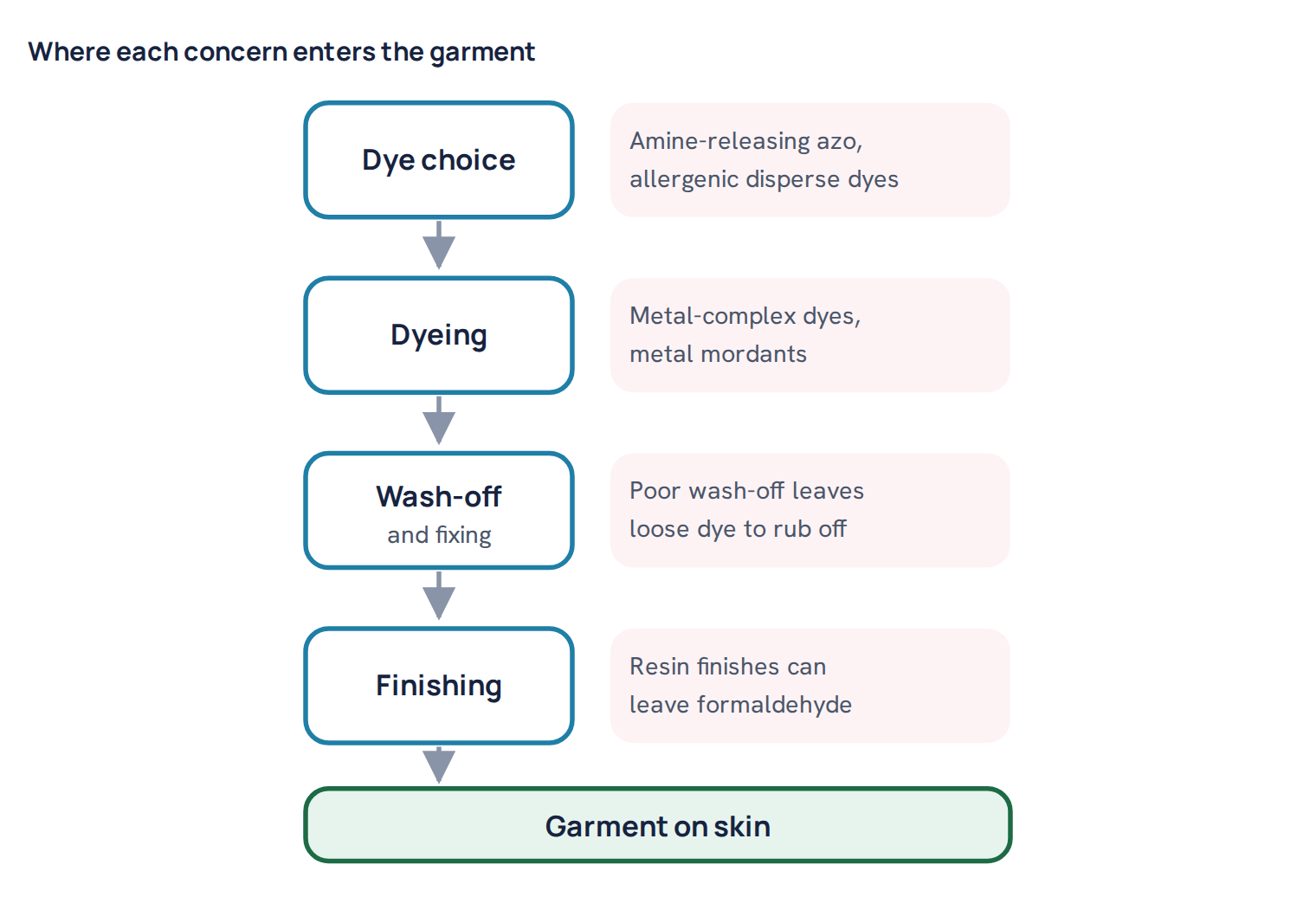
Disperse dyes colour polyester, acetate and nylon. A small number of them are well-known skin sensitisers. They can cause allergic contact dermatitis, typically an itchy rash where tight clothing rubs: waistbands, armpits, inner thighs. Dermatologists test for a handful of these dyes in patch-test series. Examples by their colour index names include Disperse Blue 106 and 124, Disperse Orange 3 and Disperse Yellow 3. Many brands’ restricted lists ban a group of such dyes. The risk is higher when fastness is poor and dye can migrate out of the fibre with sweat and heat. Some of these are azo dyes and some are not.
Residual formaldehyde from finishes
Formaldehyde does not come from the dye itself. It can come from finishing chemicals: some easy-care and anti-crease resins, and some older dye-fixing agents. Small amounts can be released from the fabric, and formaldehyde is an irritant and a known sensitiser for some people. Many regulations and buyers set limits, typically much lower for baby clothes than for adult items worn next to skin. The exact values vary by country and programme. Washing removes much of the free formaldehyde, which is one reason “wash before wearing” is good advice.
Heavy metals
Some metals enter textiles through dyeing. In industry, certain metal-complex dyes contain chromium, cobalt or copper bound tightly inside the molecule; restricted lists set limits on the extractable amount, the part that could leave the fabric in sweat. Chrome mordanting of wool, using dichromate, has largely been phased out because of worker and environmental concerns. In natural dyeing, mordants such as copper sulphate, iron (ferrous sulphate), and especially tin and chrome salts need care. Alum (potassium aluminium sulphate) is the mildest common mordant, but it should still be handled sensibly. More on this in natural dyes and mordants basics.
Loose dye rubbing off
The most common “dye problem” people notice is simply poor fastness: colour on the skin, on a white shirt, or in the wash water. This is usually unfixed or hydrolysed dye that was not washed off properly. It is mostly a nuisance, but loose dye is also the dye most free to reach skin. Good wash-off and fixing solves most of it. See why knit fabric stains in wash and perspiration tests and how to test colour fastness to washing.
How the industry controls it
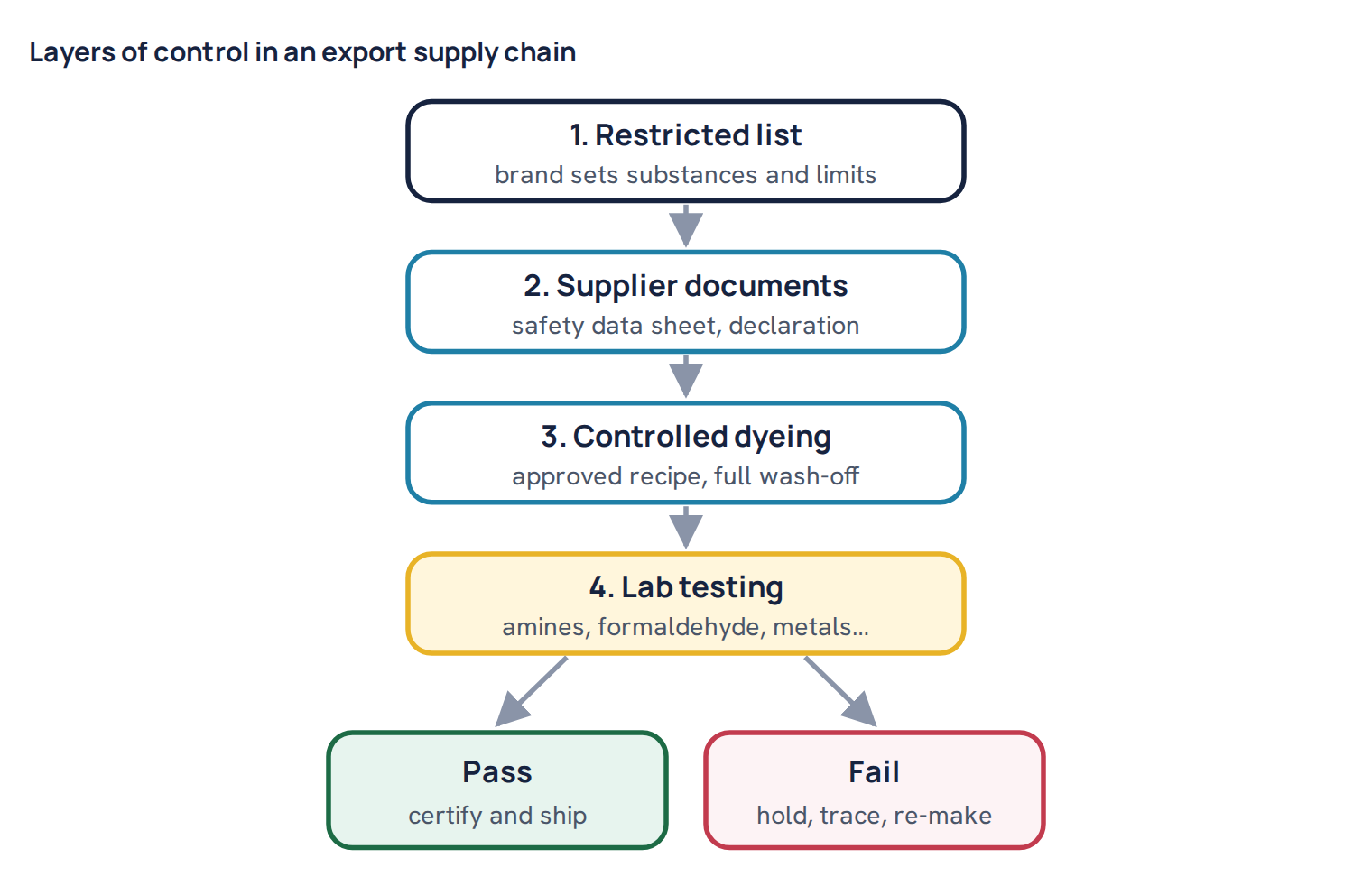
A modern export dye house does not rely on luck. Control works in layers, and each layer catches what the one before might miss.
- Restricted substance lists (RSLs). Each brand or buying group publishes a list of chemicals that must not be present above set limits in finished products. It covers listed amines, allergenic disperse dyes, formaldehyde, extractable heavy metals, and many other substances such as certain phthalates, chlorophenols and flame retardants.
- Chemical inventory and supplier documents. The dye house keeps a list of every dye and auxiliary in use, with safety data sheets and compliance declarations from the supplier.
- Laboratory testing. Brands send samples, often by risk level, to accredited labs for amine, formaldehyde, metal and other tests. A failed test means the lot is held or rejected.
- Product and factory certifications. Independent schemes test finished textiles against a list of harmful substances, or audit a factory’s chemical management. A label from such a scheme tells you the product was tested to that scheme’s limits; it does not tell you every product without a label is unsafe.
Controls are weaker in some supply chains than others, but for clothing from established brands sold in regulated markets, the chance of finding a banned amine dye is low, and when it happens it is usually caught and recalled. The everyday risks are more often comfort and allergy issues than poisoning.
Natural dyes are not automatically safer
Many home dyers now choose natural dyes because they worry that synthetic dyes are bad for the skin. That is an understandable choice, and natural dyeing is a rewarding craft. But “natural” describes where a dye comes from, not how safe it is. A few points to keep in mind:
- Mordants carry most of the risk. Most natural dyes need a metal salt to bind to the fibre. Alum is the gentlest. Iron is fairly mild in small amounts but can weaken fibres. Copper salts are toxic to aquatic life and harmful if swallowed. Tin and chrome salts are the most hazardous and are best avoided at home.
- Some dye plants are themselves toxic or irritant. Plants are chemistry too. Some dye plants are poisonous if eaten, some sap irritates skin, and some plant compounds have shown worrying results in laboratory tests. Treat plant material and extracts with the same care as any chemical: do not use cooking pots, and keep them away from children and pets.
- Fastness is often inconsistent. Natural colours can fade in light, bleed in washing, or change shade with soap and sweat. Poor fastness means more loose colour on the skin. For most natural dyes that is harmless, but it is not “safer” in itself.
- Natural dyes have no restricted list of their own. They are not tested batch by batch the way an export synthetic dye is, so quality and purity vary widely between suppliers.
- Natural dyes are the most popular choice today, because people worry that some synthetic dyes are harmful to skin.
- People also use food colours, or ready-made colours bought from the market or online, such as direct dyes that colour the garment directly, with a fixative sold alongside to fix the colour afterwards.
What about food colours?
Food colours feel like the safest option of all, and as a skin contact risk they usually are, because they are approved for eating. An interesting fact: many synthetic food colours are themselves azo dyes. They are simply azo dyes that do not release listed amines and have been assessed for food use. That alone shows why “azo” is not a useful warning word.
The trouble with food colours is performance, not safety. Most are small acid-type dyes. With vinegar and heat they can colour protein fibres such as wool and silk reasonably well, but they have little attraction to cotton. On cotton they mostly wash out, and on any fibre their light fastness is often poor. They are fine for fun projects and children’s crafts, but not designed for textiles. For a fuller comparison of home options, see home dyes explained: direct, natural and food colour.
Ready-made home dye packs are usually direct dyes for cotton, sold with a fixative. The fixative is a cationic agent that holds the dye more firmly so less colour bleeds. That improves wash fastness and reduces loose dye on the skin. You can read how it works in what is a dye fixative.
Practical safety at home
The person most exposed to dye is the dyer, not the wearer. Dye powder in the air and concentrated dye solution on the hands are far greater exposures than a finished, washed garment. These simple habits cover most of the risk.
While you dye
- Wear gloves. Dye solutions stain skin and some contain alkali, salt or mordant that irritate. Rubber or nitrile gloves are enough.
- Avoid breathing powder. Fine dye powder is the main inhalation risk, and some reactive dyes are known respiratory sensitisers in powder form. Open packets gently, mix powder into a paste with a little water first, and wear a simple dust mask when weighing.
- Ventilate. Heating a dyebath, especially with vinegar or mordants, releases steam and vapour. Work near an open window or with a fan.
- Keep tools separate. Use a bucket, pot and spoon kept only for dyeing. Never use them for food again. Keep dyes and mordants labelled and out of reach of children.
Before and after wearing
- Rinse until clear. After dyeing and fixing, rinse until the water carries little colour. This is the single most effective step for reducing loose dye on skin. Do not scrub hard or over-wash before fixing; follow the dye’s instructions.
- Wash new clothes before wearing. This applies to shop-bought clothes too. A wash removes loose dye, finishing residues and much of any free formaldehyde.
- Patch-test if you have sensitive skin. Wear a new dyed item for a short time, or keep a small piece against the inner arm, and watch for redness or itching. If you know you react to certain dyes, a dermatologist can patch-test you and tell you which to avoid.
Worked example. A buyer gets an itchy rash under the arms from a new dark navy polyester top. The likely suspects, in order: a sensitising disperse dye migrating with sweat, a finish residue, then the fibre itself. Washing the top twice, wearing a cotton layer underneath, or switching to a cotton top usually settles it. A banned azo amine is very unlikely to be the cause of a rash; those amines are restricted for long-term health reasons, not because they cause instant itching.
The balanced picture
Are fabric dyes toxic? A few historical dyes were, and some still enter poorly controlled supply chains, which is why the rules and testing exist. Are azo dyes safe? Most are, because “azo” is a bond shared by thousands of dyes, and only a small group can release the listed amines. The more common, everyday issues are allergic reactions to a few disperse dyes, finish residues, and loose dye from poor washing. Natural and food colours have their own trade-offs. If you buy dye from a supplier who can tell you what it is, handle powder with care, and wash dyed clothes before wearing them, you have covered the real risks. To start choosing a home method, go to the home dyeing section.
Questions
Are azo dyes safe?
Most are. Only a small group of azo dyes can break down into certain listed aromatic amines, and those are restricted in the EU and many other markets and banned on brand restricted lists. Compliant azo dyes are used safely every day.
Are fabric dyes toxic to skin?
Properly dyed and washed garments from regulated supply chains are low risk. The more common skin problems come from a few allergenic disperse dyes, finish residues such as formaldehyde, and loose dye from poor washing.
Does ‘azo-free’ mean a garment is safe?
Not on its own. An azo-free garment can still contain allergenic dyes or finish residues. A label showing the product was tested against a restricted substance list is more meaningful.
Are natural dyes safer than synthetic dyes?
Not automatically. Mordants such as copper, tin and chrome salts need care, some dye plants are toxic or irritant, and natural colours often have weaker fastness. Natural dyes used with alum and good washing are a reasonable low-risk choice.
Should I wash new dyed clothes before wearing them?
Yes. One wash removes much of the loose dye and finishing residue, including free formaldehyde. If you have sensitive skin, wear-test a small area first.

Textile engineer with 14+ years in dyeing and fabric development. He writes every guide on Dyeing Solution from real production work. Full profile