Why direct dyes bleed, how a cationic fixative locks them in, what it improves and what it does not, and how to fix fabric dye and check the result at home.
At a glance
CationicCharge of a direct-dye fixative
Wet fastnessMain property a fixer improves
May dropLight fastness after fixing
No fixerNeeded for well-washed reactive dyes
Quick answer: a dye fixative for home dyeing is usually a cationic dye-fixing agent. It carries positive charges, the direct dye carries negative charges, and the two join into a bigger, less soluble complex that stays in the fibre instead of washing out. It improves wash and water fastness well, but it does little for rubbing, it can lower light fastness, and it can make the shade slightly duller.
If you have ever dyed a T-shirt in a bucket and watched the colour run in the first wash, this article is for you. We will look at why some dyes bleed, what the fixative actually does at the molecular level, why the order of steps matters, and which popular tips (salt, vinegar) help and which do not. The explanation stays simple, but it follows the same chemistry a dye-house engineer uses every day.
Why direct dyes bleed in the first place
Most ready-made colours sold for home dyeing of cotton are direct dyes. They are called “direct” because they colour cellulose fibres (cotton, viscose, linen) directly from a water bath, with only salt and heat to help. No mordant and no chemical reaction are needed. That is exactly why they are easy for home use. You can read more about the dye itself in how direct dyes work on cotton.
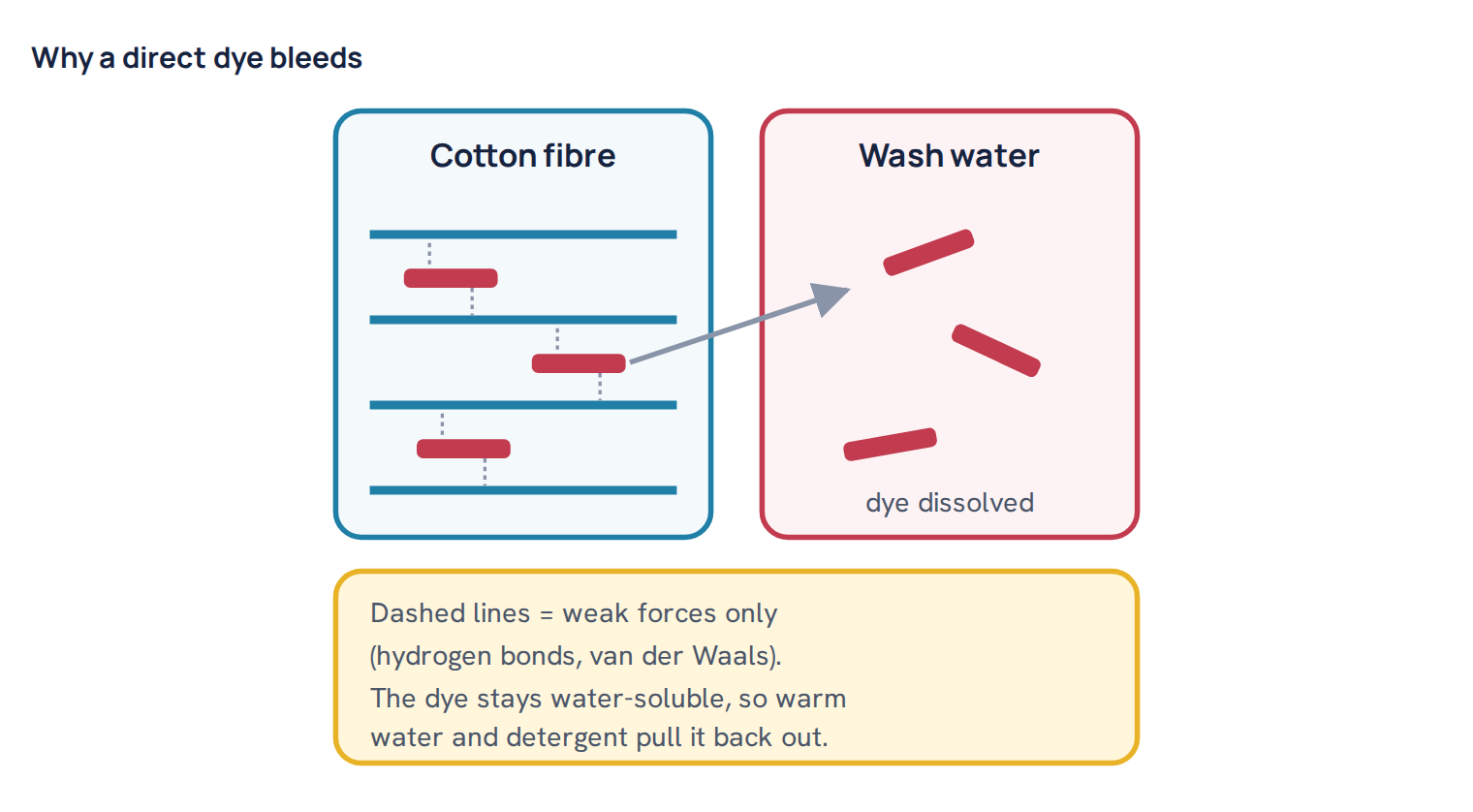
The easy route has a price. A direct dye molecule is long, flat and carries sulphonate groups (–SO₃⁻ in chemistry notation, usually sold as the sodium salt). Those sulphonate groups make the dye dissolve in water. Inside the fibre, the dye lines up along the cellulose chains and is held there only by weak physical forces: hydrogen bonds and van der Waals attraction. There is no strong chemical bond between dye and fibre.
So the dye is still water-soluble when it sits in your garment. Put the garment in warm water with detergent and some of the dye simply moves back out, the same way it moved in. That is bleeding. The warmer the water, the stronger the detergent and the longer the wash, the more dye comes out. Dark shades bleed most, because there is more dye in the fibre and more of it sits loosely near the surface.
Bleeding causes three different problems, and it helps to name them separately. First, the garment itself fades a little in each wash. Second, the loose dye stains other clothes in the same machine, which is the bigger complaint from most people. Third, a damp garment can mark skin, a car seat or a white sofa. A fixative is aimed mainly at the first two.
What a dye fixative actually is
“Fixative” is a loose shop word. In dyeing chemistry the product sold with direct dyes is a cationic dye-fixing agent, sometimes just called a cationic fixer. “Cationic” means it carries positive electrical charges when dissolved in water. Most modern fixers are water-soluble polymers built around nitrogen groups, such as quaternary ammonium polymers or polyamine condensates. Older types were condensates of dicyandiamide with formaldehyde. Many current products are sold as formaldehyde-free, which matters for skin contact and for buyer restricted-substance lists.
The fixer is not a dye and has no colour of its own. It is an after-treatment: it only works on dye that is already in the fibre. It also does not change the dye into a different dye class. A direct dye treated with a fixer is still a direct dye, just one that is harder to wash out.
How a cationic fixing agent works
The idea is simple: opposite charges attract. The direct dye in the fibre has negative sulphonate groups. The fixer molecule has many positive groups along a long chain. When the dyed garment goes into the fixer solution, the fixer moves into the fibre and its positive sites pair up with the negative sites on the dye.
Three things then happen together:
- The molecule gets bigger. One fixer chain can hold several dye molecules. The new dye–fixer complex is much larger than a single dye molecule, so it moves through the fibre pores far more slowly.
- The charges cancel. The sulphonate groups were the reason the dye dissolved. Once they are paired with the fixer’s positive groups, the complex has much less “pull” towards water. Its solubility drops sharply.
- Extra grip on the fibre. The fixer itself also has some attraction to cellulose, so the complex is held in more places than the dye alone.
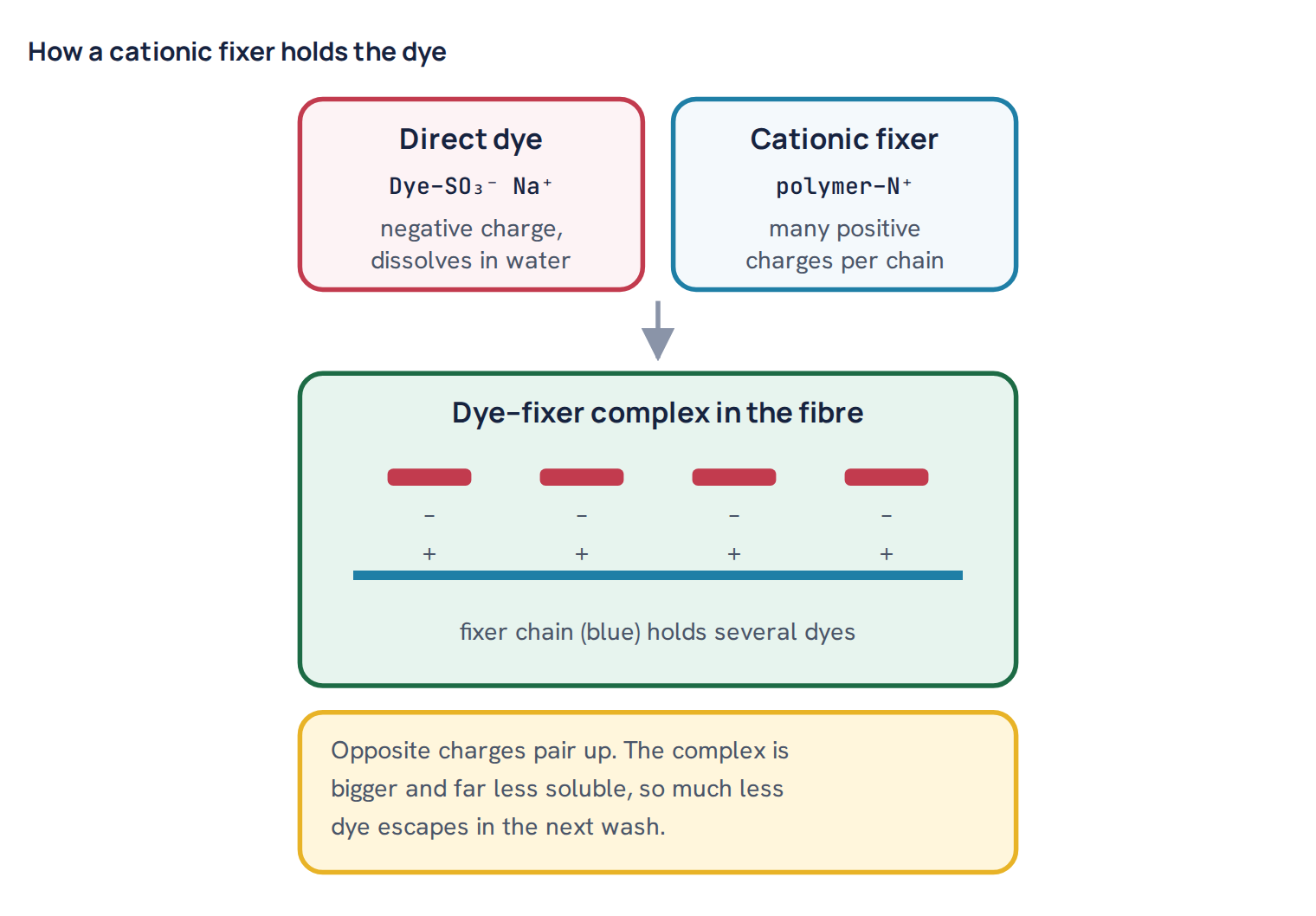
Notice that this is still not a true chemical bond to the fibre. It is a salt-type (ionic) attraction between dye and fixer, plus physical trapping. That is why fixed direct dyes are much better than unfixed ones, but they are still not as wash-fast as reactive dyes. Very hot washing, strong detergents and many wash cycles can slowly break the complex apart again.
What a fixative improves, and what it does not
People often expect a fixative to make a home-dyed garment behave like a factory-made one in every way. It will not. It is a targeted treatment with clear strengths and clear side effects.
What gets better
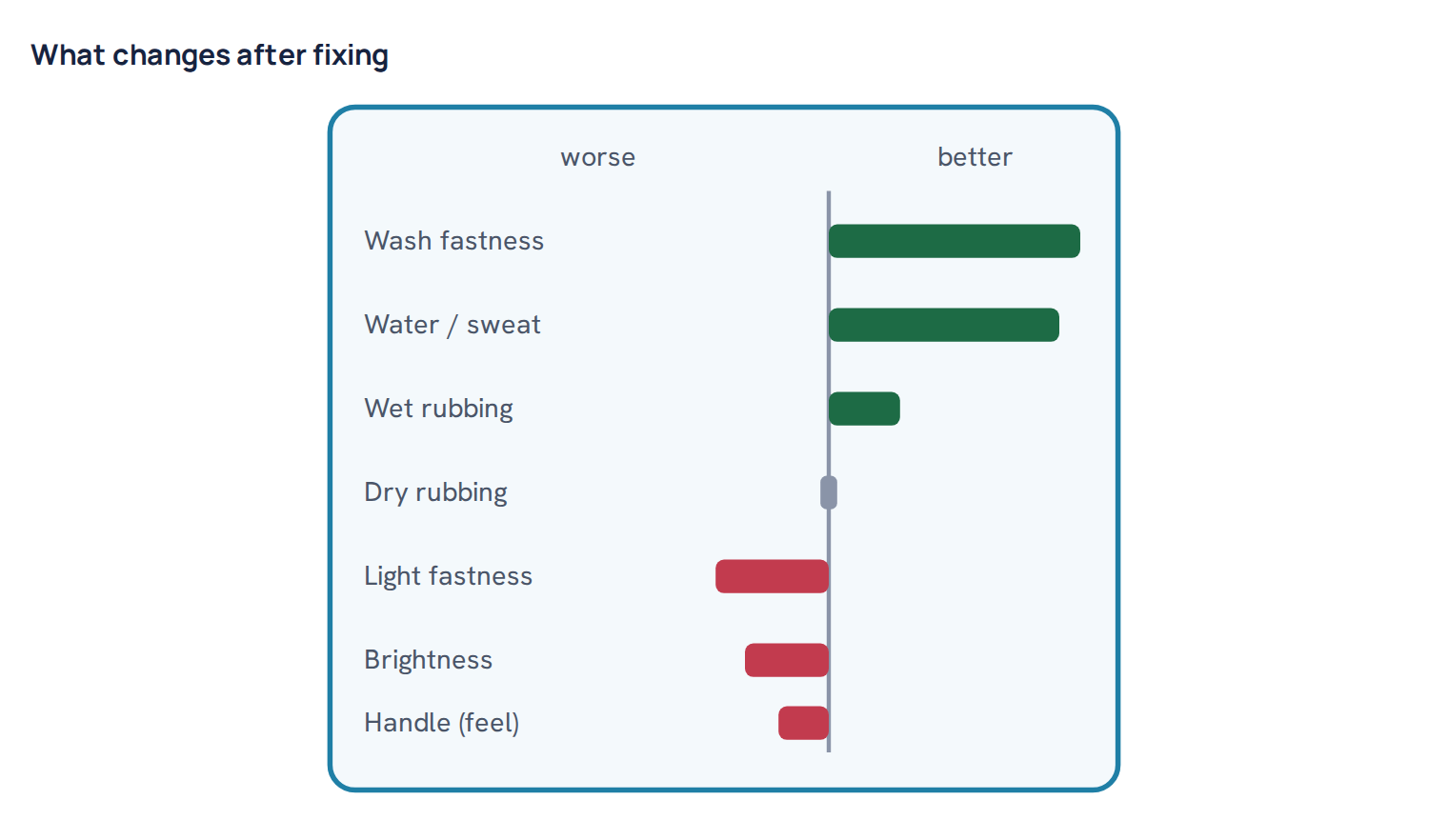
- Wash fastness. This is the main reason to use a fixer. Less colour is lost from the garment, and much less stains the other clothes in the wash.
- Water and perspiration fastness. A garment left damp, or worn in hot weather, bleeds less onto skin and nearby fabric.
What does not get much better
- Rubbing fastness. Colour that rubs off is mostly loose dye or dye-fixer deposits sitting on the surface of the fibre. The fixer cannot pull surface dye inside. Wet rubbing may improve slightly; dry rubbing usually stays about the same. Using too much fixer can even make rubbing worse, because the extra complex forms a coloured film on the surface.
What can get worse
- Light fastness. Many cationic fixers lower the light fastness of direct dyes. The amount varies a lot by dye and product: with some dyes the change is hard to see, with others a garment dried in strong sun fades noticeably faster.
- Shade. The colour often turns slightly duller, and sometimes a little darker or shifted in tone. Bright turquoise and bright pinks show this most. If you match a sample, match it after fixing, not before.
- Handle. A heavy dose can leave the fabric slightly harsh. This is mostly a factory issue, but it can be felt on home-dyed fine knits.
| Property | Effect of cationic fixer | Why |
|---|---|---|
| Wash fastness | Clear improvement | Bigger, less soluble complex |
| Water / sweat fastness | Clear improvement | Same reason |
| Wet rubbing | Small improvement at best | Surface dye is not moved inside |
| Dry rubbing | Little or no change | Depends on surface dye |
| Light fastness | May drop | Fixer affects how dye handles light |
| Shade | Slightly duller, can shift | Dye–fixer interaction changes colour |
Why you wash lightly before the second fixative dip
The order of steps matters more than most home instructions explain. Look at what is in and on the garment when it comes out of the dye bath. There is dye properly inside the fibre. There is also dye just sitting on the surface, and dye dissolved in the water held in the fabric. A wet garment can carry a lot of that loose dye.
If you put this garment straight into a fixer solution, the fixer meets the loose dye first. It reacts with it in the water and on the surface, forming coloured lumps and a film. You use up fixer on dye that was going to be lost anyway, the bath turns cloudy, and the garment ends up with a surface layer that rubs off easily. That is why a light wash comes before the main fixative dip: remove the loose dye, so the fixer can work on the dye that is really in the fibre.
“Light” is the important word. Wash too hard, or with very hot water and strong detergent, and you start stripping dye that is properly inside the fibre. You lose depth and make the shade paler and patchy. The goal is to rinse until the water runs only lightly coloured, not to wash until it runs clear.
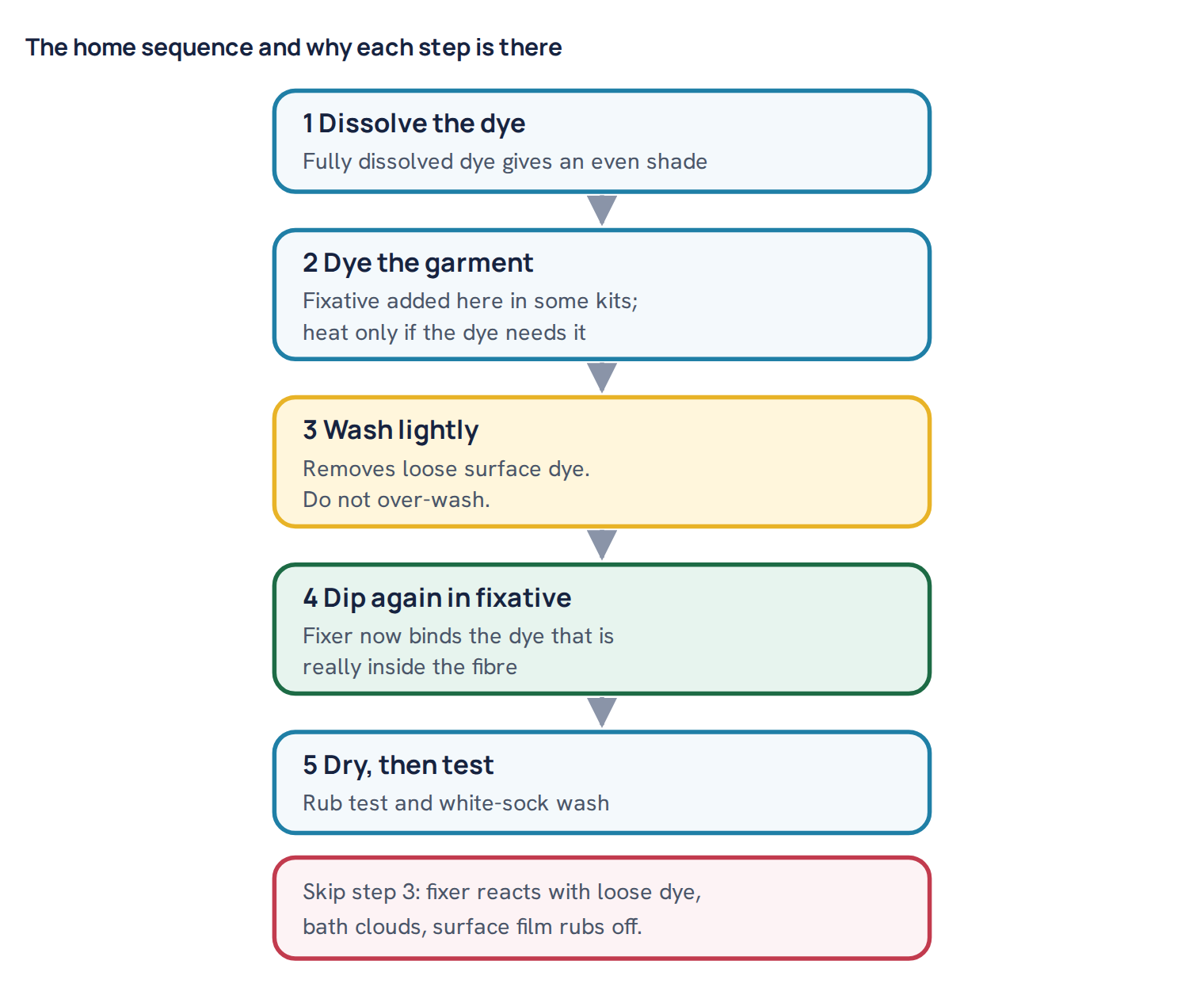
- At home, people usually use ready-made colours bought from the market or online, for example direct dyes, which colour the garment directly. A fixative is sold with them, and you fix the colour with it afterwards.
- The home process: take a bucket and water, dissolve the dye, put the garment in, add the fixative. Sometimes heat is needed and sometimes not; it depends on the dye.
- Then wash lightly (do not over-wash) and dip it again in fixative solution.
Some home kits tell you to add fixative into the dye bath near the end, as in step 2. That can help a little, but the dip after the light wash is where the fixer does its most useful work, for the reason shown above. If you want the wider picture of home dyeing methods, start at our home dyeing section.
Temperature and pH: what they do
We will not give a recipe here, but it helps to know why the label on a fixer asks for certain conditions.
Temperature. Warm water helps the fixer move into the fibre and meet the dye, so most fixers are applied warm rather than cold. But heat also loosens direct dye. If the fixer bath is very hot, dye can come out of the fibre before the fixer catches it, and you lose depth. So fixing is normally done at a moderate, warm temperature, much lower than the dyeing temperature. The exact range varies by product, so follow its label.
pH. Cationic fixers generally work best in neutral to slightly acidic water. In strongly alkaline water many of them lose part of their positive charge, so they hold the dye less well. This is one reason a rinse to remove residual soda or detergent before fixing is helpful. Very acidic water is not needed and can affect some dyes. Again, the ideal value depends on the product.
Time and amount. More is not better. A fixer bath needs enough time for the chemical to reach the dye, but once the dye sites are paired, extra fixer only sits on the surface, dulls the colour and can harm rubbing and handle.
Common mistake: washing a freshly fixed garment in very hot water with strong detergent “to test it”. Hot alkaline washing can break the dye–fixer complex. Use a mild detergent and warm, not hot, water for direct-dyed garments, even after fixing.
Salt and vinegar: two common myths
Ask around about “setting” fabric colour and you will hear salt and vinegar again and again. Both have a real role in dyeing, but not the role people think.
Salt helps uptake, not fixation
Cotton picks up a slight negative surface charge in water. Direct dyes are also negative, so the two push each other away a little. Salt (common salt or Glauber’s salt) shields these charges, so the dye can come close to the fibre and go in. That is why direct dyeing recipes use salt: it improves exhaustion, meaning more dye leaves the bath and enters the fibre. Once dyeing is over, salt does nothing to hold the dye. Soaking a finished garment in salt water does not fix the colour. Adding all the salt at the start can even cause uneven dyeing, because the dye rushes onto the fabric too quickly.
Vinegar helps acid dyes on protein, not direct dyes on cotton
Vinegar is a weak acid. Acid dyes used on wool, silk and nylon need acid in the bath: the acid gives the fibre positive amino groups, and the negative acid dye is then held by ionic attraction. So for wool and silk, vinegar is part of the real chemistry. Cotton has no such amino groups. A vinegar rinse on a direct-dyed cotton T-shirt does not create any new bond, and it does not stop bleeding in a useful way. At most it neutralises leftover alkali. For which dye suits which fibre, see dye classes: which dye for which fibre.
Worked example. A home dyer colours a cotton hoodie with a direct dye, then soaks it in salt and vinegar “to lock the colour”. The first wash still bleeds heavily. Nothing went wrong with the dye; the salt only helped the dye go in during dyeing, and the vinegar has no partner on cotton. What the hoodie needed was a light wash to remove loose dye, then the cationic fixative sold with the dye.
Fixatives and reactive dyes
Reactive dyes are the main dye class for cotton knits in industry and are also sold for home use. They work in a completely different way. Under alkaline conditions, usually with soda ash, the reactive group on the dye forms a covalent bond with the cellulose. That is a true chemical bond, far stronger than the weak forces holding a direct dye.
Not all the reactive dye bonds to the fibre. Some reacts with water instead (hydrolysed dye) and can no longer bond. This loose dye is what causes bleeding on a poorly washed reactive-dyed garment. The cure is thorough washing off, often called soaping: rinse, wash hot with a suitable detergent, rinse again. Once the loose dye is gone, the bonded dye stays, and no fixative is needed. More on this in how reactive dyes work.
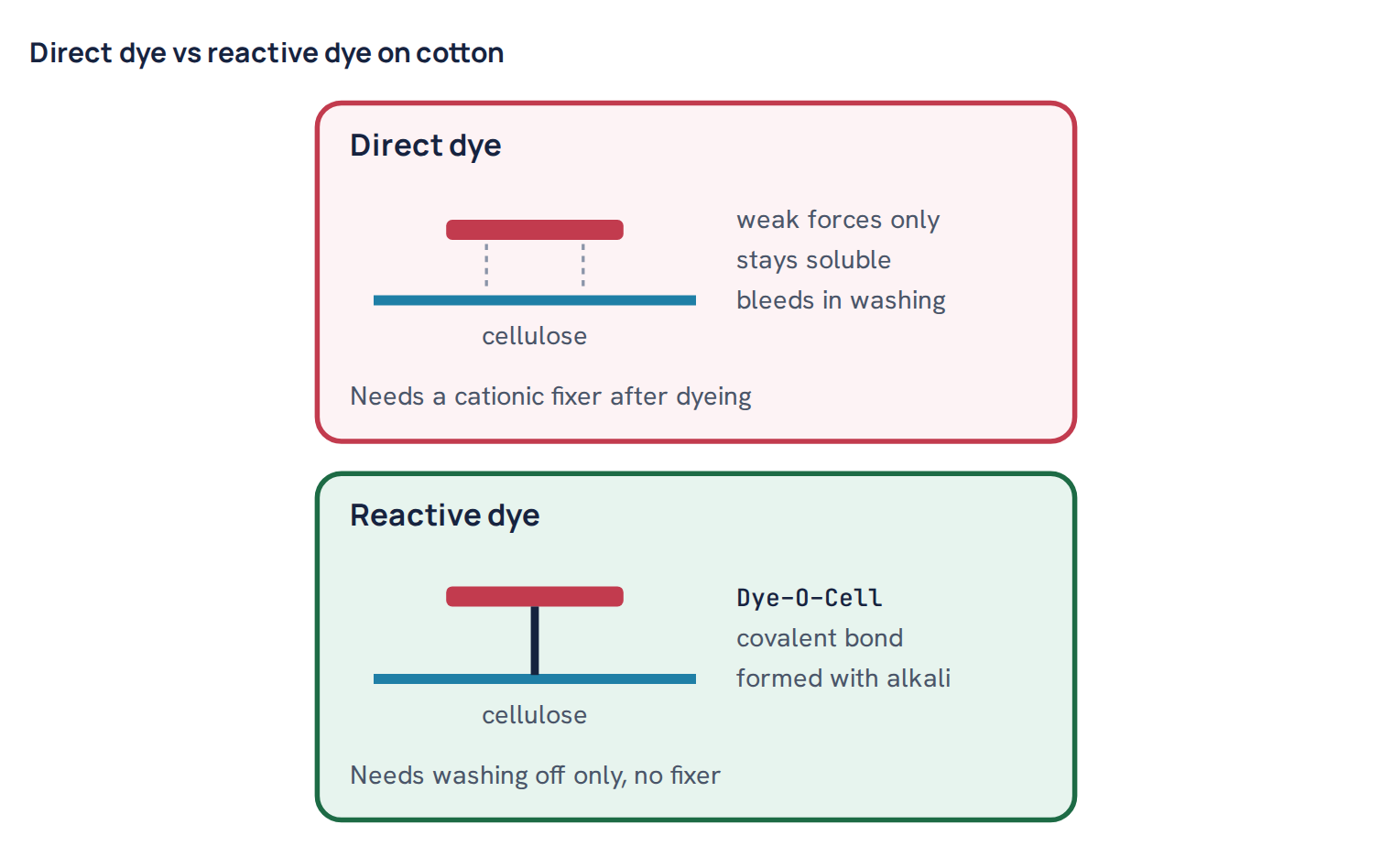
To be complete: some mills do apply a cationic fixer to very dark reactive shades, such as navy or black, as extra protection against staining. It is not standard practice, and it carries the same side effects described above, including a possible drop in light fastness. For home dyers using reactive dyes, careful washing off is the real fix. If a reactive-dyed garment still bleeds, the answer is more washing off, not a bottle of fixer.
Natural dyes are another story again. They usually rely on mordants, metal salts or tannins that link dye and fibre, rather than on a cationic fixer. And food colours are not textile dyes at all: they are designed to dissolve, so they wash out quickly whatever you do. For a comparison of the options, read home dyes explained: direct, natural and food colour.
How to test the result at home
You do not need a lab to see whether the fixing worked. These simple checks copy the idea of the standard fastness tests used in industry.
- Rub test. Use a clean white cotton cloth, slightly damp, and rub firmly on a flat area of the garment. A little colour on the cloth is normal for dark shades. Heavy colour means loose surface dye: the light wash before fixing was not enough, or too much fixer formed a surface film. A dry rub test is also useful for dark shades.
- White sock wash. Wash the garment alone with one white sock, using a mild detergent and warm water. If the sock comes out clearly tinted, the garment will stain other laundry. Wash it separately for the first few washes, or repeat the light wash and fixer dip.
- Soak test. Leave a corner or an offcut in a glass of warm water together with a small white scrap. Look at the water and the scrap after a while. This shows how the garment will behave when left damp in a bag or a washing machine.
Do the tests on a dry garment, at least a day after fixing, so you test the final state. For a more structured method and how professionals grade the results, see how to test colour fastness to washing.
Safety and good sense with fixatives
A cationic fixer is a chemical, even if it comes in a small sachet with a home dye. Wear gloves, avoid splashing eyes, and keep it away from children and food containers. Follow the product label for amounts and temperature. Older formaldehyde-based fixers are less common now; if a product does not state that it is formaldehyde-free, treat it with more care and rinse the garment well before wearing. For more on what is and is not a concern with textile dyes, read are fabric dyes safe?.
Finally, remember what the fixer is for. It turns a direct dye that bleeds badly into one that bleeds much less. It cannot turn it into a reactive dye, and it cannot fix colour that was never inside the fibre. Dissolve the dye well, wash lightly to remove the loose dye, fix with care, and test before you trust the garment with your white laundry.
Questions
What does a dye fixative do?
A cationic dye fixative pairs its positive charges with the negative charges of a direct dye. The bigger, less soluble complex stays in the fibre, so the garment bleeds and stains much less in washing.
How do I fix fabric dye so it does not bleed?
Dye the garment, wash it lightly to remove loose dye, then treat it in the fixative made for that dye, following the label. Do not over-wash before fixing, and wash the garment in warm, not hot, water afterwards.
Does vinegar or salt fix fabric dye?
Not on cotton dyed with direct dyes. Salt helps dye go into the fibre during dyeing, and vinegar is needed for acid dyes on wool, silk and nylon, but neither fixes a direct dye.
Do reactive dyes need a fixative?
Normally no. Reactive dyes form a covalent bond with cotton; any bleeding comes from unreacted dye, which is removed by thorough washing off.
Why did my colour look duller after fixing?
Cationic fixers often dull the shade slightly and can lower light fastness. Using more fixer than needed makes this worse and can also leave a surface film that rubs off.

Textile engineer with 14+ years in dyeing and fabric development. He writes every guide on Dyeing Solution from real production work. Full profile