Sublimation on nylon is possible but usually disappointing: nylon holds disperse dye weakly, so colours are dull and fade, and it is heat sensitive at sublimation temperatures. Why, when it can work, coated blanks, settings to test, and better ways to print on nylon.
At a glance
Weakdye hold
Heatsensitive
Coatedblanks work
Acid dyesin industry
Sublimation on nylon is possible but usually disappointing, and it is not recommended for most nylon garments. Sublimation ink is disperse dye, and nylon does take disperse dye, but the dye is held weakly, so colours tend to be duller and wash fastness is poor compared with polyester. Nylon is also heat sensitive: at normal sublimation temperatures around 200°C it can shine, scorch, shrink or even melt. Some products are sold as “sublimation nylon” because they have a polyester coating or face that takes the dye. For uncoated nylon, DTF, heat transfer vinyl or screen printing usually work better.
This guide explains why nylon behaves differently from polyester in sublimation, what results to expect, when sublimation on nylon can work, settings to test if you try it, coated nylon blanks, the better alternatives for nylon jackets, bags and swimwear, and how nylon is coloured properly in the dye house. It is written from the dyeing side, where we dye nylon with acid dyes and polyester with disperse dyes.
Why sublimation is made for polyester
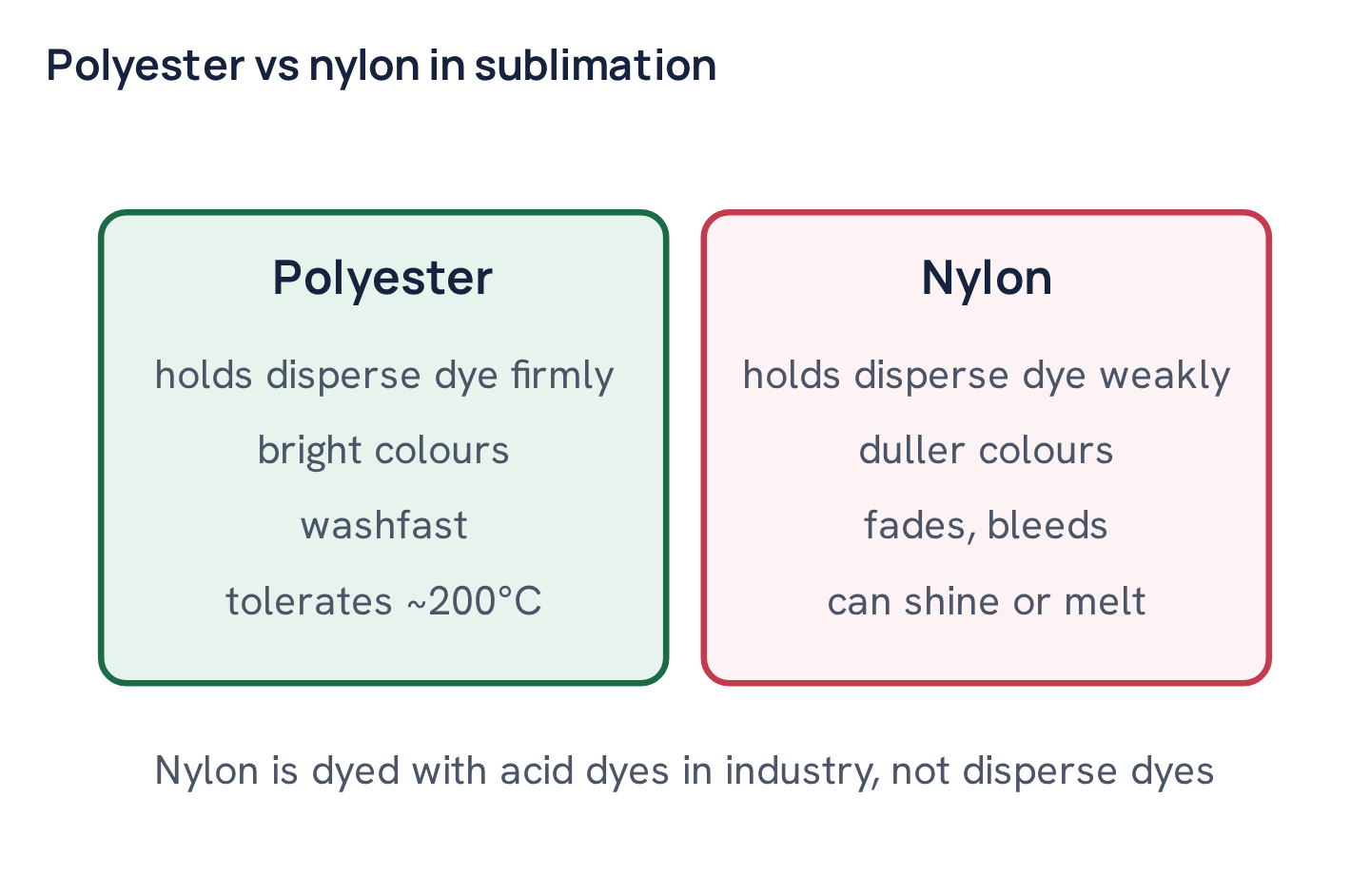
In sublimation, disperse dye printed on paper turns to gas on a hot press and enters the polyester fibre, which softens and opens at around 200°C. When the fibre cools, the dye is trapped inside. Polyester has a strong affinity for disperse dye and holds it firmly, so prints are bright and washfast. See how disperse dyes work on polyester.
Why nylon behaves differently
- Weaker hold on disperse dye: nylon absorbs disperse dye but releases it more easily, so prints fade and bleed in washing and can stain other items.
- Duller colours: nylon often gives less brilliant shades with disperse dye than polyester.
- Heat sensitivity: nylon softens and can glaze, scorch, shrink or melt near sublimation temperatures, especially thin nylon fabrics.
- Coatings and finishes: nylon jackets and bags often have water-repellent finishes or PU coatings that block dye or melt under the press.
In industrial dyeing, nylon is coloured with acid dyes, which bond ionically to amine groups in the fibre, not with disperse dyes, for exactly these reasons. See how acid dyes work on nylon.
When sublimation on nylon can work
- Coated “sublimation nylon” blanks: items such as some bags, lanyards, luggage tags or straps are made with a polyester coating or polyester face specifically to take sublimation. These work well because the dye goes into the coating.
- Nylon-polyester blends: the polyester part takes the dye properly; the nylon part gives weaker colour. Results depend on the share of polyester.
- Decorative items rarely washed: on uncoated nylon, a sublimation print may be acceptable on items such as banners that are not washed often, if the heat can be managed.
Settings to test if you try it
There is no standard setting for uncoated nylon, and results vary a lot with the fabric. If you experiment, start much lower and shorter than for polyester, for example around 160–180°C for a short time, use light pressure, a protective sheet, and a heat-resistant pad, and check for shine and shrinkage. Wash-test the result before selling anything. For coated sublimation blanks, follow the blank supplier’s settings exactly.
Common mistake: pressing a nylon windbreaker at 200°C for 60 seconds like a polyester T-shirt. The shell can glaze, shrink or melt, the water-repellent coating can be damaged, and the print may still wash out. Check the fibre content and coating before pressing anything.
Better ways to print on nylon
| Method | Suits | Notes |
|---|---|---|
| Heat transfer vinyl (nylon-rated) | Jackets, bags, sportswear | Use HTV made for nylon; low temperature; may need a catalyst-free nylon grade |
| DTF | Jackets, bags, mixed fabrics | Low-temperature settings; test adhesion on coated nylon |
| Screen printing with nylon inks | Bags, jackets, umbrellas | Inks with additives for adhesion to nylon |
| Embroidery or patches | Jackets, caps, bags | No heat risk to the fabric |
| Pad printing | Small logos on nylon items | Industrial method |
Nylon swimwear and activewear
Much swimwear and activewear is nylon-spandex. Uncoated nylon-spandex does not sublimate well, and the spandex is weakened by sublimation heat. Printed swimwear is usually made from polyester-spandex, which sublimates beautifully and holds up better in chlorine, or the nylon fabric is printed and dyed at the mill with acid dyes. If you want to sublimate swimwear or leggings yourself, choose white polyester-spandex blanks. See the nylon-elastane dyeing process.
How nylon is coloured in the dye house
For full-colour nylon fabric, mills use acid dyes. The fabric is heat set (for nylon-elastane, at about 180°C), scoured, then dyed while the pH is slowly lowered and the temperature raised towards about 98°C, so the dye goes on evenly. Afterwards a fixing agent can improve wash fastness. Printed nylon fabrics use acid-dye printing inks followed by steaming to fix them. This is why commercially printed nylon swimwear is bright and fast, while home sublimation on nylon struggles. See the 100% nylon knit dyeing process.
How to tell if a blank is nylon or polyester
- Read the fibre content label: “polyamide” means nylon.
- Check the product description for “sublimation-ready” or “polyester coated”.
- Do a test press on a hidden area or offcut at a low temperature.
- If a test print washes out heavily after one wash, the fibre is not holding the dye.
Worked example. A small business wants logos on nylon drawstring bags and on polyester sports shirts. Sublimation on the polyester shirts gives bright, permanent prints. A test sublimation on uncoated nylon bags looks dull and fades after two washes, and the bag fabric shines where pressed. Switching to nylon-rated heat transfer vinyl at a low temperature gives clean, durable logos on the bags.
What happens to nylon under a hot press
Nylon starts to soften well before it melts, and the effect is visible quickly on a heat press. The first sign is usually a shiny, glazed patch where the platen touched the fabric, often with the outline of the press or the transfer paper. Further heat can shrink the fabric locally, making puckers, and thin nylon taffeta or ripstop can stiffen or develop a melted, crunchy texture. Water-repellent finishes and polyurethane coatings on the back of jacket fabrics can also soften and stick to the lower pad. Elastane in nylon-spandex blends loses some recovery when it is overheated, so the area under a print can feel slack after washing.
Wash fastness of sublimation prints on nylon
Even when a sublimation print on nylon looks acceptable after pressing, wash fastness is the main weakness. Because the disperse dye is not held strongly inside the nylon fibre, some of it moves out into the wash water, especially in warm washes. The print fades over several washes, and the released dye can stain white areas of the same garment or other items in the load. Polyester holds the same dye much more firmly. If you need durable colour on nylon, choose a method that sits on the surface with an adhesive or binder, such as DTF or heat transfer vinyl, or buy fabric dyed and printed at the mill with acid dyes. See polyester-nylon dyeing process.
Quick test before you commit
- Cut a small piece from an offcut, seam allowance or spare item.
- Press a test print at the lowest workable temperature for a short time.
- Check for shine, puckering or stiffness.
- Wash the sample at 40°C with a small white cotton cloth.
- Compare the print and the white cloth before and after. If the print fades or the cloth is stained, sublimation is not suitable for that fabric.
Choosing blanks for mixed orders
If an order mixes nylon and polyester items, split it by method. Use sublimation for the polyester or polyester-coated items, and a surface method such as nylon-rated vinyl or DTF for the nylon items. Keep a short test record of the settings that worked for each blank, so repeat orders come out the same.
Summary
- Sublimation ink is disperse dye; nylon takes it, but holds it weakly.
- Sublimation on uncoated nylon gives duller colours and poor wash fastness.
- Nylon is heat sensitive and can shine, shrink or melt at sublimation temperatures.
- Coated “sublimation nylon” blanks and polyester-rich blends work.
- For nylon garments and bags, use nylon-rated HTV, DTF, screen printing or embroidery.
Questions
Can you sublimate on nylon?
Possible but not recommended on uncoated nylon. Nylon holds sublimation dye weakly, so prints are duller and fade, and the fabric can shine or melt under heat.
Why does sublimation not work well on nylon?
Sublimation ink is disperse dye, which polyester holds firmly but nylon holds weakly. Nylon is also heat sensitive at sublimation temperatures.
What is sublimation nylon?
Nylon items with a polyester coating or face made to take sublimation dye, such as some bags, lanyards and straps.
What temperature for sublimation on nylon?
There is no standard. If testing uncoated nylon, start much lower than for polyester, around 160 to 180°C for a short time, and wash-test. Follow supplier settings for coated blanks.
What is the best way to print on nylon?
Nylon-rated heat transfer vinyl, low-temperature DTF, screen printing with nylon inks, or embroidery.

Textile engineer with 14+ years in dyeing and fabric development. He writes every guide on Dyeing Solution from real production work. Full profile