Polyester barely shrinks in normal laundry because it was heat set at 180–200°C. Whether it shrinks in the dryer or hot water, how much it really shrinks (3% median in our records), how blends differ and how to shrink it.
At a glance
3%median length shrinkage
166polyester batches
180–200°Cheat-set temperature
Blendsshrink more
Polyester shrinks very little in normal washing and drying. The fibre itself is stable at the temperatures of a home washing machine and dryer, because it was heat set in the factory at around 180–200°C, far hotter than any laundry. What shrinkage you do see, usually a few percent, comes from the knit or weave relaxing, from cotton or other fibres in a blend, or from very high heat such as a hot iron left on the fabric. In our finishing records of 166 polyester knit batches, the median length shrinkage after our wash test was just 3%.
This guide explains why polyester behaves this way, whether polyester shrinks in the dryer or in hot water, how much it can shrink, how blends differ, and how to shrink polyester on purpose if you need to.
Why polyester resists shrinking
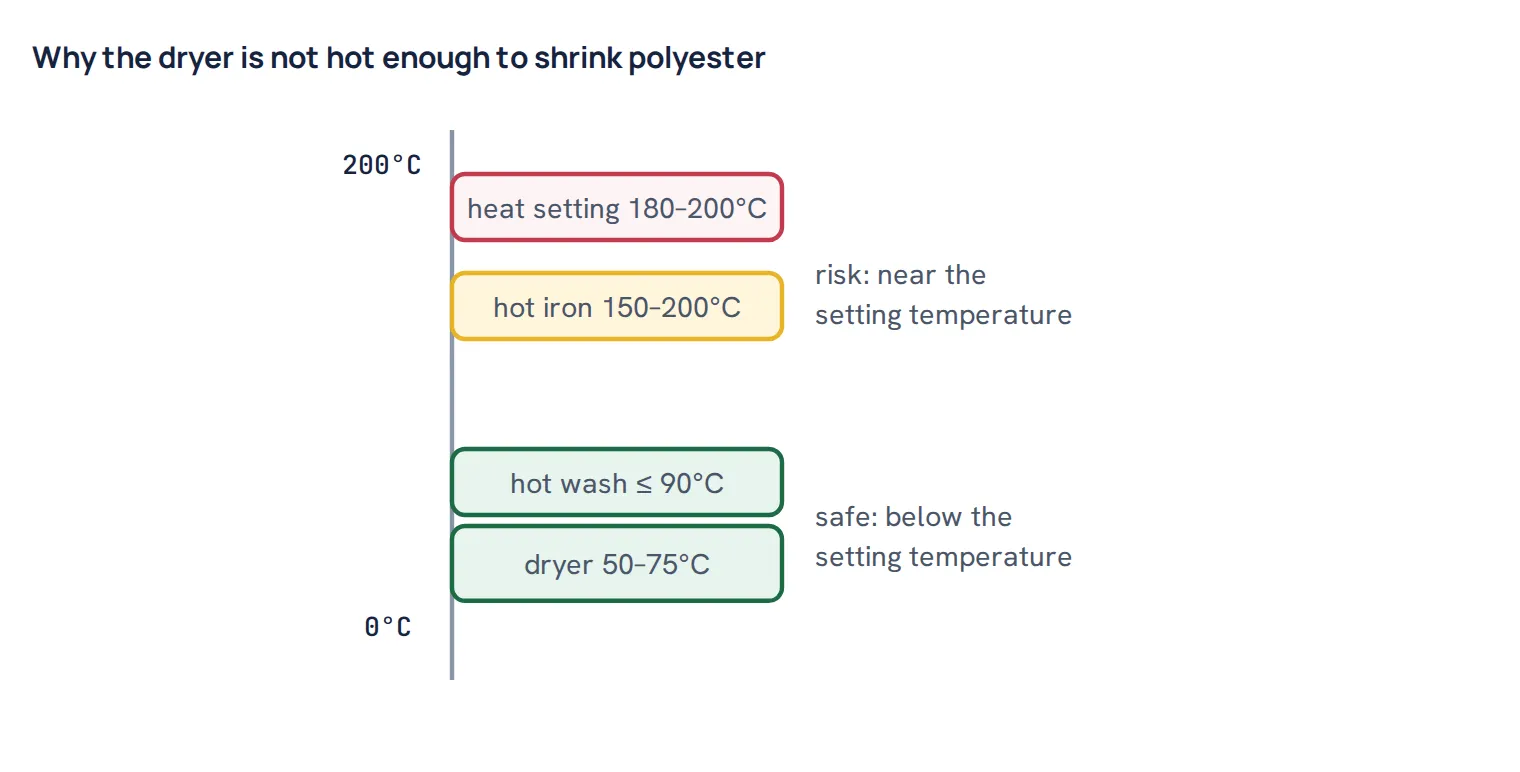
Polyester is a thermoplastic: it softens when heated and sets when cooled. During manufacture, polyester fabric is heat set on a stenter, typically at about 180–200°C, while held at its finished width and length. That locks its molecules into a relaxed, stable arrangement. As long as the fabric is not heated close to that setting temperature again, the fibre has no reason to shrink. A domestic dryer runs at roughly 50–75°C, and a hot wash at most 90°C, both well below it. See heat setting of polyester fabric for how this works.
Polyester also absorbs almost no water, so it does not swell and pull together the way cotton, rayon and linen do.
Does polyester shrink in the dryer?
Not in any meaningful way, if it is 100% polyester. A normal tumble dryer is far too cool to undo heat setting. You may see a small amount of relaxation shrinkage in the first wash and dry, especially in knits such as T-shirts and sportswear, as the loops settle after being pulled during manufacture. Our records put that at a median of 3% in length for polyester knits, with the worst tenth at about 7%.
The dryer matters more for what else is in the garment. Cotton, rayon and modal in a polyester blend shrink in a hot dryer; elastane can be weakened by high heat. So “polyester” garments that shrink in the dryer are usually blends.
Does polyester shrink in the wash or in hot water?
Very little. Hot water up to 60°C is no problem for the fibre. Very hot water, near boiling, can cause slight additional shrinkage in some fabrics and may set creases, but 100% polyester still shrinks far less than cotton under the same conditions.
How much does polyester shrink?
| Fabric (our records) | Batches | Median length shrinkage | Worst 10% |
|---|---|---|---|
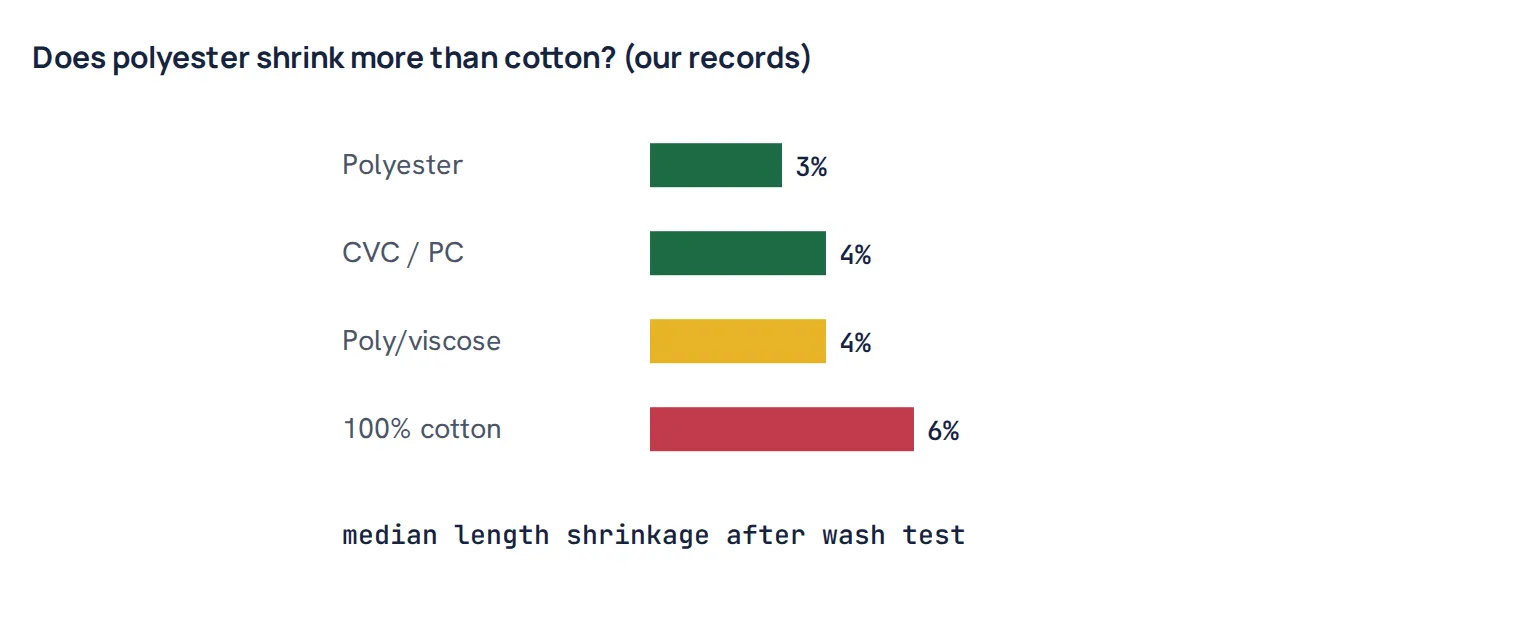
| Polyester (+ elastane) | 166 | 3% | 7% |
| Cotton/polyester (CVC, PC) | 2,514 | 4% | 7% |
| Polyester/viscose (PV) | 135 | 4% | 10% |
| 100% cotton, for comparison | 7,429 | 6% | 10% |
Figures are median length shrinkage after our dye-house wash test, from the knit GSM and shrinkage study. Width shrinkage was a median of about 2%.
Why polyester blends behave differently
Adding polyester to cotton makes a fabric more stable, which is one reason CVC and PC are popular for uniforms and team wear. In our records, cotton-polyester blends were the most predictable fabrics we finish, with 82% of parts keeping length shrinkage within 5%, against 47% for 100% cotton. But the cotton part still shrinks, so a 60/40 cotton-polyester T-shirt will shrink more than a 100% polyester one. See what CVC fabric is.
Polyester-rayon (PV) blends can shrink more than you expect, because rayon is one of the least stable fibres in water; see does rayon shrink.
Common mistake: pressing a polyester garment with a hot iron directly on the fabric. Polyester will not shrink in the wash, but a hot iron can glaze it, leave shiny marks or cause local shrinking and puckering. Use a low setting and a pressing cloth.
How to shrink polyester (and why it is hard)
Because polyester was heat set at a high temperature, it is difficult to shrink at home. The most you can usually get is a little relaxation shrinkage by washing hot and drying on the hottest dryer setting, typically a few percent at most. Blends with cotton or rayon will shrink more, because those fibres respond to heat and water. If a polyester garment truly needs to be smaller, alteration by a tailor is far more reliable than heat.
How to keep polyester from shrinking or distorting
- Wash at 30–40°C; polyester rarely needs hotter water.
- Tumble dry low or medium, and remove promptly to avoid creases.
- Iron on low with a cloth, or not at all.
- Check the label for blends: cotton, rayon or elastane content changes the care.
Worked example. A 70 cm long 100% polyester sports top shrinks a median 3% in length, about 2 cm, mostly in the first wash and dry. A 100% cotton T-shirt of the same length would shrink about 4 cm, and a rayon top about 6 cm. That is why sportswear is mostly polyester.
Summary
- Polyester barely shrinks in normal washing and drying: a median 3% in our records.
- Dryer and wash temperatures are far below the 180–200°C heat-setting temperature.
- Shrinking “polyester” garments are usually blends with cotton, rayon or elastane.
- A very hot iron is the main real risk to polyester.
For all fibres side by side, see fabric shrinkage by fibre.
Questions
Does polyester shrink?
Very little. In our records of 166 polyester knit batches the median length shrinkage after washing was 3%, about half that of 100% cotton.
Does polyester shrink in the dryer?
Not meaningfully if it is 100% polyester. A dryer runs at about 50–75°C, far below the 180–200°C at which polyester is heat set. Blends with cotton or rayon can shrink.
Does polyester shrink in hot water?
Only slightly. Hot water is well below polyester’s heat-setting temperature, so the fibre stays stable; very hot water can set creases.
Does polyester shrink more than cotton?
No. In our records polyester shrank a median 3% in length against 6% for 100% cotton.
How do you shrink polyester?
It is hard. Washing hot and drying on the hottest setting may give a few percent of relaxation shrinkage. Blends shrink more; for a real size change, use a tailor.

Textile engineer with 14+ years in dyeing and fabric development. He writes every guide on Dyeing Solution from real production work. Full profile