Fiber reactive dye forms a permanent chemical bond with cotton, linen and rayon, giving bright, washfast colour. How it works, which fibres it suits, cold-water and hot types, fiber reactive vs all-purpose dye, and safe handling.
At a glance
Bondchemical, permanent
Soda ashmakes it fix
Cellulosecotton, linen, rayon
Hourslife once mixed with soda
Fiber reactive dye is a dye that forms a permanent chemical bond with plant fibres such as cotton, linen, rayon (viscose) and hemp. Instead of just sitting in the fibre like an all-purpose dye, it reacts with the fibre and becomes part of it. That is why fiber reactive dyes give bright, deep colours that stay through repeated washing, and why they are the dyes used for most cotton T-shirts in factories and by serious home and craft dyers. The key step is alkali, usually soda ash: without it the dye will not bond.
This guide explains how fiber reactive dye works, which fibres it suits, cold-water and hot-water types, how it compares with all-purpose dye, why some colour still washes out at first, and how to handle the powder safely. It is written from the dye-house side; it does not give a home dyeing recipe.
How fiber reactive dye works
A fiber reactive dye molecule has two parts: the coloured part, and a small reactive group. Plant fibres are made of cellulose, which carries many hydroxyl (–OH) groups. In alkaline conditions, the reactive group on the dye forms a covalent bond with those hydroxyl groups. Once bonded, the dye cannot be washed out, because it is chemically joined to the fibre.
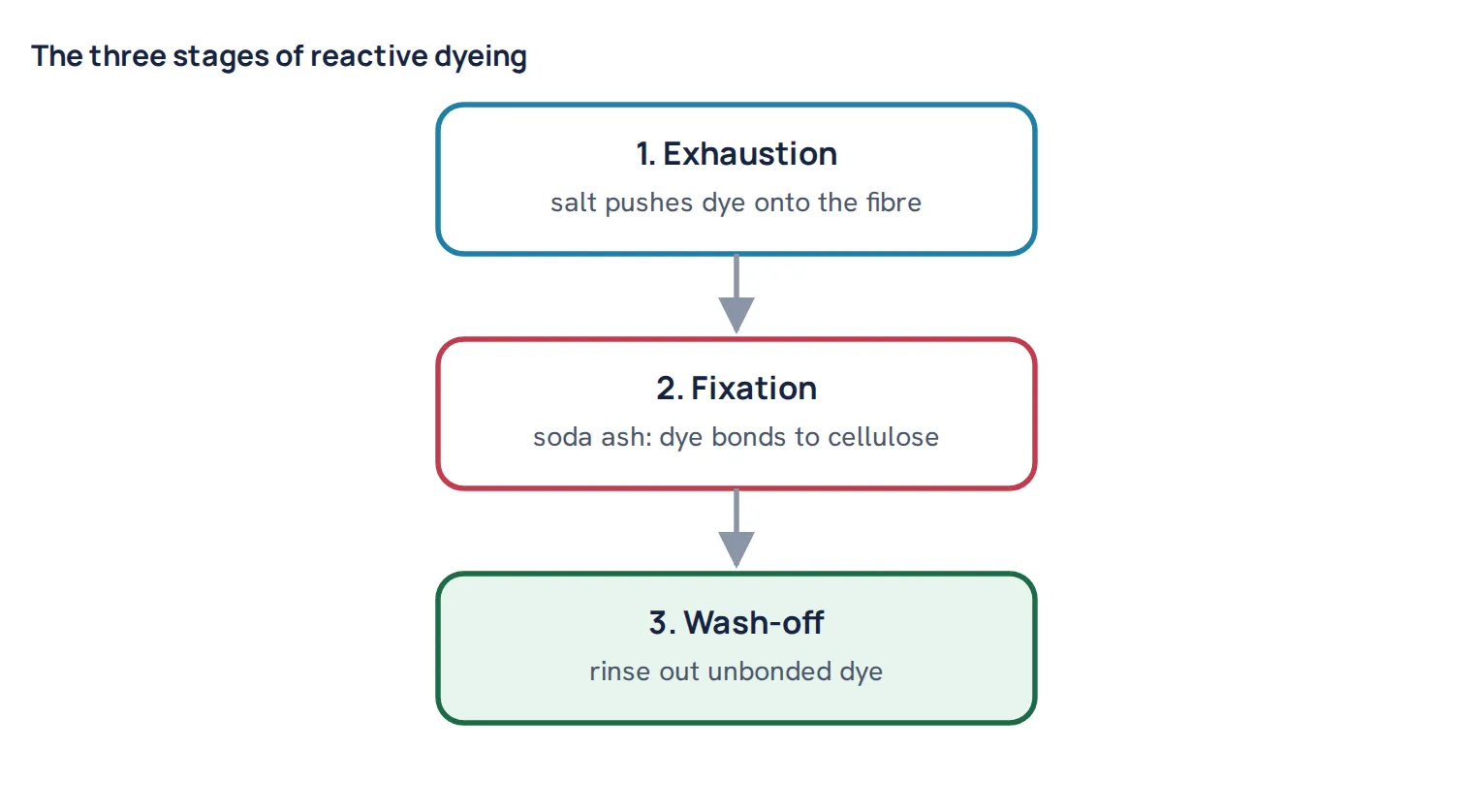
The process has three stages:
- Exhaustion: the dye moves from the water onto the fibre. Salt helps by reducing the natural repulsion between dye and fibre in water.
- Fixation: soda ash (sodium carbonate) raises the pH, and the dye reacts with the fibre.
- Wash-off: some dye reacts with water instead of the fibre (hydrolysis). This unbonded dye must be rinsed and washed out, or it will bleed later.
The chemistry in more depth is in how reactive dyes work.
What fiber reactive dye works on
| Fibre | Result |
|---|---|
| Cotton | Excellent: the standard use |
| Linen, hemp, ramie | Very good, sometimes slightly lighter |
| Rayon / viscose, modal, lyocell, bamboo viscose | Excellent, often deeper than cotton |
| Silk, wool | Possible with special methods; acid dyes are more usual |
| Nylon | Poor; use acid dyes |
| Polyester, acrylic | No: nothing to bond to |
On cotton-polyester blends, only the cotton takes the colour, giving a lighter, heathered look; see reactive vs disperse dye for how factories dye both fibres.
Fiber reactive dye for cotton
Cotton is what fiber reactive dyes were designed for. They give the widest colour range, bright turquoises and fluorescent-looking pinks to deep black, with good wash fastness once the loose dye is washed out. In our dye house, 100% cotton knit is dyed with reactive dyes at around 60°C with salt and soda ash added in steps, followed by hot rinsing and soaping; see the 100% cotton knit dyeing process.
Fiber reactive dye for linen
Linen is also cellulose and takes fiber reactive dye well, but it is stiffer and more crystalline than cotton, so shades are often slightly lighter and show a natural slubby look. Washing linen thoroughly first to remove finishes helps a lot; see can you dye linen.
Cold-water and hot-water types
Fiber reactive dyes are grouped by how reactive their reactive group is:
- Cold-water (highly reactive) types react at room temperature to about 40°C. These are the type most sold for home and craft dyeing, tie-dye and batik, because no heating is needed. They react with water quickly too, so once dissolved and mixed with soda ash they must be used within hours.
- Warm types work best at around 50–60°C and are common in industrial exhaust dyeing.
- Hot types need around 80°C and are used where slow, level dyeing is wanted.
Fiber reactive dye vs all-purpose dye
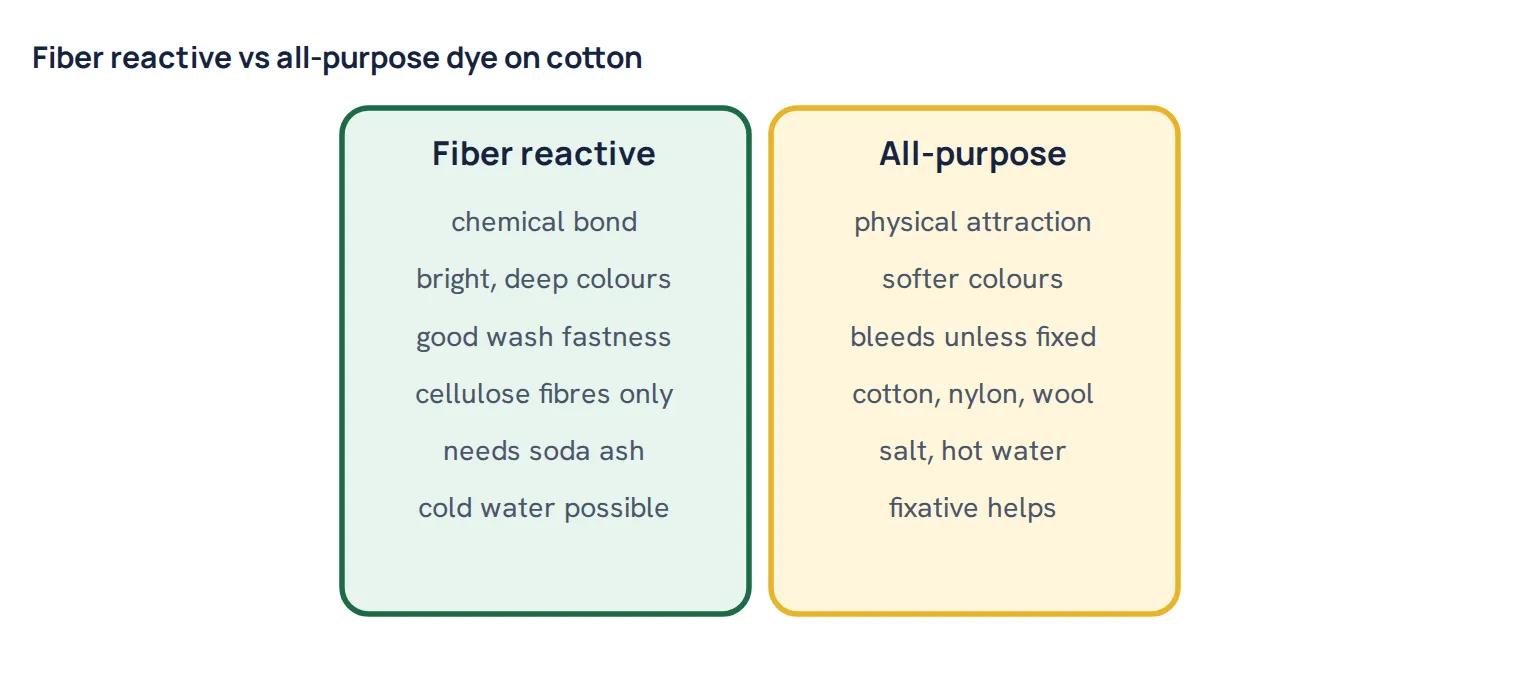
All-purpose home dyes are mixtures of direct dyes for cotton and acid dyes for nylon and wool. They are convenient and colour many fibres, but on cotton they are held only by physical attraction, so they bleed and fade unless a fixative is used; see how a dye fixative works. Fiber reactive dyes colour fewer fibres, but on cotton, linen and rayon they give brighter, longer-lasting colour. Our article on home dyes explained compares the types.
Why some colour still washes out at first
Even a perfect reactive dyeing leaves some hydrolysed dye in the fabric: dye that reacted with water instead of the fibre. It has no bond to hold it, so it comes out in the rinse and the first washes. Factories remove it with several hot rinses and a soaping; skipping that step is the main reason reactive-dyed clothes bleed. In our lab reports, deep reactive shades often reached only grade 2–3 on wet rubbing, and the cure was a better wash-off, not more dye; see why knit fabric fails wet rubbing.
Common mistake: mixing reactive dye with soda ash and keeping it for the next day. Once dye, water and alkali are together, the dye starts reacting with the water. A day later much of it has hydrolysed and can no longer bond, so the colour comes out pale and washes out.
Shelf life and safety
- Dry powder keeps for years if sealed, cool and dry; moisture makes it lose strength.
- Dissolved dye without alkali keeps for days; with soda ash, only hours.
- Powder safety: reactive dye powders can sensitise the lungs and skin. Wear a dust mask and gloves when handling powder, avoid making dust, and keep dyeing tools separate from kitchen use.
- Soda ash is alkaline and irritates skin and eyes; wear gloves.
Worked example. A white 100% cotton T-shirt and a 60/40 cotton-polyester T-shirt are dyed in the same reactive dye bath. The cotton shirt comes out a strong, even colour; the blend comes out paler with a heathered look, because the polyester fibres took no dye. Choosing 100% cotton, linen or rayon blanks is the simplest way to get full colour from fiber reactive dye.
Summary
- Fiber reactive dye bonds chemically to cellulose fibres: cotton, linen, rayon, hemp.
- Salt helps exhaustion, soda ash makes it bond, and a wash-off removes unbonded dye.
- Cold-water types suit home and craft dyeing; warm and hot types are used industrially.
- It gives brighter, more washfast colour on cotton than all-purpose dye, but does not dye polyester.
- Use mixed dye quickly and wear a mask and gloves with the powder.
Questions
What is fiber reactive dye?
It is a dye that forms a covalent chemical bond with cellulose fibres such as cotton, linen and rayon, so the colour becomes part of the fibre and resists washing out.
What is the best fiber reactive dye for cotton?
Any fiber reactive dye made for cellulose works well on cotton; cold-water types are easiest at home, while factories use warm types around 60°C. Choose by colour range and whether you can heat the bath.
Can you use fiber reactive dye on linen?
Yes. Linen is cellulose and takes fiber reactive dye well, though shades can be slightly lighter and slubbier than on cotton. Wash off any finish first.
Does fiber reactive dye work on polyester?
No. Polyester has no hydroxyl groups for the dye to bond to. Polyester needs disperse dye at high temperature.
Why do I need soda ash with fiber reactive dye?
Soda ash raises the pH so the dye can react with the cellulose. Without alkali, the dye does not bond and washes out.

Textile engineer with 14+ years in dyeing and fabric development. He writes every guide on Dyeing Solution from real production work. Full profile