Rayon is a good material for soft, cool, drapey and colourful clothes, but it is weak when wet, wrinkles easily and shrinks a median 9% in our knit records. Honest pros and cons, rayon vs cotton, polyester and modal, what it suits and how to care for it.
At a glance
Softand drapey
Breathableand cool
9%median shrinkage
Weakwhen wet
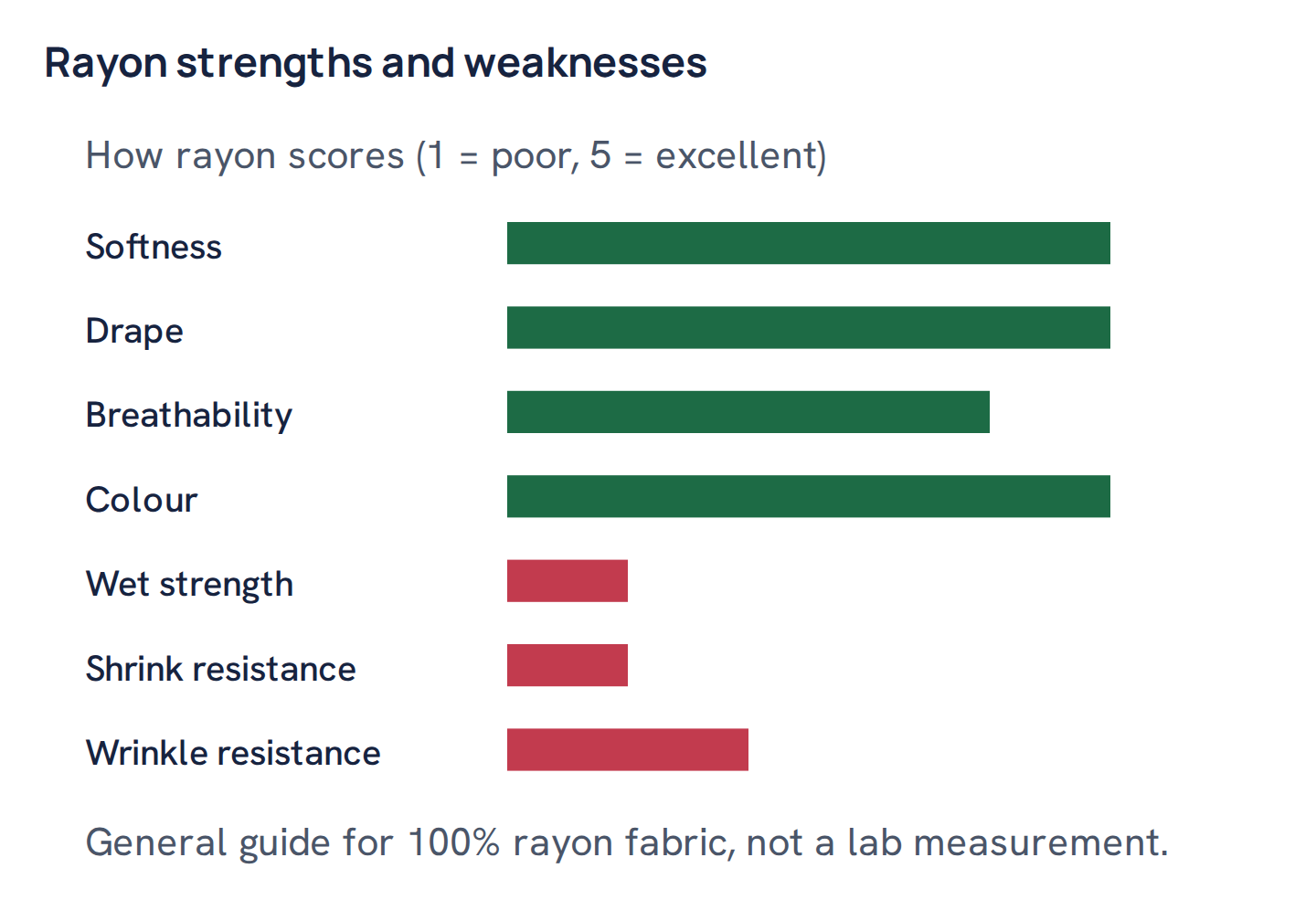
Rayon is a good material for soft, cool, drapey clothes, but not for clothes that must take rough wear or hot washing. Rayon (viscose) is made from wood cellulose. It feels silky, breathes well, takes colour brilliantly and hangs beautifully, which is why it is everywhere in summer dresses, blouses, shirts and linings. Its weaknesses are just as real: it loses much of its strength when wet, wrinkles easily, and shrinks more than most fabrics. Whether rayon is “good” depends on what you want the garment to do.
This guide gives an honest picture of rayon’s pros and cons, how it compares with cotton, polyester and modal, which garments it suits, how to judge a rayon garment before you buy it, and how to care for it so it lasts. It is written from the dye house, where we process rayon knits and see exactly where the fibre is strong and where it fails.
What rayon is
Rayon is regenerated cellulose. Wood pulp is treated chemically to dissolve the cellulose, the solution is forced through fine holes into an acid bath, and the cellulose re-forms as filaments that are cut and spun into yarn. “Rayon” is the common name in the US; “viscose” is the name of the process and the usual name elsewhere. They are the same fibre. Modal and lyocell are newer, stronger relatives made by modified or different processes. See what is viscose fabric for the full story.
Because it is made of cellulose, rayon is not plastic. It is called semi-synthetic: the raw material is natural, but the fibre is formed in a factory.
The advantages of rayon
- Soft, smooth handle. Rayon fibres are smooth and fine, so the fabric feels silky, often compared with silk at a fraction of the price.
- Beautiful drape. Rayon is heavy and fluid for its weight; skirts swing and blouses fall softly instead of standing away from the body.
- Breathable and cool. Rayon absorbs more moisture than cotton and feels cool on the skin, so it is comfortable in hot, humid weather.
- Brilliant colour. Rayon takes reactive and direct dyes very well, giving deep, bright, clean shades and vivid prints.
- No static. Because it holds moisture, rayon does not build up static the way polyester and nylon do.
- Affordable. It gives a silk-like look and feel cheaply.
- Biodegradable under suitable conditions, unlike polyester.
The disadvantages of rayon
- Weak when wet. Rayon loses a large part of its strength when wet, so it can tear, stretch or distort in the wash, especially if wrung or washed hot.
- Shrinks a lot. In our finishing records of 164 viscose knit batches, the median length shrinkage after the wash test was 9%, the worst tenth 14% or more. Only 23% of parts stayed within the usual 5% limit.
- Wrinkles easily. Rayon creases readily and needs ironing more than polyester or blends.
- Can lose shape. Stretched at elbows, knees and seat when worn and washed often.
- Fragile care. Some rayon is labelled dry-clean only; much can be washed, but only cool and gently.
- Production impact. Conventional viscose manufacture uses chemicals that must be handled and recovered properly; standards vary a lot between producers.
Is rayon better than cotton?
Rayon is softer, drapier, cooler and brighter in colour than cotton. Cotton is stronger, especially wet, shrinks less (a median 6% in our knit records against 9% for rayon), wrinkles less and tolerates hot washing. For a flowing summer dress or a soft blouse, rayon is often the better material. For jeans, towels, work shirts and children’s clothes, cotton is better. Many fabrics blend the two so you get some softness and drape with more stability.
Is rayon better than polyester?
For comfort, yes. Rayon breathes, absorbs sweat and does not cling with static; polyester absorbs almost no moisture and can feel clammy in heat. Polyester wins on durability and easy care: it barely shrinks (a median 3% in our records), dries fast, resists wrinkles and keeps its shape. Rayon-polyester blends, common in suiting, dresses and T-shirts, aim for the middle: softer and more comfortable than polyester, more stable than rayon. See does polyester shrink.
Rayon vs modal and lyocell
All three come from wood. Modal is made so its fibres are stronger and more stable when wet, so modal garments keep their shape and softness better; it costs more. Lyocell is made in a closed-loop solvent process, is the strongest of the three, and is often considered the cleaner choice. If you love rayon’s feel but hate how it behaves in the wash, modal or lyocell is the upgrade. See what is modal and what is lyocell.
Types of rayon fabric
“Rayon” covers many fabrics, and how good it feels depends a lot on which one you buy:
- Rayon challis: a light, soft plain weave with a fluid drape, the classic fabric for summer dresses, skirts and printed shirts.
- Rayon crepe: a slightly crinkled, grainy surface that hides creases better and drapes heavily; used for blouses and dresses.
- Rayon twill: a diagonal weave that is a little firmer and more durable; used for shirts and trousers.
- Rayon jersey: a knitted fabric for T-shirts and tops, very soft and drapey but prone to shrinking and growing in length.
- Rayon-spandex jersey: rayon with a few percent elastane for stretch and recovery; used in fitted tops, dresses and leggings.
- Rayon velvet and satin: lustrous, luxurious-looking fabrics for evening wear.
- Rayon linings: smooth, breathable linings for jackets and coats that do not cling like polyester linings.
Heavier, tighter rayon fabrics last longer and crease less; very light ones are coolest but most fragile.
What rayon is good for
| Good choice | Poor choice |
|---|---|
| Summer dresses, skirts and blouses | Workwear and uniforms washed hot |
| Hawaiian and resort shirts | Towels and bath robes |
| Linings for jackets and coats | Children’s play clothes |
| Scarves and drapey tops | Activewear for heavy sweating |
| Rayon-elastane fitted tops and dresses | Garments that must keep an exact size |
How we treat rayon in the dye house
Rayon’s weakness when wet shapes everything we do with it. Compared with cotton it gets a milder scour at 70–80°C instead of near-boiling, no enzyme treatment, and a whole dyeing at about 60°C with careful salt and soda additions. In the machine it must move gently, because wet rayon stretches and creases easily. After drying, the fabric is compacted to bring the length back and is wash-tested. Even with all this care, rayon keeps relaxing in the customer’s wash, which is why our records show it as the fibre that shrinks most. The full route is in the 100% viscose knit dyeing process.
How to judge a rayon garment before you buy
- Read the label. “100% rayon” or “100% viscose” behaves like rayon; “rayon/polyester” is more stable but less breathable; “rayon/spandex” stretches and fits closer.
- Check the care label. “Hand wash cold” or “machine wash cold, gentle” is normal; “dry clean only” tells you the maker expects shrinkage or distortion.
- Feel the weight. Very thin rayon is cool but tears and wrinkles more; a medium-weight rayon twill or crepe lasts longer.
- Look at the seams. Rayon frays; good garments have neat, finished seams with enough allowance.
- Check the length. Expect some shrinkage; a dress that is exactly the right length may end up short.
Common mistake: washing a new rayon dress hot and drying it in a tumble dryer. With a median 9% length shrinkage in our records, a 110 cm dress can lose about 10 cm, and the fabric may twist and pucker. Wash cold, do not wring, and dry flat or on a hanger.
Worked example. A buyer wants a soft, colourful summer shirt that will be worn often. A 100% rayon challis gives the softest drape and brightest print but needs careful washing. A rayon-polyester blend keeps its size and creases less, with a little less breathability. A modal shirt gives rayon’s feel with better wash stability at a higher price. All three are “good” materials; the right one depends on how the shirt will be cared for.
How to care for rayon
- Wash cold or at 30°C on a gentle or hand-wash cycle, inside out.
- Use mild detergent; never bleach.
- Do not wring or twist; press water out gently.
- Dry flat or on a hanger away from heat and direct sun.
- Iron on medium heat while slightly damp, on the reverse side.
- Store hung or loosely folded; rayon creases when packed tightly.
Summary
- Rayon is a good material for soft, cool, drapey, colourful clothes.
- It is weak when wet, wrinkles easily and shrinks most: a median 9% in our knit records.
- It is more comfortable than polyester, softer than cotton, less durable than both.
- Modal and lyocell give rayon’s feel with better wash stability.
- Wash cold and gently, do not wring, and dry flat to make rayon last.
Questions
Is rayon a good material?
Yes for soft, cool, drapey clothes such as summer dresses and blouses. It is weak when wet, wrinkles easily and shrinks a lot, so it is a poor choice for rough wear or hot washing.
Is rayon better than cotton?
Rayon is softer, drapier and cooler; cotton is stronger, shrinks less and handles hot washing. Choose by how the garment will be worn and washed.
Is rayon better than polyester?
For comfort yes: it breathes and absorbs sweat. Polyester is more durable, dries faster, wrinkles less and barely shrinks.
Is rayon a cheap material?
It is usually affordable and gives a silk-like look at a low price. Quality varies with yarn, weight and finishing, not only the fibre.
How long does rayon last?
With cool, gentle washing and flat drying, a rayon garment lasts well. Hot washing, wringing and tumble drying shorten its life through shrinkage and distortion.

Textile engineer with 14+ years in dyeing and fabric development. He writes every guide on Dyeing Solution from real production work. Full profile