Polyester absorbs almost no water, about 0.4% moisture regain against 8% for cotton, so it dries fast, stays light, keeps its shape and barely shrinks. What low absorbency means for sweat, stains, dyeing, microfibre towels, blends and care.
At a glance
0.4%moisture regain
3%median shrinkage
Fastdrying
130°Cdisperse dyeing
Polyester absorbs almost no water. Its moisture regain, the amount of water the fibre takes up from the air under standard conditions, is only about 0.4%, compared with about 8% for cotton and around 13% for viscose. Polyester is hydrophobic: water does not soak into the fibre but sits on the surface or between the fibres. That is why polyester dries fast, stays light when wet, keeps its shape and strength, resists water-based stains and shrinks very little. It is also why plain polyester can feel clammy when you sweat, and why polyester needs special finishes to wick sweat or to take water-based dyes and prints.
This guide explains why polyester does not absorb water, how that compares with other fibres, what it means for comfort, drying, sweat, stains, shrinkage and dyeing, how wicking polyester can still move water, polyester towels and cleaning cloths, and how to care for polyester with its low absorbency in mind. It is written from the dye-house side, where polyester’s low water uptake decides how we dye it, at high temperature with disperse dyes.
Why polyester does not absorb water
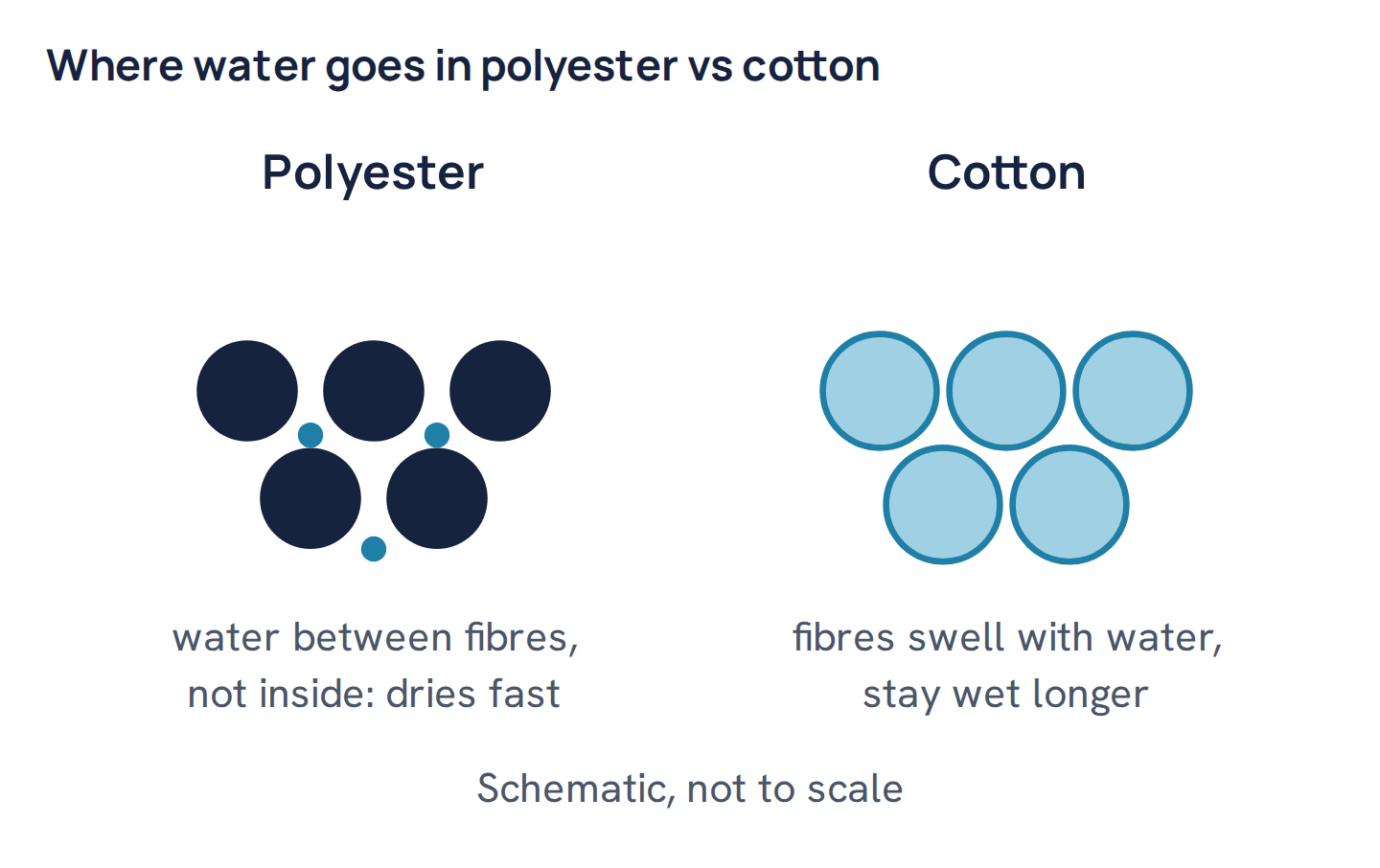
Polyester (PET) is made of long chains with very few chemical groups that attract water. Its chains are tightly packed and partly crystalline, leaving little space for water molecules to enter. Cotton and viscose, by contrast, are cellulose, full of hydroxyl groups that bond strongly with water and swell. So when polyester gets wet, the water stays outside the fibre. In fabric, water can still be held between fibres and yarns, but a wet polyester fabric releases it quickly.
Moisture regain by fibre
| Fibre | Approx. moisture regain | Behaviour when wet |
|---|---|---|
| Polyester | ~0.4% | Stays light, dries very fast |
| Acrylic | ~1–2% | Dries fairly fast |
| Nylon | ~4% | Dries fast, slightly weaker wet |
| Cotton | ~8% | Absorbs, gets heavy, dries slowly |
| Modal, lyocell | ~11–12% | Absorbs well, cool feel |
| Viscose | ~13% | Absorbs a lot, weak when wet |
| Wool | ~14–16% | Absorbs vapour, warm when damp |
What low absorbency means in practice
- Fast drying: polyester clothes and towels dry in a fraction of the time of cotton.
- Light when wet: swimwear and rain layers do not get heavy.
- Shape and strength: polyester keeps its size and strength when wet.
- Low shrinkage: fibres do not swell and relax, so polyester barely shrinks; our knit records show a median length shrinkage of 3%.
- Stain resistance: water-based stains such as coffee wash out easily.
- Oily stains stick: oil and grease cling to polyester and can be harder to remove.
- Static: dry polyester builds static because it holds so little moisture.
Polyester has no shrink property. In a CVC or PC fabric the polyester holds the structure, so the fabric cannot shrink, and washing changes the GSM very little.
Polyester and sweat
Because polyester does not absorb sweat, a dense polyester fabric leaves sweat on the skin, which feels hot and clammy. Sportswear solves this with wicking: fine fibres, special knits and hydrophilic finishes move sweat through the fabric and spread it on the outside, where it evaporates quickly. So polyester can feel drier than cotton during exercise, even though it absorbs less. See is polyester good for hot weather.
Is polyester waterproof?
No. Low absorbency is not the same as waterproof. Water can pass through the gaps between yarns in a polyester fabric, especially under pressure. Polyester sheds light rain and dries quickly, but becomes water repellent only with a DWR finish and waterproof only with a coating or membrane and sealed seams.
Polyester and dyeing
Low water uptake is exactly why polyester cannot be dyed with the water-soluble dyes used for cotton. Polyester is dyed with disperse dyes, which are only slightly soluble in water and dissolve into the fibre at high temperature, usually around 130°C under pressure, when the fibre structure opens up. After cooling, the dye is trapped inside, giving excellent wash fastness. Home dyes made for cotton will not colour polyester properly. See how disperse dyes work on polyester and can you dye polyester.
Polyester towels and cleaning cloths
Polyester microfibre cloths and towels clean and dry well despite polyester’s low absorbency. Microfibre splits filaments into extremely fine fibres, often with nylon, creating huge surface area and tiny capillary spaces that hold water between the fibres. So microfibre towels can soak up water quickly and release it easily, drying much faster than cotton. They feel different from cotton terry: lighter, smoother and sometimes “grabby” on dry skin. See is polyester a microfiber.
Polyester blends and absorbency
Blending polyester with cotton or viscose increases absorbency while keeping some of polyester’s quick drying and shape retention. A 60/40 cotton-polyester tee absorbs more than 100% polyester and dries faster than 100% cotton. Tri-blends add rayon for softness and absorbency. See what is CVC fabric.
Common mistake: trying to clean a grease stain on polyester with just water. Oil is attracted to polyester and water slides off. Pre-treat oily stains with liquid detergent or a degreasing stain remover, work it in, then wash at the warmest temperature the label allows.
How to care for polyester
- Wash at 30–40°C; polyester does not need hot water.
- Pre-treat oily stains promptly.
- Use a short dryer cycle on low, or line dry; it dries fast.
- Skip fabric softener on sportswear to keep wicking finishes working.
- Reduce static with dryer balls or by removing clothes while slightly damp.
Does polyester absorb odour?
Polyester does not absorb sweat, but oily sweat compounds stick to its surface, and bacteria feed on them, so polyester sportswear can smell more than cotton after workouts. Washing soon after use, using a sports detergent and choosing fabrics with antimicrobial finishes help. See antimicrobial finish.
Polyester in bedding and pillows
Polyester fibrefill in pillows and duvets stays lofty, dries quickly after washing and does not absorb moisture, which helps it resist mould and dust mites compared with damp natural fills. Polyester microfibre sheets feel smooth but can sleep warm because they do not absorb night sweat. Hot sleepers often prefer cotton or lyocell sheets with a polyester-filled duvet.
Worked example. After a rainy hike, a cotton T-shirt and a polyester T-shirt are hung up together. The polyester shirt is dry in about an hour; the cotton shirt is still damp the next morning. The polyester shirt also weighed far less when wet, because almost no water had entered its fibres.
Polyester in swimwear
Polyester’s low absorbency makes it excellent for swimwear: suits stay light in the water, dry quickly on the beach and resist chlorine better than nylon. Polyester-spandex swimwear holds its colour and shape for longer in pools. The trade-off is a slightly firmer feel than nylon-spandex.
How to make polyester more absorbent
Mills can make polyester behave more absorbently in several ways: blending with cotton or viscose; using fine microfibres that hold water between them; knitting two-face structures; and applying hydrophilic finishes that let water spread over the fibre surface. Some polyesters are modified at the polymer level to attract more moisture. At home, avoiding fabric softener keeps any hydrophilic finish working.
Polyester vs cotton for drying time
In practice, a polyester garment can dry several times faster than the same garment in cotton. That makes polyester useful for travel, camping and sport, where you may need to wash clothes in a sink and wear them the next morning. Cotton’s slow drying is the price of its comfort and absorbency at rest. Blends fall in between, drying faster as the polyester share rises.
Does wet polyester feel cold?
Wet polyester feels cold only briefly, because it holds little water and dries fast. Wet cotton stays wet, so it keeps drawing heat from the body for longer. That is why outdoor guides warn against cotton in cold, wet conditions and recommend polyester or wool layers.
Summary
- Polyester absorbs almost no water: about 0.4% moisture regain.
- It dries fast, stays light, keeps its shape and barely shrinks.
- It is water resistant, not waterproof.
- Wicking finishes and microfibres let polyester move water without absorbing it.
- It is dyed with disperse dyes at high temperature because water-based dyes cannot enter it.
Questions
Does polyester absorb water?
Almost none. Polyester has a moisture regain of about 0.4%, so water sits on or between the fibres rather than inside them.
Is polyester waterproof?
No. It is water resistant and dries fast, but water passes through gaps in the fabric unless it is coated or laminated.
Why does polyester dry so fast?
Because the fibres do not absorb water, it only has to evaporate from the surface and the spaces between fibres.
Do polyester towels absorb water?
Microfibre polyester towels hold water between their very fine fibres, so they absorb quickly and dry fast.
Does polyester absorb sweat?
No. Plain polyester leaves sweat on the skin; wicking polyester moves it outward to evaporate.

Textile engineer with 14+ years in dyeing and fabric development. He writes every guide on Dyeing Solution from real production work. Full profile