Nylon is moderately breathable: it absorbs about 4% moisture, more than polyester but less than cotton, and breathability depends mostly on the fabric. Nylon vs other fibres, which nylon fabrics breathe best, hot weather, leggings, underwear, wind shells, coatings and how to choose.
In this guide
- What breathability means
- Nylon vs other fibres
- Which nylon fabrics breathe best
- Is nylon good for hot weather?
- Nylon in leggings and activewear
- Nylon underwear and socks
- Wind resistance vs breathability
- Coatings, membranes and DWR
- How to choose breathable nylon
- Caring for nylon to keep it breathable
- Nylon swimwear and breathability
- Nylon in hiking and travel clothing
- Nylon microfibre
- Does nylon make you sweat?
- Nylon blends for comfort
- Nylon vs polyester for hot-weather sportswear
- Quick test for breathability
- Summary
- Questions
At a glance
~4%moisture regain
Meshbreathes best
Coatedbreathes least
Fastdrying
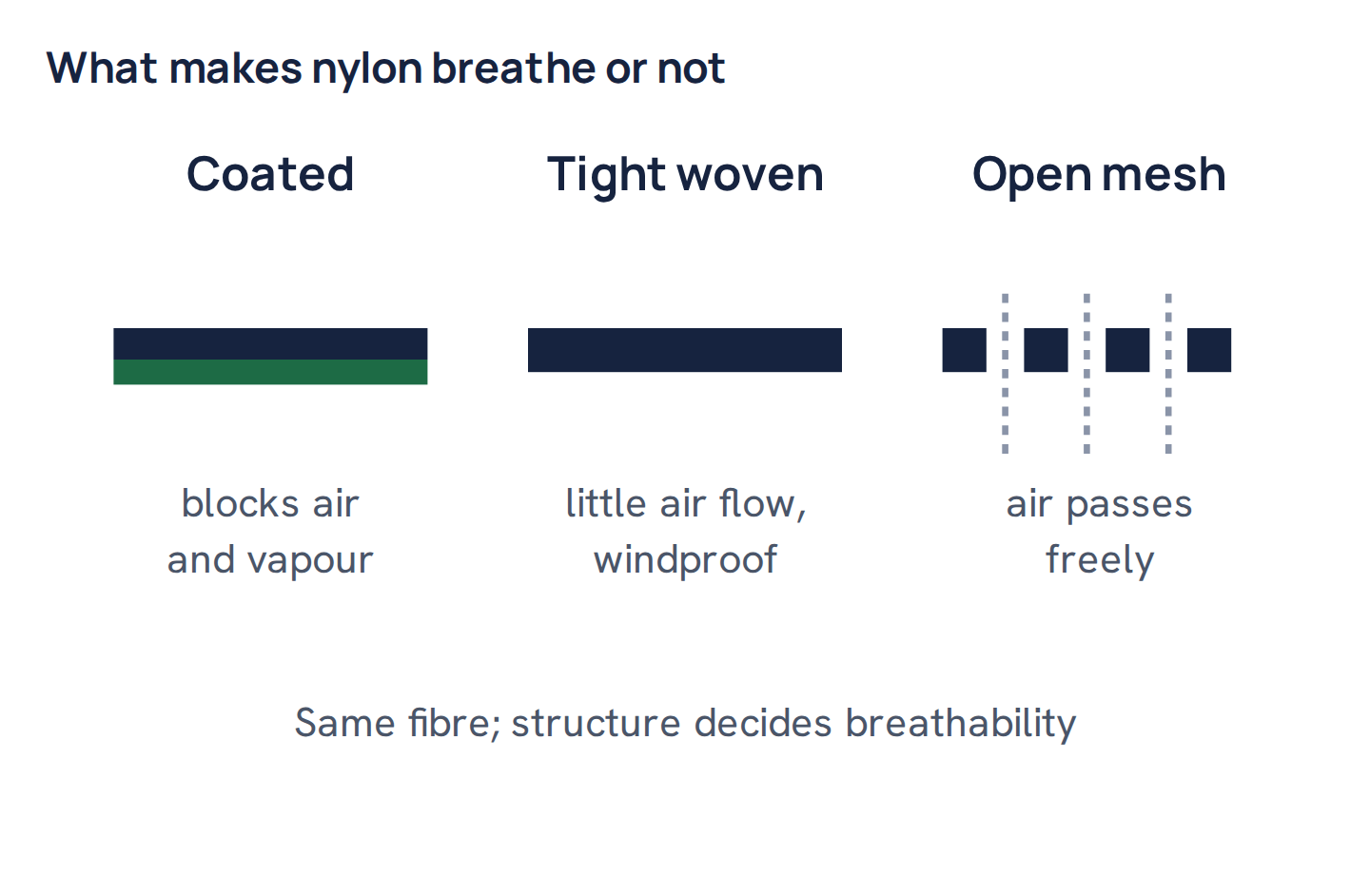
Nylon is moderately breathable: more breathable than polyester in terms of moisture, but less than cotton, linen or wool. The fibre absorbs about 4% moisture, compared with about 0.4% for polyester and 8% for cotton, so it takes up a little sweat vapour but not much. Whether a nylon fabric feels breathable depends mostly on how it is made. A thin, open nylon mesh or a light wicking knit can feel airy and dry quickly, while a tightly woven nylon windbreaker or a coated rain jacket blocks air and traps heat. For hot weather at rest, cotton or linen usually feels cooler; for active use, a lightweight nylon knit can perform well.
This guide explains what breathability means, how nylon compares with other fibres, which nylon fabrics breathe best and worst, whether nylon is good for hot weather, nylon in leggings, underwear, socks and outdoor wear, wicking and coatings, and how to choose breathable nylon. It is written from the dye-house side, where we dye and finish nylon and nylon-elastane fabrics.
What breathability means
A fabric “breathes” when air and water vapour can pass through it and when it handles sweat well. Three things matter: air permeability (how open the structure is), water vapour transmission (how easily sweat vapour escapes), and moisture handling (whether sweat is absorbed, spread or left on the skin). Nylon’s fibre gives it modest moisture absorption; its fabric structure decides the rest.
Nylon vs other fibres
| Fibre | Approx. moisture regain | Breathability in practice |
|---|---|---|
| Polyester | ~0.4% | Low to high, depends on structure |
| Nylon | ~4% | Moderate; depends on structure |
| Cotton | ~8% | High at rest |
| Linen | ~12% | Very high |
| Viscose, modal | ~11–13% | High, cool feel |
| Wool | ~14–16% | Excellent, warm when damp |
Which nylon fabrics breathe best
- Most breathable: nylon mesh, light nylon jersey, microfibre nylon knits with wicking finishes, nylon tights in fine deniers.
- Moderate: nylon-spandex leggings and activewear, nylon tricot linings.
- Less breathable: tightly woven nylon (taffeta, ripstop, windbreakers).
- Least breathable: PU-coated or laminated nylon (rain jackets, bags) unless it has a breathable membrane.
Is nylon good for hot weather?
It can be, if the fabric is light and open. Nylon dries fast and feels smooth and cool to the touch, which suits hiking shorts, swimwear and travel clothes. Dense nylon or nylon-spandex worn tight can trap heat and sweat. For relaxing in heat, cotton or linen usually feels better; for active use, light nylon or polyester knits with wicking finishes dry faster than cotton. See is polyester good for hot weather.
Nylon in leggings and activewear
Nylon-spandex leggings feel soft, smooth and cool and give good compression. They breathe moderately: thinner, single-knit leggings breathe better than thick, compressive double knits. Mesh panels behind the knee and at the waist improve airflow. Changing out of sweaty leggings promptly is good for skin comfort. See is spandex breathable.
Nylon underwear and socks
Nylon underwear is smooth and quick drying but breathes less than cotton or modal; a cotton gusset helps. In socks, nylon adds strength and stretch and is usually blended with cotton, wool or acrylic, which do most of the moisture handling. See cotton vs polyester socks.
Wind resistance vs breathability
Tightly woven nylon is popular for windbreakers precisely because it blocks air. That makes it feel warm in wind but stuffy when you work hard. Many shells balance this with vents, mesh linings and pit zips. Air-permeable “breathable” nylon shells use a slightly more open weave to let some air through while still cutting wind.
Coatings, membranes and DWR
Waterproof nylon jackets use a coating or membrane. PU coatings block both water and most vapour, so they feel clammy during activity. Breathable membranes block liquid water but let vapour through, which helps but does not make the jacket as breathable as an uncoated fabric. A DWR finish on the outside makes water bead off and keeps the face fabric from wetting out, which helps the membrane breathe. See is nylon water resistant.
Common mistake: wearing a PU-coated nylon rain jacket for a fast uphill hike on a dry day. The coating stops sweat vapour escaping, so you get wet from the inside. Use an air-permeable wind shell or a breathable-membrane jacket for activity, and open vents.
How to choose breathable nylon
- Choose lighter fabrics and visible open structures such as mesh panels.
- Look for “wicking”, “quick dry” or “air-permeable” claims.
- Avoid coated or laminated nylon unless you need waterproofing.
- Choose a looser fit for hot weather.
- Breathe through the fabric: if air passes easily, it is air-permeable.
Caring for nylon to keep it breathable
- Wash at 30°C on a gentle cycle.
- Skip fabric softener, which can block wicking finishes.
- Rinse well to remove detergent residue.
- Line dry or tumble low; heat can damage nylon and spandex.
Worked example. A hiker compares two nylon shirts on a hot trail. The first is a tightly woven nylon shirt with a crisp hand; it blocks the breeze and feels sticky. The second is a light nylon knit with a wicking finish and mesh back panel; it feels cooler and dries in minutes at rest stops. Both are nylon; the structure makes the difference.
Nylon swimwear and breathability
Breathability matters less in swimwear because it is worn wet, but drying speed matters a lot. Nylon-spandex swimsuits dry fairly quickly after swimming and feel smooth and soft. Polyester-spandex dries slightly faster and resists chlorine better. Both are far better than cotton, which stays wet and heavy.
Nylon in hiking and travel clothing
Many hiking shirts, shorts and trousers use light nylon woven fabrics with a little stretch. They are abrasion resistant, light, quick drying and often given a DWR finish. Their breathability comes from being thin and from design features such as vents and mesh-lined pockets. For hot, humid hikes, look for the lightest weight and a looser fit; for scrambling and brush, a slightly heavier, tighter nylon resists snags better.
Nylon microfibre
Nylon microfibre is made from very fine filaments, which create many tiny capillary spaces. That helps the fabric wick sweat and dry fast, and gives a softer, more supple feel. Microfibre nylon underwear, sportswear and base layers often feel more breathable than ordinary nylon of the same weight. See is polyester a microfiber.
Does nylon make you sweat?
Nylon does not make you sweat more by itself, but if it is dense, tight or coated, it can trap heat and sweat against the skin, so you feel sweatier. Light, open nylon fabrics let sweat evaporate and dry fast. If you find nylon sweaty, try a looser fit, a lighter fabric or a blend with cotton or modal.
Nylon blends for comfort
Blending nylon with cotton, modal or wool improves breathability and comfort while keeping nylon’s strength. Cotton-nylon blends are common in socks and travel trousers; nylon-wool blends in hiking socks and base layers. The natural fibre handles moisture; nylon adds durability and quick drying.
Nylon vs polyester for hot-weather sportswear
Both fibres make good hot-weather sportswear when knitted light and open with a wicking finish. Nylon feels softer and cooler to the touch and is more abrasion resistant; polyester dries slightly faster, resists sun and chlorine better and costs less. Many brands use polyester for running and team kits and nylon for premium leggings and training tops. Fit, weight and knit structure matter more than the fibre choice.
Quick test for breathability
Hold the fabric over your mouth and breathe out gently. If air passes easily, it is air-permeable and will feel airy. Then drop a little water on it: if it spreads and soaks in within seconds, it has a wicking finish; if it beads up, it is water-repellent and will feel less breathable during exercise.
Washing nylon cool and without softener keeps any wicking finish working for longer.
Summary
- Nylon is moderately breathable and absorbs about 4% moisture.
- It breathes better than polyester but less than cotton, linen or wool.
- Mesh and light knits breathe well; tight wovens and coated nylon do not.
- Nylon suits active hot-weather wear when the fabric is light and open.
- Skip softener and choose open structures for breathable nylon.
Questions
Is nylon breathable?
Moderately. Nylon absorbs a little moisture, and light, open nylon fabrics breathe well, while tight wovens and coated nylon do not.
Is nylon more breathable than polyester?
Slightly, in terms of moisture absorption. In practice the fabric structure matters more than the fibre.
Is nylon good for hot weather?
Light, open or wicking nylon fabrics suit active hot-weather use. For relaxing in heat, cotton or linen often feels cooler.
Are nylon leggings breathable?
Moderately. Thin knits and mesh panels breathe better than thick compression leggings.
Why do nylon jackets feel sweaty?
Coatings and tight weaves block sweat vapour. Choose breathable membranes, air-permeable shells and vents.

Textile engineer with 14+ years in dyeing and fabric development. He writes every guide on Dyeing Solution from real production work. Full profile