Polyester often feels smooth, slightly slick and cool, and can feel clammy in heat, but spun, microfibre and brushed polyester can feel soft and cotton-like. Why polyester feels as it does, filament vs spun vs microfibre, common fabrics, heat and cold, finishing and how to tell it by touch.
At a glance
Smoothand slick
0.4%moisture regain
Spunfeels cottony
Finishchanges handle
Polyester can feel very different depending on how it is made. Classic polyester fabrics often feel smooth, slightly slippery, cool at first touch and a little “plasticky” or synthetic compared with cotton, and they can feel warm and clammy once you start to sweat. But modern polyester can also feel soft and cottony (spun or brushed polyester), silky (satin and chiffon), fluffy (fleece), peachy (double brushed knits) or crisp (taffeta). The fibre is the same; yarn type, fibre fineness, fabric structure and finishing decide the feel.
This guide explains how polyester typically feels, why it feels the way it does, how filament, spun and microfibre polyester differ, how different polyester fabrics feel, whether polyester can feel like cotton, how it feels on the skin in heat and cold, and how to tell polyester by touch. It is written from the dye-house side, where we finish polyester and polyester-blend fabrics and adjust their handle with brushing, softening and heat setting.
Why polyester feels the way it does
- Smooth, round fibres: standard polyester filaments are smooth and uniform, so fabrics feel slick and can have a sheen.
- Low moisture absorption: polyester holds only about 0.4% moisture, so it feels dry and slightly cool at first, but traps sweat on the skin in heat.
- Stiffness: polyester fibre is relatively stiff, which gives some fabrics a crisp or springy hand.
- Static: low moisture means static builds, making fabric cling.
- Heat setting: polyester is heat set, so it springs back and resists creasing, which feels different from soft, crumpling cotton.
Filament vs spun vs microfibre polyester
| Type | How it is made | Feel |
|---|---|---|
| Filament polyester | Continuous smooth strands | Smooth, slick, often shiny |
| Textured filament | Filaments crimped for bulk | Softer, springier, less shiny |
| Spun polyester | Short staple fibres spun like cotton | Matt, soft, cotton-like |
| Microfibre polyester | Very fine filaments | Very soft, smooth, suede-like when brushed |
See polyester staple fibre and is polyester a microfiber.
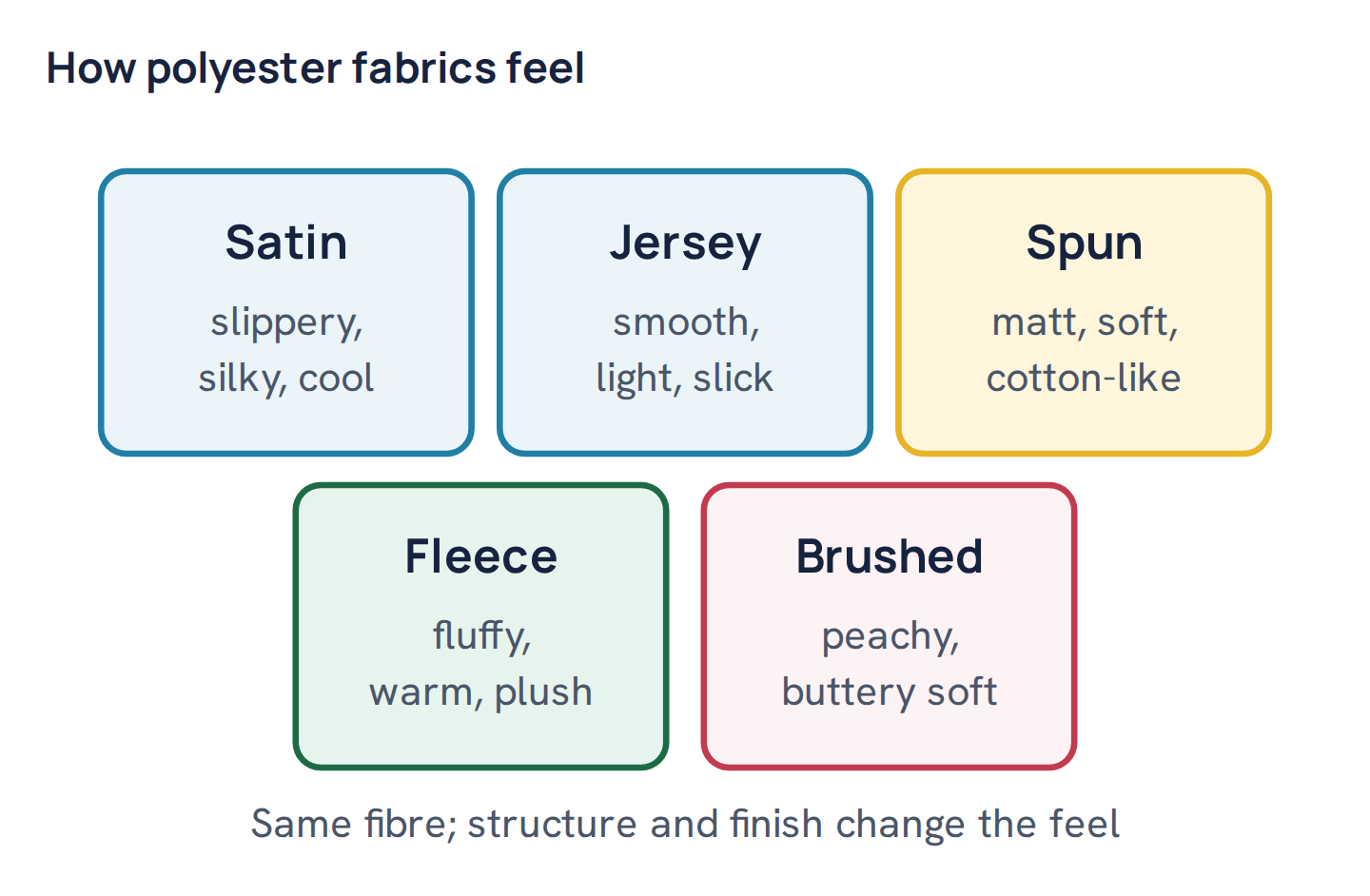
How common polyester fabrics feel
- Polyester satin and charmeuse: slippery, silky, cool, glossy.
- Chiffon and georgette: light, sheer, slightly crisp or grainy.
- Polyester jersey: smooth, light, slightly slick; sports tees.
- Spun polyester and blends: soft and matt, close to cotton.
- Polyester fleece: fluffy, warm, plush. See anti-pilling fleece.
- Double brushed polyester: very soft, peachy, buttery. See double brushed polyester.
- Taffeta and twill: crisp, smooth, slightly stiff.
- Scuba: thick, smooth, spongy, springy. See what is scuba fabric.
Does polyester feel like cotton?
Some does. Spun polyester, microfibre and brushed polyester can feel soft and cotton-like, and many people cannot tell the difference by touch in a well-made tee. The difference shows in use: polyester feels drier at first, slicker as it warms, does not absorb sweat, builds more static and does not soften with washing the way cotton does. Cotton-polyester blends feel closest to cotton. See what is poly-cotton.
How polyester feels in heat and cold
In cool, dry conditions, polyester feels comfortable and, as fleece, very warm. In heat, plain polyester can feel clammy because sweat is not absorbed. Technical polyester knits with wicking finishes feel much drier during exercise. Static can make polyester cling and feel slightly prickly in dry winter air.
How finishing changes polyester’s feel
In finishing, polyester’s handle is adjusted in several ways. Softeners, especially silicone softeners, make it smoother and silkier. Brushing and peaching raise fine fibre ends for a soft, peach-skin surface. Alkali treatment (caustic reduction) slightly etches the fibre surface to give a softer, silk-like hand to woven polyester. Heat setting fixes dimensions and can make fabric crisper or softer depending on temperature. Each changes how the same fabric feels in the hand.
Fabric with polyester must be finished at 100–110°C, not at the 140–150°C used for cotton. Hotter than that and the dye bleeds and the fastness fails.
Common mistake: judging a polyester garment only by how soft it feels in the shop. A heavily softened polyester can feel silky on the hanger but feel slick and clammy once worn for a few hours in warm weather. Think about where and how you will wear it, not only first touch.
How to tell polyester by touch
- Feels smooth and slightly slick rather than dry and matt.
- Warms up slowly in the hand; may feel cool at first.
- Springs back when crushed; resists creasing.
- May crackle or cling with static.
- Often lighter than cotton of similar thickness.
- The label is the reliable answer; a careful burn test on a thread shows melting.
Does polyester get softer with washing?
Not much. Cotton softens as washing relaxes and slightly wears its fibres; polyester stays much the same because it is stable and abrasion resistant. Softness that comes from a softener finish can actually fade with washing. Polyester fleece can become less fluffy and pill over time. Washing cool and avoiding the dryer keeps polyester feeling as it did.
Worked example. In a blind touch test, a group compares a cotton tee, a 50/50 tee and a spun polyester tee of similar weight. Most identify the cotton by its dry, matt feel, but many confuse the 50/50 and the spun polyester. After 20 minutes of brisk walking, almost everyone can tell the polyester tee: it feels warmer and slicker against damp skin.
Polyester vs nylon by feel
Nylon usually feels softer, smoother and slightly cooler than polyester, with a supple, springy hand. That is why premium leggings and lingerie often use nylon. Polyester feels a little firmer and crisper. In blind tests the difference is subtle, and fabric structure matters more than fibre. See rayon vs nylon.
Polyester vs rayon by feel
Rayon (viscose) feels cooler, softer and drapier than most polyester and absorbs sweat, so it feels more natural in heat. Polyester holds its shape better and resists creasing. Many soft fabrics blend the two to get rayon’s feel with polyester’s stability. See rayon vs polyester.
Why some polyester feels scratchy
Most polyester feels smooth, but some can feel scratchy: stiff textured yarns, coarse filament embroideries and trims, sequins, glitter yarns, and cut edges of fleece or seams. Static can also make polyester feel prickly in dry weather. Choosing finer yarns, brushed or spun polyester and garments with soft linings avoids this.
Recycled polyester feel
Recycled polyester made into the same yarn and fabric feels the same as virgin polyester. Differences in feel between garments come from the yarn, knit and finishing, not from whether the polyester is recycled.
Polyester on sensitive skin
Most people find polyester comfortable, but those with sensitive skin or eczema sometimes find it too warm, slick or static. Rarely, disperse dyes used on polyester cause skin reactions. A cotton or modal layer next to the skin, lighter colours and washing new garments before wearing help. See is polyester dangerous.
Polyester sheets and pyjamas: how they feel at night
Polyester microfibre sheets feel smooth and soft when you get into bed and do not crease. Over a warm night, many people find them warmer and less breathable than cotton or lyocell, because they do not absorb night sweat. Polyester satin pyjamas feel cool at first and slippery, then can feel warm. Brushed polyester sheets feel cosy in winter.
Weight and thickness
Polyester is a light fibre, so polyester garments often feel lighter than cotton of the same thickness. Heavy polyester fabrics such as scuba and fleece feel substantial but still lighter than cotton equivalents. That lightness is welcome in travel and sportswear, but some people associate weight with quality and find thin polyester feels “cheap” even when it performs well.
Feel is only part of the story; check the fibre label, weight and care instructions together before deciding.
Summary
- Polyester often feels smooth, slick and cool, sometimes a little synthetic.
- Spun, microfibre and brushed polyester can feel soft and cotton-like.
- Satin feels silky, fleece fluffy, double brushed peachy, taffeta crisp.
- Polyester can feel clammy in heat because it does not absorb sweat.
- Finishing (softeners, brushing, heat setting) changes polyester’s feel.
Questions
What does polyester feel like?
Usually smooth, slightly slick and cool at first touch, sometimes a little synthetic; brushed and spun polyester feel soft and cotton-like.
Does polyester feel like cotton?
Spun, microfibre and brushed polyester can feel very close to cotton, but polyester feels warmer and slicker once you sweat.
Why does polyester feel plasticky?
Smooth filaments, low moisture absorption and some finishes give a slick, synthetic feel.
Does polyester get softer after washing?
Not much. Unlike cotton, polyester stays largely the same, and softener finishes can fade.
How can I tell polyester by touch?
It feels smooth and slick, springs back from creases, may crackle with static and warms slowly in the hand.

Textile engineer with 14+ years in dyeing and fabric development. He writes every guide on Dyeing Solution from real production work. Full profile