Cationic dyes bond ionically to a small number of negative sites in acrylic and CD polyester. Learn why they strike so fast above the glass transition and how retarders, slow heating and pH keep the shade level.
At a glance
Ionicdye cation bonds to fibre –SO₃⁻ site
~75–85°Ctypical wet Tg zone of acrylic (varies)
pH 4–5.5typical acetic acid bath
~110°CCD polyester vs ~130°C for normal polyester
Acrylic and cationic-dyeable (CD) polyester are dyed with cationic dyes, also called basic dyes. The bond is ionic, just like acid dyes on nylon, but with the charges reversed: the dye is positive and the fibre carries a small number of negative sites. Two facts drive almost everything in practice. First, the number of sites is limited, so the fibre saturates and dyes compete for seats. Second, the dye hardly moves below the glass transition temperature of the fibre and then rushes on once that temperature is passed. Together these explain why acrylic is famous for unlevel dyeing, why retarders and slow heating are used, and why some dye combinations never behave. This article explains the chemistry step by step and then turns it into practical control.
A short history
Basic dyes are among the oldest synthetic dyes. Mauveine, made by accident in 1856 and usually counted as the first commercial synthetic dye, was a basic dye, and so were many of the bright reds, violets and greens that followed in the next few decades. They gave brilliant shades on silk, wool and on cotton mordanted with tannin, but their light and wash fastness on those natural fibres was poor. As better dye classes arrived, basic dyes slipped into minor uses such as paper and leather. Their revival came in the 1950s with acrylic fibres. Acrylic had anionic sites built in, and on acrylic the old weakness disappeared: the same type of dye gave bright shades with good light and wet fastness. Dye makers then developed new cationic dyes designed for acrylic, and later the same dyes found a second home on CD polyester.
What a cationic dye looks like
A cationic dye is a coloured molecule that carries a positive charge. It is supplied as a salt, so the positive dye ion comes with a negative counter-ion, usually chloride, sulphate, methosulphate or acetate. In water the salt dissociates: the coloured cation does the dyeing, and the counter-ion stays in the bath.
Chemists usually split cationic dyes into two groups by where the charge sits:
- Delocalised charge. The positive charge is spread over the whole conjugated system of the chromophore, often through a nitrogen atom that is part of the coloured part of the molecule. Many of the old basic dyes were of this type. The spreading of the charge is part of what makes the colour so bright and strong.
- Pendant (localised) charge. The positive charge sits on a quaternary ammonium group joined to the chromophore through a short chain. The coloured part is then a normal, neutral chromophore, often an azo or anthraquinone type, and the charged group acts as the “hook” to the fibre.
The modern dyes made for acrylic are often called modified basic dyes. The name simply means they were designed for synthetic fibres, with better light fastness, better stability in the dyebath and more predictable dyeing rates than the historic basic dyes. Some ranges are built specially for good migration and levelling, others for high build-up in deep shades. In this article “cationic dye” and “basic dye” are used for the same class. For a wider view of how dye classes are matched to fibres, see dye classes: which dye for which fibre.
The fibres: where the negative sites come from
Acrylic
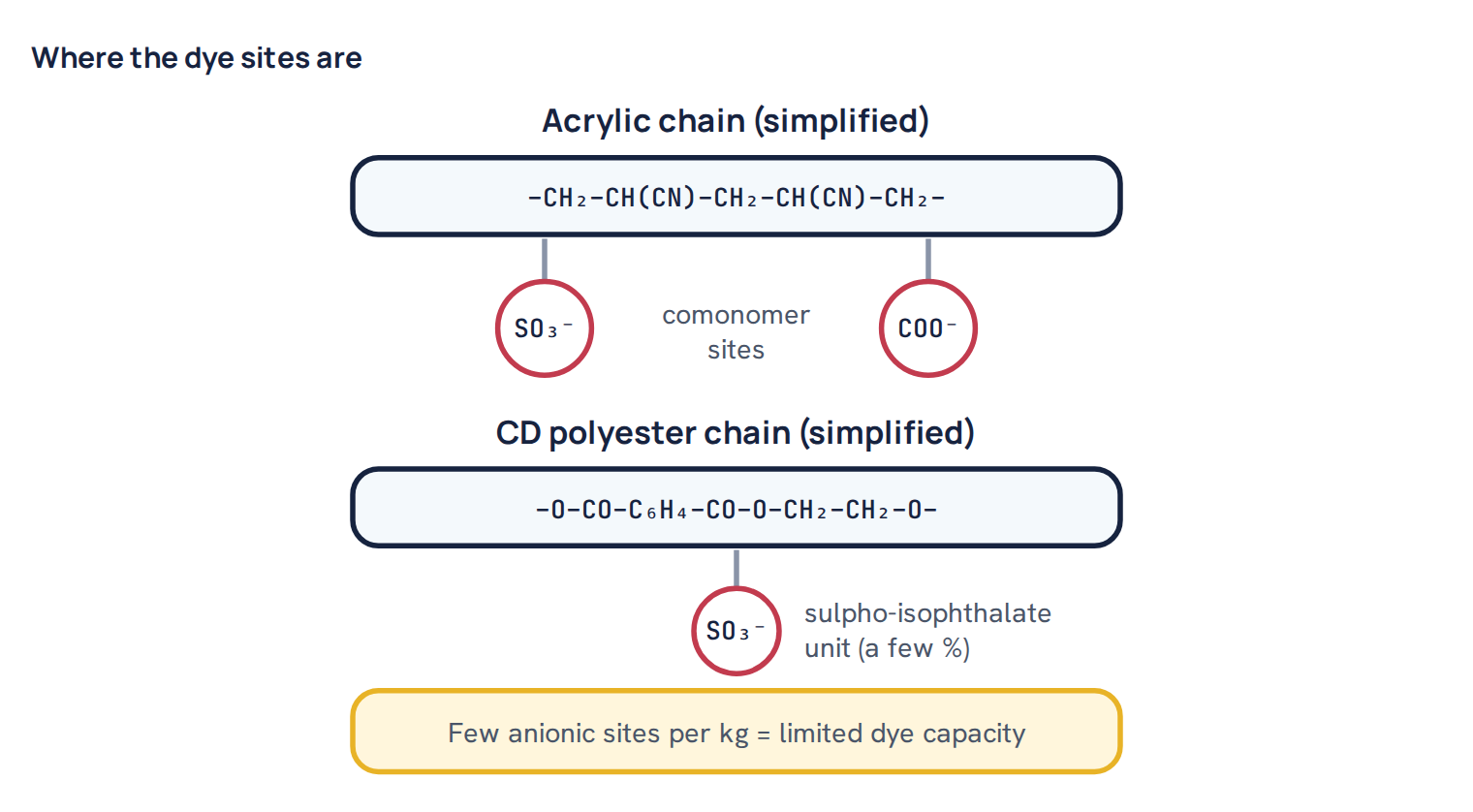
Acrylic fibre is mostly polyacrylonitrile: long carbon chains with a nitrile group (–CN) on every second carbon. Pure polyacrylonitrile is very compact and hard to dye, so commercial acrylic is a copolymer. By common definition at least 85% of it is acrylonitrile. The rest is made up of comonomers chosen for two jobs:
- Neutral comonomers, such as methyl acrylate or vinyl acetate. They break up the tight packing of the chains, open the structure a little and lower the glass transition temperature, so dye can get in.
- Acidic comonomers carrying a sulphonate (–SO₃⁻) or sometimes a carboxyl (–COO⁻) group. These are the dye sites.
Extra sulphonate and sulphate groups also come from the polymerisation itself. The initiator system commonly used to start the chain reaction leaves anionic end groups on the polymer chains. So the dye sites in acrylic come partly from the comonomer and partly from the chain ends. Sulphonate groups are strong acids and stay negative over the whole working pH range. Carboxyl groups are weak acids and are only partly charged in an acid bath, which is one reason pH has an effect on dyeing rate.
Modacrylic fibres contain less acrylonitrile (roughly 35–85%) and a larger share of other monomers, often chlorine-containing ones for flame resistance. They are dyed with cationic dyes too, but usually at lower temperatures, because their structure softens earlier.
Cationic-dyeable polyester
Normal polyester (polyethylene terephthalate) has no ionic groups and is dyed with disperse dyes at around 130°C. CD polyester is the same basic polymer with a small amount of a sulphonated comonomer built into the chain, typically a sodium salt of sulpho-isophthalic acid. Each of those units carries one –SO₃⁻ group, which gives the fibre a fixed number of anionic sites. The comonomer also disturbs the regular packing of the polyester chains a little. This makes the fibre more open, so it dyes at a lower temperature than normal polyester, and it can also take disperse dyes. For the full route, see the cationic-dyeable (CD) polyester dyeing process.
The glass transition temperature
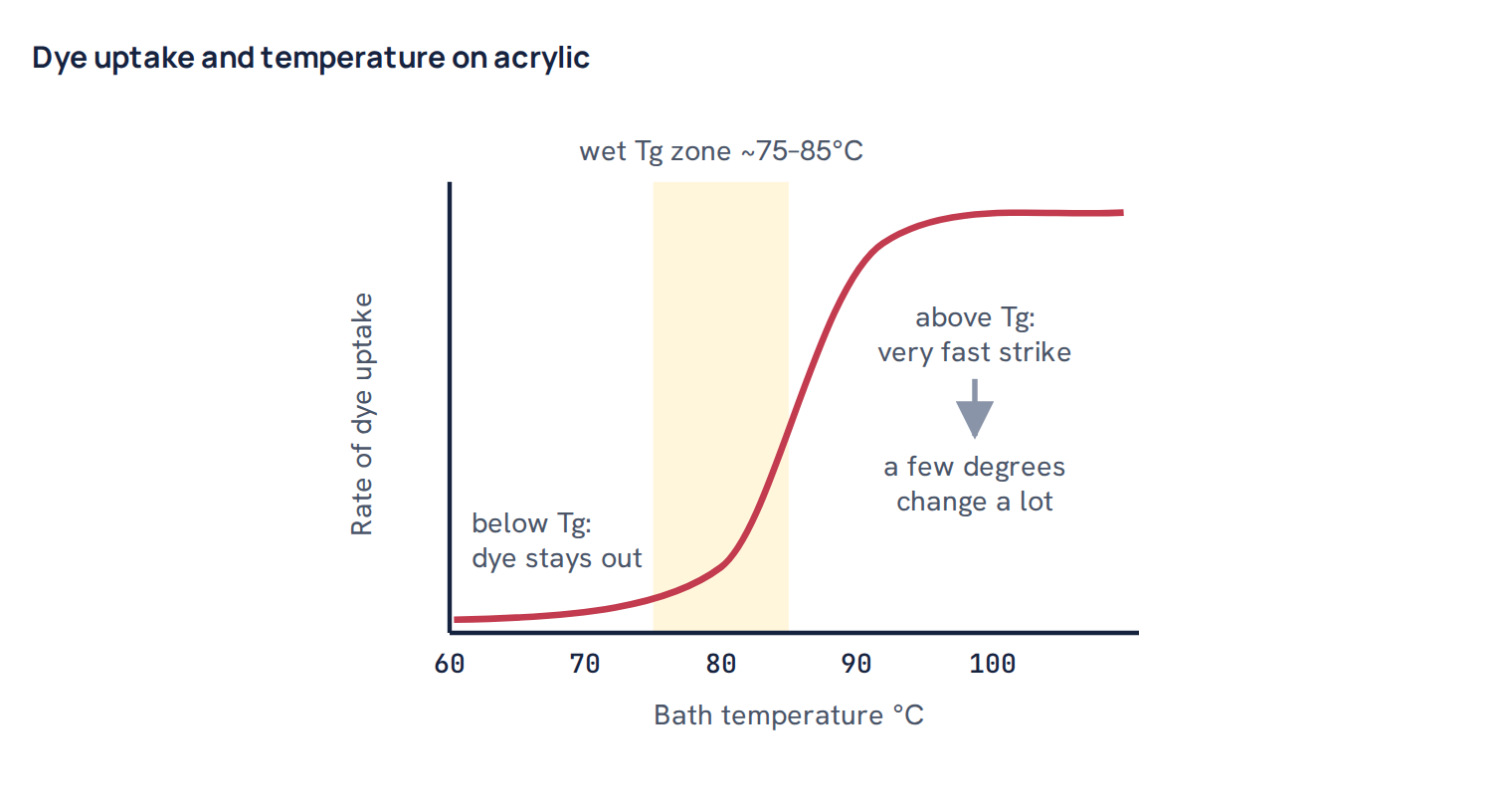
Both fibres are glassy polymers at room temperature. Their chains are frozen in place and there is almost no free space for a dye molecule to move through. When the fibre is heated past its glass transition temperature (Tg), parts of the chains start to move and the structure opens. For dry acrylic, Tg is usually quoted somewhere around 95–105°C. Water acts as a plasticiser and lowers it, so in a dyebath acrylic typically reaches its glass transition at roughly 75–85°C. The exact value depends on the comonomers and the fibre maker, so take these as typical figures, not fixed ones. CD polyester is more compact and its effective dyeing zone lies higher, which is why it needs pressure dyeing above the boil.
The mechanism: how a cationic dye holds on
The general steps of dyeing (transport through the bath, adsorption at the surface, diffusion into the fibre and fixation) are covered in how dyeing works: transport, adsorption, diffusion, fixation. For cationic dyes on acrylic, they run like this:
- Attraction. The fibre surface is negative. Dye cations in the bath are drawn to it strongly, even at low temperature. They collect at the surface, but cannot yet go inside.
- Opening. As the bath approaches the glass transition zone, the chains start to move and the fibre opens.
- Diffusion. Dye moves from the surface into the fibre and finds free anionic sites. Above Tg, diffusion speeds up very sharply with each degree.
- Fixation. The dye cation pairs with a sulphonate or carboxyl site. The sodium ion that was sitting on that site goes into the bath, where it meets the dye’s counter-ion. The bond is a salt link: an ionic bond.
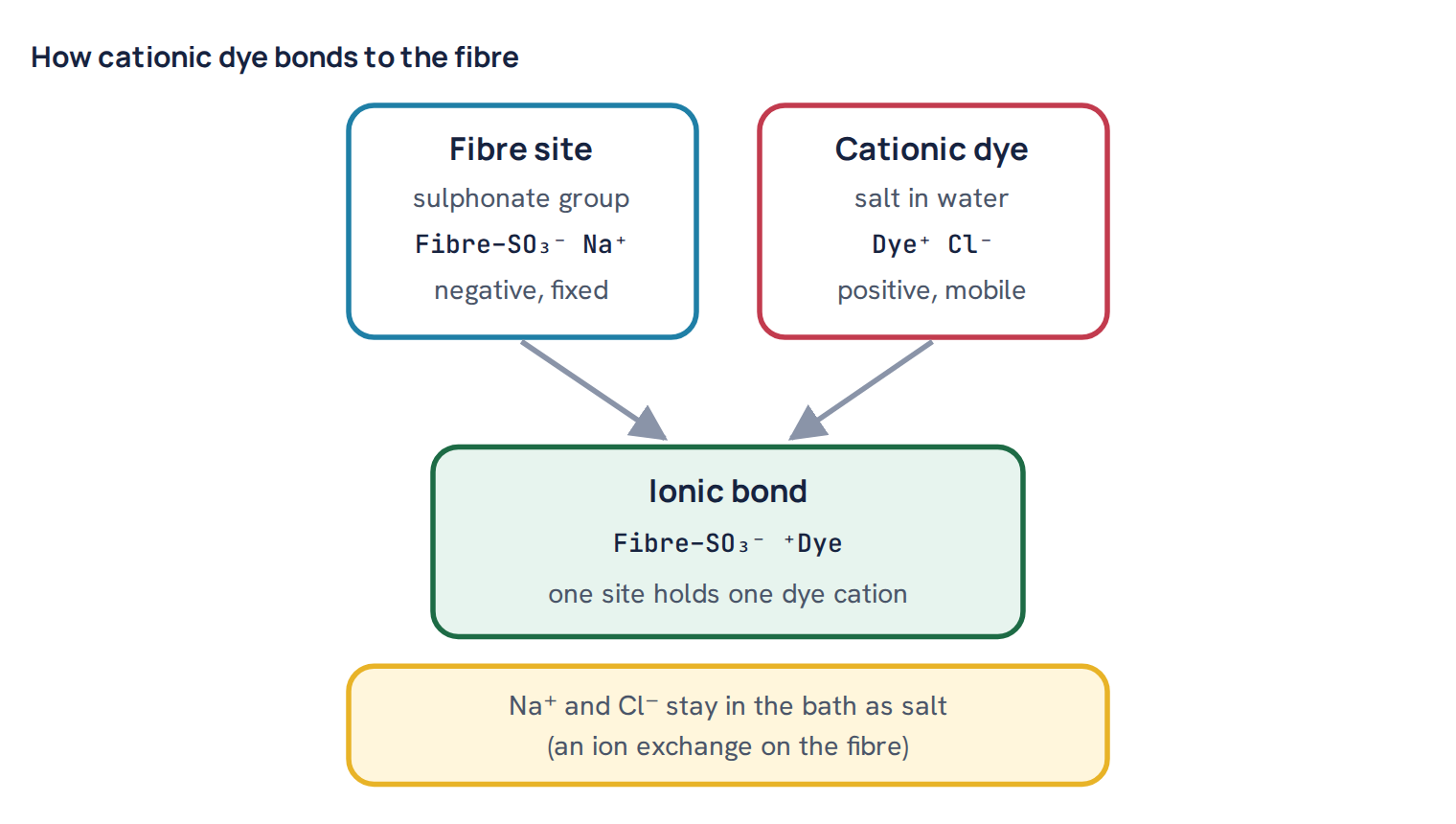
Besides the ionic bond, Van der Waals forces and other weak attractions act between the dye and the polymer chains, especially for larger dyes. But the ionic attraction dominates. It is much stronger than the hold of an acid dye on nylon in practice, because the fibre sulphonate groups are fully charged and the dye cation is attracted from the first moment. That high affinity is good for fastness, but it means the dye has very little tendency to come off once fixed. In other words, cationic dyes on acrylic migrate poorly. Whatever unevenness forms during the strike tends to stay.
Saturation and compatibility
The saturation value
Every acrylic fibre can hold only a certain amount of cationic dye, because each site takes one dye cation. Fibre makers and dye makers describe this with a fibre saturation value: roughly, the maximum amount of a standard reference dye the fibre can take, given as a percentage on weight of fibre. For common acrylics this is usually a few percent, but it varies widely between fibre types, from low values on some fibres to much higher ones on deep-dyeing types. Each dye then has its own saturation factor, which converts the fibre value into how much of that particular dye the fibre can take. A dye with a large molecule per unit of charge needs a larger amount by weight to fill the same number of sites.
The practical rule is simple. Add up the dyes in the recipe, each adjusted by its factor, and compare the total with the fibre saturation value. If the recipe goes over, the extra dye cannot fix. It stays in the bath, or sits loosely on the surface and causes poor rubbing and wet fastness. Deep blacks and navies on low-site acrylic are the usual place to meet this limit.
Compatibility: K values in plain words
In a mix, all the dyes compete for the same limited sites. If one dye goes on much faster than the others, it fills the seats first, the shade changes as the dyeing proceeds, and a small change in time or temperature gives a different result. To make recipes predictable, cationic dyes are rated by a compatibility value, often called the K value. It comes from a standard test in which dyes are run together and their order of uptake is compared. The scale usually goes from 1 to 5:
- Low K (around 1–2): high affinity, fast dyes. They strike quickly and level poorly, but build up well.
- High K (around 4–5): lower affinity, slower dyes. They go on more gradually and level better.
Dyes with the same or very close K values go on at the same rate, so their ratio stays constant from start to finish. That gives the “on-tone” build-up a dyer wants: the shade only gets deeper with time, it does not change hue. A related idea is the combination constant, which some literature uses to describe how well dyes combine; the meaning is the same in practice. Dye makers usually publish K values for each dye, and the safest recipes use dyes from one range with matched values. The same idea of matched dyes on limited sites is explained for nylon in how acid dyes work on nylon.
Why levelling is hard, and the tools for it
Put the facts together. The dye is strongly attracted from the start. Almost nothing happens below the glass transition, then uptake rises very sharply. Once fixed, the dye barely migrates. So a cationic dyeing can go from “no dye on the fibre” to “most dye on the fibre” in a temperature window of only a few degrees. If the fabric meets the dye unevenly during that window, because of liquor flow, temperature differences in the machine or folds, the unevenness is locked in. Dyers have four main tools to slow the strike.
Retarders
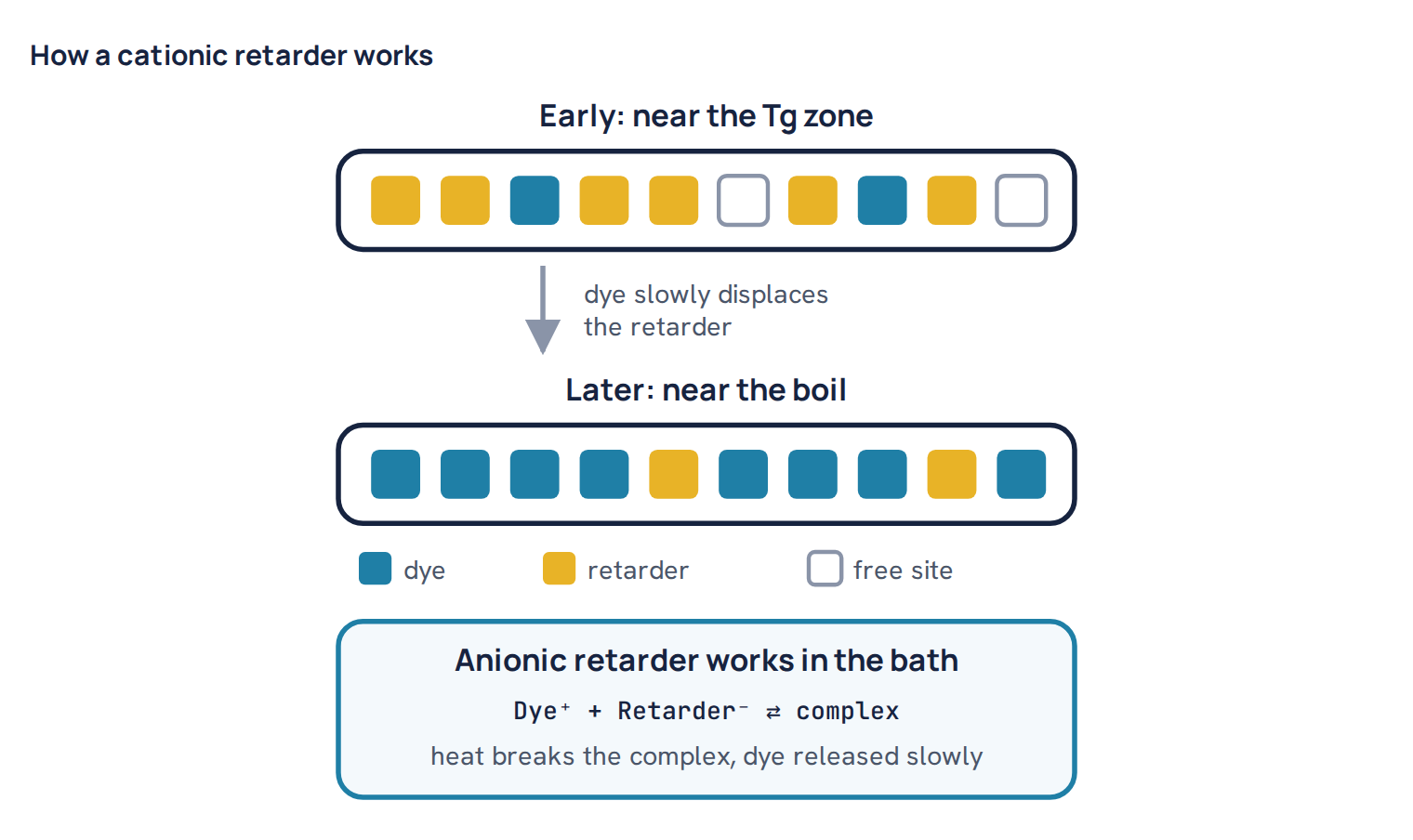
Cationic retarders are colourless cationic compounds, typically quaternary ammonium compounds with a fatty chain. They have affinity for the same anionic sites as the dye. Because they are small and fast, they take some of the sites first. The dye then has to compete with them, and it fixes more slowly as it gradually displaces the retarder. The retarder does use up sites, so in deep shades a high dose lowers the possible depth and can stop the bath exhausting. Retarders are also rated with K-type values, and the dose is chosen to “fill” part of the fibre’s saturation value together with the dye. Many dye makers give tables for the dose by shade depth: more retarder for pale shades, where levelness is critical, and little or none for deep shades, where all the sites are needed for dye.
Anionic retarders work in the bath instead of on the fibre. They are negatively charged and form a loose complex with the dye cation, which holds the dye back. As the temperature rises the complex breaks up and releases the dye gradually. The risk is that a dye–anionic complex can become insoluble and precipitate, so anionic retarders are used together with a non-ionic dispersing agent that keeps the complex dispersed. They are less common than cationic retarders and must be used only with dyes and products that are known to work together.
Slow heating through the critical zone
The most powerful tool is temperature control. The bath can be heated fairly quickly up to just below the glass transition zone, because little happens there. Through the critical zone, typically somewhere around 80–95°C for many acrylics, the heating rate is cut sharply, often to something like 0.25–0.5°C per minute, or held in steps. Some dye houses use a short hold inside the zone. The exact zone and rate depend on the fibre, the dyes and the machine, so they are confirmed in the lab and on first bulk lots. After the zone, the bath is held near the boil for diffusion and exhaustion.
pH control
Cationic dyeing is done in a weakly acid bath, normally set with acetic acid, often buffered with sodium acetate, at a pH of roughly 4–5.5. The exact value depends on the fibre and the dye range. The acid has several roles. It keeps the weak carboxyl sites partly un-ionised, so the number of active sites is a little lower and the strike a little slower. It keeps the dyes stable, because many cationic dyes change shade or decompose in neutral to alkaline conditions, especially when hot. And it protects against alkali carried in from scouring, which would push the pH up and speed the strike.
Glauber’s salt
Sodium sulphate (Glauber’s salt) is added in many acrylic recipes, often a few percent to around 10% on weight of fibre. The sodium ions compete weakly with the dye cations for the anionic sites, which gives a mild retarding effect. Salt is not a strong retarder, but it is cheap and helps in pale shades. Note that this is the opposite of its role with direct and reactive dyes on cotton, where salt pushes dye on.
The acrylic dyeing curve
A typical acrylic cycle looks like this. The figures below are an illustration of the common pattern, not a fixed recipe; dye makers and fibre makers publish their own.
- Set the bath at about 50–60°C with acetic acid (and buffer), Glauber’s salt and the retarder. Run a few minutes so everything is evenly spread.
- Add the dissolved dye slowly and run again.
- Heat at around 1°C per minute to just below the critical zone.
- Heat slowly through the critical zone, for example 0.25–0.5°C per minute, up to 98–100°C.
- Hold about 30–60 minutes, depending on shade depth.
- Cool slowly, often around 1°C per minute or less, to about 70°C or below before draining.
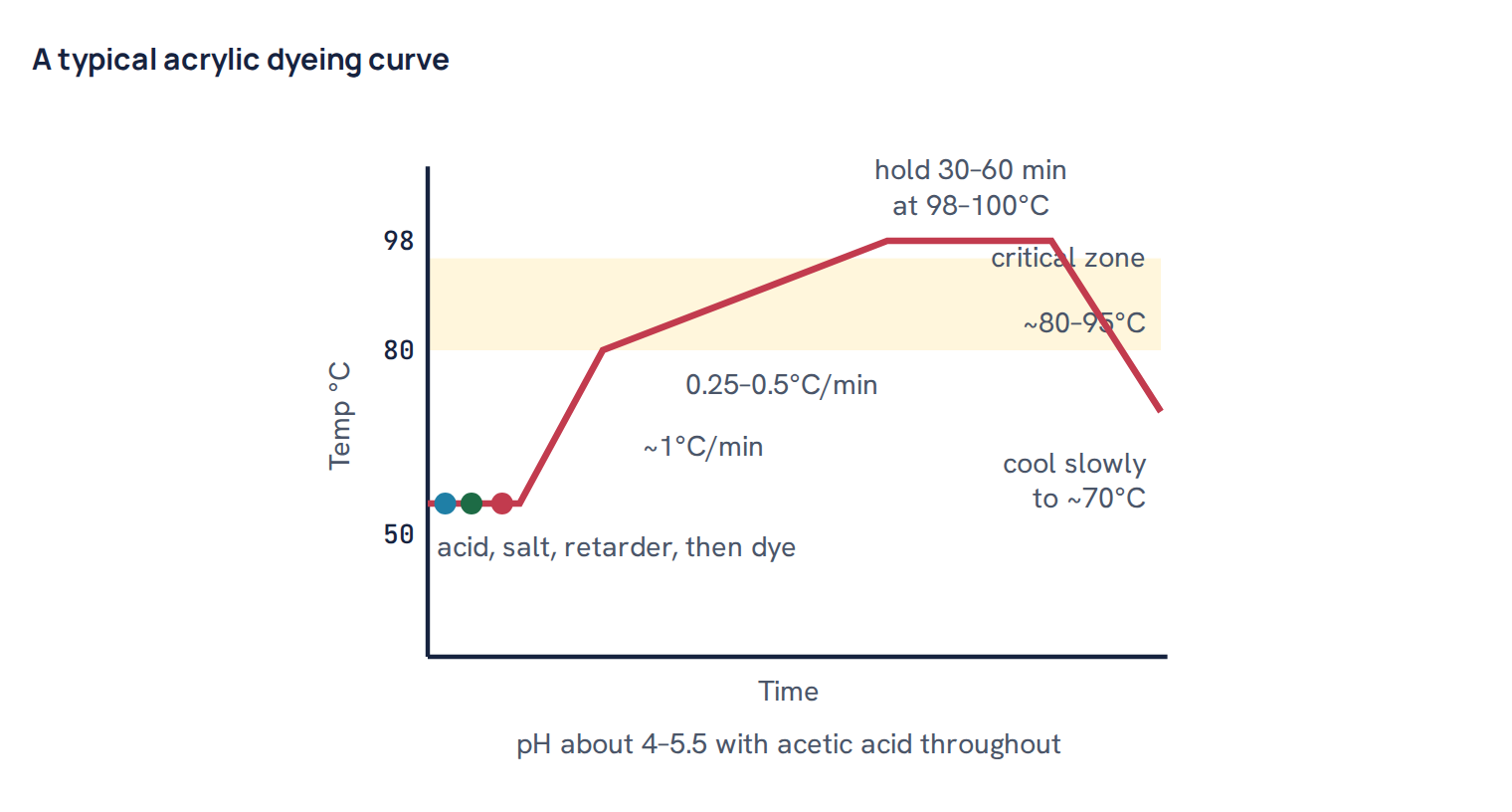
The slow cooling step matters as much as the slow heating. Hot acrylic is soft and plastic. If it is cooled suddenly, for example by draining hot or flushing with cold water, any creases present at that moment are set into the fabric as permanent marks, and the handle can become harsh. For acrylic-cotton blends, see the cotton-acrylic knit dyeing process.
Worked example. Suppose a dye maker’s table says a pale shade on a given acrylic needs retarder equal to most of the fibre’s free capacity, and a deep shade needs almost none. A dyer running a pale grey and then a deep navy on the same quality would therefore use a high retarder dose for the grey and drop it to a minimum for the navy, so the navy’s dye can use nearly all the sites. Using the pale-shade dose on the navy would leave dye in the bath and the shade would come out light and dull.
CD polyester: higher temperature, same chemistry
CD polyester follows the same ionic mechanism, with the same limited sites, compatibility rules and need for a controlled strike. The difference is temperature. The fibre is more compact than acrylic, so it needs a bath above the boil under pressure, but much less than normal polyester. Normal polyester with disperse dyes is usually dyed at around 130°C (see how disperse dyes work on polyester). CD polyester with cationic dyes is commonly dyed at around 110–120°C, depending on the fibre and the dye maker’s advice. The lower temperature saves energy and is gentler on blended fibres such as cotton or elastane.
CD polyester is less heat-sensitive than acrylic in terms of handle, but retarders, pH control and a matched dye selection are still used. Because the cationic dye has no affinity for normal polyester, CD yarns and normal yarns behave very differently in the same bath, and this opens the door to design effects.
- CD polyester is dyed with cationic dye at pH 4, heated to 110°C at 1.5°C per minute and held 45 minutes.
- We dye 100% CD polyester, CD with normal polyester for two-tone effects, and CD with cotton. In a blend, the CD part is dyed with this process and the other fibre with its own process.
- Reduction clearing is not needed for the cationic dyes themselves. It is done on fabrics with a normal polyester part that needs it.
Two-tone and cross-dye effects
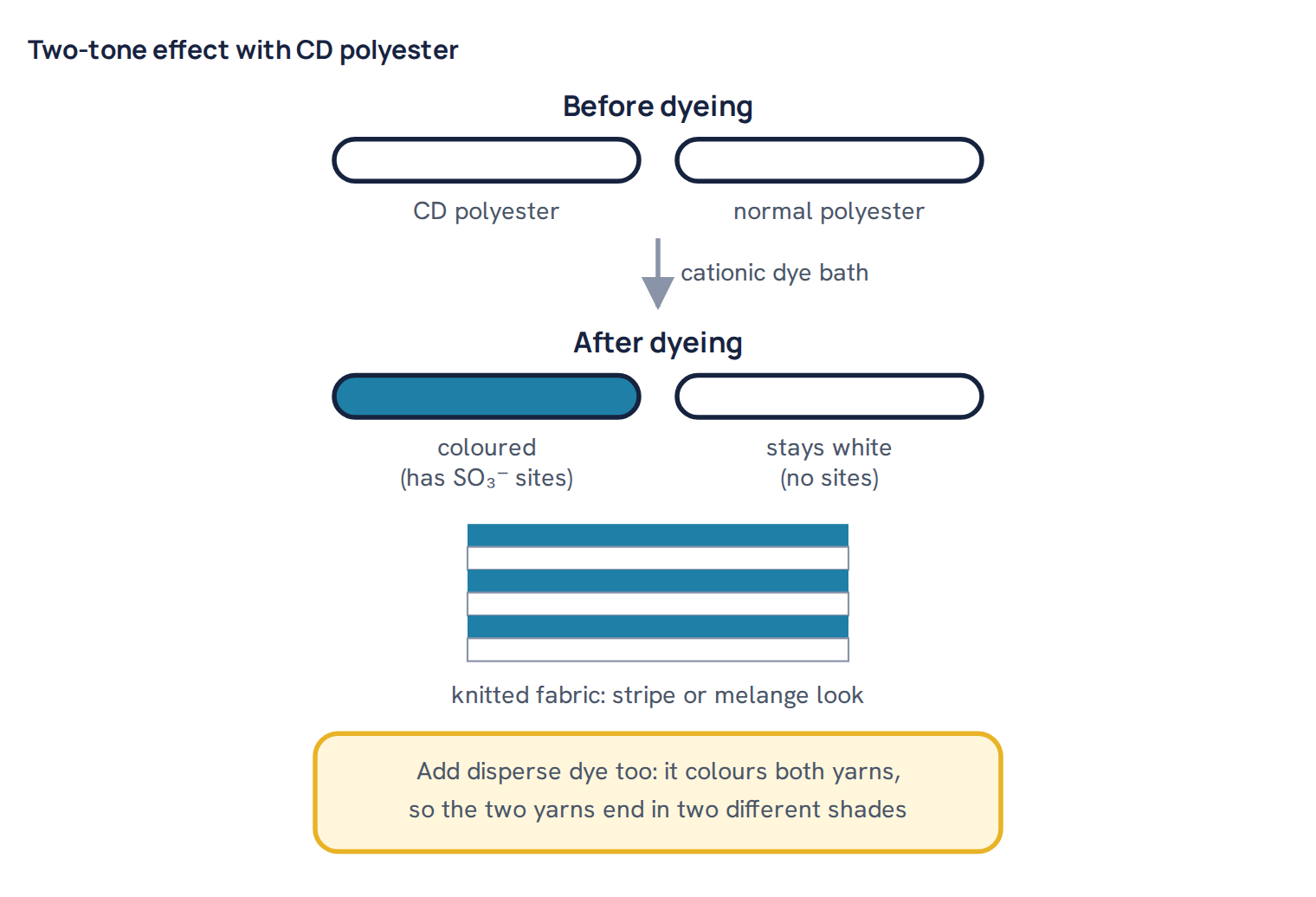
If a fabric is knitted from CD polyester yarn and normal polyester yarn, a cationic dye colours only the CD yarn. The normal polyester has no anionic sites and stays white or near white. The result is a stripe, check, heather or melange look from a single dyeing, depending on how the yarns are placed in the knit. If disperse dye is added as well, it colours both polyesters, because CD polyester also takes disperse dye. Then the normal yarn gets the disperse shade and the CD yarn gets the disperse shade plus the cationic shade, giving two different colours. The same principle works with CD polyester and cotton: a cationic dye colours the CD part, and the cotton is dyed separately with its own class, such as reactive dyes, in a contrasting or matching shade.
Blends: each fibre with its own dye class
Cationic dyes colour only the fibre with anionic sites. In blends, each component is dyed with its own class:
- Acrylic-cotton: cationic dyes for the acrylic, reactive or direct dyes for the cotton.
- CD polyester-cotton: cationic dyes for the CD part at its own temperature, reactive dyes for the cotton.
- CD polyester with normal polyester: cationic dyes for the CD part; disperse dyes if the normal polyester must be coloured too, followed by reduction clearing if the disperse shade needs it.
The key risk in blends is the charge clash. Reactive, direct and acid dyes are anionic. If anionic dye and cationic dye meet in the same bath at the wrong moment, they can form an insoluble salt and precipitate as specks and dull, uneven patches. Dye houses avoid this by dyeing the components in separate baths or stages, or, where a one-bath process is used, by choosing products that the suppliers approve for use together, often with a special anti-precipitant. Cotton can also pick up some cationic dye as a surface stain, which has poor fastness; it must be cleared off in the after-wash, otherwise it bleeds later.
Fastness
On acrylic, cationic dyes give some of the brightest shades of any dye-fibre pair. Light fastness is generally good to very good on acrylic, although it varies from dye to dye, and the older delocalised dyes in bright shades tend to be weaker than modern pendant types. Wet fastness is usually good, because the ionic bond is strong and the dye migrates little once the fibre is cool and glassy again. Rubbing fastness is good as long as the fibre was not dyed beyond saturation.
On cotton, wool and silk the picture is different. Those fibres either lack strong anionic sites or hold the dye in a less stable form, and light fastness of cationic dyes on them is poor. This is why basic dyes faded from textiles in the past, and why any cationic stain on the cotton part of a blend must be washed off. On CD polyester, fastness is generally good, though it can be slightly lower than the same dye on acrylic, depending on the dye.
Common faults and their causes
- Unlevel or streaky dyeing. Usually a fast strike: heating too fast through the critical zone, too little retarder, poor liquor flow or temperature differences in the machine. Because cationic dyes migrate poorly, these marks are hard to repair.
- Shade change from site saturation. When the recipe is close to or over the fibre’s saturation value, the fastest dye takes most sites and the slow dye is left behind. The hue shifts, depth stops building, and loose surface dye lowers fastness. Too much cationic retarder in a deep shade has the same effect.
- Incompatible dyes. Dyes with very different K values change the shade during the cycle, so small changes in time or temperature give batch-to-batch variation.
- Precipitation with anionic products. Anionic detergents, softeners, optical brighteners or anionic dyes left on the fabric or added to the bath can react with the cationic dye and form an insoluble complex. This shows as specks, dull shade, poor exhaustion or tar-like deposits in the machine. Rinse well after any anionic pretreatment and check that all auxiliaries are suitable for cationic dyeing.
- Harsh handle or loss of bulk on acrylic. Acrylic is sensitive to high temperature combined with tension or pressure. Dyeing too hot, running too long near the boil, sudden cooling, or heavy steaming under stress can flatten high-bulk yarns, give a harsher, less springy handle and set in creases. The exact limits depend on the fibre, so follow the fibre maker’s advice and avoid extremes.
- Shade change from pH or water. A high pH from alkali carry-over speeds the strike and can change the shade of sensitive dyes. Check the pH of water and fabric before dyeing.
Common mistake: using a normal anionic softener or detergent before or in a cationic dyeing. The anionic product meets the cationic dye, they precipitate together, and the result is specks and a dull, unlevel shade that is very hard to correct.
When a cationic dyeing goes wrong, ask four questions. How fast did the bath heat through the critical zone? Is the total dye and retarder within the fibre’s saturation value? Do the dyes have matched compatibility values? Did any anionic product reach the bath? Those answers explain most problems with cationic dyes on acrylic and CD polyester.
Questions
Why are cationic dyes also called basic dyes?
The older name comes from the chemistry of the dye base: the coloured part carries a positive charge, like a protonated base. Today both names are used for the same class.
Why does acrylic dye so unevenly?
Very little dye enters below the glass transition, then uptake rises sharply over a few degrees, and the fixed dye barely migrates. Any uneven strike in that short window stays in the fabric.
What does a cationic retarder do?
It is a colourless cationic compound that takes some of the fibre’s anionic sites first. The dye must displace it, so the strike is slower and more even, but too much retarder in a deep shade lowers the possible depth.
Can normal polyester be dyed with cationic dyes?
No. Normal polyester has no anionic sites, so cationic dyes do not hold on it. This is why a CD and normal polyester fabric dyed with cationic dye gives a two-tone effect.
Is reduction clearing needed after cationic dyeing?
Not for the cationic dye itself. It is done only when a normal polyester part has been dyed with disperse dyes and needs clearing.

Textile engineer with 14+ years in dyeing and fabric development. He writes every guide on Dyeing Solution from real production work. Full profile