What bias or wale skew is, how AATCC 179 and ISO 16322 measure it after washing, what limits buyers set, why knits fail, and how slitting, straightening and stenter settings prevent or correct it.
At a glance
35 / 2results / fails in our lab reports
max 4%limit in all our reports (varies)
1.4%middle result after 3 washes
3 washes41 °C normal cycle, tumble dry low
A knit T-shirt can leave the factory with perfectly straight side seams and come back from the customer’s washing machine with the seams twisted towards the front. Very often the cause is not the sewing. It is the fabric: its courses and wales were not at right angles to each other when it was cut, or they were forced to right angles during finishing and moved back once the fabric got wet. Buyers test for this as skew (also called bias or wale skew), and on knit fabric it is closely tied to spirality and bow. This article explains what skew is, how it differs from those two faults, how it is measured before and after washing, what limits buyers usually set, why knit fabric fails, and what a dye house and finishing section can do to prevent it or rescue a failed batch. It is built on the skew results in our own lab reports.
What skew is, and what it is not
Every knit fabric has two sets of lines. Wales are the vertical columns of loops, made by one needle each. Courses are the horizontal rows of loops, made by one feeder pass. In a perfect fabric the wales run straight along the length, the courses run straight across the width, and the two meet at 90 degrees. Three different faults break that square grid, and they are easy to confuse because all three end up as a twisted garment.
- Skew (bias). The courses are straight but they are not at right angles to the wales or to the selvedge. One edge of a course line is higher than the other. On a roll you see it as a stripe or course line running uphill across the width.
- Bow. The courses are curved, not straight. The centre of the course lags behind or runs ahead of the two edges, so a stripe forms an arc, like a smile or a frown across the width.
- Spirality. The wales themselves lean away from the length direction. The main driving force is the torque in the yarn: a twisted yarn wants to untwist, and in single jersey it pulls each loop over to one side. Spirality usually appears or grows when the fabric is relaxed in washing.
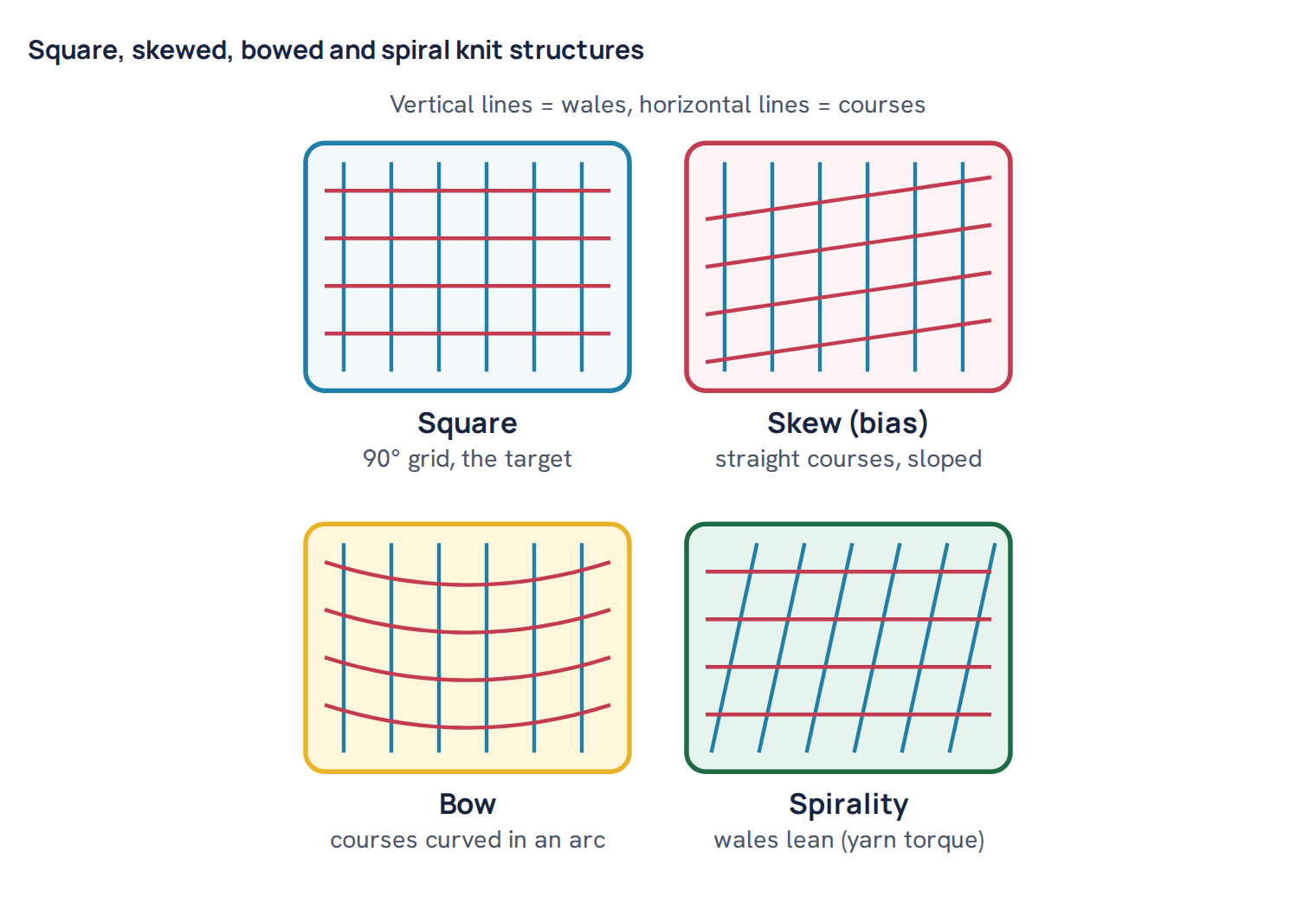
In practice the words overlap. Many buyers and labs use “skew”, “skewness change”, “twist” and “spirality” for the same washing test, because what the test measures is the final angle between the grid lines after washing, whatever caused it. The distinction still matters on the floor, because it tells you who can fix the problem. Spirality is decided mostly at the yarn and knitting stage. Skew and bow on a finished roll are mostly decided in slitting, open-width processing and stentering. A skew change that only shows after washing is usually the sum of both: some built-in yarn and knitting tendency, plus whatever the finishing line did to hide or exaggerate it. For the yarn-torque side of the story, see our guides on how to test spirality of knit fabric and spirality test fail causes and remedies.
Measuring skew on the roll, before washing
Skew on finished fabric is checked during fabric inspection, before any wash. The principle, used in the common bow-and-skew methods for woven and knit fabric, is simple. Lay the fabric flat without tension. Find a course line, a stripe or a pattern line that should run straight across. Draw or imagine a true perpendicular to the selvedge (or to a wale line) at one edge. Measure how far the course line has moved away from that perpendicular at the other edge. Then express it as a percentage of the width:
- Skew % = distance the course has moved at the far edge ÷ fabric width × 100.
- Bow % = depth of the arc at its deepest point ÷ fabric width × 100.
On solid-dyed fabric the course line is hard to see, so inspectors pull a single yarn, follow a needle-drop line, or mark a course with a pen while counting loops. On yarn-dyed stripes and engineered patterns it is easy, because the stripe itself is the course line. That is one reason yarn-dyed fabrics get tighter roll limits: the eye notices a sloping stripe on a garment immediately.
A roll can show 0% skew on the inspection table and still fail the washing test. In all our lab reports the “before” value was 0.0%. The fabric was square when it was tested. What failed was how far it moved once it was washed and tumble dried. That is why buyers care more about the after-wash result than the roll result.
Measuring skew after washing: the test principles
Two families of standard methods are used for the washing test. AATCC 179 measures skewness change and garment twist after home laundering. ISO 16322 measures spirality after laundering, with separate parts for specimen preparation, for woven and knit fabric, and for garments. The details of specimen size, marking and wash programme differ, but the idea is the same in both: mark a square reference pattern on a flat specimen, wash and dry it in a defined way, then measure how far the pattern has distorted.
Specimen and marking
A specimen is cut from the fabric, away from the selvedge and from any creases, with its edges following a wale and a course. Specimen and marking sizes are set by the standard you test to; follow its exact dimensions. The fabric is conditioned at standard temperature and humidity before marking, because a fabric that is still warm and dry from the stenter has not yet settled.
Two marking schemes are common:
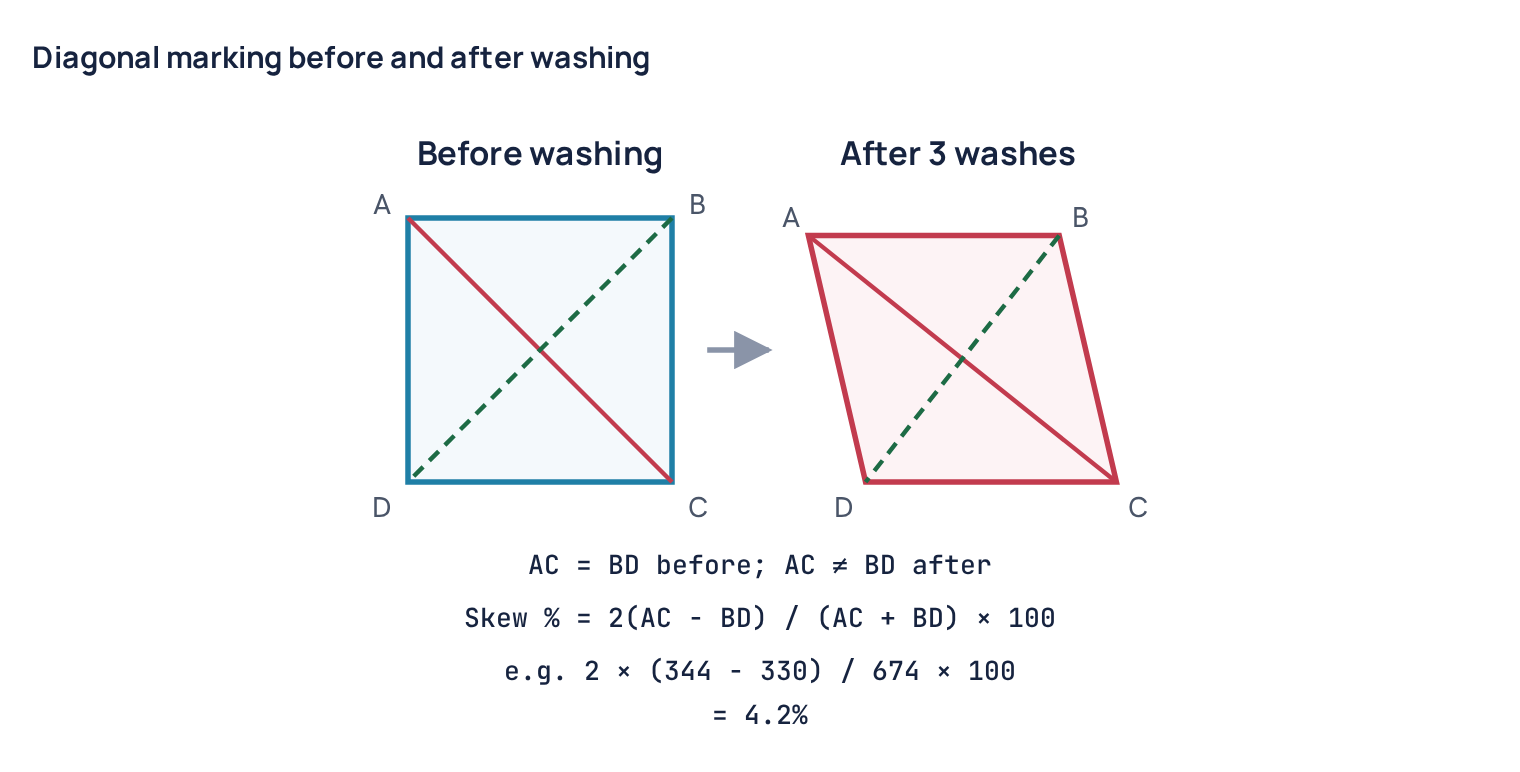
- Diagonal marking. The four corners of the reference square are marked A, B, C and D. After washing, the two diagonals AC and BD are measured. If the fabric stayed square, the diagonals stay equal. If the grid has sheared, one diagonal becomes longer and the other shorter.
- Inverted-T marking. A base line is drawn across the course direction, and a perpendicular line is drawn up along a wale from its centre. After washing, the end of the wale line has moved sideways. That sideways movement, divided by the length of the line, gives the skew or twist percentage. The angle can also be calculated from the same two numbers.
Washing and drying conditions
The specimen is washed in a standard lab washer with a reference detergent and a ballast load to make up the machine load. The buyer chooses the wash temperature, the cycle and the drying method, usually to match the care label. In our lab reports every skew test used the same programme: a normal machine wash at 41 ± 3 °C, tumble dry on low, repeated for three wash-and-dry cycles. Three cycles is the most common choice, because most of the movement happens in the first few washes. After the last cycle the specimen is conditioned again, laid flat without tension, and measured.
Reading the result
- The number. Using the diagonal method, the percentage is twice the difference between the diagonals, divided by their sum, times 100. Using the inverted-T method, it is the sideways movement divided by the original line length, times 100.
- The sign. Some reports give a plus or minus sign, or say “left” or “right”, to show which way the grid sheared. One of our results was −2.8%. Buyers normally judge the size of the number, not the direction, so −2.8% passes a 4% limit in the same way as +2.8%.
- Before and after. Many reports show the before value too. Where the before value is not zero, the change is what matters, and the buyer’s requirement should say whether it applies to the after value or to the change.
- Resolution. Measurements are taken to the nearest millimetre on a ruler. On a typical marked square, a difference of one or two millimetres moves the result by a fraction of a percent. That is why results come in steps, and why a result of 4.2% against a 4% limit is a real but marginal fail.
Common mistake: Marking the reference square along the edges of the specimen as cut, instead of along a real wale and course. If the cutter cut the specimen slightly off the grain, the “before” square is already skewed, and the result mixes cutting error with fabric movement. Always align the marks to a counted wale and a followed course.
Typical requirements
Limits vary by buyer, by fabric type and by garment. As a general picture, which you should always check against the buyer’s own manual:
| What is checked | Typical range | Notes |
|---|---|---|
| Skew after 3 home washes, plain knits | max 3–5% | 4% is very common; all our reports used max 4% |
| Skew after washing, stripes and yarn-dyed | often tighter, around 3% | sloping stripes are visible on the body |
| Skew or bow on the finished roll | around 2–5% depending on buyer | yarn-dyed and engineered stripes stricter |
| Garment twist (side seam movement) | often max 5% or a fixed distance | tested on made-up garments |
What our lab reports show
We collected the skew results from the knit lab reports that reached our desk. These are not a random sample of production. Reports usually reach us when there is a question, a new development or a problem, so the set leans towards difficult fabrics and the fail rate is higher than in normal bulk. With that in mind, the 35 results are still useful.
All 35 were tested by the diagonal-marking route with three washes at 41 °C and low tumble drying, against a limit of 4%. Thirty-three passed and two failed. Twenty-five results were 2% or lower. Seven were between 2% and 3%. One, a heavy yarn-dyed jersey, sat at 3.7%, close to the line. The middle result was 1.4%. The two fails were a CVC baby terry at 9.8% and a cotton yarn-dyed pique at 4.2%.
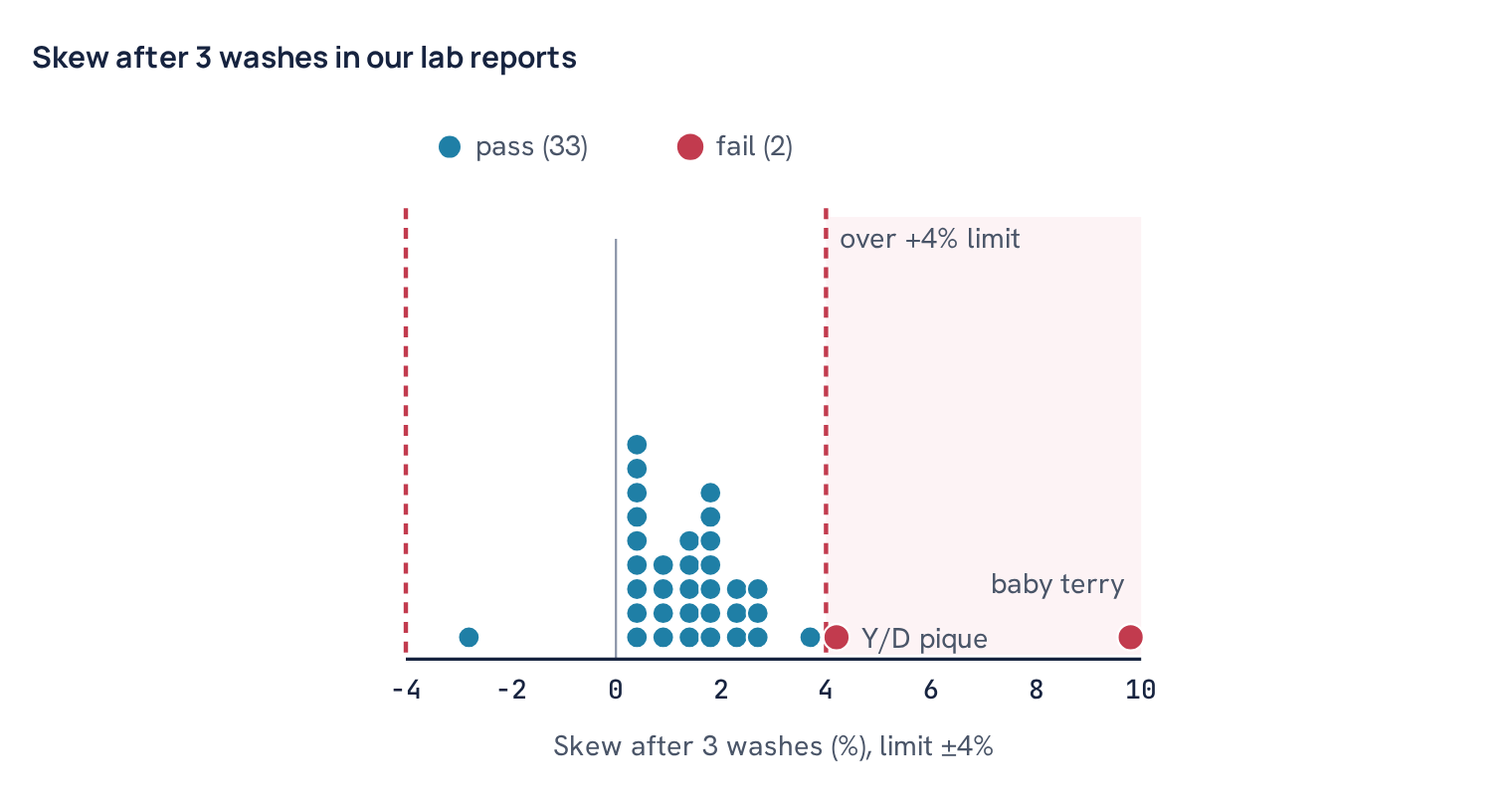
Two patterns stand out. First, simple, balanced constructions such as 1×1 rib, interlock and heavy single jersey mostly stayed below 1%. Rib and interlock are knitted from both needle beds, so the loop torque on one face is balanced by the other face. Second, both fails were fabrics where the structure itself makes skew more likely: a terry with a separate loop yarn and many feeders, and a yarn-dyed pique where any slope is easy to see and the fabric is often finished open-width. The same yarn-dyed pique quality appears twice in our set, once at 2.3% and once at 4.2%. Same construction, same weight, different lots. That gap is a reminder that skew is strongly affected by how each lot was slit, straightened and set, not only by the design.
Worked example. A report for a 305 GSM cotton yarn-dyed pique shows: method AATCC 179, diagonal marking, normal cycle 41 ± 3 °C, tumble dry low, 3 washes; before 0.0%, after 3 washes 4.2%; requirement max 4%; verdict fail. Reading it: the fabric was square when marked, so all 4.2% is movement caused by washing. With diagonals of, say, 344 mm and 330 mm, the calculation is 2 × 14 ÷ 674 × 100 = 4.2%. The fail margin is 0.2%, which is less than one millimetre on the diagonal. So the first action is to look at the specimen and confirm the marks were on a true wale and course. If they were, the result is real but marginal, and a small correction at the stenter or in relaxation is likely to bring the next lot inside the limit. A result like the baby terry at 9.8% is different: it is more than twice the limit, so no measurement detail explains it, and the cause must be found in the construction and the finishing route.
Why knit fabric skews
Knit fabric is far more easily distorted than woven fabric. Loops can slide and rotate, and the fabric has very little resistance to shear. Any process that pulls one side of the fabric ahead of the other, or that sets the courses at an angle while the fabric is hot and wet, can build skew into it. Washing then releases what was set.
Multi-feeder knitting and course inclination
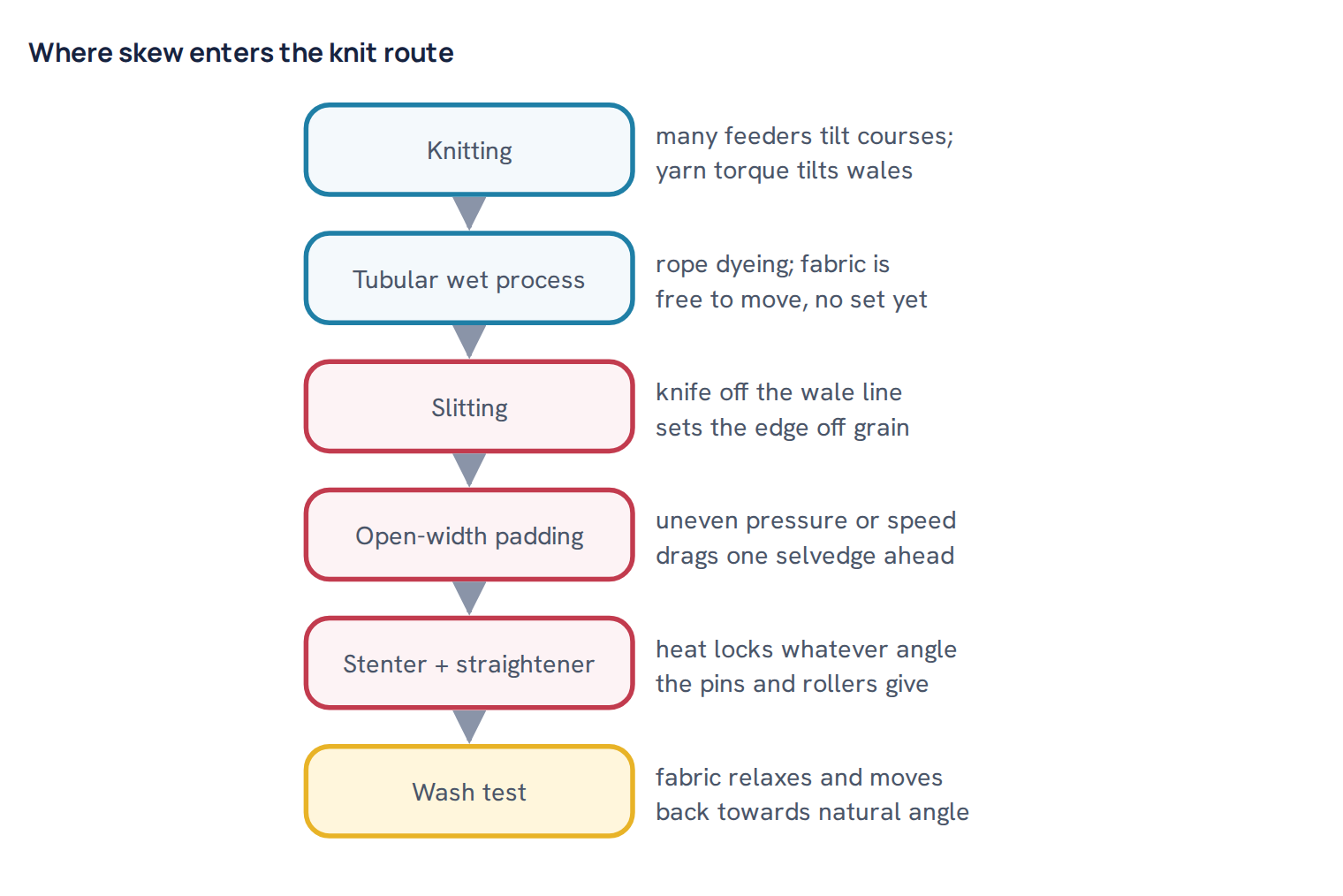
A circular knitting machine has many feeders around the cylinder, and each feeder knits its own course on every revolution. So the courses do not form separate rings. They form a helix that climbs around the tube, like the thread of a screw. The more feeders and the longer each loop, the steeper the helix. When the tube is slit open along a wale line, the courses in the open fabric are therefore not at 90 degrees to the wales. They slope by a small but real angle.
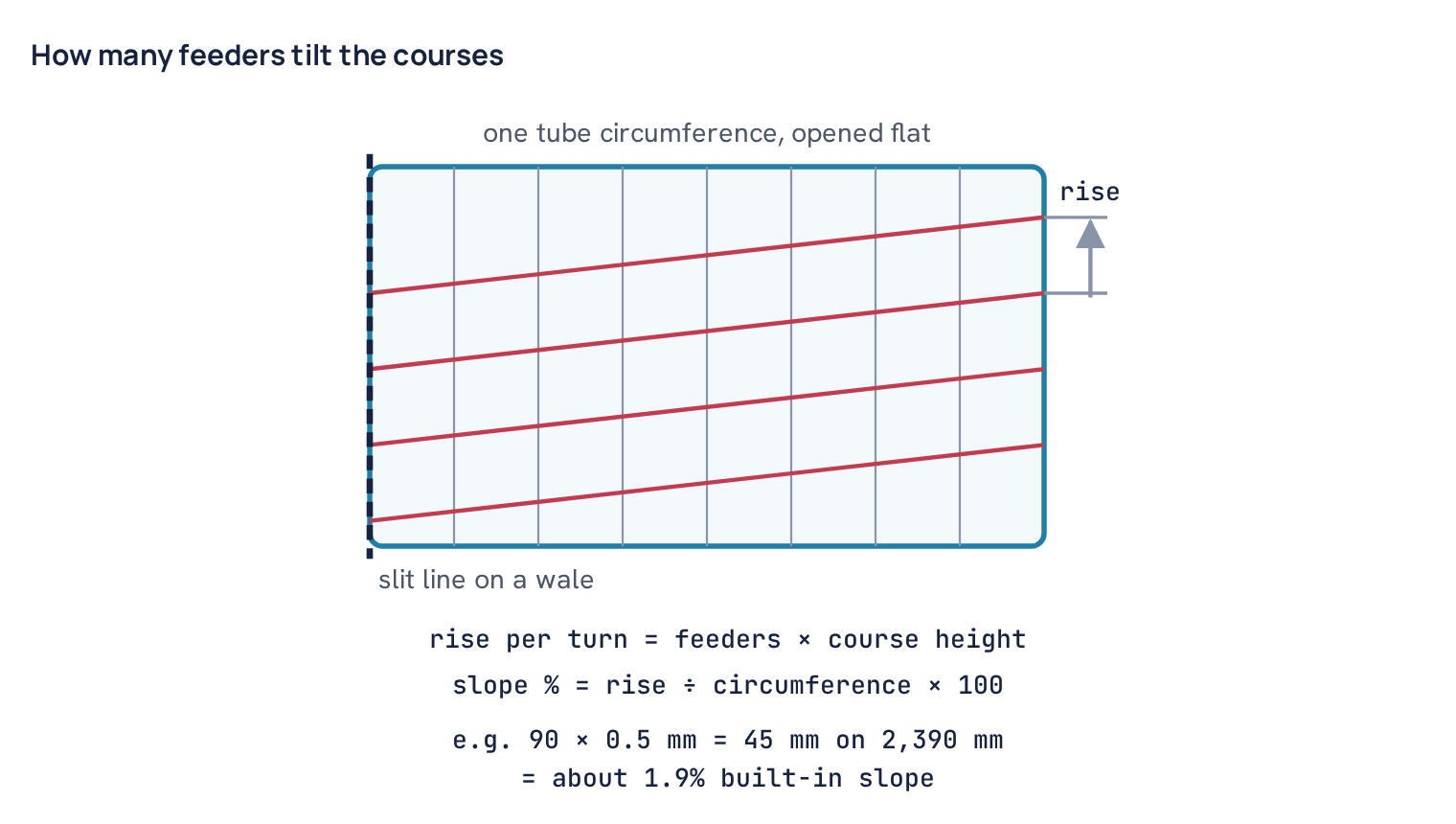
The worked numbers in the diagram are an example, not a rule, but they show the scale. A 30-inch machine has a circumference of roughly 2,390 mm. With 90 feeders and a course height of half a millimetre, each revolution climbs 45 mm, which is a slope of almost 2%. Finishing can square the courses up so the roll looks perfect, but then the wales are leaning by the same amount, and the loops are held in a strained position. Washing gives them the freedom to go back.
Tubular slitting off the needle line
Tubular fabric is slit open before open-width finishing. The cut should follow a single wale, usually a line marked during knitting by a missing needle or a needle-drop line. If the slitting knife wanders off that line, the cut edge crosses wales at an angle. The stenter clips or pins then hold that cut edge as if it were straight, and the whole width is set out of square. The fabric looks fine on the roll and moves in the wash.
Open-width processing pulling courses out of line
Every open-width machine, such as a padder, a squeezer, a dryer or a compactor, can pull one side of the fabric slightly faster than the other. Causes include worn or uneven rollers, a mangle with more pressure on one side, uneven moisture across the width, guide rollers that are not parallel, and fabric that enters off centre. Each small difference drags one selvedge ahead and puts the courses on a slope. Wet cotton knit is especially easy to pull, because wet cellulose is plastic and the loops move freely.
Stenter entry and weft straightener settings
The stenter is where skew is finally set in. Heat and drying lock the fabric geometry until the next wetting. At the entry, the two selvedges must be picked up by the pins or clips at exactly the same time and with the same overfeed. If one side is overfed more, or one chain runs ahead, the courses are set at an angle.
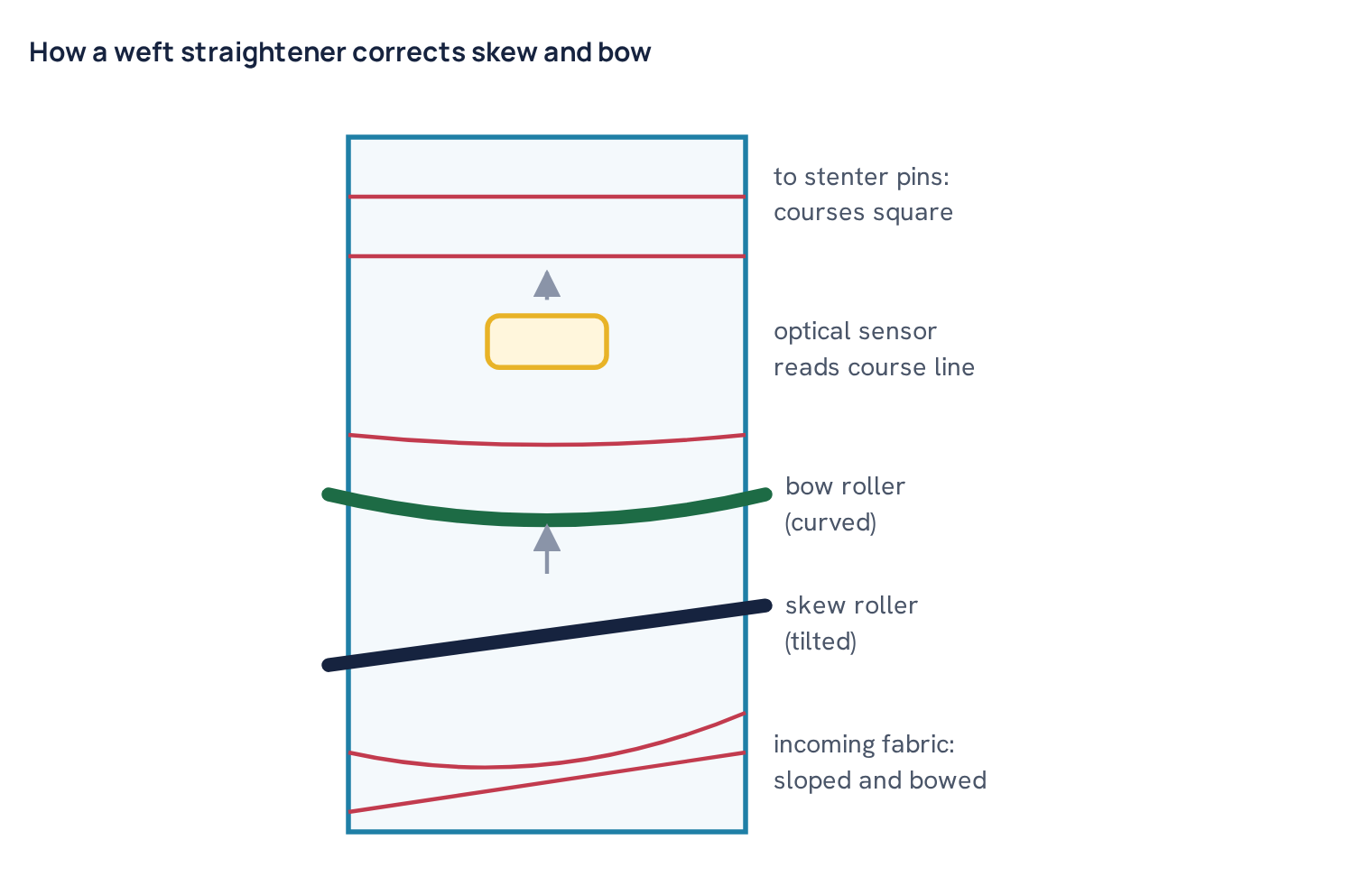
Most stenters have a weft straightener at the entry. Optical sensors read the course line or the stripe pattern, and motorised rollers correct it. A skew roller is tilted so one side of the fabric travels a longer path than the other, which brings a sloping course back to square. A bow roller is curved so the centre travels a different path from the edges, which flattens a bowed course. Straighteners work well, but they need correct settings for knit fabric: the sensor must actually be able to read the courses, and the correction must not be so aggressive that it simply forces the fabric square and stores the strain.
Diagonal and structured fabrics
Some knit structures are diagonal by design. Diagonal terry, twill-effect knits and many jacquards place their floats or tucks in a stepped pattern that moves one needle across on each course. The fabric naturally wants to shear along that diagonal. Terry and fleece also have two or three yarn systems, each with its own twist and tension, and many feeders. Pique and other tuck structures have uneven loop lengths. In all these fabrics, the stable “relaxed” geometry is not perfectly square, so forcing them square at the stenter almost guarantees movement in washing. Our terry fabric development guide and pique development guide cover the construction side in more detail.
Yarn torque underneath it all
Even when the processing is perfect, single jersey made from singles ring-spun yarn carries yarn torque. Higher twist, finer count and a looser stitch make it stronger. This is the spirality side of the problem, and it adds to or subtracts from any processing skew. It explains why one of our results came out negative: the built-in tendency of that fabric pulled the grid the other way. More on the knitting side is in the single jersey development guide.
Causes at a glance
| Cause | Stage | What you see |
|---|---|---|
| Many feeders, long loops (course inclination) | Knitting | Built-in slope that returns after wash |
| High-twist singles yarn, one direction | Yarn, knitting | Wales lean after wash (spirality) |
| Diagonal or tuck structure, terry, fleece | Design | Fabric shears along its pattern |
| Slitting off the wale line | Slitting | Edge not on grain, whole width set off square |
| Uneven roller pressure or speed side to side | Open-width wet processing | One selvedge leads, courses slope |
| Uneven overfeed or pin entry at stenter | Stenter | Skew set in by heat |
| Straightener off, misread or overcorrecting | Stenter | Square roll, large movement in wash |
| Fabric finished under tension, not relaxed | Drying, compacting | Large shrinkage and skew change together |
Looking at our two fails
The baby terry at 9.8% combines almost every risk factor. It is a three-yarn or two-yarn construction with a loop yarn and a ground yarn of different tensions, it is usually knitted on large machines with many feeders, and it is often brushed or finished open-width. A result more than twice the limit points to a fabric that was set well away from its natural angle, most likely forced square at the stenter. Fixing that takes more than a small straightener adjustment. It needs a look at the slitting line, at how hard the fabric was straightened, and at whether it could be relaxed and finished with less tension.
The yarn-dyed pique at 4.2% is a marginal fail, and the same quality passed at 2.3% in another lot. That points to lot-to-lot variation in slitting and straightening, not to a design problem. For yarn-dyed fabric the straightener has an advantage, because the stripes give the sensor a clear line to read, but only if the sensor and correction are set and checked.
Common mistake: Using the weft straightener to make every roll look perfectly square, then passing it on roll inspection. The straightener can hide built-in skew without removing it. If a quality has a known tendency to move, it is better to finish it slightly towards its natural angle and check a wash test from the first lot than to set it dead square and fail at the buyer’s lab.
Prevention checklist
- Know the risk at development. Treat terry, fleece, pique, diagonal and jacquard structures, and singles single jersey, as skew-sensitive. Run a wash skew test on the first bulk lot, not only on the lab development.
- Yarn and knitting. Use balanced or lower twist where the buyer allows, consider alternating S and Z yarns on feeders for single jersey, and keep a knitting tightness that suits the count. For critical qualities, fewer feeders reduce course inclination.
- Mark the slitting line. Knit a clear needle-out or needle-drop line and slit exactly on it. Check the slitter’s guide and knife alignment every shift.
- Keep tension even across the width. Check roller parallelism, mangle pressure from side to side, and centring at every open-width machine. Keep moisture even before the stenter.
- Set the stenter entry correctly. Equal overfeed on both sides, both selvedges pinned at the same point, and chains running together. Check with a marked course after the first few metres.
- Set and verify the straightener. Make sure the sensor can read the fabric (on solids it may need a different mode or manual correction), and do not overcorrect beyond what the fabric will hold.
- Relax before setting. A tumble or relax dryer, or a relaxed open-width pass, lets the fabric find its natural geometry before it is fixed. This also helps shrinkage; see how to test shrinkage of knit fabric.
- Heat-set blends with care. On polyester-rich blends and elastane fabrics, heat-setting fixes geometry quite strongly. Set them square only if the knitted structure is stable; otherwise the polyester holds the shear and the cotton part moves.
- Test before shipping. A quick in-house three-wash skew check on each new quality or new machine route catches problems before the buyer’s lab does.
Common mistake: Treating skew and spirality as the dyeing department’s problem alone. Yarn twist, knitting feeders, slitting and the stenter all contribute. When a test fails, bring the knitting and finishing data together before deciding what to rework.
What to do with a failed batch
- Check the report and the specimen. Confirm the method, the wash cycle and the limit. Ask whether the marks were on a true wale and course. For a marginal fail, a re-test with careful marking is reasonable.
- Measure the roll again. Check the finished rolls for skew and bow at the start, middle and end, and on several rolls. Wash a few specimens in-house to see whether the movement is consistent across the lot.
- Decide whether the cause is processing or construction. If the roll was square and the wash result is high, the fabric was probably forced square. If the slitting line wanders, slitting is involved. If the wales lean strongly, yarn torque is a major part and processing can only do so much.
- Rework if it makes sense. Re-wet the fabric, let it relax, and re-stenter it with the straightener set to finish slightly towards the fabric’s natural angle. Lower the tension and overfeed differences. For slitting errors, there is no clean fix for the cut edge, but a carefully guided re-finish can still improve the grain. Each re-stenter costs width, hand feel and sometimes shade, so check these too.
- Re-test before release. Run the full three-wash test on the reworked fabric. A roll that looks square after rework proves nothing on its own.
- Talk to the garment side. For marginal cases, cutting panels true to the wale rather than to the selvedge can reduce garment twist. Any concession or downgrade must be agreed with the buyer, not decided alone.
- Fix the route for the next lot. Record the slitting, straightener and stenter settings that passed, and make them the standard for that quality.
Skew is one of the few test results that depends almost entirely on mechanics, not chemistry. Dyes and auxiliaries hardly affect it, but every roller, knife and pin on the route does. A fabric that is slit on its line, relaxed before setting, and straightened only as far as it will hold, usually passes. The fabrics that fail are mostly those that were made to look square without really being square.
Questions
What is the difference between skew and spirality?
Skew is when straight courses are not at right angles to the wales, usually set in during slitting and stentering. Spirality is when the wales themselves lean, driven mainly by yarn torque. A washing test often measures the combined result.
How is skew calculated after washing?
With diagonal marking, skew % = 2 × (AC − BD) ÷ (AC + BD) × 100, where AC and BD are the two diagonals of a marked square measured after washing. With inverted-T marking, it is the sideways movement divided by the line length, times 100.
What is a typical skew limit for knit fabric?
Many buyers set a maximum of 3–5% after three home washes, with 4% very common. Stripes and yarn-dyed fabrics often get tighter limits, and requirements vary by buyer.
Why does fabric pass on the roll but fail after washing?
Finishing can force the courses square with the weft straightener and stenter while the loops stay strained. Washing relaxes the fabric and it moves back towards its natural angle.
Can a skew-failed batch be reworked?
Often yes: re-wet, relax and re-stenter with lower tension and the straightener set towards the fabric’s natural angle, then re-test with a full wash. Skew caused mainly by yarn torque or a bad slitting line is harder to correct.
How do you check skew in fabric?
Lay the fabric flat without tension, follow a course line or stripe across the width, and measure how far it has moved from a true perpendicular at the far edge. Skew % is that distance divided by the width, times 100. For wash skew, mark the sample, wash and dry it, and measure again.

Textile engineer with 14+ years in dyeing and fabric development. He writes every guide on Dyeing Solution from real production work. Full profile