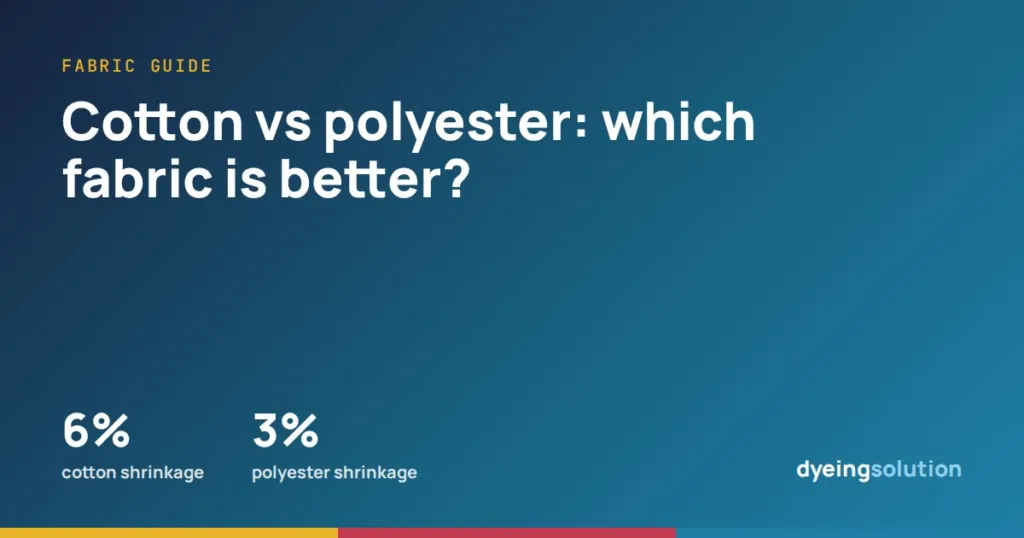
Cotton is soft, breathable and absorbent; polyester is strong, quick drying, wrinkle resistant and very stable in washing. Comfort, durability, shrinkage data from more than 14,000 knit batches, colour, odour, printing, safety, environment, blends and which to choose for each use.
At a glance
6%cotton shrinkage
3%polyester shrinkage
82%blends within 5%
Blendbest of both
Cotton is a natural fibre that is soft, breathable and absorbent, and polyester is a synthetic fibre that is strong, quick drying, wrinkle resistant and very stable in washing. Cotton is usually more comfortable for everyday wear, sleep, hot days at rest and sensitive skin. Polyester is better for sport, travel, outdoor wear and anything that must keep its size, shape and colour. Neither is simply “better”: many of the most popular fabrics, such as CVC and 50/50 T-shirts, blend the two to get the best of both.
This guide compares cotton and polyester on comfort, breathability, moisture, durability, shrinkage, wrinkles, pilling, colour and fading, stains and odour, printing, safety, environment, cost and care, and uses our finishing records from more than 14,000 knit batches to show how each fibre behaves in washing. It is written from the dye-house floor, where cotton, polyester and their blends make up most of what we dye and finish.
Cotton vs polyester at a glance
| Point | Cotton | Polyester |
|---|---|---|
| Origin | Natural plant fibre | Synthetic, from petroleum |
| Feel | Soft, natural, matt | Smooth; can be soft or slick |
| Moisture regain | About 8% | About 0.4% |
| Breathability at rest | High | Low to medium (depends on fabric) |
| Drying speed | Slow | Very fast |
| Strength and durability | Good | Very high |
| Median knit shrinkage (our records) | 6% | 3% |
| Wrinkles | Wrinkles easily (wovens) | Resists wrinkles |
| Pilling | Pills break off | Pills stay on (spun yarns) |
| Fading | Fades with washing | Holds colour well |
| Odour | Holds less odour | Can hold body odour |
| Fire | Burns, no melt | Melts and drips |
| Dye class | Reactive dyes | Disperse dyes |
Comfort and breathability
Cotton absorbs sweat and moisture vapour and lets air through, so it feels comfortable on the skin for everyday wear and sleep. Plain polyester absorbs almost nothing, so in a dense fabric sweat stays on the skin and feels clammy. But polyester knits designed to wick move sweat outward and dry fast, so during exercise they often feel drier than cotton, which soaks up sweat and stays wet. See is cotton breathable and is polyester good for hot weather.
What our records show: shrinkage and weight
Across 14,262 knit batches in our finishing records, polyester knits had a median length shrinkage of 3% after the wash test, cotton-polyester blends (CVC and PC) 4%, and 100% cotton 6%. The worst tenth of cotton parts shrank about 10%, against 7% for both polyester and cotton-polyester. In blends, 82% of cotton-polyester parts kept length shrinkage within 5%, against 47% of 100% cotton parts, and 67% of cotton-polyester parts were finished within ±5% of the required GSM, against 47% for cotton. Polyester holds the structure.
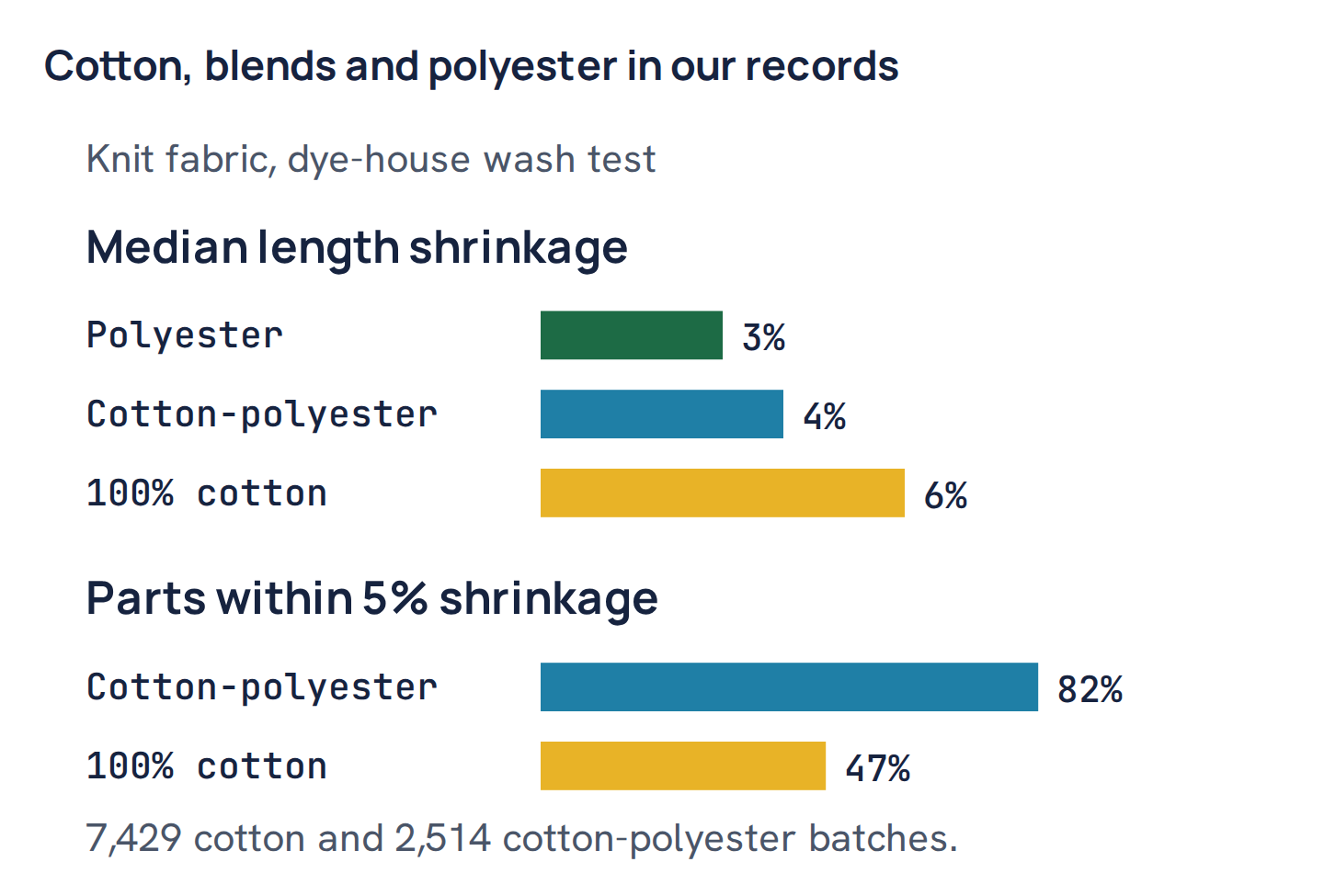
Polyester has no shrink property. In a CVC or PC fabric the polyester holds the structure, so the fabric cannot shrink, and washing changes the GSM very little.
Durability, wrinkles and pilling
Polyester is stronger and more abrasion resistant than cotton, so polyester garments usually last longer and keep their shape. It is heat-set, so it resists wrinkles and needs little ironing. Cotton wrinkles more, especially in woven shirts, but cotton knits wrinkle little. Both can pill: cotton pills tend to break off; polyester pills in spun-yarn fabrics stay attached because the fibre is strong. See does polyester pill.
Colour, fading and stains
Polyester is dyed with disperse dyes at about 130°C, which lock inside the fibre and give excellent wash fastness, so polyester holds colour well. Cotton is dyed with reactive dyes; dark cotton fades gradually with washing and rubbing. Polyester resists water-based stains but holds oily stains; cotton absorbs stains more readily but releases oils more easily in hot washes. See reactive vs disperse dye and why black T-shirts fade.
Odour
Cotton absorbs sweat into the fibre and washes clean easily, so it tends to hold less body odour. Polyester attracts oily sweat compounds to its surface, where bacteria grow, so polyester sportswear can smell more after use. Washing promptly and choosing antimicrobial finishes help.
Printing
- DTG and screen printing: best on cotton.
- Sublimation: only on polyester. See can you sublimate on cotton.
- DTF: works on both; polyester needs lower temperatures. See DTF on polyester.
Safety and skin
Both are considered safe to wear. Cotton is often preferred for babies and sensitive skin because it is soft, absorbent and breathable. Polyester can feel clammy and, rarely, disperse dyes cause skin reactions in sensitive people. In fire, cotton burns readily without melting; polyester is harder to ignite but melts and drips. See is polyester dangerous.
Environment
Cotton is renewable and biodegradable, but conventional cotton can use a lot of water and crop chemicals; organic and better-managed cotton reduce this. Polyester is made from fossil fuels and sheds microfibres, but it lasts long, needs less hot washing and ironing, and recycled polyester is widely available. Blends are harder to recycle.
Common mistake: choosing 100% cotton team shirts for a summer football club because “cotton breathes”. After a match the shirts are soaked and heavy, and after a season they have shrunk and faded. Wicking polyester is the right fibre for active sport; cotton is better for the supporters’ casual tees.
Cotton-polyester blends
Blends such as CVC (cotton-rich, often 60/40) and 50/50 combine cotton’s comfort with polyester’s low shrinkage, durability and quick drying. They are the standard for many T-shirts, sweatshirts, uniforms and workwear. The more cotton, the softer and more breathable; the more polyester, the more stable and quicker drying. See what is CVC fabric and what is poly-cotton.
Which should you choose?
| Use | Better choice |
|---|---|
| Everyday T-shirts | Cotton or cotton-rich blend |
| Sleepwear, underwear | Cotton (or modal) |
| Running, gym, team sport | Polyester |
| Travel, outdoor layers | Polyester or blends |
| Uniforms, workwear | Cotton-polyester blend |
| Baby clothes | Cotton |
| Towels | Cotton (microfibre for travel) |
Care for each
- Cotton: 30–40°C for colours, warmer for whites; tumble low; iron hot.
- Polyester: 30–40°C; tumble low; iron low; no softener on sportswear.
- Blends: 30–40°C, tumble low; iron medium.
Worked example. A school compares three polo shirts for uniforms: 100% cotton pique, 65/35 polyester-cotton and 100% polyester. After a term, the cotton polos have shrunk and faded; the polyester polos look new but some pupils find them hot in class; the polyester-cotton polos stay close to size, keep their colour and feel comfortable. The blend wins for uniforms.
Cotton vs polyester for sleep
For most people, cotton or cotton-blend sheets and pyjamas sleep cooler than polyester, because cotton absorbs night sweat and breathes. Polyester microfibre sheets feel smooth and resist wrinkles but can feel warm for hot sleepers. Polyester-filled duvets and pillows are popular because they stay lofty, wash easily and resist dust mites.
Cotton vs polyester for babies
Cotton is the usual first choice for babywear because it is soft, breathable and absorbent and tolerates frequent washing. Polyester is used in some sleepwear to meet flammability rules and in fleece outerwear. Whatever the fibre, wash new baby clothes before use and choose items with recognised safety certification.
Cotton vs polyester for towels and bedding
Cotton terry towels absorb much more water than polyester and feel soft and familiar. Polyester microfibre towels dry very fast and pack small, which suits travel and gyms. For bedding, cotton percale and sateen are cooler and more breathable; polyester microfibre is cheaper, crease resistant and fast drying.
Cost and value
Both fibres are inexpensive compared with wool, silk or linen. Polyester is usually slightly cheaper and lasts longer, so it often gives good value per wear for workwear and sportswear. Good cotton costs more but feels better and ages naturally. Value depends on how often you will wear and wash the item and how much comfort matters.
For many households, the best answer is a mix: cotton next to the skin and polyester for sport and outerwear.
Summary
- Cotton is softer, more breathable and absorbent; polyester is stronger, faster drying and more stable.
- In our records polyester knits shrank a median 3%, blends 4% and cotton 6%.
- Polyester holds colour and shape; cotton fades and wrinkles more.
- Choose cotton for comfort and polyester for sport and durability.
- Cotton-polyester blends combine the strengths of both.
Questions
Is cotton or polyester better?
Cotton is better for comfort, breathability and sensitive skin; polyester is better for sport, durability and easy care. Blends combine both.
Is cotton more breathable than polyester?
At rest, yes. During exercise, wicking polyester often feels drier because it moves sweat and dries fast.
Does polyester shrink less than cotton?
Yes. In our knit records polyester shrank a median 3% in length against 6% for cotton.
Which lasts longer, cotton or polyester?
Polyester is usually more durable and holds its colour and shape longer.
Is a cotton-polyester blend good?
Yes. Blends such as CVC and 50/50 shrink less than cotton, dry faster and still feel comfortable.

Textile engineer with 14+ years in dyeing and fabric development. He writes every guide on Dyeing Solution from real production work. Full profile