Blotchy or streaky dye can usually be improved once you know the cause. How to read the pattern, when to re-dye the same colour, go darker, strip and start again, or turn the unevenness into a design, including jeans.
At a glance
Diagnosebefore re-dyeing
More waterthe most common fix
Darkerhides unevenness
Threadpolyester stays undyed
Uneven or blotchy dye on clothes can usually be improved, but rarely by doing exactly the same thing again. First you need to know why it went patchy: a crowded pot, a garment that was not clean, dye that was not fully dissolved, or fixing chemicals added too fast. Then you choose a fix that suits the problem: re-dye in a better way, go darker, strip and start again, or turn the unevenness into a deliberate effect.
This guide uses the same reasoning a dye house uses for an uneven batch, simplified for clothes dyed at home or bought with a patchy shade.
Step 1: find out why it is uneven
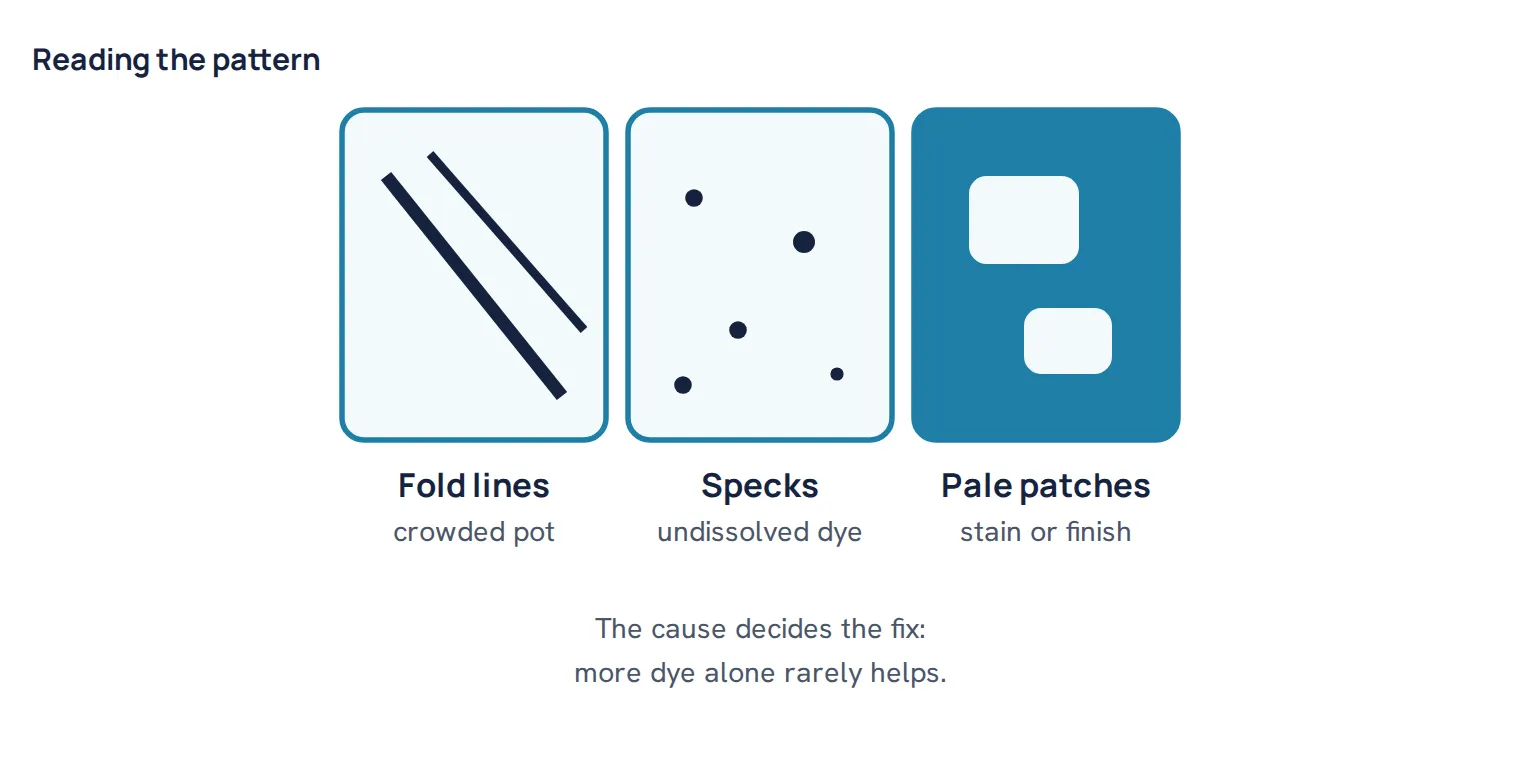
Look at the pattern of the unevenness. It tells you the cause.
| What you see | Likely cause |
|---|---|
| Dark lines along folds, lighter inside them | Pot too small; garment not moving |
| Dark specks or spots | Dye powder not fully dissolved |
| Pale patches with sharp edges | Stains, finishes or softener left on the fabric |
| Cloudy, blotchy colour all over | Dye or fixing chemicals added too fast |
| One area much lighter (collar, hem) | Different fabric or repaired area; finish |
| Lighter stitching | Polyester thread, which home dyes do not colour |
| Faded patches on an old garment | Uneven sun or wear damage before dyeing |
Step 2: choose the fix
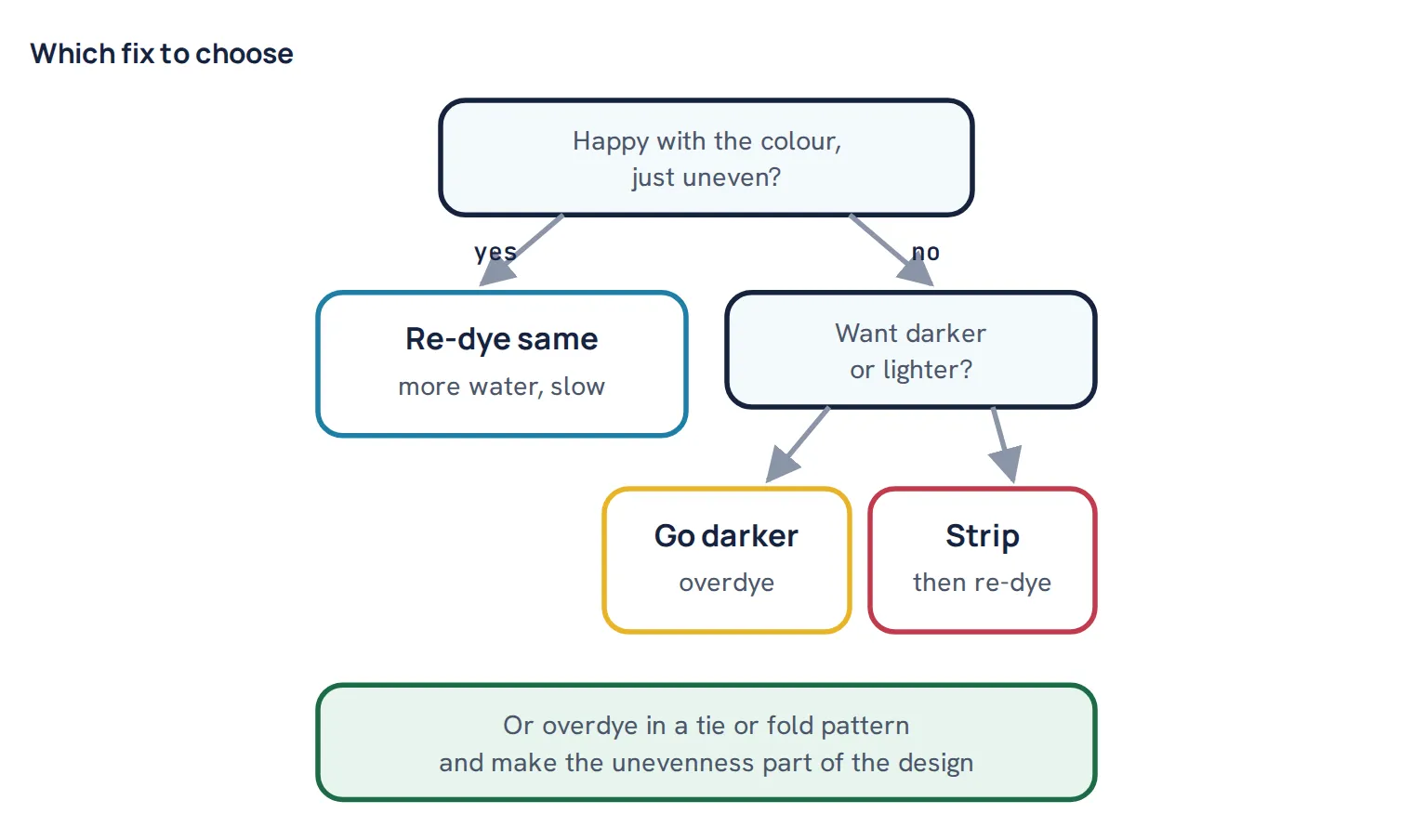
Re-dye the same colour, done properly
If the unevenness came from the process (crowding, poor stirring, rushed additions), a second dyeing in the same colour often evens it out, because the pale areas take up more dye than the areas that are already saturated. Wash the garment first, use far more water so it floats freely, stir often for the whole time, and add any salt or fixing chemicals slowly in several portions. This is the home version of the dye-house rule that levelness comes from slow, controlled additions; see level dyeing.
Go darker
A darker colour hides unevenness better than a light one. Over a patchy light blue, a navy will cover most marks; over a patchy pink, a burgundy or deep purple. Remember that dyes add together: yellow under blue gives green, so plan the new colour from the old one.
Strip and start again
If the colour is very uneven or you want a lighter result, the dye has to come out first. Colour removers based on a reducing agent strip many dyes from cotton and other cellulose fabrics, with ventilation and gloves, following the pack exactly. They rarely give pure white: most dyes strip to a pale tint. In a dye house this is a planned process with a stripping bath, a reducing bath matched to the shade and a hot soda scour afterwards; see stripping reactive-dyed cotton. After stripping, re-dye in a medium or dark colour.
Make it a feature
Patchiness can be turned into a look: a deeper overdye in a tie, fold or crumple pattern makes the original marks part of the design. This is often the most satisfying fix for a casual garment.
Common mistake: adding more dye to the same small pot and dyeing again. The fold lines come back in the same places, darker, because the cause, a crowded pot, was not changed.
How to fix uneven dye in jeans
Jeans are usually cotton denim dyed with indigo on the yarn surface, and many are made to look uneven on purpose. If home over-dyeing left blotches, a second dyeing in a large volume of water with constant movement helps, and a darker colour hides more. Polyester stitching and leather or plastic labels will not take the dye. For black jeans that faded unevenly, a fresh black dye bath usually evens them out well, because black covers almost everything.
When unevenness cannot be fixed
Some patterns will not dye out: sun-damaged fabric that has weakened unevenly, areas with resin or stain-repellent finishes, patches of a different fibre, and polyester thread. In these cases, a darker overdye or a deliberate pattern is the realistic answer. On factory fabric, unevenness from yarn lots (stripes across the knit, called barré) cannot be dyed out either, because it comes from the yarn, not the dye; see barré in knit fabric.
Worked example. A cotton shirt dyed dark green at home comes out with darker streaks along the sleeves and back. The pattern points to folds in a crowded pot. The fix: wash, then re-dye in the same green in at least twice the water, stirring every few minutes for the first half hour and adding the salt in three portions. The streaks fade because the paler areas now get the dye they missed the first time.
Summary
- Diagnose first: fold lines, specks and pale patches have different causes.
- Re-dye in the same colour with more water and slower additions when the process was at fault.
- Go darker to hide marks; strip only when you need a lighter result.
- Polyester thread, finishes and sun damage often cannot be dyed even.
For industrial knit fabric, the full fault guide is uneven and patchy dyeing in knit fabric.
Questions
How do you fix uneven dyed clothes?
Find the cause first. If the pot was crowded or additions were rushed, re-dye in the same colour with much more water, constant stirring and slow additions. Otherwise go darker or strip and re-dye.
Can you re-dye clothes that came out patchy?
Yes. Pale areas take up more dye in a second dyeing, so a properly controlled re-dye often evens the colour out.
How do I fix uneven dye on fabric?
Remove any finish or stain by washing first, then re-dye with plenty of water and slow additions, or overdye in a darker colour to hide the marks.
How do you fix uneven dye in jeans?
Re-dye in a large volume of water with constant movement, ideally in a darker colour. Black dye covers most unevenness; polyester stitching will stay undyed.
Why is my dyed shirt blotchy?
Common causes are a pot that was too small, dye that was not fully dissolved, softener or stains left on the fabric, or salt and fixing chemicals added too quickly.

Textile engineer with 14+ years in dyeing and fabric development. He writes every guide on Dyeing Solution from real production work. Full profile