Polyester staple fibre is polyester cut into short, crimped lengths so it can be spun like cotton and blended into CVC, poly-cotton and suiting, or used as fibrefill. How PSF is made, staple vs filament, lengths and deniers, types, and what it does in a fabric.
At a glance
32–38 mmcotton type
Spunlike cotton
4%CVC/PC shrinkage
Pillsmore than filament
Polyester staple fibre (PSF) is polyester cut into short lengths, usually a few centimetres long, instead of being left as continuous filament. Staple fibre is spun into yarn the same way cotton is, which lets polyester be blended with cotton, viscose or wool to make familiar fabrics such as CVC and poly-cotton T-shirts, sewing thread and suiting. PSF is also used directly, without spinning, as stuffing in pillows and duvets and in non-woven fabrics. It is one of the most widely produced fibres in the world.
This guide explains what polyester staple fibre is, how it is made, staple vs filament polyester, the common lengths and deniers, solid, hollow and recycled PSF, where it is used, how spun polyester behaves in fabric (including pilling and shrinkage), and how it is dyed. It draws on our dye-house finishing records of more than 2,500 cotton-polyester knit batches, which are made from spun polyester staple.
Staple vs filament
All man-made fibres start as continuous filaments pushed through tiny holes in a spinneret. What happens next decides the type:
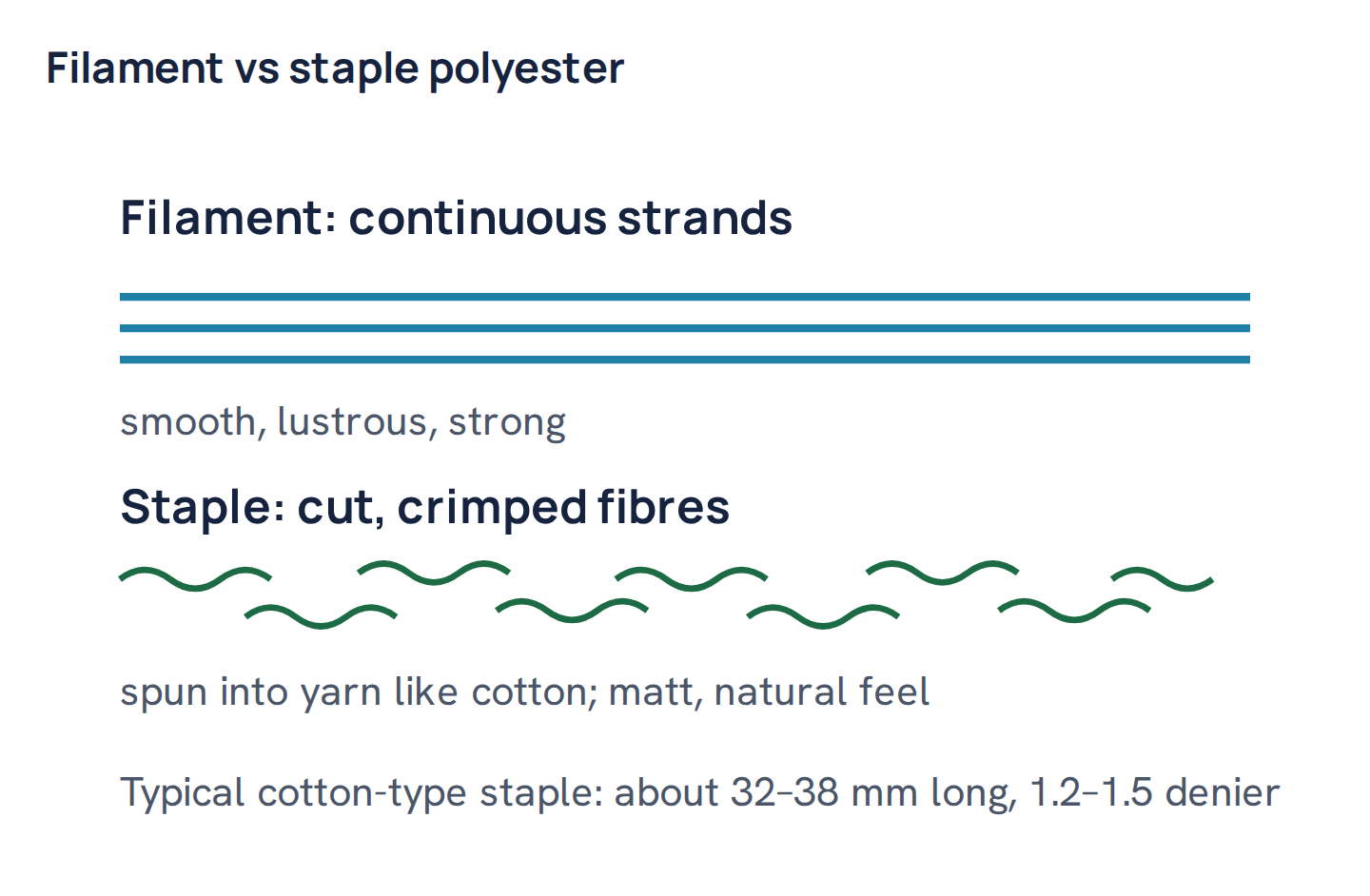
- Filament yarn: the continuous strands are kept long and wound as yarn. Filament polyester is smooth, shiny and strong; it is used for satin, chiffon-look fabrics, linings, sportswear and many technical fabrics.
- Staple fibre: the strands are gathered into a thick rope called tow, crimped to give them waviness, heat set, and cut into short lengths. These fibres are then spun like cotton or wool into a spun yarn, which looks and feels more natural and matt.
How polyester staple fibre is made
- Polymer: polyethylene terephthalate (PET) is made from petroleum-based raw materials, or recovered from used bottles for recycled PSF.
- Melt spinning: the PET is melted and pushed through spinnerets with many holes, forming fine filaments that are cooled with air.
- Drawing: the filaments are stretched several times their length, which aligns the molecules and gives strength.
- Crimping: the tow is passed through a crimper that gives the fibres a wavy shape, so they hold together during spinning and give the yarn bulk.
- Heat setting and finishing: the crimp and dimensions are fixed with heat, and a spin finish is applied to control friction and static.
- Cutting: the tow is cut to the chosen staple length and baled.
Common staple lengths and deniers
| Type | Typical length | Typical fineness | Main use |
|---|---|---|---|
| Cotton type | About 32–38 mm | About 1.2–1.5 denier | Blending with cotton or viscose for spun yarn |
| Wool type | About 51–76 mm | About 2–3 denier | Blending with wool for suiting and knitwear |
| Hollow conjugated fill | About 32–64 mm | About 7–15 denier | Pillows, duvets, padding, toys |
| Non-woven type | Various | Various | Wipes, geotextiles, felts, interlinings |
Cotton-type PSF is cut to a length similar to cotton fibre so the two can be mixed and spun on the same machines.
Solid, hollow and recycled PSF
- Solid PSF: the standard fibre for spinning into apparel yarns.
- Hollow and hollow conjugated PSF: fibres with an air channel inside, sometimes made from two polymers so they curl into a springy spiral. They are often coated with silicone to feel soft and slippery. Used as fibrefill.
- Recycled PSF: made from post-consumer PET bottles or other waste; it behaves much like new PSF and reduces the use of new oil.
- Functional PSF: fibres with special cross-sections or additives for moisture movement, flame resistance or low pilling.
Where polyester staple fibre is used
- Apparel yarns: CVC (cotton-rich) and PC (polyester-rich) blends for T-shirts, polos, sweatshirts, uniforms and workwear; polyester-viscose for suiting and dresses; polyester-wool for tailoring. See what is CVC fabric and what is poly cotton.
- Sewing thread: spun polyester thread is strong, consistent and widely used.
- Home textiles: sheets, curtains and upholstery blends.
- Fibrefill: pillows, duvets, cushions, jackets and soft toys.
- Non-wovens: wipes, filters, felts and car interiors.
What spun polyester does in a fabric
Adding spun polyester to cotton changes how the fabric behaves, and our finishing records show it clearly. Cotton-polyester blends (CVC and PC) were the most predictable fabrics we finish: across 2,514 batches the median length shrinkage after the wash test was 4%, against 6% for 100% cotton, 82% of blend parts kept length shrinkage within 5%, and 67% finished within ±5% of the required GSM, against 47% for cotton. The polyester does not shrink and holds the cotton in place.
Polyester has no shrink property. In a CVC or PC fabric the polyester holds the structure, so the fabric cannot shrink, and washing changes the GSM very little.
Spun polyester and pilling
The downside of staple polyester is pilling. A spun yarn has many fibre ends on its surface, and polyester fibres are strong, so when they fuzz and tangle, the pills cannot break off. Spun polyester and CVC fleece pill more visibly than 100% cotton, and much more than smooth filament polyester. In our lab reports, the pilling fails were concentrated in heavy CVC fleece and terry tested on the hardest Martindale setting. Low-pill PSF, compact spinning, singeing and heat setting all help. See why fleece and sweatpants pill.
Spun polyester vs filament polyester in clothes
| Point | Spun (staple) polyester | Filament polyester |
|---|---|---|
| Look | Matt, natural, cotton-like | Smooth, can be shiny |
| Feel | Soft, slightly fuzzy | Slick, cool, smooth |
| Blending | Easily blended with cotton, viscose, wool | Usually used alone or with spandex |
| Pilling | More, pills stay on | Less |
| Snagging | Less | More, filaments catch |
| Typical uses | T-shirts, polos, sweatshirts, suiting, thread | Sportswear, linings, satin, outerwear |
How to recognise spun polyester in a fabric
A fabric label rarely says “staple” or “filament”, but there are clues. Spun polyester blends are listed with another fibre, such as “60% cotton, 40% polyester” or “65% polyester, 35% viscose”, and look matt and soft like cotton. If you pull a thread from the fabric and untwist it, a spun yarn falls apart into short fibres, while a filament yarn stays as long continuous strands. Under a magnifier, spun yarn is hairy, with fibre ends sticking out; filament yarn looks smooth and glossy.
How spun polyester is dyed
Polyester, staple or filament, is dyed with disperse dyes at about 130°C under pressure, followed by reduction clearing. In a cotton-polyester blend, each fibre needs its own dye class, so the fabric is dyed in two stages: disperse dye for the polyester, reactive dye for the cotton. The finished fabric must then be dried and finished at about 100–110°C so the disperse dye does not bleed. See the CVC fabric dyeing process and reactive vs disperse dye.
Common mistake: expecting a cotton-polyester T-shirt to take a home dye like cotton. Home dyes colour only the cotton fibres, so the spun polyester stays pale and the shirt comes out lighter and heathered. Polyester needs disperse dye at high temperature.
Worked example. A uniform supplier needs polo shirts that keep their size through daily washing. A 65/35 polyester-cotton pique made from cotton-type PSF shrinks and wrinkles far less than 100% cotton, and in our records blends kept length shrinkage within 5% in 82% of parts. The trade-off is more visible pilling over time, which a low-pill fibre or singed yarn reduces.
Quality points buyers check on PSF
Spinning mills and fibre buyers judge polyester staple fibre on a few measurable properties: fineness (denier), cut length and its consistency, crimp level, tenacity and elongation, the amount and type of spin finish, and the level of defects such as over-length or fused fibres. For dyed fabrics, consistent fibre from the same lot also matters, because fibre lots can take disperse dye slightly differently and cause shade differences between batches.
Summary
- Polyester staple fibre is polyester cut into short, crimped lengths and spun like cotton.
- Cotton-type PSF is about 32–38 mm long and blended with cotton or viscose.
- Hollow PSF is used as fibrefill; recycled PSF comes mainly from PET bottles.
- Spun polyester makes blends far more stable: a median 4% shrinkage in our CVC/PC records.
- Spun polyester pills more than filament and needs disperse dyeing at high temperature.
Questions
What is polyester staple fibre?
Polyester that has been cut into short, crimped lengths, usually a few centimetres long, so it can be spun into yarn like cotton or used as fibrefill.
What is the difference between staple and filament polyester?
Filament is continuous and smooth; staple is cut into short fibres and spun into a matt, more natural-feeling yarn.
What is polyester staple fibre used for?
Blended yarns such as CVC and poly-cotton, sewing thread, home textiles, pillow and duvet filling, and non-woven fabrics.
What is hollow conjugated fibre?
A polyester staple fibre with a hollow core, often made of two polymers so it curls into a springy spiral, used as fibrefill.
Does spun polyester pill?
Yes, more than filament polyester, because spun yarn has many fibre ends and the strong polyester holds the pills on.

Textile engineer with 14+ years in dyeing and fabric development. He writes every guide on Dyeing Solution from real production work. Full profile