Reactive dye bonds to cotton at about 60°C; disperse dye dissolves into polyester at 130°C. Why neither works on the other fibre, how CVC uses both, and the faults each one brings.
At a glance
60°Ctypical reactive dyeing
130°Cdisperse on polyester
2 bathsusual CVC route
2,514CVC/PC batches in our data
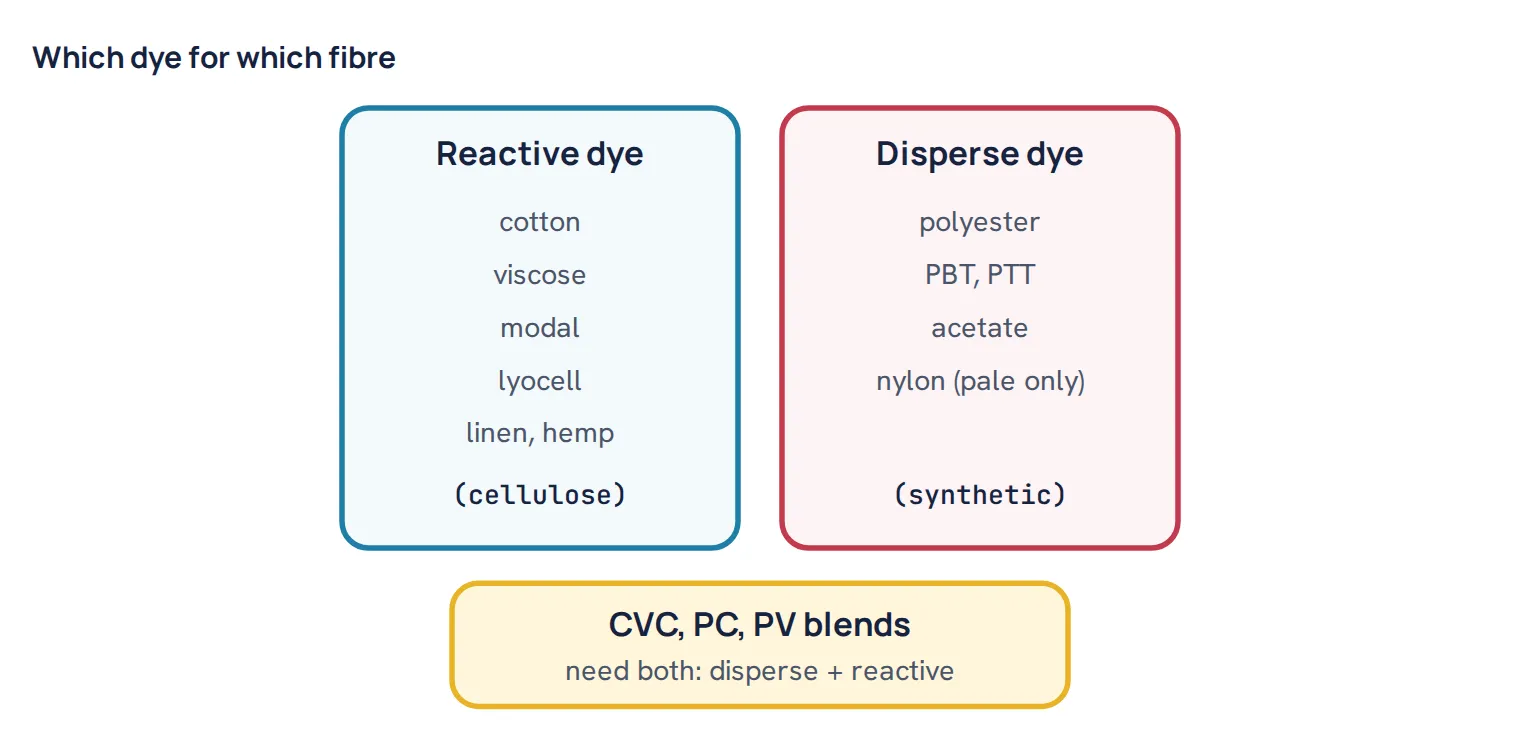
Reactive dye and disperse dye are the two dye classes that colour most of the knit fabric made today. Reactive dye is for cotton and the other cellulose fibres. Disperse dye is for polyester. They are not interchangeable: a reactive dye will not colour polyester, and a disperse dye will only stain cotton and then wash out. The reason lies in the fibres themselves, and once you see it, blends like CVC and PC make complete sense.
This guide explains how each dye works, why each one only suits its own fibre, how the dyeing conditions differ, how the two are combined on cotton-polyester blends, and the faults that come from each.
Two fibres, two very different surfaces
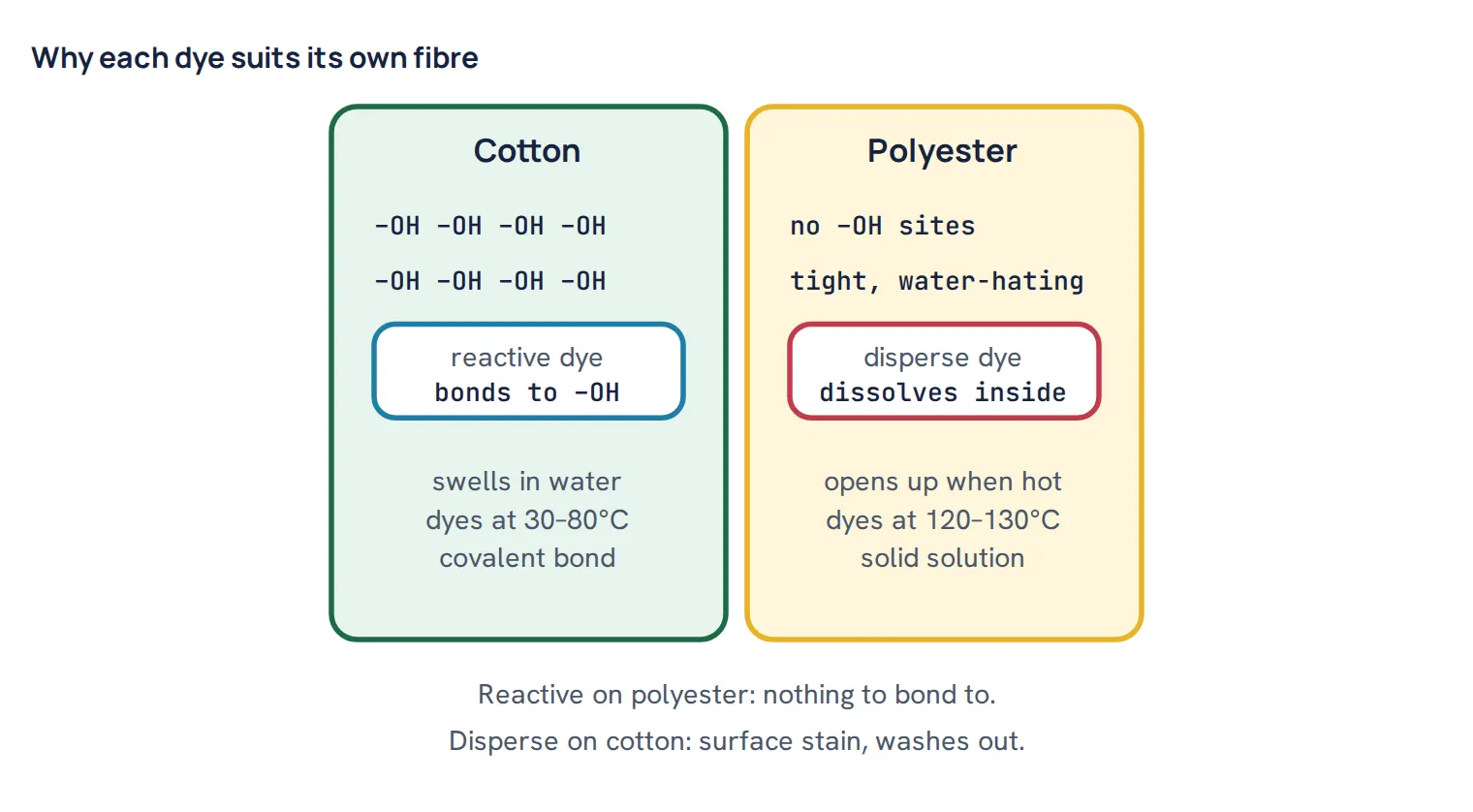
Cotton is cellulose. Its long chains carry many hydroxyl (–OH) groups, it swells in water and it soaks up water-soluble dye easily. Those hydroxyl groups are also the reaction sites for a reactive dye.
Polyester is hydrophobic. It hardly absorbs water, has no hydroxyl groups along its chain for a dye to react with, and its chains are packed tightly. Water-soluble dyes simply cannot get in. The only way to colour it from a dye bath is with a small, non-ionic molecule that dissolves into the fibre like sugar dissolves in tea, and that only happens when the fibre is hot enough for its chains to move apart.
How reactive dye works
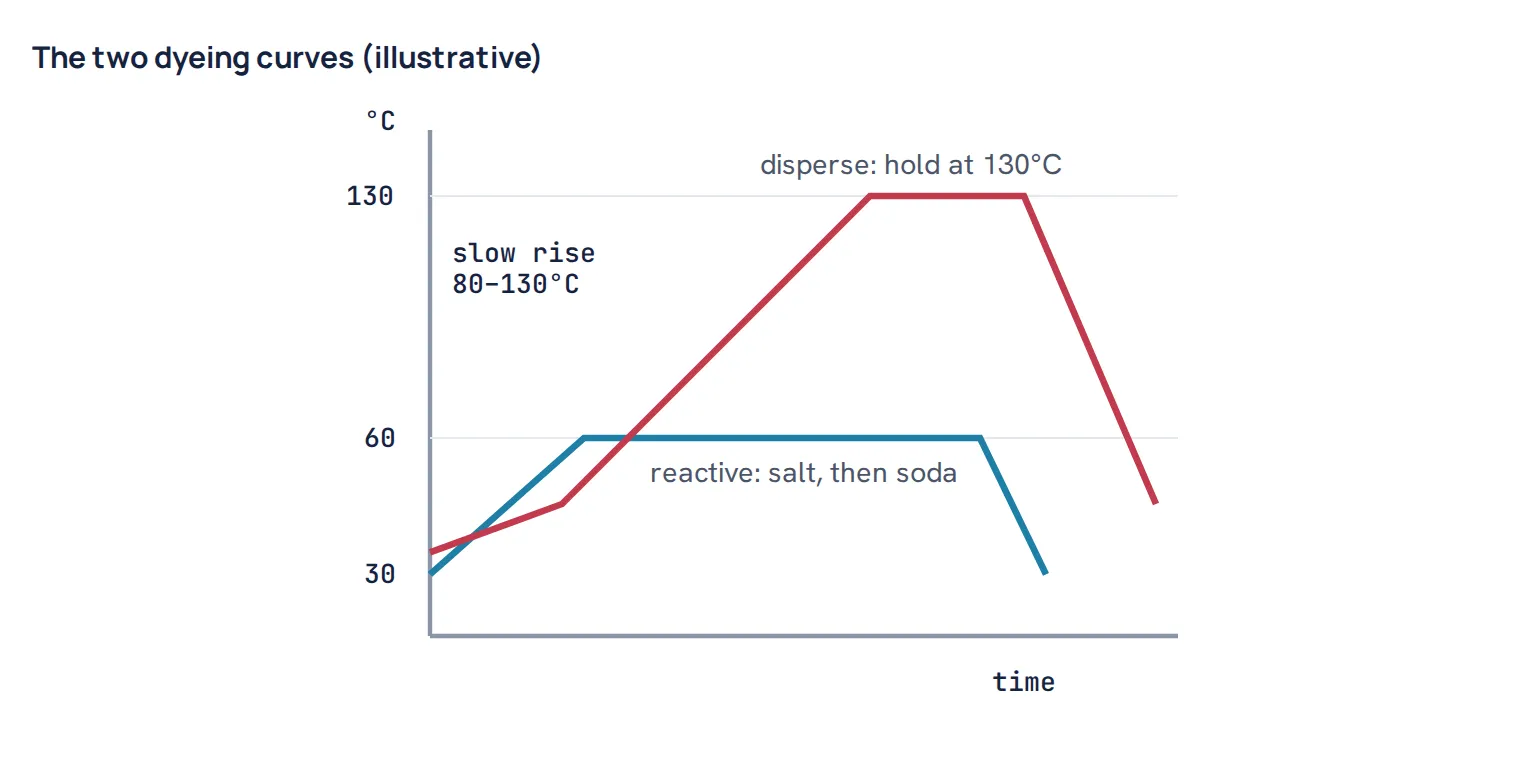
A reactive dye is water soluble and carries a reactive group. Salt pushes it from the water onto the cotton, then soda ash raises the pH so the reactive group forms a covalent bond with the cellulose. Part of the dye reacts with water instead (hydrolysis) and has to be washed out with hot rinses and soaping. Typical working temperatures are 40–80°C depending on the dye type, with 60°C the most common in knit dyeing. The full sequence is in how reactive dyes work.
How disperse dye works
A disperse dye is a small molecule with very low water solubility. It is milled to fine particles and kept in the bath as a dispersion with a dispersing agent. Above polyester’s glass transition temperature, roughly 70–80°C in water, the polymer chains start to move and single dye molecules dissolve from the bath into the fibre. The higher the temperature, the faster this goes, which is why polyester is normally dyed under pressure at 130°C. The bath is kept slightly acidic, around pH 4.5–5.5, because many disperse dyes are damaged by alkali at high temperature.
After dyeing, disperse dye that is stuck on the fibre surface is removed by reduction clearing, a hot alkaline bath with a reducing agent. Without it, wash fastness, rubbing and staining suffer. The mechanism is in how disperse dyes work on polyester.
Reactive vs disperse dye side by side
| Point | Reactive dye | Disperse dye |
|---|---|---|
| Fibres | Cotton, viscose, modal, lyocell, linen | Polyester; also acetate, some on nylon |
| Solubility | Water soluble | Almost insoluble, used as a dispersion |
| How it holds | Covalent bond with cellulose | Dissolved inside the fibre (solid solution) |
| Temperature | About 40–80°C | About 120–130°C (pressure machine) |
| Bath pH | Alkaline for fixation (soda ash) | Acidic, around pH 4.5–5.5 |
| Main additions | Salt, soda ash | Dispersing and levelling agent, acid |
| After-treatment | Hot wash-off and soaping | Reduction clearing |
| Typical faults | Poor wash-off, wet rubbing, unlevel strike | Oligomer, thermomigration, barré |
Polyester-cotton blends: using both
A CVC or PC knit contains both fibres, so it needs both dyes. The usual knit dye-house route is two baths. The polyester part is dyed first with disperse dye at 130°C and about pH 4.5, then reduction cleared. The cotton part is then scoured, given an enzyme wash where needed, and dyed with reactive dye at about 60°C, followed by the normal wash-off. In our finishing records of 2,514 cotton-polyester batches, CVC and PC were among the most predictable fabrics for finished GSM and shrinkage; the full route is in the CVC fabric dyeing process.
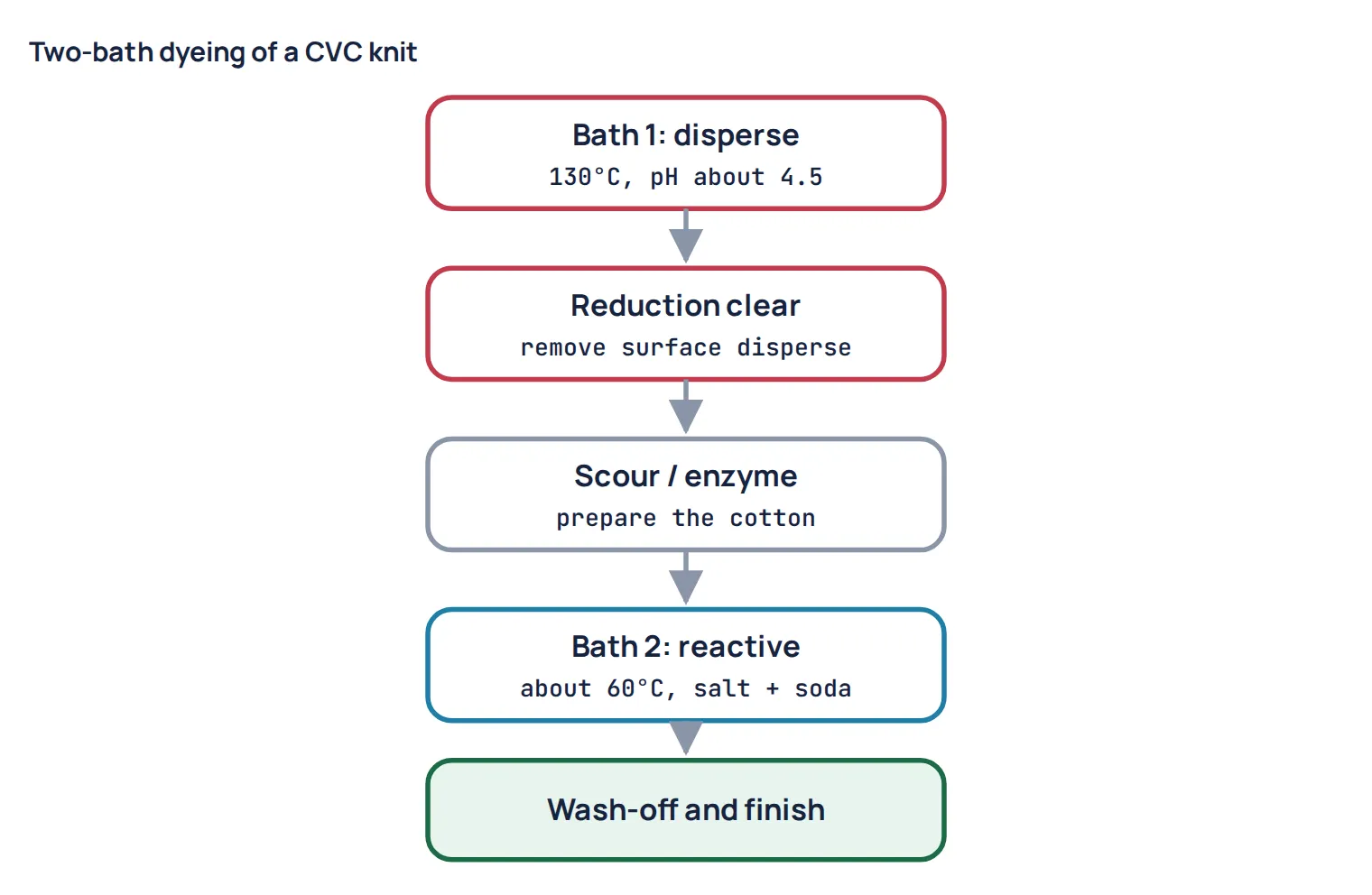
Why disperse first? The polyester needs 130°C, and reactive dyes would hydrolyse and lose strength at that temperature in alkali. The reduction clear after the disperse bath also strips any disperse dye that stained the cotton, which would otherwise show as poor wash and rubbing fastness. One-bath methods exist and save time, but they need carefully chosen dyes and are harder to keep consistent from lot to lot.
Common mistake: skipping or shortening the reduction clear on a deep CVC shade to save time. The cotton holds disperse stain that the reactive bath cannot cover, and the fabric fails staining or wet rubbing even though the shade looks right.
Faults that belong to each dye
Reactive faults are mostly about levelness and wash-off: uneven strike when salt or alkali goes in too fast, hydrolysed dye left in the fabric giving poor wash and wet rubbing fastness, and shade change after the soaping. See level dyeing for the control points.
Disperse faults come from the fibre and the heat. Oligomers (short polyester chains) come out of the fibre at high temperature and deposit as white dust. Yarn lots with different heat history take up different amounts of dye and show as barré. And thermomigration: during hot finishing on the stenter, or later during hot pressing, disperse dye moves back to the fibre surface, so staining and rubbing get worse after finishing even though they were fine after dyeing. In our hot pressing tests, CVC fleece failed on wet staining for exactly this reason (see colour fastness to hot pressing).
Fastness differences
A well washed-off reactive shade has good wash fastness; its usual limit is wet rubbing in deep shades, and chlorine and light fastness vary from dye to dye. A well reduction-cleared disperse shade on polyester has very good wash and light fastness, because the dye is locked inside a fibre that does not swell in water. Its weak points are heat (sublimation and thermomigration) and staining onto nylon and acetate in the multifibre strip during wash tests.
Worked example. A navy CVC polo passes wash fastness after dyeing, then fails staining on the polyester and nylon strips after stenter finishing at a high temperature. Nothing was wrong with the reactive bath. The disperse dye migrated to the surface in the heat. The fix is a lower finishing temperature, thermomigration-resistant disperse dyes for deep shades, and a thorough reduction clear, not more soaping of the cotton.
Summary
- Reactive dye bonds to the hydroxyl groups of cellulose at about 40–80°C in alkali.
- Disperse dye dissolves into polyester at 120–130°C in a slightly acidic bath and is fixed by staying trapped inside.
- Reactive cannot dye polyester and disperse cannot dye cotton; blends need both, usually disperse first.
- Reactive faults centre on levelness and wash-off; disperse faults on oligomer, barré and thermomigration.
For all the dye classes in one place, see dye classes explained.
Questions
Can reactive dye be used on polyester?
No. Polyester has no hydroxyl groups for the dye to bond to and does not absorb water-soluble dye, so reactive dye only stains it and washes off. Polyester needs disperse dye.
Can disperse dye colour cotton?
Not usefully. Disperse dye has no affinity for cotton; it only stains the surface and comes off in washing and rubbing. That is why reduction clearing is needed on blends.
Why is polyester dyed at 130°C?
The polyester chains only open up above the glass transition temperature, about 70–80°C in water, and dyeing becomes fast and complete around 130°C under pressure. At lower temperatures, carriers would be needed.
How is CVC fabric dyed with two dyes?
Usually in two baths: disperse dye at 130°C for the polyester, a reduction clear, then reactive dye at about 60°C for the cotton, followed by the normal wash-off.
What is thermomigration?
It is the movement of disperse dye from inside the polyester back to the fibre surface during hot finishing or pressing, which lowers rubbing and staining results after the fabric has already passed after dyeing.

Textile engineer with 14+ years in dyeing and fabric development. He writes every guide on Dyeing Solution from real production work. Full profile