A cotton blend mixes cotton with another fibre, usually polyester, elastane, modal, viscose or linen, to change how the fabric behaves. Common blends and ratios, cotton blend vs 100% cotton, how blends are dyed, and what our finishing records show about shrinkage and weight.
At a glance
CVC / PCcotton-polyester
4% vs 6%blend vs cotton
67%blends on target GSM
2 dyesfor cotton-poly
A cotton blend is a fabric made from cotton mixed with one or more other fibres, usually in the same yarn. The most common partners are polyester, elastane (spandex), viscose or modal, linen and nylon. Blending changes how the fabric behaves: polyester makes cotton shrink and wrinkle less and dry faster, elastane adds stretch, modal and viscose add softness and drape, and linen adds coolness and texture. “Cotton blend” on a label tells you the garment is not 100% cotton; the fibre percentages tell you what to expect.
This guide explains what cotton blend means, the most common cotton blends and their ratios, how each blend feels and performs, how blends compare with 100% cotton, how blended fabrics are dyed and finished, and how to read a label and care for cotton blends. It draws on our dye-house finishing records of thousands of cotton and cotton-blend knit batches.
What does cotton blend mean?
Blending usually happens before spinning: cotton fibres and the second fibre are mixed and spun together, so every yarn contains both. Sometimes two different yarns are combined during knitting or weaving instead, such as a cotton yarn knitted alongside a fine elastane yarn. On a label, fibres are listed in order of percentage by weight. “60% cotton, 40% polyester” means a cotton-rich blend; “65% polyester, 35% cotton” means polyester-rich.
Labelling rules require fibre content to be stated, and labs check it by dissolving one fibre away and weighing what is left; see how fibre content is tested.
Why blend cotton at all?
Cotton is soft, breathable, absorbent and familiar, but it has weaknesses: it shrinks, wrinkles, dries slowly, can lose shape and has little stretch. Blending lets designers keep cotton’s comfort while fixing the weakness that matters for a particular garment, and often lowers the cost.
The most common cotton blends
| Blend | Typical ratios | What the partner adds | Typical uses |
|---|---|---|---|
| Cotton-polyester (CVC, PC) | 60/40, 80/20 (CVC); 65/35, 50/50 (PC) | Less shrinkage and wrinkling, faster drying, durability, lower cost | T-shirts, polos, sweatshirts, uniforms, sheets |
| Cotton-elastane | 95/5, 97/3, 92/8 | Stretch and shape recovery | Fitted tees, leggings, jeans, underwear |
| Cotton-modal | 50/50, 60/40, 70/30 | Softness, smoothness, drape | Premium tees, underwear, loungewear |
| Cotton-viscose | 50/50, 70/30 | Drape, sheen, softness | Tops, dresses, fashion knits |
| Cotton-linen | 55/45, 70/30 | Coolness, texture, crispness | Summer shirts, trousers, dresses |
| Cotton-nylon | Various | Strength and abrasion resistance | Socks, workwear, outdoor fabrics |
| Tri-blend | About 50/25/25 poly/cotton/rayon | Very soft, drapey, heathered look | Fashion T-shirts |
See what is CVC fabric, what is poly cotton and what is tri-blend.
What our records show about cotton blends
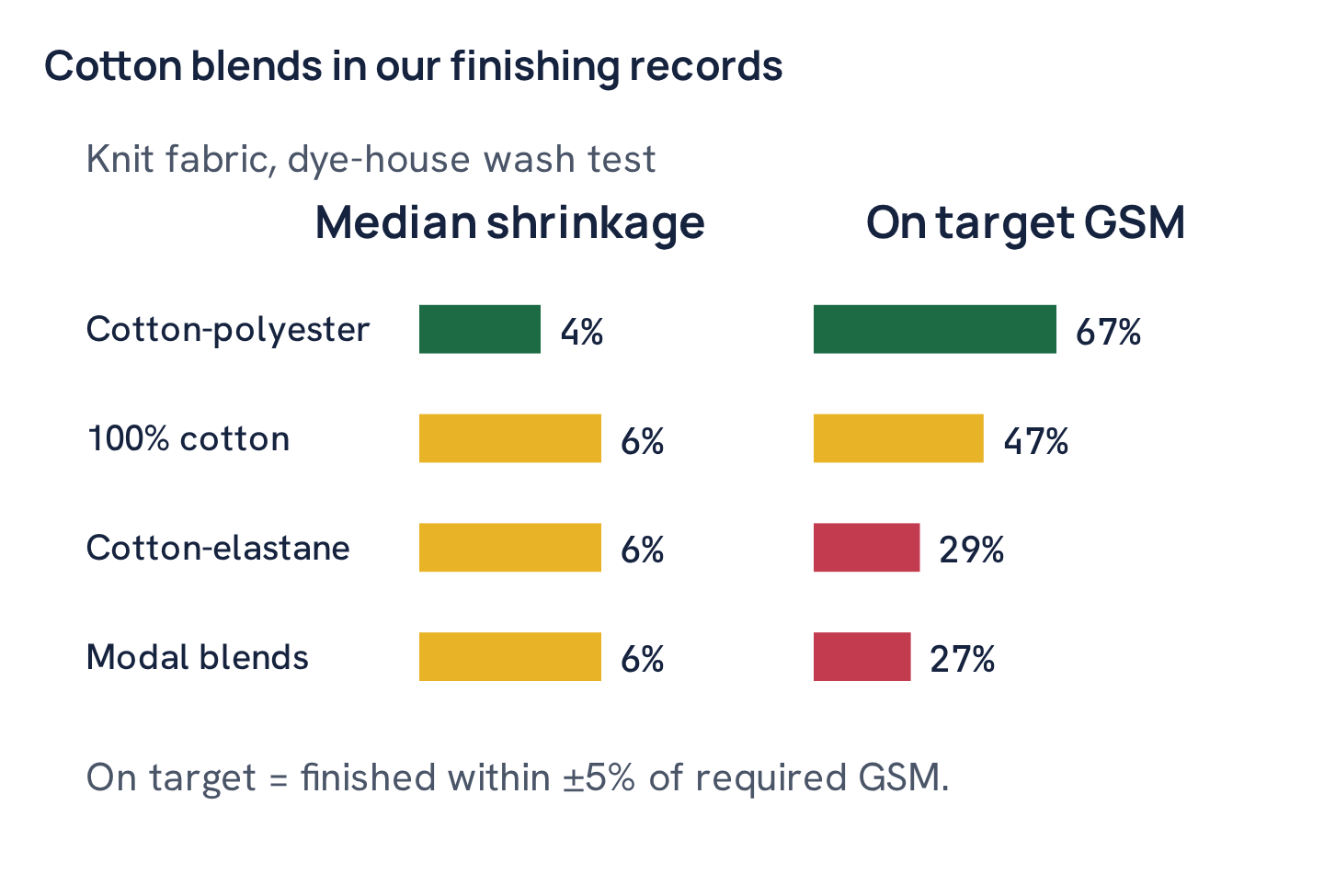
Blends behave very differently in the dye house and in the wash. In our finishing records:
- Cotton-polyester (CVC and PC), 2,514 batches: median length shrinkage 4%; 82% of parts within 5% shrinkage; 67% finished within ±5% of required GSM. The most predictable fabrics we finish.
- 100% cotton, 7,429 batches: median 6%; only 47% within 5% shrinkage; 47% on target GSM.
- Cotton-elastane, 2,355 batches: median 6% shrinkage, but only 29% on target GSM, because the elastane keeps pulling the fabric in.
- Modal blends, 374 batches: median 6% shrinkage and only 27% on target GSM; light parts gained a median 14.6% in weight after washing.
For a shopper, the practical lesson is simple: if you want a cotton garment that keeps its size, choose a cotton-polyester blend; if you want softness or stretch, accept a little more movement in the wash. See shrinkage by fibre.
Cotton blend vs 100% cotton
| Point | 100% cotton | Cotton-polyester blend |
|---|---|---|
| Breathability | Highest | Slightly lower |
| Softness | Natural, soft | Soft, a little smoother |
| Shrinkage | More | Less |
| Wrinkles | More | Fewer |
| Drying | Slow | Faster |
| Pilling | Pills wear off | Pills stay on |
| Price | Higher | Lower |
Neither is better in every way. 100% cotton is the comfort choice; a cotton-polyester blend is the easy-care choice.
How cotton blends are dyed
Dyeing depends on whether the partner fibre is cellulose or synthetic:
- Cotton with modal, viscose or linen: all cellulose, so one class of dye, usually reactive, colours both. The process is gentler for viscose and modal because they are weaker when wet.
- Cotton with polyester: two dye classes are needed: disperse dye at about 130°C for the polyester and reactive dye for the cotton, usually in two stages. That makes blends more expensive and slower to dye. Fabric containing polyester must also be finished at lower temperatures, about 100–110°C.
- Cotton with elastane: the fabric is heat set first to fix its stretch; the cotton is dyed with reactive dye and the elastane stays paler.
See the CVC dyeing process and the cotton-elastane dyeing process.
Common mistake: home dyeing a cotton-polyester T-shirt with an all-purpose dye and expecting a solid colour. The dye colours the cotton but not the polyester, so the shirt comes out lighter and speckled. The higher the polyester share, the paler the result.
Which cotton blend should you choose?
- Everyday T-shirts that keep their size: CVC (60/40 or 80/20 cotton-polyester).
- Softest, drapiest tees and underwear: cotton-modal, 50/50 or 60/40.
- Fitted tops, leggings and stretch jeans: cotton with 2–8% elastane.
- Summer shirts and trousers: cotton-linen for coolness and texture.
- Uniforms and workwear: polyester-rich PC (65/35) for durability and easy care.
- Socks: cotton with nylon and a little elastane.
- Fashion tees with a vintage feel: tri-blend.
Cotton blends and pilling
Blends with polyester or nylon pill more visibly than 100% cotton, because the strong synthetic fibres hold the pills on, while cotton pills tend to break off. This shows most on brushed fleece, sweatshirts and knitwear. Cotton-modal and cotton-viscose blends pill less. If low pilling matters most, choose 100% cotton or a cellulose blend, a tighter knit, and wash garments inside out; see why fleece and sweatpants pill.
Is a cotton blend good for sensitive skin?
Usually, yes. Cotton-modal and cotton-viscose blends are soft and absorbent and many people with sensitive skin find them as comfortable as cotton. Cotton-polyester blends are fine for most people, but the polyester share absorbs little sweat, so in heat they can feel warmer than pure cotton. For the most sensitive skin, a high cotton share in a smooth knit, washed before first wear, is the safest start.
How to read a cotton blend label
- First fibre listed: the largest share and the main behaviour of the fabric.
- “CVC”: chief value cotton, a cotton-rich cotton-polyester blend.
- “PC” or “poly-cotton”: often polyester-rich.
- “Cotton rich”: more than half cotton, but check the exact figure.
- Small elastane share (2–8%): a stretch fabric that should not be washed or dried hot.
- Care label: follows the most delicate fibre in the blend.
Cotton blends and the environment
Blending can make a garment last longer and need less ironing, which reduces energy use over its life, but it also makes recycling harder. Mechanical recycling works best on single-fibre fabrics, and separating cotton from polyester in a blend is difficult and still developing. Blends with synthetic fibres also shed microfibres in the wash. Cotton blended with other cellulose fibres, such as modal or linen, remains fully biodegradable.
How to care for cotton blends
- Wash at 30–40°C; cotton-polyester tolerates normal washing well.
- Avoid high heat for blends with elastane or polyester: tumble low and iron on a medium setting.
- Wash cotton-viscose and cotton-modal gently and dry low; they shrink more.
- Turn fleece and printed blends inside out to reduce pilling and protect prints.
Worked example. A school needs polo shirts that survive weekly washing for a year. A 65/35 polyester-cotton pique keeps its size and colour, dries fast and wrinkles little, and in our records cotton-polyester blends kept shrinkage within 5% in 82% of parts. A 100% cotton polo would feel more breathable but shrink and fade more. A 60/40 CVC splits the difference.
Summary
- A cotton blend mixes cotton with another fibre, usually in the same yarn.
- Polyester adds stability, elastane adds stretch, modal and viscose add softness and drape.
- In our records cotton-polyester blends shrank a median 4%, against 6% for 100% cotton.
- Cotton-polyester blends need two dye classes; cellulose blends need one.
- Read the percentages and follow the care label of the most delicate fibre.
Questions
What does cotton blend mean?
The fabric is made of cotton mixed with one or more other fibres, usually in the same yarn. The label lists each fibre by percentage.
Is a cotton blend better than 100% cotton?
It depends. Cotton-polyester shrinks and wrinkles less and dries faster; 100% cotton breathes best and feels most natural.
What is the most common cotton blend?
Cotton-polyester, sold as CVC when cotton-rich and PC or poly-cotton when polyester-rich, followed by cotton-elastane.
Does a cotton blend shrink?
Less than 100% cotton if blended with polyester: a median 4% against 6% in our knit records. Blends with viscose or modal can shrink as much as cotton.
Can you dye a cotton blend?
Cotton-cellulose blends dye evenly with one dye class. Cotton-polyester needs two dye classes; home dye colours only the cotton, giving a paler result.

Textile engineer with 14+ years in dyeing and fabric development. He writes every guide on Dyeing Solution from real production work. Full profile