You cannot properly sublimate on 100% cotton: sublimation ink is disperse dye, which bonds only with polyester, so on cotton it fades and washes out. Why, the workarounds, how much polyester a blend needs, typical settings, and the best alternatives for cotton shirts.
At a glance
Dispersedye ink
Polyesteronly
65%+polyester for good colour
DTFfor cotton
You cannot properly sublimate on 100% cotton. Sublimation ink is disperse dye, and disperse dye bonds only with polyester and some other synthetics, not with cotton. Pressed onto cotton, the design looks faded and washes out within a few washes. To get a sublimation print on cotton you need a workaround: a polyester coating spray, a sublimation-ready vinyl or transfer layer, a high-polyester blend, or a different method such as DTF or screen printing. The best results always come from white or light-coloured polyester.
This guide explains why sublimation needs polyester, what happens on cotton, the workarounds and how well each works, how much polyester a blend needs, typical sublimation settings on polyester, and the best alternatives for cotton shirts. It is written from the dyeing side: sublimation uses the same disperse dye chemistry we use to dye polyester in the dye house.
How sublimation works
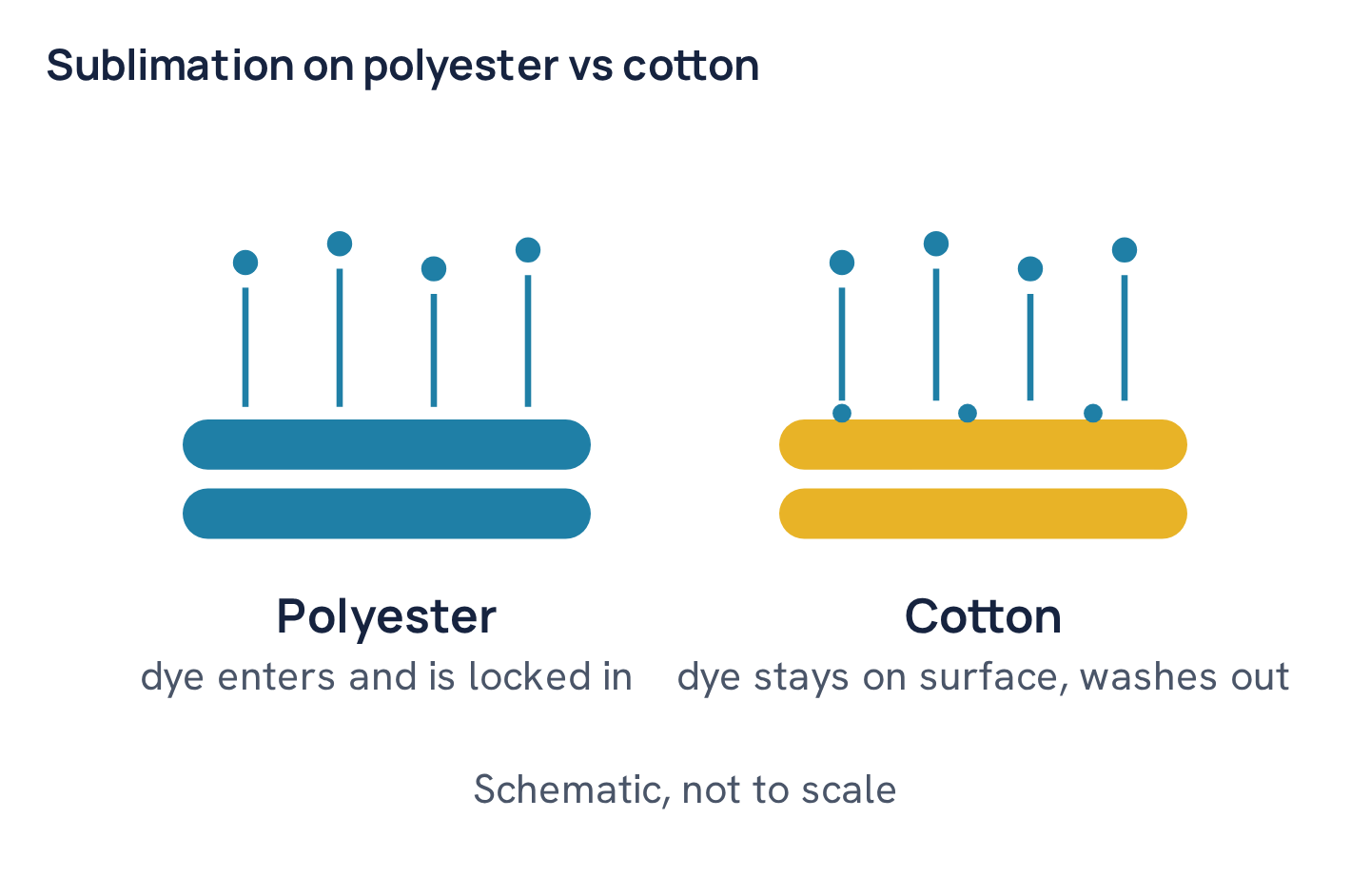
Sublimation printing uses a printer with special ink to print a mirror image onto transfer paper. On a heat press at around 200°C, the dye in the ink turns from a solid directly into a gas (it sublimes). At that temperature polyester fibres soften and their structure opens, so the dye gas enters the fibre. When the fabric cools, the fibre closes and the dye is locked inside. Because the colour is inside the fibre, a good sublimation print has no feel and is very washfast.
The ink is a disperse dye, the same class of dye used to colour polyester in industrial dyeing, where it is applied at about 130°C under pressure. See how disperse dyes work on polyester.
Why sublimation does not work on cotton
Cotton is cellulose. It has no affinity for disperse dye, does not soften with heat, and has no structure that opens and locks the dye in. On cotton, the dye gas mostly sits on the fibre surface. The print looks pale and dull from the start and largely washes out in the first few washes. Cotton is dyed with completely different dyes, usually reactive dyes that bond chemically with cellulose. See reactive vs disperse dye.
Ways to sublimate on cotton
| Method | How it works | Result |
|---|---|---|
| Sublimation coating spray | Sprays a polyester-type coating onto cotton that holds the dye | Brighter than plain cotton; can feel stiff; durability varies |
| Sublimation vinyl or HTV layer | Press a white, polyester-faced vinyl, then sublimate onto it | Bright, durable; feels like vinyl |
| Sublimation transfer paper for dark/cotton | A transfer layer carries the image onto cotton | Works; noticeable feel; not true sublimation |
| Polyester-rich blend shirts | Only the polyester share takes the dye | Brighter the more polyester; faded “vintage” look on 50/50 |
| Use DTF instead | Pigment print with adhesive | Full colour on cotton, any colour garment |
How much polyester do you need?
Only the polyester fibres take sublimation dye, so the more polyester, the brighter and more durable the print:
- 100% polyester: brightest, sharpest, most washfast.
- About 65% polyester or more: good, slightly softer colours.
- 50/50: noticeably faded, heathered “vintage” look; some colour washes out.
- Tri-blend (about 50% polyester): soft, faded print; see what is tri-blend.
- Below about 40% polyester: generally too pale; choose another method.
The garment also needs to be white or a light colour, because sublimation dye is transparent and cannot cover a dark fabric.
Typical sublimation settings on polyester
As a starting point, many sublimation garments are pressed at about 190–205°C (375–400°F) for about 40–60 seconds with medium pressure, using a protective sheet. Thin performance polyester may need the lower end of the range or a shorter time to avoid shine and press marks. Always follow the blank supplier’s guidance and test first. See heat presses for sublimation and sublimation printers for T-shirts.
Common mistake: sublimating onto a white 100% cotton T-shirt and judging the result straight off the press. It may look acceptable warm, but it is pale and will fade dramatically in the first washes. For cotton, use a coating, a sublimation-ready vinyl layer or DTF.
Do sublimation coating sprays work?
They help, but with limits. The spray coats cotton fibres with a polyester-like layer that can hold some disperse dye, so the print comes out brighter than on plain cotton. Results depend on even application and correct curing. Common drawbacks are a stiffer feel where sprayed, uneven colour if the spray is patchy, and faster fading than true sublimation on polyester. They suit decorative items, tote bags and occasional gifts more than garments washed every week.
Sublimation on dark cotton
Sublimation dye is transparent, so even on polyester it cannot show on dark fabric; the garment colour dominates. On dark cotton, the only sublimation-based option is to press a white, polyester-faced layer first, such as sublimation vinyl or a white transfer film, and sublimate onto that. For dark cotton garments, DTF or screen printing with a white underbase is simpler and more durable.
Common sublimation problems on blends
| Problem | Cause | Fix |
|---|---|---|
| Faded, washed-out colours | Too little polyester in the blend | Use 65% polyester or more, or switch method |
| Colours fade after washing | Dye on cotton fibres washes out | Use higher-polyester blanks |
| Ghosting (double image) | Paper moved when press opened | Use heat tape; lift press smoothly |
| Shiny press box | Too much heat or pressure on polyester | Lower pressure; use a pressing pillow |
Best alternatives for cotton shirts
- DTF (direct-to-film): full colour on any cotton colour; soft-ish film feel; very popular for small runs.
- DTG (direct-to-garment): water-based inks printed straight into cotton; softest feel on cotton; best on high-cotton garments.
- Screen printing: economical for larger runs; very durable.
- Heat transfer vinyl: best for text and simple shapes.
Why the dye-house view matters
In the dye house, a cotton-polyester (CVC or PC) fabric is dyed in two stages: disperse dye for the polyester, reactive dye for the cotton, because each fibre needs its own dye. Sublimation follows the same rule, but only has the disperse half. That is why a 50/50 shirt takes half the colour. It also explains why heat-transfer and sublimation prints on dyed polyester can suffer from dye migration if pressed too hot: the disperse dye in the garment itself can move. See colour fastness to hot pressing.
Worked example. A small shop wants photo-quality prints on cotton tote bags and on polyester sports tops. For the sports tops, sublimation on white polyester gives bright, permanent prints with no feel. For the cotton totes, a sublimation coating gives a quick but less durable result, while DTF gives durable full colour. The shop uses sublimation for polyester and DTF for cotton.
Choosing blanks for sublimation
- Choose white or very light colours.
- Check the fibre content: 100% polyester for the best result, or at least about 65% polyester.
- Prefer “sublimation-ready” blanks, which are made from polyester with a smooth face and no coatings that block the dye.
- Soft “cotton-feel” polyester blanks give a cotton-like handle while still taking sublimation dye.
- Test one blank before a full order, including a wash test.
Is sublimation on polyester washfast?
Yes. Because the dye is inside the polyester fibre rather than on top, a well-pressed sublimation print does not crack, peel or fade quickly, and it survives many washes. Like dyed polyester in general, it can lose a little brightness after long exposure to sunlight, and it should not be ironed hot directly on the print.
Can you sublimate on other natural fibres?
Linen, viscose, bamboo viscose, wool and silk behave like cotton for sublimation: they are not polyester, so disperse dye does not lock into them. Nylon takes some disperse dye but has poor fastness and is heat sensitive. For all of these, the same workarounds apply: a polyester coating or layer, or a different print method.
Summary
- Sublimation ink is disperse dye, which bonds only with polyester-type fibres.
- On 100% cotton, sublimation prints are pale and wash out.
- Workarounds include coating sprays, sublimation vinyl and high-polyester blends.
- For bright, durable sublimation, use white or light polyester at about 190–205°C.
- For cotton shirts, DTF, DTG or screen printing work better.
Questions
Can you sublimate on cotton?
Not properly. Sublimation dye bonds only with polyester, so on 100% cotton the print is pale and washes out within a few washes.
How do you sublimate on cotton?
Use a sublimation coating spray, a sublimation-ready vinyl or transfer layer, or choose a high-polyester blend shirt. DTF is often a better choice for cotton.
Can you sublimate on 50/50 cotton polyester?
Yes, but only the polyester half takes the dye, so the print looks faded and heathered.
What percentage of polyester do you need for sublimation?
100% gives the best result; about 65% or more gives good colour; below about 40% is usually too pale.
What is the best way to print on cotton shirts?
DTF, DTG or screen printing. They give full colour on cotton, including dark colours.

Textile engineer with 14+ years in dyeing and fabric development. He writes every guide on Dyeing Solution from real production work. Full profile