A fabric finish is any treatment applied after knitting or weaving, usually after dyeing, to change how a fabric looks, feels or performs. Mechanical vs chemical finishes, common and functional finishes, how finishing controls shrinkage and GSM, durability and label claims.
At a glance
Afterdyeing
Stenterand compactor
100–110°Cfor polyester
Severalper fabric
A fabric finish is any treatment applied to a fabric after it is knitted or woven, and usually after dyeing, to change how it looks, feels or performs. Finishing turns raw, dyed cloth into the fabric you actually buy: it can make it softer, smoother, more stable in size, less likely to pill, water repellent, wrinkle resistant, flame resistant, antimicrobial or simply better looking. Finishes are either mechanical, such as brushing, compacting or heat setting, or chemical, such as softeners, resins and functional treatments. Most fabrics get several.
This guide explains what fabric finishing is, mechanical vs chemical finishes, the most common finishes and what each does, how finishing controls shrinkage and GSM, functional finishes, how durable finishes are, how finishes affect safety and comfort, and how to read finish claims on a label. It is written from the dye-house floor, where finishing is the last and often most critical stage before fabric leaves the factory.
Where finishing fits in fabric production
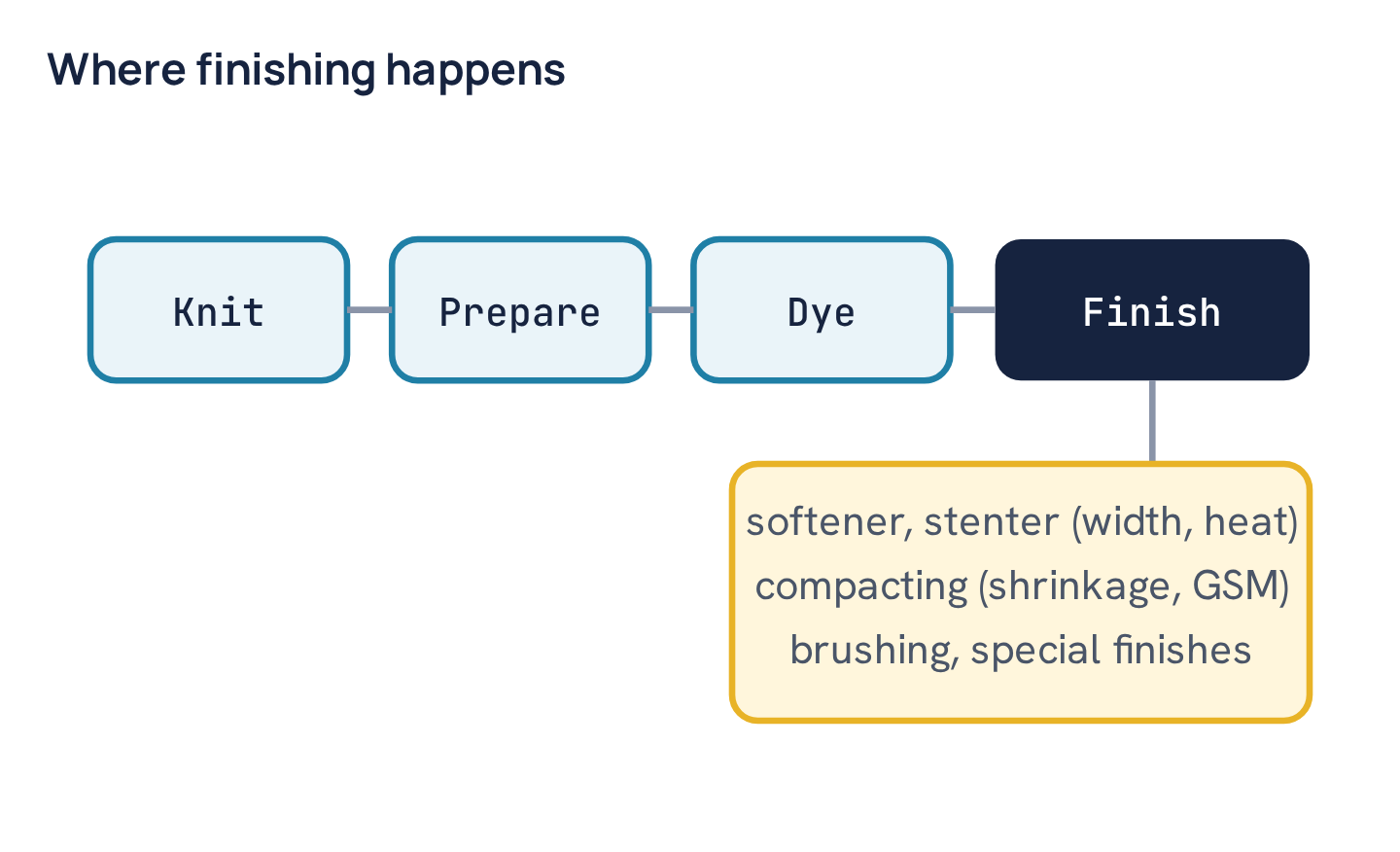
A typical knit fabric goes through knitting, preparation (scouring and bleaching), dyeing, and then finishing. On our floor the knit route runs: batching, scouring and bleaching, enzyme, dyeing, soaping, softening, slitting, stenter, and compacting. Everything after dyeing, softening, drying and stretching on the stenter, compacting, brushing or special treatments, is finishing. Finishing is where the fabric’s final width, length, weight and handle are set. See the knit dyeing and finishing flowchart.
Mechanical vs chemical finishes
| Type | Examples | What they change |
|---|---|---|
| Mechanical | Stenter drying, compacting, brushing (raising), shearing, peaching, calendering, heat setting | Size, shrinkage, GSM, surface texture, smoothness |
| Chemical | Softeners, resins, water repellents, flame retardants, antimicrobials, wicking finishes, anti-pill finishes | Handle, performance, care behaviour |
| Biological | Enzyme (bio-polishing) on cotton | Removes surface fuzz, reduces pilling, softens |
| Thermal | Heat setting, singeing | Dimensional stability, clean surface |
Common fabric finishes and what they do
- Softening: chemical softeners make the fabric feel smoother and softer. Silicone softeners give a slippery, silky hand; cationic softeners give a fuller, softer hand. Too much can reduce absorbency.
- Stentering: the fabric is held by its edges on a stenter frame, stretched to the set width and dried, and for synthetics also heat set. This controls width and, partly, weight.
- Compacting: the fabric is pushed together in length so the knit loops are closer to their relaxed shape, which reduces shrinkage in washing.
- Heat setting: for polyester, nylon and elastane blends, high heat fixes the fabric’s dimensions and stretch.
- Brushing and peaching: raise a soft nap for warmth and a velvety handle; see what is brushed cotton.
- Enzyme washing: removes loose cotton fibres for a cleaner, softer surface; see enzyme washed.
- Singeing: burns off surface fibres for a smooth, clean face, on suitable fabrics.
- Mercerising: treatment with caustic soda for lustre and strength; see what is mercerized cotton.
Finishing controls shrinkage and weight
For knit fabrics, finishing is where shrinkage and GSM are won or lost. In our finishing records of more than 14,000 knit batches, the median length shrinkage after the wash test was 3% for polyester, 4% for cotton-polyester blends, 6% for 100% cotton and 9% for viscose, and the share of parts finished within ±5% of the required GSM ranged from 67% for cotton-polyester to 47% for cotton and as low as 17% for lyocell blends. Good finishing, with the right overfeed on the stenter, correct compaction and heat setting where needed, pulls these numbers in the right direction. See shrinkage by fibre and heat setting of polyester fabric.
Fabric with polyester must be finished at 100–110°C, not at the 140–150°C used for cotton. Hotter than that and the dye bleeds and the fastness fails.
Functional (performance) finishes
| Finish | Purpose | Typical use |
|---|---|---|
| Water repellent | Makes water bead and roll off | Outerwear, bags |
| Wicking (hydrophilic) | Spreads sweat for fast drying | Sportswear |
| Antimicrobial | Limits odour-causing bacteria | Sportswear, socks, underwear |
| Wrinkle resistant (easy care) | Reduces creasing in cotton | Shirts, trousers |
| Flame resistant | Slows or stops burning | Workwear, children’s sleepwear, furnishings |
| Anti-pill | Binds fibre ends, reduces pilling | Fleece, knitwear |
| UV protective | Increases sun protection | Outdoor and swimwear |
| Cooling | Gives a cool-touch feel | Bedding, summer tops |
See antimicrobial finish for how one functional finish is applied in practice.
Common mistake: finishing a polyester-blend fabric on the stenter at cotton temperatures to speed up drying. The disperse dye migrates to the surface, rubbing and wash fastness drop, and the fabric can fail tests it would otherwise pass. Polyester blends need lower finishing temperatures.
How durable are finishes?
Mechanical finishes such as compacting and heat setting are part of the fabric’s structure and last, although knits can still relax a little in washing. Brushed surfaces gradually wear. Chemical finishes vary: some are durable through many washes, others are designed to last only a limited number. Softeners and water repellents wear off over time and are affected by detergents and fabric softener. Labels sometimes state how many washes a functional finish is tested for.
Finishes, safety and comfort
Most finishes are applied in small amounts and are washed or cured into the fabric. Some older finishing chemicals, such as certain formaldehyde-releasing resins or some fluorinated water repellents, are restricted or being phased out under product safety rules and brand chemical lists. Buyers commonly test finished fabrics for pH, formaldehyde and other restricted substances. For sensitive skin, washing new garments before use removes loose finish residues. See how fabric pH is tested.
How to read finish claims on a label
- “Pre-shrunk” or “compacted”: finishing aimed at low shrinkage; see what does pre-shrunk mean.
- “Enzyme washed”, “garment washed”: softer, cleaner surface.
- “Brushed”, “peached”, “sueded”: raised or sanded surface.
- “Moisture wicking”, “quick dry”: hydrophilic finish or special yarns.
- “Anti-odour”, “antimicrobial”: an added functional finish.
- “Water repellent”: surface finish, not waterproof.
- “Easy care”, “non-iron”: resin finish on cotton.
Worked example. Two greige cotton fleeces from the same knitting machine are dyed the same navy. One is softened, dried on the stenter with overfeed, brushed lightly, sheared and compacted; the other is just dried and softened. The first measures close to the required GSM after washing, shrinks within tolerance and pills less; the second shrinks more and pills sooner. Same fabric, different finishing.
Finishing knits vs wovens
Knit and woven fabrics share many finishes, but the priorities differ. Knits are loose, loop-based structures that stretch easily during wet processing, so knit finishing focuses on bringing length and width back to a stable shape: overfeed on the stenter, compacting and, for synthetic and elastane blends, heat setting. Woven fabrics are more stable in structure, so woven finishing often focuses on surface and performance: singeing, mercerising, calendering for smoothness or lustre, sanforising for shrinkage control, and resin finishes for easy care. Both need careful drying temperatures and correct pH at the end of processing.
How finishing affects colour
Finishing can change the final shade. Softeners, especially some silicone types, can make a colour look slightly deeper or slightly duller. High stenter temperatures can yellow white fabric or shift the shade of sensitive colours. Brushing and peaching lift fibres and make a dark colour look lighter and more frosty. For that reason, the shade is checked after finishing, not only after dyeing, and lab dips for brushed or heavily softened fabrics are sometimes made with the same finish applied.
Why the same fabric can feel different from two mills
Two mills can knit the same yarn on similar machines and dye to the same shade, yet the fabrics can feel and behave differently. The difference is usually in finishing: the softener type and amount, the stenter temperature and speed, the overfeed and compaction settings, and whether the fabric was brushed, sheared or enzyme treated. That is why buyers approve a finished fabric standard, not just the yarn and construction.
Summary
- A fabric finish is any treatment after knitting or weaving, usually after dyeing.
- Finishes are mechanical, chemical, biological or thermal, and most fabrics get several.
- Stentering, compacting and heat setting control width, shrinkage and GSM.
- Functional finishes add performance such as water repellency, wicking or flame resistance.
- Finishing temperature and chemistry also affect colour fastness and safety.
Questions
What is a fabric finish?
Any treatment applied to a fabric after it is knitted or woven, usually after dyeing, to change its look, feel or performance.
What are the types of fabric finishes?
Mechanical (stentering, compacting, brushing, heat setting), chemical (softeners, resins, functional finishes), biological (enzymes) and thermal (heat setting, singeing).
What does finishing do to shrinkage?
Overfeed drying, compacting and heat setting reduce shrinkage and control GSM. Our records show shrinkage ranging from 3% for polyester to 9% for viscose.
Do fabric finishes wash out?
Mechanical finishes are largely permanent; some chemical finishes such as softeners and water repellents wear off gradually.
Are fabric finishes safe?
Most are applied in small amounts and tested. Some older chemicals are restricted. Washing new garments before wearing removes loose residues.

Textile engineer with 14+ years in dyeing and fabric development. He writes every guide on Dyeing Solution from real production work. Full profile