Colour can enter at fibre, yarn, fabric or garment stage. Here is how garment dyeing works in a factory washing department, why brands use it, where it goes wrong, and how home bucket dyeing compares.
At a glance
4 stagesfibre, yarn, fabric or garment
Washing deptwhere industry dyes sewn garments
Cottonsewing thread so seams take colour
Bucketthe home version of garment dyeing
Quick answer. Most clothes get their colour as fabric, before cutting and sewing. Some are dyed after they are sewn: in industry this is garment dyeing, and it is done in the washing department. At home, the same idea becomes bucket dyeing. Garment dyeing is fast and flexible and gives a soft, washed look. Its weak points are shrinkage, uneven seams and small shade differences from one piece to the next.
If you have ever wondered why one T-shirt has a perfectly flat colour while a “vintage” sweatshirt looks a little faded along the seams, the answer is usually when the colour went in. Colour can be added at four points between raw fibre and the finished garment. Each point changes the cost, the look, the risk and how quickly a brand can react to fashion. This article walks through those stages, then looks closely at industrial garment dyeing and at its small-scale cousin, the home bucket.
Four places where colour can enter
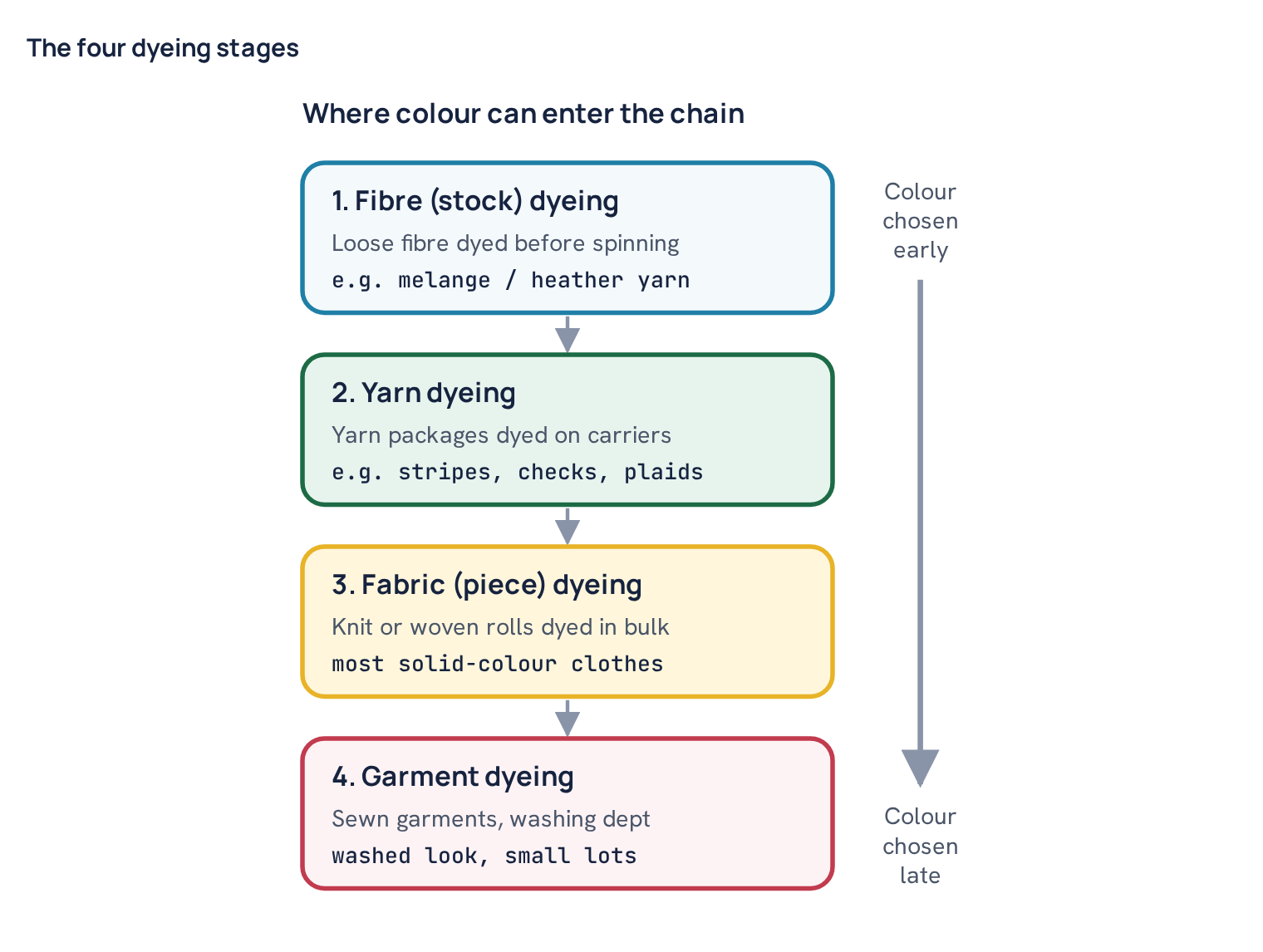
A garment starts as fibre, the fibre is spun into yarn, the yarn is knitted or woven into fabric, and the fabric is cut and sewn into a garment. A dye house can colour the material at any of these four stages. The chemistry is mostly the same at every stage. Cotton still takes reactive or direct dyes, and polyester still needs disperse dyes. What changes is the form of the material, the machine, and how early the colour decision has to be made.
Fibre dyeing
Here loose fibre, before spinning, is packed into a carrier and dyed. Blending dyed and undyed fibre (or fibres of two colours) gives the soft, speckled melange or “heather” look you see on grey sweatshirts. The colour is very deep inside the yarn, so fastness and evenness are excellent. The downside is that the colour must be decided months ahead, before the yarn is even made.
Yarn dyeing
Yarn is wound on perforated packages and dyed by pumping liquor through it. Yarn dyeing is needed whenever the pattern is built from coloured threads: stripes in a knit, checks in a shirt, a plaid. It is still an early decision, because the yarn must be dyed before knitting or weaving can begin.
Fabric (piece) dyeing
This is the main route for solid-colour clothing. Knit fabric is usually dyed in rope form in jet or soft-flow machines. Woven fabric is often dyed open-width on jiggers or on continuous and pad-batch ranges. Batches are large, often hundreds of kilograms per machine. The fabric is then finished, inspected, cut and sewn. Shade control is good because a whole batch of fabric shares the same bath, and the cutting room can keep panels from the same roll together.
Garment dyeing
Garment dyeing turns the order around. The garment is cut and sewn from undyed fabric, then the finished pieces are dyed. The colour decision moves to the very end of the chain. That single change is the reason brands use it, and also the reason it is harder to control. For which dye suits which fibre, see our guide to dye classes and fibres.
How garment dyeing works in a factory
In a garment factory, garment dyeing is not done in the fabric dye house. It is done in the washing department, the same section that does enzyme washes, stone washes, softening and other garment washes. That section already handles sewn pieces and has the machines and tumble dryers for them.
Prepared-for-dyeing fabric
The process starts before sewing. Fabric meant for garment dyeing is usually bought or made as “prepared for dyeing” (often shortened to PFD). That means it has been scoured and bleached to remove natural waxes and impurities, but it carries no optical brightener and no finish that would block dye. A softener or resin left on the fabric can resist the dye and give pale or patchy areas, so the fabric must be clean and absorbent.
The machines
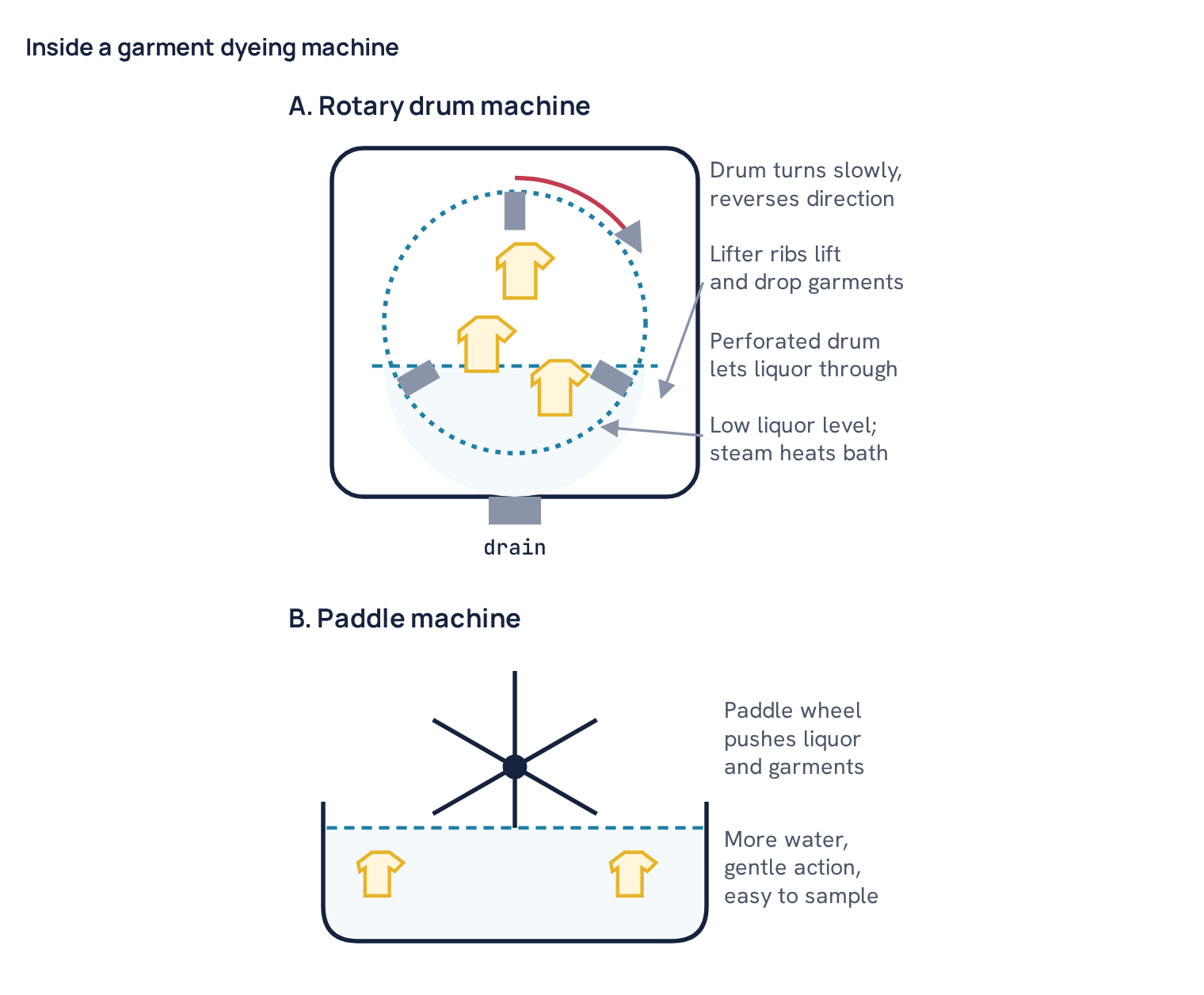
Two main machine types are used. A rotary drum machine (often side-loading) looks like a very large industrial washing machine. Garments go into a perforated inner drum, which turns slowly in the dye liquor. Ribs inside the drum lift the garments and drop them, so they keep opening and turning over. A paddle machine is an open tub, or a tub with a lid, with a large paddle wheel turning on top. The paddle pushes the liquor and garments around gently. Paddles are kind to delicate garments and allow easy shade checks, but they use more water. Drums use less water and give more mechanical action, which also helps the washed effect.
A typical sequence
The steps depend on the fibre and the dye class, but a cotton garment dyed with reactive dyes usually follows a pattern like this:
- Wetting and pre-treatment. Garments are wetted out evenly. Dry spots at this stage turn into light spots later.
- Dyeing. Dye is added gradually, then salt to push the dye towards the fibre, then alkali to make the dye react with the cotton. Temperature and dosing speed are controlled, just as in fabric dyeing.
- Washing off. Rinsing and soaping remove dye that has not bonded. Without this, the garment would bleed in the customer’s first wash.
- Optional washing effects. An enzyme wash or a light stone wash may follow to soften the hand feel and give a worn look.
- Softening, hydro-extraction and tumble drying. The tumble dryer finishes the soft, slightly crumpled garment-dyed look.
Direct dyes, sulphur dyes and pigments are also used in garment dyeing. Pigment dyeing is popular for a strong faded effect: the garment is first given a cationic treatment so the pigment can stick, and a binder holds it. The colour sits mostly on the surface, so it wears off on edges and seams during washing. That is exactly the vintage look many brands want. Direct dyes work in a simpler way, and our article on how direct dyes work on cotton explains why they need an after-treatment.
Why brands choose garment dyeing
- Fast colour decisions. The brand can hold a stock of undyed garments and decide the colour close to the selling season. If olive is selling and rust is not, the next batch can be olive. With fabric dyeing, that decision would have been fixed weeks or months earlier.
- Small lots. One drum load may be only a few dozen to a few hundred pieces, depending on the machine and the garment weight. A brand can test a colour on a small run without dyeing a full fabric batch.
- The washed, vintage look. Garments tumble in hot liquor, then go through softening and tumble drying. Seams and edges rub and take a slightly different shade. The fabric relaxes and the garment feels soft and lived-in. Many buyers value that look, and it is hard to fake with fabric dyeing.
- Colour-matched trims. If the thread, rib collar and pocket lining are all dyeable cotton, they dye together, so they match more easily than separately dyed parts.
- Less dead stock. Undyed stock can become any colour, so there is less risk of being left with racks of a colour nobody wanted.
The limits: what can go wrong
Garment dyeing gives flexibility, but every advantage has a price. Most of the problems come from the fact that a sewn garment is not a flat, uniform piece of fabric. It has layers, seams, trims and different components, and it shrinks.
Shrinkage
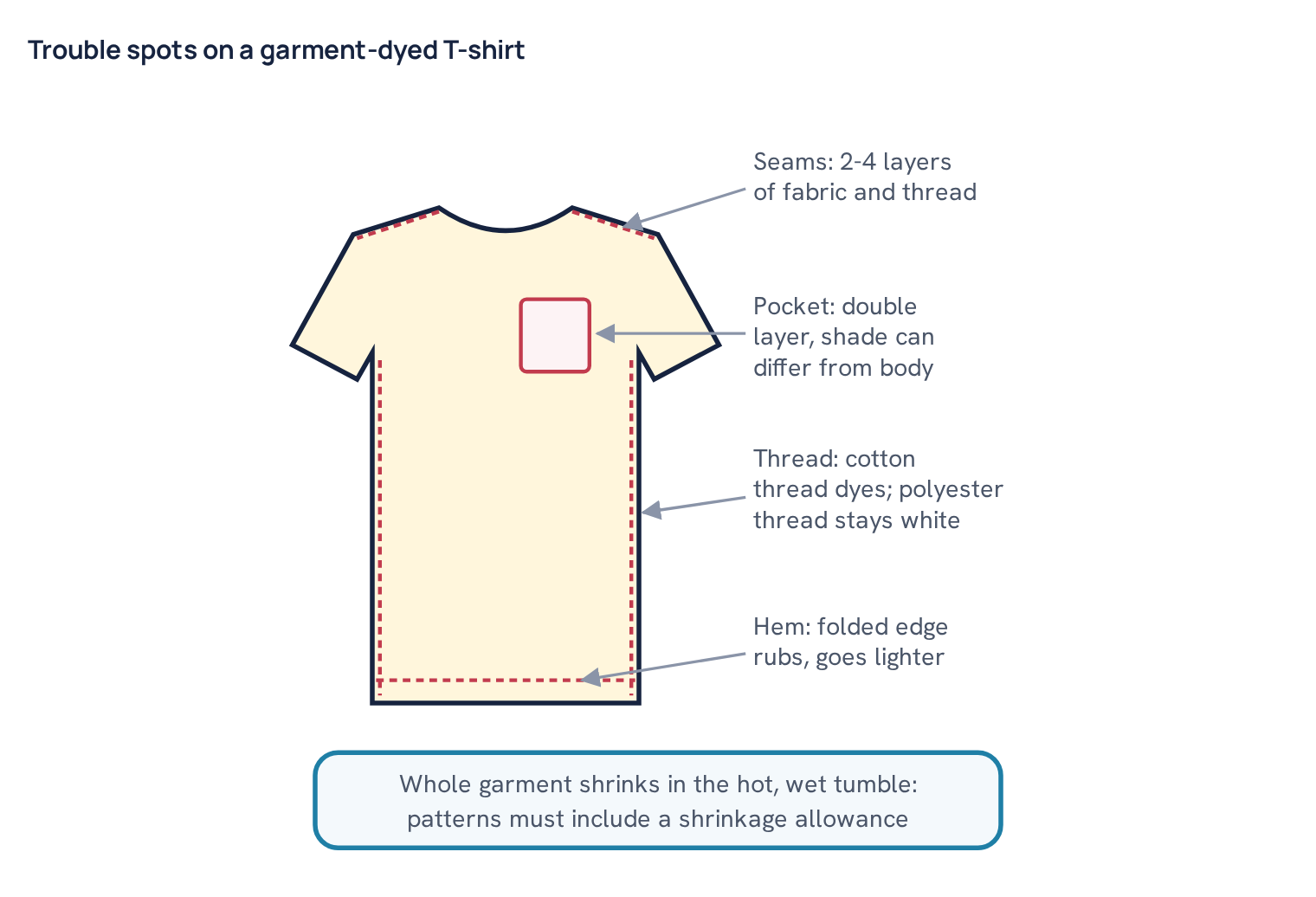
Cotton garments shrink when they are tumbled hot and wet. In fabric dyeing, shrinkage is controlled on the flat fabric by compacting or sanforising before cutting. In garment dyeing, the shrinkage happens after the garment is made, so the pattern must be cut larger to allow for it. The factory has to test the exact fabric, measure the shrinkage in length and width, and adjust the pattern. If the allowance is wrong, a whole batch ends up the wrong size. Body, rib and pocketing can shrink by different amounts and pucker a collar.
Sewing thread must be dyeable
Most garment factories sew with polyester or polyester-core thread, because it is strong and cheap. Reactive and direct dyes colour cotton but do not colour polyester. If a cotton garment is sewn with polyester thread and then dyed, every seam will show a white or pale stitch line. Sometimes designers want that contrast. If they do not, the garment must be sewn with cotton thread, or with a thread whose dyeable sheath matches the garment’s fibre. The same applies to labels, interlinings, elastic, zip tapes and buttons: each component must either take the dye or be chosen to survive the bath without bleeding, melting or cracking.
Shade variation garment to garment
In a fabric batch, every metre sits in the same bath for the whole cycle and moves through it again and again. Garments are more complicated. Some pieces sit near the outside of the load, some fold into the middle, some tangle. Small differences in water, temperature and movement reach each garment differently. The result is a little shade variation inside a batch and more between batches. A large order needs many small batches, and each can drift. Factories handle this by grading finished garments into shade bands and packing similar shades together.
Uneven seams and pockets
A seam is two to four layers of fabric plus thread, pressed together. Dye liquor reaches the outside layer easily, but the inner layers get less flow. At the same time, the raised seam rubs against the drum and other garments. Depending on the dye and the process, seams may come out darker, lighter, or with a “highlight” where the surface has been rubbed. Pockets and plackets behave in a similar way because they are double layers. Mixed components make it worse: a polyester pocket bag in a cotton pair of trousers will hardly dye with cotton dyes at all.
Common mistake: Sewing a garment-dye style with ordinary polyester thread and polyester labels “because that is what the line always uses”. After dyeing, white stitching and unreadable labels show on every piece, and the batch cannot be fixed by re-dyeing.
Fabric dyeing vs garment dyeing side by side
Neither route is better in every way. Fabric dyeing wins on consistency, cost per kilogram and control of dimensions. Garment dyeing wins on speed, flexibility and the soft, washed character. The table puts them next to home bucket dyeing, which follows the same idea as garment dyeing at a much smaller scale.
| Point | Fabric dyeing | Industrial garment dyeing | Home bucket dyeing |
|---|---|---|---|
| Where it happens | Fabric dye house | Washing department of garment unit | Kitchen, bathroom, backyard |
| Material dyed | Rolls or ropes of fabric | Sewn garments | One or a few garments |
| Typical batch | Hundreds of kg or more | Dozens to a few hundred pieces | One to a few pieces |
| When colour is decided | Before cutting | After sewing | Any time, even on old clothes |
| Shade consistency | High within a batch | Moderate, shade banding needed | Low to moderate, hard to repeat |
| Shrinkage control | On flat fabric before cutting | Allowance built into pattern | Little control, garment may shrink |
| Seams and thread | Not an issue (sewn after dyeing) | Thread and trims must suit the dye | Polyester thread stays pale |
| Look | Clean, flat, uniform | Soft, washed, vintage | Handmade, often uneven |
| Dyes used | Full industrial range | Reactive, direct, sulphur, pigment and others | Ready-made home dyes, natural dyes |
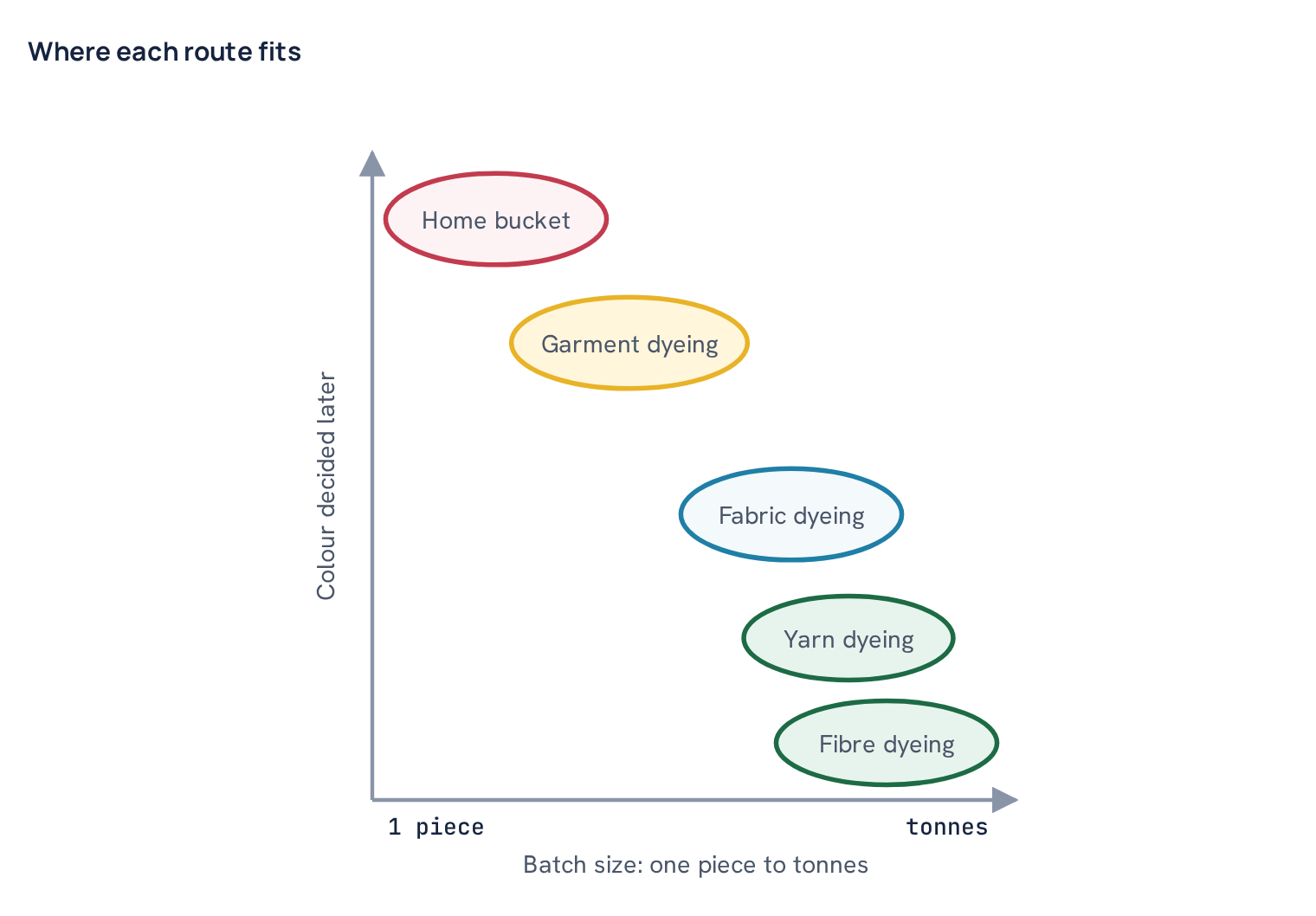
Home bucket dyeing: the small-scale cousin
At home, clothes are dyed in a bucket, a sink or a large pot. The principle is the same as in the washing department: a finished garment goes into a dye bath. What changes is the control. There is no programmed temperature curve, no dosing pump and no lab to match the shade. That is fine for refreshing a faded T-shirt or giving an old shirt a new colour, as long as you expect a handmade result rather than a factory match.
What dyes people use at home
Most home dyers buy ready-made colours from a shop or online. Many of these are direct dyes, which colour cotton and other cellulose fibres straight from a warm or hot bath with salt. They are easy to use, but their wash fastness on their own is only moderate. That is why a fixative is often sold with them. Natural dyes are very popular today, partly because people worry that some synthetic dyes may harm the skin. Some people also try food colours.
A little science helps here. Most synthetic dyes sold for textiles are safe when they meet current rules. A small group of azo dyes can break down into certain aromatic amines that are restricted, for example under EU REACH rules and in buyers’ restricted-substance lists, so compliant products avoid them. “Natural” does not automatically mean safe either: some mordants and plant extracts need careful handling. Food colours are made for food, not fibre. They behave like acid dyes, so they colour wool, silk and nylon better than cotton, and even then their wash fastness is poor. See our guides on home dyes, dye safety and azo dyes and natural dyes and mordants go into each option.
What each home step does
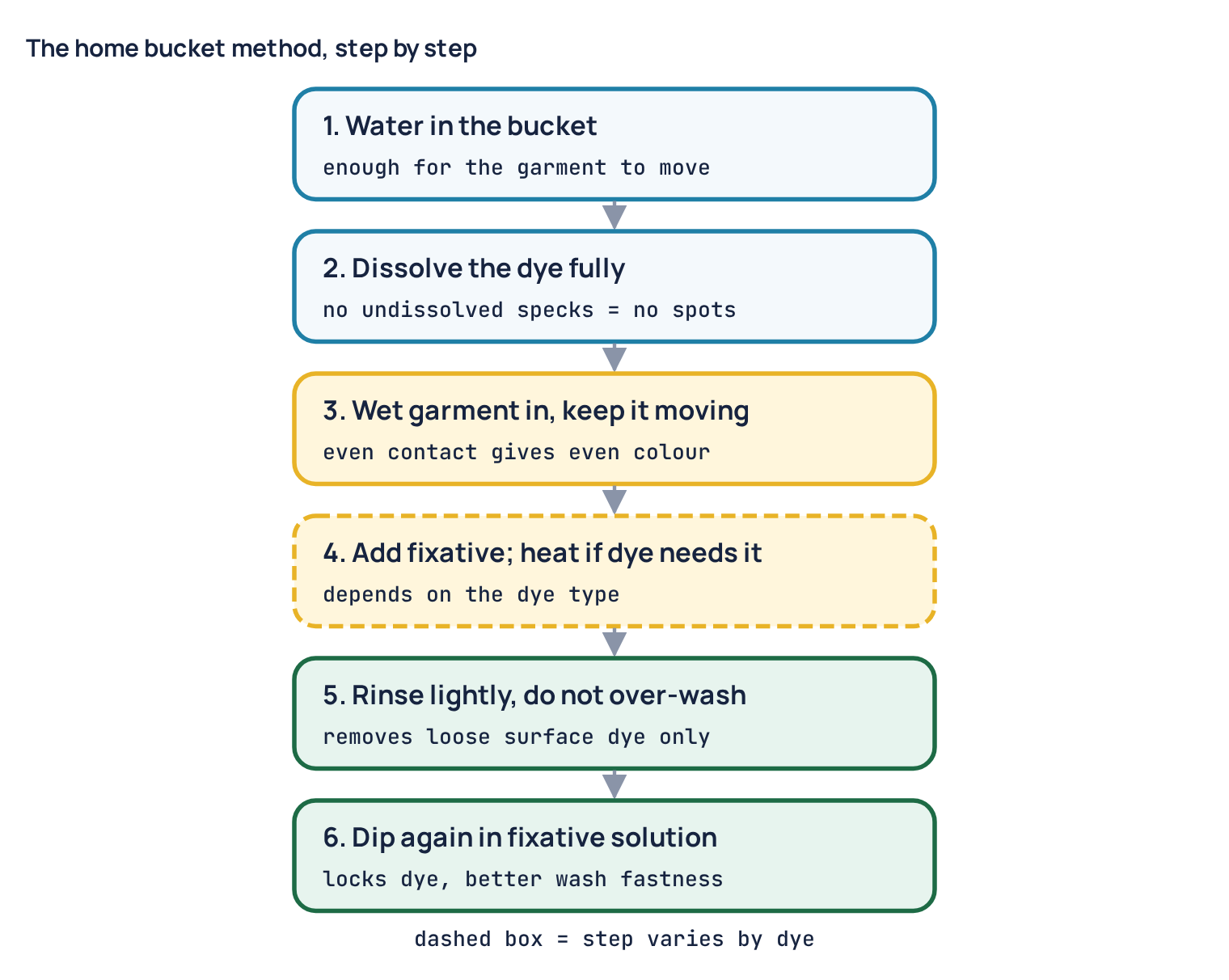
The diagram below shows the usual order. It is a concept map, not a recipe; always follow the instructions that come with your dye, because the right amounts, temperatures and times depend on the product.
- Clothes are dyed in two ways: in industry, garment dyeing is done in the washing department; at home, people dye in a bucket.
- At home people usually use ready-made colours bought from the market or online, for example direct dyes, which colour the garment directly. A fixative is sold with them, and you fix the colour with it afterwards.
- Natural dyes are the most popular choice today, because people worry that some synthetic dyes are harmful to skin. People also use food colours or ready-made colours bought online.
- The home process: take a bucket and water, dissolve the dye, put the garment in, add the fixative. Sometimes heat is needed and sometimes not, it depends on the dye. Then wash lightly (do not over-wash) and dip it again in fixative solution.
Why “fixative” can mean two things
Home dye kits use the word “fixative” loosely, so it helps to know what is going on. In the dye bath, the helper may be salt, which pushes direct dye onto cotton, or, for home dyes that react with the fibre, an alkali such as soda ash that starts the bonding. After dyeing, the true after-fixer for direct dyes is a cationic dye-fixing agent. Direct dye molecules carry a negative charge. The fixing agent carries a positive charge, so the two join into a larger, less soluble complex that is harder to wash out of the fibre. This clearly improves wash and water fastness. It can dull the shade slightly and may lower light fastness a little. More on this in our article what a dye fixative is and how it works.
Why the light rinse matters
After dyeing, some dye sits loosely on the surface. A light rinse takes this away so it does not stain other clothes later. Over-washing at this stage, before the final fix, can strip colour that has not yet been locked in, leaving the garment paler than you wanted. That is why the rinse comes before the second fixative dip, not after it.
Worked example. Someone dyes a white cotton shirt navy at home. The body comes out a rich navy, but every seam shows a thin pale line. The fabric is cotton, but the factory sewed it with polyester thread, and the home direct dye cannot colour polyester. Nothing went wrong in the bucket; it is the same thread problem the washing department faces, just at a scale of one shirt.
What home dyeing shares with the factory
The same limits follow the garment into the bucket. Cotton may shrink in hot water. Seams, pockets and hems may come out a little different from the body. Polyester thread and labels will stay pale. Two garments dyed on different days will rarely match exactly. The bucket has even less control than a drum, so movement and patience matter: a garment left bunched up in one corner will dye patchy. For more home-focused guides, visit our home dyeing section.
Choosing the right route
For a brand, the choice comes down to what the product needs. If a style needs a precise, repeatable colour across thousands of pieces, stripes or checks, or a crisp, clean surface, fabric or yarn dyeing is the safer route. If the brand wants to react quickly to sales, test colours in small runs, or sell a soft, washed, lived-in garment, garment dyeing is worth the extra care. The key is to plan for it from the start: prepared-for-dyeing fabric, the right sewing thread, trims that survive the bath, a shrinkage allowance in the pattern, and an agreement with the buyer on acceptable shade variation.
For a home dyer, the bucket is the simplest way to give a garment a second life: the same idea as the washing department, with one garment and much less machinery.
Questions
What is garment dyeing?
Garment dyeing means dyeing clothes after they have been cut and sewn, instead of dyeing the fabric first. In industry it is done in the washing department, in drum or paddle machines.
How are most clothes dyed?
Most solid-colour clothes are dyed as fabric before cutting and sewing. Striped and checked clothes are usually yarn-dyed, and melange (heather) clothes are fibre-dyed.
Why do garment-dyed clothes look washed or vintage?
The garments tumble in hot liquor and are then softened and tumble dried, so seams and edges rub and the fabric relaxes. Pigment garment dyeing adds a stronger faded effect because the colour sits mainly on the surface.
Why did the stitching stay white when I dyed my shirt at home?
The shirt was almost certainly sewn with polyester thread. Dyes for cotton, such as direct or reactive dyes, do not colour polyester, so the seams stay pale.
Do garment-dyed clothes shrink?
Cotton garments shrink during hot, wet garment dyeing, so factories cut the pattern larger to allow for it. Home-dyed cotton can also shrink, especially in hot water.
Is garment dyeing the same as reactive dyeing?
No. Garment dyeing is where the colour goes in: on the sewn garment. Reactive is a dye class. A cotton garment is often garment dyed with reactive dyes, but it can also be dyed with direct dyes or pigment for a washed look, and fabric dyeing uses reactive dyes too.

Textile engineer with 14+ years in dyeing and fabric development. He writes every guide on Dyeing Solution from real production work. Full profile