Most T-shirts are single jersey in cotton, polyester or a blend. The main T-shirt fabrics, knit structures, carded vs combed vs ring-spun yarn, fabric weight in GSM, shrinkage data from our records, printing methods, common problems and how to choose.
At a glance
Jerseymost common knit
135–240GSM range
3%polyester shrinkage
6%cotton shrinkage
Most T-shirts are made from knitted fabric, usually single jersey, in cotton, polyester or a blend of the two. The main T-shirt fabrics are 100% cotton jersey (soft, breathable, classic), combed and ring-spun cotton (smoother and finer), cotton-polyester blends such as CVC and 50/50 (less shrinkage, easier care), tri-blend (polyester, cotton and rayon for a soft, drapey, heathered tee), 100% polyester (sportswear and sublimation printing), and cotton or modal with elastane for fitted styles. Fabric weight, measured in GSM, decides whether a tee feels light and airy or heavy and structured.
This guide explains the main types of T-shirt fabric, the knit structures used (jersey, rib, interlock, pique, slub), yarn types, fabric weights, how each fabric behaves in shrinkage and printing, and how to choose the right T-shirt fabric for comfort, printing, sport or a premium feel. It is written from the dye-house side, where T-shirt jersey is the single most common fabric we dye and finish.
T-shirt fabric types at a glance
| Fabric | Feel | Strengths | Watch-outs |
|---|---|---|---|
| 100% cotton jersey | Soft, natural, breathable | Comfort, absorbency, prints well | Shrinks, wrinkles, fades |
| Combed / ring-spun cotton | Smoother, finer | Premium feel, sharper prints | Higher price |
| CVC (cotton-rich blend) | Soft, slightly smoother | Less shrinkage, durable | Slightly less breathable |
| 50/50 cotton-polyester | Light, smooth | Low shrinkage, easy care | Can pill, holds odour more |
| Tri-blend | Very soft, drapey, heathered | Vintage look, light feel | Thinner, more delicate |
| 100% polyester | Smooth, light, technical | Wicking, sublimation printing | Less breathable at rest, odour |
| Cotton or modal + elastane | Soft, stretchy | Fitted shape, recovery | Needs gentle drying |
| Modal or modal blends | Silky, cool | Softness that lasts | Higher price |
Knit structures used for T-shirts
- Single jersey: the classic T-shirt knit; smooth V-stitches on the face, loops on the back. See what is cotton jersey.
- Slub jersey: uneven yarn gives a textured, vintage look. See what is slub fabric.
- Rib: stretchy, fitted tees and tank tops, and neckbands.
- Interlock: thicker, smooth both sides; premium and babywear tees. See what is interlock fabric.
- Pique: textured knit used for polo shirts. See what is pique fabric.
- Heather and melange: mixed-colour fibres for a soft, marled look. See what is heather fabric.
Yarn types: carded, combed and ring-spun
Cotton yarn quality makes a big difference to how a tee looks and feels. Carded yarn is cheaper and has more short fibres and fuzz. Combed yarn has short fibres removed, giving a smoother, stronger, less pilling yarn. Ring-spun yarn is twisted more tightly and evenly than open-end yarn, making a softer, smoother fabric. “Combed ring-spun cotton” is the standard for better-quality tees. See what is ring spun cotton.
T-shirt fabric weight (GSM)
| Weight | Approx. GSM | Feel and use |
|---|---|---|
| Lightweight | Under about 150 | Thin, airy, summer, layering |
| Midweight | About 150–200 | Everyday tees, most retail |
| Heavyweight | About 200–240+ | Structured, boxy, streetwear, premium |
Our single jersey development records range from about 135 to 240 GSM. See what is GSM in fabric.
Shrinkage by T-shirt fabric
Fibre makes a big difference to how much a tee shrinks. In our finishing records, polyester knits shrank a median 3% in length after the wash test, cotton-polyester blends 4%, and 100% cotton 6%; 100% cotton single jersey specifically was around 5%. Blends with polyester hold their size best; pure cotton needs good compacting or pre-shrinking. See does cotton shrink and what does pre-shrunk mean.
Polyester has no shrink property. In a CVC or PC fabric the polyester holds the structure, so the fabric cannot shrink, and washing changes the GSM very little.
Printing and T-shirt fabric
- Screen printing: works on cotton and blends; cotton gives the softest plastisol-free feel with water-based inks.
- DTG: best on 100% cotton; blends give lighter, more vintage prints.
- DTF: works on cotton, blends and polyester. See DTF on cotton.
- Sublimation: only on polyester or high-polyester blends, ideally white. See can you sublimate on cotton.
Common mistake: choosing a cheap 100% cotton open-end jersey for a print-on-demand line to save cost. The fabric is fuzzy, shrinks noticeably and twists at the side seams after washing, and prints look less sharp. Combed ring-spun cotton or a CVC blend costs a little more but gives far fewer complaints.
Common T-shirt fabric problems
- Spirality (side seam twist): common in single jersey; controlled by yarn twist and finishing. See how spirality is tested.
- Shrinkage: high in under-compacted cotton.
- Pilling: more in blends and short-fibre cotton.
- Fading: dark cotton tees lose colour faster than polyester. See why black T-shirts fade.
- Neckline stretching: weak neckband without elastane.
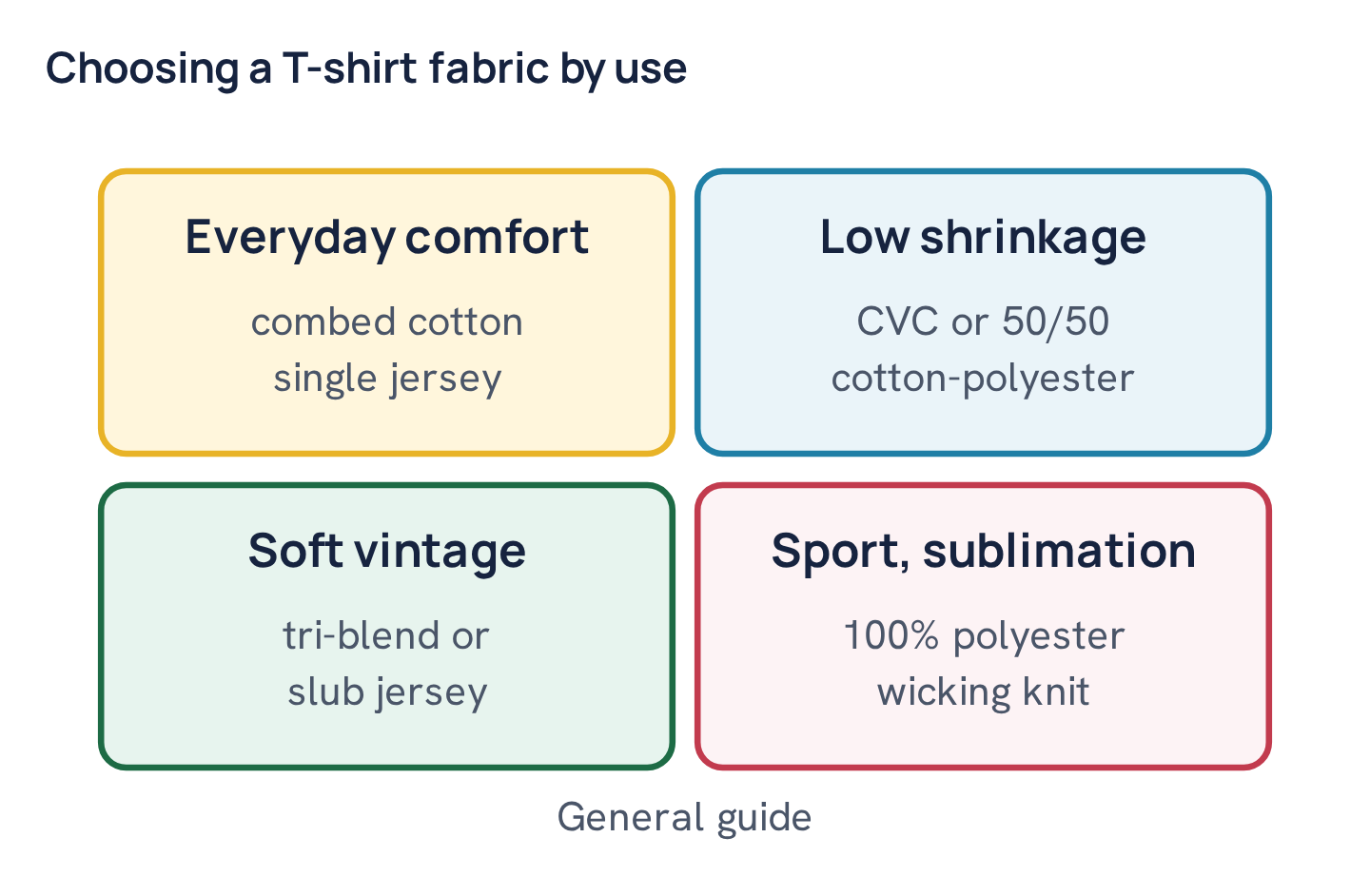
How to choose the right T-shirt fabric
- For comfort and breathability: combed ring-spun cotton, 150–180 GSM.
- For easy care and low shrinkage: CVC or 50/50.
- For a soft, drapey, vintage look: tri-blend or slub.
- For sport: polyester or polyester-spandex wicking knit.
- For a structured, premium look: heavyweight cotton, 200+ GSM.
- For fitted styles: cotton or modal with 5% elastane.
Worked example. A startup brand wants one tee for printing, everyday wear and low returns. Samples in 100% carded cotton, combed ring-spun cotton and a 60/40 CVC are washed five times. The carded cotton shrinks most and twists; the combed cotton feels best but shrinks a little; the CVC holds size and prints well. They choose combed cotton for the premium line and CVC for the core line.
Premium T-shirt fabrics
- Pima and long-staple cotton: smoother, stronger, less pilling. See what is pima cotton.
- Mercerised cotton: lustrous, crisp, holds colour well. See what is mercerized cotton.
- Cotton-modal: silky softness that lasts. See what is cotton modal.
- Merino wool jersey: odour-resistant, temperature-regulating travel tees.
- Garment-dyed heavyweight cotton: soft, lived-in look with little further shrinkage.
Organic and recycled T-shirt fabrics
Organic cotton is grown without synthetic pesticides and fertilisers and performs like conventional cotton of the same quality. Recycled cotton is often blended with virgin cotton or polyester because recycled fibres are shorter. Recycled polyester performs the same as virgin polyester. Certifications help verify these claims.
Heather and coloured T-shirt fabrics
Heather grey and other heathered colours are made by blending dyed and undyed fibres, or fibres of different types that dye differently, before spinning. Polyester-cotton blends dyed only on the cotton part also give a heathered look. Heathers hide stains and lint well and are popular for everyday tees.
How to care for T-shirts
- Wash inside out at 30–40°C with similar colours.
- Tumble low or line dry to reduce shrinkage and fading.
- Avoid ironing directly on prints.
- Store folded to avoid shoulder stretch.
T-shirt fabric for hot weather
For heat, choose light (under about 160 GSM) cotton, cotton-modal, linen-blend or slub jersey, in a loose fit and light colour. For sport in heat, choose a light, open polyester knit with a wicking finish. Avoid heavyweight cotton and dense polyester in high heat. See is cotton breathable.
T-shirt fabric for printing businesses
Print shops usually stock a combed ring-spun cotton tee for DTG and screen printing, a CVC or 50/50 blend for low-cost bulk orders, and a white polyester tee for sublimation. Consistent supply matters more than small differences in fabric: a tee that changes weight or shade between orders causes reprints and complaints.
How to check T-shirt fabric quality
- Hold it to light: even density means even yarn and knitting.
- Rub the surface: lots of fuzz suggests short fibres and future pilling.
- Stretch the neckband: it should snap back.
- Check side seams: twisted seams on a new tee suggest spirality.
- Read the label for fibre, weight and care.
Why some T-shirts get thin and see-through
Light tees made from short-fibre or open-end cotton lose fibres in every wash, so they thin quickly and become see-through at stress points. Heavier tees and those made from combed or long-staple cotton keep their density much longer. Washing cooler and avoiding the dryer also slow thinning.
Summary
- Most T-shirts are single jersey in cotton, polyester or blends.
- Combed ring-spun cotton is the standard for quality cotton tees.
- Blends with polyester shrink less; tri-blend is softest and drapiest.
- GSM sets the weight: light under 150, mid 150–200, heavy 200+.
- Choose fabric by use: comfort, care, look, sport or printing method.
Questions
What fabric are T-shirts made of?
Most are single jersey knit in cotton, polyester or a cotton-polyester blend; some use tri-blend, modal or elastane blends.
What is the best T-shirt fabric?
Combed ring-spun cotton for comfort, CVC or 50/50 for low shrinkage, tri-blend for softness and polyester for sport.
What GSM is a good T-shirt?
About 150 to 200 GSM for everyday tees; under 150 is light and over 200 is heavyweight.
Which T-shirt fabric shrinks least?
Polyester and cotton-polyester blends. In our records polyester knits shrank a median 3% and cotton 6%.
What T-shirt fabric is best for printing?
Cotton for DTG and screen printing, polyester for sublimation, and almost any for DTF.

Textile engineer with 14+ years in dyeing and fabric development. He writes every guide on Dyeing Solution from real production work. Full profile