A development guide for grey and coloured melange knits across jersey, elastane, slub and fleece constructions: what the melange percentage means, yarn lot control, wash-only processing, overdyeing, shade approval, GSM and shrinkage, built on our real records.
At a glance
636melange entries in our register
-3.7%median finished vs required GSM
+10.2%median GSM rise after the wash test
-8% to -9%length shrinkage, elastane melange rows
Melange fabric, also called heather, is the soft grey or coloured fleck you see on sweatshirts, basic tees, joggers and sports tops. The shade is not made in the dye house. It is made in the spinning mill, when dyed fibre and undyed fibre are blended before the yarn is spun. That one fact changes the whole development job. The dye house can no longer correct the shade, a yarn lot change can show as a stripe, and the usual scour, bleach and dye route is replaced by a much gentler wash. This guide follows melange from yarn to tested fabric across the constructions where it is used: plain and Lycra (elastane) jersey, slub, heavier double-knit and fleece. It builds on our development records: 636 melange entries in our fabric register. Lab data is thin, only 2 test reports reached our desk for melange, so where a value comes from general practice it is marked as typical.
What melange fabric is
Dyed fibre blended before spinning
A melange yarn is spun from a blend of two or more fibre components with different colours. In the most common case, grey melange, a small share of dark fibre is mixed with white or ecru cotton. In the fabric the dark fibres show as tiny flecks and the eye reads the mix as grey. Coloured melange works the same way, with navy, red, green or any other dyed fibre mixed with white fibre, or two coloured fibres mixed together.
The dyed component is made in one of two ways:
- Fibre (loose stock) dyeing. Loose cotton fibre is dyed in a package-type machine before spinning, usually with reactive dyes for cotton. The register calls this “fibre dyed”. Shade, fastness and the fibre damage from dyeing and drying are all fixed at the spinning mill.
- Dope dyeing (solution dyeing). For man-made fibres such as viscose or polyester, pigment is added to the polymer before the fibre is extruded. The colour is inside the fibre, so it has very good fastness. Much grey melange uses black dope-dyed fibre for this reason.
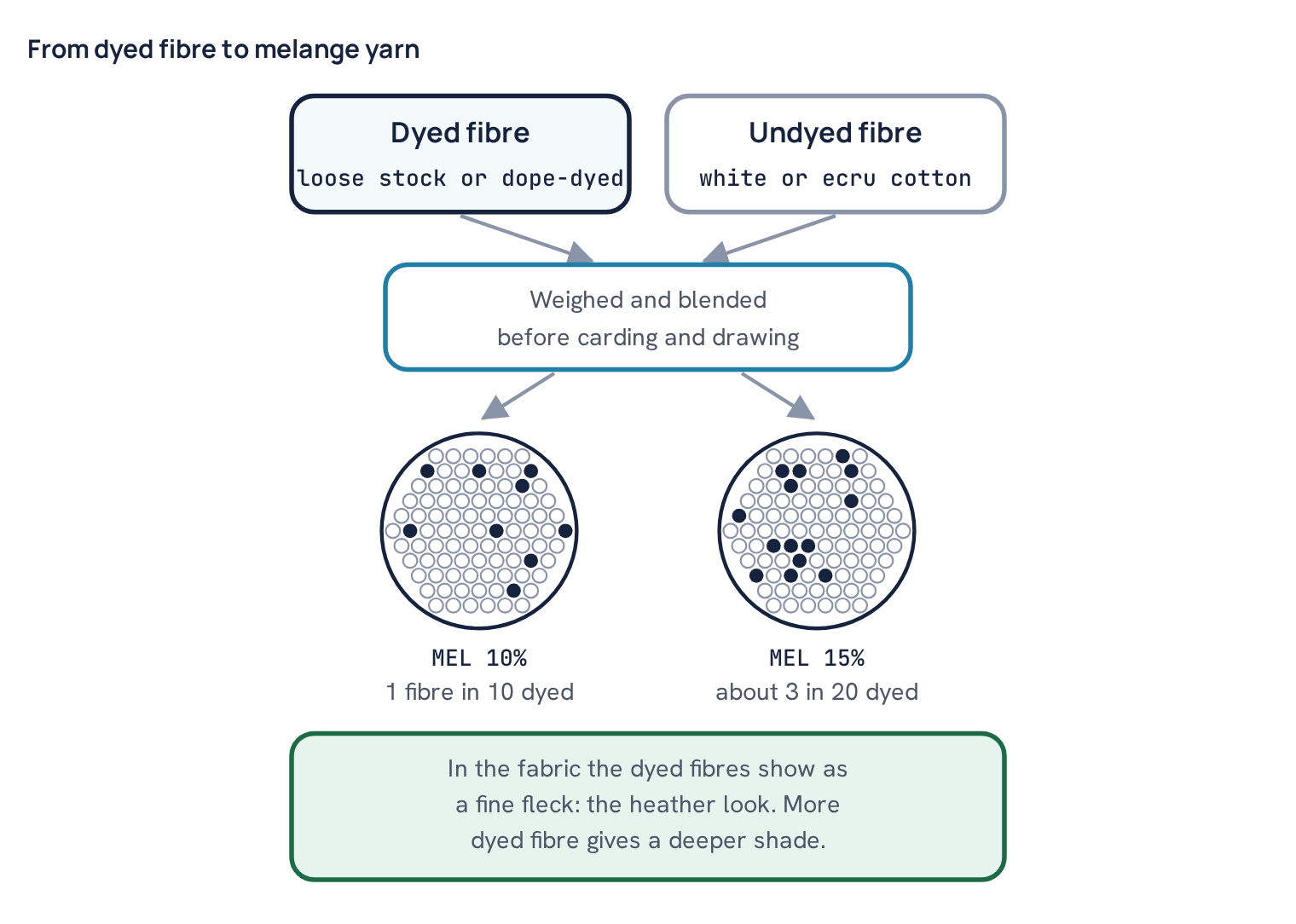
The dyed and undyed fibres are weighed in the blow room or blended as slivers at the draw frame, then carded, drawn and spun together. Draw frame blending usually gives a more exact ratio; blow room blending a more intimate mix. Either way, the final shade depends on the blend ratio, the depth of the dyed fibre and how evenly the fibres are mixed.
What “MEL 10%” means
In our register the melange share is written into the yarn description, for example “MEL 10%” or “MEL 15%”. The percentage is the share of dyed fibre in the blend by weight. A 10% melange has one part dyed fibre to nine parts undyed fibre; a 15% melange has more dyed fibre and so gives a deeper grey. Other descriptions in the register are “CTN MELANGE” (cotton melange), “CTN MELANGE FIBER DYED” and “CTN MODAL 60/40 MELANGE”, a cotton and modal blend with a dyed component.
Two points follow. First, the melange percentage is part of the shade. A buyer who approves a 10% grey melange has approved that ratio, and a 12% lot from a different mill will not match even though it is “grey melange” too. Second, the melange percentage is part of the composition. If the dyed fibre is viscose or polyester, a “10% melange” yarn is not 100% cotton, and the care label and fibre content claim must say so. Our register groups all melange entries with blended yarns (the CVC/PC family) rather than 100% cotton, which is a useful reminder to read the actual composition from the spinner’s yarn certificate every time.
Where melange is used
Melange is not a construction; it is a yarn. It is knitted on any machine. In our register the 636 entries spread across many gauges: 20G (168 entries), 24G (159), 18G (150), 16G (66) and 28G (65). The large share on 16G and 18G is typical of heavier double-knit, rib and fleece work, while 24G and 28G carry most of the jersey. The most used machine diameter is 30 inch (226 entries), then 34 inch (136), 36 inch (88), 28 inch (45) and 32 inch (44). About 30% of the entries (192 of 636) contain elastane. For the construction itself, use the matching guide: single jersey, Lycra single jersey, rib, fleece or slub and yarn-dyed single jersey. This guide covers what the melange yarn adds to each of them.
Properties you must design around
- The shade lives in the yarn. It cannot be adjusted in the dye house. Only overdyeing, which turns the fabric into a different product, changes it.
- High sensitivity to barré. Any variation in blend ratio, dyed fibre depth or count between yarn lots or cones shows directly as stripes or bands.
- Composition risk. The dyed component may be a different fibre from the base, so fibre content and labelling need care.
- Pilling. Fibre-dyed cotton is wet-processed and dried once more than ecru cotton, which can leave more short fibres and a hairier yarn. Treat melange as a pilling risk until tested.
New to heather fabric? Our short guide what is heather fabric explains heather knit and heathered jersey in plain words. This guide goes on to the development details.
Development inputs
Read the buyer’s request carefully
Collect the usual items (finished GSM and tolerance, width, composition, wash care, tests), and pay extra attention to these:
- Shade standard. Is it a physical melange standard, a previous bulk lot, or a colour code? A colour code alone is weak for melange, because the fleck structure matters as much as the average colour.
- Melange percentage and dyed fibre type. Grey melange 10% with black dope-dyed viscose and grey melange 10% with fibre-dyed cotton look similar on the day but differ in composition, fastness and how they react to processing.
- Optical brightener. Many buyers want no brightener on melange because it changes the look under daylight lamps with ultraviolet. Ask, and record the answer.
- Order size against yarn lot size. If the whole order cannot come from one yarn lot, plan lot segregation from the start.
Choosing the yarn
Spinner and lot. For melange, the spinner matters more than for ecru yarn. Each mill has its own dyed fibre source, blending line and blend control. Book the full order quantity from one lot where possible, and ask for a reserve from the same lot for repeats and shortages.
Count, spinning and twist. The same rules apply as for any knitting yarn: the count sets the weight range, ring or compact spinning gives a cleaner face, open-end gives a bulkier and cheaper yarn, and twist drives spirality. In our records the plain cotton melange rows use the same count, gauge and stitch length pairs as our piece-dyed cotton single jersey, for example 24/1 on 24G at 2.80 mm and 28/1 on 24G at 2.70 mm. So you can start from the standard knitting tables and adjust for the melange yarn’s behaviour.
Melange ratio and base fibre. Confirm the ratio and the dyed fibre on the yarn certificate. Cotton and modal melange, such as the 60/40 cotton/modal yarn in our register, gives a softer, smoother fabric but relaxes and shrinks more in water than cotton alone.
Common mistake: accepting a second yarn lot “of the same shade” by eye on the cone. Melange lots must be compared knitted, side by side, under the approval light. Cones of different lots can look the same while the fabric shows a clear band.
Knitting
Count, gauge, stitch length and GSM from our records
The table shows the melange rows in our register with at least six entries each. They cover only 100 of the 636 entries, because melange is spread across many small combinations, so read them as reference points rather than standards. Stitch length is the median in mm per loop; where a fabric uses more than one yarn, the stitch length is shown per yarn as recorded, in yarn order. “Elastane” is bare elastane filament plated with the main yarn; “full feed” means elastane at every feeder.
| # | Yarn | Gauge | Entries | Stitch length, mm | Required GSM | Finished dia, cm |
|---|---|---|---|---|---|---|
| 1 | 34/1 cotton/modal 60/40 melange + 20 den elastane, full feed | 18G | 18 | 2.80 | 200 | 140 |
| 2 | 34/1 melange 10% + 20 den elastane, full feed | 24G | 9 | 2.90 | 180 | 182 |
| 3 | 24/1 cotton melange | 24G | 9 | 2.80 | 180 | 150 |
| 4 | 34/1 melange (supplier-named type) + 40 den elastane | 24G | 8 | 2.90 + 1.30 (per yarn as recorded) | 240 | 176 |
| 5 | 34/1 melange 15% + 20 den elastane, full feed | 28G | 8 | 2.90 | 180 | 182.5 |
| 6 | 22/1 cotton melange slub | 20G | 8 | 2.95 | 180 | 162 |
| 7 | 40/1 cotton melange + 20 den elastane, full feed | 32G | 8 | 2.60 | 170 | 170 |
| 8 | 28/1 cotton melange | 24G | 7 | 2.70 | 160 | 140 |
| 9 | 40/1 cotton melange + 20 den elastane, full feed | 28G | 7 | 2.85 | 170 | 165 |
| 10 | 24/1 melange 10% | 24G | 6 | 2.85 (one entry 2.85 + 1.25) | 180 | 180 |
| 11 | 20/1 cotton melange, fibre-dyed | 20G | 6 | 2.95 | 200 | 147.5 |
| 12 | 34/1 melange 10% + 50 den polyester + 12/1 PC 65/35 | 20G | 6 | 4.50 + 3.10 + 1.55 (per yarn as recorded) | 260 | 133 |
A few patterns are worth noting. The plain cotton melange rows (3, 8 and 11) sit on the usual ladder: finer count, finer gauge, shorter stitch length, lower GSM. The elastane rows use longer stitch lengths for their weight, 2.85 to 2.90 mm for 34/1 and 40/1 on 24G and 28G, because the elastane pulls the loops together after knitting. The same 40/1 elastane melange appears on both 32G (2.60 mm) and 28G (2.85 mm) for the same 170 GSM target: a finer gauge with more needles needs a shorter loop to reach the same weight. Row 1 puts a fine 34/1 yarn on a coarse 18G machine; that pairing is more usual for rib or other double-knit structures than for jersey, but the register row does not record the construction, so check the order sheet. Row 12 is a three-yarn construction of the fleece type, with the melange yarn as the first yarn.
To try your own combinations, use the knit GSM from stitch length calculator. The relationship is the same as for any weft knit: GSM rises with a coarser count and a shorter loop.
Yarn lots, feeders and barré
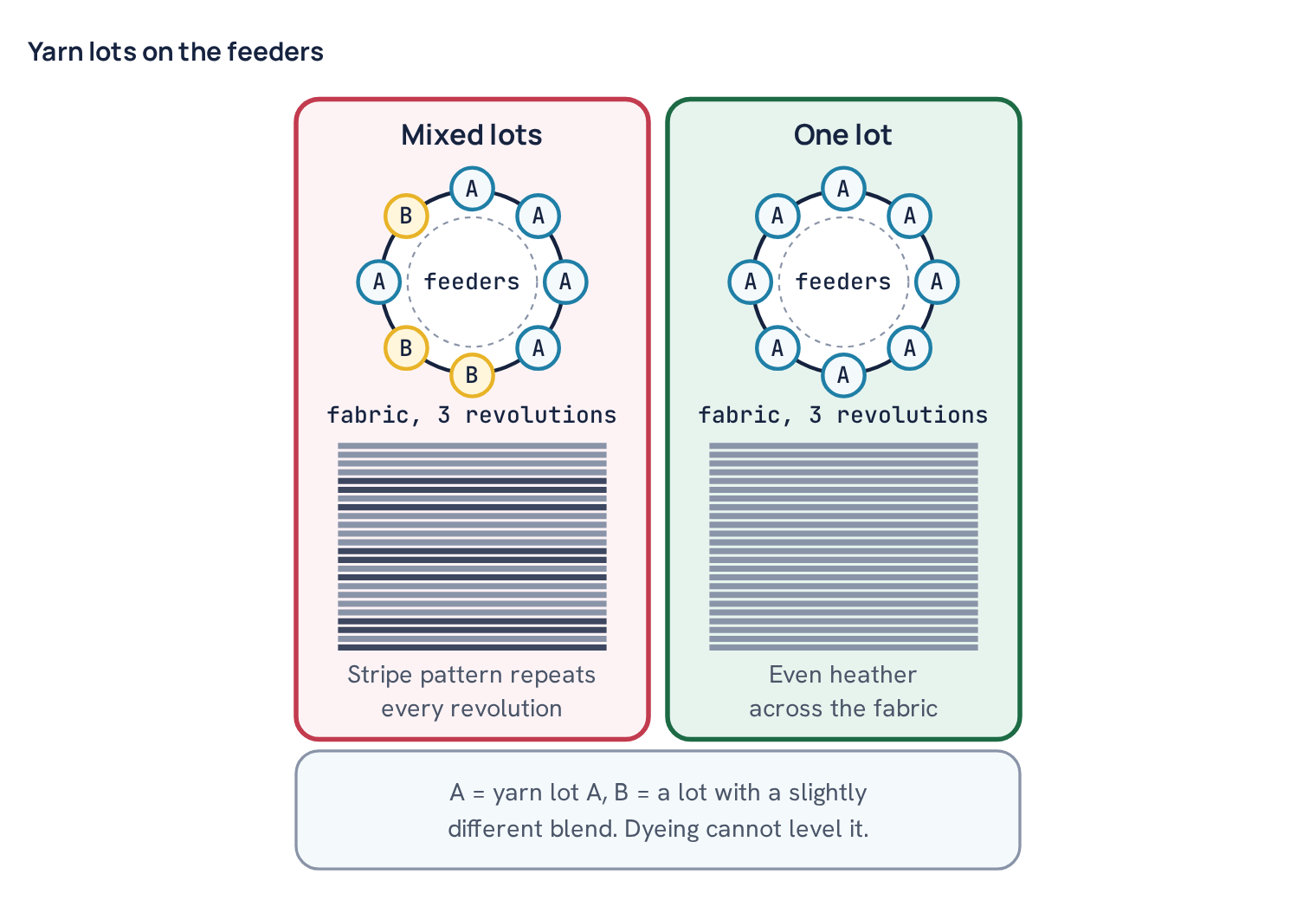
A circular machine has many feeders, and each one knits a course. If cones from two yarn lots are put on the feeders, every revolution repeats the same order of lots, and the fabric shows a stripe pattern that repeats round after round. In piece-dyed fabric a small yarn difference can partly hide under the dye. In melange there is nothing to hide it: a lot with slightly more dyed fibre, a slightly darker dyed component or a slightly different count shows directly as a darker or lighter course.
Practical rules for knitting:
- Put one yarn lot on one machine, and record the lot on the roll ticket.
- Do not top up a running machine with cones from another lot. Run the machine empty, then change the whole creel.
- Keep yarn input tension equal on all feeders. Uneven tension changes the stitch length course by course and shows as barré even with one lot.
- If a second lot is unavoidable, knit a test panel and compare it with the approved fabric first. Some mills spread two close lots on alternate feeders to break up a band into a finer pattern, but only do this after a knitted test and with the buyer’s agreement.
For more on the causes of bands and stripes, see barré in knit fabric: causes and remedies.
Elastane and multi-yarn feeding
The elastane melange rows in our register use 20 denier elastane at full feed for 34/1 and 40/1 yarns, and 40 denier with the supplier-named 34/1 melange. The elastane is plated behind the melange yarn, so the face shows only the heather. A poorly plated or broken elastane end can show through as a shiny or darker line, which is easier to see on a light grey melange than on a dark piece-dyed shade. Check elastane feed tension and plating on the greige.
Settings to record and greige inspection
Record the usual knitting settings (the full list is in the record sheet at the end) and, for melange, add the melange percentage, the dyed fibre type and the spinner’s lot number on every roll ticket.
Inspect the greige for barré, thick and thin places, neps and coloured contamination as well as the usual holes and needle lines. Melange greige already shows its final shade, so put a roll from each lot side by side under the approval light before anything goes to the dye house.
Wet processing and finishing
Why grey melange is washed, not dyed
Grey melange and coloured melange already have their shade. The wet process only has to clean the fabric, give the right handfeel and absorbency, and relax it. In our register every melange entry goes through stenter and compactor, the open-width route.
The key rule is to avoid bleaching. A peroxide bleach at the boil whitens the undyed fibre and can attack some reactive dyes on fibre-dyed cotton. Either way the contrast between dark and light fibres changes, and the fabric no longer matches the yarn standard. A wash-only route keeps the shade that was approved on the yarn. For the same reason, do not add optical brightener unless the buyer asks for it, and keep the softener type and amount fixed for the whole order.
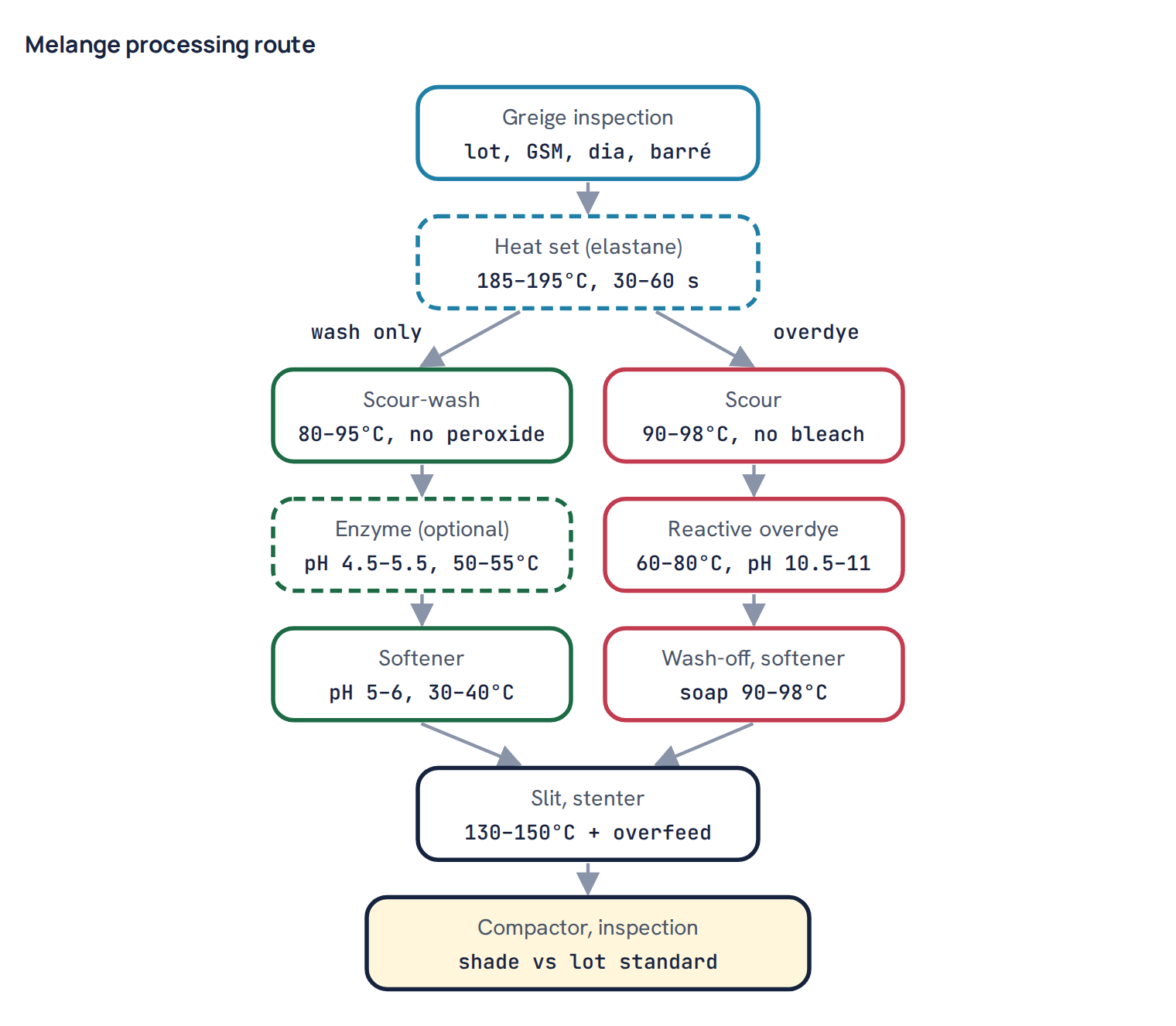
- Heat setting (elastane or polyester only). Typically 185 to 195°C for 30 to 60 seconds at the target width. In our register the heat-set flag is on 33% of melange entries, close to the share that contains elastane. Note that heat on greige cotton can cause slight yellowing, and a wash-only route cannot bleach it away. On light and white-based melange, keep the temperature and time at the lower end that still sets the elastane, and check the shade after setting.
- Scour-wash. Detergent, a sequestering agent and mild alkali, typically 80 to 95°C for 20 to 40 minutes, without hydrogen peroxide. Rinse well and neutralise. With fibre-dyed coloured melange, watch the first bath for loose dye that could stain the white fibre.
- Enzyme (optional). Acid cellulase at about pH 4.5 to 5.5 and 50 to 55°C to reduce hairiness and pilling. Removing surface fibre can make the fabric look slightly cleaner or lighter, so approve the shade after enzyme, not before.
- Softener. Typically pH 5 to 6 at 30 to 40°C. Some softeners change the shade a little, so one product and one dose for the order.
- Slitting and stenter. Drying and width setting, typically 130 to 150°C with overfeed. Elastane fabric should not be dried hotter than its heat set.
- Compactor and inspection. Steam and overfeed to set length shrinkage and GSM; then inspect GSM, width and shade against the lot standard.
A few register entries carry other flags: singeing on 14 entries and mercerising on 21 (7 mercerised only and 14 heat set and mercerised). Both change lustre and surface, and therefore the look of a melange, so treat them as part of the shade approval.
Overdyeing melange
When a buyer wants a coloured heather that is not available as melange yarn, grey melange fabric can be overdyed. The undyed fibre takes the new colour, the dark fibre stays dark, and the result is a deep coloured fleck. With reactive dyes only the cellulose parts take colour; a polyester component stays as it was. If the dark fibre is dope-dyed viscose, it also absorbs the reactive dye, which deepens it a little. The route is scour, reactive dyeing, wash-off and softener, with the same care about bleaching. The details are in our grey melange fabric overdyeing process; for cotton/modal blends see also the cotton modal knit dyeing process, and for elastane blends the cotton elastane (Lycra) knit dyeing process.
Shade continuity and approvals
Lot-to-lot shade in melange yarn
Every melange lot is a new blend. Small changes add up: the dyed fibre batch is a little deeper or lighter, the blend ratio drifts a fraction, the mixing is less even, or the count runs slightly fine or coarse. None of these differences can be corrected by dyeing, because there is no dyeing step to correct. This is the main difference from piece-dyed fabric, where the dye house can add or strip colour to bring a lot back to standard. General causes of lot variation in dyed fabric are covered in shade variation lot to lot: causes and remedies; for melange, the yarn is the first suspect.
An approval system that works
- Approve the yarn lot before bulk knitting. Ask the spinner for a knitted panel (knit-down) of each lot, or knit one on your own machine, and compare it with the buyer’s standard under the agreed light source.
- Process the panel the bulk way. Wash, set and finish it on the bulk route, because washing, heat and softener change melange slightly.
- Measure as well as look. A spectrophotometer reading against the standard gives a number to file. Tolerances vary by buyer; a CMC colour difference of about 1.0 is a typical limit. Judge the fleck pattern by eye as well, because two fabrics with the same average colour can look different.
- Keep a shade band per lot. Cut a piece from every lot and file it. When a repeat order comes, match the new lot to the band.
- Segregate in the warehouse and in cutting. Keep rolls of different lots apart and tell the garment factory, so one garment never mixes panels from two lots.
Worked example. An order of grey melange 10% jersey needs two yarn lots. The knit-downs of both lots are washed and finished on the bulk route. Lot 1 matches the standard; lot 2 is visibly a little deeper in the fleck. The dye house cannot correct lot 2. The options are to return or replace lot 2, to ask the buyer to approve lot 2 as a separate shade group for a separate set of garments, or, if the buyer agrees, to use it for an overdyed colour. Mixing the two lots on the same machine is not an option.
Barré, streaks and where they come from
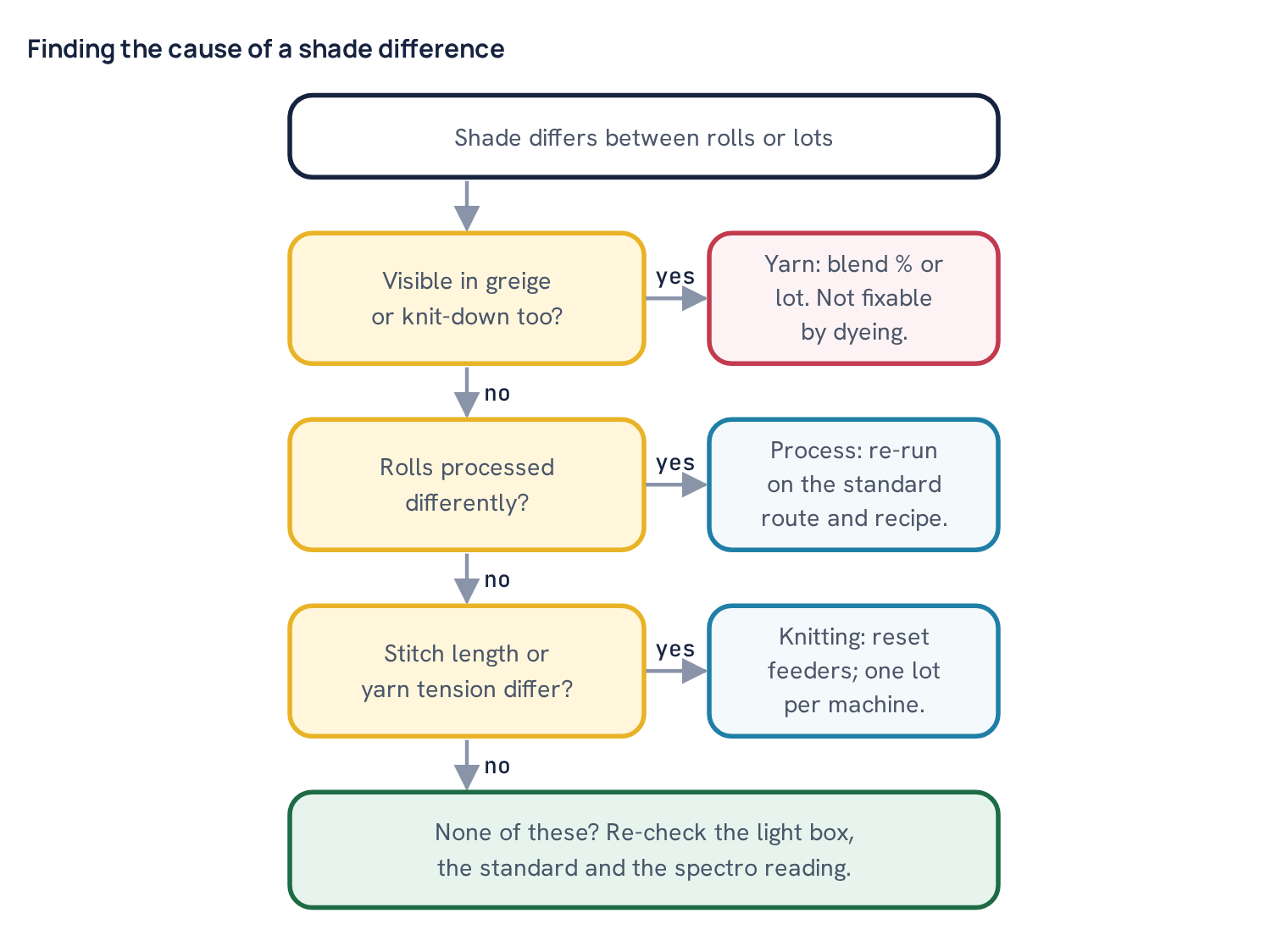
Horizontal bands in melange almost always come from the yarn or the knitting: mixed lots, a cone with a different blend, count variation or uneven feeder tension. Vertical streaks point to the knitting machine, for example a damaged needle or sinker, or to uneven stretch in finishing. Patches that follow neither courses nor wales usually come from processing, such as uneven softener pick-up or creasing. The decision chart below gives a quick way to sort them.
Hitting finished GSM and width
What our records show
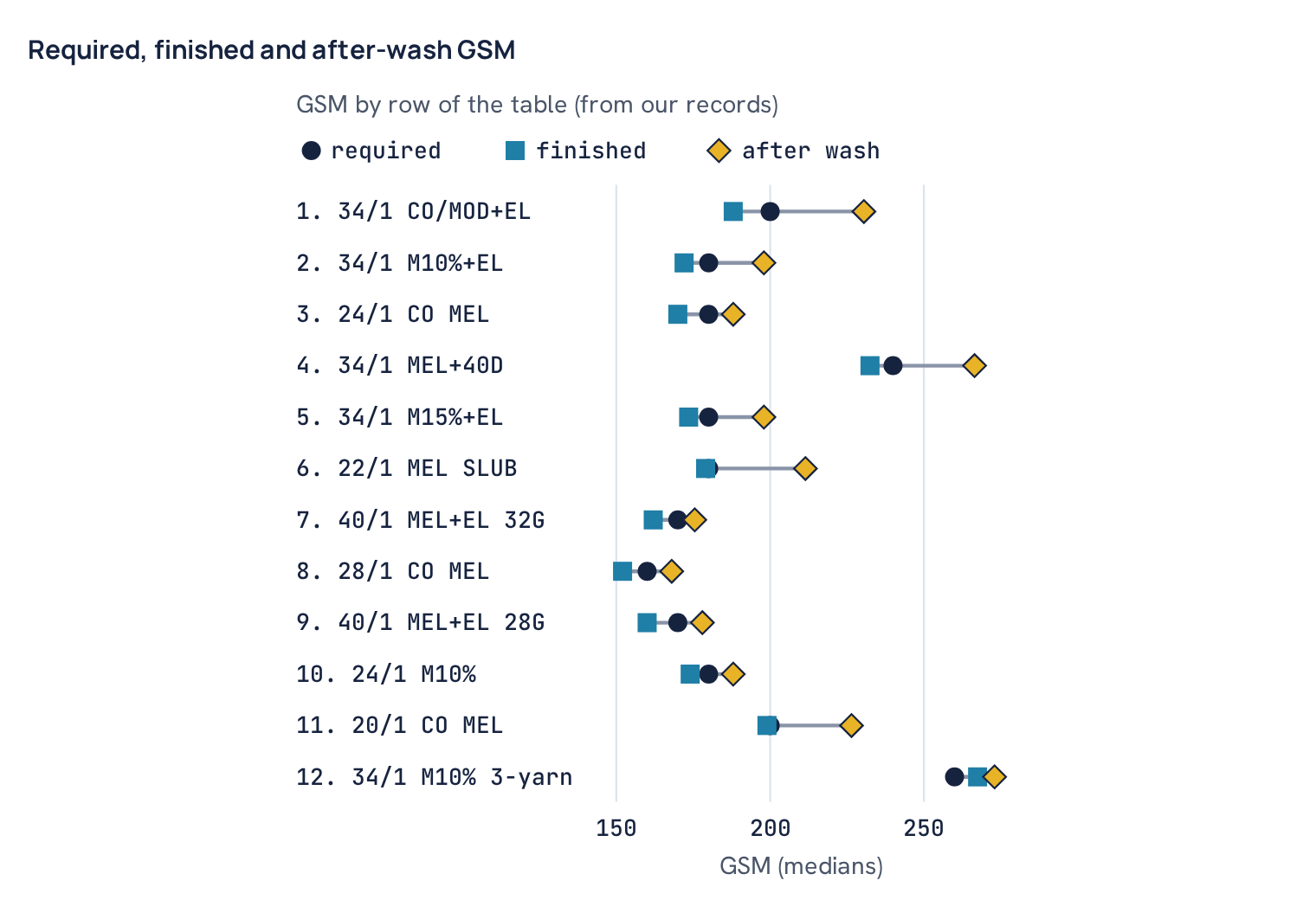
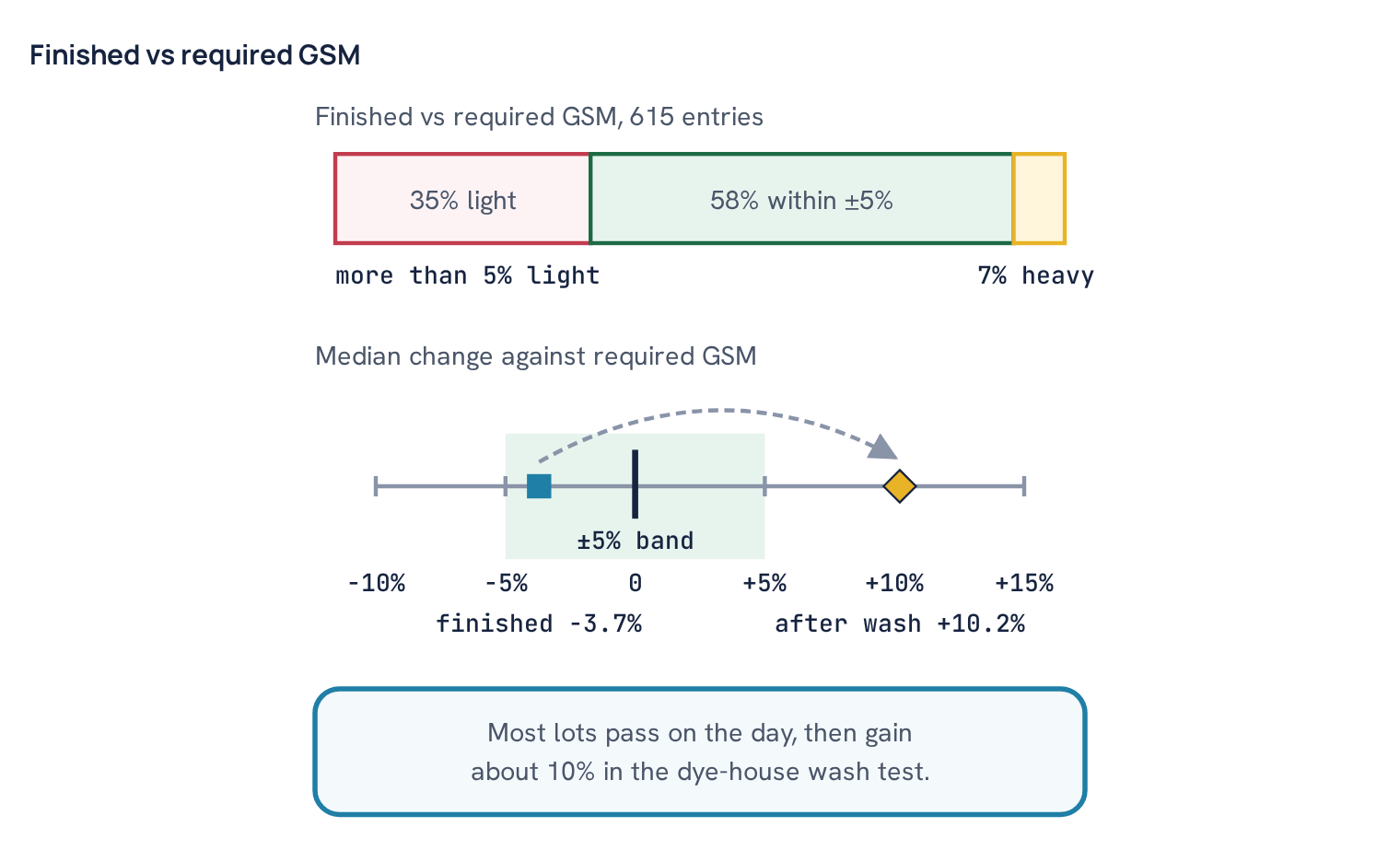
Melange finishes slightly light, but less so than our piece-dyed cotton jersey. Across 615 melange entries with both values, the median finished GSM is 3.7% below the required GSM. 58% finish within ±5%, 35% finish more than 5% light and 7% finish more than 5% heavy. After the dye-house wash test, the median GSM rises by 10.2% (614 entries). So the yarn content is right; the fabric leaves the compactor with length still stretched in, and it relaxes and gets heavier when washed.
| # | Yarn | Required GSM | Finished GSM | GSM after wash | Shrink L, % | Shrink W, % | Spirality, % |
|---|---|---|---|---|---|---|---|
| 1 | 34/1 cotton/modal melange + elastane, 18G | 200 | 188 (185–190) | 230.5 | -9 | -7 | 2 |
| 2 | 34/1 melange 10% + elastane, 24G | 180 | 172 (170–175) | 198 | -9 | -2 | 2 |
| 3 | 24/1 cotton melange, 24G | 180 | 170 (170–178) | 188 | -3 | -6 | 2 |
| 4 | 34/1 melange + 40 den elastane, 24G | 240 | 232.5 (230–248) | 266.5 | -7 | -2 | 2 |
| 5 | 34/1 melange 15% + elastane, 28G | 180 | 173.5 (170–185) | 198 | -9 | -3.5 | 2.5 |
| 6 | 22/1 cotton melange slub, 20G | 180 | 179 (177–184) | 211.5 | -4 | -6.5 | 3 |
| 7 | 40/1 cotton melange + elastane, 32G | 170 | 162 | 175.5 | -8.5 | -2 | 2 |
| 8 | 28/1 cotton melange, 24G | 160 | 152 | 168 | -6 | -4 | 2 |
| 9 | 40/1 cotton melange + elastane, 28G | 170 | 160 | 178 | -8 | -2 | 2 |
| 10 | 24/1 melange 10%, 24G | 180 | 174 | 188 | -4.5 | -2.5 | 2 |
| 11 | 20/1 cotton melange, fibre-dyed, 20G | 200 | 199 | 226.5 | -3 | -5 | 2 |
| 12 | 34/1 melange 10% + polyester + PC, 3 yarns, 20G | 260 | 267.5 | 273 | -2.5 | 0 | 2 |
Shrinkage here is the dye-house wash test on the finished fabric, not the buyer’s lab test. Three groups stand out:
- Elastane melange shrinks most in length. Rows 2, 5, 7 and 9 shrink -8% to -9% in length, with width held at -2% to -3.5%. Their GSM rises 8% to 15% after the wash. The elastane pulls the fabric together hard when it is free to relax, so heat-set width, stenter width and compaction must be planned together. See the Lycra single jersey guide for the same effect in piece-dyed fabric.
- Plain cotton melange shrinks more in width. Rows 3, 6, 8 and 11 shrink -3% to -6% in length but -4% to -6.5% in width, more width shrinkage than the -2% typical of our piece-dyed cotton jersey. A likely reason is that a short, cool wash-only route relaxes the fabric less than a full scour, bleach and dye cycle, so more of the shrinkage is left for the test. Their finished widths, 140 to 162 cm, are also narrower than the roughly 170 cm of our piece-dyed jersey; check that the stenter is not holding width that the fabric gives back in the wash.
- Cotton/modal melange moves the most. Row 1 shrinks -9% in length and -7% in width, and its GSM rises from 188 to 230.5 after the wash, about 23%. Modal swells strongly in water and relaxes a lot, so this blend needs extra relaxation in processing and more compaction.
The fleece-type row 12 is the stable exception: it finishes slightly heavy (267.5 against 260), shrinks only -2.5% in length with no width change, and gains about 2% in the wash. Spirality in the wash test is 2% to 3% for every row, with the slub row at the top of that range.
How to plan greige GSM and width
- Start from the construction guide and the closest row in the table for count, gauge and stitch length.
- Expect a median finish about 4% light, and a GSM rise of about 10% in the wash test. For elastane and cotton/modal melange expect more.
- Knit a short trial from the bulk yarn lot and run it through the full bulk route, including heat setting and enzyme if used.
- If finished GSM is low but after-wash GSM is on or above target, improve relaxation and compaction rather than shortening the stitch length.
- Record greige-to-finished ratios for GSM and width on the record sheet. For more on fibre effects, see our knit GSM and shrinkage by fibre study and the fabric shrinkage calculator.
Common mistake: stretching a light melange fabric wide on the stenter to reach the width, then shortening the stitch length to fix the GSM. The fabric becomes heavier and narrower after the first wash, and width shrinkage fails.
Testing the developed fabric
Only 2 melange lab reports reached our desk, so the right-hand column is a small sample, not a pattern.
| Test | Typical buyer requirement (varies by buyer) | Our lab reports (melange, 2 reports) |
|---|---|---|
| Dimensional stability (shrinkage) | Often within ±5% L and W after the stated wash | 2 results, 0 fails; one result after one wash L -2.1%, W -1.0% |
| Spirality | Often 5% maximum after washing | 2 results, 0 fails; 0.0% in both |
| Bursting strength | A minimum in kPa set by the buyer | 2 results, 0 fails; 153 and 197 kPa (median 175) |
| Pilling | Often grade 3–4 minimum | 1 result, pass: pilling 3–4, fuzzing 4 at 2,000 rubs |
| GSM | Often ±5% of required GSM | 1 result, pass |
| Fibre content | Within the label tolerance | 1 result, 1 fail |
| Colour fastness (washing, rubbing, perspiration, water) | Often 4 change, 3–4 staining; wet rubbing often 3 | Not in our melange set |
| pH | Often 4.5–7.5 | Not in our melange set |
The only failure in our small set is fibre content, and that matches the composition risk described above. When the dyed component is a different fibre from the base, or when the melange percentage is wrong on the label, a fibre analysis will catch it. Check the yarn certificate against the label before the first bulk order, not after the test.
Pilling is the test to watch in development. The one result, grade 3–4 with fuzzing 4, is just at a common buyer minimum. Compact yarn, a tighter construction and an enzyme bio-polish all help; with polyester in the blend, expect pills to stay on the surface rather than fall off. Test methods are in how to test pilling: box and Martindale, and fleece-specific fixes in fleece and terry pilling test fail: causes and remedies.
Colour fastness depends mostly on how the dyed fibre was made. Dope-dyed fibre is usually very fast; fibre-dyed cotton depends on the spinner’s dyeing and washing. Test after the bulk wash route, especially deep coloured melange, and take any fastness problem back to the spinner, because a wash-only route cannot fix it.
For the other tests, use the standard guides:
- How to test shrinkage of knit fabric and shrinkage test fail: causes and remedies
- How to test spirality of knit fabric and spirality test fail: causes and remedies
- How to test GSM of knit fabric and GSM test fail: causes and remedies
- How to test bursting strength and wet rubbing fastness fail: causes and remedies
Development record sheet and troubleshooting
Record sheet template
Use one sheet per trial and keep the request values and the actual values side by side. The melange-specific lines are the yarn lot, the melange percentage and the shade decision per lot.
| Stage | Record |
|---|---|
| Request | Buyer, style, required GSM and tolerance, finished width, composition, shade standard (physical or code), brightener yes/no, wash care, test standard |
| Yarn | Count, melange %, dyed fibre type (fibre-dyed cotton, dope-dyed viscose or polyester), base fibre, spinning, spinner, lot number, lot quantity and reserve, elastane denier |
| Knitting | Machine no., diameter, gauge, feeders, stitch length per yarn (measured), yarn input tension, elastane draft, feed (full/alternate), take-down, speed, one lot per machine confirmed |
| Greige | Greige GSM, tubular dia, faults, barré check, side-by-side lot comparison |
| Heat set | Temperature, time or speed, width, overfeed, shade after setting (elastane or polyester only) |
| Wet process | Route (wash only or overdye), scour recipe and temperature, no peroxide confirmed, enzyme yes/no, softener type and dose; overdye recipe if used |
| Stenter and compactor | Temperature, speed, set width, overfeed; compactor overfeed, steam, exit width |
| Finished | Finished GSM, width, GSM after wash test, shrinkage L/W, spirality, spectro reading against standard |
| Lab tests | Each result against requirement, pass/fail, including fibre content and pilling |
| Decision | Approved / adjust; shade band filed for the lot; what changes in the next trial and why |
Troubleshooting
| Problem | Likely cause | What to change |
|---|---|---|
| Lot-to-lot shade difference | Different blend ratio, dyed fibre depth or count between yarn lots | Approve each lot on a knit-down; segregate rolls; replace or regroup the lot; overdye only with buyer approval |
| Horizontal bands or barré | Mixed lots on one machine; uneven feeder tension; cone with a different blend | One lot per machine; equalise tension; remove the odd cone |
| Vertical streaks | Damaged needle or sinker; uneven stretch in finishing | Check and replace needles; check stenter and compactor tension |
| Shade lighter or brighter after processing | Peroxide or brightener used; strong enzyme; different softener | Wash-only route without peroxide; fixed softener; approve after enzyme |
| Yellowish cast on light melange | Greige heat setting too hot or too long | Lower setting temperature or time within the elastane’s needs; check shade after setting |
| Finished GSM low, after-wash GSM high | Fabric not relaxed; stretched in length or width | More compactor and stenter overfeed; less width stretch |
| Width shrinkage high | Fabric held wide on the stenter; short wash route relaxed it too little | Set width closer to the relaxed width; improve relaxation in washing |
| Length shrinkage high (elastane or modal melange) | Strong relaxation of elastane or modal in water | Plan heat-set width with stenter and compactor; more compaction |
| Pilling low | Hairy fibre-dyed yarn; polyester in blend; loose construction | Compact yarn; tighter construction; enzyme bio-polish |
| Fibre content fail | Dyed component or melange % not reflected on the label | Check yarn certificate against label before bulk |
| Staining of white fibres | Loose dye from fibre-dyed component | Better scour-wash and rinsing; ask the spinner about fibre wash-off |
Melange development is mostly yarn management. Choose the spinner and lot with care, approve each lot knitted and finished, keep one lot per machine, wash instead of bleach, and plan compaction for a fabric that gains about 10% in the wash.
Questions
What does MEL 10% mean in a melange yarn?
It is the share of dyed fibre in the blend by weight: 10 parts dyed fibre to 90 parts undyed fibre. A higher percentage, such as MEL 15%, gives a deeper shade, and the percentage is part of both the approved shade and the fibre composition.
Can a lot-to-lot shade difference in melange be corrected in dyeing?
No. The shade is made by the fibre blend in the spinning mill, and grey or coloured melange is only washed, not dyed. Approve each yarn lot on a knitted and finished panel, keep one lot per machine and segregate rolls by lot.
Why is grey melange not bleached?
Peroxide bleaching whitens the undyed fibre and can attack the dyes on fibre-dyed cotton, so the contrast and shade move away from the approved yarn standard. A scour-wash without peroxide and without optical brightener keeps the shade.
Can grey melange fabric be overdyed?
Yes. With reactive dyes the undyed cellulose fibre takes the colour while the dark fibre stays dark, giving a coloured heather; a polyester component stays undyed. The final look depends on both the recipe and the melange lot underneath.
Does melange fabric finish on target GSM?
In our records the median melange entry finishes 3.7% below required GSM, with 58% within ±5%, and rises about 10% after the dye-house wash test. Better relaxation and compaction usually fix it, rather than a heavier construction.

Textile engineer with 14+ years in dyeing and fabric development. He writes every guide on Dyeing Solution from real production work. Full profile