A development guide for yarn-dyed stripe, design, slub and heather jersey: slub yarn, package-dyed yarn, stripe repeat and feeder planning, finishing without dyeing, keeping whites clean, yarn lot shade control and testing, built on our real development records.
At a glance
906yarn-dyed, slub and heather entries
-4.4%median finished vs required GSM
+9.5%median GSM rise after the wash test
-8.5%32/1 slub length shrinkage (median)
Slub and yarn-dyed single jersey use the same plain knitted structure as basic tees, but they move the design work out of the dye house and into the yarn. In a yarn-dyed stripe the colour is in the yarn before a loop is knitted, so stripe order, stripe heights and every shade are fixed on the knitting floor. In slub jersey the texture comes from thick places spun into the yarn. Both bring problems that plain jersey never has: colour bleeding into white stripes, shade jumps between yarn lots, stripe repeats that do not fit the machine, and weight that varies with the slubs. This guide covers them from yarn to tested fabric, built on our development records: 906 entries for yarn-dyed, slub, design and heather jersey in our fabric register, and 8 test reports from our lab. The plain jersey basics (loop structure, count and stitch length, the general finishing route) are covered in the single jersey fabric development guide and are not repeated here. Values from general practice rather than our records are marked typical.
What slub and yarn-dyed jersey are
Same loops, different yarn
The structure is plain single jersey, with the same curling, spirality and stretch. What changes is what each feeder delivers. On a circular machine every feeder knits one complete course as the cylinder turns. If the feeders carry different colours, each course takes the colour of its feeder, and the colour order on the creel becomes a horizontal stripe in the fabric. If the yarn has slubs, each slub sits in a few loops of one course and shows as a short, thick, slightly darker dash.
The family in our register
Our register uses several names for these fabrics. They fall into five working groups:
- Yarn-dyed single jersey (feeder stripe). Entered as Y/D S/J, YD S/J or YD/S/J. Dyed yarns on the feeders in a fixed order make a regular stripe.
- Engineered stripe. A stripe whose repeat is longer than the feeder count allows, or that changes along the garment length (for example a plain body with a stripe band at the chest).
- Design or jacquard jersey. Entered as Y/D DESIGN JERSEY, YD DESIGN JERSEY or JACQUARD JERSEY. Needle selection places two or more colours in one course.
- Slub jersey. Entered as SLUB S/J when the fabric is knitted from undyed slub yarn and piece-dyed, and Y/D SLUB S/J when the slub yarn itself is dyed.
- Heather jersey. Entered as H/J. Knitted from melange yarn spun from dyed and undyed fibre.
Most of these entries are cotton: 789 of the 906 are recorded as cotton, 96 as CVC or PC blends, 13 as other fibres, and only 8 list an elastic yarn. The machines are coarser than for plain jersey. In the register the most used gauge is 24G (436 entries), then 20G (236) and 16G (196), with only 20 entries on 28G. Diameters are mostly 34 inch (324 entries), 30 inch (239) and 36 inch (227).
Where these fabrics are used
Yarn-dyed stripes are classic for breton tops, casual tees, polos, children’s wear and sleepwear; engineered stripes suit fashion and sports tees where the stripe must land at a set place. Slub gives a relaxed, vintage look. Heather grey is a staple for basic and sports tees because it hides marks and keeps its look after many washes.
Development inputs
What the buyer’s request adds
On top of the usual inputs (GSM, width, composition, wash care, tests), a yarn-dyed or slub request needs:
- Stripe artwork with the colour order and the height of each stripe, preferably in finished centimetres, plus a tolerance on the repeat.
- A shade standard for every colour, including the white. Four colours means four approvals.
- The white standard: natural, bleached or optical white, because each is processed differently.
- A colour transfer or staining requirement for fabrics with white or pale stripes next to dark ones.
- The slub look, approved from a physical sample.
- For heather, the melange shade and, where named, the blend ratio of dyed fibre.
Slub yarn: length, thickness and pause
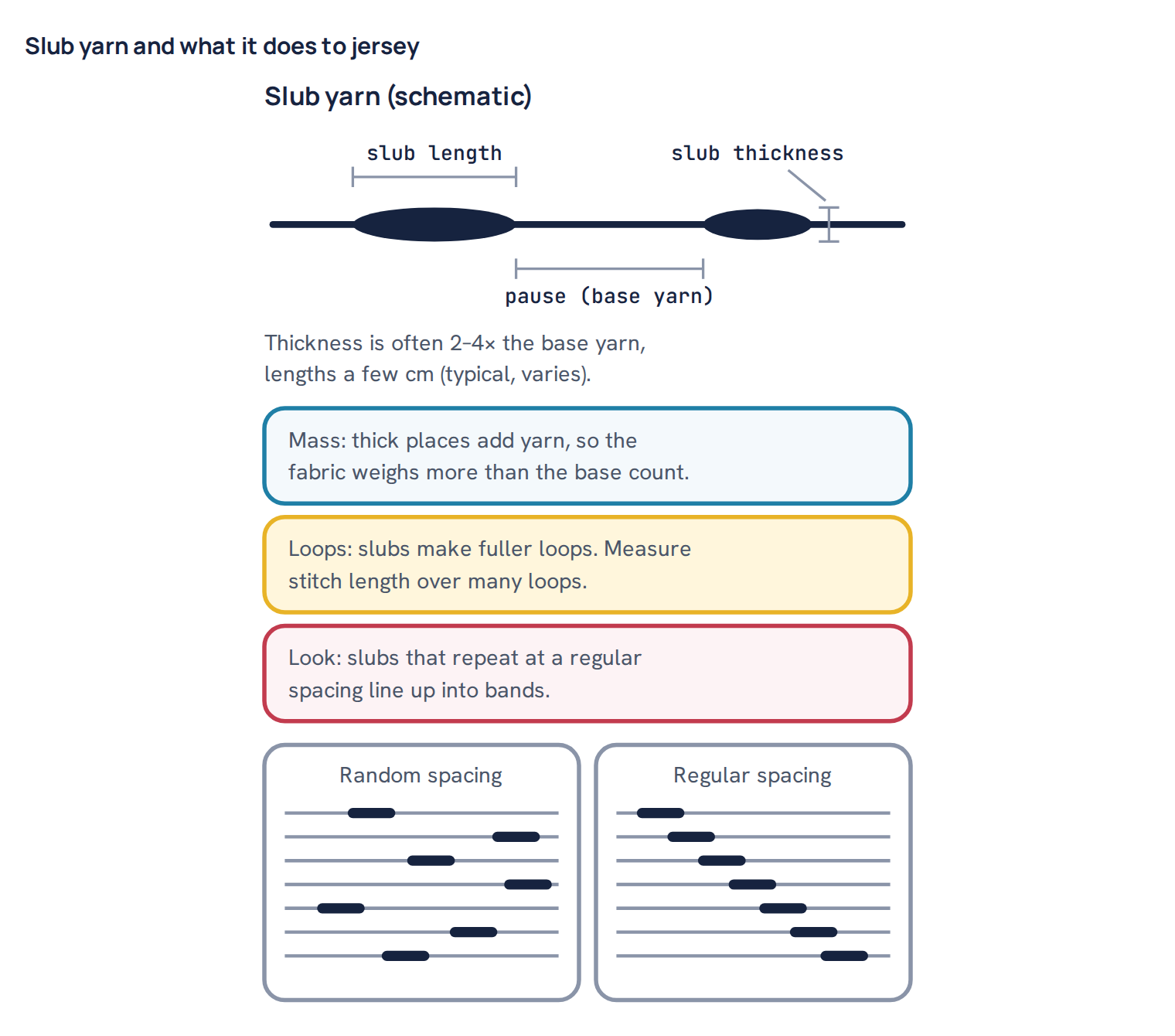
A slub yarn is spun with deliberate thick places. The spinner sets three things: the slub length (how long each thick place is), the slub thickness (how much thicker than the base yarn it is) and the pause (the length of base yarn between slubs). Typically the thickness is two to four times the base yarn and slubs are a few centimetres long, but both vary widely. The count written on the cone is a resultant count, the average over the slubs and the base yarn, so a 28/1 slub has thin places finer than 28/1 and thick places much coarser.
Slubs change the fabric in three ways:
- GSM. Because the count is an average, fabric weight follows the resultant count, but it varies more from place to place: a slub-rich GSM cut reads heavy. Weigh several cuts across the width.
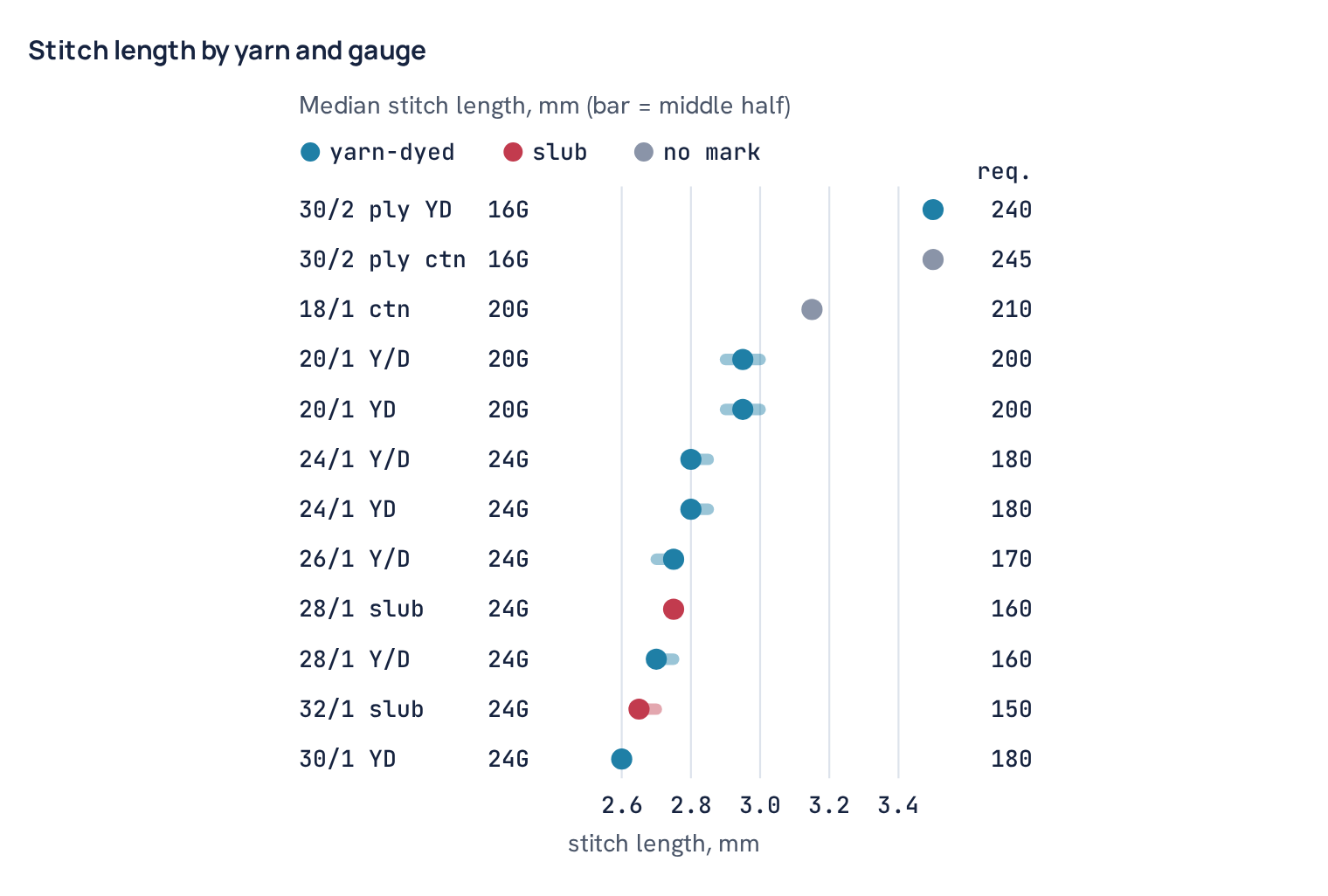
- Stitch length. A slub forms a fuller loop and robs yarn from its neighbours, so measure stitch length over a long length, for example 100 wales from several courses, and average. Knitters often set a slightly longer stitch length so slubs pass the needles without breaking; in our records 28/1 slub runs at a median of 2.75 mm on 24G against 2.70 mm for 28/1 yarn-dyed on the same gauge.
- Look. The thick places have more fibre and usually less twist, so they absorb more dye and look darker in piece-dyed fabric. That is the character of slub. But regularly spaced slubs line up across courses into bands that look like barré. Spinners randomise the pattern to prevent it; the dye house cannot fix it.
Common mistake: reporting a slub fabric as barré and sending it for re-dyeing. If the bands follow the slubs and show in greige, the cause is the yarn, and re-dyeing only adds cost. Compare with barré in knit fabric: causes and remedies before deciding.
Yarn-dyed yarn: package dyeing basics
Most yarn for yarn-dyed jersey is dyed on packages. The grey yarn is first soft-wound onto perforated tubes or springs at a controlled, even density. A typical range for cotton is about 0.33 to 0.40 g/cm³, and it varies by yarn and machine. Too hard and the liquor cannot pass evenly; too soft and it channels. Liquor is pumped through the packages, usually alternating inside-out and outside-in, at a typical liquor ratio of about 1:6 to 1:10.
The chemistry is the same as fabric dyeing: scour and bleach (with an optical brightening agent for optical whites), neutralise, dye with reactive dyes (see how reactive dyes work) and soap near the boil. A lubricating softener is applied, the yarn is dried and rewound onto waxed cones. The yarn-only risk is shading within a package, inner layers different from outer, which shows as faint bands at cone changes. Sample both layers when you approve a lot.
Shade and fastness of dyed yarn
The fabric is not dyed after knitting, so the yarn’s fastness is the garment’s fastness. Dark yarns such as navy, black and red are the concern: hydrolysed dye that was not washed out leaves the yarn in the first wet process and settles on the nearest white. That is bleeding, or back-staining.
Four controls keep it in check:
- Thorough wash-off of the yarn. Hot rinses and soaping near the boil until the water runs clear. Most bleeding is won or lost here.
- Dye selection. For dark shades next to white, choose reactive dyes with high wet fastness, such as bifunctional types.
- Cationic fixing. A fixing agent applied after soaping, typically at 40 to 60°C and mildly acidic pH (conditions vary by product), binds loose dye and improves wet fastness. It can change the shade slightly and can lower light and rubbing fastness on some shades, so approve the shade after fixing, not before.
- A yarn-level check before knitting. Wash a small swatch of each dark lot with a white strip at the buyer’s temperature. A lot that stains here will stain in the fabric.
Heather (melange) yarn
Heather yarn is spun from dyed and undyed fibre; grey melange mixes a small share of black or dark fibre into white cotton or a cotton and polyester blend. The shade depends on the blend ratio and mixing, so shade control belongs to the spinner. The fabric is only washed, softened and finished. A small blend difference between lots gives a visible shade step that the dye house cannot correct, so order from one lot where possible.
Mercerised and singed yarn
About 41% of the entries in this group carry a singeing flag in the register, and 44 carry a mercerised flag. The register does not say whether yarn or fabric was singed, but gassed and mercerised yarns are common in yarn-dyed work for a cleaner, more lustrous surface and deeper colour. Mercerised and unmercerised cotton dye differently, so never mix or swap them between trial and bulk.
Common mistake: approving the stripe on a yarn-dyed sample made from one dye lot, then knitting bulk from three lots without telling anyone. Every yarn dye lot is its own shade.
Knitting
Count, gauge and stitch length from our records
The table shows the yarn rows of our register for this fabric group, with medians and the interquartile range (the middle half of entries) for stitch length. Yarn names are given as they are entered: the register spells yarn-dyed two ways, Y/D and YD, so the same count can appear twice. Two rows, 18/1 cotton and 30/2 ply cotton, carry no yarn-dyed or slub mark; the register does not say which fabric type they belong to, so read them as part of the group, not as a specific type.
| Yarn (as entered) | Gauge | Entries | Stitch length, mm | Required GSM | Finished dia, cm |
|---|---|---|---|---|---|
| 24/1 cotton, yarn-dyed (Y/D) | 24G | 41 | 2.80 (2.80–2.85) | 180 | 172 |
| 28/1 cotton, yarn-dyed (Y/D) | 24G | 26 | 2.70 (2.70–2.75) | 160 | 150 |
| 30/1 cotton, yarn-dyed (YD) | 24G | 23 | 2.60 (2.60–2.60) | 180 | 155 |
| 28/1 cotton slub | 24G | 23 | 2.75 (2.75–2.75) | 160 | 148.5 |
| 24/1 cotton, yarn-dyed (YD) | 24G | 22 | 2.80 (2.80–2.85) | 180 | 159 |
| 18/1 cotton (no mark) | 20G | 22 | 3.15 (3.15–3.15) | 210 | 174 |
| 26/1 cotton, yarn-dyed (Y/D) | 24G | 19 | 2.75 (2.70–2.75) | 170 | 145 |
| 30/2 ply cotton (no mark) | 16G | 19 | 3.50 (3.50–3.50) | 245 | 136 |
| 20/1 cotton, yarn-dyed (Y/D) | 20G | 19 | 2.95 (2.90–3.00) | 200 | 166 |
| 30/2 ply cotton, yarn-dyed | 16G | 19 | 3.50 (3.50–3.50) | 240 | 150 |
| 20/1 cotton, yarn-dyed (YD) | 20G | 17 | 2.95 (2.90–3.00) | 200 | 170 |
| 32/1 cotton slub | 24G | 14 | 2.65 (2.65–2.70) | 150 | 170 |
Three things stand out. First, stitch lengths match plain cotton jersey of the same count (2.95 mm for 20/1, 2.80 mm for 24/1), so yarn-dyed fabric needs the same construction on a stripe machine. Second, fine counts run on 24G here, where plain 28/1 to 32/1 jersey in our records usually runs on 28G. Third, the 30/1 yarn-dyed row stands apart: 180 GSM required from 30/1 at 2.60 mm on 24G, much heavier than 30/1 normally gives. The register names only one count, and stripes often combine different yarns, so check the actual yarn list before copying it. To try combinations, use the knit GSM from stitch length calculator.
Stripe repeat and feeder planning
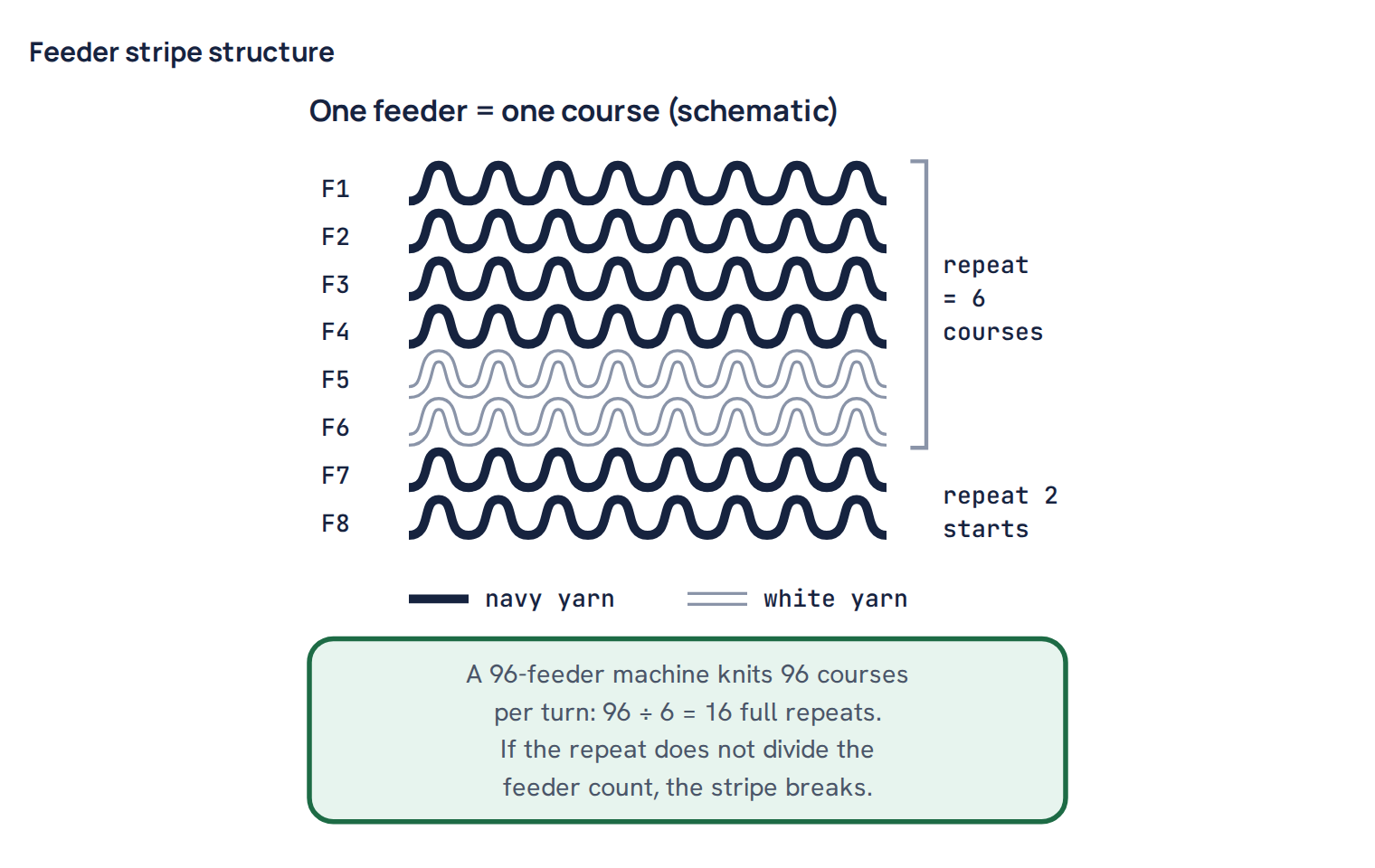
Every turn of the cylinder knits as many courses as there are active feeders. A machine has a fixed number of feeders, often around three per inch of diameter on a single jersey machine (it varies by model), so a 30 inch machine may have about 90 to 96 and a 36 inch machine about 108. For a regular feeder stripe the repeat, counted in courses, must divide the feeder count exactly. If not, the last repeat in each turn is cut short and the stripe breaks once per revolution.
The planning sequence is:
- Convert each stripe height from finished centimetres to courses, using the courses per cm of the finished fabric, not the greige.
- Add the courses to get the repeat.
- Check that the repeat divides the feeder count. If not, adjust the stripe heights by a course or two within the buyer’s tolerance, use a machine with a different feeder count, or leave some feeders empty (which costs production).
- Write the creel plan: feeder number, colour, yarn lot. Keep the same yarn lot for one colour on all its feeders.
Worked example. A buyer wants 2 cm navy and 1 cm white, a 3 cm repeat. A finished trial shows 18 courses per cm, so the repeat is 36 navy + 18 white = 54 courses. A 96-feeder machine does not work: 96 ÷ 54 is not a whole number. A 36 inch machine with 108 feeders does: 108 ÷ 54 = 2 repeats per turn. If only the 96-feeder machine is free, a 48-course repeat (32 + 16) fits it exactly, but the repeat becomes about 2.7 cm, so it needs the buyer’s agreement.
Length shrinkage changes stripe height too: 5% length shrinkage makes every stripe 5% shorter. Check the repeat again after the wash test.
Engineered stripes and design jersey
When the repeat is longer than the feeders allow, or the stripe must change along the garment, the machine needs striper units: each feeder carries several yarn fingers, typically four to six (it varies by machine), and a controller selects which colour is fed at each course. The pattern can run for hundreds of courses, so a garment-length placement, such as a plain body with a striped chest band, is possible. Striper machines run slower and need careful tension on every finger.
Single jersey design or jacquard jersey uses electronic needle selection to knit two or more colours within one course. A needle that does not knit a colour lets that yarn pass behind it as a float on the back. The fabric is heavier and less stretchy than plain jersey, float length is limited to avoid snagging, and a two-colour design needs two feeders per design course. The wet processing follows the jacquard knit dyeing and finishing flowchart.
Knitting points for dyed and slub yarns
- One lot per colour. Mark every cone with its dye lot and keep lots separate on the creel. Two lots of the same colour on neighbouring feeders give a faint stripe within a stripe.
- Even yarn tension. Softener and wax pick-up vary between dyed lots; check input tension after a lot change.
- Slub yarn guides. Slubs can catch in tight yarn guides and tensioners. Use open guides, low even tension and a lower speed.
- Clean knitting. Fly from dark yarn lands on white yarn and shows as dark specks in white stripes. Clean the machine when switching, and keep dark and white cones apart.
Greige inspection
Inspect yarn-dyed greige for the usual knitting faults, and also for wrong colour order, a missed or doubled course in the repeat, a broken repeat once per turn, dark fly on white stripes, and faint bands from mixed lots. For slub, compare the look with the approved sample before the whole lot is knitted.
Finishing route without dyeing
All 906 entries in this group are finished on an open-width route with stenter and compactor. For yarn-dyed and heather fabric there is no dyeing step: the colour is already there, and the aim of wet processing is to clean the fabric, relax it and soften it without moving colour. Piece-dyed slub jersey is different; it follows the normal route in the single jersey dyeing and finishing flowchart and the 100% cotton knit dyeing process, with extra care for level dyeing because the slubs already add variation. About 20% of the entries in the group carry a heat-set flag. Heat setting is normal for the polyester blends (see the CVC fabric dyeing process) and for the few fabrics with elastane (see the Lycra single jersey development guide); the flag appears on more entries than those alone, so check each record.
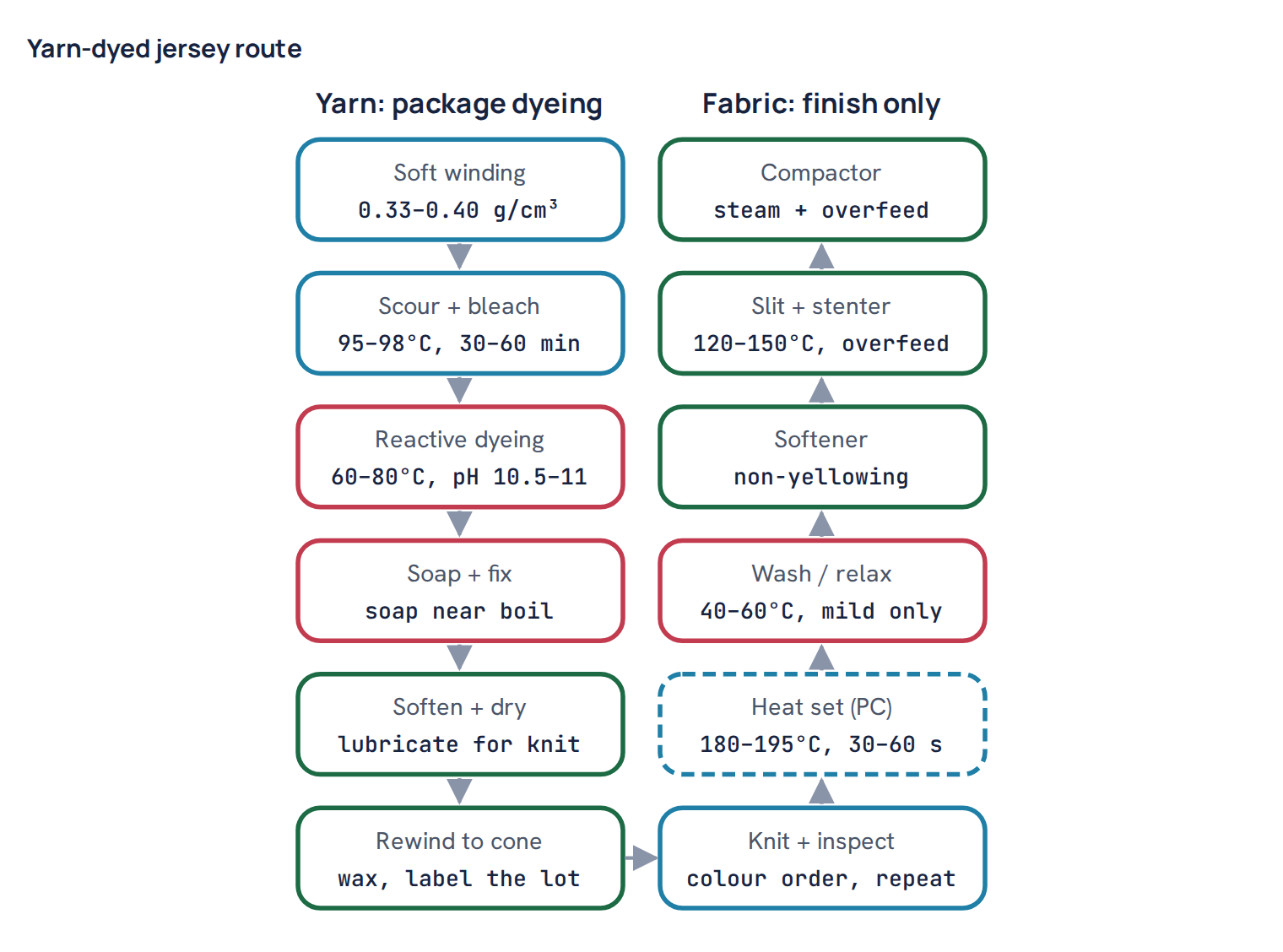
- Heat setting (polyester blends and elastane only). On the stenter at the planned width, typically around 180 to 195°C for 30 to 60 seconds. Check first that no colour changes shade at that temperature.
- Washing and relaxing. A mild wash with a non-ionic detergent and a sequestering agent, typically at 40 to 60°C for a short time, then rinsing. Add an anti-back-staining or dye-scavenging agent when dark and white stripes are next to each other. No caustic soda or peroxide, which can dull or strip colours.
- Enzyme, only if needed. Acid cellulase bio-polishing, typically pH 4.5 to 5.5 and 50 to 60°C, improves pilling and surface. Check every colour’s shade afterwards.
- Fixing, if bleeding is a risk. A cationic fixing step can be added; approve the shade after it.
- Softener. Typically at 30 to 40°C and pH 5 to 6. Use a non-yellowing softener when the fabric has white or pale stripes.
- Slitting and de-watering. Slit along a marked needle line.
- Stenter. Typically 120 to 150°C for cotton with overfeed. Optical whites can yellow if over-dried.
- Compactor. Steam and overfeed to set length shrinkage and GSM. Check the repeat here; it is the last chance to adjust length.
Keeping the white stripes white
Bleeding gets worse with high temperature, long wet time and contact without movement. Fabric left wet in a pile or roll overnight is the classic case: loose dye migrates through the water in the fabric and stains every white course it touches. So wash short and warm, use a dye-scavenging agent, keep the liquor moving, and extract and dry at once.
The white itself also matters. An optical white uses an optical brightening agent that absorbs ultraviolet light and emits blue, so the white looks brighter than a plain bleached white. It looks different under different light sources, so agree the standard and light source with the buyer and keep optical white yarn from one lot.
Shade continuity between yarn lots
A yarn-dyed order is only as even as its yarn. Each yarn dye lot is a separate shade, and an order larger than one lot contains two or more shades of every colour. To keep them together:
- Dye the full quantity at once where the package machine allows.
- Shade-band the lots: approve each new lot against the master standard on a knitted swatch.
- Allocate lots by order and by machine. One colour on one machine should come from one lot for the whole run. Change lots only at a roll end.
- Keep reference samples of each approved lot for repeat orders.
Heather follows the same logic with the spinner. For lot-to-lot problems in dyed fabric generally, see shade variation lot to lot: causes and remedies, and for piece-dyed slub with patchy results, uneven and patchy dyeing: causes and remedies.
Hitting finished GSM and width
What our records show
Like plain jersey, this group tends to finish light. The median finished GSM is 4.4% below the required GSM across 894 entries. 57% finish within ±5%, 42% finish more than 5% light and only 1% finish more than 5% heavy. After the dye-house wash test the GSM rises by a median of 9.5% (892 entries), a little more than plain cotton jersey shows.
| Yarn (as entered) | Required GSM | Finished GSM | GSM after wash | Shrink L, % | Shrink W, % | Spirality, % |
|---|---|---|---|---|---|---|
| 24/1 cotton, yarn-dyed (Y/D) | 180 | 173 (170–177) | 186 | -5 | -2 | 2 |
| 28/1 cotton, yarn-dyed (Y/D) | 160 | 152 (150–156) | 165.5 | -5 | -3 | 2.5 |
| 30/1 cotton, yarn-dyed (YD) | 180 | 175 (173–180) | 188 | -5 | -3 | 2 |
| 28/1 cotton slub | 160 | 150 (145–155) | 164 | -8 | -2 | 2 |
| 24/1 cotton, yarn-dyed (YD) | 180 | 170 (166–177) | 187.5 | -4.5 | -2 | 2 |
| 18/1 cotton (no mark) | 210 | 206.5 (204–210) | 220 | -5 | -2 | 2 |
| 26/1 cotton, yarn-dyed (Y/D) | 170 | 160 (154–160) | 175 | -8 | -2 | 2 |
| 30/2 ply cotton (no mark) | 245 | 228 (210–232) | 248 | -5 | -4 | 2 |
| 20/1 cotton, yarn-dyed (Y/D) | 200 | 193 (190–195) | 208 | -5 | -5 | 2 |
| 30/2 ply cotton, yarn-dyed | 240 | 235 (232–240) | 258 | -5 | -4 | 2 |
| 20/1 cotton, yarn-dyed (YD) | 200 | 195 (190–197) | 214 | -3 | -7 | 2 |
| 32/1 cotton slub | 150 | 130 (124–130) | 148 | -8.5 | -2.5 | 3 |
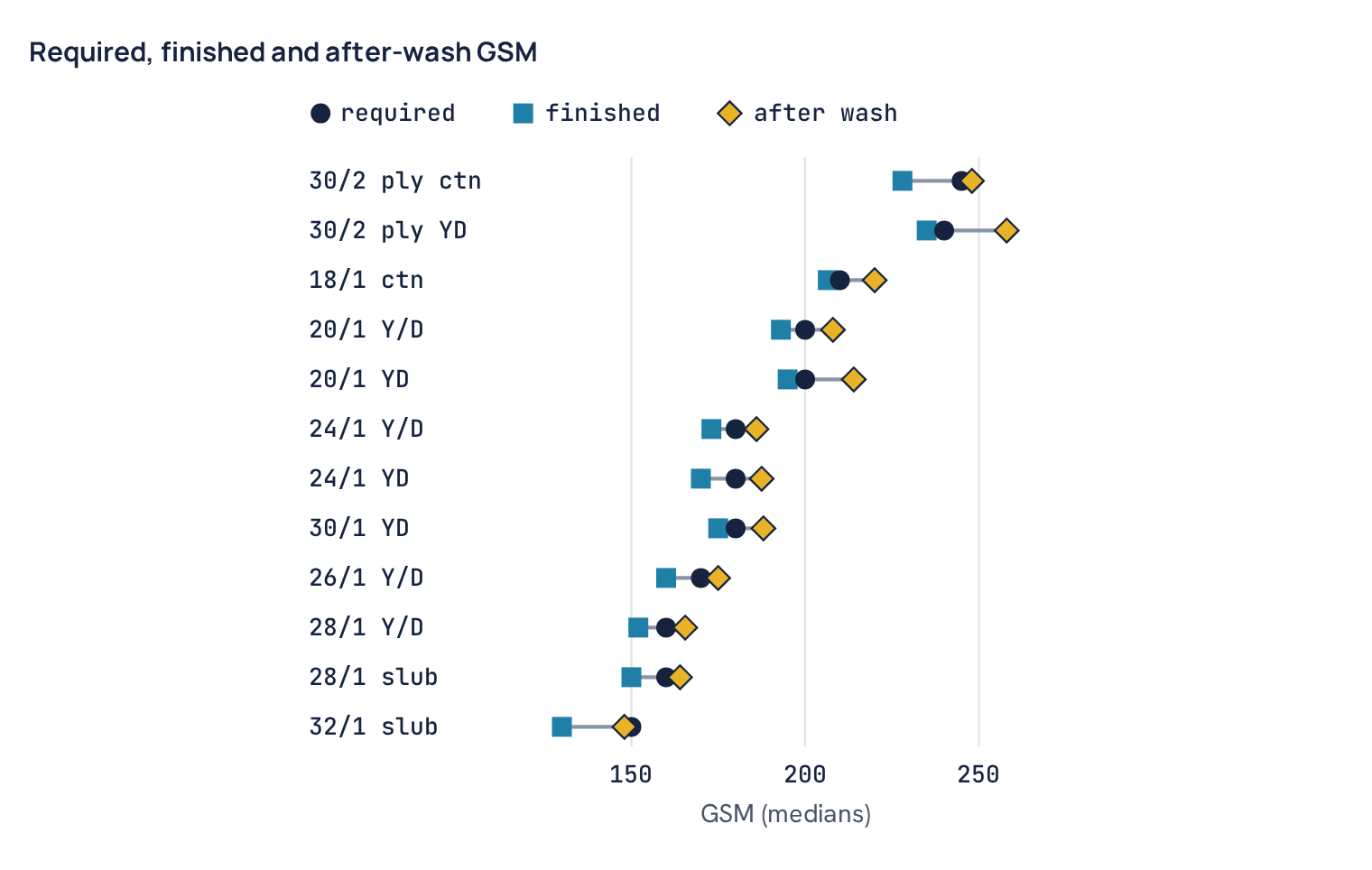
Slub finishes lightest and shrinks most
The two slub rows tell the clearest story. 28/1 slub finishes at a median of 150 GSM against 160 required, and 32/1 slub at 130 against 150, about 13% light. After the wash test both come back close to the requirement, 164 and 148. Their length shrinkage is also the highest in the group, -8% and -8.5%, against about -5% for most yarn-dyed rows. Low-twist thick places, uneven loops and length pulled in during finishing all leave more to give back in the wash. The yarn is there; the fabric has not relaxed. Plan more compaction and less length tension, and check after-wash GSM before shortening the stitch. The 32/1 slub row also has the highest spirality in the group, 3%, which fits a yarn whose twist varies along its length; see spirality test fail: causes and remedies if it becomes a problem.
Yarn-dyed rows and width
Most yarn-dyed rows finish 2 to 6% light and recover above the requirement after the wash, with length shrinkage of -3% to -5%, except 26/1 at -8%. Width shrinkage is mostly -2% to -3%, but 20/1 (YD) records -7% and 20/1 (Y/D) -5%, so do not assume that width is stable on the heavier yarn-dyed fabrics. The 30/2 ply rows show -4% width. Plan from the finished and after-wash GSM of the matching row, and estimate garment effects with the fabric shrinkage calculator. For a wider comparison of fibres, see our knit GSM and shrinkage by fibre study.
Worked example. A 28/1 slub jersey is required at 160 GSM. Our register median finishes at 150 GSM, 6% light and outside a ±5% tolerance, but the after-wash median is 164 GSM, and length shrinkage is -8%. The construction already carries enough yarn. First add compactor overfeed and lower tension in washing and stenter, which raises finished GSM and cuts shrinkage together. Shorten the 2.75 mm stitch only if after-wash GSM also falls short.
Testing the developed fabric
Our lab reports for this group are few: only 8 reached our desk, many because of a problem, so the numbers show where risks lie, not a production average.
| Test | Typical buyer requirement (varies by buyer) | Our lab reports (8 reports) |
|---|---|---|
| Dimensional stability (shrinkage) | Often within ±5% L and W after the stated wash | 4 fails in 12 results; median after one wash L -3.2%, W -1.2% |
| Spirality | Often 5% maximum after washing | 1 fail in 12; median 1.6%, max 5.8% |
| GSM | Often ±5% of required | 3 fails in 8 results |
| Colour fastness to washing | Often 4 change, 3–4 staining | 0 fails in 7 |
| Colour fastness to rubbing | Often dry 4, wet 2–3 or 3 | 1 fail in 7; wet grades seen: 4–5 (3), 4 (2), 3 (1), 2–3 (1) |
| Water and perspiration fastness | Often 4 change, 3–4 staining | 0 fails in 6 each |
| Pilling | Often grade 3–4 minimum | 1 fail in 7; mostly 4–5 pilling and 4 fuzzing |
| Bursting strength | A minimum in kPa set by the buyer | 0 fails in 6; median 399 kPa, range 88–516 kPa (7 values) |
| Light fastness | Often grade 4 or as stated | 1 result, failed |
| Fibre content and pH | Within label tolerance; often pH 4.5–7.5 | 0 fails (5 fibre, 1 pH) |
The pattern is familiar. Shrinkage (4 fails in 12) and GSM (3 fails in 8) are the weak points, which matches what the register shows about slub and yarn-dyed fabric finishing light and long. Colour results are reassuring on this small set: no wash, water or perspiration fails, and wet rubbing mostly 4 or better. The single light fastness result failed; one result proves nothing, but pale reactive shades and some fixing agents lower light fastness, so test early when required.
For stripes with white, ask the lab to judge staining on the white stripe itself, not only on the multifibre. Testing methods and fixes are covered in these guides:
- How to test shrinkage of knit fabric and shrinkage test fail: causes and remedies
- How to test spirality of knit fabric
- How to test GSM of knit fabric and GSM test fail: causes and remedies
- Wet rubbing fastness fail: causes and remedies
- How to test bursting strength of knit fabric and how to test pilling (box and Martindale)
Development record sheet and troubleshooting
Record sheet template
Use one sheet per trial and keep it with the approved swatch. Rows such as yarn dyeing and creel plan are what a plain jersey sheet does not have.
| Stage | Record |
|---|---|
| Request | Buyer, style, required GSM and tolerance, width, composition, stripe artwork with finished heights and repeat tolerance, shade standard per colour, white standard, slub or melange standard, wash care, tests |
| Yarn | Count, type, mercerised or singed, supplier; for slub: slub length, thickness, pause, pattern; for heather: blend lot |
| Yarn dyeing | Dye house, lot number per colour, package density, dye class, soaping and fixing, yarn-level staining check result |
| Knitting | Machine, diameter, gauge, feeder count, striper or jacquard, stitch length (measured over many loops), input tension, speed, take-down |
| Creel plan | Feeder number, colour, yarn lot, courses per stripe, courses per repeat, repeats per turn |
| Greige | Greige GSM, dia, greige repeat in cm, faults (colour order, broken repeat, fly, lot bands) |
| Wet process | Heat set (if any), wash temperature and time, scavenger, enzyme yes/no, fixing, softener type, time between wash and drying |
| Stenter and compactor | Temperature, speed, width, overfeed, steam |
| Finished | GSM, width, GSM after wash test, shrinkage L/W, spirality, finished repeat in cm, white stripe staining, shade per colour |
| Lab tests and decision | Each result against requirement; approved or adjust, and what changes in the next trial |
Troubleshooting
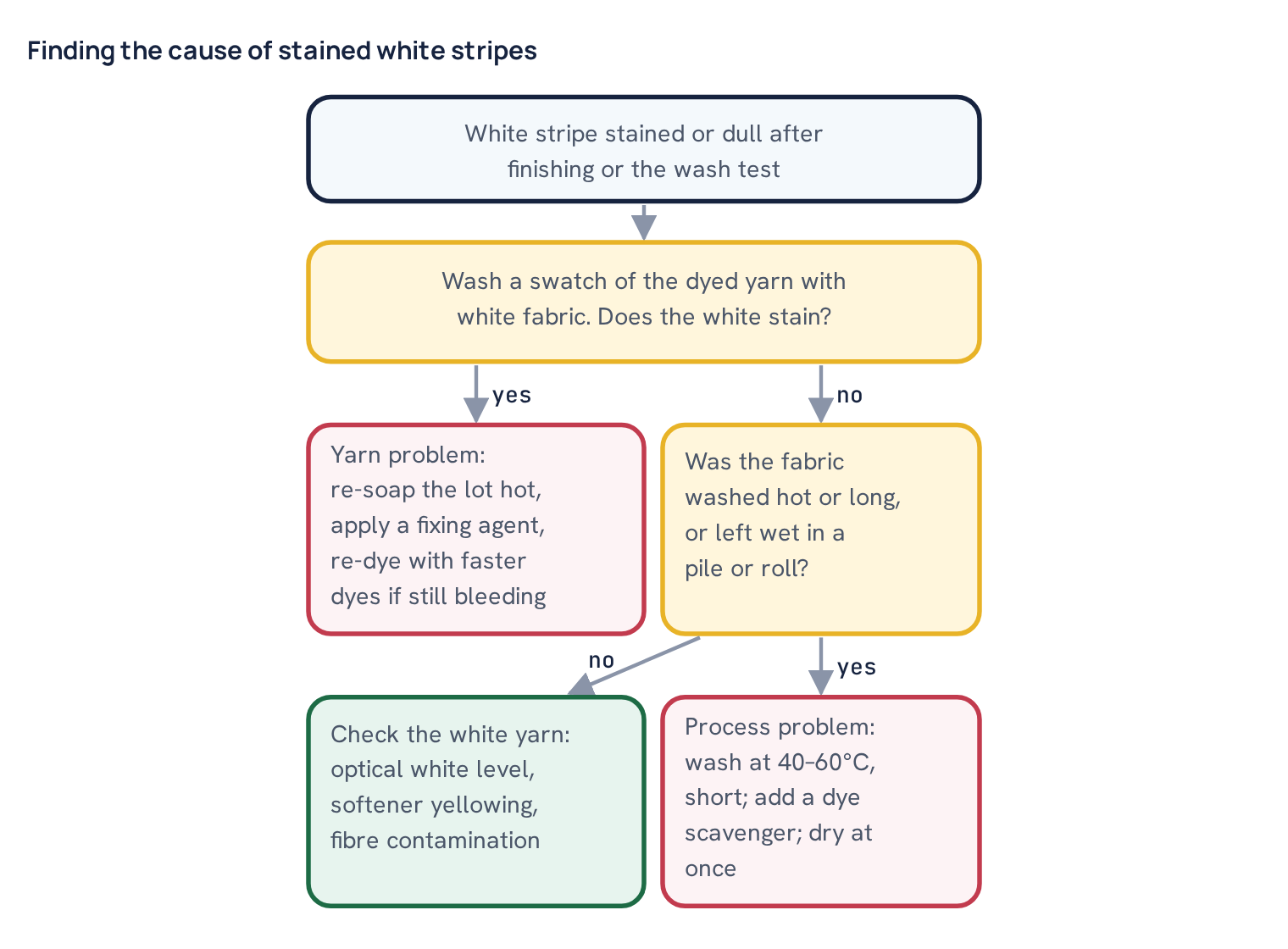
Stained whites cost the most, because the fabric often cannot be recovered. The diagram shows which stage to fix.
| Problem | Likely cause | What to change |
|---|---|---|
| White stripe stained | Poor yarn wash-off; hot or long fabric wash; fabric left wet | Check yarn lot first; re-soap or fix yarn; wash at 40–60°C with scavenger; dry at once |
| Stripe repeat breaks once per turn | Repeat does not divide the feeder count | Adjust stripe courses, change machine, or leave feeders empty |
| Finished repeat too short or long | Courses per cm taken from greige; length shrinkage not planned | Use finished courses per cm; adjust compaction; re-measure after wash |
| Faint bands within one colour | Mixed yarn dye lots; package inside-outside shading; tension differences | One lot per colour per machine; check package evenness; equalise tension |
| Shade jump between rolls | New yarn lot or melange lot | Shade-band lots on knitted swatches; change lots at roll ends and label |
| Bands in slub fabric | Regular slub pattern; mixed slub yarn lots | Ask the spinner for a randomised pattern; one lot per order |
| Slub finished GSM low | Fabric not relaxed; length tension in finishing | More compactor overfeed, less tension; check after-wash GSM before shortening stitch |
| High length shrinkage | Slub yarn; fine count; fabric pulled long | More compaction and overfeed; lower tension in washing and stenter |
| Optical white dull or yellow | Over-drying; unsuitable softener; residual alkali | Lower stenter temperature; non-yellowing softener; neutralise |
| Dark specks on white stripes | Fly from dark yarn during knitting | Clean machine and creel; separate dark and white cones |
| Holes or needle damage at slubs | Tight guides or high tension; stitch length too short | Open guides, lower tension and speed; slightly longer stitch length |
Yarn-dyed and slub jersey reward planning before the first cone goes on the creel. Fix the stripe in finished courses, make it fit the feeders, test every dark yarn lot against white, keep lots apart, wash short and dry fast, and expect slub fabric to finish light and long until it is relaxed.
New to slub? Our short guide what is slub fabric explains slub yarn and slub jersey in plain words.
Questions
Why does the stripe repeat have to divide the number of feeders?
Each machine turn knits one course per feeder. If the repeat in courses does not divide the feeder count, the last repeat of every turn is cut short and the stripe breaks once per revolution.
How do you stop dark stripes bleeding into white stripes?
Wash the dyed yarn thoroughly and soap it near the boil, use high wet-fastness dyes and a fixing agent where needed, and check each dark lot against white before knitting. Then wash the fabric short at about 40 to 60°C with a dye scavenger and dry it at once.
Is yarn-dyed jersey dyed again after knitting?
No. The colour is already in the yarn, so the fabric is only washed, softened, stentered and compacted. Strong alkali, peroxide and hot washing are avoided because they can dull colours and cause bleeding.
Why does slub jersey finish below the required GSM?
Slub fabric leaves finishing with length still stretched in. In our records 32/1 slub finishes at 130 GSM against 150 required but rises to 148 after the wash test, with about -8.5% length shrinkage, so better relaxation and compaction is the first fix.
How do you keep the shade the same across yarn lots?
Dye the full quantity at once where possible, approve each new lot on a knitted swatch against the master standard, and keep one lot per colour on one machine. Heather yarn needs the same lot control at the spinning mill.

Textile engineer with 14+ years in dyeing and fabric development. He writes every guide on Dyeing Solution from real production work. Full profile