A step-by-step development guide for single jersey jacquard, double jacquard and yarn-dyed jacquard: needle selection, floats, backings, gentle wet routes, hitting GSM and width, and testing, built on our real development records.
At a glance
53jacquard entries in our register
-7.7%median finished vs required GSM
+14.5%median GSM rise after the wash test
58%entries that finished more than 5% light
A jacquard knit carries its design in the knitting itself. Each needle is told, course by course, whether to knit a yarn or let it pass, so a motif, a logo or a multi-colour stripe appears without printing. The family covers single jersey jacquard, where the unused yarn floats across the back, and double jacquard, where a second needle bed knits a backing that locks every yarn in. Many jacquards are knitted from dyed yarn, which adds bleeding and wash-off risk to the usual problems of GSM, width and shrinkage. This guide follows the route from buyer request to tested fabric. It is built on our fabric register, which holds 53 jacquard entries (double jacquard, jacquard jersey, Lycra (elastane) jacquard jersey and their yarn-dyed versions), and on 3 lab reports. That is thin data, so we say plainly where our records stop, and values from general practice are marked as typical. If you are new to knit development, read the single jersey fabric development guide first, because jacquard builds on it.
What a jacquard knit is
Needle selection makes the pattern
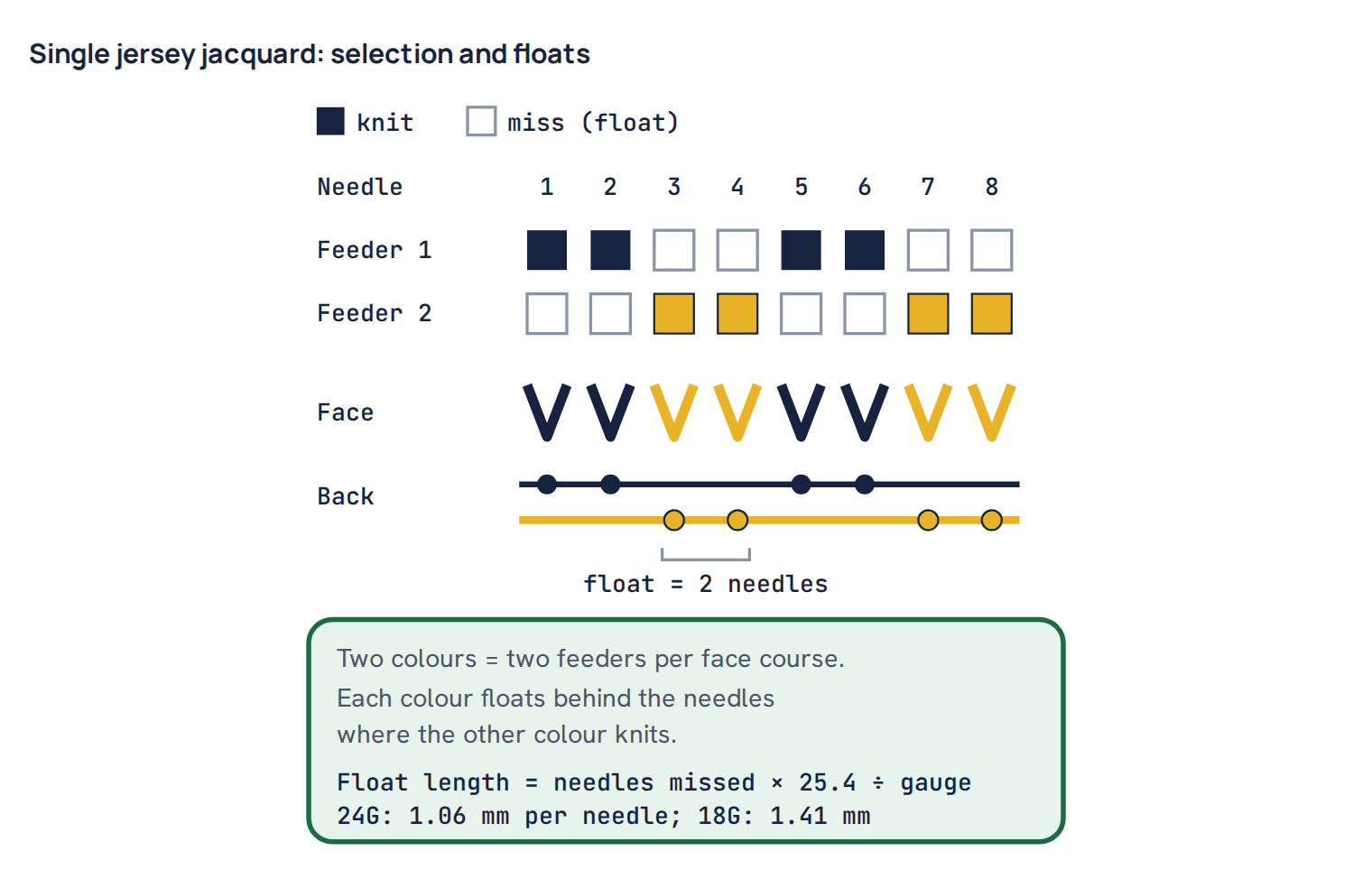
In plain single jersey every needle knits at every feeder. In a jacquard, each needle is selected or not selected at each feeder. A selected needle rises, takes the yarn and knits a loop. A needle that is not selected stays down, the yarn passes behind it, and that length of unused yarn is called a float (or a miss stitch). Some machines also have a third position, tuck, where the needle takes the yarn but does not cast off the old loop.
A two-colour design needs two feeders to make one complete row of the face. Feeder 1 carries colour A and knits only on the needles where the design shows A. Feeder 2 carries colour B and knits on the remaining needles. After both feeders have passed, every needle has knitted exactly one loop, in one colour or the other. That complete row is one face course, built from two machine courses.
Single jersey jacquard and double jacquard
- Single jersey jacquard. Knitted on one cylinder of needles. The face shows the design. The back shows floats of every colour that was not knitting at that point. The fabric is light and soft, but long floats can snag, and the floats hold the fabric narrower and less stretchy in width than plain jersey. It still curls at the edges like single jersey.
- Double jacquard. Knitted on a double jersey machine with cylinder and dial needles. The cylinder needles are selected to make the face design. The dial needles knit a backing in a fixed order. The floats are trapped between the face and the back, so nothing is exposed on either side. The fabric is heavier, firmer and more stable, it hardly curls, and it stretches less than rib or interlock.
- Yarn-dyed jacquard. Either type knitted from dyed yarns, so the colours are already in the yarn. The fabric is washed and finished rather than piece dyed.
- Piece-dyed jacquard. Knitted from one undyed yarn, so the design shows as texture (knit, tuck and float areas), or from two fibres that take dye differently, such as cotton and polyester, so the design shows as two tones after dyeing.
- Lycra jacquard jersey. Single jersey jacquard with plated elastane for stretch and recovery. It needs heat setting, like Lycra single jersey.
Jacquards are used for fashion tops, polo and dress fabrics, children’s wear, sweater-look knits, and logo or brand-name fabrics for sportswear and uniforms. Rib-based jacquards and pointelles are covered separately in the design rib, pointelle and jacquard rib guide.
Development inputs
What the buyer must give you
A jacquard request needs everything a plain jersey request needs, plus the design. Collect these before any yarn is ordered:
- The design file or artwork, with the repeat size in width and length, and the number of colours in each row.
- Colour standards for every colour, and the light source for approval. For yarn-dyed jacquard each colour is a separate yarn-dyeing lot.
- Finished GSM with tolerance, and whether GSM is judged on the fabric as delivered or after washing.
- Finished width, and whether the repeat must fit a garment panel or a placement.
- Composition, for example 100% cotton, CVC or cotton with elastane.
- Wash care and tests, including any float length limit, skew limit, and colour fastness and staining requirements. Buyers of yarn-dyed fabric often care most about staining onto the white or light colours.
Choosing the yarn
Count, gauge and quality. The count must suit the gauge, as in any knit. In our register only one yarn and gauge pairing has enough entries to show: 24/1 cotton on 24 gauge. Other qualities appear only once or twice, so treat the usual knitting rule as your guide: a coarser count on a coarser gauge, a finer count on a finer gauge. Combed, ring or compact yarn gives a cleaner design edge and fewer snags than hairy yarn.
Twist. Single jersey jacquard can show spirality like plain jersey, so knitting-twist yarn and balanced feeding matter. Double jacquard is much less prone to it, because the two beds hold the loops in balance.
Yarn-dyed yarn. Ask the yarn dyer for fastness test results on every colour before knitting: washing (change and staining), water, perspiration and wet rubbing. Dark and bright reactive shades must be soaped thoroughly at the yarn stage. Check that all colours have similar shrinkage and count; a colour lot that was dyed or dried harder can knit tighter or shrink differently and shows as a band.
Common mistake: knitting the first yarn-dyed trial with yarn that has not been tested for bleeding. If a dark colour bleeds onto the white ground in the first wash, no finishing step can bring the white back, and the whole lot is lost.
Knitting
Electronic needle selection
Older jacquard machines select needles mechanically, with pattern wheels, drums or selector jacks with butts at different heights. Their repeat width is limited, and a design change means resetting the jacks. Modern machines use electronic selection: at each feeder, a selector unit (usually piezo or electromagnetic) decides needle by needle whether that needle knits, tucks or misses. The design is drawn as a bitmap on a computer, where each pixel is one loop and each colour is assigned to a feeder. Because every needle is controlled separately, the repeat can be as wide as the whole needle bed.
Points to check when preparing the pattern file:
- Repeat width and needle count. A 34 inch, 24 gauge machine has about 34 × 3.1416 × 24 = 2,560 needles, and an 18 gauge machine of the same diameter about 1,920. A repeat that does not divide the needle count leaves a broken repeat at one point of the tube. For open-width fabric, place that point on the slitting line.
- Two-way or three-way technique. Two-way selection gives knit or miss. Three-way adds tuck, which is used for texture and to tie down long floats.
- Colour sequence. Write down which colour is on which feeder. A yarn put on the wrong feeder gives a design in the wrong colours across the full width.
- Save and name the file with the design reference and version. Bulk must run from the same file as the approved trial.
Colours per course
Each colour in a row needs its own feeder, so the number of colours per course sets how fast the fabric grows. As a typical example, a machine with 72 feeders makes 36 face courses per turn with two colours, 24 with three and 18 with four. More colours per course therefore means lower production. In single jersey jacquard it also means more floats, because each colour floats wherever the others are knitting, and the back becomes heavier and more crowded. In double jacquard it means more backing courses for each face course, which makes the fabric heavier and firmer. Many designs therefore use two colours per course, with a third or fourth colour only in some rows.
Float length limits
The float length is the number of needles missed in a row, times the needle pitch. Needle pitch is 25.4 ÷ gauge mm: about 1.06 mm at 24 gauge and 1.41 mm at 18 gauge. In the finished fabric the real float can be a little shorter or longer, depending on how much the width is pulled in or stretched.
| Needles missed | Float at 24G, mm | Float at 18G, mm |
|---|---|---|
| 3 | 3.2 | 4.2 |
| 5 | 5.3 | 7.1 |
| 7 | 7.4 | 9.9 |
| 10 | 10.6 | 14.1 |
There is no single standard limit. Many mills work to a maximum somewhere around 5 to 7 mm for single jersey jacquard worn next to the skin, and buyers of children’s wear often set their own, stricter limit because fingers and toes can catch in floats. Values vary by buyer and end use, so ask for the limit. When the design has a longer float, there are three remedies: change the design, tie the float down with a tuck every few needles (the tuck can show faintly on the face, so trial it), or move the design to double jacquard, where the backing holds every float.
Worked example. A single jersey jacquard on 24 gauge has a motif with a plain area 9 needles wide in colour A. Colour B floats across the back for 9 × 1.06 = about 9.5 mm. If the buyer’s limit is 6 mm, a tuck of colour B on the middle needle splits the float into two floats of 4 needles, about 4.2 mm each. Knit a trial and check that the tuck does not show as a dot on the face.
Backing structures in double jacquard
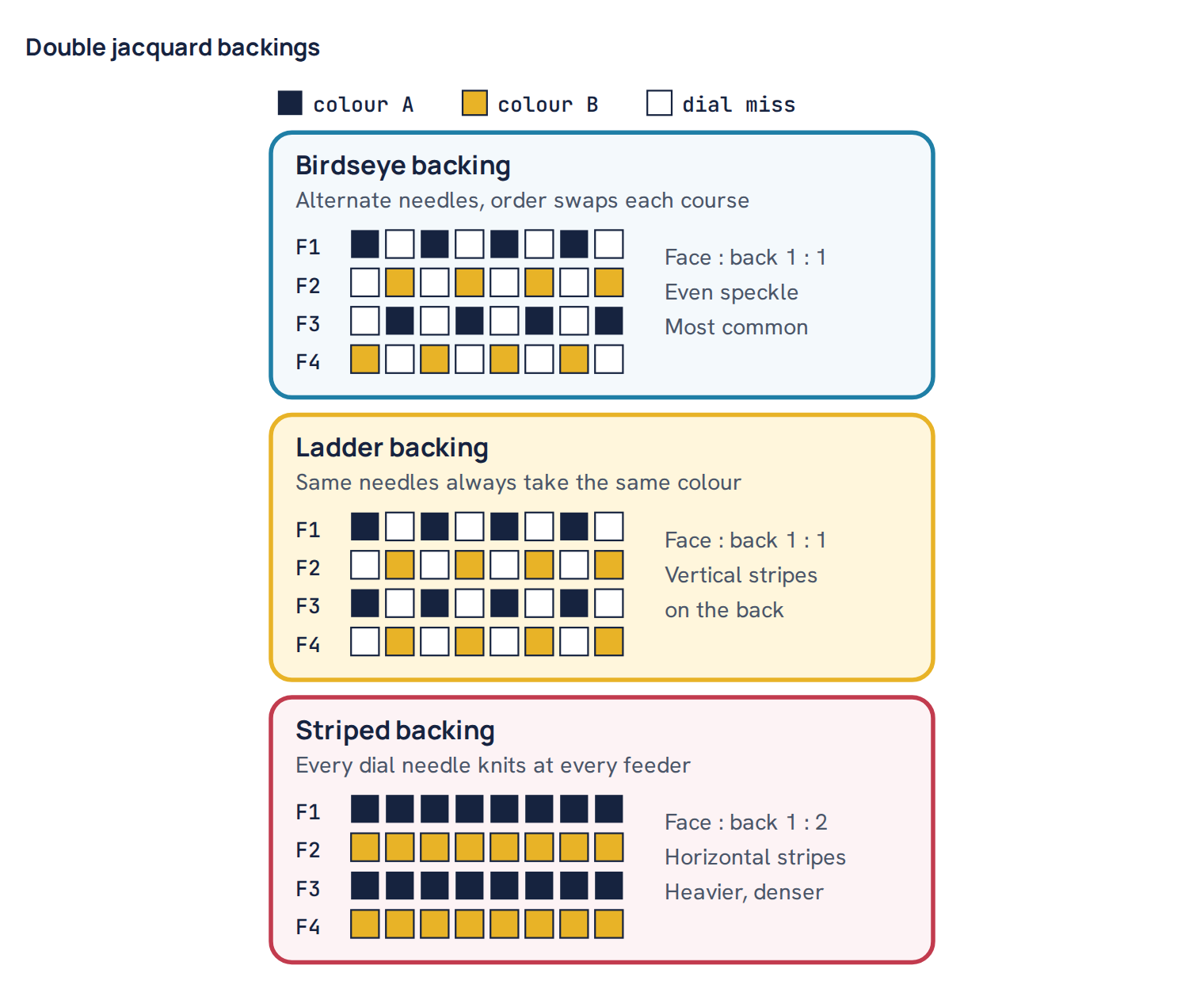
In double jacquard the dial needles decide what the back looks like and how heavy the fabric is. The three classic backings for a two-colour design are:
- Birdseye backing. At each feeder, alternate dial needles knit; the next feeder knits the other half; and the order swaps every course. The back shows a fine speckle of both colours. Each face course is matched by one back course (a 1:1 ratio), so the fabric is balanced and not too heavy. This is the most common backing.
- Ladder backing (vertical stripe backing). Alternate dial needles knit, but the same needles always take the same colour, so the back shows fine vertical stripes. The ratio is also 1:1.
- Striped backing (horizontal stripe). Every dial needle knits at every feeder, so each colour makes a full back course. There are two back courses for every face course, so the fabric is heavier and denser, and the back shows horizontal stripes.
With more colours the ratios change. A three-colour birdseye design needs three feeders per face course and gives one and a half back courses per face course. Plan the GSM with the backing in mind, because the backing can add a large share of the weight.
Show-through (grin-through). In double jacquard a dark backing colour can show between the face loops of a light colour. A tighter stitch, the right dial height and balanced tension between cylinder and dial reduce it. Check the face of a white or pale area against the approved sample under the buyer’s light source.
Machine, gauge and diameter in our records
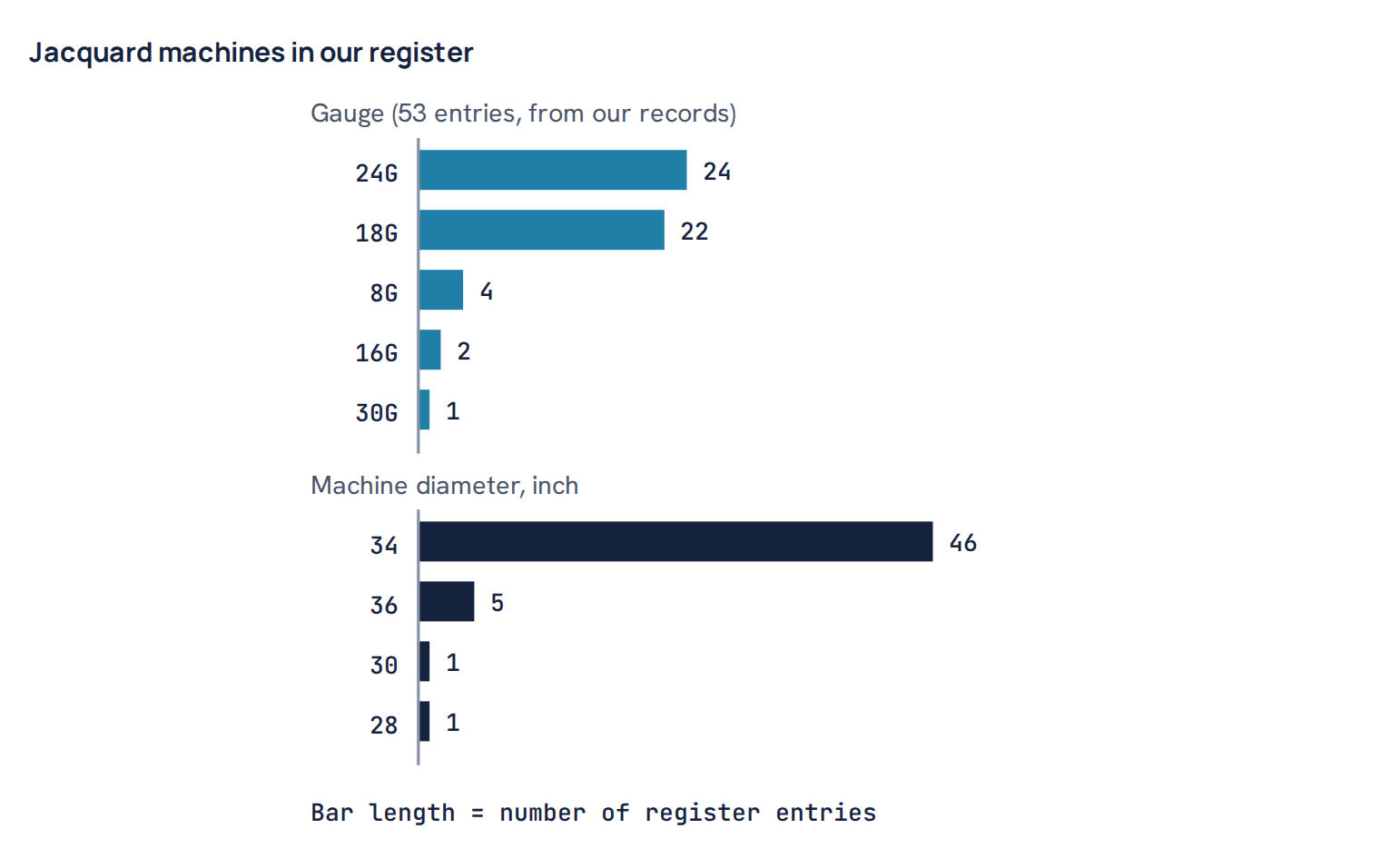
All 53 jacquard entries in our register were finished open width. Most were knitted on 34 inch machines (46 entries), with a few on 36, 30 and 28 inch. The gauge split is almost even between 24 gauge (24 entries) and 18 gauge (22 entries), with a few coarse 8 gauge and 16 gauge entries and one 30 gauge entry.
The register has enough entries to give medians for only one yarn and gauge pairing:
| Yarn | Gauge | Entries | Stitch length, mm | Required GSM | Finished GSM | GSM after wash | Finished dia, cm | Shrink L / W, % | Spirality, % |
|---|---|---|---|---|---|---|---|---|---|
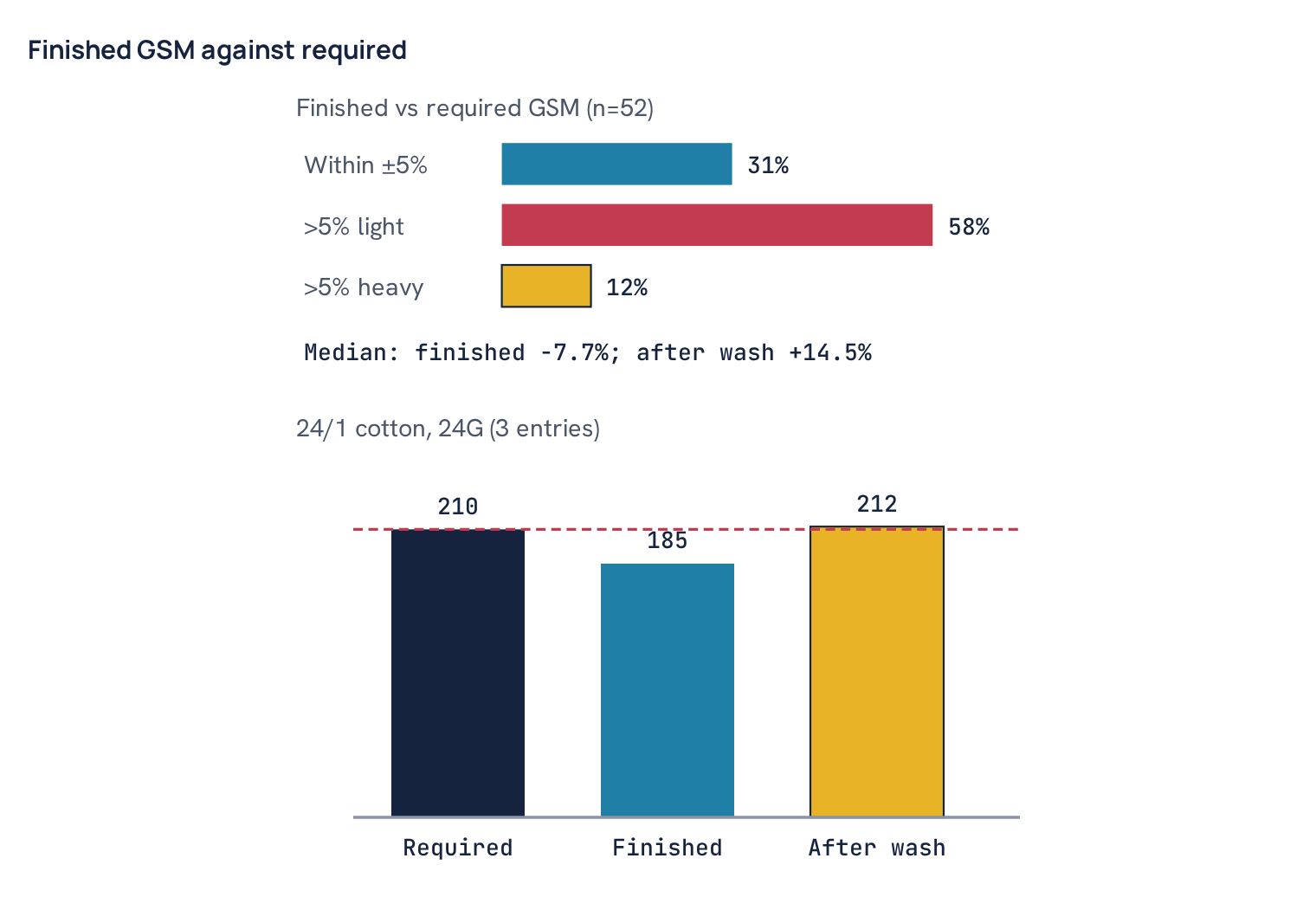
| 24/1 cotton | 24G | 3 | 2.25 | 210 | 185 | 212 | 164 | -9 / -5 | 3 |
Three entries are a small base, so read this row as one worked case, not a standard. It shows the jacquard pattern clearly. The stitch length is short compared with plain jersey of the same count, which is expected: a jacquard carries extra yarn in its floats or backing, so it reaches its weight with shorter loops. The fabric finished 25 GSM below the requirement but came back to 212 GSM after the dye-house wash test, and it shrank 9% in length and 5% in width in that test. The yarn was there; the fabric had not relaxed. Its 5% width shrinkage is more than double the usual -2% of plain cotton single jersey.
Stitch length and GSM in jacquard
The usual formula, GSM = courses per cm × wales per cm × stitch length × tex ÷ 100, works only roughly for jacquard, because floats and backing loops add yarn that a single loop length does not describe. Use the knit GSM from stitch length calculator for a first estimate, then rely on a trial. Record the yarn input per feeder as well as the stitch length: with a yarn length counter, write the metres of yarn per machine turn for each feeder. Two feeders with the same cam setting can take different amounts of yarn when the design gives them different numbers of knitted needles.
Settings to record and greige inspection
- Machine number, diameter, gauge, number of feeders, and single or double jacquard.
- Pattern file name and version, repeat size, colours per course, and colour on each feeder.
- Backing type (birdseye, ladder or striped) and dial height or timing for double jacquard.
- Stitch length as measured, and yarn input per feeder.
- Yarn count, colour, dye lot and supplier for each feeder; elastane denier and draft for Lycra jacquard.
- Take-down tension, speed, greige GSM, tubular dia and roll weight.
In greige inspection look for wrong colours, missing or broken repeats, mis-selection lines (one needle or selector failing, which shows as a vertical line through the design), long or loose floats, holes, and barre from mixed yarn lots. Measure greige GSM and dia after the roll has rested.
Dyeing and finishing route
All 53 entries in our register went through an open-width route with stenter and compactor. The route depends on whether the fabric is piece dyed or yarn dyed. A shorter overview is in the jacquard knit dyeing and finishing flowchart.
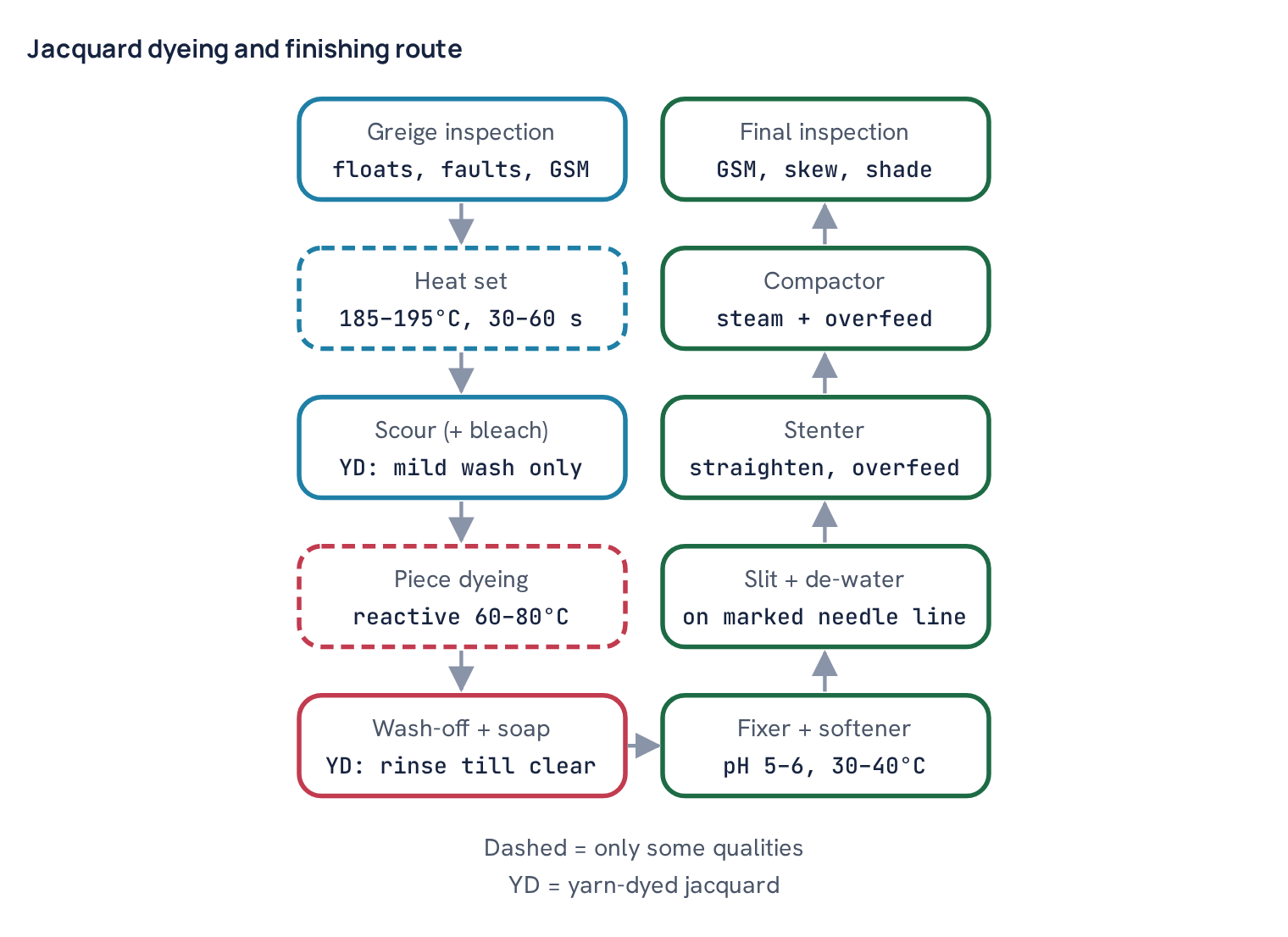
The finishing flags in the register show what was added to the basic route. Of the 53 entries, 23 contain polyester or elastane (16 CVC or PC, 6 CVC or PC with elastane, 1 cotton with elastane), and 19 carry a heat-set flag, so the heat-set share is 36%. Three entries were singed, one was both heat-set and singed, and four were mercerised. The rest, 27 entries, had no extra step.
- Heat setting. For elastane and polyester blends the greige is set on the stenter at the planned width, typically 185 to 195°C for 30 to 60 seconds. It fixes width, stops curling and keeps the design from distorting in the wet process. Do not dry later at a higher temperature than the heat set.
- Pretreatment for piece-dyed jacquard. Scour and bleach as for any cotton knit, typically 95 to 98°C for 45 to 60 minutes with caustic soda and hydrogen peroxide. See the 100% cotton knit dyeing process.
- Pretreatment for yarn-dyed jacquard. No bleaching, because peroxide and alkali would change the dyed colours. A mild scour or wash with a non-ionic detergent, typically 50 to 70°C, removes knitting oil and dirt. Keep the bath near neutral.
- Dyeing (piece-dyed only). Reactive dyeing for cotton, typically fixing at 60 to 80°C and pH 10.5 to 11 (see how reactive dyes work). For a two-tone polyester and cotton jacquard, the polyester part is dyed with disperse dyes at about 130°C, as in the CVC fabric dyeing process; dyeing only one fibre leaves the other white or light and gives the two-tone design. Elastane jacquard follows the cotton elastane knit dyeing process.
- Wash-off. For piece-dyed fabric, rinse, neutralise and soap near the boil. For yarn-dyed fabric, the aim is to remove loose dye before it can stain the light colours: start cold or warm, rinse until the water runs clear, and keep the liquor moving so loose dye does not settle on the white areas.
- Fixing agent and softener. A cationic dye-fixing agent can improve wet fastness of dark yarn-dyed colours. It can shift the shade slightly and harden the handfeel, so check the shade after finishing. Softener typically at 30 to 40°C and pH 5 to 6.
- Slitting and de-watering. Slit on the marked needle line, which should also be the point where any broken repeat sits. Do not leave wet yarn-dyed fabric in a pile or a trolley for hours: dark colours can migrate into light ones where the fabric folds and touches.
- Stenter. Typically 130 to 160°C for cotton, with overfeed. Use the weft straightener to correct bow and skew before the fabric is pinned, and keep width pull low. A jacquard stretched wide becomes lighter and its motif becomes wider and shorter than the approved design.
- Compactor. Steam and overfeed to set the length, reduce shrinkage and bring the GSM up. Watch that a raised or textured jacquard is not pressed flat.
- Final inspection. GSM, width, shrinkage, skew and repeat size, plus shade and staining of every colour against the standard.
Common mistake: running a yarn-dyed jacquard through the same hot scour and bleach as a piece-dyed fabric. The dark colours bleed into the white ground, and the bright colours lose depth. Agree the yarn-dyed route with the dye house before the trial goes in.
Hitting finished GSM and width
What our records show
Jacquard finishes light more often than plain single jersey in our register. Across 52 entries with both values, the median finished GSM is 7.7% below the required GSM. Only 31% of entries finished within ±5%, 58% finished more than 5% light, and 12% finished more than 5% heavy. The GSM after the dye-house wash test is a median 14.5% higher than the finished GSM (50 entries), almost twice the rise we see in plain cotton single jersey.
Why jacquard finishes light
- The structure holds a lot of stretch. Floats and backing loops are pulled straight during wet processing and on the stenter. When a washed sample is free to relax, the floats pull the fabric together and the loops shorten in length, so the GSM rises and the fabric shrinks.
- Width is pulled to meet the target. Jacquard is narrower than plain jersey for the same needle count, because floats limit width stretch. Pulling it out to the target width on the stenter makes it lighter.
- Too little compaction. Fabric that leaves the compactor with length still in it stays light and shrinks in the wash test.
How to plan greige GSM and dia
- Agree with the buyer whether GSM is measured as delivered or after washing. With a 14.5% median rise, the two can differ by more than any tolerance.
- Plan the stenter width close to the fabric’s relaxed width, not the maximum it will reach. If the width is too narrow, change the machine diameter or gauge rather than stretching it.
- Knit a trial and send it through the full bulk route. Record greige GSM and dia, finished GSM and dia, and GSM and shrinkage after the wash test.
- If finished GSM is low but after-wash GSM is on target, add overfeed on the stenter and compactor and reduce width pull. If both are low, shorten the stitch length slightly or change the count.
- Write the greige to finished ratios on the record sheet, with the design and backing type, because a different design on the same machine can finish differently.
Worked example. A jacquard is required at 200 GSM. At our median, it would finish about 7.7% light, at about 185 GSM, which fails a ±5% tolerance. If you simply knit it heavier so that it finishes at 200, the median 14.5% after-wash rise would take it to about 229 GSM after the customer’s first wash. The better fix is to relax it more in finishing: more overfeed, less width pull, enough compaction, so that the finished and after-wash GSM come closer together.
Shrinkage, pattern distortion and skew
The dye-house wash test in our register shows how much shrinkage a jacquard can hold, as in the 24/1 row (-9% length, -5% width). Shrinkage also changes the design: a motif that shrinks more in length than in width becomes shorter and wider, and a repeat that was knitted to fit a garment panel may no longer fit. Measure the repeat size on the finished fabric and again after washing, and compare it with the approved artwork. You can estimate the effect on cut size with the fabric shrinkage calculator, and fibre effects are compared in our knit GSM and shrinkage by fibre study.
Skew and bow are more visible on a jacquard than on plain fabric, because a straight line in the design shows any slant. The main causes are:
- Spirality in single jersey jacquard: yarn twist and the number of feeders make the courses lean, as in plain jersey. The 24/1 row recorded 3% spirality in the dye-house test.
- Slitting off the needle line, which cuts the tube at an angle to the wales.
- Uneven feeding on the stenter, with one edge running ahead of the other, or one edge overfed more.
Correct skew and bow with the weft straightener before the stenter pins, and check with a straight line drawn across a course on the finished fabric. For causes and fixes, see spirality test fail: causes and remedies.
Testing the developed fabric
Only 3 jacquard lab reports reached our desk, with between 1 and 4 results per test. That is too few to say anything about typical jacquard performance, so the table shows what was found and nothing more. Reports usually reach us because of a problem, so their fail rate is higher than in overall production.
| Test | Typical buyer requirement (varies by buyer) | Our lab reports (jacquard, 3 reports) |
|---|---|---|
| Dimensional stability | Often within ±5% L and W after the stated wash | 4 results, 0 fails; after one wash median L +0.1%, W +1.6% (growth), n=2 |
| GSM | Often ±5% of required | 3 results, 2 fails |
| Spirality | Often 5% maximum after washing | 3 results, 0 fails; 0.0% in all |
| Skew | Set by the buyer, often a few percent | 1 result, 0 fails |
| Bursting strength | A minimum in kPa set by the buyer | 2 results, 1 fail; 135 and 500 kPa |
| Pilling (box method) | Often grade 3–4 minimum | 2 results, 0 fails; pilling 4–5, fuzzing 4 |
| Colour fastness to rubbing | Often dry 4, wet 2–3 or 3 | 2 results, 0 fails; wet grades 3 and 5 |
| Fastness to washing, water, perspiration | Often 4 change, 3–4 staining | Washing 1, water 2, perspiration 1; no fails |
| pH | Often 4.5–7.5 | 1 result, 0 fails |
| Fibre content | Within label tolerance | 3 results, 0 fails |
Two of the three GSM results failed, which agrees with the register: jacquard tends to finish light. One bursting result was low at 135 kPa while another reached 500 kPa. Bursting strength in jacquard varies a lot with the structure, because floats and single jersey areas are weaker than double-knit areas, so test the weakest part of the design. See how to test bursting strength and bursting strength fail: causes and remedies. Note that the lab shrinkage results (a buyer test) are much smaller than the dye-house wash test figures in the register; the two tests use different methods and should not be compared directly.
For yarn-dyed jacquard, add a staining check that most plain fabrics do not need: wash a sample with a white multifibre strip, and also look at the fabric’s own white or light areas after the wash. The guides below cover the methods and fixes:
- How to test shrinkage of knit fabric and shrinkage test fail: causes and remedies
- How to test GSM of knit fabric and GSM test fail: causes and remedies
- How to test spirality of knit fabric
- Pilling test, box and Martindale
- Wet rubbing fastness fail: causes and remedies
Development record sheet and troubleshooting
Record sheet template
Use one sheet per trial and keep the design details with the fabric details. A jacquard that is approved but cannot be repeated because nobody saved the pattern file version is a common and expensive loss.
| Stage | Record |
|---|---|
| Request | Buyer, style, design reference and version, repeat size, colours, required GSM and basis (as delivered or after wash), width, composition, wash care, tests, float limit |
| Yarn | Count, type, supplier, lot; for yarn-dyed, colour, dye lot and yarn fastness results; elastane denier |
| Knitting | Machine no., diameter, gauge, feeders, single or double jacquard, pattern file, colour per feeder, backing type, stitch length, yarn input per feeder, take-down, speed |
| Greige | Greige GSM, tubular dia, roll weight, repeat size, faults found |
| Heat set / singeing | Temperature, time, set width, overfeed |
| Wet process | Route (piece or yarn-dyed), scour or wash recipe, dye recipe, wash-off steps, fixing agent, softener |
| Stenter | Temperature, speed, set width, overfeed, straightener setting |
| Compactor | Overfeed, steam, exit width |
| Finished | GSM, width, GSM after wash, shrinkage L/W, spirality, skew, repeat size, shade and staining |
| Decision | Approved or adjust; what changes in the next trial and why |
Troubleshooting
| Problem | Likely cause | What to change |
|---|---|---|
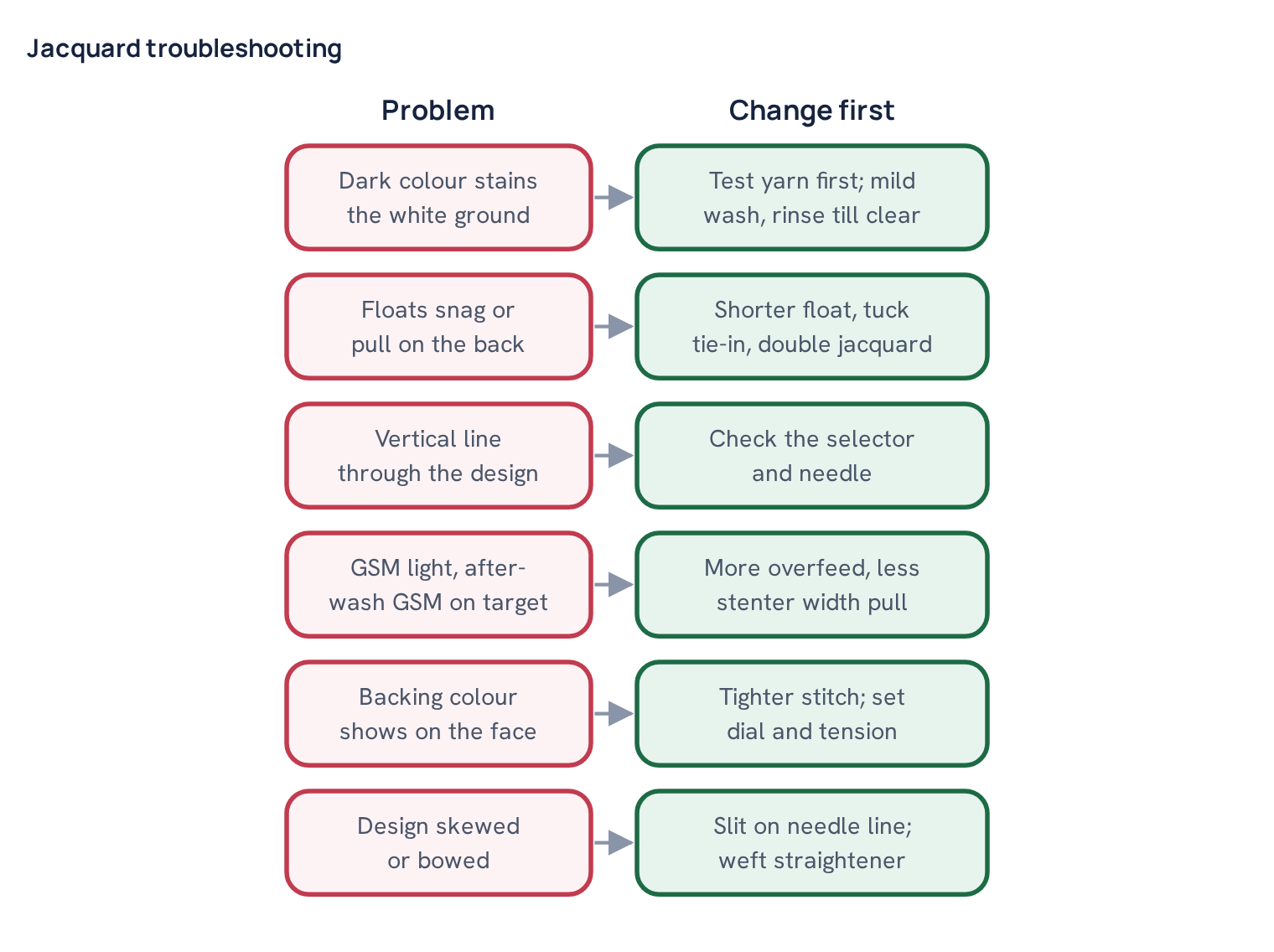
| Dark colour stains white ground | Poorly soaped yarn; hot route; wet fabric left in piles | Test and re-wash yarn; mild route; rinse until clear; fixing agent; dry quickly |
| Floats snag or pull | Float longer than the limit; hairy yarn | Redesign; tuck tie-in; double jacquard; smoother yarn |
| Vertical line through the design | Faulty selector or needle | Check the selector at that feeder; replace the needle |
| Wrong colours in the design | Yarn on the wrong feeder; wrong file version | Check the feeder list and file against the approved trial |
| Backing shows on the face | Loose stitch; dial setting; tension imbalance | Tighter stitch; adjust dial height or timing; balance tension |
| Finished GSM light, after-wash GSM on target | Fabric stretched; too little compaction | More overfeed; less width pull; more compaction |
| High width shrinkage, motif narrows | Width set wider than relaxed width | Set width nearer the relaxed width; change dia or gauge |
| Skewed or bowed design | Spirality; slitting off-line; uneven stenter feed | Slit on the needle line; use the weft straightener; check feeding |
| Bands across the fabric | Mixed yarn or dye lots | One lot per colour; see barre causes |
| Shade differs between lots | Different yarn-dyed lots or finishing | Lot control; see lot-to-lot shade variation |
Jacquard development is plain knit development with three extra jobs: control the design (file, feeders, floats and backing), protect the colours (yarn testing and a gentle wet route for yarn-dyed fabric), and keep the fabric from being stretched in finishing. Our records say the last one is where most jacquards go wrong, so plan relaxation and compaction from the first trial.
Questions
What is the difference between single jersey jacquard and double jacquard?
Single jersey jacquard is knitted on one needle bed, so unused colours float across the back. Double jacquard adds dial needles that knit a backing, which traps the floats and gives a heavier, firmer, more stable fabric.
How long can a float be in a jacquard knit?
There is no single standard. Many mills keep floats to roughly 5 to 7 mm in single jersey jacquard worn next to the skin, and children’s wear buyers often set stricter limits. Float length is needles missed times 25.4 divided by the gauge.
What is birdseye backing?
A double jacquard backing where alternate dial needles knit at each feeder and the order swaps every course. It gives a fine speckled back and one back course per face course, so the fabric stays balanced and not too heavy.
Why does jacquard finish below the required GSM?
Floats and backing loops are stretched in wet processing and on the stenter. In our records jacquard finishes a median 7.7% light, 58% of entries finish more than 5% light, and GSM rises a median 14.5% after the dye-house wash test.
How do you stop a yarn-dyed jacquard from bleeding?
Test every dyed yarn for washing, water and wet rubbing fastness before knitting, use a mild wash instead of scour and bleach, rinse until the water runs clear, consider a dye-fixing agent, and dry the fabric quickly instead of leaving it wet in piles.
What is jacquard knit?
A knitted fabric whose pattern is made in the knitting itself: each needle is selected, course by course, to knit or miss a yarn, so motifs, logos or multi-colour designs appear without printing. Single jersey jacquard floats the unused yarn on the back; double jacquard locks it in with a knitted backing.

Textile engineer with 14+ years in dyeing and fabric development. He writes every guide on Dyeing Solution from real production work. Full profile